


Community hub
Recent from talks
Contribute something
Nothing was collected or created yet.
Polregio
View on Wikipedia | This article needs additional citations for verification. (April 2020) |
Polregio (formerly Przewozy Regionalne) is a train operator in Poland, responsible for local and interregional passenger transportation. Each day it runs approximately 3,000 regional trains. In 2002 it carried 215 million passengers.
Key Information


The company was founded in 2001 from the splitup of the PKP Passenger Transport Sector of the once-unitary Polskie Koleje Państwowe national rail operator into several companies to meet European Union requirements.
Train categories
[edit]

- REGIO (R)
- local passenger train, 2nd class only, stops (usually) at all stations
- REGIOplus
- semi-fast local passenger train, 2nd class only, stops at a limited number of stations, same fare as Regio
- interREGIO (IR)
- low-cost inter-regional fast train, 2nd class only, stops at medium and major stations only; since 1 September 2015 only on routes Łódź – Warszawa and Ełk – Grodno (Belarus), due to company's economics and restructuring.[1]
- REGIOekspres (RE)
- fast trains on international routes; stop at major stations only; 1st and 2nd class, higher standard than IR; currently only on the routes: Dresden Hbf - Wrocław Główny and Frankfurt (Oder)-Poznań (both operated by DB Regio on the German part of the route as RegionalExpress)
From 26 May 2006 until 1 February 2014, Polregio also operated an airport rail link service (the first in whole of Poland) called Balice Ekspres, connecting the John Paul II International Airport Kraków-Balice with Kraków Main railway station with its own fare. The service ceased when the railway line was upgraded and electrified and then taken over by Koleje Małopolskie for its SKA1 line.
For domestic routes IR and RE trains share the same fare for the 2nd class (meaning you can board an RE train with an IR ticket and vice versa). With the exception of the two above-mentioned RegioEkspres trains, there is no reservation in any of the Przewozy Regionalne trains.
Until 1 December 2008 the company also used to run other 300 interregional and international fast trains (pociąg pospieszny), but per the government's decision, the interregional and international fast trains were transferred to its then-sister company, PKP Intercity S.A. and rebranded to "Tanie Linie Kolejowe".
Ownership
[edit]Until 22 December 2008 Przewozy Regionalne was a wholly owned subsidiary of the PKP Group, after that date all of its shares have been transferred to the 16 regional governments. Thus, the company is no longer part of the PKP Group and on interregional routes its InterRegio trains compete with PKP Intercity TLK trains.
On 8 December 2009 it finally changed its name from PKP Przewozy Regionalne to Przewozy Regionalne, and in January 2017, the company started using the brandname POLREGIO[2] for its services.
| Voivodship | Number of shares |
Percentage of shares |
Location of directorate |
|---|---|---|---|
| Greater Poland | 123,243 | 9.7% | Poznań |
| Kuyavia-Pomerania | 73,691 | 5.8% | Bydgoszcz |
| Lesser Poland | 81,315 | 6.4% | Kraków |
| Łódź | 72,421 | 5.7% | Łódź |
| Lower Silesia | 92,750 | 7.3% | Wrocław |
| Lublin | 69,880 | 5.5% | Lublin |
| Lubusz | 45,739 | 3.6% | Zielona Góra |
| Masovia | 171,523 | 13.5% | Warsaw |
| Opole | 43,198 | 3.4% | Opole |
| Podlaskie | 48,281 | 3.8% | Białystok |
| Pomerania | 90,208 | 7.1% | Gdynia |
| Silesia | 116,890 | 9.2% | Katowice |
| Subcarpathia | 62,257 | 4.9% | Rzeszów |
| Świętokrzyskie | 38,116 | 3.0% | Kielce |
| Warmia-Masuria | 67,339 | 5.3% | Olsztyn |
| West Pomerania | 73,691 | 5.8% | Szczecin |
Fleet
[edit]Electric multiple units
[edit](as at 15 June 2020)
| Type | Number | Speed | Manufacturer | Modernized |
|---|---|---|---|---|
| EN57
and modernisations |
211 | 110 km/h | Pafawag | |
| 75 | 110 km/h | Pesa, ZNTK MM, Newag | ||
| 65 | 120 km/h | ZNTK Mińsk Mazowiecki | ||
| 14 | 120 km/h | |||
| 23 | 120 km/h | |||
| 3 | 120 km/h | |||
| 4 | 120 km/h | Newag | ||
| 4 | 120 km/h | |||
| 14 | 120 km/h | HCP FPS | ||
| EN71 | 20 | 110 km/h | ||
| ED72
and modernisations |
9 | 110 km/h | ||
| 4 | 110 km/h | ZNTK Mińsk Mazowiecki | ||
| 2 | 120 km/h | |||
| 6 | 120 km/h | |||
| EN62 | 1 | 160 km/h | Pesa | |
| EN62A | 5 | 160 km/h | ||
| EN64 | 5 | 160 km/h | ||
| EN76 | 6 | 160 km/h | ||
| EN76A | 2 | 160 km/h | ||
| EN81 | 2 | 120 km/h | ||
| EN96 | 4 | 160 km/h | ||
| EN96A | 4 | 160 km/h | ||
| EN99 | 4 | 160 km/h | ||
| EN61 | 1 | 110 km/h | Newag | |
| EN63 | 1 | 160 km/h | ||
| EN63A | 41 | 160 km/h | ||
| EN63B | 8 | 160 km/h | ||
| ED78 | 30 | 160 km/h | ||
| EN90 | 10 | 160 km/h | ||
| EN98 | 3 | 160 km/h | ||
| Together: 581 | ||||
.jpg)
,_Wroc%C5%82aw_G%C5%82%C3%B3wny,_2018-06-15.jpg)
.jpg)


._Newag_Impuls_36WEa-28.jpg)


Electric locomotives
[edit](as at 15 June 2020)
| Type | Number | Speed | Manufacturer | Modernized |
|---|---|---|---|---|
| EP07P | 5 | 125 km/h | Pafawag | ZNLE Gliwice |
| Together: 5 | ||||
-
 EP07P-2003
.jpg)
Diesel locomotives
[edit](as at 15 June 2020)
| Type | Number | Speed | Manufacturer | Modernized |
|---|---|---|---|---|
| SM42 | 11 | 90 km/h | Fablok | |
| SU42 | 7 | 90 km/h | ZNTK Nowy Sącz | |
| SM04 | 5 | 30 km/h | Zastal | |
| Together: 23 | ||||


.jpg)
Carriages
[edit](as at 15 June 2020)
| Type | Number | Speed | Manufacturer | Modernized |
|---|---|---|---|---|
| 120A | 9 | 120 km/h | Pafawag | |
| Bmnopux | 18 | 120 km/h | Waggonbau Görlitz | Pesa |
| 161A | 5 | 160 km/h | HCP | |
| 162A | 6 | 160 km/h | ||
| 163A | 5 | 160 km/h | ||
| 113Aa | 2 | 160 km/h | ||
| Together: 45 | ||||
-
 Bmnopux
 -
 120A
120A -
 161A
161A -
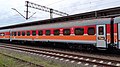 162A
162A -
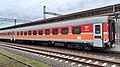 163A
163A -
 113Aa
113Aa


Diesel multiple units
[edit](as at 15 June 2020)
| Type | Number | Speed | Manufacturer |
|---|---|---|---|
| SA103 | 13 | 120 km/h | Pesa |
| SA105 | 6 | 100 km/h | ZNTK Poznań |
| SA106 | 5 | 120 km/h | Pesa |
| SA107 | 2 | 100 km/h | Kolzam |
| SA108 | 6 | 100 km/h | ZNTK Poznań |
| SA109 | 7 | 100 km/h | Kolzam |
| SA131 | 1 | 120 km/h | Pesa |
| SA132 | 3 | 120 km/h | |
| SA133 | 24 | 120 km/h | |
| SA134 | 17 | 120 km/h | Pesa, ZNTK MM |
| SA135 | 8 | 120 km/h | |
| SA136 | 12 | 120 km/h | Pesa |
| SA137 | 7 | 120 km/h | Newag |
| SA138 | 3 | 120 km/h | |
| SA139 | 11 | 120 km/h | Pesa |
| SA140 | 2 | 130 km/h | Newag |
| Together: 139 | |||
_Lichen99.jpg)

_Lichen99.jpg)

.jpg)
See also
[edit]


Incidents
[edit]On October 5, 2023, around 7 a.m., two Polregio trains collided near the Gdynia-Główna station. According to information provided by emergency services, the accident resulted in injuries to four individuals, including members of the railway crew.
In the 2012 Szczekociny rail crash, an interREGIO and Intercity train collided with each other near Szczekociny.
References
[edit]- ^ "Zmiany w ofercie Przewozów Regionalnych" (in Polish). Przewozy Regionalne. Archived from the original on 2015-08-15. Retrieved 18 September 2015.
- ^ "Regional Transport turns into POLREGIO!". polregio.pl. 2017-01-02. Archived from the original on 2017-03-07.
External links
[edit] Media related to Polregio at Wikimedia Commons
- Official website


 Railway operators of Poland Railway operators of Poland | |
|---|---|
| Passenger | |
| Freight | |
Polregio
View on GrokipediaHistory
Formation and early operations
Polregio, originally established as PKP Przewozy Regionalne, was founded on 1 October 2001 as part of the restructuring of the Polish State Railways (PKP) to separate passenger transport operations from infrastructure management and promote market liberalization in line with European Union directives.[1][4] This split transformed the former PKP Passenger Transport Sector into a dedicated subsidiary focused on regional and short-distance services, operating as a state-owned entity within the PKP Group. Headquartered in Warsaw at ul. Grójecka 17, the company inherited a substantial fleet and network from PKP, enabling it to provide services across all 16 voivodeships of Poland from the outset.[1][5] In its initial years, PKP Przewozy Regionalne rapidly scaled operations, launching thousands of daily regional trains to connect urban centers, rural areas, and agglomeration routes nationwide. By 2006, the company was running approximately 2,600 passenger trains and 84 express services daily, serving a network that stopped at over 1,900 stations and carried 161.4 million passengers in domestic traffic that year alone.[5] These services emphasized affordable, frequent connectivity for commuters and local travelers, with the inherited rolling stock—including over 1,000 electric multiple units and more than 3,200 passenger cars—forming the backbone of operations despite varying conditions and ages.[5][4] Early operations were marked by significant financial challenges, including heavy reliance on state subsidies to cover operational deficits and maintain unprofitable routes. In 2006, for instance, the company received over 491 million PLN in subsidies from local governments for regional services, alongside 218 million PLN from the Ministry of Transport for inter-regional routes and additional compensation for statutory fare discounts totaling 244 million PLN.[5] Integrating the inherited PKP fleet posed logistical hurdles, as modernization efforts were limited by budget constraints, leading to occasional service disruptions amid competition from road transport and emerging private operators. A key milestone came in May 2006 with the launch of the Balice Ekspres, Poland's first dedicated airport rail link connecting Kraków Główny station to Kraków Airport (Balice), enhancing multimodal integration and demonstrating the company's role in supporting national infrastructure development.[6][4]Ownership transfers and rebranding
On 22 December 2008, all shares of Przewozy Regionalne were transferred from the PKP Group to Poland's 16 voivodeship governments, marking a significant decentralization of ownership and creating a consortium model where regional authorities became direct stakeholders.[7] This shift aimed to better integrate rail services with local transportation needs and reduce central oversight, aligning with broader reforms in Poland's rail sector.[8] On 4 November 2015, the state-owned Industrial Development Agency (Agencja Rozwoju Przemysłu S.A., ARP) acquired a controlling interest of 50% plus one share, initiating a major restructuring that led to the company's first profit in 2016.[1] The voivodeships hold varying stakes in the company, reflecting differences in regional size and involvement; for instance, as of October 2022, the Masovian Voivodeship owned 207,982 shares, representing approximately 6.75% of the total capital.[3] On 1 December 2021, Przewozy Regionalne converted from a limited liability company to a joint-stock company (S.A.), with ARP retaining its majority stake and the voivodeships as minority owners.[1][7] This adjustment bolstered financial stability through state support without altering the regional consortium framework.[3] The ownership transfer profoundly impacted governance by devolving funding responsibilities to the voivodeships, which now organize and subsidize regional services through multi-year contracts, adapting to post-2008 financial constraints like reduced central subsidies.[8] This structure has fostered greater regional autonomy in service planning but required new mechanisms for inter-voivodeship coordination and revenue sharing.[8] Following the ownership change, the company underwent rebranding to reflect its regional orientation. On 8 December 2009, it officially renamed itself Przewozy Regionalne, dropping the "PKP" prefix to distance from the national parent group and emphasize local ties.[1] In November 2016, it adopted the brand POLREGIO, introducing a modern logo, unified visual identity, and updated livery for vehicles to enhance market presence and passenger appeal.[1][9] On 23 January 2020, the company was renamed POLREGIO sp. z o.o. to align the legal name with the brand. This evolution supported operational independence and compliance with evolving European rail market standards.[1] As of 2025, the ownership remains stable under ARP's majority control, with no major share redistributions reported since 2021, though ongoing regional funding contracts continue to shape governance dynamics.[3]Services
Train categories
Polregio operates a range of passenger train categories tailored to regional and inter-regional needs, emphasizing accessibility, efficiency, and alignment with public service obligations across Poland's voivodeships. These categories form a service hierarchy, from basic local transport to faster connections between key urban centers, with most services requiring no seat reservations to promote flexibility for passengers.[10][2] The foundational REGIO category comprises local and agglomeration passenger trains designed for short-distance travel within a single region or between adjacent voivodeships, typically stopping at all stations along the route and offering second-class seating only. These services prioritize frequent, affordable access to smaller communities and urban peripheries, with some accelerated variants making fewer stops to improve journey times.[2][11] Building on this, REGIOplus trains provide semi-fast local services with limited stops at selected stations, also limited to second-class seating, to efficiently bridge local and broader regional journeys without the full stop pattern of REGIO trains. This category enhances connectivity for commuters seeking quicker options on moderately longer routes.[10] interREGIO (IR) services focus on inter-regional links between major cities, featuring fewer stops than REGIOplus for faster travel times and second-class seating throughout; a prominent example is the route connecting Łódź and Warsaw, where trains halt only at key intermediate stations. Introduced as part of Polregio's expansion in commercial offerings around 2015, these trains address demand for efficient mid-distance travel.[2][12] For international express needs, REGIOekspres (RE) trains deliver higher-standard services with both first- and second-class accommodations, emphasizing speed and comfort on cross-border routes such as Dresden to Wrocław and Frankfurt (Oder) to Poznań, where stops are confined to principal stations. These represent Polregio's premium international segment, distinct from domestic regional operations.[10] In 2019, Polregio launched superREGIO as a commercial enhancement to regional travel, offering high-standard amenities, reduced travel times, and competitive fares on select domestic routes like Katowice to Zator and Ostrowiec Świętokrzyski to Wrocław Główny, with support for standard discounts and no mandatory reservations. This category complements interREGIO by targeting seasonal and leisure demand with improved passenger experience.[13][14] Among discontinued services, the Balice Ekspres operated from 2006 to 2014 as Poland's inaugural airport rail link, providing direct second-class connections between Kraków Główny and John Paul II International Airport Kraków-Balice, but was subsequently transferred to another operator following infrastructure changes. Polregio's categories have evolved to better integrate with EU rail standardization initiatives, promoting uniform service definitions and interoperability for cross-border and regional passenger flows.Routes and network coverage
Polregio provides regional passenger rail services across all 16 voivodeships of Poland, owned collectively by these regional authorities, with operations centered on local, inter-voivodeship, and agglomerative lines that emphasize connectivity in less-served areas.[15][2] The network prioritizes non-electrified routes and secondary tracks integral to Poland's broader rail infrastructure managed by PKP Polskie Linie Kolejowe, serving over 1,950 stations and running about 2,000 trains daily to support daily commuting and regional travel.[2] Key domestic routes encompass inter-regional InterREGIO (IR) services, such as the high-frequency Warsaw to Łódź line, which connects major urban centers with faster, limited-stop patterns. Local REGIO services form dense networks in industrial and coastal areas, including extensive coverage in Silesia for intra-provincial links around Katowice, Pomerania for connections along the Baltic coast from Gdańsk to Słupsk, and Lesser Poland for routes radiating from Kraków to nearby towns and tourist sites.[2] These operations integrate with national infrastructure to fill gaps in high-speed and long-distance coverage, focusing on accessibility for shorter trips averaging around 47 km.[16] Internationally, Polregio extends RE services across borders, including connections to Germany such as the Zielona Góra to Görlitz route via Zgorzelec, facilitating cross-border regional travel. Polregio formerly operated the Ełk to Grodno line as an InterREGIO service to Belarus, providing vital links for eastern Polish communities, but it has been suspended since 2020 due to border closures and geopolitical challenges.[17][10][18] In 2023, Polregio carried 97.3 million passengers, accounting for approximately 26% of Poland's total rail ridership of 374.4 million—a 9.4% increase from 2022—reflecting strong post-COVID-19 recovery driven by subsidized fares, expanded schedules, and economic rebound.[19][20][21] In 2024, Polregio carried 100.9 million passengers, a record high reflecting continued growth and the largest market share among regional operators, with demand exceeding pre-pandemic levels.[22] Post-2023 expansions include new regional partnerships, such as enhanced services in Dolnośląskie Voivodeship with record 12.4 million passengers in 2024, and no major closures reported. Electrification initiatives feature EU-funded acquisitions, like four new electric multiple units for Świętokrzyskie in 2025, allowing Polregio to extend operations onto upgraded electrified lines and support sustainable growth.[23][24]Organization
Ownership structure
Polregio S.A. operates under a mixed ownership model where Agencja Rozwoju Przemysłu S.A. (ARP), a state-owned development agency, holds the majority stake of 1,540,607 shares, equivalent to 50% plus one share of the company's total share capital of 616,242,600 PLN divided into 3,081,213 shares of 200 PLN nominal value each.[3] The remaining 1,540,606 shares are collectively owned by the governments of Poland's 16 voivodeships, forming a consortium that reflects the regional nature of its passenger services.[3] This structure, established in 2015 when ARP acquired its controlling interest to support the company's restructuring, balances national industrial policy objectives with local transportation needs.[1] Among the voivodeships, shareholdings vary based on regional size and service demands, with no single voivodeship holding a majority of the collective regional stake. The largest holder is the Masovian Voivodeship with 207,982 shares (approximately 13.5% of the non-ARP shares), followed by the Greater Poland Voivodeship (149,439 shares) and the Silesian Voivodeship (141,736 shares). Smaller stakes are held by voivodeships like the Świętokrzyskie Voivodeship (46,218 shares). The full distribution is as follows:| Voivodeship | Number of Shares | Nominal Value (PLN) |
|---|---|---|
| Dolnośląskie | 112,465 | 22,493,000 |
| Kujawsko-Pomorskie | 89,355 | 17,871,000 |
| Lubelskie | 84,733 | 16,946,600 |
| Lubuskie | 55,461 | 11,092,200 |
| Łódzkie | 87,815 | 17,563,000 |
| Małopolskie | 98,599 | 19,719,800 |
| Mazowieckie | 207,982 | 41,596,400 |
| Opolskie | 52,380 | 10,476,000 |
| Podkarpackie | 75,490 | 15,098,000 |
| Podlaskie | 58,543 | 11,708,600 |
| Pomorskie | 109,383 | 21,876,600 |
| Śląskie | 141,736 | 28,347,200 |
| Świętokrzyskie | 46,218 | 9,243,600 |
| Warmińsko-Mazurskie | 81,652 | 16,330,400 |
| Wielkopolskie | 149,439 | 29,887,800 |
| Zachodniopomorskie | 89,355 | 17,871,000 |
Management and workforce
Polregio's management board consists of two key members as of November 2025. Aleksandra Grzywaczewska serves as the acting president of the management board and member responsible for financial affairs; she joined the board in September 2025 after a career at the company since 2015, where she managed the finance office and secured over 600 million PLN in funding for projects. Wojciech Dinges acts as vice president of the management board, bringing expertise in railway development from prior roles at Koleje Śląskie and the European Commission's DG MOVE. The supervisory board, which oversees the management, is chaired by Remigiusz Paszkiewicz and includes members Katarzyna Gawlik-Tarnowska (deputy chair), Tomasz Pęcherz, Sławomir Centkowski, and Robert Pilarczyk. The workforce at Polregio comprises approximately 7,000 employees as of 2025, encompassing roles such as nearly 1,900 train drivers (including a notable number of women, the highest among Polish carriers), maintenance technicians at regional depots, and administrative personnel supporting operations across 14 branches. To address staffing needs amid fleet modernization, the company hired up to 300 former PKP Cargo employees in 2024, focusing on operational and technical positions. Employees are distributed across regional depots in cities like Wrocław, Poznań, and Gdańsk, where they handle daily train servicing, safety inspections, and passenger support. Polregio maintains active labor relations through engagement with unions, including NSZZ "Solidarność," which represents workers in collective bargaining. A prolonged collective dispute from 2023 was resolved in March 2024 via an agreement that delivered financial benefits to employees, such as wage increases and improved conditions, ending strikes and stabilizing operations. The company operates a dedicated training center in Częstochowa, which has conducted multiple courses on safety protocols, modernization technologies, and machine operator certification since 2020, training over 120 individuals to enhance skills for electric and diesel fleet handling. These programs emphasize regulatory compliance and accident prevention, aligning with EU railway standards. The 2016 rebranding from Przewozy Regionalne to Polregio, which introduced a new logo and corporate colors (blue, navy, and green), streamlined internal branding and boosted employee identification with the updated regional focus, though it primarily targeted passenger perception improvements.Rolling stock
Electric multiple units
Polregio's electric multiple units (EMUs) form the backbone of its electrified regional passenger services, operating primarily on Poland's 3 kV DC and 25 kV 50 Hz AC networks to deliver REGIO and interREGIO trains. These self-propelled units enable efficient short- to medium-distance travel, with typical configurations accommodating 100 to 350 passengers, including 130 to 210 seats, depending on the model and length. As of October 2025, the fleet comprises approximately 420 units, dominated by modernized legacy models but bolstered by recent procurements to address capacity demands and replace ageing stock.[30] The EN57 class and its variants represent the largest segment, with over 240 units in service, including 54 unmodified EN57s and modernized versions such as 74 EN57-2s (upgraded in 2006–2007 by PESA with enhanced interiors), 59 EN57ALs (modernized by ZNTK Mińsk Mazowiecki for improved reliability), 36 EN57ALcs (2017 upgrades increasing power to 1000 kW and speed to 120 km/h), and 20 EN57FPS units (2017 H. Cegielski modernizations adding air conditioning and accessibility features). These 3-car, 580–1000 kW units, originally built from 1962 to 1993, operate at 110–120 km/h on DC lines, carrying up to 212 passengers in second class with recent retrofits for Wi-Fi, LED lighting, and wheelchair access to meet EU accessibility standards.[30] Newer models include the EN63 family from Newag, with the EN63A Impuls comprising 36 three-car units delivered from 2014, providing 1600 kW power for 160 km/h operation on AC lines and seating 150 passengers in a low-floor design optimized for regional express services; the family totals approximately 65 units including EN63 (1 unit, 2013), EN63B (8 units, 2020), EN63H (12 units, 2021, bi-mode), and 36WEhb (8 units, 2024, bi-mode). Additional specialized units encompass one EN62 (2013 PESA three-car, 2000 kW, 160 km/h, 162 seats) and four 14WE units (2005 builds, 580 kW, 110 km/h, 184 seats) acquired refurbished in July 2025 from CargoUnit to strengthen Małopolska Voivodeship operations.[30][31] Modernization efforts since 2020 have focused on efficiency and passenger comfort, including a 2025 contract with PESA Mińsk Mazowiecki for overhauling seven ED72 four-car units (110–120 km/h, originally Pafawag builds) to extend their lifespan with updated traction systems and interiors. Post-2020 procurements, funded by EU grants and voivodeship budgets, include framework agreements signed in 2023 for up to 200 new EMUs (deliveries scheduled 2025–2026), alongside specific 2025 orders: four new units for Świętokrzyskie Voivodeship (minimum 150 passengers, air-conditioned, single-space layout; deliveries from 2027) and six from Fabryka Pojazdów Szynowych for Lubuskie (deliveries by 2029). These initiatives aim to expand electrified coverage in eastern and western Poland.[32][33][34][35][36]| Model | Quantity (2025) | Builder/Year | Power (kW) | Max Speed (km/h) | Configuration | Key Features/Capacity |
|---|---|---|---|---|---|---|
| EN57 & variants | ~243 | Pafawag/1962–1993 (modernized 2006–2017) | 580–1000 | 110–120 | 3-car | DC operation; up to 212 seats; modernized for Wi-Fi, accessibility[30] |
| EN63 family | ~65 | Newag/2013–2024 | 1600 | 160 | 3-car | AC/bi-mode operation; low-floor; 150 seats for faster REGIO services[30] |
| 14WE | 4 | Various/2005 (refurb. 2025) | 580 | 110 | 3-car? | Acquired for regional lines; 184 seats; efficiency upgrades[31] |
| New 2025 orders (various) | 10 (ordered) | PESA/FPS/etc./2025–2029 | Varies | 110–160 | 2–3-car | EU-funded; air conditioning, 150+ passengers; deliveries from 2027[34][35][36] |
Electric locomotives
Polregio operates a small fleet of five EP07P electric locomotives, rebuilt from the EU07 class in 2012 by ZNLE Gliwice, with no additions or retirements reported as of 2025.[30][37] These units, numbered EP07P-2001 to EP07P-2005, are utilized primarily for hauling passenger carriages on electrified routes.[30] The EP07P locomotives are designed for the Polish 3 kV DC electrification system, featuring a Bo'Bo' wheel arrangement, a total weight of 80 tonnes, and a maximum speed of 125 km/h.[37][38] They deliver a continuous power output of 2,000 kW (2,720 hp) and a one-hour rating of 2,080 kW (2,825 hp), enabling them to handle passenger trains up to approximately 700 tonnes.[37][39] This configuration supports efficient operation on interREGIO services, such as routes from Poznań to Wrocław and southwest Poland.[40] Maintenance for the EP07P fleet is conducted at depots in key locations including Wrocław and Poznań, with major overhauls completed in 2017 to extend their service life amid Polregio's fleet modernization efforts.[40] The 2012 rebuilds included upgrades such as new reduction gears (76:21 ratio), air-conditioned crew compartments, redesigned control panels, and improved headlights, enhancing reliability for passenger operations.[37] Despite their limited number, the EP07P locomotives play a strategic role in Polregio's fleet by providing high-capacity hauled train options on electrified lines, complementing self-propelled units for longer-distance interREGIO routes where greater passenger volumes demand traditional locomotive-hauled formations.[40][39]Diesel locomotives
Polregio operates a limited fleet of diesel locomotives primarily for hauling passenger carriages on non-electrified secondary lines, with a focus on the SM42 and SU42 series as of 2025. These locomotives support regional services in rural areas where electrification infrastructure is absent or incomplete, enabling operations on routes like those to the Hel Peninsula.[41][42] The SM42, a Bo'Bo' diesel-electric locomotive originally produced by Fablok in Chrzanów, forms the backbone of Polregio's diesel hauling fleet, with 26 units reported in service or storage as of October 2025. These locomotives deliver 800 horsepower (590 kW) from an 8C22 engine, achieving a top speed of 90 km/h, and are suited for light freight and seasonal passenger duties due to the lack of built-in heating systems. Fuel efficiency has been improved through modernizations, such as the installation of MTU or Caterpillar engines in select units, which enhance performance while reducing emissions compared to original configurations. For instance, SM42-349 was actively used at the Chojnice depot in June 2025 for regional operations.[43][42][30] The SU42 variant, rebuilt from SM42 and SP42 models for passenger service, provides similar 800 horsepower output but includes electric heating capabilities (500 V DC or 3000 V AC) to support year-round operations in colder climates. 8 such units remain in Polregio's inventory, often deployed for short-haul REGIO trains on non-electrified tracks. Modernizations in the late 1990s and early 2000s incorporated 180 kW Caterpillar CAT3208 engines and updated generators, improving reliability and slightly boosting fuel economy for rural routes.[42][30] In response to environmental regulations and Poland's electrification expansion, Polregio has pursued upgrades to lower-emission diesel technologies, including hybrid prototypes and energy recovery systems tested on SM42 variants since 2014, though full fleet transition remains limited due to the shift toward diesel multiple units. As of 2025, the company plans further replacements amid ongoing retirements, such as the decommissioning of SM42-329 in January, to align with EU decarbonization goals while maintaining service on unelectrified lines. Total diesel locomotive holdings have declined from 23 units in 2020 to 34 active examples (26 SM42 + 8 SU42).[42][44][30]| Model | Horsepower | Key Applications | Modernization Examples |
|---|---|---|---|
| SM42 | 800 hp (590 kW) | Secondary line passenger hauling (warm seasons), rural REGIO services | MTU/Caterpillar engines for reduced emissions; energy accumulators (post-2014) |
| SU42 | 800 hp (590 kW) | Year-round passenger trains with heating on non-electrified routes | CAT3208 engine upgrades (1999-2000) for improved fuel efficiency |