


Community hub
Recent from talks
Contribute something
Nothing was collected or created yet.
Freightliner Group
View on Wikipedia
Freightliner Group is a rail freight and logistics company headquartered in the United Kingdom. It is owned by Brookfield, a Canadian investment management company and GIC, a Singaporean sovereign wealth fund.
Key Information


It was originally created after the Transport Act 1968 as Freightliner Limited, a British government-owned company. From its onset, Freightliner was focused on the haulage of international traffic, thus came to centre its activities around Britain's sea ports, often building new multimodal freight depots adjacent to such locations to better capture this business. During the late 1970s, it was reorganised under British Rail, and became a part of its Railfreight Distribution subsidiary during the late 1980s. Work to expand the loading gauge on routes such as the East Coast Main Line were undertaken, allowing trains hauling larger containers to use those routes, were conducted around this time. Numerous domestic depots previously operated by Freightliner were closed during the 1990s in preparation for the privatisation of British Rail that same decade.
As a consequence of the privatisation initiative, the business unit was reorganised as Freightliner Limited; on 25 May 1996, it was privatised and sold in a management buyout, supported by 3i and Electra Private Equity for £5.4 million. Freightliner quickly set about modernising and expanding its locomotive fleet, ordering Class 57 and Class 66 locomotives. During 1999, it established the Heavy Haul business; five years later, the Logico service was also launched. By 2014, Freightliner Limited had become the largest intermodal freight transport operator in the United Kingdom,[4] as well as the second largest freight operating company in the country by revenue, behind DB Cargo UK.[5] It had also expanded its operations into various other countries, including Australia, the Netherlands and Poland. In 2008, Freightliner Group was purchased by Railinvest Holding Company, a subsidiary of Arcapita Bank of Bahrain. In 2015, Freightliner was acquired by Genesee & Wyoming. In 2024, it was split from Genesee & Wyoming by its parent companies Brookfield and GIC.
History
[edit]
British Rail
[edit]The idea of shipping freight in set-sized containers went back to the 1930s in the UK with the adoption of the Conflat system. But it was Dr Richard Beeching who, in his report Reshaping Britain's Railways, advanced the concept of containerised freight in the UK.[6]
Beeching proposed 55 depots placed strategically across the UK, serviced by fixed-consist permanently coupled air-braked trains, with an average journey between depots of 150 miles (240 km) and a shortest distance of 50 miles (80 km). British Railways progressed with the concept, envisaging 40-foot (12 m) length wagons – later increased to 60 ft (18 m) – carrying 8 ft × 8 ft × 8 ft (2.4 m × 2.4 m × 2.4 m) standard sized international shipping containers in lengths of 10 to 27 ft (3.0 to 8.2 m), later adapted to 20 to 40 ft (6.1 to 12.2 m). These BR UK-adopted standards were formed on the basis of analysis of then current international intermodal practise, and later adopted as the base of the internationally agreed ISO 668. Containers would be loaded at the dedicated inland terminals, using gantry cranes for transshipment between road and rail.[7]
During January 1964, the prototype flat wagon was produced by Shildon railway works; later that same year, 100 production wagons were turned out from Ashford railway works.[6] The first revenue-earning train ran between York Way/Maiden Lane in North London and Gushetfaulds in Glasgow on 15 November 1965.[6] Soon adopting the Freightliner name, the first single-shipper train was operated on 20 August 1968, hauling specially designed 30-foot (9.1 m) containers carrying parts for Ford Escort cars that were destined for assembly in plants on the European mainland.[8]
Freightliner Ltd (1968)
[edit]Beeching's original concept envisioned Freightliner servicing a domestic freight market, which by 1968 had resulted in British Railways developing 17 purpose-built depots. However, Freightliner's most profitable routes were those servicing Britain's major ports, specifically traffic to/from continental Europe and Ireland, as well as import/export traffic to the rest of the world. This pattern of profitability was recognised in the Transport Act 1968, whereby Freightliner became a separate listed commercial company wholly owned by the UK Government, but which leased its UK domestic rail transport from British Railways.[6]
By the end of the 1960s, Freightliner operated 28 terminals and 56 routes, however, the company's shift in focus from the original domestic freight market to the international market serviced via ports continued for the next 30 years, with many of the original domestic depots which did not service port traffic either never opening or eventually closing (i.e.: Kings Cross, Sheffield, Swansea, Swindon), whilst investment in seaport depots – specifically Southampton, Harwich, and the Port of Felixstowe where Beeching's plan had never envisaged a depot – continued at an increasing pace.[6] Part of the consolidation of rail depots was enabled by a greater focus on Freighliner's own HGV network of dedicated lorries, which expanded the servicing footprint of each rail depot, and hence allowed increased efficiency through creating longer and better utilised train routes.[6]
Dudley Freightliner Terminal, 10 miles (16 km) from Birmingham, on the site of the old railway station was opened in October 1967. This initially proved to be one of the most profitable such terminals in the country, while the Birmingham terminal was ultimately one of the least financially viable. In 1981, due to a lack of international traffic, Freightliner was planning to close Dudley and transfer its function to Birmingham. Given a reprieve in 1983, it finally closed during 1986.[9]
Increasing Irish traffic resulted in a depot being opened at the Port of Holyhead, as well as Freightliner having dedicated operations in both Belfast and Dublin.[6] This also resulted in UK Government granting Freightliner funds to create a dedicated multimodal terminal at the Port of Liverpool to replace its previously lost rail freight traffic, and then further investment in second multimodal terminals at both Felixstowe and the Port of Tilbury.[6]
Return to British Railways
[edit]The Transport Act 1978 brought Freightliner back inside the control of British Railways, mostly driven by the investment required to ease the rail network's loading gauge restrictions that hampered the transport of shipping containers 8 ft 6 in (2.59 m) and 9 ft (2.7 m) in height.[6]
Freightliner immediately made a major pitch to the BR Board to allow 8 ft 6 in contains to be carried on the East Coast Main Line (ECML), which involved lowering the track in Stoke area[clarify], as well as in Peascliffe and Penmanshiel tunnels (in Lincolnshire and the Scottish Borders, respectively). The alterations were successfully completed at Stoke and Peascliffe, but Penmanshiel Tunnel collapsed in March 1979 while work was underway, killing two workers and severing the ECML between Edinburgh and Berwick.[10] The extent of the collapse meant that reconstruction was considered to be too dangerous and expensive, so the tunnel was bypassed by a new section of line constructed in an open cutting slightly to the west of the original alignment that opened five months later in late August.[10] Freightliner later withdraw its services on that stretch of the ECML.[6]
During the 1980s, Freightliner became part of BR's 1980s non-bulk Railfreight Distribution (RfD) division, which brought about its first ever allocation of locomotives. After experimenting with other rail operators solutions to coping with the new larger containers, in 1990 BR agreed the order of 700 flat-wagons from SNCF supplier Arbel Fauvet Rail, which could immediately accommodate 8 ft 6inch height containers at 75 mph speeds.[6] This was further supplemented in 1991 with leased flat-wagons from Tiphook.[6] Further experimentation with SNCF-leased Multifret flat-wagons – which could accommodate 9 ft containers at speeds of up to 90 mph (140 km/h) – led to an order of 45 BR-specified "Lowliner" wagons with a deck height of only 720 mm (2 ft 4 in), which allowed the transport of 9-foot-high containers on routes approved for 8 ft 6 in containers using the existing wagon fleet.[6]
Although designed to accommodate 9 ft containers over the entire BR network, the slow delivery of Lowliners meant that the entire allocation was utilised instead to carry 8 ft 6 in containers on trains to and from London Thamesport, circumventing the restricted clearances on the former South Eastern & Chatham Railway.[6] The withdrawal of Sealink's dedicated freight service from Holyhead also brought about the end of Freightliner's dedicated service to Northern Ireland via North Wales.[6]
Privatisation - Freightliner (1995) Ltd
[edit]
As part of the Privatisation of British Rail, the loss-making RfD division came under increasing pressure, leading to the immediate closure of the Speedlink division. Freightliner closed the residual domestic-serving depots, including London's Willesden and Stratford, Bristol (closed in 1992, later reopened in 2014) Glasgow Gushetfaulds, and consolidation of Manchester's traffic on the newly opened Euroterminal (later switched back to the previously closed Trafford Park).[6]
The Freightliner business unit had its assets transferred into a new company, Freightliner (1995) Limited, in preparation for sale.[11] Rejected as not sufficiently profitable by English Welsh & Scottish Railway,[6] on 25 May 1996, Freightliner was purchased in a management buyout backed by 3i and Electra Private Equity for a sum of £5.4 million.[12] As part of the sale agreement, the UK Government awarded the company a track-access grant of £75 million up until the year 2000.[6]

Freightliner's immediate need was for improved reliability from its locomotive fleet. During 1997, the company commissioned Brush Traction to rebuild of six of its Class 47 locomotives to create the Class 57, which was fitted with reconditioned General Motors power units and reworked ex-Class 56 alternator groups. The first of these was released in July 1998, and coincided with the unveiling of the new British Racing Green Freightliner livery. After an evaluation period, Freightliner was sufficiently impressed to order a further six in June 1999, with plans for an eventual fleet of 25.[13] However, in actuality, no additional Class 57 locomotives were delivered to Freightliner, largely due to the company opting to place orders for new-built Class 66s, all being leased from Porterbrook.[14]
During 1999, Freightliner established its Heavy Haul business. In March 2004, Freightliner launched Logico, providing short-term or one-off spaces on intermodal trains, it is typically active at major British freight hubs such as the South Wales International Terminal and the Port of Felixstowe.[15][16] By 2014, Freightliner was actively trying to increase such trains in response to requests for higher service frequencies from ports.[17]
During 2007, Freightliner commenced operations in Poland;[6] its primary activity in the Polish market has been the haulage of aggregates and coal traffic.[18]
Post-privatisation
[edit]
On 13 June 2008, Freightliner Group was purchased by Railinvest Holding Company Limited,[19] a subsidiary of Arcapita Bank of Bahrain.[20][21]
On 30 June 2009, Freightliner commenced operations in Australia, having secured an initial contract with Namoi Cotton Co-operative to haul containerised processed cotton traffic in New South Wales.[22] Over the following six years, it would become an accredited rail service provider in Western Australia, Southern Australia and Queensland, as well as expanding into hauling coal and other agricultural traffic for various customers in New South Wales.[18]
In February 2015, as part of the sale of Freightliner from Arcapita Bank to Genesee & Wyoming, the latter purchased a 95% shareholding which increased to 100% in 2020. At the time of the acquisition, Freightliner's portfolio comprised approximately 250 standard gauge locomotives along with 5,500 wagons, and had a headcount in excess of 2,500 employees worldwide.[23][18]
On 12 November 2015, British Rail Class 47 No. 47830 (D1645), which is operated by Freightliner, was named Beeching's Legacy to mark 50 years since the first container train ran under British Rail.[24]
In April 2018, Freightliner unveiled its new brand identity during an event at the NEC Birmingham, bringing the brand inline with parent company Genesee & Wyoming.[25]
On 1 July 2019, it was announced that Freightliner's parent company Genesee & Wyoming is to be bought for US$8.4 billion by a consortium including Brookfield Infrastructure, GIC and Brookfield's institutional partners.[26]
In April 2024, Freightliner UK and Europe split from G&W becoming sister companies, since they were both still owned by Brookfield and GIC.[27]
In September 2025 it was announced that Freightliner UK Intermodal Logistics would be split off and sold to CMA CGM, with the transaction expected to complete in early 2026. Freightliner Heavy Haul and non-UK Freightliner operations will remain under Freightliner Group.[28]
Subsidiaries
[edit]Freightliner Group has the following subsidiaries: [29]
- Freightliner Ltd
- Freightliner Heavy Haul
- Freightliner Maintenance (has maintenance facilities in the United Kingdom at Crewe Basford Hall, Leeds Midland Road and Ipswich)[30]
- Freightliner Poland and Germany
- Rotterdam Rail Feeding
- Pentalver Container Sales & Conversions
Operations
[edit]United Kingdom
[edit]
When Freightliner was privatised in 1996, it only operated Intermodal container services. These ran from ports including Felixstowe, Southampton and Tilbury to terminals such as Birmingham, Trafford Park in Manchester, Stourton (Leeds), Coatbridge (Central Scotland), Ashton Gate (Bristol), and Wentlooge (Newport, South Wales). The network has been expanded with additional destinations added.[31] Freightliner also operate an extensive road distribution network with 300 road vehicles. Freightliner also provides drivers for Scottish TransPennine Express services.
In 1999, Freightliner set up Heavy Haul initially operating railway infrastructure trains for Network Rail moving ballast, rails etc. before moving into other bulk loads including aggregates, cement, coal, petroleum, scrap metal and waste. Initially run as a division of Freightliner Limited, in 2001 operations were transferred to a new subsidiary, Freightliner Heavy Haul Limited.[32] Reportedly, Heavy Haul operations were hit particularly hard during the Great Recession that started in 2008, but, the firm was actively acquiring additional wagons and staff in order to accommodate new growth on top of the recovery of demand from many of its established customers by 2015. Furthermore, due to a lack of available slots on most mainlines, there was an increased emphasis on running longer trains rather than routing additional ones.[33]
During April 2006, Freightliner Maintenance Limited was established as a separate entity dedicated to the repair and maintenance of traction and rolling stock.[34] It acquired a maintenance depot and took on 13 staff in Leeds from a former supplier that same year, and was promptly made responsible for the maintenance of Freightliner's 75 Heavy Haul locomotives. Within its first three years, the division had extended its scope into wagon maintenance, and was reportedly consistently achieving a 95% availability rate on the company's 657 coal wagons; it also had engineering teams and mobile workshops stationed in Birmingham, London, Bristol, York, Scotland and Crewe that undertook scheduled maintenance along with unexpected call-outs.[35] The subsidiary competitively tenders for maintenance work, without any preference from the rest of the company. By 2011, Freightliner Maintenance was servicing all 111 of the company's UK-based Class 66 locomotives, and had branched into both track maintenance and rail freight development activities as well.[36]
In October 2021, the company switched most of its electric operations to diesel trains due to the increased cost of electricity.[37][38] One month later, Freightliner announced positive results from an alternative fuel trial it was conducted for its diesel-powered fleet, allegedly halving the carbon emissions incurred.[39]
Poland
[edit]_Travelarz.JPG)
During 2006, Freightliner expanded its operations into Poland. A subsidiary company, Freightliner PL Sp. z o.o., was established to bid for contracts hauling coal traffic.[40] The first contract was for coal transport from Lubelski Węgiel Bogdanka SA near Bogdanka (Bogdanka-Lublin coal mine) to Kozienice Power Station. The service began in September 2007.[41][42] Most of Freightliner PL's services operate on the Gdańsk to Warsaw corridor and in southern Poland. In February 2015, Freightliner PL signed a €17.5M contract to lease five Newag Gliwice 5 MW (6,700 hp) electric six-axle E6DCF Dragon locomotives from ING Lease. With each equipped with a 520 kW (700 hp) diesel engine for last-mile operation, they are scheduled to be delivered from May to July 2016.[43] Furthermore, Freightliner opted to export 13 of its Class 66 locomotives from the UK to Poland for operations there.[14]
Australia
[edit]Freightliner began exploring opportunities in the Australian rail market with Freightliner Australia established by April 2007. By June 2008 Freightliner Australia had been accredited as a rail operator in the state of New South Wales[44] and by September 2009 also had accreditation in Queensland and Western Australia. In June 2009, Freightliner Australia commenced operating containerised cotton services from Wee Waa to Port Botany.[45][46][47] In September 2009 Freightliner Australia signed a 10-year deal with Xstrata to haul export coal from the Hunter Valley to Newcastle, commencing in September 2010.[48][49] Under the deal, Xstrata owned the rolling stock with Freightliner Australia providing the engineering, logistics, maintenance and operational support.[50][51] In May 2012 Freightliner Australia commenced operating a Warren to Port Botany service.
In December 2016, Glencore, who had purchased Xsrata, sold its Hunter Valley coal haulage business to Genesee & Wyoming Australia that was also owned by Freightliner's parent company Genesee & Wyoming.[52][53] Freightliner's Australian business was merged into Genesee & Wyoming Australia and the brand retired.
Netherlands
[edit]In 2013, Freightliner bought Netherlands-based intermodal container operator European Rail Shuttle B.V. from Maersk Line.[54] This subsidiary, has focused on the cross-border intermodal traffic that runs between the northern European ports of Rotterdam, Bremerhaven and Hamburg to various cities across Germany, Poland, Italy and elsewhere in continental Europe.[18] In 2018 the business was sold to Swiss-based Hupac.
Fleet
[edit]United Kingdom
[edit]Freightliner inherited a fleet of ageing Class 47 diesel locomotives and Class 86 and Class 90 electric locomotives from British Rail.
In 1997, Freightliner placed an order for six Class 57 locomotives. These were rebuilt by Brush Traction at Loughborough from Class 47s and fitted with a refurbished EMD engine and a reconditioned alternator, improving reliability and performance. The first was delivered in July 1998. After an evaluation period Freightliner was sufficiently impressed to order a further six in June 1999.[55]

During the late 1990s and early 2000s, Freightliner placed multiple orders for new-build Class 66s, cumulating in 111 locomotives being delivered to the company.[14] In order to better haul heavier trains, Freightliner directed that several of its Class 66s be regeared, which resulted in a reduced maximum speed in exchange for a higher tractive effort. Once in service, the type proved to be quite reliable, with Freightliner reportedly recording a regular availability rate of 98% along with an average of 70,000 miles between failures, more than double that of the Class 57 fleet.[14] By 2004, the company's Class 66s had replaced all of the Class 47s, as well as the Class 57s after another two years. Freightliner also leased some Class 66s that had been formerly operated by Direct Rail Services.
During November 2007, Freightliner announced an order for 30 Class 70s under a project called Project Genesis.[56] The first two were delivered in November 2009. These have released a number of Class 66s with five going to Colas Rail, 13 to Freightliner Poland and four to GB Railfreight.[57]
Freightliner also used their single Class 47 (47830) on driver route learning. In 2024, 47830 was sold to Locomotive Services Limited and was repainted into BR Green.[58]
Poland
[edit]Freightliner PL ordered seven EMD Class 66s as well as 432 Greenbrier Eamnoss type coal hopper wagons. These have been supplemented by an EMD Class 66 formerly used by Häfen und Güterverkehr Köln and 12 Class 66s transferred from Freightliner's UK operations. A 13th was sent from the UK in October 2012. These units underwent various modifications to allow them to operate on the Polish network.[59]
Australia
[edit]Freightliner Australia commenced operations using hired in GL class locomotives from Chicago Freight Car Leasing Australia (CFCLA). After a longer-term lease was agreed, two were repainted into Freightliner livery in September 2010.[60] The Warren service that commenced in May 2012 also used locomotives hired from CFCLA. Two CF class locomotives were repainted in Freightliner livery. The Xstrata coal contract was operated by XRN class locomotives that were owned by the customer.[61][62] Wagon types are PHEH and PHYH for the coal traffic and CQBY, CQFY and CQYY on the grain traffic.[63]
Fleet detail
[edit] | This section needs additional citations for verification. (January 2023) |
United Kingdom
[edit]| Class | Image | Type | Built | Wheel arr. | In traffic | Numbers | Notes |
|---|---|---|---|---|---|---|---|
| 08 | 
|
Diesel shunter | 1953 | 0-6-0 | 10 | 08077, 08530, 08531, 08575, 08585, 08624, 08691, 08764, 08785, 08891 | |
| 59 |  |
Diesel locomotive | 1985-1995 | Co-Co | 4 | 59001/002, 59004/005 | Acquired from Mendip Rail in 2019.[65] |
| 4 | 59101-59104 | ||||||
| 6 | 59201-59206 | Acquired from DB Cargo UK in 2019.[citation needed] | |||||
| 66 | 
|
1999-2008 | 7 | 66413-66416, 66418-66420 |
Acquired from Direct Rail Services in 2011. 66411, 66412 & 66417 exported for use in Freightliner PL | ||
| 81 | 66501-520, 66522-526, 66528-529, 66531-534, 66536-572, 66585, 66587-594, 66596-599 | 66521 written off after Great Heck rail crash.
66527, 66530, 66535, 66582, 66583, 66584, 66586 and 66595 have been exported to Poland, the operating subsidiary Freightliner PL 66573-581 have been sold to Colas Rail and GB Railfreight and renumbered 66846-850 and 66738-741 respectively. | |||||
| 19 | 66601-607, 66610, 66613-623 | 66608, 66609, 66611, 66612, 66624 and 66625 have been exported to Poland, the operating subsidiary Freightliner PL. | |||||
| 7 | 66951-66957 | ||||||
| 70 | 
|
2009-2011 | 19 | 70001-70011, 70013-70020 | 70012 dropped while being unloaded at Newport; returned to manufacturers and is currently used as a test bed. | ||
| 90 | 
|
Electric locomotive | 1987-1990 | Bo-Bo | 25 | 90003-90016,90018 90040-90049 |
90018 & 90040 sold by DB Cargo UK to Freightliner in April 2024[66] |
| Total | 182 | ||||||
Poland
[edit]| Class | Image | Type | Introduced | Wheel arr. | In traffic | Numbers |
|---|---|---|---|---|---|---|
| EMD Series 66 | 
|
Diesel | 2006-07 | Co-Co | 13 | 66008-011, 013-015 & 66601-606 |
| Newag Dragon E6ACTd |
|
Electric (Diesel last-mile slave) |
2016 | 5 | E6ACTd-101 – E6ACTd-105 |
Australia
[edit]| Class | Type | Introduced | Wheel arr | In traffic | Numbers | Notes |
|---|---|---|---|---|---|---|
| GL | Diesel | 1971/72 remanufactured 2004 | Co-Co | 2 | GL111, GL112 | leased from Chicago Freight Car Leasing Australia |
| XRN | 2010-12 | 30 | XRN001-030 | owned by Xstrata | ||
| CF | 2013 | 2 | CF4407, CF4408 | leased from Chicago Freight Car Leasing Australia | ||
| G | 1988 | 2 | G533, G535 |
Netherlands
[edit]| Class | Type | Introduced | Wheel arr. | In traffic | Numbers | Notes |
|---|---|---|---|---|---|---|
| Vossloh G1206 | Diesel | Bo-Bo | 3
|
Shunting and local operations | ||
| Vossloh G 2000 | 1
|
|||||
| EMD Class 66 | Co-Co | Withdrawn, lease ended | ||||
| BR182 (Siemens ES 64 U2) | Electric | Bo-Bo | 1
|
|||
| BR185 (Bombardier TRAXX) | 2
|
|||||
| BR189 (Siemens ES 64 F4) | 12
|
See also
[edit]Gallery
[edit]-
 57012 Freightliner Envoy at Ipswich in 2004
 -
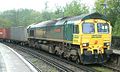 66534 OOCL Express in the Freightliner livery introduced in 1998 at Virginia Water in 2004
 -
 66605, with Freightliner 40 1965-2005 at Dundee in 2007
 -
 66 610 on the East Coast Main Line near York in 2008
 -
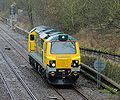 70001 leaves Clay Cross Tunnel working 0Z70 Lawley Street – Leeds Midland Road
 -
 86613 and 86610 at Ipswich in 2004
 -
 The Freightliner maintenance depot at Leeds Midland Road.


References
[edit]- ^ "Genesee & Wyoming Appoints Tim Shoveller as CEO of UK/Europe Operations". gwrr.co.uk. Retrieved 8 August 2023.
- ^ "G&W agrees to buy Freightliner Group". Railway Gazette International. Archived from the original on 26 February 2015. Retrieved 25 February 2015.
- ^ "Careers". freightliner.co.uk. Retrieved 1 September 2015.
- ^ "Freight on Rail Members". freightonrail.org.uk. Retrieved 30 April 2014.
- ^ "Britain's Railways Today - Freight". moorerail.com.
- ^ a b c d e f g h i j k l m n o p q r s "Freightliner's 50 years". Railways Archive. 23 December 2015. Retrieved 16 April 2019.
- ^ "British Railways Board Freightliner Brochure 1965" (PDF). railwaysarchive.co.uk. 1965.
- ^ "Fords run first company Freightliner". Modern Railways. No. 241. October 1968. p. 551.
- ^ Doherty, Andrew. "Dudley Station". Rail Around Birmingham.
- ^ a b McNaughton, Lt. Col. I.K.A. (2 August 1983). Report on the Collapse of Penmanshiel Tunnel that occurred on 17th March 1979 in the Scottish Region British Railways (PDF). London: Her Majesty's Stationery Office. ISBN 0-1155-0626-8. Retrieved 2 January 2023.
- ^ "Freightliner (1995) Limited: Company no 3118392". Companies House. Retrieved 30 May 2022.
- ^ "Secretary of State for Transport - Written Answers". Hansard. 27 November 1996.
- ^ "Freightliner signs deals for five 66s and six 57s". Rail. No. 358. 2 June 1999. p. 4.
- ^ a b c d "Fifteenth anniversary of the Class 66". railmagazine.com. 17 April 2013.
- ^ "Freightliner Ltd". portoffelixstowe.co.uk. Retrieved 30 May 2022.
- ^ "Records Broken as Container Trains' Expand in Welsh Business". rail.co.uk. 13 March 2012.
- ^ Clinnick, Richard (17 September 2014). "Ports want rail freight to operate 365 days a year". railmagazine.com.
- ^ a b c d "Genesee & Wyoming Inc. Enters into Agreement to Acquire FreightlinerGroup Limited; Expands Rail Operations in the United Kingdom,Continental Europe and Australia". businesswire.com. 24 February 2015.
- ^ "Railinvest Holding Company Limited: Company no 6522978". Companies House. Retrieved 30 May 2022.
- ^ "Freightliner acquired by Arcapita". 13 June 2008.
- ^ "Electra Priv Equity ELTA Final Results". Bloomberg. 13 June 2008.
- ^ "Freightliner Australia begins with cotton contract". railwaygazette.com. 2 July 2009.
- ^ Smith, Kevin (26 March 2015). "G&W completes Freightliner acquisition". International Railway Journal. Retrieved 21 October 2021.
- ^ "Freightliner marks 50 years with a naming". The Railway Magazine. Vol. 161, no. 1, 377. Horncastle, Lincs: Mortons Media Group. 2 December 2015. p. 7. ISSN 0033-8923.
- ^ "Freightliner unveils new brand identity at Multimodal". Freightliner. 2 May 2018.
- ^ "Genesee & Wyoming to be acquired in US$8·4bn deal". Railway Gazette. 1 July 2019. Retrieved 7 July 2019.
- ^ "FREIGHTLINER TO BE SPLIT FROM GENESEE & WYOMING". Railway Herald. 3 April 2024. Retrieved 20 January 2024.
- ^ Trompiz, Gus (22 September 2025). "CMA CGM acquires rail logistics firm Freightliner UK". Reuters. Retrieved 19 November 2025.
- ^ "Our Organisation". gwrr.co.uk. Retrieved 20 January 2025.
- ^ Bendall, Simon (January 2017). "New Basford Hall TMD unveiling with remembrance naming". Rail Express. No. 248. Horncastle: Mortons Media. p. 15. ISSN 1362-234X.
- ^ "Freightliner Intermodal Terminal & Ports Network". Freightliner.
- ^ "Freightliner Heavy Haul Limited: Company no 3831229". Companies House. Retrieved 21 October 2021.
- ^ "Heavy duty…". railmagazine.com. 4 March 2015.
- ^ "Freightliner Maintenance Limited Limited: Company no 5713164". Companies House. Retrieved 30 May 2022.
- ^ Curtis, Dave (12 December 2009). "Maintaining control". globalrailwayreview.com.
- ^ Curtis, Dave (6 December 2011). "FML's continuous expansion to achieve positive results". globalrailwayreview.com.
- ^ Longley, Alex (14 October 2021). "U.K. Freight Train Firm Turns to Diesel as Electricity Soars". Bloomberg. Retrieved 21 October 2021.
- ^ Stephen, Paul (13 October 2021). "UPDATED: Freightliner to withdraw entire electric fleet". railmagazine.com.
- ^ "Freightliner claims emissions success". railmagazine.com. 19 November 2021.
- ^ Freightliner prepares to compete in Poland, 1 March 2007
- ^ "Freightliner PL wykona zlecenie dla LW Bogdanka", rynekinfrastruktury.pl (in Polish), 26 September 2011
- ^ "Polish freight progress", railwaygazette.com, 19 October 2007
- ^ "Freightliner PL orders Dragon locomotives". Railway Gazette. 2 February 2015.
- ^ "NSW Accredited Operators". Independent Transport Safety and Reliability Regulator. Archived from the original on 19 June 2008. Retrieved 30 June 2008.
- ^ "Freightliner Australia begins with cotton contract". Railway Gazette International. 2 July 2009. Retrieved 23 April 2014.
- ^ Freightliner Start Up Motive Power issue 65 August 2009 page 6
- ^ Freightliner enters Australian rail market Railway Digest September 2009 page 5
- ^ "Freightliner signs deal with Xstrata Coal" (PDF). Freightliner. 25 September 2009. Retrieved 18 November 2009.
- ^ Coal contract down under The Railway Magazine issue 1304 December 2009 page 89
- ^ "Xstrata launches its own rail service". Australian Financial Review. 12 September 2010. Retrieved 23 April 2014.
- ^ Xsrata Rail launches Hunter Valley coal services Railway Digest November 2010 page 13
- ^ G&W and Macquarie to buy Glencore Rail coal haulage business Railway Gazette International 20 October 2016
- ^ Genesee & Wyoming $1.1b GRail win opens NSW rail haulage to competition Australian Financial Review 20 October 2016
- ^ "Freightliner Group announces acquisition of ERS Railways". railwaygazette.com. 19 June 2013.
- ^ Rail Magazine (556): 54, 3 January 2007
{{citation}}: Missing or empty|title=(help) - ^ "GE enters UK loco market". Railway Gazette International. 26 November 2007.
- ^ AB Rail UK Loco database, archived from the original on 31 August 2012
- ^ "News Round-up Locomotive Services". Modern Railways. No. 340. August 2024. p. 20.
- ^ FPL 66s Revised Data Table 15 March 2012
- ^ Motive Power Roundup Motive Power issue 76 July 2011 page 28
- ^ "Xstrata Fleet List". vicsig.net.
- ^ "XRN Class". railpage.com.au.
- ^ "FLA". Freightliner.
- ^ "Change of ownership of Locomotives G533 and G535" (PDF). Australian Rail Track Corporation. 9 January 2015. Archived from the original (PDF) on 2 April 2015.
- ^ Holden, Michael (22 May 2020). "Freightliner purchases 14 Class 59 locomotives as Mendip Rail contract continues". Rail Advent. Retrieved 13 September 2020.
- ^ "First Class 90s head for scrap while DB Cargo UK sells two to Freighliner". Rail Express. No. 337. p. 18.
Further reading
[edit]- Hunt, John (17–30 December 1997). "All night long...". Rail. No. 320. EMAP Apex Publications. pp. 18–23. ISSN 0953-4563. OCLC 49953699.
- Hunt, John (25 February – 10 March 1998). "All day and all of the night". Rail. No. 325. EMAP Apex Publications. pp. 36–41. ISSN 0953-4563. OCLC 49953699.
- Holley, Mel (21 October – 3 November 1998). "Freightliner to hit 50% growth two years earlier than anticipated". Rail. No. 342. EMAP Apex Publications. p. 13. ISSN 0953-4563. OCLC 49953699.
- Margetts, F.C. (April 1976). "Trains For Tomorrow". Trains. A.c. Kalmbach. pp. 40–46.
External links
[edit]
Freightliner Group
View on GrokipediaHistory
Establishment under British Rail (1965–1968)
![BR Freightliner container flats 60152-601403 outside the National Railway Museum][float-right] British Rail introduced the Freightliner service in 1965 to modernize freight operations amid declining rail market share to road transport, focusing on containerized intermodal haulage for efficient, high-speed rail trunk services combined with road drayage.[7] The initiative drew from earlier trials with palletized and containerized freight but emphasized standardized ISO-compatible containers on purpose-built wagons to enable rapid loading and unloading at dedicated terminals, bypassing traditional marshalling yards.[8] The inaugural revenue-earning Freightliner train operated on 15 November 1965, running from York Way terminal (also known as Maiden Lane) in north London to Gushetfaulds in Glasgow, Scotland, marking the service's entry into the domestic freight market.[7] [9] Initial operations utilized Class 47 diesel locomotives hauling trains of specially designed flat wagons carrying a mix of general merchandise in 8-foot-wide containers, with services expanding to key industrial routes to compete directly with road hauliers.[2] By mid-1968, British Rail had developed 17 specialized Freightliner terminals across the network to support growing volumes, primarily serving inland point-to-point shipments for manufacturers and distributors.[10] In 1968, Freightliner extended into international trade with the opening of the first rail-served import/export terminals at Southampton and Harwich, facilitating container handling from continental Europe and beyond to integrate with emerging deep-sea shipping lines.[8] The service's first dedicated single-shipper train ran on 20 August 1968, transporting Ford Escort car parts in custom 30-foot containers, demonstrating adaptability for automotive logistics.[11] These developments under British Rail ownership culminated in the Transport Act 1968, which on 25 October received royal assent and paved the way for Freightliner's separation into a distinct entity under the National Freight Corporation effective 1 January 1969, shifting it from direct British Rail control.[12] [7]National Freight Corporation Period (1968–1982)
In 1968, under the provisions of the Transport Act 1968, Freightliner Limited was established as a distinct entity separate from British Rail's direct operations, becoming a subsidiary of the newly formed National Freight Corporation (NFC) while British Rail retained a 49% minority stake to facilitate coordinated rail access.[7] This structure aimed to leverage Freightliner's early profitability—demonstrated by its containerized intermodal services since 1965—for commercial expansion within the state-owned NFC framework, which integrated road and rail freight activities previously under British Road Services.[13] Operations focused on high-speed container trains hauled primarily by British Rail Class 47 diesel locomotives, serving an expanding network of terminals for domestic and international cargo, including palletized goods and maritime imports.[8] Early growth included the opening of dedicated rail-served import/export terminals at Southampton in 1968, followed by Harwich, to handle continental containers via ferry links, marking Freightliner's shift toward integrated multimodal logistics under NFC oversight.[8] By late 1968, plans advanced for cross-Irish Sea services, with approvals for Freightliner routes connecting British terminals to Irish ports, enhancing NFC's haulage synergies by combining rail trunks with road distribution.[14] The network grew to over 20 terminals by the mid-1970s, transporting millions of tons annually, though traffic volumes fluctuated with economic conditions; for instance, 1975 data showed approximately 1.5 million containers moved, reflecting resilience amid oil crises but vulnerability to competition from road haulage.[15] Financial performance under NFC was mixed: initial profitability from efficient container standardization justified the 1968 separation, but by 1976, operations reported losses due to rising fuel costs, wage inflation, and underutilized capacity, prompting parliamentary scrutiny of NFC's joint ownership model.[15] NFC managed Freightliner as a semi-autonomous unit, investing in specialized wagons like the 60-foot Freightliner flats for ISO containers, yet integration challenges arose from divided control with British Rail, including disputes over track access charges.[8] In 1978, the Transport Act transferred full controlling interest in Freightliners Limited from NFC to the British Railways Board, vesting all securities held by NFC to streamline rail freight under unified state rail authority, effectively ending NFC's majority involvement though operational continuity persisted into the early 1980s. This shift aligned with broader NFC privatization efforts in 1982, but Freightliner's intermodal focus remained, with terminals like those in London, Manchester, and Liverpool handling peak loads exceeding 2 million tons by 1980 despite subsidy dependencies.[15][13]Return to British Rail Ownership (1982–1995)
In 1978, Freightliner was transferred back to the ownership of the British Railways Board under the provisions of the Transport Act 1978, ending its tenure under the National Freight Corporation.[7] This reversion integrated Freightliner more closely with British Rail's rail operations, allowing for unified traction and infrastructure use. By 1980, the proportion of deep-sea container traffic in Freightliner's operations had increased to 42%, reflecting a strategic pivot toward international intermodal services amid declining domestic volumes.[7] The establishment of British Rail's Railfreight sector in 1982 marked a key organizational shift, centralizing all freight activities—including Freightliner's container trains—under a dedicated division to improve efficiency and marketing.[16] This period saw infrastructure enhancements, such as the 1983 opening of a second terminal at Felixstowe, doubling capacity at the UK's primary container port and supporting growth in imported goods handling.[7] Domestic Freightliner services were discontinued in 1987, with closures of terminals including Aberdeen, Dundee, Edinburgh, Newcastle, Hull, Longsight, Nottingham, and Swansea, as the focus narrowed to international routes.[17] [7] By 1988, Freightliner's traction pool comprised 10 Class 08 shunters, 3 Class 31 locomotives, 27 Class 37s, 29 Class 47s, and 26 AC electrics (primarily Class 86s) for electrified lines.[7] Further rationalization occurred, with depots at King's Cross, Dudley, Aintree, and Greenock closing in 1986; Willesden and Bristol in 1992; and Glasgow Gushetfaulds in 1993, shifting traffic to Coatbridge.[7] In 1991, 45 'Lowliner' wagons were introduced for taller containers, alongside delivery of 700 new intermodal flat wagons to modernize the fleet.[7] A revamped timetable in 1992 optimized service frequencies on core routes.[7] In 1995, amid British Rail's privatization, Freightliner's intermodal business was separated from Railfreight Distribution and sold to a management buyout for £5.39 million on 25 May, establishing Freightliner (1995) Limited as an independent entity.[7] [18] This transition preserved Freightliner's specialized role in container freight while ending direct British Rail control.[18]Privatization and Management Buyout (1995)
In 1995, as part of the British Rail privatization process mandated by the Railways Act 1993, the Freightliner intermodal freight operation was separated from the broader Railfreight Distribution (RfD) sector and transferred into a newly formed entity, Freightliner (1995) Limited, wholly owned by the British Rail Board.[17][19] This restructuring aimed to isolate Freightliner's container and intermodal services—primarily deep-sea and domestic container traffic—for sale as a standalone going concern, distinct from RfD's bulk and international freight activities.[17][20] At the time, Freightliner operated nine terminals and focused on serving five privately owned port facilities, reflecting a niche but specialized role in the UK's rail freight market.[21] The privatization initiative, driven by the Conservative government's policy to introduce competition and private investment into rail freight, encountered limited external interest in Freightliner due to its narrow operational scope and the challenges of transitioning from state ownership.[22] Bids were anticipated in early 1996, culminating in a management buyout (MBO) led by Freightliner's senior executives, supported by private equity firms 3i and Electra Private Equity.[17][22] The sale completed on 25 May 1996 for £5.4 million, marking one of the final dispositions of BR's freight assets and enabling Freightliner to operate independently under private ownership.[7][20][23] Post-MBO, the new ownership prioritized fleet modernization and operational efficiencies to compete in the deregulated market, though the 1995-1996 transition period involved retaining BR infrastructure access rights and navigating the shadow Office of the Rail Regulator's oversight.[7][19] This buyout preserved Freightliner's focus on intermodal services, avoiding absorption into larger entities like the eventual English Welsh & Scottish Railway that acquired most other RfD operations.[17][19]Post-Privatization Expansion (1996–2007)
Following its privatization through a management buyout in May 1996 for £5 million, Freightliner focused on strengthening its core intermodal container services while investing in fleet renewal to replace aging British Rail-era locomotives.[17] The company placed an order for General Motors-built Class 66 diesel-electric locomotives in 1998, with initial deliveries commencing the following year; these heavy-haul machines provided significantly improved reliability, reducing the locomotive casualty rate to one per 77,000 miles operated—over ten times better than the preceding Class 47 fleet.[24] In late 1999, Freightliner established its Heavy Haul Limited subsidiary to diversify into bulk freight transport, targeting commodities such as cement, coal, and aggregates previously dominated by other operators; this move broadened the company's market scope beyond containers and addressed customer demands for alternative rail suppliers in these sectors.[25][26] Heavy Haul operations grew steadily, leveraging the upgraded locomotive fleet to secure contracts for secure, high-volume movements, while the parent company's intermodal business benefited from expanded port linkages, including Felixstowe and Southampton.[27] By 2007, Freightliner's expansion culminated in the announcement of Project Genesis, a initiative to procure advanced Class 70 locomotives from General Electric, with the first units (70001 and 70002) entering testing; this procurement aimed to further enhance traction capabilities for heavier intermodal and bulk trains amid rising freight volumes.[17] The period also saw incremental terminal optimizations and livery updates, such as the 1998 introduction of a distinctive blue-and-yellow scheme on new Class 66s, symbolizing the company's post-privatization identity and operational maturity.[24]Acquisition by Deutsche Bahn and Subsequent Developments (2008–2024)
In 2008, Freightliner Group was acquired by Arcapita, a Bahrain-based private equity firm operating through its subsidiary Railinvest Holding Company, marking a shift from previous investors Electra Partners and 3i.[28] Under Arcapita's ownership, the company focused on operational efficiencies and fleet modernization, including the introduction of 30 Class 70 (PowerHaul) locomotives from General Electric starting in 2010, designed for heavy intermodal and bulk freight with 3,600 horsepower outputs and improved fuel efficiency over prior models.[29] These additions supported expanded services amid rising container volumes, with Freightliner transporting its millionth container during this era, while maintaining terminals in the UK, Poland, and Australia.[2] By 2015, Arcapita divested Freightliner to U.S.-based Genesee & Wyoming Inc. (G&W) for approximately £490 million (about $800 million), acquiring roughly 95% of shares and integrating it into G&W's portfolio of over 100 short-line railroads worldwide.[30] This transaction enhanced G&W's European footprint, enabling cross-operational synergies in intermodal logistics and heavy haul sectors. Under G&W, Freightliner pursued infrastructure adaptations, such as leveraging UK gauge enhancements on routes like the East Coast Main Line to accommodate larger containers, thereby increasing payload capacities and market share in containerized freight.[7] From 2015 to 2024, Freightliner navigated economic pressures including the 2008 financial crisis aftermath and the COVID-19 disruptions, which temporarily reduced volumes but prompted diversification into biomass, aggregates, and cement haulage. By 2021, the company reported a return to profitability, driven by resilient intermodal demand and cost controls amid shifting freight patterns away from road transport.[31] Operations expanded with new contracts, such as those for Breedon Group aggregates, and fleet maintenance at facilities like Leeds Midland Road depot, sustaining a locomotive roster exceeding 200 units primarily comprising Class 66 and Class 70 models. In 2024, Freightliner announced structural separations from G&W for UK and European units to streamline management, without altering core ownership.[32] Throughout, competition intensified with DB Cargo UK (formerly English Welsh & Scottish Railway), yet Freightliner's focus on intermodal efficiency maintained its status as the UK's largest container freight operator by volume.[33]Ownership Transition to CMA CGM (2025–present)
On September 22, 2025, CMA CGM Group, a French maritime shipping and logistics conglomerate, announced its agreement to acquire the UK intermodal logistics business of Freightliner Group Ltd., encompassing rail and road freight operations, inland terminals, and the Freightliner brand for intermodal services.[34][5] The seller, Freightliner Group Ltd., was previously owned by Brookfield Infrastructure Partners (Canada) and GIC (Singapore), which retained control following the divestiture of the intermodal division.[35][36] The transaction excludes Freightliner's heavy haul operations in the UK, its Rotterdam Rail Feeding activities in the Netherlands, and its Australian subsidiary, which continue under separate ownership.[37][38] CMA CGM stated the acquisition aims to integrate rail freight with its global container shipping network, enhancing end-to-end logistics efficiency and supporting modal shift to rail for sustainability, with Freightliner UK Intermodal to operate independently under its existing management team post-closing.[34][39] As of October 2025, the deal remains subject to regulatory approvals from UK and EU authorities and is anticipated to finalize in early 2026, marking CMA CGM's second European rail freight investment after its 2024 acquisition of a Polish operator.[40][41] Industry observers noted the move as a strategic response to rising demand for intermodal solutions amid port congestion and decarbonization pressures, though financial terms were not disclosed.[38][42]Ownership and Corporate Structure
Evolution of Ownership
Freightliner was established in 1965 as a division of British Railways to pioneer intermodal container freight services in the United Kingdom.[2] In 1968, a 51% stake was transferred to the state-owned National Freight Corporation, forming Freightliner Limited as a semi-independent subsidiary while British Railways retained operational involvement.[43] Losses prompted its return to full British Railways control under the provisions of the Transport Act 1978, effective from 1976, integrating it into the state-owned rail network's freight operations.[43][44] During the privatization of British Rail in the 1990s, Freightliner was separated from the Railfreight Distribution sector and sold on 25 May 1996 through a management buyout for £5.4 million, backed by private equity firms 3i and Electra Partners.[23] This marked the transition to private ownership, with the management team acquiring a significant stake alongside the investors. In 2008, Electra Partners and 3i divested their holdings to Arcapita, a Bahrain-based private equity firm, in a transaction valued at approximately £320 million.[28] Arcapita owned Freightliner until 2015, when it sold approximately 95% of the shares to Genesee & Wyoming Inc., a U.S.-based shortline railroad operator, for £490 million (about $733 million), with management retaining a minority interest.[45] Genesee & Wyoming achieved full ownership by 2020.[46] In 2019, Brookfield Infrastructure Partners and GIC, Singapore's sovereign wealth fund, acquired Genesee & Wyoming in an $8.4 billion deal, indirectly assuming control of Freightliner.[47] By April 2024, Freightliner was restructured as a standalone entity under the same Brookfield and GIC ownership, operating as a sister company to Genesee & Wyoming.[32] In September 2025, CMA CGM Group, a French shipping and logistics conglomerate, announced the acquisition of Freightliner's UK Intermodal Logistics division—the company's core rail freight operation—for an undisclosed sum, with the transaction expected to close in early 2026 pending regulatory approval.[34] The remaining divisions, including Heavy Haul, Rotterdam Rail Feeding, and operations in Poland and Germany, continue under Brookfield and GIC ownership.[5] This partial divestiture reflects a strategic focus on intermodal synergies for CMA CGM while preserving specialized freight segments independently.Current Governance and Key Personnel
As of October 2025, Freightliner Group is led by Chief Executive Officer Tim Shoveller, who assumed the position in August 2023 after serving as Managing Director of Network Rail's North West and Central Region, bringing extensive experience in UK rail infrastructure and operations.[48] Shoveller oversees the group's strategic direction, including intermodal and bulk freight services across the UK, Europe, and Australia. In September 2025, the CMA CGM Group announced its agreement to acquire Freightliner's UK intermodal logistics operations for an undisclosed sum, with the transaction expected to finalize in early 2026; the acquired entity, encompassing rail and road activities, inland terminals, and the Freightliner brand, will operate independently under its existing management team, preserving continuity in governance and leadership.[34] [37] Prior to this transition, Freightliner functioned as a private limited company under its prior ownership structure, with directors accountable to promoting stakeholder interests as per UK corporate governance standards.[49] Key supporting executives include Andrew Spencer as Chief Financial Officer, responsible for financial strategy and oversight, and David Penney as Managing Director, focusing on operational delivery.[50] Detailed board composition remains non-public, consistent with the practices of privately held rail logistics firms, though ultimate oversight will shift to CMA CGM upon deal completion without immediate personnel disruptions announced.[51]Subsidiaries and Operational Divisions
Freightliner Group structures its operations through specialized subsidiaries and divisions, primarily focused on rail freight, intermodal logistics, and related services across Europe. In the United Kingdom, heavy haul activities are managed under Freightliner Heavy Haul Limited, a dedicated entity handling the transport of bulk commodities including aggregates, steel, and construction materials using a fleet optimized for oversized and heavy loads.[52] This division complements the group's core intermodal services by addressing non-containerized freight demands. European subsidiaries include Freightliner Poland sp. z o.o., which operates rail freight services within Poland and extends to neighboring countries, leveraging local infrastructure for cross-border efficiency.[53] Freightliner Germany, based in Berlin, holds licenses for both freight and passenger rail operations throughout Germany, supporting international routes into Poland, Belarus, and Ukraine.[53] Rotterdam Rail Feeding B.V. (RRF), a licensed railway undertaking in the Netherlands and Germany, focuses on import and export rail feeding, maintaining a proprietary locomotive fleet for dedicated container and bulk movements from ports like Rotterdam.[53] Pentalver Container Sales operates as a key logistics support subsidiary, functioning as the United Kingdom's primary supplier of new and used shipping containers, with a track record of handling over 250,000 units to facilitate intermodal operations.[53] These entities remain under the Freightliner Group's ownership following the September 2025 announcement of CMA CGM's acquisition of the UK intermodal business, which excludes heavy haul and continental operations.[54]Business Operations
Intermodal Freight Services in the United Kingdom
Freightliner's intermodal freight services in the United Kingdom focus on the rail transport of maritime containers between major deep-sea ports and inland terminals, integrated with road haulage for door-to-door delivery.[55] Established as a core operation since the company's origins in containerized freight, these services emphasize efficient, low-emission logistics, handling standard and high-cube containers via dedicated rail networks.[56] The company operates from key ports including Felixstowe, Southampton, London Gateway, and Liverpool, connecting to 12 rail-served inland terminals such as Birmingham, Cardiff, Cannock, Doncaster, Leeds, and Manchester.[57] [35] These facilities provide container storage, handling, maintenance, and repair, supported by digital systems like vehicle booking and terminal operating software for sub-30-minute turnaround times.[57] In 2024, Freightliner transported 770,000 containers via rail, with an average of 400,000 annually from Felixstowe alone.[58] [59] Daily operations include over 80 rail services and more than 40 combined truck-rail routes, serving nationwide coverage.[35] In April 2025, Freightliner doubled its rail services from London Gateway, shifting volumes from Felixstowe in response to port customer demands.[60] Terminals feature sustainability measures, including alternative fuels and solar-powered infrastructure, aligning with broader decarbonization goals in UK freight.[57] Following the September 2025 acquisition of its UK intermodal division by CMA CGM, operations continue independently, enhancing integration with European shipping networks while maintaining focus on UK port-to-inland flows.[54] This structure supports Freightliner's position as a leading operator in the UK's intermodal sector, prioritizing rail to reduce road congestion and emissions.[55]Heavy Haul and Bulk Freight Operations
Freightliner Heavy Haul, established in 1999, specializes in the rail transport of bulk commodities including coal, aggregates, cement, and construction materials, serving sectors such as energy, waste management, and infrastructure development.[27][61] The division operates bespoke haulage solutions adaptable to customer needs, utilizing customer-owned or Freightliner wagons for point-to-point movements across the UK network.[62] Key operational capabilities encompass terminal management for storage, handling, and distribution of aggregates from quarries and bulk products, supported by in-house maintenance services for wagons and track infrastructure.[62] The fleet primarily consists of Class 66 locomotives, supplemented by heavier-duty options like Class 70 PowerHaul units for demanding routes, enabling service to over 100 UK locations with a focus on reliability and flexibility.[52][63] Trains replace up to 129 heavy goods vehicle movements, achieving a 76% reduction in CO2 emissions per tonne compared to road haulage, aligning with sustainability goals through decarbonization initiatives.[52] Advanced tools like the OMNIA platform provide real-time supply chain visibility and route optimization, while REEC supports consultancy from project inception to execution.[62] Following the September 2025 acquisition of Freightliner's intermodal operations by CMA CGM, the Heavy Haul division continues independently under a new brand, emphasizing growth in bulk materials transport amid shifting ownership structures.[54] This separation allows focused expansion in non-intermodal freight, maintaining operations for secure and efficient bulk movements without integration into the acquiring entity's container logistics.[64]Continental European Operations (Poland and Netherlands)
![Freightliner Class 66 locomotive at Wasilków, Poland]float-right Freightliner's continental European operations center on subsidiaries in Poland and the Netherlands, emphasizing intermodal freight and cross-border haulage to connect key logistics hubs. Freightliner PL Sp. z o.o., established in 2006, serves as the primary entity in Poland, initially bidding for domestic rail contracts and commencing services with newly acquired rolling stock as the inaugural private freight operator on Polish rails.[2] By 2025, it has grown into Poland's largest independent private rail freight provider, handling intermodal transports, including container and semi-trailer services, across Poland and into neighboring markets.[65] In May 2025, Freightliner PL integrated its first European Locomotive Leasing Vectron locomotive, optimized for intermodal routes to enhance efficiency on electrified networks.[66] In the Netherlands, operations fall under Rotterdam Rail Feeding (RRF), a licensed rail provider active in both Dutch and German territories, facilitating terminal-to-terminal feeds and last-mile connections at the Port of Rotterdam.[67] RRF supports Freightliner's broader European network by managing shunting and short-haul services, with a focus on safety and reliability in high-volume port environments.[68] Cross-border initiatives link these operations, exemplified by the March 2025 launch of a thrice-weekly intermodal shuttle between Rotterdam and Rzepin in western Poland, dedicated to semi-trailer transport and leveraging combined resources from Freightliner's Dutch, German, and Polish entities.[69] Additional services include grain shipments from Poland reaching Dutch destinations, underscoring Freightliner's role in diversifying cargo types amid Europe's shifting trade corridors.[70] These entities, distinct from the UK intermodal division acquired by CMA CGM in September 2025, continue under prior ownership structures, maintaining operational autonomy.[38]Australian Operations
Freightliner Group expanded into Australia by forming Freightliner Australia Pty Ltd as a subsidiary dedicated to rail freight haulage. The entity operated services transporting bulk commodities such as grain, cotton, and coal, as well as intermodal containers, primarily along eastern seaboard routes including New South Wales and Queensland networks.[71] These operations utilized locomotives like GE C44aci models adapted for Australian conditions, supporting contracts with mining and agricultural sectors.[30] In February 2015, Genesee & Wyoming Inc. acquired Freightliner Group, incorporating the Australian subsidiary into its broader regional portfolio to enhance short-haul and bulk freight capabilities. This integration aligned Freightliner Australia's activities with G&W's existing Australian entities, focusing on efficiency in competitive markets dominated by operators like Aurizon and Pacific National. By 2016, Freightliner Australia managed additional contracts, such as Glencore's Hunter Valley coal services, under the G&W umbrella.[30][72] The Australian operations were restructured as G&W Australia rebranded to One Rail Australia around 2020, with Freightliner Australia's legal entity noted in regulatory filings as operating under this new identity. In 2022, Aurizon acquired One Rail Australia for A$2.35 billion to diversify its freight portfolio, followed by the 2023 divestiture of its East Coast Rail business to Magnetic Rail Group. Consequently, as of 2025, Freightliner Group maintains no direct or active rail operations in Australia, with former assets fully transitioned to independent entities.[73][74][75]Rolling Stock and Technology
Locomotive Fleet Composition
Freightliner's United Kingdom locomotive fleet totals approximately 185 units, dominated by EMD Class 66 diesel-electric locomotives, which number over 100 and serve as the primary traction for intermodal and bulk freight services across non-electrified and mixed routes.[56][76] These six-axle, 3,200 horsepower machines, built between 1999 and the mid-2010s, handle the majority of operations due to their reliability, high tractive effort, and adaptability to varying wagon loads.[76] The fleet includes 25 electric locomotives, primarily British Rail Class 90s, enabling operations on the 25 kV AC overhead electrified network, which covers about 38% of UK rail lines and supports efficient intermodal services on routes like the West Coast Main Line.[77] These 5,000 horsepower units, originally built in the late 1980s and refurbished for Freightliner use, have been expanded through acquisitions from other operators, enhancing electric traction capacity amid decarbonization efforts.[78] For heavy haul applications, Freightliner deploys 20 General Electric Class 70 locomotives, introduced from 2009 onward, offering 4,000 horsepower and superior low-speed adhesion for demanding bulk freight like aggregates and biomass.[79] These units complement the Class 66 fleet on routes requiring higher power-to-weight ratios, with ongoing trials for sustainable fuels such as hydrotreated vegetable oil (HVO).[80]| Class | Type | Approximate Number | Primary Use |
|---|---|---|---|
| 66 | Diesel-electric | >100 | General intermodal and bulk freight |
| 90 | Electric | 25 | Electrified intermodal routes |
| 70 | Diesel-electric | 20 | Heavy haul bulk services |
Wagon and Container Fleet
Freightliner's wagon fleet primarily comprises intermodal flat wagons optimized for container transport, with a focus on designs accommodating standard ISO containers. Traditional types include FEA and FGA bogie wagons, featuring spine constructions with outriggers for securing containers, enabling efficient loading of 20-foot and 40-foot units.[81] These wagons form the backbone of intermodal services, often operated in sets of varying lengths to match train formations and route clearances. In 2021, Freightliner introduced a new generation of FFA-G wagons, with 230 units procured to enhance efficiency for 40-foot container traffic. The first batch of 40 arrived from Poland in September 2021, designed with low-profile platforms, modern low-track-force bogies, and a tare weight of 18.5 tonnes, achieving full W10 gauge clearance while reducing energy consumption.[82][83] For heavy haul operations, the fleet includes repurposed box wagons, such as former coal wagons converted to aggregate carriers in partnership with WH Davis and Porterbrook, supporting bulk freight flows like cement and construction materials.[84] The container operations rely on customer-supplied ISO-standard units, predominantly 20-foot (TEU) and 40-foot (FEU) dry freight containers from deep-sea ports, with Freightliner facilitating over 800,000 TEU movements annually as of 2024.[41] Wagons are equipped with twistlocks and locating pins to secure these containers, accommodating high-cube variants up to 9'6" in height on low-platform designs developed since the 1980s.[83] Maintenance for the intermodal wagon fleet occurs at facilities like Southampton Maritime Maintenance Depot, ensuring reliability across the UK network.[59]Modernization Efforts and Technological Innovations
Freightliner introduced the Class 70 locomotives starting in late 2009, enabling longer and heavier freight trains through advanced features like regenerative braking and improved traction control, which enhanced efficiency on intermodal routes.[7] These GE PowerHaul units, numbering up to 30 in Freightliner's fleet by 2015, supported increased wagon loads and better fuel economy compared to prior diesel classes.[27] In sustainability efforts, Freightliner conducted successful trials of hydrotreated vegetable oil (HVO) fuel in locomotives, including a 106-mile run by Class 70 unit 70017 from Merehead to Acton.[80] By June 2024, in partnership with Ocean Network Express, Freightliner adopted HVO100 for all UK rail cargo journeys, achieving up to 90% reduction in CO2 emissions without power loss relative to diesel.[85] This dual-fuel capability extends to broader fleet applications, aligning with decarbonization goals.[56] Digitally, Freightliner implemented fleet telematics and remote condition monitoring to optimize locomotive performance and predict maintenance needs, contributing to reliable operations across over 185 units.[56] Track-and-trace systems and vehicle booking platforms enhance visibility, yielding market-leading terminal turnaround times and cost savings for hauliers.[86] Additionally, the RailSmart Co-Pilot app, deployed via iPads in cabs, manages delays by logging real-time data for operators.[87] Terminal operations saw automation upgrades through Tideworks' TOS integrations by 2025, streamlining booking and reducing manual processes for improved consistency and speed.[88] Freightliner also pioneered lighter wagons and extended train formations, doubling container capacity per service while maintaining safety standards.[27] These innovations, including the largest UK electric locomotive fleet for electrified routes, underscore efforts to boost modal shift from road to rail.[56]Performance and Economic Impact
Growth Metrics and Market Share
Freightliner Group has maintained its position as the leading rail freight operator in Great Britain, with operational growth reflected in increasing freight train kilometers and market share. In 2024, the company recorded 9.92 million freight train kilometers, surpassing competitors and underscoring its dominance in intermodal and bulk freight segments.[89] Its share of total freight train kilometers reached 32.9% in the January to March 2025 quarter, an increase from 31.6% in the corresponding period of 2024 and 30.9% in the prior year, indicating incremental gains amid fluctuating overall rail freight volumes.[90][91] In freight vehicle kilometers, Freightliner held a 38.9% share during the first quarter of 2024, reinforcing its scale in high-volume intermodal services.[92] The company's focus on intermodal freight aligns with sector trends, as intermodal maritime cargo comprised 38% of all rail freight moved from April 2024 to March 2025, up 1 percentage point from the previous year, with Freightliner as the primary operator in this category.[90] Overall UK rail freight volumes grew 7% year-on-year in the second quarter of 2024, driven partly by intermodal expansions, though total annual tonnage stood at 69 million tonnes for the year ending March 2024.[93][94] Financial metrics for the group, encompassing UK, continental European, and Australian operations, show turnover of £514.4 million for the latest reported period ending December 2023, reflecting expansion through acquisitions and operational efficiencies.[95] This growth trajectory was bolstered by the September 2025 acquisition of its UK intermodal logistics business by CMA CGM, which handled significant container volumes and positioned Freightliner for further modal shift from road to rail.[54] In the broader UK rail freight market, Freightliner's competitive edge persists despite regulatory and economic pressures, with its market leadership enabling resilience in a sector where intermodal services continue to capture increasing shares of domestic and import/export logistics.[96]| Metric | 2023 (Q1) | 2024 (Q1) | 2025 (Q1) |
|---|---|---|---|
| Freight Train Kilometers Share | 30.9% | 31.6% | 32.9% |
| Freight Vehicle Kilometers Share (2024 Q1) | N/A | 38.9% | N/A |