Hubbry Logo
Potentiometer (measuring instrument)Potentiometer (measuring instrument)Main
Open search
Potentiometer (measuring instrument)
Community hub
Potentiometer (measuring instrument)
logo
7 pages, 0 posts
0 subscribers
Be the first to start a discussion here.
Potentiometer (measuring instrument)
from Wikipedia

A potentiometer is an instrument for measuring voltage or 'potential difference' by comparison of an unknown voltage with a known reference voltage. If a sensitive indicating instrument is used, very little current is drawn from the source of the unknown voltage. Since the reference voltage can be produced from an accurately calibrated voltage divider, a potentiometer can provide high precision in measurement. The method was described by Johann Christian Poggendorff around 1841 and became a standard laboratory measuring technique.[1]

In this arrangement, a fraction of a known voltage from a resistive slide wire is compared with an unknown voltage by means of a galvanometer. The sliding contact or wiper of the potentiometer is adjusted and the galvanometer briefly connected between the sliding contact and the unknown voltage. The deflection of the galvanometer is observed and the sliding tap adjusted until the galvanometer no longer deflects from zero. At that point the galvanometer draws no current from the unknown source, and the magnitude of voltage can be calculated from the position of the sliding contact.

This null balance measuring method is still important in electrical metrology and standards work and is also used in other areas of electronics.

Measurement potentiometers are divided into four main classes listed below.

Principle of operation

[edit]
Dial potentiometer, with built-in galvanometer and reference voltage source

The principle of a potentiometer is that the potential dropped across a segment of a wire of uniform cross-section carrying a constant current is directly proportional to its length. The potentiometer is a simple device used to measure the electrical potentials (or compare the e.m.f of a cell). One form of potentiometer is a uniform high-resistance wire attached to an insulating support, marked with a linear measuring scale. In use, an adjustable regulated voltage source E, of greater magnitude than the potential to be measured, is connected across the wire so as to pass a steady current through it.

Between the end of the wire and any point along it will be a potential proportional to the length of wire to that point. By comparing the potential at points along the wire with an unknown potential, the magnitude of the unknown potential can be determined. The instrument used for comparison must be sensitive, but need not be particularly well-calibrated or accurate so long as its deflection from zero position can be easily detected.

Constant current potentiometer

[edit]
A potentiometer being calibrated and then measuring an unknown voltage.
R1 is the resistance of the entire resistance wire. The arrow head represents the moving wiper.

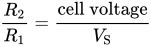
In this circuit, the ends of a uniform resistance wire R1 are connected to a regulated DC supply VS for use as a voltage divider. The potentiometer is first calibrated by positioning the wiper (arrow) at the spot on the R1 wire that corresponds to the voltage of a standard cell so that
A standard electrochemical cell is used whose emf is known (e.g. 1.0183 volts for a Weston standard cell).[2][3]

The supply voltage VS is then adjusted until the galvanometer shows zero, indicating the voltage on R2 is equal to the standard cell voltage.

An unknown DC voltage, in series with the galvanometer, is then connected to the sliding wiper, across a variable-length section R3 of the resistance wire. The wiper is moved until no current flows into or out of the source of unknown voltage, as indicated by the galvanometer in series with the unknown voltage. The voltage across the selected R3 section of wire is then equal to the unknown voltage. The final step is to calculate the unknown voltage from the fraction of the length of the resistance wire that was connected to the unknown voltage.

The galvanometer does not need to be calibrated, as its only function is to read zero or not zero. When measuring an unknown voltage and the galvanometer reads zero, no current is drawn from the unknown voltage and so the reading is independent of the source's internal resistance, as if by a voltmeter of infinite resistance.

Because the resistance wire can be made very uniform in cross-section and resistivity, and the position of the wiper can be measured easily, this method can be used to measure unknown DC voltages greater than or less than a calibration voltage produced by a standard cell without drawing any current from the standard cell.

If the potentiometer is attached to a constant voltage DC supply such as a lead–acid battery, then a second variable resistor (not shown) can be used to calibrate the potentiometer by varying the current through the R1 resistance wire.

If the length of the R1 resistance wire is AB, where A is the (-) end and B is the (+) end, and the movable wiper is at point X at a distance AX on the R3 portion of the resistance wire when the galvanometer gives a zero reading for an unknown voltage, the distance AX is measured or read from a pre-printed scale next to the resistance wire. The unknown voltage can then be calculated:

Constant resistance potentiometer

[edit]

The constant resistance potentiometer is a variation of the basic idea in which a variable current is fed through a fixed resistor. These are used primarily for measurements in the millivolt and microvolt range.

Microvolt potentiometer

[edit]

This is a form of the constant resistance potentiometer described above but designed to minimize the effects of contact resistance and thermal emf. This equipment is satisfactorily used down to readings of 1000 nV or so.

Thermocouple potentiometer

[edit]

Another development of the standard types was the 'thermocouple potentiometer' especially adapted for temperature measurement with thermocouples.[4] Potentiometers for use with thermocouples also measure the temperature at which the thermocouple wires are connected, so that cold-junction compensation may be applied to correct the apparent measured EMF to the standard cold-junction temperature of 0 degrees C.

Analytical chemistry

[edit]

To make a potentiometric determination of an analyte in a solution, the potential of the cell is measured. This measurement must be corrected for the reference and junction potentials. It can also be used in standardisation methods. The concentration of the analyte can then be calculated from the Nernst Equation. Many varieties of this basic principle exist for quantitative measurements.

Metre bridge

[edit]

A metre bridge is a simple type of potentiometer which may be used in school science laboratories to demonstrate the principle of resistance measurement by potentiometric means. A resistance wire is laid along the length of a metre rule and contact with the wire is made through a galvanometer by a slider. When the galvanometer reads zero, the ratio between the lengths of wire to the left and right of the slider is equal to the ratio between the values of a known and an unknown resistor in a parallel circuit.[5]

See also

[edit]

References

[edit]
[edit]
Revisions and contributorsEdit on WikipediaRead on Wikipedia
from Grokipedia
A potentiometer is a null-type electrical measuring instrument designed to precisely determine the (EMF) or potential difference of a source without drawing any current from it, thereby avoiding loading effects that can introduce errors in other voltmeters. It operates on the principle of comparing an unknown voltage to a known voltage produced by a stable current through a resistance wire or coil, adjusting a sliding contact until the difference is zero as indicated by a . This balance method ensures high accuracy, often to four , by relying on resistance ratios rather than measurement. Invented in 1841 by German physicist Johann Christian Poggendorff, the slide-wire potentiometer marked a significant advancement in electrical metrology, building on earlier compensation techniques to enable reliable low-voltage measurements. Early designs, such as Poggendorff's original apparatus, used a long uniform wire with a jockey contact, while later developments like the Kohlrausch drum (late 19th century) and commercial models from Leeds & Northrup (e.g., Type K in the 1920s) incorporated multi-turn coils and standardized cells for enhanced precision and range. Prior to the widespread adoption of digital voltmeters in the mid-20th century, the potentiometer was the primary tool for calibrating standard cells, measuring thermocouple outputs, and verifying small EMFs in laboratory settings. The instrument's key advantages include its insensitivity to variations in the driving battery's EMF, as measurements depend only on the ratio of wire segments, and its adaptability for both DC and AC applications through phase-sensitive variants. Applications extended beyond voltage to indirect measurements, such as temperature differences via thermocouples or electrolytic conductivities, with multirange models achieving resolutions down to 0.0001°C equivalents. Though largely supplanted by electronic instruments today, the potentiometer's null-balance concept remains foundational in precision and inspires modern null detectors.

Fundamentals

Definition and Purpose

A , in the context of a measuring instrument, is a device that determines the (EMF) or potential difference of an unknown by comparing it to a known variable voltage derived from a standard source, such that the two voltages balance to produce zero current through a detector. This null method ensures that no current is drawn from the unknown source during , preventing any alteration to its internal state or across its resistance. The primary purpose of the potentiometer is to achieve high-precision voltage measurements in scenarios where conventional voltmeters would introduce errors by loading the circuit with measurable current. It is particularly valuable for calibrating other instruments, such as voltmeters, and for accurately determining the EMF of sources like batteries or electrochemical cells, where even small currents could significantly affect the readings due to internal resistances. By relying on the balance condition rather than deflection or current flow, the potentiometer offers superior accuracy, often to within microvolts, without requiring knowledge of the source's internal impedance. Unlike a rheostat or variable , which adjusts resistance to control current in a circuit, the as a measuring instrument focuses on null detection to equate voltages precisely, serving a diagnostic rather than regulatory function. This distinction underscores its role in precise quantification over mere circuit tuning. The origins of the potentiometer trace to 1841, when German physicist Johann Christian Poggendorff developed the slide-wire version for accurate voltage comparisons in , enabling reliable assessments of potential differences in early electrical experiments.

Historical Development

The potentiometer as a measuring instrument originated in 1841 with the work of German physicist Johann Christian Poggendorff, who devised a slide-wire device to measure electromotive force (EMF) through a compensation method that balanced the unknown EMF against a known portion without drawing current from the source being measured. This null method addressed limitations in earlier voltmeters, providing higher accuracy for electrical experiments. Poggendorff's innovation laid the foundation for precise potential difference measurements in laboratory settings. In 1868, English electrical engineer advanced the instrument's practical application, particularly for testing submarine telegraph cables, where accurate resistance and potential assessments were essential for long-distance communication reliability. introduced the term "potentiometer" to describe the device, formalizing its nomenclature in his on . By 1900, the potentiometer had achieved widespread adoption in laboratories, with standardized designs such as slide-wire and dial types becoming essential for and research. Commercial models like the & Northrup Type K, introduced around 1905, dominated lab use through the mid-20th century due to their reliability and versatility. In the 1920s, it proved instrumental in , enabling accurate temperature monitoring in emerging industrial processes. By the mid-20th century, the instrument was largely supplanted by digital voltmeters for most applications.

Operating Principles

Basic Principle of Operation

The basic principle of operation of a potentiometer as a measuring instrument relies on the null balance method, where an unknown voltage ExE_x is balanced against a variable portion of a known potential gradient produced along a uniform resistance wire or network, with the gradient calibrated using a standard cell of known EMF EsE_s. A steady current is passed through the wire, creating a uniform potential gradient along its length. The unknown voltage ExE_x is connected in opposition to a variable portion of this gradient via a sliding contact (jockey), and the position is adjusted until no current flows through a detector, indicating balance. At this null point, the potential difference across the selected portion of the wire exactly equals ExE_x, allowing precise measurement without drawing current from the source being measured. The balance condition is given by the equation Ex=(lls)EsE_x = \left( \frac{l}{l_s} \right) E_s, where ll is the balancing length from one end of the wire to the null point for the unknown, lsl_s is the balancing length for the standard cell obtained during calibration under the same current conditions, and EsE_s is the electromotive force (EMF) of the standard cell. This relationship arises because the potential drop is directly proportional to the length of the wire segment under uniform current flow. A key aspect of this method is the infinite resistance approximation at balance, where the circuit configuration ensures no current is drawn from the unknown ExE_x. This prevents any loading effect or alteration of the measured voltage, enabling highly accurate determinations compared to direct methods. The derivation of the balance condition follows from Kirchhoff's voltage law applied to the measurement loop. At the null point, the sum of voltages around the loop is zero: the unknown voltage ExE_x opposes the drop across the wire segment, with zero current, yielding Ex=IρlE_x = I \cdot \rho \cdot l, where II is the current in the wire and ρ\rho is the resistance per unit length. During calibration with the under the same current, Es=IρlsE_s = I \cdot \rho \cdot l_s. Dividing these equations eliminates IρI \cdot \rho and gives Ex=(lls)EsE_x = \left( \frac{l}{l_s} \right) E_s. This principle operates under key assumptions, including a steady voltage from the standard cell to maintain constant current and a uniform resistance distribution along the wire to ensure a linear potential gradient.

Key Components and Setup

The key components of a standard potentiometer setup for measuring electromotive force (EMF) include a uniform resistance wire, a standard reference cell such as the Weston cell with an EMF of approximately 1.018 V at 20°C, a sensitive galvanometer for null-point detection, and a driving battery to provide a stable current source. The resistance wire, typically 1 to 10 meters long and made from materials like manganin or constantan to ensure a low temperature coefficient of resistance (around ±10 ppm/°C), is stretched linearly along a scale for precise length measurements. In some precision setups, a decade resistance box serves as an alternative to the continuous wire, allowing discrete resistance adjustments in steps for calibration and measurement. The circuit configuration involves connecting the driving battery in series with the resistance wire and a rheostat to maintain a , ensuring a uniform along the wire. The unknown EMF source (or during calibration) is connected in series with the and a (a sliding contact or ) that taps points along the wire to vary the effective resistance until a null balance is achieved, where no current flows through the . A high-resistance box (typically 500–2000 Ω) is placed in series with the to limit current and protect it from damage during initial jockey adjustments or imbalances. Calibration begins by connecting the standard reference cell (e.g., ) in place of the unknown source and adjusting the to find the null point, thereby determining the wire's constant K=EslsK = \frac{E_s}{l_s}, where EsE_s is the standard EMF and lsl_s is the balancing length. The driving battery voltage is then fine-tuned via the rheostat to achieve a suitable gradient (often 0.001–0.002 V/cm), and the process is repeated for verification to account for any minor variations in wire uniformity. Practical considerations include using protective resistors or shunts to safeguard the from excessive currents, particularly when the jockey is not at balance, and selecting wire materials with minimal effects to maintain accuracy over ambient changes of 15–35°C. The setup is typically arranged linearly on a wooden or insulated board, with the wire ends connected to binding posts for the battery and rheostat at one side, the and key switch in the middle circuit branch, and the EMF source terminals accessible for switching between standard and unknown cells; a jockey arm slides parallel to the scaled wire for precise contact.

Types of Potentiometers

Constant Current Potentiometer

The constant current potentiometer operates on the null balance principle, where an unknown (emf) is balanced against a known potential drop across a portion of a uniform resistance wire or dial assembly, with a stable current maintained throughout the circuit. The design incorporates a high-stability , typically derived from a battery in series with a large shunt or rheostat, to ensure the current remains constant irrespective of minor variations in the supply voltage. This setup includes an or precision shunt for monitoring the current, with typical values ranging from 10 to 100 mA depending on the voltage range and wire resistance. A key advantage of this configuration is the reduction of errors arising from battery voltage fluctuations, as the constant current simplifies the balance equation to Ex=IRlLE_x = I \cdot R \cdot \frac{l}{L}, where ExE_x is the unknown emf, II is the constant current, RR is the total resistance of the potentiometer wire, ll is the length corresponding to the balance point, and LL is the total wire length. is performed using a to adjust the current for a precise reference voltage, enabling direct readout in volts via dial settings or slide-wire position. This approach achieves high precision, often better than 0.01%, without drawing significant current from the source during null detection. In laboratory applications prior to the 1950s, constant current potentiometers were widely employed for precision voltmetry, such as calibrating standard cells and measuring low emfs in electrochemical setups, with instruments like the Leeds & Northrup Type K serving as standard tools in electrical metrology labs. However, the method is sensitive to temperature variations in the current source components, which can alter the resistance of the shunt or battery internal impedance, potentially introducing drift unless compensated with thermal stabilization.

Constant Resistance Potentiometer

The constant resistance potentiometer utilizes a fixed resistance network, typically composed of precision resistors or a uniform wire, to divide current proportionally between segments, enabling accurate measurement of (EMF). A supplies the reference voltage across the total resistance, ensuring a stable known potential for comparison with the unknown EMF. This design contrasts with slide-wire variants by maintaining a constant total resistance, which simplifies circuit stability and reduces sensitivity to environmental factors like variations in the resistive elements. In operation, balance is achieved by adjusting a dial or tap point to alter the resistance , thereby dividing the current such that the potential drop matches the unknown EMF at null detection via a . The governing equation is Ex=Es×R1R1+R2E_x = E_s \times \frac{R_1}{R_1 + R_2}, where ExE_x is the unknown EMF, EsE_s is the EMF, R1R_1 is the resistance in one segment (often the adjustable portion), and R2R_2 is the complementary fixed segment. Key components include a multi-turn dial mechanism for precise selection, replacing the slide wire of other types, along with a source in advanced implementations like the Kelvin-Varley configuration to ensure proportional current division without altering total resistance. This offers advantages in simplicity for direct dial-based readings, allowing users to interpret results from calibrated scales without complex position measurements, and it is less susceptible to errors from wire non-uniformity since adjustments rely on fixed taps rather than continuous sliding contacts. Historically, constant resistance designs, such as the Lindeck variety, were common in early 20th-century bench instruments for EMF standardization and calibration at institutions like the National Bureau of Standards, providing reliable precision for scientific and industrial applications before digital alternatives emerged.

Microvolt Potentiometer

The microvolt potentiometer is a specialized variant of the constant resistance potentiometer adapted for precise of ultra-low voltages in the 1–100 μV range, where standard setups lack sufficient sensitivity for null detection. It achieves this through design modifications that enhance resolution and minimize , enabling applications requiring high accuracy in low-signal environments. Unlike conventional potentiometers, which typically handle millivolt levels, the microvolt version incorporates amplification and shielding to balance unknown electromotive forces (EMFs) against a known with minimal offset errors. Key design enhancements include the use of low-resistance strips or wires (ranging from 0.004 to 0.2 ohms across multiple shunts) to reduce ohmic drops and effects, paired with high-sensitivity galvanometers capable of 50 mm deflection per μV. Thermal shields, such as aluminum enclosures with felt insulation, and symmetrical four-terminal resistors prevent parasitic EMFs, while pre-amplifiers or null detectors boost signal detection for balances as low as 0.1 μV. In operation, the instrument features extended scales or multiple ranges (e.g., 2–2000 μV) calibrated via dial mechanisms or slide wires, maintaining the core Ex=klE_x = k \cdot l, where kk is the potentiometric constant adjusted to approximately 10610^{-6} V/mm through low reference currents (10–15 mA) and long effective lengths, allowing direct readout in microvolts without external scaling. Balancing involves reversing the key to average out offsets, achieving accuracies of 0.1–0.2% in the target range. These instruments found early applications in strain gauge readings, where microvolt-level outputs from resistance changes under mechanical stress are balanced potentiometrically in physics laboratories, and in precision resistance measurements for calibrating low-value standards. Development accelerated in the post-1930s era with the integration of vacuum tube amplifiers as null detectors to amplify signals, improving sensitivity beyond mechanical limits; for instance, NIST prototypes from 1932–1939 laid foundational designs for and EMFs. Modern versions incorporate electronic feedback circuits, such as operational amplifiers, for automated balancing and digital readouts, enhancing stability in automated systems. A primary error source in microvolt potentiometers is thermal EMF, generated at junctions of dissimilar metals due to temperature gradients (e.g., 1–2 μV/°C for copper-), which can introduce offsets comparable to the signal. This is minimized through copper-free construction using uniform or alloys throughout the wire and contacts, combined with thermal tie-downs and symmetric shielding to ensure uniformity below 0.05°C differences. Lead reversal techniques further average out residual thermal effects, maintaining precision below 0.002 μV in controlled environments.

Thermocouple Potentiometer

The thermocouple potentiometer is a specialized adaptation of the DC potentiometer designed for precise measurement of the small electromotive forces (EMFs) generated by thermocouples, which typically range from 10 to 50 μV per °C depending on the thermocouple type. This configuration incorporates cold junction compensation to account for variations in the reference junction temperature and employs low-thermal-resistance circuits to minimize heat-induced errors in the voltage signal. These adaptations ensure accurate temperature readings by isolating the thermoelectric voltage from environmental influences, making it suitable for applications requiring high sensitivity to subtle EMF changes. In operation, the instrument achieves null balance by adjusting a slide wire or dial so that the potential drop across a portion of the uniform resistance wire or network—driven by a stable —opposes the thermocouple EMF, with a galvanometer indicating equilibrium when no current flows through the thermocouple circuit. The standard cell is used separately to calibrate the instrument's scale by determining the potentiometric constant k. Scales are calibrated specifically for common thermocouple types, such as Type K (chromel-alumel) or Type J (iron-constantan), converting measured voltages directly to temperature values using standardized tables. The balancing process involves adjusting a slide wire or dial until the galvanometer reads zero, thereby determining the EMF without drawing current from the source, which preserves measurement integrity. The measured thermocouple EMF EtcE_{tc} is calculated as Etc=kl+VcE_{tc} = k \cdot l + V_c, where kk is the calibration constant (determined from the EMF EsE_s at its balance length lsl_s as k=Es/lsk = E_s / l_s), ll is the balancing length along the potentiometer wire, and VcV_c is the compensation voltage adjusted for the reference junction temperature relative to the standard 0°C ice point. This equation incorporates the proportional across the wire and adds a correction term derived from the cold junction temperature, often using the sensitivity α\alpha (e.g., approximately 40 μV/°C for Type K) as Vc=α(Tc0C)V_c = \alpha \cdot (T_c - 0^\circ \mathrm{C}). Historically, the thermocouple potentiometer played an essential role in industrial thermometry during the 1920s, enabling reliable monitoring of high-temperature processes in and . Portable versions, such as those developed by & Northrup, were particularly valued for on-site furnace monitoring, allowing technicians to assess temperatures up to 1500°C with minimal setup. Key components include shielded leads connecting the thermocouple to the instrument, which reduce electromagnetic and ensure signal fidelity over distances. Automatic referencing to the 0°C ice point is achieved via an or equivalent compensator, often a or resistance network, to maintain the reference junction at a stable . These elements, combined with the and , form a robust setup optimized for the low-voltage demands of thermocouple signals.

Applications and Variants

Use in Analytical Chemistry

Historically, the potentiometer was used in for potentiometric titrations, where it measured (EMF) changes to detect endpoints in reactions such as acid-base or processes. By balancing the unknown cell potential against a known voltage without drawing current, the potentiometer ensured high precision in tracking potential shifts as titrant was added, avoiding errors from indicator dyes. A primary historical application was pH measurement, where the potentiometer balanced the potential of a glass indicator electrode against a to determine activity in solutions. This relied on the , which describes the as E=E0RTnFln[H+]E = E^0 - \frac{RT}{nF} \ln[\mathrm{H}^+] where EE is the cell potential, E0E^0 is the standard potential, RR is the , TT is in , nn is the number of electrons transferred (1 for H+^+), and FF is Faraday's constant. At 25°C, this simplifies to E=E00.059pHE = E^0 - 0.059\,\mathrm{pH}, allowing direct correlation between measured potential and . In titrations, the potentiometer detected equivalence points through sharp potential jumps as the system's oxidation-reduction balance shifted. This method offered superior precision compared to colorimetric approaches, which suffered from subjective interpretation and interference in colored solutions. The potentiometer's application in dates to the early , with uses in precise endpoint detection laying the groundwork for electronic meters developed in . Today, electronic instruments have largely replaced manual potentiometers in such applications.

Metre Bridge Configuration

The metre bridge, also known as a slide-wire bridge, consists of a one-meter-long uniform wire, typically made of , , or , stretched taut between two strips mounted on a wooden base. These strips are bent at right angles to securely clamp the wire and create two gaps for inserting resistances, with a scale marked along the wire for precise length measurements. A , a metal rod with a sharp knife-edge contact, slides along the wire to locate the balance point where no current flows through the connected . In operation for resistance measurement, the unknown resistance RxR_x is placed in one gap, and a known standard resistance RsR_s from a resistance box is placed in the other gap, forming a configuration powered by a low-voltage battery. The is adjusted until the shows null deflection, indicating balance, at which point the ratio of resistances equals the ratio of wire segments: RxRs=l100l\frac{R_x}{R_s} = \frac{l}{100 - l} where ll is the balancing length from one end in centimeters. Solving for RxR_x gives Rx=Rsl100lR_x = R_s \cdot \frac{l}{100 - l}, allowing direct calculation without needing current values. For voltage applications, the metre bridge enables direct comparison of electromotive forces (EMFs) by establishing a uniform voltage gradient along the wire, similar to a basic setup, though calibrated with the fixed one-meter scale for ratio measurements rather than absolute values. This configuration is widely used in educational settings, such as school and undergraduate laboratories, to verify and principles of resistance ratios through hands-on experiments. It offers sufficient accuracy for such purposes, typically around 1% with good equipment when the null point is near the wire's midpoint to minimize relative errors in length measurement. A notable variant is the Carey Foster bridge, which modifies the metre bridge by adding equal resistances at both ends of the wire to provide fine adjustments for end corrections, improving sensitivity for measuring small differences in medium resistances. However, the metre bridge's performance can be limited by non-uniformity in the wire's cross-section, leading to inconsistent resistance per unit length and potential errors in balancing.

Advantages and Limitations

Precision and Accuracy Benefits

The potentiometer's null measurement principle provides significant precision benefits by achieving effectively infinite at the balance point, where no current is drawn from the measured source, thereby eliminating loading errors that plague instruments with finite impedance. This characteristic is particularly advantageous for low-voltage DC measurements, as it preserves the integrity of the source voltage without introducing shunting effects. In contrast, moving-coil voltmeters, which draw measurable current due to their (typically 20 kΩ/V or less), can cause errors exceeding 1% in high-impedance circuits below 1 V. The potentiometer's superiority in this regard made it the preferred tool for precise DC low-voltage work in laboratories until the advent of electronic alternatives. Advanced potentiometers achieve resolutions as fine as 0.01 μV, enabling detection of minute voltage differences through sensitive galvanometers that respond to deflections as small as 0.002 μV. Overall accuracy typically reaches 0.01% over common ranges of 0.1–10 V, limited primarily by the stability of the reference standard cell and the uniformity of the potentiometer wire. For instance, saturated Weston cells, commonly used as the voltage reference, exhibit typical drift rates of about 2 μV per year, with well-maintained groups achieving lower rates through averaging, ensuring long-term reliability with minimal recalibration needs. Wire non-linearity, arising from manufacturing variations in resistance per unit length, introduces errors around 0.1%, which can be mitigated through calibration against precision standards. In , the potentiometer served as the foundational instrument for maintaining voltage standards from the late until the early 1970s, when Josephson junction arrays began supplanting electrochemical cells like the Weston standard. National laboratories, including the National Bureau of Standards (now NIST), relied on potentiometric comparisons to propagate the volt with uncertainties below 0.001%, establishing it as the benchmark for absolute voltage measurements in that era. This role underscored its enduring value in high-precision applications where conceptual accuracy outweighed setup complexity.

Practical Constraints and Modern Alternatives

The operation of analog potentiometers involves a time-consuming manual balancing process, requiring iterative adjustments of the sliding contact to achieve a null deflection on the , which can take several minutes per . This setup is also bulky and costly, rendering it unsuitable for field or portable applications where compact instruments are essential. Furthermore, these devices exhibit sensitivity to environmental disturbances, including vibrations that can cause false deflections in the galvanometer and variations leading to wire errors of approximately 0.002% per °C due to combined effects of resistance change and expansion. Maintenance poses additional challenges, as the used for calibration experiences gradual voltage drift over time, requiring periodic recalibration, with cells lasting 10-20 years or more under proper maintenance, while the requires specific adjustments—often critical damping—to minimize oscillations and ensure precise null detection without overshoot. In modern contexts, digital multimeters (DMMs) have superseded analog potentiometers for most voltage measurements, providing high exceeding 10 MΩ to minimize loading effects on sensitive sources like thermocouples or batteries. Potentiometric analog-to-digital converters (ADCs), commonly implemented in successive architectures, enable automated balancing in systems by digitally adjusting a feedback DAC to null the input voltage. Electronic null detectors, emerging in the post-1980s era, utilize chopper-stabilized amplifiers or to replace mechanical galvanometers, offering greater stability and sensitivity without mechanical wear. The transition to these digital alternatives accelerated after the , driven by advances in that enabled compact, automated with superior speed and reliability, though analog potentiometers persist in specialized laboratories to ensure to national voltage standards.

References

Add your contribution
Related Hubs
User Avatar
No comments yet.