


Community hub
Recent from talks
Contribute something
Nothing was collected or created yet.
Standard cell
View on Wikipedia
In semiconductor design, standard-cell methodology is a method of designing application-specific integrated circuits (ASICs) with mostly digital-logic features. Standard-cell methodology is an example of design abstraction, whereby a low-level very-large-scale integration (VLSI) layout is encapsulated into an abstract logic representation (such as a NAND gate).
Cell-based methodology – the general class to which standard cells belong – makes it possible for one designer to focus on the high-level (logical function) aspect of digital design, while another designer focuses on the implementation (physical) aspect. Along with semiconductor manufacturing advances, standard-cell methodology has helped designers scale ASICs from comparatively simple single-function ICs (of several thousand gates), to complex multi-million gate system-on-a-chip (SoC) devices.
Construction of a standard cell
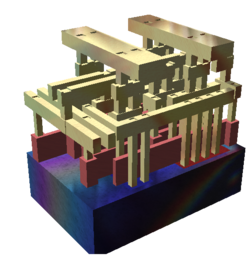
[edit]A standard cell is a group of transistor and interconnect structures that provides a boolean logic function (e.g., AND, OR, XOR, XNOR, inverters) or a storage function (flipflop or latch).[1] The simplest cells are direct representations of the elemental NAND, NOR, and XOR boolean function, although cells of much greater complexity are commonly used (such as a 2-bit full-adder, or muxed D-input flipflop.) The cell's boolean logic function is called its logical view: functional behavior is captured in the form of a truth table or Boolean algebra equation (for combinational logic), or a state transition table (for sequential logic).
Usually, the initial design of a standard cell is developed at the transistor level, in the form of a transistor netlist or schematic view. The netlist is a nodal description of transistors, of their connections to each other, and of their terminals (ports) to the external environment. A schematic view may be generated with a number of different computer-aided design (CAD) or electronic design automation (EDA) programs that provide a graphical user interface (GUI) for this netlist generation process. Designers use additional CAD programs such as SPICE to simulate the electronic behavior of the netlist, by declaring input stimulus (voltage or current waveforms) and then calculating the circuit's time domain (analog) response. The simulations verify whether the netlist implements the desired function and predict other pertinent parameters, such as power consumption or signal propagation delay.
Since the logical and netlist views are only useful for abstract (algebraic) simulation, and not device fabrication, the physical representation of the standard cell must be designed too. Also called the layout view, this is the lowest level of design abstraction in common design practice. From a manufacturing perspective, the standard cell's VLSI layout is the most important view, as it is closest to an actual "manufacturing blueprint" of the standard cell. The layout is organized into base layers, which correspond to the different structures of the transistor devices, and interconnect wiring layers and via layers, which join together the terminals of the transistor formations.[1] The interconnect wiring layers are usually numbered and have specific via layers representing specific connections between each sequential layer. Non-manufacturing layers may also be present in a layout for purposes of design automation, but many layers used explicitly for place and route (PNR) CAD programs are often included in a separate but similar abstract view. The abstract view often contains much less information than the layout and may be recognizable as a Library Exchange Format (LEF) file or an equivalent.
After a layout is created, additional CAD tools are often used to perform a number of common validations. A design rule check (DRC) is done to verify that the design meets foundry and other layout requirements. A parasitic extraction (PEX) then is performed to generate a PEX-netlist with parasitic properties from the layout. The nodal connections of that netlist are then compared to those of the schematic netlist with a layout vs schematic (LVS) procedure to verify that the connectivity models are equivalent.[2]
The PEX-netlist may then be simulated again (since it contains parasitic properties) to achieve more accurate timing, power, and noise models. These models are often characterized (contained) in a Synopsys Liberty format, but other Verilog formats may be used as well.
Finally, powerful place and route (PNR) tools may be used to pull everything together and synthesize (generate) very-large-scale integration (VLSI) layouts, in an automated fashion, from higher level design netlists and floor-plans.
Additionally, a number of other CAD tools may be used to validate other aspects of the cell views and models. And other files may be created to support various tools that utilize the standard cells for a plethora of other reasons. All of these files that are created to support the use of all of the standard-cell variations are collectively known as a standard-cell library.
For a typical Boolean function, there are many different functionally equivalent transistor netlists. Likewise, for a typical netlist, there are many different layouts that fit the netlist's performance parameters. The designer's challenge is to minimize the manufacturing cost of the standard cell's layout (generally by minimizing the circuit's die area), while still meeting the cell's speed and power performance requirements. Consequently, integrated circuit layout is a highly labor-intensive job, despite the existence of design tools to aid this process.
Library
[edit]A standard-cell library is a collection of low-level electronic logic functions such as AND, OR, NOT, flip-flops, latches, and buffers. These cells are realized as fixed-height, variable-width full-custom cells. The key aspect with these libraries is that they are of a fixed height, which enables them to be placed in rows, easing the process of automated digital layout. The cells are typically optimized full-custom layouts, which minimize delays and area.
A typical standard-cell library contains two main components:
- Library database - consists of a number of views often including layout, schematic, symbol, abstract, and other logical or simulation views. From this, various information may be captured in a number of formats including the Cadence LEF format, and the Synopsys Milkyway format, which contain reduced information about the cell layouts, sufficient for automated place and route tools.
- Timing abstract - generally in Liberty format, to provide functional definitions, timing, power, and noise information for each cell.
A standard-cell library may also contain the following additional components:[3]
- A full layout of the cells
- SPICE models of the cells
- Verilog models or VHDL-VITAL models
- parasitic extraction models
- DRC rule decks
An example is a simple XOR logic gate, which can be formed from OR, NOT and AND gates.
Application of standard cell
[edit]Strictly speaking, a 2-input NAND or NOR function is sufficient to form any arbitrary Boolean function set. But in modern ASIC design, standard-cell methodology is practiced with a sizable library (or libraries) of cells. The library usually contains multiple implementations of the same logic function, differing in area and speed.[3] This variety enhances the efficiency of automated synthesis, place, and route (SPR) tools. Indirectly, it also gives the designer greater freedom to perform implementation trade-offs (area vs. speed vs. power consumption). A complete group of standard-cell descriptions is commonly called a technology library.[3]
Commercially available electronic design automation (EDA) tools use the technology libraries to automate synthesis, placement, and routing of a digital ASIC. The technology library is developed and distributed by the foundry operator. The library (along with a design netlist format) is the basis for exchanging design information between different phases of the SPR process.
Synthesis
[edit]Using the technology library's cell logical view, the logic synthesis tool performs the process of mathematically transforming the ASIC's register-transfer level (RTL) description into a technology-dependent netlist. This process is analogous to a software compiler converting a high-level C-program listing into a processor-dependent assembly-language listing.
The netlist is the standard-cell representation of the ASIC design, at the logical view level. It consists of instances of the standard-cell library gates, and port connectivity between gates. Proper synthesis techniques ensure mathematical equivalency between the synthesized netlist and original RTL description. The netlist contains no unmapped RTL statements and declarations.
The high-level synthesis tool performs the process of transforming the C-level models (SystemC, ANSI C/C++) description into a technology-dependent netlist.
Placement
[edit]The placement tool starts the physical implementation of the ASIC. With a 2-D floorplan provided by the ASIC designer, the placer tool assigns locations for each gate in the netlist. The resulting placed gates netlist contains the physical location of each of the netlist's standard-cells, but retains an abstract description of how the gates' terminals are wired to each other.
Typically the standard cells have a constant size in at least one dimension that allows them to be lined up in rows on the integrated circuit. The chip will consist of a huge number of rows (with power and ground running next to each row) with each row filled with the various cells making up the actual design. Placers obey certain rules: Each gate is assigned a unique (exclusive) location on the die map. A given gate is placed once, and may not occupy or overlap the location of any other gate.
Routing
[edit]Using the placed-gates netlist and the layout view of the library, the router adds both signal connect lines and power supply lines. The fully routed physical netlist contains the listing of gates from synthesis, the placement of each gate from placement, and the drawn interconnects from routing.
DRC/LVS
[edit]
Design rule check (DRC) and layout versus schematic (LVS) are verification processes.[2] Reliable device fabrication at modern deep-submicrometer (0.13 μm and below) requires strict observance of transistor spacing, metal layer thickness, and power density rules. DRC exhaustively compares the physical netlist against a set of "foundry design rules" (from the foundry operator), then flags any observed violations.
The LVS process confirms that the layout has the same structure as the associated schematic; this is typically the final step in the layout process.[2] The LVS tool takes as an input a schematic diagram and the extracted view from a layout. It then generates a netlist from each one and compares them. Nodes, ports, and device sizing are all compared. If they are the same, LVS passes and the designer can continue. LVS tends to consider transistor fingers to be the same as an extra-wide transistor. Thus, 4 transistors (each 1 μm wide) in parallel, a 4-finger 1 μm transistor, or a 4 μm transistor are viewed the same by the LVS tool. The functionality of .lib files will be taken from SPICE models and added as an attribute to the .lib file.
In semiconductor design, standard cells are ensured to be design rule checking (DRC) and layout versus schematic (LVS) compliant. This compliance significantly enhances the efficiency of the design process, leading to reduced turnaround times for designers. By ensuring that these cells meet critical verification standards, designers can streamline the integration of these components into larger chip designs, facilitating a smoother and faster development cycle.
Other cell-based methodologies
[edit]"Standard cell" falls into a more general class of design automation flows called cell-based design. Structured ASICs, FPGAs, and CPLDs are variations on cell-based design. From the designer's standpoint, all share the same input front end: an RTL description of the design. The three techniques, however, differ substantially in the details of the SPR flow (synthesize, place-and-route) and physical implementation.
Complexity measure
[edit]For digital standard-cell designs, for instance in CMOS, a common technology-independent metric for complexity measure is gate equivalents (GE).
See also
[edit]References
[edit]- ^ a b A. Kahng et al.: "VLSI Physical Design: From Graph Partitioning to Timing Closure", Springer (2022), doi:10.1007/978-3-030-96415-3, ISBN 978-3-030-96414-6, pp. 11-13.
- ^ a b c A. Kahng et al.: "VLSI Physical Design: From Graph Partitioning to Timing Closure", Springer (2022), doi:10.1007/978-3-030-96415-3, ISBN 978-3-030-96414-6, p. 9.
- ^ a b c D. Jansen et al. "The Electronic Design Automation Handbook", Springer (2003), doi:10.1007/978-0-387-73543-6, ISBN 978-14-020-7502-5, pp. 398-420.
External links
[edit]- VLSI Technology— This site contains support material for a book that Graham Petley is writing, The Art of Standard Cell Library Design
- Oklahoma State University— This site contains support material for a complete System on Chip standard cell library that utilizes public-domain and Mentor Graphics/Synopsys/Cadence Design System tools
The standard cell areas in a CBIC are built-up of rows of standard cells, like a wall built-up of bricks
- Virginia Tech— This is a standard-cell library developed by the Virginia Technology VLSI for Telecommunications (VTVT)
Standard cell
View on GrokipediaOverview
Definition and Purpose
Standard cells are pre-designed, reusable building blocks in integrated circuit design, consisting of logic gates or functional units such as AND gates, OR gates, and flip-flops. These cells feature a fixed height to ensure uniform alignment in a grid-based layout, variable widths depending on the complexity of the function, and standardized power, ground, and signal interfaces for seamless interconnection.[4][5][6] The primary purpose of standard cells is to facilitate automated design flows in application-specific integrated circuits (ASICs) by offering pre-verified and pre-characterized components that minimize custom layout efforts, enhance manufacturing yield through regularity, and enable scalability across CMOS technology nodes.[4][5] This approach shifts the design burden from manual transistor-level implementation to higher-level abstraction, allowing electronic design automation (EDA) tools to efficiently map logical descriptions to physical layouts.[6] Key benefits include predictable performance in terms of timing, power consumption, and area occupation, which stem from the cells' rigorous characterization during development.[4][6] For instance, a basic inverter cell typically comprises a PMOS transistor stacked atop an NMOS transistor between power (VDD) and ground (VSS) rails, providing inversion functionality with minimal footprint.[5] Standard cell libraries compile these units to support broader ASIC implementation.[6]Historical Development
The standard cell methodology emerged in the late 1960s and 1970s alongside the development of metal-oxide-semiconductor (MOS) integrated circuits, marking a shift from fully manual transistor-level layouts to modular building blocks that facilitated more efficient design automation. Early implementations included Fairchild's Micromosaic MOS standard cell approach introduced in 1967, which allowed for pre-designed logic cells to be arranged on a chip, and RCA's 1971 patent for a bipolar standard cell structure, though the latter was more akin to primitive gate arrays with fixed transistor arrangements. By the 1970s, as MOS technology matured, companies like Fairchild and Motorola expanded these concepts with offerings such as Polycell, enabling the creation of application-specific integrated circuits (ASICs) that balanced customization with reduced design effort compared to full-custom designs. This period laid the groundwork for standard cells as reusable logic primitives, primarily gates and flip-flops, optimized for silicon area and performance in early large-scale integration (LSI) chips.[7][8] The 1980s saw widespread adoption of standard cells in ASIC design, transitioning from gate array precursors to true cell-based methodologies that supported full-custom layouts while accelerating time-to-market. Pioneered by firms like Fairchild and RCA, standard cells became integral to high-density MOS processes, with tools for automated placement and routing emerging to handle the growing complexity driven by Moore's Law, which predicted transistor density doubling roughly every two years. This era's shift from labor-intensive full-custom designs to standard cell libraries reduced development cycles from months to weeks for many projects, as engineers could assemble circuits from verified cells rather than drafting every transistor manually. By the late 1980s, standard cells were standard in commercial ASIC flows, enabling higher integration levels in products like microprocessors and signal processors.[9][10] In the 1990s, standardization efforts further propelled the methodology, with Synopsys introducing the Liberty format around 1999 to unify cell library descriptions for timing, power, and functionality across EDA tools, fostering interoperability in global design teams. The 2000s integrated standard cells with deep submicron processes (below 130 nm), where challenges like interconnect delays and leakage necessitated optimized libraries with multi-threshold voltage cells and decap insertions to maintain performance amid shrinking geometries. Moore's Law continued to drive cell density increases, with libraries evolving to support billions of transistors per chip while prioritizing power efficiency.[11][12][13] By the 2010s and into the 2020s, standard cell libraries adapted to advanced transistor architectures, transitioning from planar CMOS to FinFET at 22 nm (around 2011) for improved gate control and reduced short-channel effects, and then to gate-all-around (GAA) nanosheet transistors at 3 nm nodes starting in 2022 with Samsung's production. These evolutions, up to 2025, emphasize buried power rails and backside power delivery in libraries to boost density and efficiency, sustaining Moore's Law through design-technology co-optimization despite physical scaling limits. For example, Intel's 18A process node, entering high-volume production in late 2025, incorporates backside power delivery via PowerVia to enhance density and efficiency.[14][15][16][17][18] The ongoing driver remains faster time-to-market, as cell-based flows now enable designs with trillions of transistors in weeks, far surpassing full-custom feasibility.Design and Construction
Internal Structure
Standard cells are designed with a fixed height, typically spanning 7 to 12 metal routing tracks, to enable uniform placement in rows during layout, while their width varies according to the cell's complexity and required drive strength.[19] Power and ground rails, connected to VDD and VSS respectively, run horizontally across the top and bottom of the cell, providing consistent supply distribution and facilitating abutment with adjacent cells.[20] The internal transistor arrangement follows a complementary CMOS structure, with PMOS transistors placed in the upper n-well region and NMOS transistors in the lower p-substrate region to optimize area and routing efficiency.[21] Diffusion regions are shared between adjacent transistors of the same type where possible, reducing overall cell area by minimizing the number of separate source and drain implants.[22] Input and output ports are positioned on the sides of the cell for easy access by metal interconnects, while VDD and GND connections tie directly to the horizontal power rails.[23] Within the cell, multiple metal layers—starting from Metal 1 for local connections and progressing to higher layers for intra-cell routing—interconnect the transistors, gates, and contacts, ensuring signal integrity and minimizing parasitics.[24] To balance speed, power, and area trade-offs, standard cells are available in variants with different drive strengths, achieved by scaling transistor widths (e.g., x1, x2, x4 multipliers), and multiple threshold voltage options: low (LVT) for higher speed at increased leakage, standard (SVT) for balanced performance, and high (HVT) for lower leakage with reduced speed.[6] All variants maintain the same fixed height and pin locations to ensure compatibility in automated place-and-route flows. A representative example is the inverter cell, which consists of a single PMOS transistor connected in series with a single NMOS transistor between VDD and GND, with their gates tied to the input and drains forming the output; the layout features polysilicon gates spanning both diffusion regions, metal contacts for source/drain connections, and shared diffusion to compact the structure into the standard cell frame.[24]Fabrication Process
The fabrication of standard cells begins with the design phase, where engineers translate high-level behavioral descriptions into transistor-level schematics and physical layouts using electronic design automation (EDA) tools such as Cadence Virtuoso. This process involves creating layouts that adhere to the target process technology's constraints, including the placement of transistors, interconnects, and contacts within a fixed-height cell boundary to ensure compatibility with automated place-and-route flows. Design rule checking (DRC) is performed iteratively during layout to verify compliance with foundry-specific rules, such as minimum feature sizes and spacing, preventing manufacturability issues before proceeding to fabrication.[25][3] The core manufacturing occurs through complementary metal-oxide-semiconductor (CMOS) process technology, which fabricates the cells on silicon wafers via a sequence of steps tailored to the technology node. Key operations include photolithography to pattern features using masks, plasma etching to remove unwanted material, and ion implantation for doping to form n-type and p-type regions, thereby creating nMOS and pMOS transistors. For advanced nodes like 7 nm, extreme ultraviolet (EUV) lithography is employed to achieve sub-10 nm resolutions with single patterning, enabling denser integration while managing challenges such as stochastic defects. These steps build the multi-layer structure, including active areas, gate polysilicon, contacts, and metal interconnects, up to the required metallization levels.[26][27][28] Prior to inclusion in a library, standard cells undergo verification through circuit simulations to confirm functionality and performance. SPICE-based simulations, often using tools like UltraSim, model the cell's electrical behavior under various conditions to validate logic operation and timing. Parasitic extraction follows, computing resistance and capacitance from the layout to generate accurate netlists for further analysis, ensuring the cell's post-layout performance matches design intent.[3][29] Yield considerations are integrated throughout to maximize production efficiency and reliability. Designs avoid unnecessary redundancy in structures to minimize area overhead and defect susceptibility, while antenna rules limit the length-to-gate area ratio of metal lines to prevent charge buildup during plasma etching, which could damage gate oxides. These rules, enforced via DRC, promote higher wafer yields by mitigating plasma-induced damage without requiring additional diodes in most cases.[30][31] Post-fabrication, verified standard cell layouts are converted into photomasks for foundry production, allowing batches of cells to be manufactured in advance on test wafers or as part of process qualification vehicles. These physically realized cells, along with their extracted models, are then compiled into libraries for ASIC integration, enabling reuse across designs while the masks support scalable replication in volume manufacturing.[30][32]Standard Cell Libraries
Library Composition
A standard cell library serves as a repository of pre-designed, reusable building blocks for digital integrated circuit design, typically comprising hundreds of cell types, including variants, tailored to a specific technology node.[33] These core elements include basic logic gates such as AND, OR, NAND, NOR, inverters, and XOR gates; sequential components like D flip-flops, T flip-flops, latches, and scan-enabled variants; and functional cells such as multiplexers, half-adders, full-adders, and decoders.[19][34][35] The cells are organized primarily by function—categorizing them into combinational logic, sequential logic, clock-related cells (e.g., buffers and integrated clock gates), and special-purpose cells—to facilitate efficient selection during automated design processes.[6] This organization is inherently tied to the technology node, such as 130 nm or 7 nm processes, ensuring compatibility with the foundry's design rules and manufacturing capabilities.[19] The library's data is stored in standardized formats to support various stages of the design flow. Physical information, including cell boundaries, pin locations, and routing layer abstractions, is provided in the Library Exchange Format (LEF), which abstracts the layout for place-and-route tools without revealing proprietary details.[6] Timing, power, and functional models are encapsulated in Liberty (.lib) files, an ASCII-based format that describes cell behavior under different operating conditions, enabling accurate simulation and optimization.[36] These formats ensure interoperability across electronic design automation (EDA) tools from vendors like Synopsys and Cadence.[19] Within the library, cells are hierarchically structured by drive strength and threshold voltage to allow designers to balance performance, power, and area trade-offs. Drive strength variants (e.g., X1 for low drive, X4 or higher for increased output capability) enable cells to handle varying fanout loads while maintaining uniform height for row-based placement.[6] Threshold voltage options, such as low-Vt (LVT) for high-speed paths, standard-Vt (SVT) for balanced operation, and high-Vt (HVT) for low-leakage scenarios, occupy the same physical footprint but differ in transistor characteristics.[34] Additionally, the library incorporates non-functional cells like fillers for density uniformity and manufacturing yield improvement, decap (decoupling capacitor) cells for noise reduction and power integrity, well taps for latch-up prevention, and endcaps for boundary protection.[6][34] While standard cell libraries focus on primitive cells as foundational elements—such as individual gates and flip-flops that serve as building blocks for larger structures—they occasionally integrate higher-level intellectual property (IP) macros, like simple adders or multipliers, to accelerate common functions.[19] Vendor-specific implementations vary; for instance, TSMC provides comprehensive libraries with multiple Vt options and power management cells optimized for their process nodes, such as the 65 nm slim library that reduces logic area by 15%.[37] Intel's 10 nm libraries include a diverse assortment of primitive cells with advanced power delivery features for high-performance computing.[38] In contrast, the open-source SkyWater 130 nm process development kit (PDK) offers seven libraries (e.g., high-density with approximately 627 cells and 9 metal tracks), emphasizing accessibility for research and education while supporting 1.8 V and 5 V operations.[35] Recent developments as of 2025 include open-source frameworks like ZlibBoost for flexible library generation and characterization.[39]Characterization and Modeling
Characterization of standard cells involves simulating their electrical behavior across various process, voltage, and temperature (PVT) corners to generate accurate models for design tools. This process typically employs circuit simulators like HSPICE to perform detailed transistor-level simulations, capturing how cells respond under different operating conditions such as typical process at nominal voltage (1.0 V) and temperature (25°C), or worst-case slow process at low voltage (0.8 V) and high temperature (125°C). These simulations measure key parameters including propagation delay, transition times, and power consumption for each input-to-output timing arc, ensuring models reflect real-world variability.[40][41] Key models extracted during characterization include timing arcs, which represent delay as a function of input slew rate and output load capacitance, enabling static timing analysis (STA) tools to predict signal propagation. Power models consist of tables for dynamic power, which accounts for switching activity and capacitive charging, and static power, arising from leakage currents in transistors. Additionally, noise margins are characterized to quantify a cell's immunity to voltage perturbations, with static noise margin (SNM) defined as the minimum DC noise voltage that causes a logic upset, often evaluated for inverters and buffers in the library. These models prioritize conceptual behaviors, such as how increased load capacitance nonlinearly affects delay in timing arcs.[42][43][44] The primary output formats for these models are Non-Linear Delay Model (NLDM) tables, which provide lookup tables for delay and slew as functions of input slew and output load, offering simplicity and compatibility with most STA tools. For higher accuracy in advanced designs, Composite Current Source (CCS) models are used, representing the output current waveform as a function of input voltage over time, which better captures nonlinear effects like driver-receiver interactions. Library formats such as Liberty (.lib) serve as containers for these NLDM and CCS models, integrating timing, power, and noise data.[42][45] Automation tools like Synopsys PrimeTime facilitate STA by incorporating these models, applying On-Chip Variation (OCV) derating factors to account for intra-die variations based on path depth to avoid over-pessimism. OCV derates are typically specified in tables that adjust cell delays multiplicatively or additively, with advanced variants using distance and logic depth for more precise variation modeling.[46] In advanced nodes like 5 nm and beyond, characterization incorporates statistical models to handle increased variability from effects such as line-edge roughness and quantum confinement, necessitating probabilistic delay distributions over deterministic corners. These models use Monte Carlo simulations or parametric approaches to predict cell performance under random variations, improving yield predictions for FinFET or nanosheet-based cells.Role in ASIC Design Flow
Logic Synthesis
Logic synthesis is the process of converting register-transfer level (RTL) descriptions, typically written in hardware description languages like Verilog or VHDL, into a gate-level netlist composed of standard cell instances from a technology library.[47] This mapping is performed by electronic design automation (EDA) tools such as Synopsys Design Compiler, which elaborates the RTL, performs high-level optimizations, and technology maps the logic to equivalent standard cells while adhering to design constraints.[48] The resulting netlist represents the design as interconnected gates, flip-flops, and other primitives, enabling subsequent physical implementation steps. Cell models from the library, including timing and power characterizations, are referenced briefly to ensure accurate mapping without altering the logical behavior.[6] The primary optimization goals during logic synthesis are to minimize area, meet timing requirements, and reduce power consumption, guided by user-specified constraints such as target clock frequency, maximum path delay, and power budgets.[49] For instance, timing constraints define the required clock period to ensure signal propagation delays do not violate setup or hold times, while area and power goals influence cell selection to balance density and leakage/dynamic dissipation.[50] These objectives are achieved through iterative transformations that restructure the logic while preserving functionality, often prioritizing timing closure for high-performance designs or power efficiency in low-energy applications.[51] Cell selection occurs by matching RTL operators and expressions to logically equivalent standard cells from the library, such as inverters, NAND gates, or flip-flops, with variants chosen based on drive strength to optimize signal integrity and delay.[52] Drive strength, quantified by the cell's ability to charge/discharge capacitive loads (e.g., higher-strength cells like X4 variants reduce propagation delay but increase area and power), is adjusted during technology mapping and post-mapping optimization to resolve timing slacks on critical paths.[53] Techniques like gate resizing automatically upscale or downscale cells to meet constraints without manual intervention.[54] Advanced techniques enhance optimization, including retiming, which repositions registers across combinational logic to balance path delays and improve clock frequency, and cloning, which duplicates gates to alleviate high fanout or timing violations on shared logic.[55] Retiming integrates seamlessly with technology mapping to minimize the critical path length while preserving sequential behavior. For efficiency, multi-bit cells such as multi-bit flip-flops (MBFFs) are employed during register allocation, merging multiple single-bit registers into shared clock networks to reduce interconnect area, clock power, and routing congestion.[57] These methods can yield up to 20-30% power savings in clock trees for data-parallel designs, depending on the benchmark.[58] As of 2025, artificial intelligence (AI) and machine learning (ML) are increasingly integrated into logic synthesis tools to predict optimal cell selections and transformations, analyzing historical design data to improve power, performance, and area (PPA) outcomes more efficiently than traditional heuristic methods.[59][60] The output of logic synthesis is a gate-level netlist in Verilog or VHDL format, consisting of instantiated standard cells with connectivity, hierarchy preserved where applicable, and annotations for timing/power estimates, ready for physical design phases.[61]Placement and Floorplanning
Placement and floorplanning represent critical stages in the ASIC design flow where the synthesized netlist serves as input for assigning physical locations to standard cells within a defined chip area.[62] Floorplanning establishes the overall chip architecture by defining the core area for standard cell placement, positioning input/output (I/O) pads around the periphery, and strategically placing larger macros—such as memories or IP blocks—before standard cells to avoid interference and optimize space utilization. This integration ensures that macros are fixed early to guide subsequent standard cell placement, maintaining accessibility for routing and power distribution while adhering to design constraints like chip aspect ratio.[63] Standard cell placement algorithms begin with an initial positioning phase, often using simulated annealing to explore configurations that minimize total wirelength by iteratively swapping or displacing cells based on a cost function, inspired by metallurgical annealing processes. Force-directed methods complement this by modeling cells as charged particles repelling each other to spread them evenly while attracting connected cells to reduce interconnect lengths, typically solved via numerical optimization like conjugate gradients.[62] Following initial placement, legalization aligns cells to predefined grid rows and sites in the standard cell library, snapping positions to comply with fabrication rules and row orientations without altering connectivity.[64] The primary objectives of placement are to minimize half-perimeter wirelength (HPWL) as a proxy for interconnect delay and power, while avoiding congestion hotspots that could hinder routing, all while respecting the power grid by distributing cells to balance current loads.[65] Commercial tools like Cadence Innovus and Synopsys IC Compiler automate this process, targeting density utilizations around 70% to leave space for routing resources and buffers.[66][67] Key challenges include balancing the chip's aspect ratio during floorplanning to match I/O pinout and macro shapes, preventing elongated layouts that exacerbate wirelength or timing issues.[68] Additionally, placement must incorporate clock tree awareness by prioritizing low-skew positioning for clock sinks, often through timing-driven optimizations that pre-empt clock buffer insertion.[69] These considerations ensure scalability for large designs, where global optimization trades off against local density constraints.[65] In recent years, as of 2025, AI-driven approaches have emerged in placement and floorplanning, using ML models to predict congestion hotspots, optimize macro placement, and generate initial layouts that reduce wirelength by up to 10-15% compared to conventional methods, enhancing scalability for complex chips.[70][71]Routing and Interconnect
In standard cell-based ASIC design, routing establishes electrical connections between the pins of placed standard cells using multiple metal layers, transforming the logical netlist into a physical layout. This process treats the pins of the placed cells as fixed endpoints and adheres to technology-specific design rules to ensure manufacturability and performance. The interconnects, formed primarily from metal wires and vias, account for a significant portion of the chip's delay and power consumption due to their resistance and capacitance.[72] Routing proceeds in two main stages: global routing and detailed routing. Global routing divides the chip area into coarse regions, such as tiles or channels, and assigns approximate paths for each net to minimize total wirelength and avoid congestion hotspots. This stage optimizes the overall topology by selecting preferred directions and layers, often using graph-based algorithms to balance density across the design. Detailed routing then refines these paths by assigning exact tracks on specific metal layers, inserting vias to transition between layers, and resolving any remaining conflicts within the allocated channels. In standard cell designs, routing typically utilizes multiple metal layers—M1 for local connections near the cells, up to M10 or higher in advanced nodes for global signals—while complying with rules for minimum metal width (e.g., 0.05–0.1 μm in sub-28 nm processes), spacing (e.g., 0.07–0.15 μm between parallel wires), and via dimensions (e.g., square vias of 0.06–0.1 μm with enclosure rules around contacts). These constraints prevent shorting, electromigration, and yield issues.[72][73][74][75] Optimization during routing focuses on reducing interconnect parasitics and ensuring signal integrity. Efforts include minimizing the number of vias—each adding contact resistance (typically 1–10 Ω) and capacitance (0.01–0.1 fF)—through topology adjustments and layer preferences, as well as shortening wire lengths to lower overall resistance and capacitance. For signal integrity, crosstalk is mitigated by enforcing spacing rules between adjacent nets, switching layers for aggressor-victim pairs, or inserting shielding wires, which can reduce coupling capacitance by up to 50% in dense regions. Antenna avoidance is integrated into the routing flow to prevent plasma-induced damage during fabrication; this involves jumper insertion on routing trees or routing sensitive nets on higher metal layers to limit exposed gate areas below a maximum threshold (e.g., 100–1000 μm). Commercial tools like Cadence NanoRoute automate these stages, performing unified global and detailed routing with built-in optimization for wirelength, via count, and timing, often achieving routability in under 10% overflow for large designs.[76][77][72][78] As of 2025, AI and ML techniques are transforming routing by predicting optimal paths, resolving congestion in real-time, and minimizing vias and wirelength through reinforcement learning and graph neural networks, leading to improved routability and up to 20% better PPA in advanced nodes.[59][79] The outcome of routing is a complete physical netlist, including detailed geometries for all interconnects, ready for mask generation. Post-routing, parasitic extraction tools derive the RC network from the layout, capturing wire capacitances (proportional to length and width) and resistances (inversely proportional to width) for subsequent timing and power simulations. This ensures the interconnects meet performance targets without excessive iterations.[72][77]Verification and Optimization
Design Rule Checking and Layout vs. Schematic
Design Rule Checking (DRC) and Layout versus Schematic (LVS) form critical physical verification stages in the standard cell-based ASIC design flow, confirming that the placed and routed layout adheres to manufacturing constraints and design specifications. These processes identify discrepancies early, preventing costly respins and ensuring the final GDSII file is production-ready.[80][81] DRC systematically scans the layout for violations of foundry-defined geometric rules, such as minimum spacing between metal wires, enclosure of vias by surrounding metal, and minimum feature widths, which help mitigate lithography and etching variations in advanced nodes. Violations, including potential shorts from inadequate spacing or opens from insufficient enclosure, are flagged as error markers overlaid on the layout for debugging. Industry-standard tools like Calibre from Siemens EDA and Pegasus from Cadence perform these checks using rule decks in formats such as SVRF, supporting hierarchical processing to handle the billions of polygons in modern designs efficiently.[80][82][83] LVS verification extracts a connectivity netlist from the layout—accounting for devices, wires, and parasitics—and compares it against the reference schematic netlist to confirm identical topology, device counts, and net assignments. This process preserves design hierarchy for scalability and tolerates minor geometric differences, such as parameter mismatches within specified thresholds, while detecting issues like unintended connections or missing components. Tools like Calibre and IC Validator from Synopsys automate this comparison, often integrating with parasitic extraction for downstream analysis.[81][84] In the design flow, DRC and LVS are executed iteratively following placement, clock tree synthesis, and routing, with results feeding back into optimization loops until signoff criteria are met. Fixes for identified violations are implemented via Engineering Change Orders (ECOs), which enable targeted modifications—such as rerouting shorts or adjusting geometries—without full re-synthesis, leveraging spare cells or metal layers to preserve timing and area.[85][86] Advanced verification extends to density management through metal fill insertion, where non-functional dummy shapes are added to empty regions to satisfy uniform metal density rules (typically 20-80% per layer), promoting even chemical-mechanical polishing and reducing topography-induced defects. Electromigration (EM) checks complement this by analyzing current densities in power and signal nets against foundry limits, using metrics like average and peak currents to flag high-risk interconnects prone to voiding or hillocking, often verified via tools integrated with DRC flows.[87][88] Collectively, DRC and LVS safeguard manufacturability by preempting the majority of process-related defects, such as yield-impacting shorts or connectivity errors, before tapeout, thereby minimizing fabrication risks in standard cell designs.[82][89]Timing, Power, and Area Analysis
In post-layout analysis for standard cell-based ASICs, timing, power, and area metrics are evaluated through simulations to verify performance and identify optimization opportunities before tapeout. These assessments leverage extracted netlists and parasitics to model real-world behavior, ensuring the design achieves target clock speeds, power budgets, and density while accounting for process variations. Static Timing Analysis (STA) computes delays along all combinational paths using pre-characterized cell models from the library, which provide lookup tables for cell delays based on input transition times and output capacitances. Path delays incorporate both intrinsic cell delays and interconnect effects from parasitic extraction. STA enforces setup checks to ensure data arrives sufficiently before clock edges (e.g., with margins for on-chip variation) and hold checks to prevent data instability after edges, using longest and shortest path analyses respectively. Synopsys PrimeTime serves as a primary tool for signoff STA, supporting multi-scenario variation modeling and delivering accuracy certified by foundries down to advanced nodes.[90][91] Power analysis distinguishes dynamic power from switching activity and static power from leakage currents. Dynamic power estimation employs vectorless techniques for average toggle rates across the design or simulation-based methods using input vectors (e.g., in formats like SAIF or VCD) to capture realistic activity factors in standard cell instances. Static power is typically evaluated vectorlessly by aggregating leakage values from cell libraries under operating conditions like temperature and voltage. Cadence Voltus IC Power Integrity Solution performs these analyses with distributed processing for full-chip signoff, integrating glitch-aware estimation and foundry-certified models for nodes as small as 3nm.[92] Area metrics quantify design efficiency through cell count, which reflects logic complexity, and utilization ratio, calculated as the percentage of silicon occupied by standard cells versus total die area (routing channels and whitespace). Silicon area is derived by summing individual cell footprints from the library, adding routing overhead (often 20-50% of total area), and scaling for utilization targets around 70% to accommodate placement density and yield.[43][93] Optimization involves iterative loops post-layout, such as gate sizing to upscale or downscale cells for delay reduction while monitoring power increases, and buffer insertion along high-fanout nets to mitigate slew degradation and improve timing closure. These techniques trade off area expansion (e.g., larger cells or added buffers increasing footprint by 10-20%) against timing gains (up to 18% delay improvement) and power penalties from higher capacitance. Sensitivity-based statistical sizing further refines these adjustments under process variations, achieving up to 16% better delay percentiles without excessive area overhead. Tools like PrimeTime and Voltus integrate these loops for ECO guidance, balancing multi-objective trade-offs.[94][95]Variations and Alternatives
Advanced Standard Cell Types
Advanced standard cell types have evolved to address the escalating demands for power efficiency, performance, and density in modern integrated circuits, particularly as process nodes shrink below 7 nm. These specialized cells incorporate variations in transistor threshold voltages (Vt) to balance speed and leakage. Multi-Vt libraries feature low-Vt cells deployed in critical timing paths to enhance drive strength and speed, while high-Vt cells are used in non-critical areas to minimize subthreshold leakage current, achieving up to 50% reduction in overall standby power without significant area overhead. This approach, known as multi-threshold CMOS (MTCMOS), allows designers to optimize power and performance during synthesis by selectively assigning Vt values based on path timing analysis.[96][97] Low-power variants extend these capabilities with techniques like power gating, where dedicated sleep transistors are integrated into standard cells to isolate power domains during idle periods, cutting leakage by over 90% in inactive blocks. Multi-supply domain cells include level shifters and isolation cells to manage voltage islands, enabling different supply levels across the chip for dynamic power scaling. Support for dynamic voltage and frequency scaling (DVFS) is facilitated through retention flip-flops and always-on logic cells that preserve state during voltage transitions, allowing runtime adjustments to supply voltage for workload-adaptive power savings of 20-40% in processors. These cells are essential for battery-constrained applications, ensuring seamless integration in automated design flows.[98][99][100] High-density standard cells are tailored for emerging architectures like 3D integrated circuits (ICs) and chiplets, where vertical stacking reduces interconnect lengths and improves bandwidth. In 3D ICs, cells are optimized with through-silicon via (TSV)-aware layouts to minimize thermal hotspots, enabling up to 40% area savings compared to 2D equivalents through monolithic or sequential stacking. For chiplet-based designs, modular cells support inter-die interfaces with standardized power delivery networks, facilitating heterogeneous integration. FinFET-optimized cells leverage tri-gate structures for better electrostatic control, reducing leakage by 30% at 7 nm while maintaining high drive currents, as seen in predictive design kits (PDKs). Gate-all-around (GAA) or nanosheet cells further enhance density at 3 nm nodes by surrounding the channel completely, improving short-channel effects and enabling 15-20% performance gains over FinFETs in standard cell libraries.[101][102][103] Custom enhancements include tunable cells that employ adaptive body biasing to fine-tune threshold voltages post-fabrication, compensating for process variations and achieving 10-25% leakage reduction or speed boosts as needed. Forward body bias (FBB) lowers Vt for faster operation in active modes, while reverse body bias (RBB) raises it for standby, implemented via row-based schemes in standard cell rows without altering layouts. These cells are particularly valuable in subthreshold designs for IoT devices. As examples, SRAM compilers generate memory arrays using extended standard cells like 6T or 8T bitcells, treated as macro cells for seamless integration and offering configurable sizes with power gating support. Open-source variants, such as those developed for RISC-V cores like PICO-RV32, provide freely accessible libraries in SkyWater 130 nm PDK, enabling community-driven optimizations and rapid prototyping of low-power processors.[104][105][106]Comparison with Other Methodologies
Standard cell design methodologies offer a semi-custom approach to application-specific integrated circuit (ASIC) development, striking a balance between design flexibility and manufacturing efficiency. In contrast to full-custom design, which involves transistor-level optimization for every circuit element, standard cells utilize pre-characterized libraries of logic gates and flip-flops, enabling automated placement and routing. This results in significantly reduced design time and non-recurring engineering (NRE) costs for standard cells compared to full-custom, but at the expense of suboptimal area and performance; full-custom can achieve up to 1.7× higher speed and 3 to 10× better power efficiency through custom layouts that minimize parasitics and enable advanced techniques like supply gating.[107][107] Compared to programmable logic devices such as field-programmable gate arrays (FPGAs), standard cell ASICs provide fixed, optimized hardware tailored to specific applications, yielding superior density and efficiency for production runs. FPGAs excel in prototyping and low-volume scenarios due to their reconfigurability, but they incur higher area overhead (up to 40× for logic elements), slower critical path delays (3 to 4×), and greater dynamic power consumption (around 12×) relative to standard cell ASICs fabricated in the same 90 nm process node.[108][108] Gate arrays, an older fixed-base approach, similarly pre-fabricate transistor arrays for metal customization, but standard cells surpass them in density and performance by allowing full custom layout of active layers, avoiding the routing congestion inherent in gate array bases.[109] Structured ASICs represent a hybrid methodology, featuring pre-fabricated base layers (including transistors and lower metals) with customization limited to upper metal interconnects, positioning them between standard cells and FPGAs in the design spectrum. While structured ASICs reduce NRE costs and accelerate time-to-market compared to standard cells by minimizing mask layers, they lag in unit cost at high volumes, performance, and power efficiency due to larger die sizes and fixed routing constraints. Structured ASICs were more popular in the 2000s but have declined in adoption as of 2025, with EDA tool advancements making standard cell flows more viable for mid-volume production; modern alternatives include embedded FPGAs for reconfigurability needs.[109][110]| Aspect | Standard Cell Advantage | Alternative Advantage (e.g., Full-Custom/FPGA/Structured) |
|---|---|---|
| Time-to-Market | Faster design (months vs. years for custom) | FPGA: Instant reconfiguration for prototypes |
| Power Efficiency | Good for semi-custom; significant dynamic power savings possible | Full-custom: 3–10× better via optimized circuits |
| Area/Density | High density with custom layout | FPGA: 40× overhead; Structured: Larger die from fixed base |
| Cost (High Volume) | Lowest unit cost due to optimized die | Structured: Lower NRE; FPGA: No NRE but higher per unit |
| Performance | Balanced speed (up to 1.7× vs. custom gap) | Full-custom: Highest; FPGA: 3–4× slower |
Performance Evaluation
Complexity Metrics
Complexity metrics in standard cell-based designs quantify the intricacy and efficiency of integrated circuits by evaluating factors such as structural composition, physical layout, interconnect demands, and energy consumption. These measures provide technology-independent benchmarks to compare designs across process nodes and methodologies, enabling designers to assess trade-offs in performance, area, and power during synthesis and physical implementation.[111] Basic metrics include cell count, which tallies the total number of standard cells instantiated in the design to gauge overall logic density, and gate equivalents (GE), a normalized unit representing circuit complexity in terms of equivalent two-input NAND gates or inverters, independent of specific technology.[112] For performance benchmarking, the fanout-of-4 (FO4) delay serves as a standard inverter metric, measuring the propagation delay of an inverter driving four identical inverters, which normalizes variations in process, voltage, and temperature to estimate gate-level timing.[113] Key equations define core physical and logical attributes. The total area of a standard cell layout is calculated as the sum over all cells of their individual areas, where each cell area is the product of its width and fixed height , yielding , reflecting the row-based placement structure.[114] Logic depth, representing the maximum number of logic stages along any path from input to output, is defined as the longest chain of gates, , which influences critical path delay and pipelining efficiency.[3] As modern System-on-Chip (SoC) designs integrate billions of transistors, accurate prediction of key design properties has become essential. Early-stage architectural exploration and physical synthesis depend on reliable models that capture the interplay between logic complexity and inter-block communication demands. The cornerstone model in this field is Rent's Rule, an empirical power-law relationship first observed by E.F. Rent at IBM in the 1960s and formally described by Landman and Russo in 1971. It relates the number of external signal connections (terminals or pins, T) of a logic block to the number of internal components (gates or standard cells, g) within it, typically expressed as T = t · g^p, where t is the average terminals per block and p is the Rent exponent (reflecting locality of connections), typically ranging from 0.5 to 0.75.[115][116] Rent's Rule has proven invaluable for estimating interconnect lengths, wiring demands, and overall layout complexity in VLSI and SoC designs, enabling a priori predictions of area, power, and performance in advanced technologies.[117] Advanced metrics address interconnect complexity through Rent's rule, which models the number of interconnections required for a module with transistors as , where is a constant and the exponent typically ranges from 0.5 to 0.7 for VLSI designs, indicating hierarchical wiring demands and potential routing congestion.[118] However, the original Rent's rule exhibits limitations, particularly its insensitivity to the hierarchical structure of systems and its reliance on a single Rent exponent across all levels, which can lead to inaccuracies in complex VLSI designs. To overcome these weaknesses, Alexander Tetelbaum proposed generalizations of Rent's rule in 1995, introducing a graph-based framework that extends the model's applicability to hierarchical systems and enhances prediction accuracy. This approach models the system as a graph, where nodes represent components and edges denote interconnections, allowing for a more nuanced analysis of structural constraints at different hierarchy levels.[119][120] Tetelbaum's extended formula incorporates these hierarchical aspects by allowing variable Rent exponents for different partitioning levels in the graph, generally expressed in a form that adjusts the basic power-law relationship to account for graph partitioning and system structure, such as , where subscript denotes the hierarchy level, and is a function capturing the graph properties at that level. Key properties of this generalization include its ability to handle multi-level hierarchies explicitly, providing sensitivity to the specific topology of the design, and facilitating better estimations of layout parameters like wire lengths and pin counts in standard cell-based ASICs. These properties make it particularly suitable for modern SoC designs where hierarchy plays a critical role in managing interconnect complexity.[119][121] The advantages of Tetelbaum's generalizations lie in their improved accuracy over the traditional Rent's rule, with studies showing prediction errors reduced by approximately 4.7% in certain applications, and their broader domain of applicability to diverse hierarchical architectures. By integrating graph-based partitioning techniques, the model addresses routing congestion more effectively in standard cell and VLSI design flows, enabling designers to anticipate and mitigate interconnect challenges during early synthesis stages. This enhancement supports more reliable performance evaluation and optimization in advanced semiconductor technologies.[122] Power complexity is evaluated via leakage power per gate, which quantifies static dissipation in each cell due to subthreshold and gate leakage mechanisms, often reported in nanowatts per gate to assess standby efficiency in scaled technologies.[5] The power-delay product (PDP), computed as the product of average power consumption and propagation delay for a gate or path, serves as a figure of merit for energy efficiency, balancing dynamic and static contributions in standard cell evaluations.[123] Synthesis and place-and-route tools generate detailed reports on these metrics, including cell count, area utilization, GE totals, and interconnect estimates, facilitating iterative optimization during the VLSI design flow.[124]Scalability Considerations
As semiconductor process nodes have scaled from 180 nm to 2 nm (with sub-2 nm nodes in development), standard cell designs have faced escalating challenges from increased process variability and IR drop, driven by quantum effects, short-channel effects, and higher power densities that undermine traditional 2D geometric scaling. Variability arises from stochastic factors such as random dopant fluctuations and line-edge roughness, leading to threshold voltage shifts that degrade timing predictability in cells like inverters and NAND gates. IR drop, exacerbated by narrow interconnects and high current densities, causes voltage sags that can reduce performance by up to 10-15% in dense layouts without mitigation, necessitating finer-grained power grid designs.[125][126] To address integration limits in planar designs, 3D and advanced packaging approaches have emerged, including stacked standard cells in monolithic 3D integrated circuits (ICs) where NMOS and PMOS transistors are vertically integrated via fine-pitch contacts. This stacking reduces cell footprint by approximately 50% for logic elements like inverters, enabling 30-50% smaller overall logic area while shortening interconnect lengths by over 10%, which improves delay and power efficiency in benchmarks such as LDPC decoders. Chiplet interfaces, standardized through protocols like Universal Chiplet Interconnect Express (UCIe), facilitate modular standard cell libraries across heterogeneous dies, allowing seamless power and signal distribution but requiring careful alignment of cell heights and I/O pads to minimize latency at inter-die boundaries.[127][126] However, the breakdown of Dennard scaling since around 2005 has intensified these issues, as power density rises without proportional voltage reductions, limiting sustainable clock frequencies and necessitating paradigm shifts like complementary field-effect transistors (CFETs) for continued density gains. CFETs stack n-type and p-type channels vertically, enabling 50% scaling in standard cell and SRAM areas beyond the 3 nm node while mitigating short-channel effects.[125][128] Mitigation strategies rely on adaptive standard cell libraries that incorporate process variation models, such as statistical timing analysis tools using multivariate regression to predict delay under PVT corners, allowing dynamic adjustment of cell sizing. These libraries integrate variation-aware characterizations, enabling robust placement and routing that accounts for IR drop gradients across the die.[129]References
- https://ycunxi.[github](/page/GitHub).io/cunxiyu/papers/isvlsi18ret.pdf