



Community hub
Recent from talks
Contribute something to knowledge base
Content stats: 0 posts, 0 articles, 1 media, 0 notes
Members stats: 0 subscribers, 0 contributors, 0 moderators, 0 supporters
Subscribers
Supporters
Contributors
Moderators
Hub AI
Ilinden–Preobrazhenie Uprising AI simulator
(@Ilinden–Preobrazhenie Uprising_simulator)
Hub AI
Ilinden–Preobrazhenie Uprising AI simulator
(@Ilinden–Preobrazhenie Uprising_simulator)
Ilinden–Preobrazhenie Uprising
The Ilinden–Preobrazhenie Uprising (Bulgarian: Илинденско-Преображенско въстание, romanized: Ilindensko-Preobrazhensko vastanie), consisting of the Ilinden Uprising (Macedonian: Илинденско востание, romanized: Ilindensko vostanie; Greek: Εξέγερση του Ίλιντεν, romanized: Exégersi tou Ílinden) and Preobrazhenie Uprising, was an organized revolt against the Ottoman Empire, which was prepared and carried out by the Internal Macedonian-Adrianople Revolutionary Organization, with the support of the Supreme Macedonian-Adrianople Committee, which included mostly Bulgarian military personnel. The name of the uprising refers to Ilinden, a name for Elijah's day, and to Preobrazhenie which means Feast of the Transfiguration. The revolt lasted from the beginning of August to the end of October.
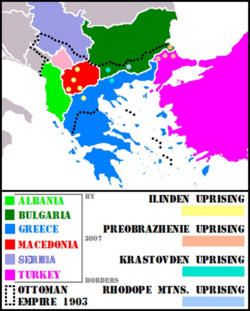
The uprisings had as an aim the autonomy for Macedonia and Adrianople regions. The Ilinden Uprising in the region of Macedonia affected the Manastir vilayet, where it was organized by Macedonian Bulgarians, joined mainly by some Patriarchist Macedonian Slavs (called Grecomans and Serbomans), and some Patriarchist and Exarchist Aromanians and Albanians. A provisional government was established in the town of Kruševo, proclaimed as the Kruševo Republic. Among the revolutionary leaders of the republic there was strive for an independent Macedonian state. It was to be established firstly in the Manastir vilayet, and later expanded to the whole of Macedonia. However, the republic was overrun after ten days by the Ottoman forces. On August 19, the closely related Preobrazhenie Uprising, organized by Thracian Bulgarian revolutionaries in the Adrianople vilayet, led to the liberation of a large area in the Strandzha Mountains, and the creation of a provisional government in Vassiliko, the Strandzha Republic. This lasted 26 days before being put down by the Ottomans. The insurrection also affected the vilayet of Kosovo and the Salonica vilayet.
By the time the rebellion had started, many of its most promising potential leaders, including Ivan Garvanov and Gotse Delchev, had already been arrested or killed by the Ottomans. The general staff of the uprising attempted to provoke an intervention by the Great Powers, by sending them a letter and a memorandum in which they informed about the atrocities committed by the Ottomans, but the Great Powers proceeded their status quo policy. Towards the end of the uprising when it was evidently clear that there will be no intervention, a desperate call was made to convince the Bulgarian government to send the army against the Ottomans, but the government was pressured by the Great Powers to refrain from military intervention. The revolutionaries managed to maintain a guerrilla campaign against the Ottomans for almost three months, but the uprising was suppressed. This was followed by a mass wave of refugees from the regions of Macedonia and Thrace, mostly to Bulgaria, but also to the United States and Canada. Its greater effect was that it persuaded the European powers to attempt to convince the Ottoman sultan that he must take a more conciliatory attitude toward his Christian subjects in Europe. Through bilateral agreement, signed in 1904, Bulgaria committed not to support the revolutionary movement, while the Ottomans undertook to implement the Mürzsteg Reforms, however neither happened.
The uprising is celebrated in both Bulgaria and North Macedonia as the peak of their nations' struggle against the Ottoman rule. In Bulgaria it is considered as a general rebellion prepared by the joint revolutionary organization of the Bulgarians in the Ottoman Empire, with a common goal autonomy for Macedonia and Adrianople regions, and later unification with Bulgaria. While in North Macedonia it is asserted that there were two separate uprisings with different ultimate objectives, which in the case of the Ilinden one was independent Macedonia. Calls for common celebrations, especially from the Bulgarian side, did little to change this state of affairs.
The competition for control between national groups took place largely via of propaganda campaigns in the Ottoman Empire, aimed at winning over the local population, and conducted largely through churches and schools. Various groups were also supported by the local population and the three competing governments.
The Internal Macedonian-Adrianopolitan Revolutionary Organization (IMARO) was founded in Thessaloniki in 1893. The group had a number of name changes prior to and subsequent to the uprising. It was predominantly Bulgarian and supported an idea for autonomy for Macedonia and Adrianople regions within the Ottoman state with a motto of "Macedonia for the Macedonians". IMARO's inspiration certainly belonged to the nineteenth-century Balkan practice whereby the powers maintained the fiction of Ottoman control over effectively independent states under the guise of autonomous status within the Ottoman state; (Serbia, 1829–1878; Romania, 1829–1878; Bulgaria, 1878–1908). Autonomy, in other words, was as good as independence. Moreover, from the Macedonian perspective, the goal of independence by autonomy had another advantage. More important, IMARO was aware that neither Serbia nor Greece could expect to obtain the whole of Macedonia and, unlike Bulgaria, they both looked forward to and urged partition. Autonomy, then, was the best prophylactic against partition, that would unite the multi-ethnic Macedonian population. However, the idea of Macedonian autonomy was strictly political and did not imply a secession from Bulgarian ethnicity.
The Supreme Macedonian-Adrianople Committee (SMAC) was a group formed in 1895 in Sofia, Bulgaria, which enjoyed the covert but close cooperation with the Bulgarian government. The members of this group were called the Supremists, and advocated annexation of the region by Bulgaria. The two groups had different strategies. IMARO sought to prepare a carefully planned uprising in the future, but the Supremists preferred immediate raids and guerilla operations to foster disorder and a precipitate intervention from the Great Powers. A leader of IMARO, Gotse Delchev, was a strong advocate for proceeding slowly. SMAC urged a speedy uprising although they had little faith in the internal movement. Their president Danail Nikolaev thought that IMARO's idea for a peasant uprising was unreal and perceived Delchev as a "brash youngster". Nikolaev thought that for the struggle to succeed, trained soldiers were needed and also clandestine aid and finance of the Bulgarian government.
On the other hand, a smaller group of conservatives in Thessaloniki organized a Bulgarian Secret Revolutionary Brotherhood (Balgarsko Tayno Revolyutsionno Bratstvo). The latter was incorporated in IMARO by 1900 and its members as Ivan Garvanov, were to exert a significant influence on the organization. They were to push for the Ilinden–Preobrazhenie Uprising and later became the core of IMARO's right-wing faction. In 1899, Garvanov developed a friendship with Supremists' new leader Boris Sarafov, through which Garvanov managed to come to eminence in IMARO. Despite the mutual hostility, in this period IMARO and the Supremists collaborated and with Sarafov's help Garvanov and some of the Supremists became members of the IMARO's central committee in Thessaloniki.
Ilinden–Preobrazhenie Uprising
The Ilinden–Preobrazhenie Uprising (Bulgarian: Илинденско-Преображенско въстание, romanized: Ilindensko-Preobrazhensko vastanie), consisting of the Ilinden Uprising (Macedonian: Илинденско востание, romanized: Ilindensko vostanie; Greek: Εξέγερση του Ίλιντεν, romanized: Exégersi tou Ílinden) and Preobrazhenie Uprising, was an organized revolt against the Ottoman Empire, which was prepared and carried out by the Internal Macedonian-Adrianople Revolutionary Organization, with the support of the Supreme Macedonian-Adrianople Committee, which included mostly Bulgarian military personnel. The name of the uprising refers to Ilinden, a name for Elijah's day, and to Preobrazhenie which means Feast of the Transfiguration. The revolt lasted from the beginning of August to the end of October.
The uprisings had as an aim the autonomy for Macedonia and Adrianople regions. The Ilinden Uprising in the region of Macedonia affected the Manastir vilayet, where it was organized by Macedonian Bulgarians, joined mainly by some Patriarchist Macedonian Slavs (called Grecomans and Serbomans), and some Patriarchist and Exarchist Aromanians and Albanians. A provisional government was established in the town of Kruševo, proclaimed as the Kruševo Republic. Among the revolutionary leaders of the republic there was strive for an independent Macedonian state. It was to be established firstly in the Manastir vilayet, and later expanded to the whole of Macedonia. However, the republic was overrun after ten days by the Ottoman forces. On August 19, the closely related Preobrazhenie Uprising, organized by Thracian Bulgarian revolutionaries in the Adrianople vilayet, led to the liberation of a large area in the Strandzha Mountains, and the creation of a provisional government in Vassiliko, the Strandzha Republic. This lasted 26 days before being put down by the Ottomans. The insurrection also affected the vilayet of Kosovo and the Salonica vilayet.
By the time the rebellion had started, many of its most promising potential leaders, including Ivan Garvanov and Gotse Delchev, had already been arrested or killed by the Ottomans. The general staff of the uprising attempted to provoke an intervention by the Great Powers, by sending them a letter and a memorandum in which they informed about the atrocities committed by the Ottomans, but the Great Powers proceeded their status quo policy. Towards the end of the uprising when it was evidently clear that there will be no intervention, a desperate call was made to convince the Bulgarian government to send the army against the Ottomans, but the government was pressured by the Great Powers to refrain from military intervention. The revolutionaries managed to maintain a guerrilla campaign against the Ottomans for almost three months, but the uprising was suppressed. This was followed by a mass wave of refugees from the regions of Macedonia and Thrace, mostly to Bulgaria, but also to the United States and Canada. Its greater effect was that it persuaded the European powers to attempt to convince the Ottoman sultan that he must take a more conciliatory attitude toward his Christian subjects in Europe. Through bilateral agreement, signed in 1904, Bulgaria committed not to support the revolutionary movement, while the Ottomans undertook to implement the Mürzsteg Reforms, however neither happened.
The uprising is celebrated in both Bulgaria and North Macedonia as the peak of their nations' struggle against the Ottoman rule. In Bulgaria it is considered as a general rebellion prepared by the joint revolutionary organization of the Bulgarians in the Ottoman Empire, with a common goal autonomy for Macedonia and Adrianople regions, and later unification with Bulgaria. While in North Macedonia it is asserted that there were two separate uprisings with different ultimate objectives, which in the case of the Ilinden one was independent Macedonia. Calls for common celebrations, especially from the Bulgarian side, did little to change this state of affairs.
The competition for control between national groups took place largely via of propaganda campaigns in the Ottoman Empire, aimed at winning over the local population, and conducted largely through churches and schools. Various groups were also supported by the local population and the three competing governments.
The Internal Macedonian-Adrianopolitan Revolutionary Organization (IMARO) was founded in Thessaloniki in 1893. The group had a number of name changes prior to and subsequent to the uprising. It was predominantly Bulgarian and supported an idea for autonomy for Macedonia and Adrianople regions within the Ottoman state with a motto of "Macedonia for the Macedonians". IMARO's inspiration certainly belonged to the nineteenth-century Balkan practice whereby the powers maintained the fiction of Ottoman control over effectively independent states under the guise of autonomous status within the Ottoman state; (Serbia, 1829–1878; Romania, 1829–1878; Bulgaria, 1878–1908). Autonomy, in other words, was as good as independence. Moreover, from the Macedonian perspective, the goal of independence by autonomy had another advantage. More important, IMARO was aware that neither Serbia nor Greece could expect to obtain the whole of Macedonia and, unlike Bulgaria, they both looked forward to and urged partition. Autonomy, then, was the best prophylactic against partition, that would unite the multi-ethnic Macedonian population. However, the idea of Macedonian autonomy was strictly political and did not imply a secession from Bulgarian ethnicity.
The Supreme Macedonian-Adrianople Committee (SMAC) was a group formed in 1895 in Sofia, Bulgaria, which enjoyed the covert but close cooperation with the Bulgarian government. The members of this group were called the Supremists, and advocated annexation of the region by Bulgaria. The two groups had different strategies. IMARO sought to prepare a carefully planned uprising in the future, but the Supremists preferred immediate raids and guerilla operations to foster disorder and a precipitate intervention from the Great Powers. A leader of IMARO, Gotse Delchev, was a strong advocate for proceeding slowly. SMAC urged a speedy uprising although they had little faith in the internal movement. Their president Danail Nikolaev thought that IMARO's idea for a peasant uprising was unreal and perceived Delchev as a "brash youngster". Nikolaev thought that for the struggle to succeed, trained soldiers were needed and also clandestine aid and finance of the Bulgarian government.
On the other hand, a smaller group of conservatives in Thessaloniki organized a Bulgarian Secret Revolutionary Brotherhood (Balgarsko Tayno Revolyutsionno Bratstvo). The latter was incorporated in IMARO by 1900 and its members as Ivan Garvanov, were to exert a significant influence on the organization. They were to push for the Ilinden–Preobrazhenie Uprising and later became the core of IMARO's right-wing faction. In 1899, Garvanov developed a friendship with Supremists' new leader Boris Sarafov, through which Garvanov managed to come to eminence in IMARO. Despite the mutual hostility, in this period IMARO and the Supremists collaborated and with Sarafov's help Garvanov and some of the Supremists became members of the IMARO's central committee in Thessaloniki.
Recent media
Recent media