Proclamation 4483
Proclamation 4483
Main page
13598

Proclamation 4483

logo
Community Hub0 subscribers
Read side by side
from Wikipedia

Proclamation 4483 and Executive Order 11967 reproduced in the Federal Register (click to view full document)

Proclamation 4483, also known as the Granting Pardon for Violations of the Selective Service Act, was a presidential proclamation issued by Jimmy Carter on January 21, 1977. It granted unconditional pardons to all Americans who evaded the draft in the Vietnam War by violating the Military Selective Service Act. It was implemented through Executive Order 11967.

Draft evasion was common during the Vietnam War, especially among pacifists, conscientious objectors, and those involved in the anti-war movement. Blanket pardons had been used by presidents in the past to grant clemency following times of war, and the possibility of amnesty for draft evaders became a polarizing issue during the 1976 United States elections, as the United States' involvement in Vietnam ended during the second Nixon administration.

President Gerald Ford implemented Executive Order 11803, which allowed Vietnam draft evaders to receive conditional amnesty. Carter deliberated on the issue in his 1976 presidential campaign, deciding that unconditional blanket pardons were necessary for the country to move past Vietnam. Veterans' groups were split on the proclamation, and it was generally celebrated by pacifists and pro-amnesty groups, however it was criticized by some because it did not pardon deserters.

[edit]

Article Two of the Constitution of the United States grants the president the power to issue pardons for federal crimes.[1] Amid the Civil War, Congress passed a law in 1862 granting the president the power to issue blanket pardons and amnesties.[1] This power was used by Abraham Lincoln and Andrew Johnson to pardon secessionists. Harry S. Truman invoked the power of general pardons after World War II and during the Korean War to pardon desertion, as well as for convicted criminals who then served in the military.[2]

The Supreme Court ruled in Ex parte Garland (1867) that pardons entirely absolve the recipient of guilt,[2] and in Knote v. United States (1877) that pardons and amnesties are the same thing under federal law.[1] Other cases in the 19th and 20th centuries determined that those who are offered pardons do not have to accept them, and that presidential pardons cannot be modified by Congress.[3]

The Nationality Act of 1940 imposed loss of citizenship on American citizens who flee the United States to avoid service in times of war, or who are court-martialed for desertion.[4] The Immigration and Nationality Act of 1952 allowed for restoration of citizenship under these conditions should one return to serve in the armed forces during times of war.[5] It also specified that leaving the United States after failure to comply with the Selective Service System indicated an attempt to avoid service. The National Emergencies Act of 1976 repealed nationality laws that allow loss of citizenship for fleeing military service in times of war, but it did not elaborate on the status of those who fled during the Vietnam War.[6]

Draft evasion in the Vietnam War

[edit]

There were 1,857,304 men drafted into the Vietnam War, and approximately 210,000 of the drafted men evaded the draft through violation of the Selective Service Act.[7][8] Four percent of draft evaders were convicted.[8] Draft evaders and deserters who fled the country mostly went to Canada or to Sweden.[9] Tens of thousands of draft evaders fled to Canada.[10]

The Vietnam War was incredibly controversial in the United States.[11][12] The popular public backlash to the war created an atmosphere where draft evasion was seen as a legitimate political stance as opposed to an act of cowardice or betrayal. A distinction emerged between those who evaded the draft before joining the military, and those who joined and then deserted. The former were primarily white and middle class, while the latter were primarily lower class and disproportionately consisted of racial minorities. Racial minorities and the poor were often unable to evade the draft prior to military service because they did not have enough money to take refuge in another country. Draft evaders remained the primary focus of protest movements, which were led by predominantly white and middle-class civil rights organizations and students groups. Deserters received less attention in public discourse.[12]

Amnesty debate

[edit]

By the 1970s, the subject of amnesty for draft evaders was a polarizing political issue.[13] Senator Robert A. Taft introduced a "conditional amnesty" bill in 1971 that would allow amnesty in exchange for three years of military or civil service.[2] Amnesty was debated in the 1972 presidential election, where it caused infighting within the Democratic Party.[13] Supporters of amnesty like William P. Dixon said that it would benefit the poor and people from minority groups who did not have honorable discharges.[14] The party's presidential candidate George McGovern ran on amnesty for draft evaders, but he lost the election.[13] His opponent, Richard Nixon, strongly opposed amnesty.[15] Some opponents of amnesty, such as congressmen William Jennings Bryan Dorn and Sonny Montgomery, worried that it would undermine future drafts because people would evade the draft with the expectation of a pardon.[16]

American involvement in the Vietnam War ended on March 29, 1973.[17] President Gerald Ford signed Executive Order 11803 on September 16, 1974, which granted conditional amnesty to draft evaders if they agreed to work in public service for two years.[14] It also allowed review of previous convictions for draft evasions.[8] Pollster Louis Harris reported at the time that amnesty for draft evaders was supported by 56 percent of people in the United States.[7] A board was created to process 18,354 applications, though only 15 percent of the applications met eligibility requirements.[14] The clemency program received multiple extensions until its closure on March 31, 1975.[18]

Jimmy Carter's position

[edit]
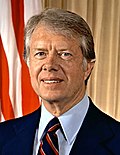
Jimmy Carter stands smiling in a shirt and tie in front of microphones.
Jimmy Carter supported a policy of blanket pardons for draft evaders during his 1976 presidential campaign.

Jimmy Carter supported the Vietnam War longer than most Democrats, maintaining his position until 1974, one year after the United States' involvement ended. He was open to support for draft evaders, as he felt that it was unfair for disproportionately poor men to be fighting in the war.[19] He did not support amnesty when he began campaigning in the 1976 presidential election, but he had his staff bring him literature on the issue.[11] Among the writing they brought him was the National Council for Universal and Unconditional Amnesty, the Congressional Fact-Sheet on Amnesty, Amex-Canada, Religious Statements on Amnesty, Americans for Amnesty's Update on National Amnesty Week, Amnesty Information Service's Amnesty Fact Sheet, transcripts of Congressional testimony, and media clips.[20] His adult sons also expressed to him their support for amnesty.[21]

Carter framed clemency for draft evaders as a practical solution to reduce Vietnam-era tensions, rather than one of ideological principle.[21][22] He also wanted draft evaders to be able to participate in society without fear of prosecution,[23] describing the years in exile as "adequate punishment".[18] Carter called it the "single hardest decision" of his campaign.[11] He opposed clemency for deserters on the basis that leaving active military service endangered the lives of other soldiers.[24]

To avoid the strong connotations associated with the term amnesty, Carter described his policy as blanket pardons, which he specified would come without judgement or comment.[25] Amnesty was seen as implying validation or acceptance of the anti-war movement, while pardons were seen as forgiveness toward draft evaders without condoning any motive for evading the draft. Carter emphasized these definitions while campaigning to seek approval of blanket pardons.[26] McGovern's campaign four years earlier had been derided as "amnesty, abortion, and acid", and Carter wished to avoid a repeat of this.[27] Carter paid less attention to the issue of amnesty after receiving the Democratic Party nomination, as his polling showed it was not a major issue.[28] His opponent Ford was against further clemency,[27] but Ford's own unsuccessful clemency program disincentivized him from raising the issue against Carter.[28] Carter won the presidential election, and there were questions about whether he would pardon deserters along with draft evaders. His younger advisors supported pardons for deserters, while the advisors closer to his own age warned against it.[29]

Executive order

[edit]

Carter signed Proclamation 4483 on January 21, 1977, his first full day in office.[8] It was implemented through Executive Order 11967,[8] the first executive order to be issued by Carter.[22] The pardons applied to all draft evaders regardless of whether they were convicted,[8] and unlike the clemency program implemented by Ford, it did not mandate any conditions to be eligible for the pardon.[30] It did not apply to people who deserted, committed acts of violence while protesting, or received a less-than-honorable discharge.[8]

Proclamation 4483 applied to those who "violated the Military Selective Service Act by draft-evasion acts or omissions committed between August 4, 1964 and March 28, 1973".[31] Approximately 265,650 Americans were pardoned in some form. Most of these, about 250,000, were people who had never registered for the draft. There were 7,150 convicted draft evaders who received pardons, joining the 1,600 who had already been pardoned under Ford's program, and cases were dropped for another 3,500 people being prosecuted for draft evasion. Seven were released from prison by the proclamation. Another 5,000 people who had left the country were permitted to visit through relaxed immigration laws.[32] It was limited to offenses against the Selective Service Act and did not affect the Uniform Code of Military Justice, which includes desertion.[23] It also did not restore citizenship for those who lost it after fleeing to another country to avoid service.[33]

Aftermath

[edit]

Congress made efforts to restrict funding for anything related to processing the pardons.[34] The Veterans of Foreign Wars was among the veterans' groups that criticized the proclamation, saying that it would be preferable for draft evaders to return to the United States through the justice system.[22] Barry Goldwater, a supporter of the Vietnam War, referred to the proclamation as "the most disgraceful thing that a president has ever done".[8] Many pro-amnesty groups celebrated the pardons as an improvement.[35] Others accused Carter of protecting predominantly middle-class draft evaders while ignoring the needs of the predominantly poorer Americans who had deserted after conscription.[8][36] The American Veterans Committee held this position, saying that both desertion and less-than-honorable discharges should be pardoned.[31] The proclamation was positively received by the Soviet Communist Party newspaper Pravda, which declared that the United States had admitted fault.[35]

Carter expanded his offer of clemency in March 1977 by letting veterans with less-than-honorable discharges appeal their status. Although sixty percent of appeals were accepted, only nine percent of eligible veterans appealed. Deserters were included in the offer, but they were required to surrender to a military base, so most were distrustful and did not accept.[37] Pro-amnesty senator Alan Cranston and anti-amnesty senator Strom Thurmond introduced a bill together that would make veterans with appealed discharges ineligible for veterans' benefits. Carter signed into law against the advice of his cabinet and top aides, fearing that a veto would go back on an agreement with Speaker of the House Tip O'Neill only for his veto to be overruled.[34]

By the time Proclamation 4483 was issued, prosecution and prison sentences for draft evaders had mostly come to an end, and the Department of Justice received only 99 requests for pardon certificates in the first six months. Those who left the country had already settled elsewhere, and only 85 returned in the same time frame.[38] After the Soviet Invasion of Afghanistan in 1979, Carter restored the requirement that men register for a draft.[39]

Carter's decision to issue pardons despite political backlash signaled the style of politics he practiced, in which he was willing to make decisions without the support of Congress or the American public.[40] The decision had a significant effect on his presidential legacy for both supporters and critics.[31] Carter rarely spoke publicly about the pardons in his post-presidential life,[39] though he stood by the decision to issue them, saying that it was an extension of Ford's clemency program and it was "the right thing to do".[31]

Notes

[edit]

References

[edit]
Revisions and contributorsEdit on WikipediaRead on Wikipedia
from Grokipedia
Proclamation 4483 was a presidential proclamation issued by Jimmy Carter on January 21, 1977, granting a full, complete, and unconditional pardon to individuals who committed nonviolent offenses under the Military Selective Service Act through draft-evasion acts or omissions between August 4, 1964, and March 28, 1973.[1][2] This measure, enacted on Carter's first full day as president, targeted an estimated 100,000 to 200,000 draft evaders, many of whom had fled to Canada or other countries to avoid conscription during the Vietnam War.[3] The proclamation, accompanied by Executive Order 11967 establishing an administrative process for pardon certificates, sought to reconcile national divisions by restoring civil rights and clearing records for eligible individuals, though it explicitly excluded military deserters, those who failed to report for induction after receiving orders, and persons convicted of violent crimes or other unrelated offenses.[2][1] While praised by anti-war advocates for promoting healing, it drew sharp criticism from veterans' organizations and military families, who argued it dishonored those who served and failed to address deserters, estimated at over 500,000, leaving a perception of inequity in clemency.[4][5] Empirical data indicate limited uptake, with only about 20,000 to 30,000 applications processed and fewer than half of known exiles returning to the United States, reflecting ambivalence among beneficiaries toward the conditional nature of restored rights like federal employment eligibility but not full veteran benefits equivalence.[6][7]

Historical Context

Vietnam War Conscription System

The Selective Service System administered conscription for the Vietnam War under the authority of the Military Selective Service Act of 1967, which required all male U.S. citizens and male immigrants aged 18 to 26 to register for potential military service.[8] Local draft boards classified registrants into availability categories, including 1-A for those immediately eligible for induction, while deferments were granted for college students (2-S), married men with children (3-A), and medical or occupational disqualifications (4-F).[8] Draft calls escalated with U.S. military involvement in Vietnam, rising from 112,386 inductions in fiscal year 1964 to a peak of 382,010 in 1966, as troop levels in Southeast Asia grew from under 20,000 in 1964 to over 500,000 by 1968.[9] Prior to 1969, the order of induction followed a "college-qualified" sequence prioritizing younger registrants without deferments, which critics argued favored educated, affluent men able to secure student postponements, resulting in disproportionate burdens on working-class and minority communities. To address perceived unfairness, Congress amended the 1967 Act on November 26, 1969, establishing a random lottery system based on birth dates for men born between 1944 and 1950.[10] The first lottery drawing occurred on December 1, 1969, in Washington, D.C., where 366 blue capsules containing dates were manually drawn from a glass drum, assigning sequence numbers from 1 to 366; men with lower numbers (typically under 195 for the 1944 cohort) faced higher induction risk, with the process televised to promote transparency.[10] Subsequent lotteries covered later birth years, but calls declined after 1969 amid Vietnamization and anti-war protests. From August 1964 to February 1973, the Selective Service inducted 1,857,304 men into the armed forces, primarily the Army, out of approximately 27 million eligible males during the era.[9][11] The final draft call occurred on December 7, 1972, with induction authority lapsing on June 30, 1973, after which the U.S. transitioned to an all-volunteer force.[10] This system prompted widespread resistance, including over 200,000 documented draft evasion cases, as registrants sought alternatives to combat deployment amid rising casualties and domestic opposition to the war.

Scale and Methods of Draft Evasion

During the Vietnam War era (1964–1973), draft evasion encompassed both legal deferments and illegal avoidance of Selective Service obligations, with the latter affecting an estimated 210,000 individuals investigated by the U.S. Department of Justice for violations such as failure to register, report for induction, or comply with classification orders.[12] Broader estimates suggest up to 600,000 men illegally evaded the draft through non-compliance, though many cases went unprosecuted due to resource constraints and policy shifts toward leniency by the early 1970s.[13] Only about 3,250 convictions for draft offenses occurred between 1965 and 1973, reflecting selective enforcement amid overwhelming caseloads and public opposition to the war.[14] These figures contrast with the 1.857 million inductions under the Selective Service System, highlighting evasion's impact on recruitment amid a pool of roughly 27 million draft-eligible men aged 18–26.[9] Illegal methods predominated among prosecuted evaders and included outright refusal to report for induction or physical examinations, which accounted for the majority of Justice Department referrals.[12] Many evaders destroyed or publicly burned their draft cards in acts of civil disobedience, with over 150 such incidents reported by 1965, prompting Congress to criminalize the practice via the 1965 amendment to the Universal Military Training and Service Act.[15] Fleeing to Canada emerged as a prominent tactic, with U.S. officials estimating 40,000 to 70,000 draft dodgers and deserters relocating there by 1972, often via informal networks providing guidance on border crossing and false identities.[14] Other evasion strategies involved fabricating disqualifications, such as claiming conscientious objector (CO) status under Selective Service classification I-O, though approval rates hovered below 20% due to stringent requirements for demonstrated pacifism predating the war.[16] Medical deferments were sought by exaggerating conditions like psychiatric disorders, homosexuality (disqualifying under military standards until 2011), or physical ailments (e.g., obesity or hearing loss), with draft boards examining over 1 million such claims annually by the late 1960s.[17] Some evaders lived "underground" domestically, using aliases or relocating to avoid detection, contributing to an undetermined number of unresolved cases estimated at 150,000 to 200,000 by Ford administration analyses.[18] While legal deferments—such as student (II-S), occupational (II-A), or paternal (III-A)—shielded millions and were criticized for class biases favoring educated or affluent men, these blurred into evasion when manipulated (e.g., strategic enrollments in substandard colleges or sudden fatherhood post-lottery).[17] Joining the National Guard or Reserves served as a quasi-legal workaround, enlisting over 1 million men by 1970 to preempt active-duty drafts, though slots were limited and politically influenced.[11] Organized resistance groups, like the Catholic Worker Movement or Clergy and Laymen Concerned About Vietnam, provided counseling on these tactics, amplifying evasion through seminars and legal aid that reached thousands.[19] Overall, evasion reflected causal factors including war unpopularity, perceived inequities in the lottery system introduced in 1969, and moral opposition, rather than mere opportunism.[16]

Preceding Pardon Efforts

Gerald Ford's 1974 Clemency Program

On September 16, 1974, President Gerald Ford issued Proclamation 4313, establishing a conditional clemency program for Vietnam-era draft evaders and military deserters who had not yet been prosecuted or convicted.[20] The initiative required eligible individuals to return to the United States voluntarily, affirm their allegiance to the country through an oath expressing remorse for their actions, and complete a period of alternative public service—typically ranging from 12 to 24 months—as assigned by the Presidential Clemency Board.[21] This service could include work with charitable organizations, conservation projects, or community health efforts, with the duration determined based on the severity of the offense and individual circumstances.[22] The program was implemented through Executive Order 11803, signed the same day, which created the nine-member Presidential Clemency Board—chaired by Charles Colson, a former Nixon aide—to review applications, recommend service terms, and oversee discharges.[23] Ford estimated around 50,000 deserters and 12,000 draft evaders remained in exile or under indictment, though actual figures were uncertain due to incomplete records; the program targeted those who had fled to avoid service during the 1964–1973 Vietnam conflict period.[24] Convicted offenders were ineligible for this clemency but could apply for standard presidential pardons, while non-indicted individuals in jeopardy of prosecution were encouraged to participate to clear their status.[25] Upon successful completion, participants received a Certificate of Satisfactory Service in lieu of a full pardon, which did not restore full civil rights like voting or jury service in all cases and carried no guarantee of honorable military discharge equivalence.[22] Participation proved limited, with approximately 22,000 applications filed with the Clemency Board by early 1975, representing a small fraction of the estimated 125,000 potentially eligible individuals.[26] Only about 6,000 to 13,000 clemency discharges were ultimately granted, as many applicants either withdrew due to the rigorous service requirements or faced delays in board processing; the program closed on January 20, 1975, with the end of Ford's initial term considerations, though some cases lingered.[22] Critics, including veterans' groups, argued the conditional terms undermined military honor without equating to true amnesty, while Ford defended it as a balanced step toward national reconciliation without blanket forgiveness.[24] The low uptake highlighted divisions over Vietnam accountability, setting the stage for subsequent full pardon discussions.[27]

Issuance and Provisions

Jimmy Carter's Campaign Commitment

During his 1976 presidential campaign, Jimmy Carter promised to issue an unconditional pardon to those who evaded the Vietnam War draft, positioning the action as essential for healing national divisions stemming from the conflict.[6] This commitment differentiated draft evaders—civilian violators of the Selective Service Act—from military deserters, whom Carter stated should face military justice rather than presidential clemency.[28] He articulated a preference for pardon over the limited clemency program implemented by President Gerald Ford in 1974, arguing in a Newsweek interview that a full pardon better addressed the underlying injustices perceived by evaders.[29] Carter's pledge emerged amid ongoing debates over Vietnam-era amnesty, with the candidate framing it as a moral imperative to restore unity without excusing service in an unpopular war.[30] Public statements, including during a February 1976 visit to Seattle, highlighted the promise but also sparked immediate controversy, as audiences there expressed anger over perceived leniency toward lawbreakers.[31] Despite such backlash, the commitment aligned with Carter's campaign theme of ethical governance and was reiterated in platforms like the Democratic nominee's policy outlines, which listed pardoning draft evaders as a key initiative.[32] The promise contributed to Carter's appeal among younger voters and anti-war constituencies, though it alienated segments of the military and conservative base, foreshadowing post-election criticisms.[5] By election day on November 2, 1976, the pledge had become a defining element of his platform on Vietnam reconciliation, ultimately fulfilled through Proclamation 4483 shortly after his inauguration.[33]

Details of Proclamation 4483

Proclamation 4483 was issued by President Jimmy Carter on January 21, 1977, his first full day in office, under the authority of Article II, Section 2 of the U.S. Constitution, which empowers the president to grant pardons for offenses against the United States except in cases of impeachment.[2] The proclamation granted a full, complete, and unconditional pardon to all persons who committed any offense in violation of the Military Selective Service Act (MSSA) or regulations promulgated pursuant thereto between August 4, 1964—the date of the Gulf of Tonkin Resolution marking the escalation of U.S. involvement in Vietnam—and March 28, 1973, the date by which the last draft registrations were processed before the all-volunteer force transition.[2] [1] The pardon's scope encompassed draft evasion acts or omissions, such as failure to register for the draft, failure to report for induction or examination, or other non-compliance with Selective Service obligations during the specified period, whether the individuals had been convicted, indicted, or simply evaded detection.[2] It restored to the pardoned individuals all political, civil, and other rights forfeited due to conviction or status as fugitives from such offenses, effectively clearing criminal records related solely to these violations and allowing reintegration into society without legal impediments from draft-related charges.[2] The pardon applied retroactively and unconditionally, without requiring individual applications for forgiveness, though later administrative processes under the Department of Justice provided for certificates of pardon to document the relief for purposes like employment or passport applications. Explicit exclusions limited the proclamation's reach: it did not extend to offenses involving the use of force or violence against persons or property, nor to violations committed by agents, officers, or employees of the Selective Service System in connection with their official duties.[2] This distinction ensured that acts of resistance escalating to criminal violence or internal corruption within the draft administration remained prosecutable. The proclamation took effect immediately upon Carter's signature on January 21, 1977, and was published in the Federal Register on January 24, 1977.[2] Notably, it addressed civilian draft evaders but excluded military deserters, whose cases were handled separately through an accompanying executive order requiring application for clemency.[1]

Accompanying Executive Order 11967

Executive Order 11967, issued by President Jimmy Carter on January 21, 1977, provided the administrative framework for implementing Proclamation 4483 by addressing violations of the Military Selective Service Act from August 4, 1964, to March 28, 1973.[34] [35] The order directed the Attorney General to dismiss all pending indictments related to these violations, except in cases involving serious acts of force or violence or offenses committed by agents or employees of the Selective Service System.[34] It further required the termination of any ongoing investigations into such matters and prohibited the initiation of new ones, subject to the same exceptions.[34] The executive order also facilitated the reentry of affected individuals into the United States who had been barred due to Selective Service violations, permitting them to return under terms applicable to other aliens while excluding the specified exceptional cases.[34] Additionally, it extended full pardon relief to those who had previously received partial clemency under President Gerald Ford's Executive Order 11803 and Proclamation 4313, provided they qualified under the new criteria.[34] Published in the Federal Register on January 24, 1977 (42 FR 4393), the order ensured coordinated federal action to execute the pardon without further prosecutorial pursuit in eligible instances.[35]

Implementation Process

Eligibility Criteria and Application Procedure

Proclamation 4483 applied to individuals who violated the Military Selective Service Act (MSSA) between August 4, 1964, and March 28, 1973, encompassing acts or omissions of draft evasion such as failure to register, report for induction, or comply with classification orders.[2][1] Eligibility extended to both those convicted of such offenses and those who may have committed them but faced no charges, provided the violations did not involve the use of force or violence against persons or property, nor were perpetrated by Selective Service System officials or employees in the course of their duties.[2][36] The pardon did not cover military deserters or those absent without leave, distinguishing it from prior efforts like Gerald Ford's clemency program.[36] The pardon was unconditional and self-executing, requiring no formal application from eligible individuals for its legal effect.[36] Executive Order 11967 directed the Attorney General to administratively implement it by dismissing all pending indictments and prosecutions (except those involving excluded violent acts or SSS personnel misconduct), recalling outstanding warrants, terminating investigations, and halting new ones related to covered offenses.[36] For non-citizens or exiles abroad, the order facilitated reentry into the United States under immigration parole provisions, excluding those in excepted categories.[36] To document the pardon for practical purposes, such as clearing criminal records for employment or licensing, affected individuals could request a Certificate of Pardon from the Office of the Pardon Attorney at the Department of Justice.[37] Requests required a written application including the individual's full name, date and place of birth, Social Security number (if available), and details of the Selective Service violation, with no fee or extensive documentation needed beyond self-identification.[37] Certificates were issued upon verification against records, aiding in expungement or correction of Selective Service files, though the pardon itself did not automatically upgrade military-related discharges or address state-level convictions.[37][36]

Actual Participation and Outcomes

Approximately 100,000 draft evaders had fled the United States during the Vietnam War era, primarily to Canada, where they established lives amid a receptive political and social environment. Following the issuance of Proclamation 4483, only about 50,000 of these exiles returned to the U.S., indicating limited participation among those abroad despite the removal of legal impediments to reentry. The program's structure under Executive Order 11967 required applicants to submit forms to the Department of Justice attesting to their violations of the Military Selective Service Act, after which certificates evidencing the pardon were issued to facilitate practical benefits like passport renewal or employment clearance. Government records identified 209,517 men formally accused of draft violations, with an additional estimated 360,000 evaders never charged, yielding a potential pool exceeding 500,000 eligible individuals.[33] However, comprehensive data on total certificate applications remains sparse, as many domestic evaders encountered no ongoing legal restrictions and thus saw little need to engage the process, while others harbored skepticism toward federal authorities. Initial processing in early 1977 affected around 10,000 cases immediately, primarily those with pending indictments or convictions, clearing records for approximately 9,000 who had been found guilty or pleaded guilty.[38] The outcomes emphasized selective reintegration: applicants received unconditional pardons without further penalties, restoring civil rights and eligibility for federal benefits, but the exclusion of military deserters—estimated at nearly 100,000 who absconded after enlistment or induction—left their status unresolved pending separate administrative reviews.[6] Low overall participation relative to the eligible population reflected both the pardon’s focus on nonviolent Selective Service offenses and the reality that evasion methods often avoided formal prosecution, minimizing post-war repercussions for many. No widespread denials occurred for eligible draft evaders, as the proclamation applied blanket clemency, though administrative hurdles and non-participation constrained broader societal healing effects.[1]

Contemporary Reactions

Support from Anti-War and Progressive Groups

Anti-war organizations and progressive advocacy groups, which had long campaigned against the Vietnam War and for amnesty for draft resisters, generally welcomed Proclamation 4483 as a step toward reconciliation and validation of conscientious objection. The National Council for Universal, Unconditional Amnesty (NCUUA), a coalition formed in the mid-1970s that included the American Civil Liberties Union (ACLU), War Resisters League (WRL), Women Strike for Peace, Vietnam Veterans Against the War (VVAW), and the National Council of Churches, had organized protests, conferences, and petitions urging broad pardons for draft evaders and deserters.[39] These efforts, including a 1974 international conference in Toronto hosted by exiles and VVAW, pressured candidates like Carter during the 1976 election to address the estimated 210,000 draft evaders and thousands of deserters.[39] Upon issuance of the proclamation on January 21, 1977, groups within the NCUUA celebrated it as enabling resisters to return and reintegrate without felony convictions, viewing it as partial fulfillment of their demands for healing the societal rifts caused by the war.[39] The WRL and VVAW, in particular, highlighted the pardon's role in acknowledging the moral stand against an unjust war, with activists noting it allowed approximately 100,000 eligible individuals to apply for relief from Selective Service violations dating from August 4, 1964, to March 28, 1973.[39] [1] The American Veterans Committee, a progressive veterans' organization, praised the move for promoting national unity but advocated expansion to include deserters, arguing they represented disproportionately minority and disadvantaged groups excluded from the pardon.[30] This support reflected broader anti-war sentiment that had urged pardons since the war's end, seeing Proclamation 4483 as a culmination of grassroots organizing rather than mere executive clemency, though some activists critiqued its limitations by not covering military deserters or less-than-honorable discharges.[30] [39] Overall, these groups framed the pardon as a pragmatic acknowledgment of draft resistance's legitimacy, aiding the return of exiles from Canada, Sweden, and elsewhere where up to 30,000 Americans had fled to avoid conscription.[30]

Criticisms from Veterans, Military, and Conservatives

Veterans' organizations vehemently opposed Proclamation 4483, perceiving it as a betrayal of those who served despite the war's unpopularity. The American Legion's National Security Commission director, Michael Schlee, declared that the group "deeply regrets and protests" the pardon, asserting it was divisive rather than healing.[40] This stance built on earlier backlash, as in August 1976, when Jimmy Carter faced boos from hundreds of Legion members at their national convention after pledging to issue such pardons.[41] Similarly, Veterans of Foreign Wars chapters and other military advocacy groups criticized the measure for equating draft evaders with honorable service members, with some expelling internal supporters of amnesty to maintain organizational solidarity against perceived unpatriotic leniency.[5][6] Conservative politicians amplified these military critiques, framing the proclamation as an erosion of accountability and respect for duty. Arizona Senator Barry Goldwater labeled it "the most disgraceful thing a president has ever done," arguing it dishonored the sacrifices of Vietnam combatants.[42] The Republican National Committee echoed this, describing the pardon as a "slap in the face to all those Americans and their families who did their duty" amid the war's hardships.[40] Kansas Senator Bob Dole, Carter's 1976 vice-presidential debate opponent, opposed blanket amnesty as overly permissive, contending it undermined legal obligations without requiring contrition or alternative service.[5] Broader conservative commentary highlighted the pardon's failure to address deserters—estimated at over 20,000—who fled after enlisting, unlike the roughly 10,000 draft evaders covered, and viewed it as prioritizing political reconciliation over justice for the war's 58,220 American fatalities.[43][30] Critics within these circles argued the policy implicitly validated evasion as a moral equivalent to service, exacerbating resentment among those who endured combat, captivity, or post-war societal stigma without equivalent forgiveness.[6]

Aftermath and Legacy

Short-Term Societal and Political Effects

The proclamation triggered swift political opposition from conservative figures and veterans' groups, who argued it dishonored those who served in Vietnam and signaled weakness in national defense. Organizations like the Veterans of Foreign Wars and American Legion issued statements decrying the blanket pardon as an injustice to combat veterans, with some leaders calling for congressional oversight or reversal.[5] [40] This backlash contributed to early criticisms of Carter's administration as overly conciliatory toward anti-war elements, though it fulfilled a key campaign pledge that had garnered support from progressive Democrats during the 1976 election.[33] Societally, the amnesty prompted limited immediate repatriation, as many of the estimated 100,000 draft evaders who had fled abroad—primarily to Canada and Sweden—had integrated into local communities and showed reluctance to return despite the removal of legal barriers.[7] Official reports indicated only a few hundred applications processed in the first weeks, with broader data later revealing that roughly half of exiles ultimately remained overseas rather than seeking reintegration.[44] Public reactions ranged from relief among affected families to widespread resentment among the broader populace, exacerbating lingering Vietnam-era divisions without achieving Carter's stated goal of rapid national reconciliation.[40]

Long-Term Evaluations and Debates

Over decades, evaluations of Proclamation 4483 have highlighted its limited success in fostering national reconciliation after the Vietnam War. While intended to address "unfinished business" by allowing draft evaders to reintegrate without legal penalties, the pardon failed to bridge divides between those who served and those who evaded, with many veterans perceiving it as an inequitable absolution that overlooked their sacrifices.[5] Studies and analyses indicate persistent resentment among military communities, contributing to a narrative where evaders received clemency without equivalent public service or accountability, unlike proposals for conditional amnesty under prior administrations.[29] This tension endured, as evidenced by ongoing discussions in military policy reviews framing the pardon as exacerbating post-war societal fractures rather than resolving them.[45] Empirical data on outcomes reveal modest reintegration effects. Of approximately 100,000 draft evaders estimated to have fled to Canada, only about 4,000 to 5,000 returned following the pardon, with roughly half of exiles overall choosing repatriation to rebuild lives in the U.S.[7] Returnees regained rights such as voting and federal employment eligibility, but many encountered enduring social stigma and employment barriers from private sectors wary of their records, limiting broader societal healing.[44] Long-term scholarly assessments note that the policy affected fewer than 10,000 immediate cases initially, with deferred actions for tens of thousands abroad, underscoring its narrow scope and failure to encompass deserters, whose discharges remained upgraded only through separate reviews.[38] Debates center on the pardon’s implications for legal accountability and military ethos. Critics, particularly from conservative and veteran circles, contend it undermined respect for lawful authority by granting unconditional relief without reparative measures, potentially signaling to future generations that draft resistance carries no enduring cost—a view echoed in analyses of its role in perpetuating Vietnam-era moral ambiguities.[5] Supporters, including anti-war advocates, argue it exemplified merciful leadership essential for closure, enabling personal redemption amid a war widely critiqued for its strategic flaws, though empirical evidence of reduced recidivism or enhanced civic participation remains anecdotal rather than robust.[39] These contrasting perspectives persist in policy discourse, with some framing the legacy as a precedent for executive clemency in divisive conflicts, while others highlight its exclusion of active-duty deserters as evidence of incomplete justice, leaving unresolved inequities in military records that affected benefits for decades.[29]

References

User Avatar
No comments yet.