



Community hub
Recent from talks
Knowledge base stats:
Talk channels stats:
Members stats:
Psittacosaurus
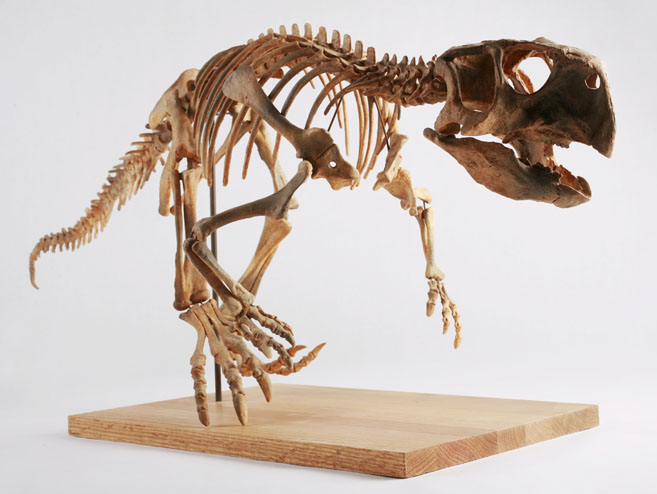
Psittacosaurus (/ˌsɪtəkəˈsɔːrəs/ SIT-ə-kə-SOR-əs; "parrot lizard") is a genus of extinct ceratopsian dinosaur from the Early Cretaceous of what is now Asia, existing between 125 and 105 million years ago. It is notable for being the most species-rich non-avian dinosaur genus. Up to 13 species are known, from across China, Mongolia, Russia, and Thailand. The species of Psittacosaurus were obligate bipeds at adulthood, with a high skull and a robust beak. One individual was found preserved with long filaments on the tail, similar to those of Tianyulong. Psittacosaurus probably had complex behaviours, based on the proportions and relative size of the brain. It may have been active for short periods of time during the day and night, and had well-developed senses of smell and vision.
Psittacosaurus was one of the earliest ceratopsians, but closer to Triceratops than Yinlong. Once in its own family, Psittacosauridae, with other genera like Hongshanosaurus, it is now considered to be senior synonym of the latter and an early offshoot of the branch that led to more derived forms. The genera closely related to Psittacosaurus are all from Asia, with the exception of Aquilops, from North America. The first species was either P. lujiatunensis or closely related, and it may have given rise to later forms of Psittacosaurus.
Psittacosaurus is one of the most completely known dinosaur genera. Fossils of hundreds of individuals have been collected so far, including many complete skeletons. Most age classes are represented, from hatchling through to adult, which has allowed several detailed studies of Psittacosaurus growth rates and reproductive biology. The abundance of this dinosaur in the fossil record has led to the labelling of Lower Cretaceous sediments of east Asia the Psittacosaurus biochron.
In 1922, American paleontologist Henry Fairfield Osborn took part in the Third Asiatic Expedition of the American Museum of Natural History to discover fossils and geologic formations from the Cretaceous and Tertiary of Mongolia. In the Oshih Formation of the Artsa Bogdo Basin, Wong, the Mongolian chauffeur, discovered a nearly complete skull, jaws, and skeleton of a dinosaur, which was given the nickname of "Red Mesa skeleton". The location of discovery is also known as the Oshih locality of the Khukhtek Formation, of Early Cretaceous Aptian to Albian age. The specimen, catalogued as AMNH 6254, was described in 1924 by Osborn, only partially prepared, who gave it the name Psittacosaurus mongoliensis, describing its parrot-like beak on the suggestion of fellow American paleontologist William King Gregory. Osborn demonstrated the taxon was unique based on the short and deep snout, and the broad rear skull, as well as by lacking teeth in the premaxilla. In the same paper, Osborn also described another new taxon he considered similar to Psittacosaurus, Protiguanodon mongoliense, which was found in the same expedition but from the Ondai Sair Formation. The holotype of Protiguanodon, AMNH 6253, included a nearly complete skeleton found articulated, and partial remains of the skull. While Osborn considered Protiguanodon and Psittacosaurus separate based on the lack of horns on the jugal bones in Protiguanodon, a general dissimilarity in the skeletons, and wide geographic separation of the two specimens, Gregory suggested in correspondence that the Protiguanodon specimen could represent a juvenile of Psittacosaurus, based on similarities in size, the parietal bones, and the quadrate bones. Osborn created the new family Psittacosauridae for Psittacosaurus, which he considered possibly related to Ankylosauria, while he placed Protiguanodon within the family Iguanodontidae as the only member of the new subfamily Protiguanodontinae.
Osborn published an additional description of the specimens of Protiguanodon and Psittacosaurus in 1924, citing his previous study as naming both to be members of Psittacosauridae, and considering the separate status of Protiguanodontinae as uncertain. Further preparation of the skeleton of AMNH 6254 showed significant similarities in the skeletons of Psittacosaurus and Protiguanodon, including the number of teeth, the number of pre-caudal vertebrae, and other details of the skull and skeleton. Osborn also referred the specimen AMNH 6261 from the Oshih Formation to Psittacosaurus, so the teeth of the two taxa could be compared. It was mentioned in 1932 by American paleontologist Roy Chapman Andrews that AMHN 6254 was the only good specimen that could be found at Oshih, with only one additional skull and jaws of an adult, and two hatchling skulls, having been found in a later revisit to the locality in 1923.
Following the discovery of material of psittacosaurids in Haratologay in Inner Mongolia, Yang Zhongjian described two additional species in 1932. Known from a crushed skull and fragmentary lower jaw, Young named Psittacosaurus osborni, distinguished by its small size and lack of a sagittal crest on the parietal. The second species, P. tingi, was named for partial lower jaws and teeth, which Young only tentatively referred to Psittacosaurus instead of Protiguanodon. Both specimens, stored in the Institute of Vertebrate Paleontology and Paleoanthropology as IVPP RV31039 and IVPP RV31040 respectively, come from the Xinpongnaobao Formation. An additional tooth, partial hand, and fragments of vertebrae and limbs were found in the same locality, with the tooth being referred to Protiguanodon and the remainder of the material being uncertain. Additional Psittacosaurus material from possibly the same locality was described later in 1953 by Birger Bohlin, who considered the remains to likely belong to P. mongoliensis.
The Soviet Expeditions into Mongolia from 1946 to 1949 uncovered more material of Psittacosaurus. In 1946 they discovered a new locality, Ulan Osh, where a disarticulated specimen of Psittacosaurus mongoliensis was found, and in 1948 they revisited the sites of the American expeditions and excavated fragmentary postcrania from Oshih and Ondai Sair. The material from these expeditions was taken to the Paleontological Institute of Moscow. Soviet excavations near Kemerovo in Siberia also discovered a partial skull and skeleton of multiple individuals referrable to Psittacosaurus. This material was described by Soviet paleontologist Anatoly Rozhdestvensky in 1955, who also proposed that Protiguanodon mongoliense, Psittacosaurus osborni, and Psittacosaurus tingi were junior synonyms of Psittacosaurus mongoliensis.
In 1958, Yang published a paper on the dinosaurs of Laiyang, in which he described multiple discoveries of Psittacosaurus from a collection of localities of the Qingshan Formation. Of this material, the nearly complete skeleton and skull IVPP V738 was described as the type of the new species Psittacosaurus sinensis, which was found in a red layer 10 mi (16 km) northwest of Rongyang City in Shandong. Yang also assigned 11 other specimens to the taxon, considering it to be the most diverse Psittacosaurus species known at the time. It was distinguished from the other known species by a shorter and wider snout, and an overall smaller size at 675 mm (26.6 in). Yang also revised the classifications of the other species of Psittacosaurus. Following similar conclusions to Rozhdestvensky, Yang considered Protiguanodon to be a junior synonym of Psittacosaurus, but retained the species as separate giving former Protiguanodon mongoliense the new species name Psittacosaurus protiguanodonensis, as otherwise both it and Psittacosaurus mongoliensis would have the same species name. Contrasting Rozhdestvensky, Yang retained the earlier Chinese species P. osborni and P. tingi as separate from P. mongoliensis, but not separate from each other, making P. tingi a junior synonym of P. osborni. Following his new breakdown of species, Yang described the distribution of the genus Psittacosaurus: P. sinensis was the only species known from Shandong; P. osborni and possibly P. mongoliensis were both known from Haratologay (also known as Tebch); P. mongoliensis and P. protiguanodonensis were both known form Oshih; and P. mongoliensis was possibly known from Kemerovo.
Hub AI
Psittacosaurus AI simulator
(@Psittacosaurus_simulator)
Psittacosaurus
Psittacosaurus (/ˌsɪtəkəˈsɔːrəs/ SIT-ə-kə-SOR-əs; "parrot lizard") is a genus of extinct ceratopsian dinosaur from the Early Cretaceous of what is now Asia, existing between 125 and 105 million years ago. It is notable for being the most species-rich non-avian dinosaur genus. Up to 13 species are known, from across China, Mongolia, Russia, and Thailand. The species of Psittacosaurus were obligate bipeds at adulthood, with a high skull and a robust beak. One individual was found preserved with long filaments on the tail, similar to those of Tianyulong. Psittacosaurus probably had complex behaviours, based on the proportions and relative size of the brain. It may have been active for short periods of time during the day and night, and had well-developed senses of smell and vision.
Psittacosaurus was one of the earliest ceratopsians, but closer to Triceratops than Yinlong. Once in its own family, Psittacosauridae, with other genera like Hongshanosaurus, it is now considered to be senior synonym of the latter and an early offshoot of the branch that led to more derived forms. The genera closely related to Psittacosaurus are all from Asia, with the exception of Aquilops, from North America. The first species was either P. lujiatunensis or closely related, and it may have given rise to later forms of Psittacosaurus.
Psittacosaurus is one of the most completely known dinosaur genera. Fossils of hundreds of individuals have been collected so far, including many complete skeletons. Most age classes are represented, from hatchling through to adult, which has allowed several detailed studies of Psittacosaurus growth rates and reproductive biology. The abundance of this dinosaur in the fossil record has led to the labelling of Lower Cretaceous sediments of east Asia the Psittacosaurus biochron.
In 1922, American paleontologist Henry Fairfield Osborn took part in the Third Asiatic Expedition of the American Museum of Natural History to discover fossils and geologic formations from the Cretaceous and Tertiary of Mongolia. In the Oshih Formation of the Artsa Bogdo Basin, Wong, the Mongolian chauffeur, discovered a nearly complete skull, jaws, and skeleton of a dinosaur, which was given the nickname of "Red Mesa skeleton". The location of discovery is also known as the Oshih locality of the Khukhtek Formation, of Early Cretaceous Aptian to Albian age. The specimen, catalogued as AMNH 6254, was described in 1924 by Osborn, only partially prepared, who gave it the name Psittacosaurus mongoliensis, describing its parrot-like beak on the suggestion of fellow American paleontologist William King Gregory. Osborn demonstrated the taxon was unique based on the short and deep snout, and the broad rear skull, as well as by lacking teeth in the premaxilla. In the same paper, Osborn also described another new taxon he considered similar to Psittacosaurus, Protiguanodon mongoliense, which was found in the same expedition but from the Ondai Sair Formation. The holotype of Protiguanodon, AMNH 6253, included a nearly complete skeleton found articulated, and partial remains of the skull. While Osborn considered Protiguanodon and Psittacosaurus separate based on the lack of horns on the jugal bones in Protiguanodon, a general dissimilarity in the skeletons, and wide geographic separation of the two specimens, Gregory suggested in correspondence that the Protiguanodon specimen could represent a juvenile of Psittacosaurus, based on similarities in size, the parietal bones, and the quadrate bones. Osborn created the new family Psittacosauridae for Psittacosaurus, which he considered possibly related to Ankylosauria, while he placed Protiguanodon within the family Iguanodontidae as the only member of the new subfamily Protiguanodontinae.
Osborn published an additional description of the specimens of Protiguanodon and Psittacosaurus in 1924, citing his previous study as naming both to be members of Psittacosauridae, and considering the separate status of Protiguanodontinae as uncertain. Further preparation of the skeleton of AMNH 6254 showed significant similarities in the skeletons of Psittacosaurus and Protiguanodon, including the number of teeth, the number of pre-caudal vertebrae, and other details of the skull and skeleton. Osborn also referred the specimen AMNH 6261 from the Oshih Formation to Psittacosaurus, so the teeth of the two taxa could be compared. It was mentioned in 1932 by American paleontologist Roy Chapman Andrews that AMHN 6254 was the only good specimen that could be found at Oshih, with only one additional skull and jaws of an adult, and two hatchling skulls, having been found in a later revisit to the locality in 1923.
Following the discovery of material of psittacosaurids in Haratologay in Inner Mongolia, Yang Zhongjian described two additional species in 1932. Known from a crushed skull and fragmentary lower jaw, Young named Psittacosaurus osborni, distinguished by its small size and lack of a sagittal crest on the parietal. The second species, P. tingi, was named for partial lower jaws and teeth, which Young only tentatively referred to Psittacosaurus instead of Protiguanodon. Both specimens, stored in the Institute of Vertebrate Paleontology and Paleoanthropology as IVPP RV31039 and IVPP RV31040 respectively, come from the Xinpongnaobao Formation. An additional tooth, partial hand, and fragments of vertebrae and limbs were found in the same locality, with the tooth being referred to Protiguanodon and the remainder of the material being uncertain. Additional Psittacosaurus material from possibly the same locality was described later in 1953 by Birger Bohlin, who considered the remains to likely belong to P. mongoliensis.
The Soviet Expeditions into Mongolia from 1946 to 1949 uncovered more material of Psittacosaurus. In 1946 they discovered a new locality, Ulan Osh, where a disarticulated specimen of Psittacosaurus mongoliensis was found, and in 1948 they revisited the sites of the American expeditions and excavated fragmentary postcrania from Oshih and Ondai Sair. The material from these expeditions was taken to the Paleontological Institute of Moscow. Soviet excavations near Kemerovo in Siberia also discovered a partial skull and skeleton of multiple individuals referrable to Psittacosaurus. This material was described by Soviet paleontologist Anatoly Rozhdestvensky in 1955, who also proposed that Protiguanodon mongoliense, Psittacosaurus osborni, and Psittacosaurus tingi were junior synonyms of Psittacosaurus mongoliensis.
In 1958, Yang published a paper on the dinosaurs of Laiyang, in which he described multiple discoveries of Psittacosaurus from a collection of localities of the Qingshan Formation. Of this material, the nearly complete skeleton and skull IVPP V738 was described as the type of the new species Psittacosaurus sinensis, which was found in a red layer 10 mi (16 km) northwest of Rongyang City in Shandong. Yang also assigned 11 other specimens to the taxon, considering it to be the most diverse Psittacosaurus species known at the time. It was distinguished from the other known species by a shorter and wider snout, and an overall smaller size at 675 mm (26.6 in). Yang also revised the classifications of the other species of Psittacosaurus. Following similar conclusions to Rozhdestvensky, Yang considered Protiguanodon to be a junior synonym of Psittacosaurus, but retained the species as separate giving former Protiguanodon mongoliense the new species name Psittacosaurus protiguanodonensis, as otherwise both it and Psittacosaurus mongoliensis would have the same species name. Contrasting Rozhdestvensky, Yang retained the earlier Chinese species P. osborni and P. tingi as separate from P. mongoliensis, but not separate from each other, making P. tingi a junior synonym of P. osborni. Following his new breakdown of species, Yang described the distribution of the genus Psittacosaurus: P. sinensis was the only species known from Shandong; P. osborni and possibly P. mongoliensis were both known from Haratologay (also known as Tebch); P. mongoliensis and P. protiguanodonensis were both known form Oshih; and P. mongoliensis was possibly known from Kemerovo.