Hubbry Logo
search
logo
1933908

Purple fringing

logo
Community Hub0 Subscribers
Read side by side
from Wikipedia
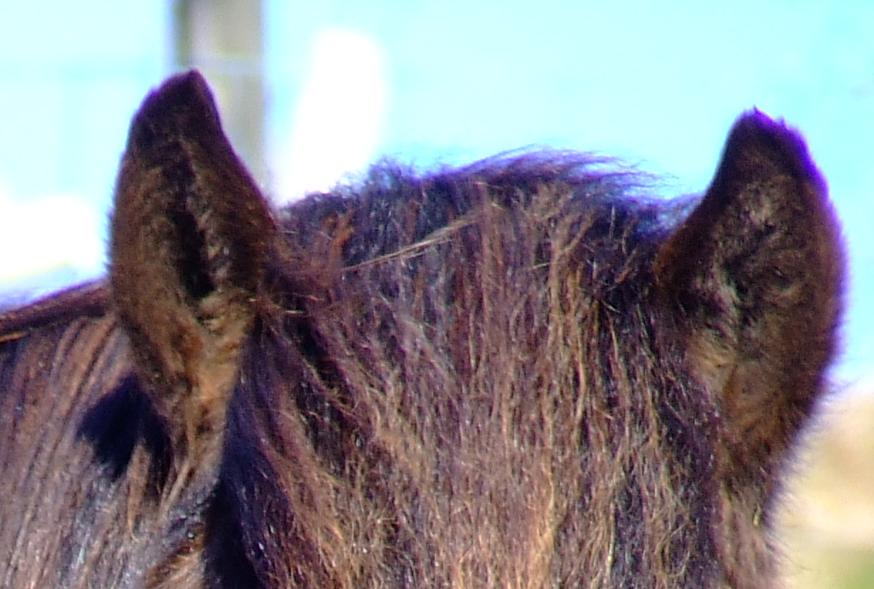
Severe purple fringing can be seen at the edges of the horse's forelock, mane, and ear.
A wider-view context of the above cropped image, from a Fujifilm FinePix S5200 camera.

In photography (particularly digital photography), purple fringing (sometimes called PF) is the term for an unfocused purple or magenta "ghost" image on a photograph. This optical aberration is generally most visible as a coloring and lightening of dark edges adjacent to bright areas of broad-spectrum illumination, such as daylight or various types of gas-discharge lamps.

Lenses in general exhibit axial chromatic aberration, in which different colors of light do not focus in the same plane. Normally, lens designs are optimized so that two or more (at least three for apochromatic lenses) wavelengths of light in the visible spectrum focus at the same plane. Wavelengths very different from those optimized in the design process may be severely out of focus while the reference colors are in focus; this axial chromatic aberration is usually severe at short wavelengths (violet). Lens performance may be poor for such wavelengths in other ways too, including an increase in flare due to anti-reflective coatings also being optimized for the expected wavelengths.

Most film has relatively low sensitivity to colors outside the visible range, so light spread in the near ultraviolet (UV) or near infrared (IR) rarely has a significant impact on the image recorded. However, image sensors used in digital cameras commonly are sensitive to a wider range of wavelengths.[citation needed] Although the lens glass itself filters out much of the UV light, and all digital cameras designed for color photography incorporate filters to reduce red and IR sensitivity,[citation needed] the chromatic aberration can be sufficient for unfocused violet light to tint nearby dark regions of the image.[citation needed] Bright cloudy or hazy skies are strong sources of scattered violet and UV light,[citation needed] so they tend to cause the problem.

The term purple fringe used to describe one aspect of chromatic aberration dates back to at least 1833.[1] However, Brewster's description with a purple fringe on one edge and a green fringe on the other is a lateral chromatic aberration. A general defocus of the shortest wavelengths resulting in a purple fringe on all sides of a bright object is the result of an axial or longitudinal chromatic aberration. Quite often, these effects are mixed in an image. Axial chromatic aberration is more subject to reduction by stopping down the lens than lateral chromatic aberration is, so the purple fringing can be very dependent on f-number: a larger f-number (smaller aperture) reduces axial aberration.

Other explanations

[edit]

Purple fringing is usually attributed to chromatic aberration as described above. Other attributed causes of purple fringing in digital photography include many hypothesized sensor effects:

  • Digital noise in dark areas
  • Image processing and interpolation artifacts (almost all CCDs and CMOS require considerable processing)
  • Stray ultraviolet and/or infrared light
  • Image bloom from overexposure of CCD sensor (not applied to CMOS)

Mitigations

[edit]

Commonly advocated methods of avoiding purple fringing include:

  • Avoid shooting with a lens at fast apertures in high contrast scenes
  • Avoid overexposing highlights (e.g. specular reflections and bright sky behind dark objects)
  • Shoot with a strong UV-cut filter[2]

Post-processing to remove purple fringing (or chromatic aberration in general) usually involves scaling the fringed colour channel, or subtracting some of a scaled version of the blue channel, or other blue-channel tricks.[3][4]

References

[edit]
Revisions and contributorsEdit on WikipediaRead on Wikipedia
from Grokipedia
Purple fringing, also known as purple haloing, is a common optical artifact in digital photography characterized by unwanted purple or magenta-colored fringes appearing along high-contrast edges in images, such as leaves against a bright sky or branches silhouetted by sunlight.[1] This phenomenon is a specific manifestation of chromatic aberration, where a lens fails to focus all wavelengths of light onto the same focal plane due to varying refractive indices for different colors, resulting in color misalignment on the image sensor.[2] It is most noticeable in high-contrast scenarios and can degrade image quality by creating distracting outlines that detract from sharpness and color accuracy.[3] The primary causes of purple fringing stem from lens design limitations, particularly in lateral (transverse) chromatic aberration, where shorter blue-violet wavelengths focus differently from longer red wavelengths, leading to purple edges on one side of objects.[1] Longitudinal (axial) chromatic aberration contributes as well, especially in out-of-focus areas or when shooting at wide apertures, causing color shifts in front of or behind the focal plane.[2] Factors exacerbating the issue include using wide-angle zoom lenses, backlighting, or post-processing adjustments like highlight recovery and increased saturation, which can amplify the fringes.[3] While modern lenses incorporate low-dispersion glass elements to minimize these effects, purple fringing remains prevalent in budget optics or challenging lighting conditions.[1] Correction of purple fringing is achievable through both preventive techniques and software editing. Photographers can mitigate it in-camera by stopping down the aperture (e.g., to f/5.6 or narrower), avoiding extreme wide angles, or selecting lenses with apochromatic designs that better correct for color dispersion.[2] In post-production, tools like Adobe Lightroom's "Remove Chromatic Aberration" feature or the Defringe sliders automatically detect and neutralize purple hues along edges, while manual adjustments in software such as Capture One target specific color channels for precise removal.[1][3] These methods restore image fidelity without significantly altering the overall composition.

Definition and Characteristics

Definition

Purple fringing is a specific type of chromatic aberration observed in digital photography, characterized by the appearance of purple or magenta-colored fringes along high-contrast edges in images, particularly at high-contrast edges where dark subjects are set against bright backgrounds.[1][4] This artifact arises when a lens fails to focus all wavelengths of light precisely onto the same point on the image sensor, resulting in color misalignment that manifests as unwanted colored outlines.[5] The phenomenon occurs due to the dispersion of light, where different colors (wavelengths) of the visible spectrum refract at slightly varying angles through the lens elements, causing them to converge at marginally different focal points on the sensor plane.[4][6] In digital images, this wavelength-dependent focusing leads to a separation of color channels, with the purple hue emerging prominently from the overlap or misalignment of red and blue light components at these edges.[1] While chromatic aberration in general can produce fringes of various colors such as green, red, or blue depending on the lens design and lighting conditions, purple fringing is distinguished by its characteristic magenta-purple tint, which is often exacerbated by interactions between the lens's optical properties and the sensor's color filter array, making it especially visible in scenarios involving strong specular highlights or overexposed areas.[5][4] This specific coloration sets it apart from broader chromatic effects, highlighting the role of digital sensor sensitivity in amplifying the artifact.[1]

Visual Appearance

Purple fringing appears as unwanted purple or magenta halos encircling the edges of high-contrast subjects in photographs, creating a noticeable color distortion that outlines objects unnaturally.[1] These halos are typically more pronounced around dark subjects against bright backgrounds, such as tree branches silhouetted against an overexposed sky, and can vary in shape from thin outlines to broader bleeds depending on the severity.[2] Unlike green or blue fringing associated with other forms of chromatic aberration, purple fringing often exhibits an asymmetric quality, appearing stronger or more intense on one side of the edge due to uneven light dispersion.[4] The intensity of purple fringing is heavily influenced by high contrast ratios, particularly in scenes involving specular highlights on foliage, buildings, or metallic surfaces like chrome car parts against a clear sky.[1] Overexposure in highlight areas exacerbates the effect, leading to mild halos in moderately contrasted images or pronounced color bleeding in extreme cases, where the purple tint visibly encroaches into adjacent tones.[2] This artifact can be more prominent in uncorrected RAW files, while many cameras apply in-camera corrections to reduce it in JPEGs; RAW files retain unprocessed sensor data that allows for easier post-adjustment.[7] To identify purple fringing, photographers can inspect high-contrast boundaries for unnatural magenta edges, especially in wide-angle lens shots where the effect can worsen due to increased aberrations; for instance, sunlight filtering through leaves may show subtle purple rims on the brighter side, escalating to bold outlines in backlit scenarios.[4] Severity levels range from barely perceptible tinges in well-exposed images to distracting artifacts that degrade overall image quality, often most evident when viewing at 100% magnification.[1]

Causes

Optical Aberrations

Purple fringing in photography arises from chromatic aberrations in lens design, including both lateral (transverse) and longitudinal (axial) types, where different wavelengths of light fail to focus precisely on the same plane or position, resulting in color misalignment on the image sensor.[8][2] Lateral chromatic aberration causes color fringing due to varying image magnifications for different wavelengths, often producing purple or magenta edges on one side of high-contrast objects, such as leaves against a bright sky. Longitudinal chromatic aberration (LoCA) occurs when wavelengths focus at varying distances along the optical axis; shorter wavelengths like blue focus closer to the lens, while longer wavelengths like red focus farther away, causing out-of-focus areas to exhibit colored halos—specifically, objects in front of the focal plane often show purple fringing, while those behind display green.[1] This axial separation of color channels degrades image sharpness and introduces unwanted color artifacts in high-contrast scenes.[9] The purple hue specifically stems from the incomplete correction of blue-violet wavelengths (around 400-450 nm) by standard lens elements, where these shorter wavelengths experience greater refraction and defocus relative to the green channel, which is typically the reference for focus in human vision and camera sensors.[1][9] In lenses without advanced correction, the blue channel's misalignment can combine with residual red fringes to produce the characteristic magenta-purple edges, particularly noticeable in bokeh or specular highlights.[2] Lenses prone to pronounced chromatic aberration and resulting purple fringing include budget zoom lenses, long telephotos, and those lacking apochromatic elements, which are designed to minimize dispersion across multiple wavelengths.[6][10] Historical lenses from before the 2000s, often using simpler glass formulations without fluorite or extra-low dispersion (ED) elements, were especially susceptible due to limited manufacturing precision in correcting color separation.[10] These issues are exacerbated at wide apertures (e.g., f/1.8 or wider), where the focal shift between colors is most pronounced.[8] At its core, this aberration originates from the physics of dispersion in optical materials, where the refractive index $ n $ varies with light wavelength $ \lambda $, causing blue light to bend more sharply than red.[11] Conceptually, this wavelength-dependent refraction—often approximated in models as $ n(\lambda) = A + \frac{B}{\lambda^2} + \cdots $, where shorter $ \lambda $ yields higher $ n $—prevents all colors from converging at a single focal point, fundamentally limiting achromatic performance in non-specialized lenses.[9][12] Such optical imperfections can be further amplified by the camera sensor's response to misaligned light.[1]

Digital Sensor Effects

Purple fringing can arise from issues in the Bayer filter array used in most digital camera sensors, where demosaicing algorithms interpolate missing color values from the mosaic pattern of red, green, and blue filters. At high-contrast edges, these algorithms may misinterpret color channels, particularly amplifying purple artifacts from uncorrected blue light spillover or saturation effects, leading to erroneous magenta or purple halos. This electronic contribution complements optical precursors like chromatic aberration, where light focuses differently, but the demosaicing process can exaggerate the artifact during color reconstruction.[13][7] Sensor-specific factors further influence purple fringing susceptibility. In high-megapixel sensors, smaller pixel sizes increase the visibility of diffraction and resolution of fine color shifts, making fringing more apparent as the sensor captures subtler mismatches in color alignment. CMOS sensors, dominant in modern cameras, are generally less prone to this than older CCD sensors due to reduced readout noise and absence of charge blooming, where overexposed pixels overflow into adjacent ones, often manifesting as purple fringes in CCDs from excess blue-sensitive charge spilling over. For instance, blooming in CCDs can desaturate colors and produce localized purple artifacts in bright-to-dark transitions.[1][13][14] In-camera JPEG processing often exacerbates purple fringing through automatic sharpening and noise reduction algorithms applied after demosaicing. These processes enhance edge contrast and suppress grain but can highlight uncorrected color fringes if chromatic aberration mitigation is incomplete, as sharpening amplifies the mismatched color channels without prior alignment. In contrast, RAW files retain unprocessed sensor data, showing the artifact in its raw form but allowing post-production tools to apply targeted corrections before sharpening, thereby reducing visibility more effectively.[7][15] Modern trends show reduced purple fringing in full-frame sensors compared to crop sensors, primarily due to larger pixel sizes that better average out color aberrations and advanced on-sensor processing. For example, early 2000s digital SLRs like the Nikon D70 (crop sensor, CCD) exhibited prominent fringing in high-contrast scenes, while contemporary full-frame mirrorless cameras such as the Sony A7R V employ improved demosaicing and noise handling to minimize it, even at high resolutions. Crop sensors in compact systems, with denser pixel arrays, remain more susceptible unless paired with sophisticated firmware corrections.[16][17][1]

Occurrence and Examples

Common Scenarios

Purple fringing is frequently observed in backlit subjects, where bright light sources create stark contrasts against darker foreground elements, such as tree branches silhouetted against an overexposed sky. This phenomenon becomes particularly evident around high-contrast edges, including foliage outlines or architectural details against luminous backgrounds, and is exacerbated by specular reflections on surfaces like water bodies or polished metal objects.[1][2] Lens and aperture choices significantly influence the visibility of purple fringing, with wide-open apertures at f/2.8 or lower commonly triggering the effect in zoom lenses due to increased optical demands. Telephoto lenses can exhibit more pronounced purple fringing due to longitudinal (axial) chromatic aberration, particularly at wide apertures. The artifact is most noticeable when images are viewed at 100% magnification, where pixel-level details reveal the color halos that may be subtle in thumbnails.[18][19] In specific photographic genres, purple fringing manifests predictably; landscape photography often shows it along foliage edges against bright skies, while product photography highlights it on shiny surfaces like glass or chrome under directed lighting. Astrophotography encounters the issue as purple halos around stars, especially in wide-field shots with slight focus errors.[1][2]

Historical Context

While chromatic aberration occurred in film photography, purple fringing as a distinct artifact gained prominence with the transition to digital imaging in the late 1990s and early 2000s, as early digital single-lens reflex cameras like the Nikon D1 (released in 1999) and Canon EOS-1D (released in 2001) introduced CCD sensors susceptible to such artifacts, often manifesting in high-contrast areas due to initial mismatches between legacy lenses and digital capture systems.[1][20] User reports of purple fringing surged in photography communities during 2003–2005, with frequent complaints documented on forums like DPReview regarding its appearance in overexposed highlights and edges, particularly with consumer and prosumer digital cameras of the era. In response, third-party lens manufacturers such as Sigma and Tamron accelerated the refinement of apochromatic (APO) lens designs, which employ low-dispersion glass elements to minimize chromatic aberrations; Sigma's APO lineup, originating in 1981, evolved through the 2000s to better suit digital sensors, while Tamron's SP series similarly incorporated advanced corrections by the late 2000s and into 2010.[21][22][23] Post-2015 advancements marked a significant decline in purple fringing's occurrence, driven by improved multi-layer lens coatings—like Canon's Blue Spectrum Refractive optics introduced in 2015—and the widespread shift to CMOS sensors, which largely eliminated CCD blooming effects. Concurrently, AI-enhanced demosaicing techniques in camera firmware and post-processing software have further reduced interpolation errors that contribute to color fringing. Nonetheless, the artifact remains observable in entry-level equipment under demanding conditions. Early documentation in professional reviews, including DPReview's lens and camera tests, elevated awareness and spurred the adoption of quantitative evaluation standards, such as Imatest's metrics for lateral chromatic aberration, which measure fringing in pixels or percentages to benchmark lens performance.[24][1][7]

Mitigation Strategies

Hardware Solutions

Hardware solutions for mitigating purple fringing primarily involve advancements in lens design and camera construction that address chromatic aberrations at the optical level. Apochromatic (APO) lenses incorporate low-dispersion glass elements, such as fluorite or extra-low dispersion (ED) glass, to minimize longitudinal chromatic aberration (LoCA), which causes purple fringing by focusing different wavelengths of light at slightly different points along the optical axis.[25] For instance, Canon's fluorite lenses, developed in 1968, combine a convex fluorite element with a concave high-dispersion glass lens to eliminate residual chromatic aberration, particularly effective in telephoto designs where fringing is more pronounced.[25] Similarly, Nikon's ED glass, with its low refractive index variation across wavelengths, effectively compensates for color fringing when paired with standard optical glass, enhancing sharpness and color fidelity in NIKKOR lenses.[26] Multi-layer anti-reflective coatings on lens elements further reduce flare and ghosting, which can exacerbate fringing in high-contrast scenes by scattering light and amplifying color artifacts. Nikon's Nano Crystal Coat, introduced in 2002, applies nanometer-sized particles to lens surfaces to minimize internal reflections across a broad spectrum, thereby suppressing oblique light-induced flare that contributes to edge fringing.[27] These coatings optimize light transmission without altering the primary dispersion correction provided by low-dispersion materials. Accessories must be selected carefully, as some can inadvertently worsen fringing by introducing additional optical elements. Low-quality UV or polarizing filters add extra glass surfaces that may increase reflections and amplify chromatic aberrations, particularly in wide-angle setups.[28] In contrast, teleconverters, while extending focal length, magnify existing lens imperfections, including chromatic aberration, leading to more visible purple edges; high-quality models from reputable manufacturers are recommended to minimize this effect.[29] Best practices include using premium, multi-coated filters only when necessary and avoiding teleconverters with lenses prone to LoCA.

Software Corrections

Software corrections for purple fringing primarily involve post-processing techniques that detect and mitigate color channel misalignments after image capture, often leveraging lens profiles or algorithmic analysis to restore accurate colors at high-contrast edges.[30] In-camera tools, such as those in Canon and Nikon cameras, apply automatic chromatic aberration removal during RAW processing or JPEG generation, using pre-loaded lens data to adjust color fringing in real-time without user intervention.[31][32] For instance, Canon's Digital Lens Optimizer and Nikon's auto lateral chromatic aberration correction realign red, green, and blue channels based on manufacturer-specific profiles, reducing purple fringes in supported lens-camera combinations.[33] Post-processing software like Adobe Lightroom and Photoshop offers dedicated defringe tools within the Lens Corrections panel, where users enable "Remove Chromatic Aberration" for automatic correction or manually adjust sliders for purple hue (typically 0-100%) and amount to desaturate fringes selectively.[30] The eyedropper tool allows sampling of purple fringe areas to target specific hues, applying masks to edges without affecting the overall image saturation, which is particularly effective for localized corrections in high-contrast scenes like backlit subjects.[34] Similarly, Capture One's Lens Tool includes a purple fringing checkbox that activates an algorithm analyzing light behavior through the lens to estimate and restore original colors, distinguishing artificial fringes from natural purples rather than simply desaturating.[3] Underlying these tools are algorithms that often rely on edge detection in the luminance channel to identify fringing locations, followed by color channel subtraction or desaturation to eliminate bleed, as proposed in early methods using spatial analysis of color artifacts in CCD sensor outputs.[14] More advanced approaches, such as DxO's pixel realignment using optical module data, shift misaligned colors geometrically for precise correction, while green-channel compensation techniques restore natural tones in fringe-affected regions by referencing the less aberrant green channel.[8] These methods perform best on RAW files, where full sensor data allows non-destructive adjustments, and support batch processing for applications like landscape photography with widespread fringing.[35] However, over-correction can introduce edge softening or unnatural desaturation, necessitating manual refinement with masks, and results may vary with severe aberrations or non-profiled lenses.[3]

References

User Avatar
No comments yet.