Hubbry Logo
DaylightDaylightMain
Open search
Daylight
Community hub
Daylight
logo
8 pages, 0 posts
0 subscribers
Be the first to start a discussion here.
Daylight
Daylight
from Wikipedia
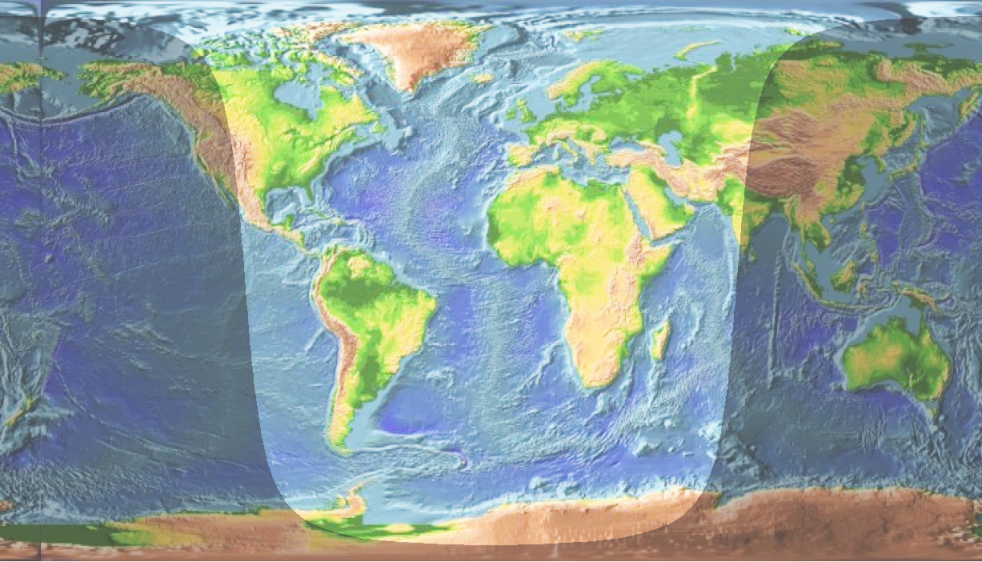
World map showing the areas of Earth receiving daylight around 1:00 pm UTC in April

Daylight is the combination of all direct and indirect sunlight during the daytime. This includes direct sunlight, diffuse sky radiation, and (often) both of these reflected by Earth and terrestrial objects, like landforms and buildings. Sunlight scattered or reflected by astronomical objects is generally not considered daylight. Therefore, daylight excludes moonlight, despite it being reflected indirect sunlight.

Definition

[edit]

Daylight is present at a particular location, to some degree, whenever the Sun is above the local horizon. This is true for slightly more than 50% of the Earth at any given time, since the Earth's atmosphere refracts some sunlight even when the Sun is below the horizon.

Outdoor illuminance varies from 120,000 lux for direct sunlight at noon, which may cause eye pain, to less than 5 lux for thick storm clouds with the Sun at the horizon (even <1 lux for the most extreme case), which may make shadows from distant street lights visible. It may be darker under unusual circumstances like a solar eclipse or very high levels of atmospheric particulates, which include smoke (see New England's Dark Day), dust,[1] and volcanic ash.[2]

Intensity in different conditions

[edit]
Illuminance Example
120,000 lux Brightest sunlight
111,000 lux Bright sunlight
109,880 lux AM 1.5 global solar spectrum sunlight (= 1,000.4 W/m2)[3][circular reference]
20,000 lux Shade illuminated by entire clear blue sky, midday
1,000–2,000 lux Typical overcast day, midday
400 lux Sunrise or sunset on a clear day (ambient illumination)
<200 lux Extreme of thickest storm clouds, midday
40 lux Fully overcast, sunset/sunrise
<1 lux Extreme of thickest storm clouds, sunset/rise

For comparison, nighttime illuminance levels are:

Illuminance Example
<1 lux Moonlight,[4] clear night sky
0.25 lux A full Moon, clear night sky[5][6]
0.01 lux A quarter Moon, clear night sky
0.002 lux Starlight, clear moonless night sky, including airglow[5]
0.0002 lux Starlight, clear moonless night sky, excluding airglow[5]
0.00014 lux Venus at brightest,[5] clear night sky
0.0001 lux Starlight, overcast moonless night sky[5]

For a table of approximate daylight intensity in the Solar System, see sunlight.

See also

[edit]

References

[edit]
[edit]
Revisions and contributorsEdit on WikipediaRead on Wikipedia
from Grokipedia
Daylight is the natural illumination originating from the Sun that reaches Earth's surface during the daytime period, comprising direct solar radiation, diffuse skylight from atmospheric , and reflected light from terrestrial objects and surroundings. This light exhibits dynamic variations in intensity, spectral composition, and influenced by factors such as time of day, season, , conditions, and atmospheric composition. Outdoor daylight typically ranges from approximately 1,000 under skies to over 100,000 during clear midday conditions with direct . Daylight is essential for human health and well-being, providing optimal conditions for with high contrast sensitivity and color rendering compared to artificial sources. It regulates circadian rhythms via intrinsically photosensitive cells, promoting during the day and production at night to support quality. Additionally, exposure to daylight facilitates B-induced synthesis in the skin, which is critical for calcium absorption, bone mineralization, and immune function, with deficiencies linked to conditions like and . In and , daylight serves as a key resource through daylighting strategies, which involve the controlled admission of into buildings to minimize reliance on electric lighting, thereby reducing energy use by up to 20-60% in well-designed spaces. These approaches, including the use of windows, skylights, and light shelves, not only enhance visual comfort and spatial but also boost occupant , mood, and overall satisfaction by mimicking natural diurnal light patterns.

Fundamentals

Definition

Daylight refers to the visible and near-visible originating from direct and diffuse solar that reaches Earth's surface during the period. This natural illumination stems solely from , including both direct rays from the sun and indirect contributions from scattered and reflected , providing the primary source of for terrestrial environments when the sun is above the horizon. Unlike twilight, which occurs when the sun is below the horizon and the sky is illuminated only by scattered sunlight in the upper atmosphere, daylight is characterized by the sun's direct presence above the horizon, ensuring brighter and more uniform illumination during these hours. This distinction highlights daylight's role in defining the active diurnal cycle, separate from the dimmer, transitional lighting of dawn, , or nighttime. The term "daylight" has roots in Old English, formed as a compound of "dæg" (day) and "leoht" (), denoting the illumination of day as opposed to . In , it is frequently used interchangeably with "" to emphasize its origin from solar sources without artificial supplementation. Grasping daylight's fundamentals, particularly sunlight's central role as the originating , lays the groundwork for exploring its physical makeup and variations.

Physical Composition

Daylight at the Earth's surface primarily comprises two main components: direct and diffuse daylight. Direct sunlight refers to the unobstructed rays emanating directly from the Sun, delivering concentrated, high-intensity illumination that follows a narrow beam path to the observer. This component dominates under clear atmospheric conditions, contributing significantly to the overall brightness and enabling sharp shadows due to its directional nature. In contrast, diffuse daylight arises from the of solar radiation by atmospheric molecules, aerosols, cloud particles, and ground surfaces, resulting in a more uniform, non-directional illumination that fills the sky and reduces contrast. This scattered light provides even coverage across surfaces, minimizing harsh shadows and glare compared to direct . The solar spectrum serves as the fundamental origin of both components before atmospheric interactions modify their paths. The proportion of direct sunlight to diffuse daylight varies markedly with sky conditions. Under clear skies, direct sunlight typically accounts for approximately 90% of the total light reaching the surface, with the remainder being diffuse. In overcast conditions, however, direct sunlight is entirely blocked by clouds, making diffuse daylight constitute 100% of the available illumination. These diffuse characteristics stem from distinct scattering processes in the atmosphere. , which preferentially scatters shorter blue wavelengths by small molecules like and oxygen, is responsible for the predominantly blue appearance of clear skies. Conversely, by larger particles, such as water droplets in clouds, scatters all visible wavelengths more equally, producing the white or gray light observed from overcast skies.

Properties

Spectral Distribution

Daylight's spectral distribution arises primarily from the Sun's emission, approximated as at an of approximately 5800 K, encompassing (UV) wavelengths below 400 nm, visible light from 400 to 700 nm, and infrared (IR) radiation above 700 nm. This composition results in a broad that appears as white light to the , though it is not perfectly uniform across all wavelengths. The (CIE) defines standard illuminants to model daylight, with D65 representing average midday conditions in Western and , incorporating both direct sunlight and diffuse sky light. This illuminant features a with peak intensity in the green-yellow region around 500–550 nm, consistent with the blackbody peak predicted by for solar temperatures. The theoretical basis for this distribution is , which describes the B(λ,T)B(\lambda, T) of a blackbody as a function of wavelength λ\lambda and temperature TT: B(λ,T)=2hc2λ51ehc/λkT1B(\lambda, T) = \frac{2hc^2}{\lambda^5} \frac{1}{e^{hc / \lambda k T} - 1} where hh is Planck's constant, cc is the , and kk is Boltzmann's constant. Applied to the Sun's surface temperature of about 5800 K, this equation yields a curve that closely matches observed before atmospheric effects. However, the spectrum reaching Earth's surface deviates from the ideal blackbody curve due to atmospheric absorption; for instance, (O₃) in the strongly attenuates UV radiation below 300 nm, while primarily absorbs in the IR region above 700 nm. These absorptions create characteristic gaps and reductions in the extraterrestrial spectrum, altering the overall energy distribution of daylight.

Intensity and Brightness

Daylight intensity, measured as in , typically ranges from approximately 1,000–2,000 under typical overcast conditions to over 100,000 during clear midday skies with direct . This substantial variation highlights daylight's role as a primary environmental light source, far exceeding the illuminance of , which measures around 0.1 on a clear night. The illuminance EE from direct sunlight on a surface follows an adaptation of the inverse square law, given by the formula E=Icosθd2E = \frac{I \cos \theta}{d^2}, where II is the luminous intensity of the source in candela, θ\theta is the angle of incidence relative to the surface normal, and dd is the distance from the source. This equation accounts for both the geometric spreading of light and the cosine effect of the angle, providing a foundational model for predicting daylight's energy distribution on terrestrial surfaces. Perceived brightness of daylight, however, extends beyond mere luminance to encompass subjective factors such as visual and contrast within the scene. refers to the eye's adjustment to prevailing light levels, which can alter sensitivity and thus the sensation of , while contrast involves relative differences in luminance between adjacent areas that enhance or diminish perceived intensity. Daylight's , ranging from 5000 to 6500 , contributes to its cooler, bluish appearance compared to warmer artificial sources like incandescent at approximately 2700 . This range, defined by CIE standard illuminants such as D50 and D65, influences not only visual clarity but also the overall perception of brightness in natural settings.

Variations

Temporal Changes

Daylight undergoes significant temporal changes driven by and orbital dynamics, manifesting in both diurnal and annual cycles that alter its duration, intensity, and characteristics. The diurnal cycle begins at sunrise, when the Sun's disk first appears above the horizon, and progresses through increasing illumination until sunset, with daylight duration varying by and . Intensity builds from low values near dawn, reaching a peak at solar noon when the Sun is at its highest elevation, delivering the maximum direct beam to the surface. This peak occurs because the angle of incidence is minimized, reducing the atmospheric path length traversed by sunlight and thus minimizing and absorption. As the Sun descends post-noon, intensity symmetrically declines until sunset. Seasonal variations arise from Earth's 23.5° relative to its , causing the Sun's to shift between +23.5° at the and -23.5° at the . In winter at mid-latitudes, shorter daylight periods and lower solar elevations result in reduced intensity, often 20-50% less than summer averages due to the Sun's oblique increasing the atmospheric path length. Equinoxes, occurring around and , mark transitions where the is zero, yielding approximately 12 hours of daylight globally. Solstices define extremes: the brings the longest days in the , while December's yields the shortest. At the , daylight remains roughly 12 hours year-round, with minimal seasonal fluctuation in duration. These changes are amplified by atmospheric effects, such as increased at longer path lengths. The solar elevation angle α, which governs these intensity variations, is calculated as: sinα=sinϕsinδ+cosϕcosδcosH\sin \alpha = \sin \phi \sin \delta + \cos \phi \cos \delta \cos H where φ is the observer's , δ is the solar declination, and H is the (zero at solar noon, increasing 15° per hour). This formula quantifies how elevation—and thus path length—evolves over the day and year.

Spatial Influences

Spatial influences on daylight arise primarily from geographic position and local environmental factors, which modulate the amount, quality, and distribution of reaching the Earth's surface. plays a fundamental role in determining daylight patterns: in polar regions above approximately 66.6° N or S, the Earth's results in the midnight sun during summer, where the Sun remains above the horizon for up to 24 continuous hours, providing extended periods of daylight. For instance, at the , the Sun is visible for about 190 days from late to late , circling the sky without setting. Conversely, during winter, these areas endure , with the Sun remaining below the horizon for up to 175 days, leading to prolonged darkness interrupted only by twilight or moonlight. In contrast, tropical regions near the experience more consistent daylight availability, with day lengths varying minimally around 12 hours year-round and higher overall intensity due to the Sun's more perpendicular incidence, delivering greater direct solar radiation compared to higher latitudes. Altitude further alters daylight by reducing the thickness of the atmosphere through which passes, thereby decreasing absorption and of shorter wavelengths. At higher elevations, (UV) radiation, including UV-A and UV-B components, increases by approximately 10–20% per kilometer due to less filtering by and other atmospheric constituents. This enhancement affects both the intensity and composition of daylight, with implications for surface exposure in mountainous regions. Urban environments introduce additional spatial constraints through building density and , where tall structures create persistent shadowing that limits and diffuse penetration. In dense cities, obstructions such as high-rise restrict views of the to upper portions, often reducing near ground level or building facades to less than 10% of unobstructed outdoor levels, thereby altering the balance between and reflected . Differences between oceanic and continental settings stem from variations in atmospheric moisture, which influences . Over , higher relative promotes greater aerosol hygroscopic growth and interactions, enhancing Rayleigh and and resulting in brighter diffuse daylight with a more even distribution. This effect can increase aerosol cross-sections by 40–80% in humid conditions near clouds or marine boundaries, compared to drier continental interiors where lower allows more direct beam transmission and reduced diffuse components. In architectural contexts, these spatial factors manifest in metrics like the daylight factor (DF), which quantifies indoor relative to external conditions under skies. Urban canyons in dense cities typically yield DF values of 1–5% due to mutual from adjacent buildings, significantly lower than the 10% or more achievable in open rural or suburban areas with minimal obstructions.

Measurement

Units and Metrics

Daylight quantification relies on standardized photometric units that account for human visual perception, primarily through the photopic luminosity function, which weights light intensity according to the eye's sensitivity to different wavelengths peaking at around 555 nm. The primary unit for measuring the amount of light incident on a surface, known as , is the (lx), defined as one lumen per square meter (lm/m²). This metric captures the total visible light flux received per unit area, essential for assessing daylight availability in indoor environments. Luminance, which quantifies the brightness of a surface or light source as perceived by the eye, is measured in candela per square meter (cd/m²). It represents luminous intensity per unit projected area and is crucial for evaluating the visual comfort and glare potential from daylight-reflecting surfaces. Another key metric is the daylight factor (DF), expressed as a percentage, which represents the ratio of internal illuminance at a point within a space to the simultaneous external illuminance on a horizontal plane under overcast sky conditions. DF provides a relative measure of daylight penetration, independent of time or weather, and is widely used in architectural design to ensure adequate natural lighting. In architectural applications, the useful daylight illuminance (UDI) metric assesses the percentage of time a space experiences levels conducive to occupant comfort and , typically within the range of 100 to 2000 . UDI categorizes daylight into bins—below 100 (supplementary needed), 100–2000 (useful range), and above 2000 (potential )—allowing designers to optimize building envelopes for balanced distribution over annual occupancy hours. This climate-based approach has gained prominence as a more dynamic alternative to static metrics like DF, emphasizing occupant . The evolution of these units traces back to imperial measures like the (fc), defined as one lumen per , which dominated early 20th-century lighting standards in the United States and Britain. The transition to SI units accelerated after the 1960 establishment of the as an by the General Conference on Weights and Measures (CGPM), with full adoption in photometry following the 1979 redefinition of the in terms of . By the late 1970s, organizations like the (IES) shifted recommendations to , listing foot-candles parenthetically for compatibility, marking the widespread replacement of in professional practice. A direct conversion between these systems is 1 ≈ 0.0929 foot-candles, reflecting the area difference between a square meter and while preserving photopic weighting. This equivalence ensures continuity in historical data analysis for daylight studies, though modern applications prioritize for its alignment with international standards.

Techniques and Instruments

Lux meters are essential instruments for measuring , the primary metric for assessing daylight availability on indoor and outdoor surfaces, typically in units of . These devices employ photodetectors with response curves approximating the human eye's photopic sensitivity (V(λ) function) to quantify visible incident on a plane. Sky scanners are specialized photometers that map the distribution across the entire sky dome by rotating to sample multiple angular positions, typically in a grid of 145 patches, enabling detailed characterization of sky brightness patterns for daylight analysis. High dynamic range (HDR) imaging techniques facilitate the mapping of indoor daylight by capturing multiple exposures from a single camera viewpoint, merging them into images that represent s spanning over 20 orders of magnitude, from which and metrics can be derived. Sky patch models, such as the CIE Standard General , divide the celestial hemisphere into discrete patches to parameterize distributions across 15 standardized sky types, ranging from to clear conditions, supporting accurate daylight simulations without direct measurement. Field methods for daylight assessment include continuous monitoring with data loggers, which integrate light sensors to record variations over extended periods, often at intervals as short as one second, to capture temporal fluctuations in real-world environments. Predictive modeling employs simulation software like Radiance, an open-source ray-tracing tool that computes daylight distributions in virtual scenes by tracing paths from sky models to surfaces, validated against physical measurements for architectural applications. Calibration of these instruments follows standards traceable to the National Institute of Standards and Technology (NIST), involving comparison against reference photometers under controlled levels, achieving relative expanded uncertainties typically below 0.6% (k=2) for professional-grade meters and similar devices.

Impacts

Biological and Health Effects

Daylight plays a crucial role in regulating human circadian rhythms through its blue light component, particularly wavelengths around 450-480 nm, which activates intrinsically photosensitive retinal ganglion cells (ipRGCs) and suppresses production by the . This suppression during daytime exposure helps synchronize the -wake cycle, promoting alertness and metabolic coordination, while inadequate daylight can lead to desynchronization and associated disorders. The timing and intensity of this blue light exposure are key, as it resets the body's internal clock to align with the 24-hour solar day. Exposure to B (UVB) in daylight, spanning 290-320 nm, enables the synthesis of in the skin by converting to previtamin D3, which isomerizes to 3 (cholecalciferol). For fair-skinned individuals, about 10-15 minutes of midday sun exposure several times a week is typically sufficient to meet daily requirements and support health, immune function, and calcium absorption, though needs vary by type, , and season. Insufficient UVB from limited daylight can result in , increasing risks for conditions like and . Daylight also confers specific benefits, such as reducing the risk of in children through increased outdoor time, which exposes eyes to higher light intensities and release that inhibits eye elongation. Studies indicate that at least 2 hours of daily outdoor activity can lower the risk of rapid progression by up to 54% in school-aged children. Conversely, reduced winter daylight contributes to (SAD), a form of depression linked to disrupted circadian rhythms and lowered serotonin levels due to shorter photoperiods. mimicking daylight has been shown to alleviate SAD symptoms in approximately 50-60% of cases. Beyond humans, daylight influences plant growth via , where shoots grow toward directional blue light in the spectrum to optimize and resource capture. This response, mediated by phototropin receptors, allows to position leaves for maximum light interception. In animals, daylight patterns serve as navigational cues for migration; many , including birds and , use time-compensated sun compasses that track the sun's arc and polarized to maintain orientation over long distances. These cues synchronize seasonal movements, ensuring timely arrival at breeding or feeding grounds.

Environmental and Architectural Applications

In architectural design, daylighting strategies such as clerestories and atriums are employed to optimize penetration into building interiors, enhancing illumination while minimizing reliance on artificial sources. Clerestories, positioned high on walls above eye level, allow diffuse light to wash across ceilings and upper walls, reducing glare and distributing even illumination without obstructing views or privacy. Atriums, as central open spaces, facilitate vertical light transmission through skylights and surrounding glazing, effectively daylighting multiple floors in deep-plan buildings. These approaches aim to achieve a daylight factor (DF) of 2-5%, a metric representing the ratio of indoor to outdoor under overcast skies, which ensures adequate lighting for most tasks while supporting energy efficiency. Implementing such strategies can yield significant savings, with studies indicating reductions in electricity use by up to 30-70% when integrated with automatic controls that dim or switch off electric lights in response to available daylight. For instance, in environments, combining side-lighting from clerestories with photosensor-linked systems has demonstrated consistent offsets to artificial demands, particularly during peak daylight hours. Beyond , these designs contribute to overall building performance by leveraging passive solar principles to moderate loads, though careful integration is required to balance gains and losses. Daylight plays a fundamental environmental role by powering , the process through which convert solar radiation into , forming the basis of global primary . Gross primary (GPP), estimated at approximately 120-130 PgC per year across terrestrial and oceanic ecosystems, directly correlates with solar insolation—the amount of incoming reaching the Earth's surface—which varies by , season, and atmospheric conditions. In ecosystems, diffuse daylight components enhance canopy penetration, boosting compared to direct beam radiation alone, thereby supporting higher net primary rates in vegetated areas. This linkage underscores daylight's influence on carbon cycling and , as fluctuations in insolation due to cloud cover or aerosols can alter by 10-20% regionally. In sustainability frameworks, daylighting is prioritized through standards like v4.1 (as of 2025), which awards points if at least 55% (1 point) or 75% (2 points) of regularly occupied spaces achieve a spatial Daylight Autonomy (sDA) of 300 for at least 50% of annual operating hours, along with limits on excessive exposure to control . Glare control is integral to these requirements, often achieved via external shading devices such as overhangs, louvers, or automated blinds that preserve views while mitigating direct solar intrusion, ensuring compliance without compromising occupant comfort. These measures not only reduce operational —potentially cutting building-wide consumption by 20-30%—but also align with broader goals of resource conservation and indoor . Post-2000 green architecture trends have increasingly incorporated passive solar design in net-zero buildings, where daylighting strategies maximize free solar resources to offset annual needs. For example, structures like the in (completed 2013) utilize extensive south-facing glazing, light shelves, and atriums to achieve high daylight autonomy, contributing to its net-zero status by minimizing lighting and heating demands. More recently, the International Building at Amsterdam (completed 2024) employs advanced electrochromic glass and AI-optimized shading to deliver daylight to over 90% of its floor area, exemplifying integration of daylighting for net-zero certification under while reducing embodied carbon. Such projects highlight a shift toward holistic integration of daylight for resilience and low-impact operations in urban contexts.

Historical and Cultural Context

Scientific History

Early scientific understanding of daylight began with ancient observations of atmospheric phenomena. In the BCE, documented the colors observed in the atmosphere, attributing them to the interaction of with air and vapors in his work Meteorologica, where he described how light passing through dense air produces various hues, including crimson and purple. Building on this, Islamic scholars in the 9th century advanced studies on light refraction; , in treatises like De Aspectibus, explored the bending of light rays through different media, laying foundational principles for understanding how atmospheric layers alter daylight propagation. The marked a shift toward experimental of daylight's composition. In 1666, conducted pivotal prism experiments on , demonstrating that white daylight disperses into a of colors, establishing the and its spectral nature in his later . This was complemented by quantitative measurements in 1729, when published Essai d'optique sur la gradation de la lumière, introducing early photometric methods to assess and through media, effectively founding the field of photometry for daylight evaluation. In the 20th century, international standardization elevated daylight science. The International Commission on Illumination (CIE), established in 1913, defined initial standard illuminants in 1931, including B and C to represent direct and average daylight, respectively, enabling consistent colorimetry and lighting assessments based on spectral distributions. In 1964, the CIE introduced illuminant D65 as a more accurate representation of average daylight with a correlated color temperature of 6500 K. From the 1970s, satellite technology enabled global monitoring; the Nimbus-7 satellite, launched in 1978, used its Earth Radiation Budget (ERB) instrument to measure incoming solar irradiance continuously, providing data on daylight variations influenced by clouds and aerosols over nearly 15 years. Recent advances have linked daylight trends to through aerosol-induced . Studies reveal a ~4-8% global reduction in surface solar radiation from the 1950s to the 1980s due to atmospheric , masking some warming effects, until brightening trends emerged post-1990s with cleaner air policies, as synthesized in comprehensive reviews of ground and observations.

Cultural Significance

Daylight has long served as a profound symbol in human culture, representing enlightenment, truth, and the triumph of good over evil. In , light was frequently depicted as a divine emanation, illuminating figures to signify spiritual awakening and moral clarity, as seen in the works of artists like and , where techniques enhanced symbolic depth. In literature, daylight often metaphorically embodies knowledge and revelation, echoing philosophical traditions such as Plato's , where emerging into light signifies escaping ignorance. Religious festivals further underscore this symbolism; for instance, , the Hindu Festival of Lights celebrated annually in October or November, involves lighting lamps (diyas) to commemorate the victory of light over darkness, good over evil, and knowledge over ignorance, drawing from myths like the return of Lord Rama. In daily life, particularly in regions with abundant , daylight has shaped work rhythms and social customs. The , a midday rest prevalent in Mediterranean and Latin American countries like and , originated as a practical to intense afternoon heat and extended daylight, allowing workers to avoid peak temperatures and resume activities in the cooler evening. Pre-electricity, agricultural calendars worldwide revolved around natural daylight cycles, dictating planting, harvesting, and labor hours to maximize productivity within available light, as farming operations aligned with sunrise and sunset rather than artificial timekeeping. Modern cultural practices reflect efforts to harness daylight for societal efficiency, most notably through (DST). First implemented nationally in on April 30, 1916, during to conserve energy by extending evening daylight, DST spread rapidly across and beyond, with the adopting it federally in 1966 via the . By 2025, over 70 countries and territories observe DST seasonally, adjusting clocks to align work and with longer summer days, though debates persist on its energy-saving efficacy and health impacts. Artistic movements have celebrated daylight's ephemeral qualities, capturing its cultural resonance through visual innovation. The Impressionists of the , led by , prioritized the transient effects of natural light on landscapes and architecture, as exemplified in Monet's series (1892–1894), where over 30 paintings depict the facade at different times of day to explore how shifting daylight alters perception and mood. This focus on light's mutability not only defined the movement's aesthetic but also symbolized modernity's embrace of fleeting beauty and temporal change.

References

Add your contribution
Related Hubs
User Avatar
No comments yet.