Hubbry Logo
BalasagunBalasagunMain
Open search
Balasagun
Community hub
Balasagun
logo
8 pages, 0 posts
0 subscribers
Be the first to start a discussion here.
Balasagun
Balasagun
from Wikipedia

Balasagun (Kyrgyz: Баласагун or Баласагын Balasagyn; simplified Chinese: 八剌沙衮; traditional Chinese: 八剌沙袞; pinyin: Bā là shā gǔn) was an ancient Sogdian city in modern-day Kyrgyzstan, located in the Chüy Valley between Bishkek and the Issyk-Kul lake. Located along the Silk Road, the ruins of the city were inscribed in 2014 on the UNESCO World Heritage List as part of the Silk Roads: the Routes Network of Chang'an-Tianshan Corridor World Heritage Site.[1]

Key Information

Balasagun was founded by the Sogdians, a people of Iranian origin and the Sogdian language was still in use in this town until the 11th century.[2]

It was the capital of the Kara-Khanid Khanate from the 10th century until it was taken by the Qara Khitai (Western Liao dynasty) in 1134. It was then captured by the Mongols in 1218. The Mongols called it Gobalik "Pretty City". It should not be confused with Karabalghasun, now Ordu-Baliq in Mongolia, which was the capital of the Uyghur Khaganate.

Founded by the Kara-Khanid Khanate in the ninth century, Balasagun soon supplanted Suyab as the main political and economical centre of the Chüy Valley; its prosperity declined after the Mongol conquest. The poet Yūsuf Balasaguni, known for writing the Kutadgu Bilig, is thought to have been born in Balasagun in the 11th century. The city also had a sizable Nestorian Christian population; one graveyard was still in use in the 14th century.[3] Since the 14th century, Balasagun is a village with plenty of ruins 12 kilometres (7.5 mi) southeast of Tokmok.

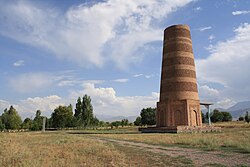
The Burana zone, located at the edge of Tokmok and 6 kilometres (3.7 mi) from the present village of Balasagun, was the west end of the ancient city. It includes the Burana Tower and a field of stone petroglyphs, the Kurgan stelae. The Burana Tower is a minaret built in the 11th century on the ruins of the ancient city Balasagun. It is 24 metres (79 ft) in height, though when it was first built it topped 46 metres (151 ft). Several earthquakes through the centuries caused much damage, and the current building represents a major renovation carried out in the 1970s.

References

[edit]
Revisions and contributorsEdit on WikipediaRead on Wikipedia
from Grokipedia
Balasagun was a medieval city located in the Chui Valley of present-day , established as a key trading and cultural hub along the route that connected with the West. Founded in the AD on the site of an earlier settlement and flourishing by the , it served as one of the dual capitals of the Eastern Khanate following the division of the Karakhanid state, alongside , and facilitated the exchange of goods, ideas, and influences among Indian, Chinese, Sogdian, and Turkic civilizations. Today, its extensive ruins, spanning 25-30 square kilometers and including remnants of a central fortress, bazaars, religious structures, and domestic buildings, form the Burana , preserved as a testament to Central Asia's historical interconnectedness. The city's strategic position in the upper Chui Valley, approximately 10 kilometers south of modern and 2.5 kilometers east of Donarik village, enabled it to thrive as a multicultural center under Karakhanid rule from the 10th to 12th centuries, with features like workshops, a bathhouse, arable lands, and a system supporting a diverse . Archaeological evidence, including Nestorian Christian inscriptions and gravestones, highlights the presence of , while the site's avoidance of total destruction during Genghis Khan's Mongol invasions in the early —leading to its renaming as Gobalik, or "good city"—allowed partial survival amid broader regional turmoil. By the , Balasagun had declined due to shifting trade routes and political changes, leaving behind scattered monuments that underwent systematic excavation in the 1920s, 1950s, and 1970s. Among the most notable surviving elements is the , an 11th-century octahedral structure originally part of a larger complex, possibly serving as a or , which stands as a rare example of medieval Central Asian architecture in a predominantly nomadic . The site is managed by an onsite museum housing artifacts such as carved stones and ceramics, underscoring Balasagun's role in the Karakhanid Khanate's economic prosperity through , spices, and precious metals trade. Recognized for its outstanding universal value, Balasagun is included in 's tentative list of Silk Roads Sites in (submitted in 2010), emphasizing its contribution to global heritage as a bridge between continents and epochs.

Etymology and Names

Origins of the Name

According to a theory proposed in Turkish scholarship, the name Balasagun derives from the Old Turkic compound "Boyla Sangun," denoting a linked to a prominent or administrative figure, with "Boyla" serving as a title for high-ranking officials attested in ancient Turkic inscriptions such as the Bilge Kağan and memorials, and "Sangun" referring to a general or commander. This etymological root reflects the Turkic cultural and political influences in the region during the early medieval period, evolving phonetically into "Bala Sagun" or "Balasagun" as Turkic dialects adapted under the Kara-Khanid dynasty. Although the city itself was founded by Sogdians—an Iranian-speaking people whose linguistic and commercial networks shaped pre-Islamic —the name Balasagun demonstrates a fusion of Sogdian settlement patterns with emerging Turkic nomenclature, as Sogdian traders and settlers interacted closely with incoming Turkic groups in the Chu Valley. Alternative Turkic names for the city include "Quz-Ordu" and "Quz-Uluš," as recorded by the 11th-century scholar Maḥmūd Kāšḡarī. The earliest widely attested mention of the name appears in the 10th-century Arabic geographical text Ahsan al-Taqasim fi Ma'rifat al-Aqalim by , who portrayed it as a substantial and resource-rich urban center in the Yeti Su (Semirechye) region, thereby preserving its connection to the diverse, pre-Islamic toponymic traditions of . This reference highlights the name's continuity amid the Islamization of the area, bridging Sogdian foundational elements with Turkic dominance. The name's phonetic form has persisted in local usage, particularly in Kyrgyz, where it is pronounced and written as Баласагун (Balasagun), adapting medieval Turkic sounds to modern Kipchak Turkic phonology without significant alteration. Later variations, such as the Mongol-era "Gobalik" meaning "beautiful city," briefly overlaid this foundational name but did not supplant its Turkic-Sogdian heritage.

Historical Variations

Following the Mongol conquest of Balasagun in 1218 during the campaign against the , the city received the designation Gobalik in Mongol records, translating to "beautiful city" and highlighting the invaders' admiration for its urban beauty and strategic position, as noted in chronicles that preserved accounts of the empire's Central Asian campaigns. This name persisted in post-conquest administrative documents, underscoring the city's continued significance within the despite its partial destruction. In Arabic and Persian historical texts, the name appeared as Balasghun, a phonetic that emphasized its prominence in Islamic and networks. This variation reflected the integration of the site into broader Persianate scholarship on , where it symbolized the transition from Turkic to Mongol dominion. Medieval cartographers and chroniclers often confused Balasagun with nearby sites such as , an earlier Sogdian settlement in the Chüy Valley, or the distant Karabalghasun (modern in ), due to overlapping phonetic elements and vague itinerary descriptions in sources like the 10th-century Hudud al-Alam. 20th-century scholarship, particularly Vasily Bartold's fieldwork in 1893 at Ak-Beshim, clarified these distinctions by identifying Ak-Beshim definitively as through epigraphic and numismatic evidence, while confirming Burana as the core of Balasagun based on its Kara-Khanid-era remains. These efforts resolved longstanding ambiguities in medieval maps, attributing prior mix-ups to the region's dense cluster of ancient urban centers. The core name Balasagun, with possible Sogdian roots as a basis for its initial form, thus evolved through these multicultural lenses without altering its foundational linguistic structure.

Geography and Location

Physical Setting

Balasagun is situated in the Chüy Valley of northern , at coordinates 42°44′48″N 75°14′55″E, on a fertile plain formed by the drainage basin of the Chu River and bordered by the foothills of the mountains to the south. This location placed the ancient city in a region of temperate steppes and oases, where the valley's alluvial soils, enriched by river sediments, supported intensive through channels drawn from the Chu River. The surrounding landscape features expansive grasslands that transitioned into semi-arid steppes, providing grazing lands that complemented the valley's crop production. The climate of the Chüy Valley is classified as semi-arid continental, characterized by cold winters with average lows reaching -9°C in and occasional drops to -20°C, and hot summers with average highs of 30°C in , occasionally exceeding 35°C. Annual is low, averaging around 300-400 mm, concentrated in spring and early summer, which necessitated reliance on the River's meltwater from the for to sustain , , and fruit orchards vital to the city's development. This environmental setting fostered a of approximately six months, enabling Balasagun to thrive as an agricultural hub. To the east, the site lies approximately 120 km from the western shore of Lake , whose basin influenced regional hydrology and trade connectivity, while the encircling ranges and northern Chu-Ili mountains acted as natural barriers, offering defensive advantages by channeling access routes and deterring large-scale invasions. These topographic features not only protected the plain but also directed migratory paths and caravans through the valley, underscoring Balasagun's strategic environmental role.

Relation to Modern Settlements

Balasagun is situated approximately 80 kilometers east of , the capital of , and about 12 kilometers south of the town of , falling within the administrative boundaries of the modern . This positioning places the ancient site in a fertile that continues to support contemporary agricultural activities, reflecting a continuity in human settlement patterns from historical trade hubs to present-day rural economies. The ruins of Balasagun overlap with modern villages such as Burana and the nearby settlement of Don-Aryk, where archaeological remnants are interspersed with residential areas and farmlands. These villages integrate the ancient structures into everyday landscapes while parts of the area are designated as protected zones under Kyrgyzstan's of Monuments of National Importance. Cultivation in adjacent privately owned fields is regulated to minimize damage, such as through depth-limited plowing, ensuring the site's archaeological integrity amid ongoing agricultural use. Soviet-era planning significantly influenced the site's surroundings, with collectivized agriculture transforming the Chüy Valley into intensive farmland that partially overlaid ancient remains. Infrastructure developments, including the nearby A365 highway connecting to , have facilitated access but also posed risks to the site's buffer zones through increased traffic and potential expansion. Following Kyrgyzstan's in 1991, population shifts occurred, marked by rural-to-urban migration toward and ethnic demographic changes that reduced rural densities in areas like , leading to updated plans from 2011 to 2015 that emphasize conservation amid evolving settlement pressures. In 2023, a conservation project funded by the U.S. Embassy stabilized the , enhancing its preservation.

History

Founding and Early Period

The site of Balasagun in the Chuy Valley shows evidence of settlement from the 6th century CE, with archaeological layers indicating early occupation likely established by Sogdian traders as a vital outpost along the , facilitating commerce between , , and beyond. The city's name reflects its Sogdian roots, with the term "Balasagun" deriving from Iranian linguistic elements associated with authority and settlement. As an early multicultural hub, it attracted merchants and settlers from Sogdiana, Persia, and , fostering a blend of Iranian, Turkic, and Eastern influences that shaped its foundational economy centered on trade in , spices, and precious goods. By the 8th century, the Chuy Valley, including sites near Balasagun such as Suyab (modern Ak-Beshim), integrated into the sphere of the Uyghur Khaganate following the defeat of Tang Chinese forces and the rise of Turkic alliances. This period saw the construction of Buddhist temples and the presence of artifacts like steles and sculptures, evidencing strong Buddhist influences in the initial settlements, likely introduced through Sogdian and Chinese networks. Manichaean elements also appeared in the region, aligned with the Uyghur state's adoption of the faith, as indicated by broader archaeological traces of religious syncretism in Uyghur-controlled territories. The late 9th century marked a pivotal shift toward Islamic dominance in the area, as Karluk Turkic groups, centered at Balasagun, encountered expanding Samanid influence from , leading to the incorporation of Muslim traders and administrative practices. This transition was accompanied by the development of basic fortifications to protect growing markets and the establishment of caravanserais, transforming the outpost into a more structured urban center amid rising Turkic-Islamic interactions.

Kara-Khanid Era

In the mid-10th century, Balasagun emerged as a pivotal center under the , designated as the capital following its conquest by the Karakhanids around 940 CE during the reign of Satuq Bughra Khan. This ruler, who had converted to earlier in his rule, established the city as the primary administrative hub for the eastern branch of the khanate, overseeing territories from Semirechye to . As a strategic location on the , Balasagun facilitated Turkic governance over diverse nomadic and settled populations, blending steppe traditions with emerging Islamic administration. The Kara-Khanids' adoption of as the state religion in the mid-10th century profoundly shaped Balasagun's role as a religious center, marking it as the first Turkic dynasty to officially embrace the faith. Satuq Bughra Khan's conversion around 934 CE set the precedent, leading to the construction of mosques and madrasas that reinforced orthodox Sunni practices amid a region of mixed Zoroastrian, Buddhist, and Nestorian influences. This shift not only solidified the khanate's legitimacy among Muslim polities like the Samanids but also positioned Balasagun as a beacon for Islamic scholarship and proselytization in . Balasagun reached its zenith in the under rulers such as Yusuf Kadir Khan (r. 1040–1060), who consolidated power in the eastern after internal divisions split the realm into eastern and western branches. During this period, the city expanded significantly, covering approximately 30 square kilometers and developing into a bustling metropolis that supported trade, craftsmanship, and governance. Building on its earlier Sogdian foundations, Balasagun's growth reflected the khanate's prosperity, with fortified walls, palaces, and markets accommodating a diverse populace engaged in . Cultural patronage flourished in Balasagun under Kara-Khanid rule, exemplified by the works of the poet and philosopher Yūsuf Balasaguni, a native of the city active in the . His seminal text, (completed around 1070 CE), dedicated to the ruler Tavghach Bughra Khan, offered ethical and political guidance in Turkic verse, blending Islamic principles with Turkic wisdom traditions. This literary achievement, alongside advancements in astronomy, mathematics, and , underscored Balasagun's status as an intellectual hub, fostering a synthesis of Persian, Arabic, and Turkic influences that endured in Central Asian culture.

Decline and Destruction

The decline of Balasagun commenced in circa 1137 CE when it was captured by the (Western Liao dynasty), ending its role as the primary capital of the and triggering an initial economic downturn through the imposition of vassalage and redirected regional authority. The established Balasagun as their own capital, but administrative control over western territories increasingly centered on under Kara-Khanid puppet rulers, diminishing Balasagun's political and commercial centrality. This downturn intensified with the Mongol invasion in 1218 CE, led by Genghis Khan's generals Jebe and Subutai during the conquest of the Qara Khitai. Balasagun surrendered to avoid immediate siege, but the campaign brought widespread devastation, including massacres of resistors, widespread fires, and severe depopulation as inhabitants fled or were enslaved, as detailed in the chronicles of Persian historian Ata-Malik Juvayni. Juvayni recounts how the city's submission did not spare it from the broader Mongol reprisals against Qara Khitai holdouts, leaving much of the urban fabric in ruins, though it was renamed Gobalik ("good city") reflecting partial survival amid the destruction and accelerating its marginalization. By the 14th century, repeated invasions and shifting trade dynamics had reduced Balasagun to a minor village, overshadowed amid the political upheavals of the and subsequent nomadic migrations. The city's final eclipse came with the rise of the nearby settlement of , to which many residents relocated as Balasagun was largely abandoned.

Archaeological Remains

Excavation History

The archaeological exploration of Balasagun began in the late with initial surveys by Russian explorers in the Semirechye of what is now . In 1885, F.V. Poyarkov identified a medieval Christian approximately 1.5 versts of the Burana , conducting small-scale excavations that uncovered over 20 stones with crosses and inscriptions, as well as structures and Muslim burials nearby. These efforts were followed in 1886 by N.N. Pantusov and A.M. Fetisov, who excavated 34 graves at the same , documenting Nestorian burial practices and registering numerous stones. V.D. Gorodetsky further inspected the site in 1886 and 1888, providing detailed measurements and descriptions that confirmed the ruins' medieval significance. Major excavations commenced during the Soviet period, particularly from the 1940s to the 1970s, under the auspices of institutions such as the Kyrgyz Academy of Sciences and the Semirechye Archaeological Expedition. Systematic digs in the Chuy Valley, including at the Burana site, uncovered elements of the ancient citadel and facilitated the restoration of the between 1970 and 1974. These efforts, spanning the , , and 1970s, involved exploratory work that mapped the site's layout and preserved key structures. Following Kyrgyzstan's independence, archaeological projects at Balasagun-related sites intensified in the through the , often with international collaboration. UNESCO-supported excavations at Ak-Beshim from 2011 to 2013, funded by the Funds-in-Trust and involving the National Research Institute for Cultural Properties in alongside Kyrgyz partners, revealed Qarakhanid-era layers including a main street, alleys, and houses dated to the late via radiocarbon analysis, indicating early Islamization and site abandonment around that time—two centuries earlier than previously estimated. These findings contributed to ongoing debates about Balasagun's precise location, contrasting sites like Burana and Ak-Beshim. In 2025, renewed research at the site in Kazakhstan's Zhambyl region, identified by some as Balasagun's core, focused on the medieval city's central shakhristan and fortifications through targeted excavations, aiming to resolve identification controversies and illuminate Karakhanid societal structures along the .

Major Structures and Findings

The stands as the most iconic surviving structure at the Balasagun , constructed in the as a from baked bricks during the Kara-Khanid era. Originally reaching a height of approximately 46 meters, the cylindrical tower was significantly damaged by earthquakes over the centuries, reducing its current height to about 25 meters; restorations in the stabilized the structure while preserving its original form. Inside, a narrow spiral of baked brick steps ascends counterclockwise to the upper levels, facilitating access for the muezzin's and enabling its dual function as a for over the surrounding city. Adjacent to the tower lie the remnants of the citadel mound, encompassing the foundations of the Kara-Khanid and central fortress that anchored the urban core of Balasagun. This elevated enclosure, part of a larger fortified layout spanning 25-30 square kilometers, included defensive walls and administrative buildings indicative of the city's political importance. Three 12th-century mausoleums, associated with Kara-Khanid elite burials, survive in partial form near ; these brick structures feature dynastic crypts and are accompanied by carved stone stelae—anthropomorphic grave markers typical of Turkic funerary traditions, often depicting human figures or symbols of status. Excavations have yielded a range of artifacts illuminating daily life and craftsmanship in medieval Balasagun, including Qarakhanid such as large storage jars, cooking pots, and glazed bowls produced in local workshops. Nestorian Christian gravestones with cross inscriptions and Syriac text, reflecting the presence of a Christian community amid Islamic dominance, continued in use for burials until the . Additionally, traces of sophisticated channels— pipes and conduits channeling water from nearby canyons—underscore the engineered that supported and sustained the city's population along the .

Cultural and Economic Role

Trade and Economy on the Silk Road

Balasagun served as a central node in the Chang'an-Tianshan Corridor of the Silk Roads, a vital segment linking ancient China with Central Asia and beyond during the 10th to 12th centuries. As the capital of the Kara-Khanid Khanate's eastern branch, it functioned as a major trading settlement where merchants exchanged goods across Eurasian networks, bridging settled agricultural communities and nomadic groups like the Turks and Sogdians. Its strategic position in the fertile Chu Valley, with access to irrigation systems and proximity to mountain passes, enhanced its role in facilitating overland commerce between East and West. The city's trade networks primarily handled luxury and essential commodities, including , , , iron , and exported from , while importing horses, spices, jewels, grapes, pomegranates, and nuts from Central Asian regions toward Persia and . These exchanges supported long-distance that traversed the corridor, with Balasagun acting as a key waypoint for rest, resupply, and negotiation among traders from diverse origins, including , , , and . The influx of such underscored Balasagun's as an economic interface, where market activities and like way stations bolstered the flow of commerce. Locally, Balasagun's economy relied on sustained by the River's extensive networks, including canals and reservoirs that enabled cultivation of and fruits in the surrounding valleys. Craftsmanship thrived through production of and textiles, drawing on regional techniques influenced by exchanges, while revenues from taxing passing caravans further enriched the urban center. These activities created a self-sustaining hub, where agricultural surpluses and artisanal outputs complemented the transit trade. Balasagun's trade prominence waned following its capture during the Mongol conquest in 1218, as part of the campaigns against the Khwarezmian Empire and remnants, which disrupted local networks and shifted major routes southward. The city was renamed Gobalik but gradually declined in importance. The disrupted local networks, leading to a decline in caravan activity through the region and the eventual overshadowing of northern corridors by southern paths.

Intellectual and Religious Contributions

Balasagun served as the birthplace of the renowned scholar and poet (c. 1018–1070), who composed ("Blessed Knowledge"), the earliest known major work of . This philosophical poem, completed around 1069 during the Kara-Khanid era, explores ethics, governance, and statecraft through allegorical dialogues among four ideal archetypes—ruler, , sage, and subject—drawing on Islamic principles alongside traditions to advocate for justice, wisdom, and moral virtue in leadership. As a native of Balasagun, Yūsuf's work elevated the city as a center of Turkic intellectual expression, influencing subsequent literature and political thought across . Under Kara-Khanid rule, Balasagun emerged as a prominent hub for , particularly the , with the establishment of madrasas that institutionalized religious and scholarly education. These institutions, supported by the state since the , taught core Islamic subjects such as the Qur'an, , and , while integrating secular disciplines like , astronomy, and logic to foster a synthesis of and knowledge. The Kara-Khanids' promotion of Sunni doctrines helped solidify Islam's dominance in the region, transforming Balasagun into a key node for theological discourse and cultural dissemination. The city's religious landscape reflected broader pluralism, accommodating diverse faiths amid its role in exchanges. Archaeological evidence reveals a significant Nestorian Christian community, with graves dating from the 11th to 14th centuries indicating ongoing use of shared burial sites alongside Muslim ones, underscoring interfaith coexistence. Lingering Buddhist influences persisted through artifacts such as temple remnants and statues, remnants of earlier Central Asian traditions that blended with emerging Islamic practices. This diversity manifested architecturally in structures like the Burana minaret, whose design fused Persian, Arab, and Sogdian elements into an early Islamic form, symbolizing Balasagun's role in cultural and religious synthesis.

Legacy and Preservation

UNESCO Recognition

In 2014, the ruins of Balasagun were inscribed on the World Heritage List as part of the serial property "" (Reference no. 1442), which encompasses a 5,000 km stretch of ancient routes across , , and . This recognition highlights Balasagun's role in facilitating profound cultural exchanges along the from the 2nd century BCE to the 16th century CE, meeting criteria (ii), (iii), (v), and (vi) for its outstanding example of interchange of human values, exceptional testimony to civilizations, significant traditional , and association with events of universal importance through monuments and sites that demonstrate the interaction between Eurasian civilizations. The designated site boundaries for Balasagun incorporate key archaeological features, including the iconic (an 11th-century minaret), the remnants of the central , and several mausoleums, spanning a core area of approximately 36 hectares surrounded by protective buffer zones to preserve the integrity of these structures. These elements collectively represent the urban layout and architectural legacy of Balasagun as a major Kara-Khanid capital and hub, ensuring the site's authenticity in conveying its historical significance. Since its inscription, has implemented ongoing monitoring and management frameworks in collaboration with the States Parties of , , and to safeguard the property. This includes periodic reporting and reactive measures, with management plans addressing threats such as from environmental factors and the pressures of increasing on the fragile ruins. These efforts emphasize sustainable preservation techniques, such as structural reinforcements and visitor management strategies, to maintain the site's outstanding universal value for future generations.

Contemporary Importance

Balasagun's remnants, particularly the and surrounding archaeological zone near , have emerged as a prominent in contemporary . This influx underscores the site's appeal as an accessible day trip from , offering panoramic views of the Chüy Valley and insights into history through on-site exhibits of balbals (ancient stone monuments) and medieval artifacts. The Burana Museum, established as an open-air facility in 1976 following restoration efforts, enhances visitor engagement by displaying excavated items such as pottery and inscriptions, making the site a vital hub for in the region. In Kyrgyzstan's educational landscape, Balasagun plays a key role in curricula, emphasizing its significance as a cradle of Turkic heritage and facilitating the reclamation of in the post-Soviet era. Lessons on the city's Kara-Khanid foundations and the legacy of figures like poet Yusuf Balasaguni integrate it into broader narratives of medieval Turkic civilizations, fostering pride in shared Central Asian roots. The Kyrgyz National University named after Jusup Balasagyn in further amplifies this educational focus, hosting programs that explore the site's intellectual contributions and promoting Turkic cultural studies through collaborations with international heritage organizations. Preservation efforts at Balasagun confront modern challenges, including threats from such as accelerated erosion and flooding risks in the Chüy Valley due to rising temperatures and altered precipitation patterns. These environmental pressures, which have intensified Kyrgyzstan's vulnerability to natural disasters, endanger the structural integrity of exposed ruins like the . In response, 2025 archaeological initiatives at the section of Balasagun—conducted by university teams—have advanced documentation and conservation, bolstered by academic partnerships that echo broader international grant support for sites. Its inscribed status on the World Heritage List aids these protection measures by prioritizing sustainable management.

References

Add your contribution
Related Hubs
User Avatar
No comments yet.