
Recent from talks
Qaraqosh
Knowledge base stats:
Talk channels stats:
Members stats:
Qaraqosh
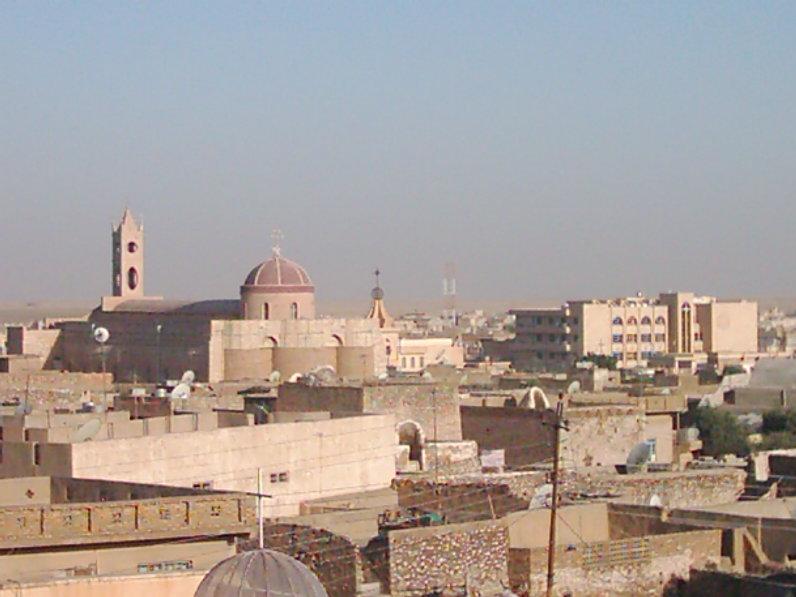
Qaraqosh (Syriac: ܩܪܩܘ݂ܫ, romanized: Qaraqoš; Arabic: بغديدا, romanized: Baḡdīda (official name), or Arabic: بخديدا, romanized: Baḵdīda, also known as al-Ḥamdāniyya or Qara-Qūš; a Turkic placename meaning "Black Bird") is a city in the Nineveh Governorate, of Iraq located about 32 kilometres (20 mi) southeast of the city of Mosul and 60 kilometres (37 mi) west of Erbil amid agricultural lands, close to the ruins of the ancient Assyrian cities Kalhu and Nineveh. The city has an Assyrian Christian majority.
Qaraqosh is connected to the main city of Mosul by two main roads. The first runs through the Assyrian towns of Bartella and Karamlesh, which connects to the city of Erbil as well. The second, which was gravel before being paved in the 1990s, is direct to Mosul. All of its Assyrian Christian citizens fled to the Kurdistan Region after the IS invasion on August 6, 2014. The town was under control of IS until October 19, 2016, when it was liberated as part of the Battle of Mosul after which residents have begun to return. According to archbishop Nizar Semaan, by July 2024 about half of the city's original 50,000 residents had returned to Qaraqosh.
Local Assyrians, who are ethnically distinct from Arabs and Kurds, speak the Qaraqosh dialect of Northeastern Neo-Aramaic.
The present name of the town, Qaraqosh, is first attested in a source from the sixteenth century. It is of Turkic origin, meaning 'Black Bird', and was introduced either by the Ottomans after their conquest of the area at the beginning of the sixteenth century or by the Turkoman rulers of the region in the fifteenth century. The local population, however, when speaking in their Aramaic dialect, still refer to the town by its former name. The name Bakhdida (Syriac: ܒܝܬ ܟܘܕܝܕܐ; Beth Khdeda), is of uncertain origin and when translated from the Syriac language it has two components Beth which means "house", and Khodida which could either mean "Youths" in Aramaic or actually "Baghdadak" a diminutive form of Baghdad, Old Persian meaning "God's gift". Some also believe that Bakhdida comes from the Aramaic Beth Deta, meaning "Land of the Kite".
As of October 2016, the city is under the control of the Nineveh Plain Protection Units. On November 25, 2017; Nineveh Plain Protection Units (NPU) celebrated the completion of its new military camp in Bakhdida, Nineveh Plain.
Students from the village were harassed in University of Mosul; many female students were forced to wear an Islamic dress for fear of being attacked. On May 2, 2010, a convoy of buses carrying students from Bakhdida to the University of Mosul was the target of a coordinated attack, which killed and injured more than a hundred.
The Iraqi Ministry of Education started the construction of a subsidiary of the University of Mosul which in 2014 became the University of AL-Hamdaniya, which is planned to serve the whole Nineveh Plains region. The University of AL-Hamdaniya currently consists of two colleges: The college of Education and the college of Administration and Economics. The University is based at the Mosul-Erbil road, Al-Hamdaniya intersection.
It is thought that the ancient city of Rasin mentioned in some texts, the second city built by the Assyrian king Nimrud, was in Bakhdida.
Hub AI
Qaraqosh AI simulator
(@Qaraqosh_simulator)
Qaraqosh
Qaraqosh (Syriac: ܩܪܩܘ݂ܫ, romanized: Qaraqoš; Arabic: بغديدا, romanized: Baḡdīda (official name), or Arabic: بخديدا, romanized: Baḵdīda, also known as al-Ḥamdāniyya or Qara-Qūš; a Turkic placename meaning "Black Bird") is a city in the Nineveh Governorate, of Iraq located about 32 kilometres (20 mi) southeast of the city of Mosul and 60 kilometres (37 mi) west of Erbil amid agricultural lands, close to the ruins of the ancient Assyrian cities Kalhu and Nineveh. The city has an Assyrian Christian majority.
Qaraqosh is connected to the main city of Mosul by two main roads. The first runs through the Assyrian towns of Bartella and Karamlesh, which connects to the city of Erbil as well. The second, which was gravel before being paved in the 1990s, is direct to Mosul. All of its Assyrian Christian citizens fled to the Kurdistan Region after the IS invasion on August 6, 2014. The town was under control of IS until October 19, 2016, when it was liberated as part of the Battle of Mosul after which residents have begun to return. According to archbishop Nizar Semaan, by July 2024 about half of the city's original 50,000 residents had returned to Qaraqosh.
Local Assyrians, who are ethnically distinct from Arabs and Kurds, speak the Qaraqosh dialect of Northeastern Neo-Aramaic.
The present name of the town, Qaraqosh, is first attested in a source from the sixteenth century. It is of Turkic origin, meaning 'Black Bird', and was introduced either by the Ottomans after their conquest of the area at the beginning of the sixteenth century or by the Turkoman rulers of the region in the fifteenth century. The local population, however, when speaking in their Aramaic dialect, still refer to the town by its former name. The name Bakhdida (Syriac: ܒܝܬ ܟܘܕܝܕܐ; Beth Khdeda), is of uncertain origin and when translated from the Syriac language it has two components Beth which means "house", and Khodida which could either mean "Youths" in Aramaic or actually "Baghdadak" a diminutive form of Baghdad, Old Persian meaning "God's gift". Some also believe that Bakhdida comes from the Aramaic Beth Deta, meaning "Land of the Kite".
As of October 2016, the city is under the control of the Nineveh Plain Protection Units. On November 25, 2017; Nineveh Plain Protection Units (NPU) celebrated the completion of its new military camp in Bakhdida, Nineveh Plain.
Students from the village were harassed in University of Mosul; many female students were forced to wear an Islamic dress for fear of being attacked. On May 2, 2010, a convoy of buses carrying students from Bakhdida to the University of Mosul was the target of a coordinated attack, which killed and injured more than a hundred.
The Iraqi Ministry of Education started the construction of a subsidiary of the University of Mosul which in 2014 became the University of AL-Hamdaniya, which is planned to serve the whole Nineveh Plains region. The University of AL-Hamdaniya currently consists of two colleges: The college of Education and the college of Administration and Economics. The University is based at the Mosul-Erbil road, Al-Hamdaniya intersection.
It is thought that the ancient city of Rasin mentioned in some texts, the second city built by the Assyrian king Nimrud, was in Bakhdida.
Recent media