Hubbry Logo
QuillanQuillanMain
Open search
Quillan
Community hub
Quillan
logo
8 pages, 0 posts
0 subscribers
Be the first to start a discussion here.
Quillan
Quillan
from Wikipedia

Quillan (French pronunciation: [kijɑ̃] ; Languedocien: Quilhan) is a commune in the Aude department in southern France. On 1 January 2016, the former commune of Brenac was merged into Quillan.[3]

Key Information

Geography

[edit]

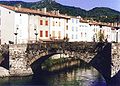
Quillan is located at the foothills of the Pyrenees, on the road between Carcassonne and Perpignan. The River Aude runs through the town. At the base of the mountains, fields of sunflowers and vineyards straddle the roads with snow-capped peaks in the distance.

The beaches of the Mediterranean are about an hour away. In the other direction, Carcassonne is a 45-minute drive, while Toulouse is one and a half hours away. Quillan is a medium-sized town 6 km from Espéraza, neighbouring the commune of Ginoles.

History

[edit]

Historically, Quillan was a stopping point on the ancient and winding road between Carcassonne and Perpignan. The River Aude traditionally carried timber and other local products to Carcassonne and the Canal du Midi. The town was particularly noted for hat making, and then later, the production of formica.[4]

With the construction of the toll-road joining Carcassonne to Perpignan via Narbonne, the town has moved away from production towards eco-tourism, tourism and outdoor pursuits such as rambling, biking, kayaking, rafting and walking.[citation needed] The surrounding area is rich in geographical and historical interest including many Cathar castles.

Population

[edit]
Historical population
YearPop.±% p.a.
1968 5,052—    
1975 5,168+0.32%
1982 4,663−1.46%
1990 4,031−1.80%
1999 3,745−0.81%
2007 3,605−0.48%
2012 3,448−0.89%
2017 3,258−1.13%
Source: INSEE[5]

Economy

[edit]

The town and surrounding villages are largely agricultural, producing milk, grapes, wine (including the Blanquette de Limoux), wheat, sunflowers, eggs and meat from poultry and cows. In the last few years, tourism has increased and during the warmer months many tourists flock to Quillan and its surroundings for outdoor activities, cultural events, and restaurants. There are many bed-and-breakfasts and rentals.

Culture

[edit]

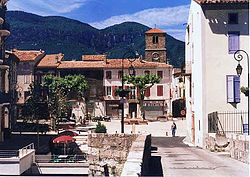
From 1996[6] to 2014,[7] a week-long Folklore Festival was held in August where dancers, musicians and singers from 10 or 12 different countries perform during the day and evening on the town square of Quillan.[8]

It is popular for whitewater rafting, canoeing, fishing and kayaking on the river Aude and other outdoor activities including cycling, hiking and running.[citation needed]

Transportation

[edit]

There is a 1 euro bus/train that goes from Quillan to Carcassonne and from Quillan to Perpignan, each day. The railway line from Carcassonne stops in Limoux and Espéraza but some train services have been replaced by buses. Using this service, it's about 50 minutes to Carcassonne and about 1.25 hours to Perpignan. From Perpignan it's an easy short train to Barcelona or up to Narbonne and the TGV lines that depart from the South of France. By car, Quillan is 45 minutes from Carcassonne and one and a half hours from Toulouse.

See also

[edit]

References

[edit]
[edit]
Revisions and contributorsEdit on WikipediaRead on Wikipedia
from Grokipedia
Quillan is a commune in the department of the Occitanie region in , situated at an altitude of 291 meters along the Aude River and surrounded by the foothills of the , including the distinctive "Three Pins" hills from which the town derives its name. With a of 2,992 inhabitants as of 2022, it serves as a key gateway to outdoor activities in the Pyrénées Audoises region, renowned for white-water rafting, , and along its river valleys and trails. Historically, Quillan traces its origins to the , when it was first mentioned as a possession of the archbishops of , who constructed a by the on the site of earlier Visigothic fortifications. The town expanded in the with a new district on the left bank of the , featuring a of narrow streets, and was fortified with ramparts during the amid regional conflicts, including the Wars of Religion that saw control alternate between Catholic and Protestant forces. Economically, Quillan prospered from a medieval tanning industry that evolved into 19th-century hat manufacturing—earning it the nickname "city of hats"—before shifting to boot and slipper production in the and briefly to manufacturing in the ; today, dominates, bolstered by its natural setting and facilities like the Lac du Saint-Bertrand for and . Notable landmarks include the 13th-century Château de Quillan, a square-planned structure with four turrets offering panoramic views, originally an administrative seat for the archbishops and later damaged in wars before serving as a quarry. The 17th-century Notre-Dame-des-Olives church and the ancient stone-arched bridge over the Aude highlight the town's medieval heritage, while modern amenities such as a large municipal swimming pool and proximity to rail lines connect it to nearby Limoux (30 km north) and the broader Cathar Country. On January 1, 2016, the neighboring commune of Brenac was merged into Quillan, expanding its territory to approximately 34.6 square kilometers with a population density of 86.4 inhabitants per km². The local economy features a 55.9% employment rate among those aged 15-64, with significant public administration and commerce sectors, and a median income of €18,670 per consumption unit in 2021.

Geography and Environment

Location and Topography

Quillan is situated in the department of the Occitanie region in , at the coordinates 42°52′34″N 2°10′57″E. It lies within the administrative boundaries of the department, serving as a key commune in the Upper Aude Valley and acting as a gateway to the mountains. The town is approximately 8 km north of Espéraza, enhancing its connectivity within the regional landscape. The topography of Quillan is characterized by its position in the foothills of the , forming part of the varied terrain of the Pyrénées Audoises area, which features rolling hills, deep valleys, and forested slopes. Elevations range from a low of 261 meters to a high of 1,122 meters, with an average around 291 meters near the town center. The commune covers an area of 34.63 km², which expanded following the merger with the neighboring commune of Brenac on January 1, 2016, incorporating additional mountainous terrain into its boundaries. The Aude River bisects the town, shaping its central geography and supporting the local hydrology through its flow from the eastward. Surrounding the commune are steep mountain ridges and narrow valleys typical of the Upper Aude Valley, contributing to a diverse geological context influenced by the broader Pyrénées Audoises natural environment, where rivers and streams play a vital role in drainage and support.

Climate and Ecology

Quillan experiences an (Cfb under the Köppen-Geiger system) with influences from the Mediterranean and . The average annual temperature is approximately 13°C, with precipitation totaling around 894 mm yearly, predominantly during wetter winters. Seasonal variations are moderate, featuring mild summers with an average temperature of 21°C in and cooler winters averaging 5°C in . Proximity to the introduces occasional snowfall in winter, with data derived from regional monitoring stations. Summers remain relatively dry, while autumn and spring see increased rainfall, contributing to the area's transitional Mediterranean-Pyrenean character. Ecologically, Quillan lies in a biodiversity-rich transition zone, with riparian ecosystems along the River supporting diverse fish species such as (Salmo trutta) and grayling (), alongside bird populations including cormorants (Phalacrocorax carbo). Forested uplands feature mixed stands of oaks (Quercus spp.), (Pinus sylvestris), and beeches (), enhancing habitat connectivity. The area's inclusion in the Parc Naturel Régional Corbières-Fenouillèdes, established in 2021, promotes conservation through designations, protecting over 240 heritage species and fostering sustainable land use. The region faces environmental challenges from flood risks posed by the Aude River, with historical inundations recorded, including events in 2020. Post-2016 communal merger with Brenac, Quillan has advanced sustainable water management via the Schéma d'Aménagement et de Gestion des Eaux (SAGE) for the Haute Vallée de l'Aude, emphasizing flood prevention, resource preservation, and integrated basin planning.

History

Early Settlement and Medieval Period

Archaeological evidence from the Aude Valley indicates early human presence dating back to the period, with the site of Saint Quirgue near Quillan revealing an enclosure defined by dry-stone walls, possibly an , alongside protohistoric artifacts such as quern fragments, incineration burials containing bronze fibulae from the early 5th century BCE, and ceramics including urns and jars. These finds suggest continuous occupation through the and s, with Iron Age materials reflecting regional cultural influences potentially linked to Celtic groups in southern . During the Roman era, Quillan hosted a settlement known as Calianum on the right bank of the River (then called the Atax), positioned along key trade routes in the that facilitated connections between and . The site's strategic location in the narrow supported early economic activities, though specific Roman infrastructure like roads or villas remains sparsely documented locally. By the early medieval period, Quillan emerged as a fortified settlement; its first historical mention dates to 781 CE as villae Quilianus, associated with a Visigothic fortress under the control of the of . In 844 CE, King Charles the Bald ordered the return of Quilhanus to the archbishop, affirming ecclesiastical authority amid Carolingian conflicts. The medieval period marked Quillan's growth as a hub for regional trade and defense, bolstered by its crossroads position in the Valley. By 1125 CE, the site featured fortifications on a hill overlooking the river, initially held by the family, viscounts of , before being seized in the late 12th century by . The Cathar heresy, prevalent in the region, drew the (1209–1229), during which Simon de Montfort captured Quillan around 1210 as part of the archbishop's domains, granting it to his ally Guy de Lévis; this event prompted strengthened local fortifications to counter the heresy and secure trade paths. Post-crusade, in 1232 CE, the archbishops of rebuilt the castle on the fortress ruins as their administrative center, featuring a square plan with corner towers. King Louis IX elevated Quillan to town status with a in 1247 CE, fostering markets and bridges across the to support commerce and around emerging religious sites, including the 14th-century Romanesque Notre-Dame de l'Assomption Church. Through the 13th to 15th centuries, under Narbonne's archbishops and later French royal oversight, Quillan served as a vital defensive and economic node, with further enhancements during the in 1394 CE. In the 16th and 17th centuries, during the Wars of Religion (1562–1598), control of the town and castle alternated between Catholic and Protestant forces, leading to conflicts, damage, and the reinforcement of ramparts.

Industrial Era and Modern Developments

The industrialization of Quillan began in the mid-19th century, evolving from a medieval tanning industry and driven by the establishment of hat-making workshops that capitalized on local resources from the surrounding Pyrenean foothills. By the late 1800s, the sector had expanded significantly, with several factories operating in the town and the surrounding Haute Vallée de l'Aude, including major ones like Jean Bourrel that employed up to 1,200 workers at its peak in the early ; the region produced hundreds of thousands of felt hats annually, with individual factories contributing around 135,000. This growth was fueled by steam-powered machinery introduced during the , transforming Quillan into a key center for chapellerie in the valley. The hat industry faced sharp decline after due to changing fashion trends and synthetic material competition, leading to factory closures and economic strain during the mid-20th century. In response, several facilities pivoted to producing laminates starting in the early 1950s, with the first plant established in 1952 in a repurposed hat workshop; this shift made Quillan France's primary production hub for nearly 50 years, employing up to 200 workers and supporting the local economy through the 1980s. However, the factory's closure in 2004 triggered unemployment spikes, exacerbating post-war vulnerabilities compounded by the impacts of both , which had disrupted supply chains and labor during conflicts. The 1999 floods in the Aude department further hindered industrial recovery by damaging infrastructure and delaying redevelopment efforts in the region. In the , Quillan underwent administrative changes with its 2016 merger with the neighboring commune of Brenac, effective January 1, which expanded the municipal area by approximately 13.7 square kilometers and integrated Brenac's 214 residents to bolster administrative efficiency and state funding. Post-2000, the town transitioned toward eco-tourism, leveraging its natural surroundings for amid the decline of . This shift has been supported by EU-funded upgrades, including riverbank protections and green pathways, alongside regional Occitanie policies such as the Plan Cœur de Ville initiative, which has funded urban revitalization projects like street rehabilitations to enhance attractiveness and economic resilience since 2018.

Demographics and Society

The population of Quillan reached its historical peak of 5,168 inhabitants in 1975, following a slight increase from 5,052 in 1968. Thereafter, the commune experienced a steady decline, dropping to 3,288 by 2016 and further to 2,992 in 2022, reflecting broader patterns of rural depopulation in . As of 2025 estimates, the population is approximately 2,851 inhabitants. This resulted in a of 86.4 inhabitants per square kilometer in 2022. The 2016 merger with the neighboring commune of Brenac incorporated additional territory and residents, contributing to a temporary stabilization in figures immediately following the administrative change. Recent demographic trends indicate an aging , with 68.4% of residents aged 45 and older in 2020, including 26.9% between 60 and 74 years and 19.2% aged 75 and over. Birth rates remain low at 5.5 per 1,000 inhabitants in 2020, consistent with rural French communes where is below the national average. Migration patterns have driven much of the decline, with younger residents outflowing to nearby urban centers in search of employment opportunities, exacerbating rural depopulation. Counterbalancing this to some extent is an influx of retirees, drawn to the area's natural appeal, alongside seasonal eco-tourists supporting local stability.

Education and Healthcare

Quillan maintains a robust local education system tailored to its rural community, encompassing public institutions from through secondary levels. The primary education sector includes the École Maternelle Publique , located at Allée Georges , which caters to young children, and the École Primaire Publique Paulin Nicoleau at Rue de Picaussel, serving students up to age 11. These schools collectively educate the town's younger population, emphasizing foundational skills in a small-town setting. Secondary education is provided by the Collège Michel Bousquié on Avenue , a offering general and preparatory curricula for students aged 11 to 15, under the direction of Mme Florence Fischer. For upper , the Lycée Professionnel Edouard Herriot at 1 Avenue Président Herriot focuses on vocational in fields such as industry and services, preparing students for local opportunities. While Quillan hosts this professional lycée, general academic lycées are accessible in nearby , approximately 28 km away, supporting broader educational pathways. Higher education opportunities for Quillan residents are primarily accessed through regional universities, including the Université de Via Domitia in Perpignan, about 100 km east, and institutions in , roughly 150 km north, which offer degrees in various disciplines including those relevant to the local economy. is supported through departmental resources like the Maison Départementale des Solidarités in Quillan, which facilitates training programs, including skills development aligned with and local services to aid workforce integration. Community initiatives in schools, such as environmental awareness tied to the region's , complement formal education by fostering ties to the valley's natural heritage. Healthcare in Quillan emphasizes accessible within its rural context, with services centered on a multi-professional health house, the Maison de Santé Pluriprofessionnelle de la Haute Vallée de l'Aude, which coordinates general practitioners and specialists. Local doctors, such as Dr. Jean-Paul Didden at the Centre Médical Pasteur on 23 Avenue de la Jonquière, provide routine consultations, supported by multiple pharmacies including Pharmacie Wissemer-Marty at 2 Rue Jules Ferry and Pharmacie Fouet-Chaubet at 2 Boulevard Jean Jaurès. For advanced care, the Centre Hospitalier de Limoux-Quillan, located in nearby (28 km away), offers medical consultations, rehabilitation, and an Ehpad for elderly residents. Hospital services beyond local capabilities are available at the Centre Hospitalier de , approximately 52 km from Quillan, reachable in about 45-50 minutes by car, ensuring emergency access for the . Post-2010s initiatives in the department have strengthened these provisions through expanded multi-professional houses and outreach, addressing challenges like physician shortages and supporting an aging population via programs integrated with the Limoux-Quillan center's Ehpad facilities. These efforts reflect broader French policies to enhance in underserved areas, with outreach focusing on preventive services for seniors amid demographic shifts toward older residents.

Economy

Agriculture and Local Production

Quillan's agricultural sector is characterized by small-scale, family-run farms that emphasize diverse, terroir-driven production in the Haute-Vallée de l'Aude. Primary crops include vineyards cultivated for sparkling wines such as under the AOP designation, alongside cereals like and oilseeds such as sunflowers, which thrive in the valley's fertile soils. Livestock farming focuses on production from cows, , and sheep, yielding , cheeses, and artisanal products, while , , , and lamb contribute to meat output. These operations reflect a blend of traditional methods and modern adaptations, with many farms integrating mixed cropping and pastoral systems to maintain . Local specialties highlight the region's unique offerings, including Aude Valley olives pressed into extra-virgin oils and varietal honeys from diverse floral sources, often produced under organic standards. Cooperative markets in Quillan, such as the Marché des Producteurs de Pays, facilitate direct sales from these small farms, fostering community ties and economic resilience by connecting producers with consumers. Dairy products like and cow cheeses from nearby estates exemplify this focus on quality over volume. EU subsidies through the (CAP) have supported transitions to since the 2010s, aiding conversions that now represent a significant portion of local operations and promoting in the Pyrenean . Farmers in Quillan face ongoing challenges from climate variability, including persistent droughts that have reduced water availability and impacted crop and livestock yields across the department. These conditions, exacerbated by rising temperatures, have prompted a shift toward sustainable practices aligned with the EU Green Deal, such as water-efficient irrigation and to mitigate and enhance resilience. This evolution underscores the sector's adaptation to environmental pressures while preserving its role in systems.

Tourism and Services

Quillan's tourism industry leverages its position in the Aude Valley to offer outdoor adventures centered on water and mountain activities. The Aude River provides world-class opportunities for whitewater sports, including , canoeing, , and swim descents, primarily through the Centre Sports Nature de la Forge, a dedicated facility for nature-based pursuits. trails in the nearby Pyrénées Audoises start from the town, allowing access to diverse terrains ranging from forested paths to high-altitude routes, appealing to both casual walkers and experienced trekkers. These attractions are enabled by the valley's topography, with the river's gorges and surrounding peaks creating ideal conditions for such sports. Accommodations cater to adventure seekers and families, featuring guesthouses (chambres d'hôtes), campsites, and holiday rentals. The Centre Sports Nature de la Forge includes a youth hostel, gîte d’étape for hikers, and group camping options, while Camping La Sapinette offers 41 pitches with electric hookups, 23 chalets for 4-6 people, and amenities like a overlooking the . Since the early , agritourism has expanded through gîtes—rural lodgings often tied to local farms—providing stays that integrate visitors with the area's natural and agricultural heritage, as promoted by networks like . The bolsters with retail shops selling outdoor gear and local products, alongside restaurants highlighting Aude wines and regional cuisine, such as those in the town center and near the river. This sector has grown as a key economic driver in the department, where ranks as the leading activity, supporting the transition from industrial decline—exemplified by the 2004 closure of the factory—to service-oriented employment. Eco-tourism initiatives emphasize , including proposals for a greenway path between and Quillan to connect existing attractions and promote low-impact travel. Quillan's proximity to , about 110 kilometers by road, has fostered cross-border visitors since the , with the town serving as a French gateway for those exploring the from the . Infrastructure like charging stations further aids eco-conscious .

Culture and Heritage

Cultural Events and Festivals

Quillan hosts a variety of recurring cultural events that emphasize its regional heritage and community spirit, drawing participants from local associations and international visitors alike. The most prominent was the International Folklore Festival of the Pyrénées Audoises, established in 1996 and held annually through 2014 each August for a full week. This event showcased , music, and performances by groups from 10 to 12 countries, taking place in the town square with daytime and evening shows that highlighted global traditions. Local associations continue to organize diverse gatherings, including annual competitions along the River, such as the Fête de la Pêche at Lac du Saint-Bertrand, which features contests and community activities for over 30 participants. Quillan also served as a key venue for the 2024 World Championship, an international event on the and nearby waters that attracted teams from 27 countries. Summer nights form another staple, integrated into the town's seasonal cultural program with concerts and performances during the August fêtes, fostering lively evenings of regional and contemporary sounds. Occitan language workshops, supported by local cultural groups, promote the preservation of the region's linguistic traditions through informal sessions and community classes. Additionally, La Romeria celebrates Quillan's Trans-Pyrenean ties with Spanish-influenced festivities honoring cross-border cultural exchanges. These events, often coordinated by resident associations, reflect a broader evolution from historical trade fair origins toward contemporary themes blending and culture, such as nature-integrated performances and sustainable gatherings in the . The town also hosts the annual , featuring Spanish and international cinema screenings.

Notable Landmarks and Traditions

Quillan boasts several notable landmarks that reflect its medieval heritage and industrial past. The Église Notre-Dame de l'Assomption, first mentioned in 930 and constructed in the with Romanesque stylistic elements, stands as a central historical site, featuring a classical portal from the 17th century and later 19th-century enlargements. The ruins of the old hat factories, particularly the former chapellerie Calbet-Bourrel site, serve as a heritage testament to the town's 19th- and 20th-century hat-making industry, which produced up to 135,000 felt hats annually in the early 1900s before transitioning to plastics; these structures are documented in regional cultural inventories. Medieval-era bridges over the River, such as the Pont Vieux with possible 11th- or 12th-century origins and a 17th-century stone reconstruction, facilitated trade and defense in the valley. Local traditions in Quillan are deeply rooted in Occitan , preserved through events like the Festival du Folklore International (1996–2014), which showcased regional dances, music, and stories from the area. Annual harvest celebrations emphasize communal gatherings tied to the agricultural calendar, reflecting broader Occitan customs of honoring seasonal yields in the Valley. The town's chapellerie legacy is documented through historical sites and regional museums, such as the Musée de la Chapellerie in nearby Espéraza, which preserves techniques of hat production using local and felt. Preservation efforts classify key sites under French heritage laws, with the Château de Quillan inscribed as a in 1954, while the church and factory ruins are included in the regional Mérimée inventory for cultural protection. Tourist trails, such as the GR 367 Sentier Cathare, link these landmarks, offering paths from Quillan to nearby Cathar sites like Puivert Castle and integrating interpretive markers on the 13th-century regional history. Unique aspects include Cathar history markers at the Château de Quillan, which served as a refuge during the 13th-century and highlights the heretic movement's influence in the . Pyrenean myths, such as tales of ancient mountain guardians and fairy lore from the Hautes-Pyrénées tradition, are woven into local storytelling during cultural events, blending regional legends with Occitan narratives.

Infrastructure and Transportation

Transport Networks

Quillan's transport networks primarily revolve around and rail connections that leverage its position in the Aude Valley, facilitating access to regional hubs like and while supporting local mobility and tourism. The primary access to Quillan is via the D118 highway from , approximately 53 kilometers away, with a driving time of about 45 minutes, and the D117 highway to , roughly 75 kilometers distant and taking around 1 hour and 20 minutes. Quillan also benefits from proximity to the A61 autoroute, with the nearest exit near , enabling efficient links to broader motorway networks for longer journeys. Rail services are provided by the TER Occitanie network, with the Quillan station serving as a key stop on the line to ; the line between and Quillan was suspended from 2018 to 2025 but has since resumed operations. While there is no directly in Quillan, passengers can transfer to services at . For connections to , transfers are available via . Fares on this line, including to major cities like , are subsidized at €1 for single tickets as part of the region's liO initiative to promote affordable regional travel. Local transport options include bus services such as the liO line 402, which operates within and connects Quillan to nearby areas like and Axat for intra-regional trips. Complementing these are bike paths along the River, offering scenic routes for cyclists exploring the valley, and dedicated parking facilities near the town center to accommodate tourists arriving by car. Recent developments since 2016 have enhanced cross-border connectivity, including road improvements along routes to , which is about a 1.5- to 2-hour drive from Quillan via the N20, aiding increased traffic to the principality. These networks collectively bolster Quillan's role as a transit point for tourists heading to Pyrenean destinations.

Public Services and Utilities

Quillan provides essential utilities through a combination of municipal and regional services. The municipal water supply is sourced primarily from the Aude River and local springs, managed under a delegation to Eau France, which ensures distribution and treatment compliant with national standards. Electricity is supplied via the town's municipal energy agency, EQO (Électricité de Quillan et de l'Ouest audois), a local that operates the regional grid and promotes energy efficiency. Waste management falls under the Communauté de Communes des Pyrénées Audoises, which oversees household , programs, and operates a dedicated déchetterie in Quillan for sorting recyclables, organic waste, and bulky items. Administrative services are centralized at the Mairie de Quillan, located at 17 Rue de la Mairie, which handles permits, civil registry, , and public markets. Since 2020, the town has expanded digital services, including online appointment booking for national ID cards and passports through the France Services platform, enhancing accessibility for residents. Public safety is supported by the Police Municipale, which manages local patrols, traffic control, and community alerts via a 24/7 tele-alert system established in 2016, contactable at 04 68 20 93 37. The fire station, Centre de Secours des Sapeurs-Pompiers de Quillan, provides emergency response services under the SDIS 11 (Service Départemental d'Incendie et de Secours de l'Aude), with ongoing recruitment to bolster volunteer and professional staff. Community facilities include the Médiathèque Municipale, offering books, digital resources, and cultural events with extended hours on weekdays and Saturdays to serve local needs. Sports infrastructure features centers like the Espace Cathare complex, which supports training in water sports such as on the River, catering to both recreational users and regional athletes. Broadband connectivity has seen significant expansion, with over 90% of households eligible for optic through points of mutualization managed by national providers as of mid-2025, addressing rural access challenges. Sustainability efforts align with EU directives on energy and waste, including energy efficiency programs through EQO that encourage reduced consumption and renewable integration. The town has pursued solar projects, such as a photovoltaic park project—with a building permit obtained in 2023 and construction commencing in 2024—to generate clean energy and support local economic returns, reflecting broader commitments to environmental standards. These initiatives tie into by enhancing service reliability for expanding residential demands.

References

Add your contribution
Related Hubs
User Avatar
No comments yet.