
Recent from talks
RAF Coltishall
Knowledge base stats:
Talk channels stats:
Members stats:
RAF Coltishall
Royal Air Force Coltishall more commonly known as RAF Coltishall (IATA: CLF, ICAO: EGYC) is a former Royal Air Force station located 10 miles (16 kilometres) north-north-east of Norwich, in the English county of Norfolk, East Anglia, which operated from 1939 to 2006.
It was a fighter airfield in the Second World War and afterwards, a station for night fighters, then ground attack aircraft until closure.
After longstanding speculation, the future of the station was sealed once the Ministry of Defence announced that the Eurofighter Typhoon, a rolling replacement aircraft, displacing the ageing SEPECAT Jaguar, would not be located there. The last of the Jaguar squadrons left on 1 April 2006, and the station finally closed, one month early and £10 million under budget, on 30 November 2006.
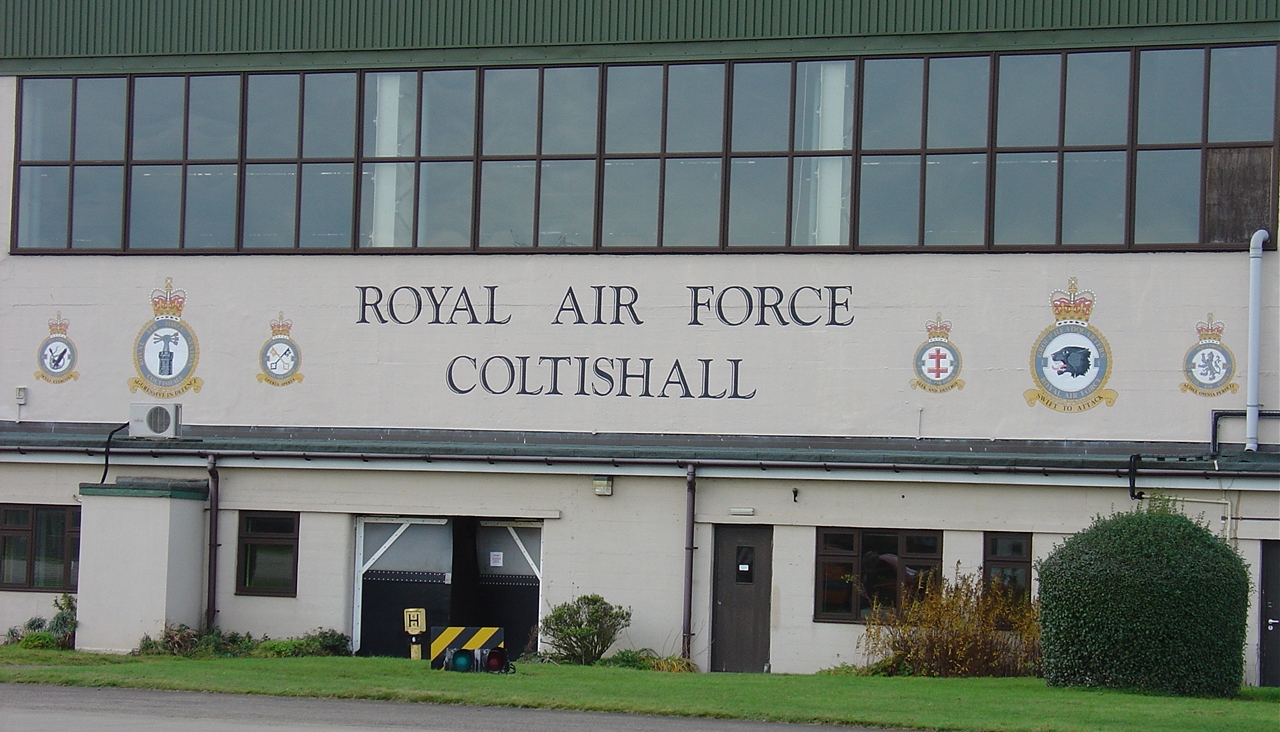
The station motto was Aggressive in Defence. The station badge was a stone tower surmounted by a mailed fist grasping three bind-bolts (blunt arrows), which symbolised a position of strength in defence of the homeland, indicative of the aggressive spirit which Coltishall fighter aircraft were prepared to shoot down the enemy.
Work on RAF Coltishall was started in February 1939. The airfield, then known as Scottow Aerodrome, was initially built as a bomber station, on land near Scottow Hall. Following the established tradition, the station would have been named after the nearest railway station, which would have made it RAF Buxton, but to avoid possible confusion with the town of Buxton in Derbyshire, it was named after the local village of Coltishall instead. The airfield was completed and entered service in May 1940 as a fighter base. The first aircraft movement at Coltishall was a Bristol Blenheim IV L7835 flown by Sergeant RG Bales and Sergeant Barnes.
During the Second World War, Coltishall operated the Hawker Hurricane. A notable Coltishall fighter pilot was Douglas Bader, appointed as leader of No. 242 Squadron, a mainly Canadian Hurricane squadron. They had suffered significant losses in the recent Battle of France, and he was credited with restoring their morale.
Coltishall later became home to night fighters. At the same time, the Royal Navy Fleet Air Arm operated aircraft from RAF Coltishall over the North Sea. From 10 February to 7 April 1945, it was the airfield for No. 124 Squadron, at that time a fighter-bomber squadron flying Supermarine Spitfire IX.HF's, whilst the squadron was bombing V-2 launch sites in the Netherlands. At the end of the war, Coltishall was briefly given over to Polish squadrons until they returned home.
In the 1950s, RAF Coltishall was a designated a 'V-bomber dispersal airfield', which V bombers tasked with delivery of the British nuclear deterrent; the Avro Vulcan, Handley Page Victor, and Vickers Valiant, could use in the event of their home station being damaged by enemy action.
Hub AI
RAF Coltishall AI simulator
(@RAF Coltishall_simulator)
RAF Coltishall
Royal Air Force Coltishall more commonly known as RAF Coltishall (IATA: CLF, ICAO: EGYC) is a former Royal Air Force station located 10 miles (16 kilometres) north-north-east of Norwich, in the English county of Norfolk, East Anglia, which operated from 1939 to 2006.
It was a fighter airfield in the Second World War and afterwards, a station for night fighters, then ground attack aircraft until closure.
After longstanding speculation, the future of the station was sealed once the Ministry of Defence announced that the Eurofighter Typhoon, a rolling replacement aircraft, displacing the ageing SEPECAT Jaguar, would not be located there. The last of the Jaguar squadrons left on 1 April 2006, and the station finally closed, one month early and £10 million under budget, on 30 November 2006.
The station motto was Aggressive in Defence. The station badge was a stone tower surmounted by a mailed fist grasping three bind-bolts (blunt arrows), which symbolised a position of strength in defence of the homeland, indicative of the aggressive spirit which Coltishall fighter aircraft were prepared to shoot down the enemy.
Work on RAF Coltishall was started in February 1939. The airfield, then known as Scottow Aerodrome, was initially built as a bomber station, on land near Scottow Hall. Following the established tradition, the station would have been named after the nearest railway station, which would have made it RAF Buxton, but to avoid possible confusion with the town of Buxton in Derbyshire, it was named after the local village of Coltishall instead. The airfield was completed and entered service in May 1940 as a fighter base. The first aircraft movement at Coltishall was a Bristol Blenheim IV L7835 flown by Sergeant RG Bales and Sergeant Barnes.
During the Second World War, Coltishall operated the Hawker Hurricane. A notable Coltishall fighter pilot was Douglas Bader, appointed as leader of No. 242 Squadron, a mainly Canadian Hurricane squadron. They had suffered significant losses in the recent Battle of France, and he was credited with restoring their morale.
Coltishall later became home to night fighters. At the same time, the Royal Navy Fleet Air Arm operated aircraft from RAF Coltishall over the North Sea. From 10 February to 7 April 1945, it was the airfield for No. 124 Squadron, at that time a fighter-bomber squadron flying Supermarine Spitfire IX.HF's, whilst the squadron was bombing V-2 launch sites in the Netherlands. At the end of the war, Coltishall was briefly given over to Polish squadrons until they returned home.
In the 1950s, RAF Coltishall was a designated a 'V-bomber dispersal airfield', which V bombers tasked with delivery of the British nuclear deterrent; the Avro Vulcan, Handley Page Victor, and Vickers Valiant, could use in the event of their home station being damaged by enemy action.
Recent media