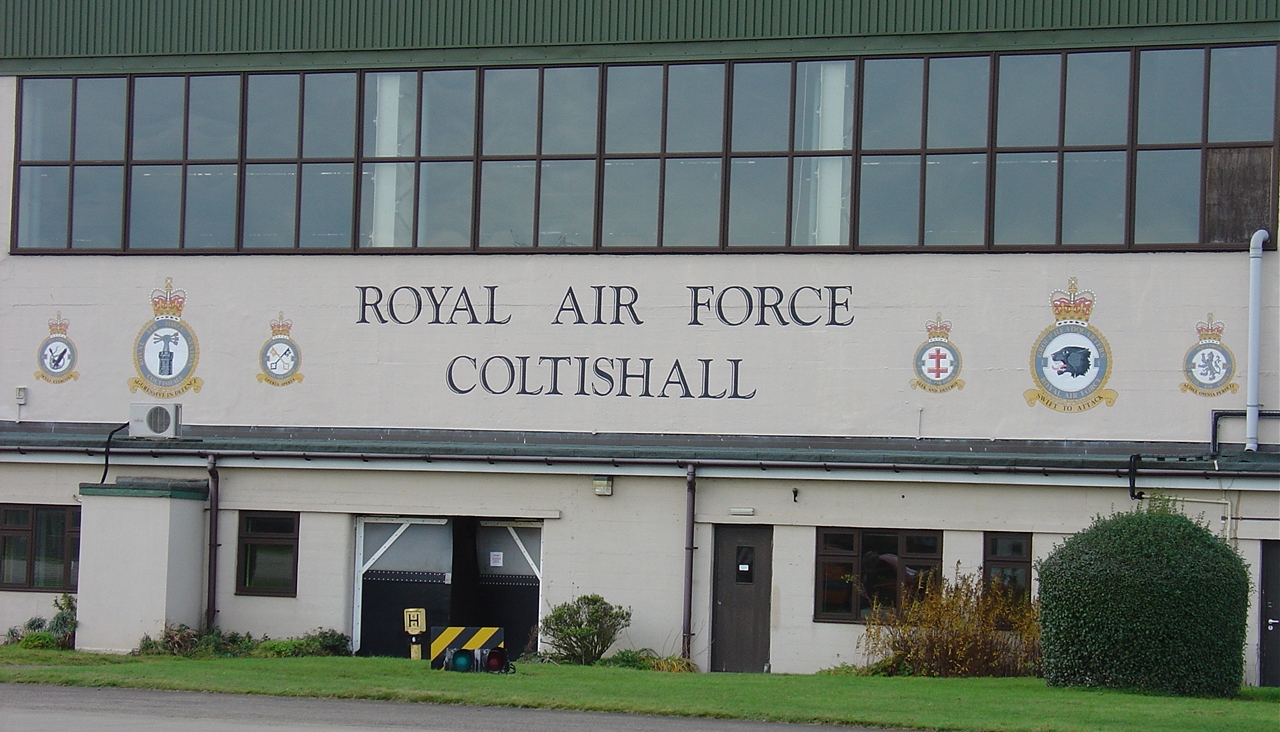

RAF Coltishall
View on Wikipedia
 | This article needs more citations. (December 2012) |
Royal Air Force Coltishall more commonly known as RAF Coltishall (IATA: CLF, ICAO: EGYC) is a former Royal Air Force station located 10 miles (16 kilometres) north-north-east of Norwich, in the English county of Norfolk, East Anglia, which operated from 1939 to 2006.[3]
Key Information


It was a fighter airfield in the Second World War and afterwards, a station for night fighters, then ground attack aircraft until closure.
After longstanding speculation, the future of the station was sealed once the Ministry of Defence announced that the Eurofighter Typhoon, a rolling replacement aircraft, displacing the ageing SEPECAT Jaguar, would not be located there. The last of the Jaguar squadrons left on 1 April 2006, and the station finally closed, one month early and £10 million under budget, on 30 November 2006.
The station motto was Aggressive in Defence.[4] The station badge was a stone tower surmounted by a mailed fist grasping three bind-bolts (blunt arrows), which symbolised a position of strength in defence of the homeland, indicative of the aggressive spirit which Coltishall fighter aircraft were prepared to shoot down the enemy.
History
[edit]Second World War
[edit]Work on RAF Coltishall was started in February 1939. The airfield, then known as Scottow Aerodrome, was initially built as a bomber station, on land near Scottow Hall. Following the established tradition, the station would have been named after the nearest railway station, which would have made it RAF Buxton, but to avoid possible confusion with the town of Buxton in Derbyshire, it was named after the local village of Coltishall instead. The airfield was completed and entered service in May 1940 as a fighter base. The first aircraft movement at Coltishall was a Bristol Blenheim IV L7835 flown by Sergeant RG Bales and Sergeant Barnes.
During the Second World War, Coltishall operated the Hawker Hurricane. A notable Coltishall fighter pilot was Douglas Bader, appointed as leader of No. 242 Squadron, a mainly Canadian Hurricane squadron. They had suffered significant losses in the recent Battle of France, and he was credited with restoring their morale.[5]
Coltishall later became home to night fighters. At the same time, the Royal Navy Fleet Air Arm operated aircraft from RAF Coltishall over the North Sea. From 10 February to 7 April 1945, it was the airfield for No. 124 Squadron, at that time a fighter-bomber squadron flying Supermarine Spitfire IX.HF's, whilst the squadron was bombing V-2 launch sites in the Netherlands. At the end of the war, Coltishall was briefly given over to Polish squadrons until they returned home.
Cold War
[edit]
In the 1950s, RAF Coltishall was a designated a 'V-bomber dispersal airfield', which V bombers tasked with delivery of the British nuclear deterrent; the Avro Vulcan, Handley Page Victor, and Vickers Valiant, could use in the event of their home station being damaged by enemy action.
Postwar, the station was home to a variety of units and aircraft, including de Havilland Mosquitos, Gloster Javelins and, from 1963, the Historic Aircraft Flight (now known as the Battle of Britain Memorial Flight or BBMF). RAF Coltishall became home to the RAF's first English Electric Lightning F.1s when No. 74 (Fighter) Squadron began to receive the jet in June 1960, after arriving the year before. No. 74 (F) Squadron relocated to RAF Leuchars in Scotland on 2 March 1964.[6] No. 226 Operational Conversion Unit (OCU) arrived at the base on 12 April 1964, tasked with training new pilots how to fly the Lightning. The last Lightnings left Coltishall in September 1974 when No. 266 OCU departed.[7]
The Lightnings were replaced by the Anglo-French SEPECAT Jaguar GR.1, with the first Jaguar unit, No. 54 (F) Squadron, arriving at Coltishall on 8 August 1974.[8] They were soon joined by No. 6 Squadron who arrived at the base in November 1974, making the station exclusively home to the Jaguar in terms of fixed wing aircraft.[9]

No. 41 (Designate) Squadron formed at RAF Coltishall on 1 October 1976, and worked up as a Jaguar unit until officially standing up on 1 April 1977, when the No. 41 Squadron operating the McDonnell Douglas Phantom FGR.2 at RAF Coningsby disbanded the previous day.[10]
In 1991, elements of all three based Jaguar units; Nos. 6, 41 and 54 Squadrons, along with associated support personnel deployed to Muharraq Airfield, Bahrain, in preparation for Operation Granby due to Saddam Hussein's invasion of Kuwait.[11]
Coltishall played host to several United States Air Force Coronet deployments during the Cold War:
- Coronet Heron – 12 to 23 June 1978 saw the deployment of 12 McDonnell Douglas RF-4C Phantom IIs from the 62nd Tactical Reconnaissance Squadron.[12]
- Coronet Joust – 23 June to 7 July 1983 saw the deployment of 12 RF-4C Phantom IIs from the 106th Tactical Reconnaissance Squadron (Alabama Air National Guard).[13]
- Coronet Mobile – 13 to 26 September 1986 saw the deployment of 11 RF-4C Phantom IIs from the 106th Tactical Reconnaissance Squadron (Alabama Air National Guard).[14]
1991 to closure
[edit]The Jaguars deployed again, this time to Incirlik Air Base, Turkey, to participate in Operation Warden which set up a no-fly zone over Iraq.[15] Between 1993 and 1995, the Jaguars deployed to Gioia del Colle Air Base, Italy, as part of Operation Deny Flight to enforce a no-fly zone over the Balkans. In 1997, No. 54 Squadron deployed to Italy once more in support of Operation Deliberate Guard.[16] No. 6 Squadron deployed once again to Incirlik in 1998 as part of Operation Resinate.[17]

On 21 July 2000, No. 16 (Reserve) Squadron, the Jaguar OCU, arrived at RAF Coltishall from RAF Lossiemouth, Scotland.[18] In December 2000, five Jaguars from No. 41 (F) Squadron deployed to Luleå Airport, Sweden, to train alongside Saab 37 Viggens of the Norrbotten Wing.[19]
Coltishall was also home to the yellow search and rescue (SAR) helicopters of No. 202 Squadron tasked with conducting air-sea rescue operations (Westland Sea King), and latterly No. 22 Squadron (Westland Wessex), but under subsequent reorganisation, the SAR operations were moved to RAF Wattisham, in Suffolk where they remained until 15 July 2015, following the privatisation (and thus disbandment) of the entire UK military search and rescue operations.
Coltishall eventually became the last surviving operational RAF fighter airfield involved in the Battle of Britain (other than RAF Northolt), and a visible remnant in the form of a Second World War revetment still stands adjacent to the north-west taxiway and, together with one of the two sets of 1950s Cold War blast walls, is now a scheduled monument.[20]
With the anticipated arrival of the Eurofighter Typhoon in the RAF, the gradual retirement of the Jaguar force began. Coltishall was not chosen as a future Typhoon airfield for a number of reasons, and so, with no future RAF role for Coltishall, the station was earmarked for closure.

The UK's Ministry of Defence, in the 'Delivering Security in a Changing World' review, announced that the station would close by December 2006. The first two Jaguar squadrons to disband, No. 16 (R) Squadron and No. 54 (F) Squadron, did so on 11 March 2005.[21] The final Jaguar squadrons departed on 1 April 2006, when No. 6 Squadron transferred to RAF Coningsby, however, this was subsequently disbanded on 31 May 2007 (to await delivery of the Eurofighter Typhoon at RAF Leuchars), and No. 41 (F) Squadron transferred to RAF Coningsby in OCU role. The final front line RAF movement from the station was by Jaguar XZ112, piloted by Jim Luke, on 3 April 2006.
Of the final gate guardians, the replica Hawker Hurricane (dedicated to Douglas Bader) was transferred to RAF High Wycombe, and the Jaguar was formally named the Spirit of Coltishall, and was subsequently transferred to the grounds of Norfolk County Council where she is dedicated to the memory of all those who served at Coltishall. RAF Coltishall is commemorated at the RAF Air Defence Radar Museum at Neatishead (which Coltishall formerly parented).
Some limited flying from light aircraft, including those of the Coltishall Flying Club, did continue after the end of RAF flying operations, until October 2006. While 1 April 2006 saw the disbandment parade for the station, it did not actually disband and finally close until 30 November 2006. Associated facilities such as the Douglas Bader Primary School for military dependents were also closed. On the final day of the station, the gates were opened to the public; anybody with photographic ID was welcomed onto the station to have a look around and view the final closing ceremony and parade, which saw a flypast by four RAF Jaguars, and a solitary Hawker Hurricane from the Imperial War Museum Duxford.
On 30 November 2006, RAF Coltishall was officially handed over to Defence Estates (the then MoD agency responsible for all UK Military sites) who were to handle the disposal of the site; it was then formally known as MoD Coltishall until its ultimate disposal.
The site was sold to Norfolk County Council for £4 million.[citation needed]
Station commanders
[edit]_fighter_pilot_in_a_Hawker_Hurricane_of_No._257_Squadron_RAF,_circa_1941.jpg)
- Note: The ranks shown are the ranks held at the time of holding the appointment of commanding officer, Royal Air Force Coltishall.
| date from | date to | rank | name |
|---|---|---|---|
| 15 May 1940 | 9 January 1941 | Wing Commander | W K Beisiegal |
| 9 January 1941 | 11 September 1942 | Group Captain | Ronald Lees |
| 11 September 1942 | 20 April 1943 | Group Captain | George D Harvey |
| 20 April 1943 | 10 December 1943 | Group Captain | Arthur V Harvey |
| 10 December 1943 | 25 May 1945 | Group Captain | A H Donaldson |
| 25 May 1945 | 9 August 1945 | Group Captain | A H Dunn |
| 9 August 1945 | 27 February 1946 | Group Captain | T H Rolski |
| 27 February 1946 | 13 February 1947 | Group Captain | Aleksander Gabszewicz |
| 13 February 1947 | 22 January 1948 | Wing Commander | Robert Stanford Tuck |
| 22 January 1948 | 6 March 1950 | Wing Commander | Denis Spotswood |
| 6 March 1950 | 1 February 1951 | Wing Commander | E L Colbeck-Welch |
| 1 February 1951 | 8 May 1953 | Group Captain | A H Smythe |
| 8 May 1953 | 12 December 1955 | Group Captain | P P Hanks |
| 12 December 1955 | 25 November 1958 | Group Captain | John Clayton Sisson CBE DFC |
| 25 November 1958 | 1 June 1959 | Wing Commander | W Laing |
| 1 June 1959 | 15 November 1961 | Group Captain | Harold A C Bird-Wilson |
| 15 November 1961 | 1 November 1963 | Group Captain | L H Malins |
| 1 December 1963 | 3 June 1966 | Group Captain | R L Topp |
| 4 June 1966 | 3 January 1969 | Group Captain | M E Hobson |
| 3 January 1969 | 20 November 1969 | Group Captain | W J Stacey |
| 20 November 1969 | 18 November 1971 | Group Captain | J T Jennings |
| 18 November 1971 | 28 December 1973 | Group Captain | J A Gilbert |
| 28 December 1973 | 6 August 1976 | Group Captain | L Swart |
| 6 August 1976 | 6 September 1978 | Group Captain | J H Honey |
| 6 September 1978 | 15 October 1980 | Group Captain | T H Stonor |
| 15 October 1980 | 3 December 1982 | Group Captain | T J Nash |
| 3 December 1982 | 8 February 1985 | Group Captain | G R Profit |
| 8 February 1985 | 4 June 1987 | Group Captain | M R French |
| 4 June 1987 | 2 August 1989 | Group Captain | F J Hoare |
| 3 August 1989 | 16 August 1991 | Group Captain | M J Abbott |
| 16 August 1991 | 5 July 1993 | Group Captain | J P Dacre |
| 5 July 1993 | 28 July 1995 | Group Captain | N C Rusling |
| 28 July 1999 | 5 September 1997 | Group Captain | T C Hewlett |
| 5 September 1997 | 5 September 1999 | Group Captain | Stephen G G Dalton |
| 6 September 1999 | 5 October 2001 | Group Captain | Chris N Harper |
| 6 October 2001 | 28 November 2003 | Group Captain | R D Cobelli |
| 28 November 2003 | 2006 | Group Captain | Graham A Wright, OBE |
| 2006 | 13 October 2006 | Wing Commander | Paul Robins[22] |
| 13 October 2006 | 30 November 2006 | Squadron Leader | Jason Hughes[23] |
Coltishall squadrons
[edit]

_SEPECAT_Jaguar_T4_XX838_%27FZ%27_of_41_Squadron_from_RAF_Coltishall_at_a_hardened_aircraft_shelter_(HAS)_dispersal_somewhere_in_RAF_Germany_(RAFG)_in_2005.jpg)

- No. 1 Squadron RAF;[24] Spitfire LFIXb, F21
- No. 6 Squadron RAF;[24] Jaguar GR1/1A/1B, T2/T2A, GR3/3A, T4/T4A (November 1974 – April 2006)
- No. 16 Squadron RAF[24] (? – March 2005) (Squadron Standard now laid up in Notre-Dame Cathedral Saint-Omer, France)
- No. 22 Squadron RAF;[24] Beaufort I, II, Whirlwind HAR2, HAR10, Wessex HAR2
- No. 23 Squadron RAF;[24] Mosquito NF36, Vampire NF10, Venom NF2, NF3, Javelin FAW4, FAW7, FAW9R
- No. 25 Squadron RAF;[24] Mosquito VI, XVII, NFXXX
- No. 26 Squadron RAF[24]
- No. 29 Squadron RAF;[24] Beaufighter IF, VIF
- No. 41 Squadron RAF;[24] Javelin FAW4, Jaguar GR1/1A/1B, T2/T2A, GR3/3A, T4/T4A (1976 – April 2006)
- No. 42 Squadron RAF;[24] Beaufort I, II
- No. 54 Squadron RAF;[24] Jaguar GR1/1A/1B, T2/T2A, GR3/3A, T4/T4A (August 1974 – March 2005) (Squadron Standard now laid up in Norwich Cathedral)
- No. 64 Squadron RAF;[24] Spitfire I, Vb, LEVc
- No. 66 Squadron RAF;[24] Spitfire I
- No. 68 Squadron RAF;[24] Beaufighter IF, VI, Mosquito XVII, XIX, XXX
- No. 72 Squadron RAF;[24] Spitfire I
- No. 74 Squadron RAF[24] 'Tigers'; Spitfire IIa, Hunter F6, Lightning F1, F3 (1940, 1960–1966)
- No. 80 Squadron RAF;[24] Tempest V
- No. 93 Squadron RAF;[24] Havoc I
- No. 109 Squadron RAF[24]
- No. 118 Squadron RAF;[24] Spitfire Vb
- No. 124 Squadron RAF;[24] Spitfire XI
- No. 125 Squadron RAF;[24] Mosquito XIV, XXX
- No. 133 Squadron RAF;[24] one of the American-piloted Eagle Squadrons formed 1941, Hurricane IIb
- No. 137 Squadron RAF;[24] Whirlwind I
- No. 141 Squadron RAF;[24] Mosquito NF36, Meteor NF11, Venom NF3, Javelin FAW4
- No. 151 Squadron RAF;[24] Hurricane I, IIb, IIc, Defiant I
- No. 152 Squadron RAF;[24] Spitfire IIa
- No. 154 Squadron RAF;[24] Spitfire Va, Vb
- No. 195 Squadron RAF;[24] Typhoon Ib
- No. 202 Squadron RAF;[24] Whirlwind HAR10, Sea King HAR3
- No. 222 Squadron RAF;[24] Spitfire Ia, IIa, IIb
- No. 226 Squadron RAF OCU;[24] Lightning F1, F1A, F3, T4, T5, T55
- No. 228 Squadron RAF;[24] Whirlwind HAR10
- No. 228 Squadron RAF OCU;[24] Mosquito (various), Meteor (various)
- No. 229 Squadron RAF;[24] Spitfire XI, XVI
- No. 234 Squadron RAF;[24] Spitfire Vb, Vc
- No. 242 Squadron RAF;[24] Hurricane I
- No. 255 Squadron RAF;[24] Beaufighter IIF
- No. 257 Squadron RAF;[24] Hurricane I, IIa, IIb, IIc
- No. 264 Squadron RAF;[24] Mosquito NF36
- No. 266 Squadron RAF;[24] Typhoon Ia, Ib
- No. 274 Squadron RAF;[24] Tempest V
- No. 275 Squadron RAF;[24] Sycamore HR13, HR14
- No. 278 Squadron RAF;[24] Lysander IIa, Walrus I, II, Anson I
- No. 288 Squadron RAF;[24] Hurricane I, Defiant TT II/III
- No. 303 Polish Fighter Squadron;[24] Spitfire IX, Mustang IV (1944, 1945)
- No. 306 Polish Fighter Squadron;[24] Mustang III
- No. 307 Polish Night Fighter Squadron;[24] Mosquito XXX
- No. 309 (Polish) Squadron;[24] Mustang III, IV
- No. 312 (Czechoslovak) Squadron RAF;[24] Spitfire XI
- No. 315 (Polish) Squadron;[24] Mustang III
- No. 316 (Polish) Squadron;[24] Mustang III
- No. 318 (Polish) Squadron RAF;[24] Spitfire IX
- No. 409 Squadron RCAF;[24] Beaufighter VI
- No. 453 Squadron RAAF;[24] Spitfire IX
- No. 488 Squadron RNZAF;[24] Beaufighter II
- No. 602 Squadron RAF;[24] Spitfire IX, XVI
- No. 603 Squadron RAF;[24] Spitfire XVI (1945)
- No. 604 Squadron RAF;[24] Beaufighter I
- No. 610 Squadron RAF; Spitfire Vb, Vc[citation needed]
- No. 611 Squadron RAF;[24] Spitfire IX
- No. 616 Squadron RAF;[24] Spitfire I
- 809 Naval Air Squadron, Fleet Air Arm;[24] Sea Hornet F20, NF21
- 819 Naval Air Squadron, Fleet Air Arm;[24]
- 841 Naval Air Squadron, Fleet Air Arm;[24] Albacore I, Swordfish I, II
- 849 Naval Air Squadron, Fleet Air Arm;[24] Gannett AEW3, COD4, T5
Units
[edit]The following units were here at some point:
- Battle of Britain Memorial Flight (June 1969 - March 1976)[25]
- Air Fighting Development Squadron (September 1959 - October 1962)[26]
- US 346th Fighter Squadron;[24]
- US 17th Night Fighter Squadron[24]
- No. 11 Fighter Command Servicing Unit[24]
- No. 12 Group Target Towing Flight (August - October 1941)[27]
- No. 13 Fighter Command Servicing Unit[24]
- No. 1489 (Target Towing) Flight (December 1941 - May 1942) became No. 1489 (Fighter) Gunnery Flight (May 1942 - April 1943) [28]
- No. 2719 Squadron RAF Regiment[24]
- No. 2725 Squadron RAF Regiment[24]
- No. 2735 Squadron RAF Regiment[24]
- No. 2812 Squadron RAF Regiment[24]
- No. 2885 Squadron RAF Regiment[24]
- No. 3206 Servicing Commando[24]
- No. 3210 Servicing Commando[24]
- Eastern Sector HQ (January 1947 - July 1958)[29]
- Fighter Command Navigation Radio Conversion Flight[24]
- Jaguar Training Flight[24]
- Lightning Conversion Squadron RAF (January 1960 - August 1961)[30]
- Lightning Special Engineering Project Team (April 1972 - April 1974)[30]
Redevelopment
[edit]The former married quarters were transferred to the MoD's preferred property agents, Annington Homes, who started a lengthy process of upgrading the former military housing into civilian houses for sale on the open market.
During January 2007, the Home Office expressed an interest in the site, and in early February earmarked it for potential use as an immigration detention facility, but this was subsequently ruled out.
In July 2007, a petition was set up on the 10 Downing Street website to campaign for Coltishall to be reopened as a civil airfield.
In December 2007, fresh reports in the media suggested the site would be used as a prison, but this angered local residents who had not been informed of the disposal progress.
In January 2009, plans to build a Category C prison at the site was approved by North Norfolk District Council (NNDC).[31] The entire technical site then became under the control of the Ministry of Justice (MoJ), and building works to convert all of the former male single-persons living accommodation H-blocks and the Junior Ranks Mess and NAAFI social club, along with the completion of the dual perimeter fences, and a new access road began in 2009. This new establishment became known as HM Prison Bure, named after the nearby River Bure, can house over 500 male sex offenders.[32]
On 19 July 2010, North Norfolk District Council proposed that the entire site should be designated as a conservation area (United Kingdom) because of its historical and architectural interest.[33]
In 2013, the remainder of the former RAF Coltishall technical site became known as the Scottow Enterprise Park, taking up approximately 600 acres of the former RAF base. Its repurposed military buildings are now home to tenants in industries from construction to film.[34]
In April 2015, Scottow Moor Solar Limited built a 32 megawatts (43,000 electric horsepower) solar farm on the site.[35] In April 2016, another 18 megawatts (24,000 electric horsepower) of solar panels were added, bringing the solar farm's total capacity to 50 megawatts (67,000 electric horsepower).[36]
In June 2019, a British aircraft manufacturer became established at the airfield. Swift Aircraft have been allowed to produce up to 98 aircraft a year, and use its runway for up to eight flights per day by the local government. This will employ roughly 100 local people.[citation needed]
The main guardroom has been turned into a Heritage Centre documenting the history of the site.[37]
Heritage
[edit]Station badge and motto
[edit]RAF Coltishall's badge, awarded in January 1953, features a fortified tower with a clenched gauntlet holding three blue arrows (bind bolts). The tower relates to the strength in defence of the station. The gauntlet and arrows represent the fighter aircraft based at the station and their aggressive nature.[38]
The station's motto is 'Aggressive in Defence'.[4]
Gate guardians
[edit]

Prior to closure, Coltishall had two gate guardians. The first (on display outside the main gate and security fence) was a Jaguar S which was an airframe formed from various Jaguars, including the front fuselage of XW563. It arrived from RAF Brüggen in 2001 and was on display at the main gate until February 2007 when it was relocated to Norfolk County Hall.[39]
A replica fibreglass Hawker Hurricane was on display on the roundabout in front of Station Headquarters from 1989, until it was relocated to RAF High Wycombe in October 2006.[40]
Built heritage
[edit]In September 2010, the former RAF Coltishall site was designated as a conservation area by North Norfolk District Council and Broadland District Council.[41]
Parts of the airfield were designated as scheduled monuments in March 2008. The designation covers a single Second World War era aircraft dispersal point (labeled as a 'fighter pen') and eight pairs of Cold War era dispersal revetment blast walls dating from the 1950s. Historic England describes the blast walls as rare and outstandingly well preserved.[42]
The former Officers' Mess was designated as a grade II listed building in October 2017. The neo-Georgian style building was built between 1939 and 1940.[43]
On July 18, 2024, Jaguar XZ384 left storage RAF Cosford arriving on July 19 at the former RAF Coltishall, where it has been placed as an exhibit next to the Java Bean Cafe and Coffee Roasters on site. [44]
See also
[edit]References
[edit]Citations
[edit]- ^ a b Falconer 2012, p. 68.
- ^ Birtles 2012, p. 30.
- ^ Official Commemorative Magazine: Royal Air Force Coltishall, 65th Anniversary, 'Aggressive in Defence' 1940-2005
- ^ a b Pine, L.G. (1983). A dictionary of mottoes (1 ed.). London, England: Routledge & Kegan Paul. p. 7. ISBN 0-7100-9339-X.
- ^ see "Douglas Bader 1910-1982" at 18:45 – via YouTube.
- ^ "No 74 Squadron". Air of Authority – a history of RAF organisation. Retrieved 10 April 2020.
- ^ "226 Operational Conversion Unit". Air of Authority – a history of RAF organisation. Retrieved 10 April 2020.
- ^ "No 54 Squadron". Air of Authority – a history of RAF organisation. Retrieved 10 April 2020.
- ^ "No 6 Squadron". Air of Authority – a history of RAF organisation. Retrieved 10 April 2020.
- ^ "No.41 Squadron". nationalcoldwarexhibition.org. Royal Air Force Museum. Retrieved 4 April 2020.
- ^ "British Forces involved in Operation Granby". RAF.MoD.uk. Royal Air Force. Archived from the original on 4 March 2016. Retrieved 10 April 2020.
- ^ "Deployments – 1978". Sharpshooter – Military Aviation Journal. Archived from the original on 18 August 2004. Retrieved 10 April 2020.
- ^ "Deployments – 1983". Sharpshooter – Military Aviation Journal. Archived from the original on 18 August 2004. Retrieved 10 April 2020.
- ^ "Deployments – 1986". Sharpshooter – Military Aviation Journal. Archived from the original on 18 August 2004. Retrieved 10 April 2020.
- ^ "41 Squadron: Seek and Destroy". Air-Scene UK. Archived from the original on 5 April 2016. Retrieved 10 April 2020.
- ^ "No.54 Squadron". NationalColdWarExhibition.org. Royal Air Force Museum. Retrieved 4 April 2020.
- ^ "6 Squadron - 1991–2003". 6 Squadron RAF Association. 13 January 2017. Retrieved 10 April 2020.
- ^ "No 16 Squadron". Air of Authority – a history of RAF organisation. Retrieved 10 April 2020.
- ^ "Jaguars make history with deployment to Sweden". RAF.MoD.uk. RAF Coltishall. Archived from the original on 29 September 2003. Retrieved 10 April 2020.
- ^ Historic England. "World War II fighter pen, Cold War blast walls and associated remains at the airfield formerly known as RAF Coltishall (1021425)". National Heritage List for England. Retrieved 10 December 2012.
- ^ "Jaguar retirement". Target Aviation Photography. Archived from the original on 13 February 2012. Retrieved 10 April 2020.
- ^ "A final farewell to RAF Coltishall". Norwich.gov.uk (Press release). Norwich City Council. 2006. Archived from the original on 16 July 2011. Retrieved 12 October 2006.
- ^ "Spirit of Coltishall". AirSceneUK.org.uk. 2006. Archived from the original on 21 November 2008. Retrieved 30 November 2006.
- ^ a b c d e f g h i j k l m n o p q r s t u v w x y z aa ab ac ad ae af ag ah ai aj ak al am an ao ap aq ar as at au av aw ax ay az ba bb bc bd be bf bg bh bi bj bk bl bm bn bo bp bq br bs bt bu bv bw bx by bz "Coltishall". Airfields of Britain Conservation Trust. Retrieved 12 April 2020.
- ^ Sturtivant, Hamlin & Halley 1997, p. 81.
- ^ Sturtivant, Hamlin & Halley 1997, p. 55.
- ^ Sturtivant, Hamlin & Halley 1997, p. 188.
- ^ Sturtivant, Hamlin & Halley 1997, p. 136.
- ^ Sturtivant, Hamlin & Halley 1997, p. 104.
- ^ a b Sturtivant, Hamlin & Halley 1997, p. 201.
- ^ "Prison at old RAF base approved". BBC News.
- ^ "Norfolk ex-airbase jail to house sex offenders". Archant Regional Ltd. EDP24.co.uk. 11 August 2009. Retrieved 2 October 2009.
- ^ [1] Archived 18 July 2011 at the Wayback Machine
- ^ "Former RAF Coltishall site passes 500-worker milestone". EDP24.co.uk. 22 August 2018.
- ^ "RAF Coltishall £50m solar farm begins power generation". BBC News. 17 April 2015.
- ^ McGilvray, Ally (25 April 2016). "What the huge solar farm at RAF Coltishall looks like from the air". EDP24.co.uk.
- ^ "About – RAF Coltishall Heritage Centre".
- ^ "RAF Coltishall". RAFHT.co.uk. RAF Heraldry Trust. Retrieved 23 April 2022.
- ^ "Norwich – County Hall, Norfolk". Demobbed – Out of Service British Military Aircraft. Retrieved 23 April 2022.
- ^ "Changing of the guard at RAF Coltishall". Eastern Daily Press. Archant Community Media. 18 October 2006. Retrieved 23 April 2022.
- ^ "Conservation area approved at ex-RAF base Coltishall". BBC News. 19 September 2010. Retrieved 23 April 2022.
- ^ "World War II fighter pen, Cold War blast walls and associated remains at the airfield formerly known as RAF Coltishall, Scottow – 1021425". Historic England. 7 March 2008. Retrieved 23 April 2022.
- ^ "Officers' Mess at the former RAF Coltishall, Buxton with Lammas – 1424475". Historic England. Retrieved 23 April 2022.
- ^ "Thunder & Lightnings - SEPECAT Jaguar - Survivor XZ384 (8954M)".
Bibliography
[edit]- Birtles, P. (2012). UK Airfields of the Cold War. Midland Publishing. ISBN 978-1-85780-346-4.
- Falconer, J. (2012). RAF Airfields of World War 2. UK: Ian Allan Publishing. ISBN 978-1-85780-349-5.
- Jennings, Mick MBE (2007). Royal Air Force Coltishall, Fighter Station. A Station History. Cowbit, Spalding, Lincolnshire, UK: Old Forge Publishing. ISBN 978-1-906183-01-1.
- Sturtivant, R.; Hamlin, J.; Halley, J. (1997). Royal Air Force flying training and support units. UK: Air-Britain (Historians). ISBN 0-85130-252-1.
- Sullivan, Wing Commander John MBE, MSc, RAF (2008). Big Cat Diary: The Last Year of the Jaguar with 6 Squadron RAF. Published by the author. ISBN 978-0-9557247-0-1.
{{cite book}}: CS1 maint: multiple names: authors list (link).
External links
[edit]


RAF Coltishall
View on GrokipediaOriginally constructed as a bomber base in 1938–1939 but rapidly repurposed for fighter operations during the early stages of World War II, the station contributed to the defense of East Anglia and participated in the Battle of Britain with squadrons flying aircraft such as Supermarine Spitfires and Hawker Hurricanes.[3][4]
Throughout the Cold War, RAF Coltishall hosted advanced jet squadrons, including those equipped with the Sepecat Jaguar for ground-attack roles, which deployed on combat operations in the Gulf War, the Balkans, and Sierra Leone, marking the station's evolution from wartime interceptor base to modern expeditionary platform.[5][4]
As one of the RAF's longest continuously operational airfields, spanning over 66 years, it closed in November 2006 following the disbandment of its final Jaguar squadrons, with the site subsequently entering conservation and redevelopment phases.[2][6]
Historical Development
Establishment and World War II Operations
RAF Coltishall, initially designated as Scottow Aerodrome, began construction in February 1939 as part of the Royal Air Force's pre-war expansion to establish a network of bomber stations across Britain. The site, located near the village of Coltishall in Norfolk, was planned to standard specifications for a bomber airfield, including five C-type hangars for aircraft storage and maintenance, along with associated technical buildings and runways. However, with the intensification of the air war following the declaration of hostilities in September 1939, the airfield's role shifted toward fighter operations to bolster home defense against anticipated German aerial incursions. By May 1940, amid the fall of France and the imminent Battle of Britain, the station was redesignated for Fighter Command use.[7][8] The station achieved operational status on 23 June 1940, placed under No. 12 Group of RAF Fighter Command, responsible for covering the Eastern and Midlands sectors. Initial operations involved Bristol Blenheim light bombers for reconnaissance and early fighter patrols, but it quickly transitioned to frontline fighter duties. Squadrons equipped with Hawker Hurricanes were deployed to intercept Luftwaffe formations during the Battle of Britain, contributing to the defense of East Anglia and the vital industrial heartlands further north. Notably, No. 242 Squadron, led by the legless ace pilot Group Captain Douglas Bader, operated from Coltishall starting in July 1940, engaging in dogfights and convoy patrols that inflicted losses on German bombers and fighters. The station's proximity to the North Sea made it a forward base for rapid scrambles against raids targeting Norwich and surrounding areas, with pilots logging hundreds of sorties in the critical period from July to October 1940.[1][9][8] Throughout the remainder of World War II, RAF Coltishall supported a rotating roster of fighter squadrons, incorporating Supermarine Spitfires alongside Hurricanes for air superiority missions, intruder operations over occupied Europe, and escort duties for Allied bombers. It hosted units such as No. 66 Squadron, which flew Spitfires in offensive sweeps, and elements of the American "Eagle Squadrons" for training and patrols before their full integration. The airfield's infrastructure, though incomplete at activation, proved resilient under sustained operational tempo, with expansions to accommodate increased traffic and radar-directed intercepts. By war's end in 1945, Coltishall had logged thousands of combat hours, underscoring its role in maintaining air parity against the Luftwaffe's initial onslaught and subsequent V-1 flying bomb threats in 1944.[1][10][9]Cold War Fighter Base Role
During the early Cold War period, RAF Coltishall emerged as a critical hub for Britain's air defense, hosting the Royal Air Force's first operational English Electric Lightning squadrons equipped for high-speed interception. The Lightning F.1 variant entered service with No. 74 Squadron at Coltishall in June 1960, marking the RAF's transition to supersonic interceptors capable of Mach 2 speeds to counter potential Soviet bomber incursions into UK airspace.[11] [12] This squadron, known as "The Tigers," conducted air defense patrols and quick reaction alert (QRA) duties, with the base supporting conversion training through the Lightning Conversion Squadron from January 1960 to August 1961.[1] By 1966, upgrades to F.3 variants enhanced capabilities, maintaining Coltishall's role until the last Lightnings departed in September 1974.[11] [6] In 1974, as the Lightning era concluded, RAF Coltishall transitioned to the SEPECAT Jaguar, becoming the "Home of the Jaguar" with multi-role fighter-bomber squadrons focused on tactical ground attack while retaining air-to-air proficiency. No. 54 Squadron arrived as the first Jaguar unit in the summer of 1974, followed by No. 6 Squadron in November, which re-equipped with Jaguar GR.1 aircraft for NATO ground attack roles, including rapid deployment exercises across Europe.[6] [13] No. 41 Squadron also operated Jaguars for tactical reconnaissance, contributing to the station's strike wing structure that emphasized low-level strike missions against armored threats in Central Europe scenarios.[14] The Jaguars, serving from 1974 through the Cold War, were armed with conventional and nuclear-capable ordnance, underscoring Coltishall's evolution from pure interception to versatile tactical air power.[14] Throughout the Cold War, Coltishall's fighter operations emphasized deterrence against Warsaw Pact aggression, with squadrons participating in NATO exercises simulating defensive intercepts and offensive strikes. The base's infrastructure supported continuous QRA commitments, ensuring rapid response to airborne threats, while Jaguar units honed skills in air-to-air refueling and bombing competitions, winning multiple trophies in events like the 1978 Tactical Bombing Competition.[1] [13] This dual Lightning-Jaguar legacy positioned Coltishall as one of the RAF's enduring front-line fighter stations, adapting to shifting strategic priorities from high-altitude air defense to close air support amid evolving nuclear and conventional threats.[1]Post-Cold War Deployments and Closure
Following the dissolution of the Warsaw Pact in 1991, RAF Coltishall's Jaguar-equipped squadrons—No. 6, No. 41, and No. 54—shifted focus to expeditionary operations, leveraging the aircraft's close air support and reconnaissance capabilities. In response to Iraq's invasion of Kuwait on 2 August 1990, twelve Jaguar GR1A aircraft from the Coltishall Wing deployed to Thumrait Air Base in Oman on 11 August 1990, forming the initial RAF contingent for Operation Granby.[15] This deployment supported reconnaissance and strike missions, with the detachment later relocating to Muharraq in Bahrain for Operation Desert Storm commencing 17 January 1991.[16] Between 16 January and 28 February 1991, the Jaguar Detachment executed 158 sorties against Iraqi ground targets, employing laser-guided bombs and cluster munitions while avoiding losses despite operating in contested airspace.[16] [17] Subsequent engagements included enforcement of the Northern No-Fly Zone over Iraq under Operations Warden (from 1997) and Northern Watch (succeeding Resinate), with Coltishall Jaguars rotating to Incirlik Air Base in Turkey for armed reconnaissance and strikes against Iraqi forces violating the zone.[18] These missions extended into the early 2000s, including deployments to Gioia del Colle in Italy for Balkan operations such as those supporting NATO's Kosovo Force after 1999, though primary Jaguar contributions emphasized precision strikes and intelligence gathering amid evolving threats from Saddam Hussein's regime.[4] The squadrons maintained readiness for rapid deployment, conducting over 1,000 sorties in these theaters by 2003, reflecting the base's adaptation to post-Cold War asymmetric conflicts rather than massed armored threats.[5] By the mid-2000s, the SEPECAT Jaguar's obsolescence—lacking modern avionics for fourth-generation threats—prompted its phase-out in favor of the Eurofighter Typhoon and Tornado GR4. No. 6 Squadron, the last Coltishall-based Jaguar unit, disbanded on 31 March 2006, with its aircraft transferring to RAF Coningsby.[19] The station achieved closure ahead of schedule, one month early and £10 million under budget, on 30 November 2006, marking the end of 67 years of continuous RAF fighter operations at the site.[2] Post-closure, the airfield transitioned to civilian uses, including a Category C prison (HMP Wayland expansion precursor) on portions of the site, while technical area structures were preserved for heritage value under conservation designations.[20] This drawdown aligned with broader Ministry of Defence rationalization, prioritizing joint expeditionary basing over legacy Cold War infrastructure.[21]Command Structure and Units
Station Commanders
The station commanders of RAF Coltishall oversaw the base's operational, administrative, and defensive functions from its wartime activation in 1940 through its closure in 2006, typically as senior RAF officers ranked Wing Commander or Group Captain.[22] Early commanders during World War II managed intense fighter operations amid the Battle of Britain and subsequent campaigns, while later ones directed Cold War-era interceptor and strike missions with aircraft such as the English Electric Lightning and SEPECAT Jaguar.[22] The following table summarizes known appointments, drawn from historical RAF organizational records; some dates are partial due to archival limitations.[22]| Appointment Date | Rank | Name |
|---|---|---|
| 15 May 1940 | Wing Commander | W K Beisiegel |
| 9 Jan 1941 | Wing Commander | R B Lees |
| 1941 | Wing Commander | S H Hardy |
| 1943 | Group Captain | A V Harvey |
| 30 Jan 1948 | Group Captain | D F Spotswood |
| 1950 | Group Captain | E L Colbeck-Welch |
| 1959 | Group Captain | H A C Bird-Wilson |
| 13 Nov 1961 | Group Captain | L A Mallins |
| 1 Dec 1963 | Group Captain | R L Topp |
| 5 Jun 1966 | Group Captain | M E Hobson |
| 3 Jan 1969 | Group Captain | W J Stacey |
| 21 Nov 1969 | Group Captain | J T Jennings |
| 19 Nov 1971 | Group Captain | J A Gilbert |
| 28 Dec 1973 | Group Captain | L Swart |
| 6 Aug 1976 | Group Captain | R J Honey |
| 8 Sep 1978 | Group Captain | T H Stonor |
| 17 Oct 1980 | Group Captain | T J Nash |
| 3 Dec 1982 | Group Captain | G R Profit |
| 8 Feb 1985 | Group Captain | M R French |
| 1987 | Group Captain | F Hoar |
| 1989 | Group Captain | M Abbott |
| 1991 | Group Captain | P Dacre |
| 1993 | Group Captain | N R Rusling |
| 1995 | Group Captain | S G G Dalton |
| Sep 1999 | Group Captain | C N Harper |
| Oct 2001 | Group Captain | R D Cobelli |
| 19 Dec 2003 | Group Captain | G A Wright |
Squadrons and Operational Units
RAF Coltishall hosted various Royal Air Force squadrons throughout its operational history, primarily focused on fighter and ground-attack roles. During World War II, it served as a key fighter base, with No. 66 Squadron becoming the first resident unit on 29 May 1940, equipped with Spitfire Mk I aircraft for air defense operations.[23] Later in the war, No. 124 Squadron operated from the station as a fighter-bomber unit from 10 February to 7 April 1945, flying Supermarine Spitfire IX.HF variants.[10] In the post-war period, Coltishall transitioned to advanced interceptor roles during the Cold War. No. 74 Squadron introduced the English Electric Lightning F.1 to service at the base in June 1960, marking the start of supersonic fighter operations there, with the full complement of 13 aircraft delivered by 26 September 1960.[24] Lightning squadrons maintained Quick Reaction Alert duties from Coltishall until their phase-out in 1974.[6] The station's final era featured SEPECAT Jaguar squadrons for strike and reconnaissance missions. No. 54 Squadron received its first Jaguars in summer 1974 and achieved operational status on 1 January 1975.[15] No. 6 Squadron relocated to Coltishall in November 1974, operating Jaguars until the station's closure on 1 April 2006.[25] Additional Jaguar units included No. 16 Squadron and No. 41 Squadron (formed 1 October 1976, operational by April 1977), with Nos. 16 and 54 disbanding in March 2005 ahead of the final drawdown.[6][26]| Squadron | Primary Period at Coltishall | Key Aircraft |
|---|---|---|
| No. 66 Squadron | 1940 | Spitfire Mk I[23] |
| No. 124 Squadron | February–April 1945 | Spitfire IX.HF[10] |
| No. 74 Squadron | 1960–1974 (Lightning era) | English Electric Lightning F.1/F.3[24][27] |
| No. 54 Squadron | 1974–2005 | SEPECAT Jaguar GR.1/GR.3[15][6] |
| No. 6 Squadron | November 1974–April 2006 | SEPECAT Jaguar GR.1/GR.3[25] |
| No. 16 Squadron | 1970s–2005 | SEPECAT Jaguar[26] |
| No. 41 Squadron | 1977–2006 | SEPECAT Jaguar[6] |