Hubbry Logo
RAF Fauld explosionRAF Fauld explosionMain
Open search
RAF Fauld explosion
Community hub
RAF Fauld explosion
logo
8 pages, 0 posts
0 subscribers
Be the first to start a discussion here.
RAF Fauld explosion
RAF Fauld explosion
from Wikipedia

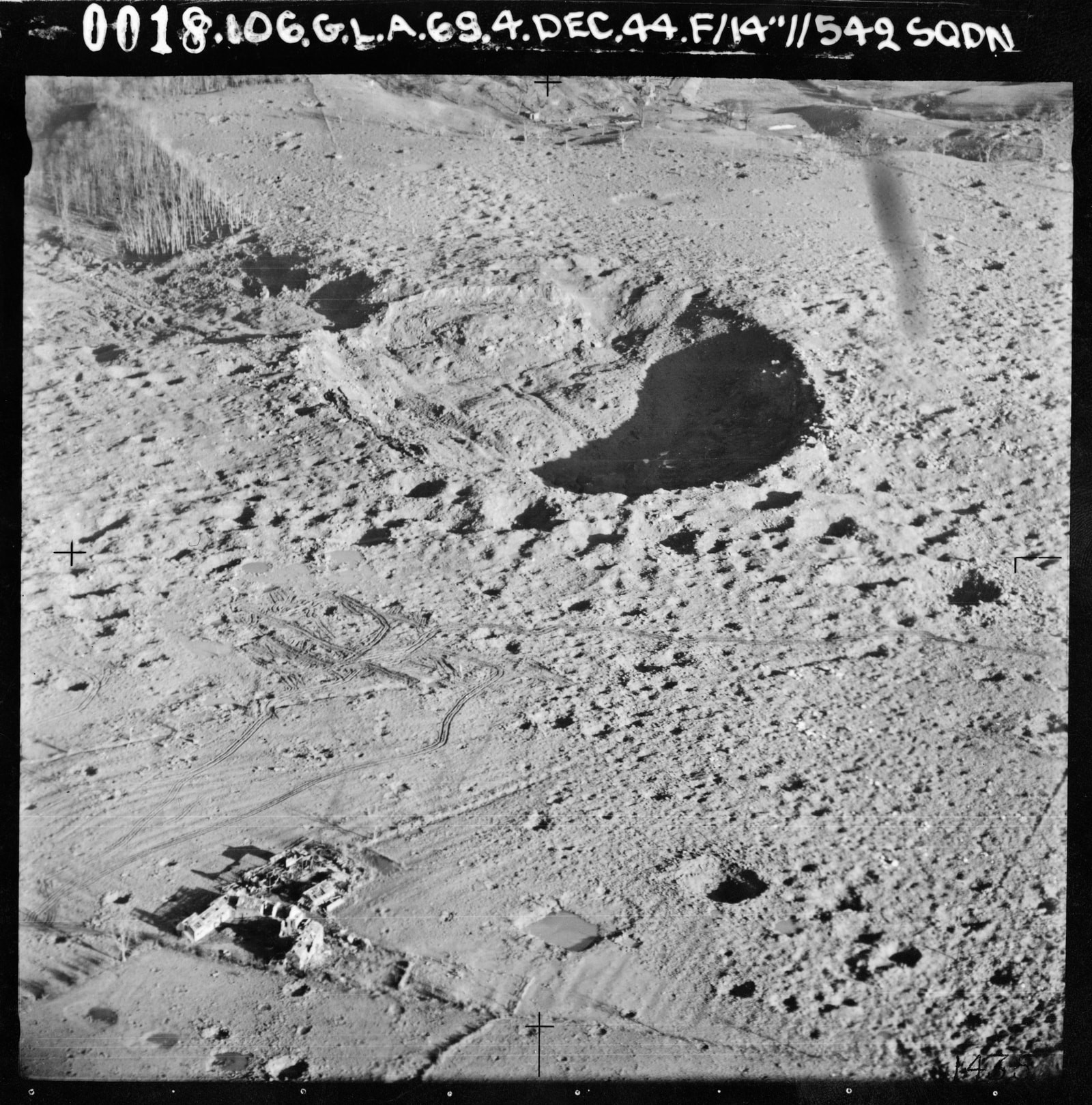
The RAF Fauld explosion occurred during the Second World War at the RAF Fauld underground munitions storage depot in Staffordshire, England at 11:11 am on Monday, 27 November 1944. The blast, which was one of the largest non-nuclear explosions in history and the largest on UK soil detonated between 3,500 and 4,000 tonnes (3,900 and 4,400 tons) of high explosive military ordnance. It created an explosion crater with a depth of 100 feet (30 m) and a maximum width of 1,007 feet (307 m).[1]

Key Information

A reservoir containing 450,000 cubic metres (16,000,000 cu ft) of water was obliterated, along with nearby buildings and an entire farm. Flooding from the reservoir added to the destruction.[2]

A combination of the power of the explosion and wartime censorship in the UK means that the exact death toll is uncertain; it is believed that about 70 people died in the explosion and resulting flood.[3] The crater, which is now known as the Hanbury Crater, is still visible just south of Fauld, to the east of Hanbury, Staffordshire.[4][5][3]

Explosion

[edit]

No. 21 Maintenance Unit RAF Bomb Storage dump was constructed in disused underground gypsum mine workings. The tunnels were used to store a variety of ordnance, bombs and explosives used by the Royal Air Force; in addition to shells and bombs, it also held up to 500 million rounds of small arms ammunition.[6] At 11:15 hours on 27 November 1944, two explosions occurred within the ordnance storage depot. Up to 4,000 tonnes (4,400 tons) of explosives detonated prematurely, including 3,500 tonnes (3,900 tons) of high explosive bombs.[5][3] It left a crater 300 yards (270 m) by 233 yards (213 m) in length and 100 feet (30 m) deep, covering 12 acres (4.9 ha).[4][5][3]

Eyewitnesses reported seeing two distinct columns of black smoke in the form of a mushroom cloud ascending several thousand feet, and a blaze at the foot of each column. According to the commanding officer of 21 M.U., Group Captain Storrar, an open dump of incendiary bombs caught fire but it was allowed to burn itself out without damage or casualties.[4][5][3]

All property within a radius of 34 mile (1.2 km) of the crater was completely or significantly damaged.[7] Upper Castle Hayes Farm was completely destroyed. The Peter Ford & Sons lime and gypsum works to the north of the village and Purse cottages were obliterated. The lime works was also flooded when the explosion destroyed the reservoir dam. Hanbury Fields Farm, Hare Holes Farm and also Croft Farm with adjacent cottages were all extensively damaged. Debris also damaged Hanbury village.[4][5][3]

Casualties

[edit]

At the time, no precise records were kept monitoring the exact number of workers at the facility. While the exact death toll is uncertain as a result of this, at least 70 people are believed to have died in the explosion. The official report stated that 90 were killed, missing or injured,[7][8] including:

  • 26 killed or missing at the RAF dump—divided between RAF personnel, civilian workers and some Italian prisoners of war who were working there—5 of whom were gassed by toxic fumes; 10 were also severely injured. Six are buried in military graves.[3]
  • 37 killed (drowned) or missing at Peter Ford & Sons gypsum mine and plaster mill, and surrounding countryside; 12 also injured.
  • Approximately 7 farm workers at the nearby Upper Castle Hayes Farm.
  • One diver was killed during search and rescue operations.[3]

Two hundred cattle were also killed by the explosion. Some live cattle were removed from the vicinity, but were found dead the following morning.[7]

The inscription on the memorial stone that was erected at the crater in November 1990, lists 70 names of people who died as a result of the explosion. 18 of these names are people who are still missing and presumed dead. A relief fund organised by the local people made payments to victims and their families until 1959.[6]

Investigation

[edit]
Bombs being stacked in one of the tunnels at RAF Fauld

The cause of the disaster was not made public at the time. As it was during the Second World War, the British government did not want Nazi Germany or the Empire of Japan to know the extent of the disaster. A secret investigation concluded that a variety of factors and circumstances had contributed to the cause.[1]

There had been staff shortages, a management position had remained empty for a year, and 189 inexperienced Italian prisoners of war were working in the mines at the time of the accident. There were also equipment shortages, a lack of training for the workers, multiple agencies in the mine resulted in a lack of an organised chain of command, and pressure from British government and military to increase work rate for the war effort resulted in safety regulations being often overlooked.[1]

It was not until 1974, that the report was publicly released. The explosion was probably caused by a site worker removing a detonator from a live bomb using a brass chisel, rather than a wooden batten, resulting in sparks. An eyewitness testified that he had seen workers using brass chisels, in direct contravention of safety regulations.[9]

Aftermath

[edit]
A sign warning of unexploded munitions at the crater site in Fauld

Although much of the storage facility was annihilated by the explosion, the site continued to be used by the RAF for munitions storage until 1966, when No. 21 Maintenance Unit was disbanded.[2] Following France's withdrawal from NATO's integrated military structure in 1966,[10] the site was used by the United States Army between 1967 and 1973 to store US ammunition previously stored in France.[2]

By 1979, RAF Fauld had been closed and fenced off. The area is now covered with over 150 species of trees and wildlife. Access is restricted as a significant amount of explosive ordnance remains buried in the site. The UK government has deemed its removal too expensive to be feasible.[11]

Memorial

[edit]
A memorial to the victims at the National Memorial Arboretum in Staffordshire

On 13 September 1990, 46 years after the initial incident, it was announced that a memorial stone was to be erected to commemorate those who died, to be paid for by the public, as Hanbury Parish Council did not have the necessary funds. The stone used for the memorial was donated by the Italian government and flown to the United Kingdom on an RAF plane.[12] It was unveiled on 25 November 1990.[13]

A second memorial was dedicated on the 70th anniversary of the explosion, 27 November 2014. A tourist trail leads to the crater from the Cock Inn pub in Hanbury, which was damaged by debris from the explosion.[14]

The maintenance unit was the subject of several paintings under the collective title "The Bomb Store" by David Bomberg, who was briefly employed as a war artist by the War Ministry in 1943.[15]

See also

[edit]

References

[edit]

Further reading

[edit]
Revisions and contributorsEdit on WikipediaRead on Wikipedia
from Grokipedia
The RAF Fauld explosion was a devastating accident on 27 November 1944, when approximately 4,000 tons of bombs detonated at an underground munitions storage depot at RAF Fauld, near Hanbury and Tutbury in , , killing 70 people and creating a approximately 100 feet (30 m) deep and covering 12 acres. The explosion took place at 11:11 a.m., when a spark—likely from an using a chisel instead of the safer tool to remove a from a 4,000-pound —ignited a in the depot's high-explosive storage area. This incident, part of No. 21 Maintenance Unit's operations during , involved munitions destined for and was kept under official secrecy until a 1974 RAF Court of Enquiry declassified details confirming the cause as an avoidable . Among the casualties were around 35 RAF personnel working inside the bomb store, 31 civilians at the nearby GRC Plasterboard Works factory—who were killed by a massive wave of mud and water from a burst 6 Italian prisoners of war, and several others affected by toxic fumes, with 18 bodies never recovered. The blast's force, estimated at about one-fifth that of the atomic bomb, obliterated the Cock Inn pub, Upper Castle Hayes Farm, and the factory, while shattering windows up to 30 miles away and registering on seismographs in . Regarded as the largest non-nuclear explosion in British history, the event highlighted wartime risks in munitions handling and led to improved safety protocols, though no senior officers faced punishment. The resulting Hanbury Crater remains a prominent landscape feature today, with memorials unveiled in 2014 for the 70th anniversary and recognized by the UK Parliament in 2024 for the 80th to honor the victims, including civilians commemorated by the .

Background

RAF Fauld Depot

The RAF Fauld Depot served as a key underground munitions storage facility during , established as part of No. 21 Maintenance Unit under RAF Maintenance Command to support the war effort against . Located in the rural countryside near Tutbury, the site was selected for its existing disused gypsum mine tunnels, which provided natural camouflage from and structural protection against potential attacks. These tunnels, part of a historic mining complex in the Fauld area, were repurposed to create a secure, dispersed storage system away from more vulnerable surface installations. The depot's layout featured an extensive network of underground tunnels within the gypsum mines, segmented into dedicated areas for storing bombs, fuses, pyrotechnics, and other explosives, while surface structures handled administrative functions, loading, and preliminary processing. This design allowed for efficient organization and climate-controlled conditions that helped preserve munitions integrity. Complementing the subterranean storage were rail connections and handling yards on the surface, facilitating the movement of heavy ordnance. The facility's primary operational role was to supply high-explosive and incendiary bombs to squadrons, acting as a critical node in the chain for campaigns. By late 1944, the depot was managing substantial stockpiles, with a capacity of up to 40,000 tons of munitions including , detonators, and , underscoring its scale as one of the RAF's primary repositories for such materials. It also functioned as a repair and maintenance center for defective devices, involving processes like fuse assembly and filling. The workforce comprised hundreds of RAF personnel and civilian contractors drawn from local industries, such as the nearby British Plaster Board and surrounding farms, who managed daily operations including checks, transportation, and preparation of ordnance for dispatch. Strict access controls and routine safety protocols were integral to operations in this high-risk environment.

Munitions Storage Practices

The RAF Fauld depot, part of No. 21 Maintenance Unit, primarily stored high-explosive and incendiary bombs, along with detonators and rifle ammunition. The underground facility, adapted from disused mine tunnels, had a designed capacity of up to 40,000 tonnes of munitions to support wartime RAF operations. By , the stockpile in the high-explosive storage area totaled approximately 3,500 tons, including large 4,000 lb bombs intended for campaigns. Handling procedures at the depot emphasized secure underground and to ensure munitions readiness. Bombs and other ordnance were moved through the tunnel network using light railways and trolleys for manual positioning in storage chambers. The site doubled as a repair for defective devices, where workers filled or adjusted explosives in under controlled conditions; this labor force included hundreds of personnel, notably Italian prisoners of war employed in non-combat roles. Fuses were typically stored separately from the main bomb casings to reduce the likelihood of unintended initiation during handling or . Safety protocols followed standard RAF guidelines for munitions depots, including prohibitions on smoking and open flames, along with electrical grounding to prevent sparks in the presence of volatile . However, wartime demands often resulted in procedural shortcuts, such as overloading storage areas and insufficient oversight of repair tasks, where tools like chisels were used on sensitive components like exploder pockets. The gypsum mine setting introduced site-specific risks, including potential structural instability from prior extraction activities and the accumulation of fumes in enclosed spaces, compounded by limited for some and POW workers engaged in explosive handling.

The Incident

Prelude to the Explosion

On 27 November 1944, a Monday during the final stages of World War II, the RAF Fauld depot in Staffordshire was operating under standard conditions as Allied forces continued their advances across Europe, including the push toward Germany following the Normandy landings and subsequent campaigns. The site, designated No. 21 Maintenance Unit, served as a key underground facility for storing and maintaining munitions to support RAF operations, with daily activities including the handling and preparation of bombs for frontline use. Around 11:00 a.m., routine work was underway in the bomb-filling bay (Building 21), where civilian and were engaged in filling and assembling ordnance, including 250-pound medium-capacity bombs. This incident contributed to the tense but contained atmosphere, as operations continued without immediate escalation to senior command. The workforce at Fauld included over 1,000 RAF and civilian employees, supplemented by nearly 200 Italian prisoner-of-war laborers who were tasked with labor-intensive duties such as stacking and transporting munitions. Wartime staffing shortages had led to reduced oversight on site, with many experienced personnel deployed elsewhere, fostering a reliance on junior staff and civilians for day-to-day . Accounts highlight protocol lapses around safety procedures in the filling bay, though details remain tied to testimonies. The morning's atmospheric conditions were clear and sunny, with no reports of air raids or other external threats, which reinforced a false sense of security amid the depot's high-risk environment. This normalcy allowed the day's tasks to proceed without heightened precautions, setting the stage for the subsequent events at approximately 11:11 a.m.

Cause and Detonation Sequence

The accepted cause of the RAF Fauld explosion was in the bomb maintenance area, where personnel used improper tools during the repair of a defective munition. According to the RAF Court of Enquiry, declassified in , airmen attempted to remove an exploder pocket from a 4,000 lb using a rather than the required non-sparking tool, generating a spark that ignited the filler inside the . This incident occurred amid wartime pressures that led to procedural shortcuts, including inadequate supervision and equipment shortages. The detonation sequence began at 11:11 a.m. on 27 in Building 21, the underground bomb-filling and repair section of the gypsum mine complex. The initial of the single produced shockwaves that traveled through the interconnected tunnels, triggering sympathetic detonations in nearby storage areas filled with high-explosive ordnance. This rapidly engulfed over 3,800 tons of Torpex-filled bombs and other munitions across multiple chambers, completing the primary blast propagation in under a minute. The underground confinement of the mine structure intensified the shockwaves, channeling and fragments that accelerated the spread. Investigations estimated the total explosive yield based on the mass of detonated material and the physics of confined blasts, though precise measurements were impossible due to the total destruction of the site. The rapid physics of led to near-instantaneous energy release that formed a massive and ejected over a wide radius. Official reports highlighted uncertainties in the exact spark mechanism, noting that while the incident was the most probable trigger, alternative possibilities like a discarded were raised but lacked supporting evidence. and enemy action were thoroughly investigated and dismissed, with the enquiry emphasizing systemic lapses in munitions storage practices that allowed the rapid propagation.

Immediate Consequences

Physical Destruction

The explosion at RAF Fauld on 27 November 1944 created the Hanbury Crater, a vast depression approximately 100 feet (30 meters) deep and 250 yards (230 meters) wide, spanning an area of 12 acres and permanently altering the local landscape. The force of the detonation, involving between 3,500 and 4,000 tons of high explosives (primarily bombs filled with and other high explosives) stored underground, ejected enormous quantities of earth and rock, with the resulting scar visible from several miles away. The munitions depot itself was utterly obliterated, with one-third of the RAF Fauld site reduced to rubble in an instant. Nearby infrastructure suffered catastrophic damage: the Cock Inn pub in the village of Hanbury was completely destroyed and later rebuilt, while an adjacent plaster-board factory was severely impacted by the blast and subsequent debris. The shockwave extended outward, causing structural harm to buildings within a 10-mile radius, including shattered walls and roofs in the surrounding countryside. Environmentally, the blast ruptured a nearby , unleashing around 6 million gallons of water that mingled with tons of displaced soil to form a torrent of , creating flash flood-like conditions that swept through the valley and engulfed low-lying areas. Large chunks of , some weighing up to a , were hurled airborne, while a massive rose thousands of feet into the sky, scattering fine over wide distances and temporarily blanketing the region in . The event also generated seismic vibrations strong enough to register on instruments across and be mistaken for an in some locations. In terms of scale, the RAF Fauld incident remains the largest non-nuclear explosion ever recorded on soil, equivalent to approximately 3.5 kilotons of TNT and surpassing the 1917 (2.9 kt) in overall yield and localized destructive force.

Casualties and Human Impact

The RAF Fauld explosion claimed 70 lives, the highest death toll from a single non-nuclear incident on British soil during . Among the confirmed fatalities were 58 civilians, 6 RAF personnel, and 6 Italian prisoners of war who were laboring at the site (historical accounts vary, with some estimating higher military deaths). No one survived in the of the blast, where workers in the underground filling bays and storage tunnels bore the brunt of the detonation. The victims encompassed a range of demographics typical of wartime munitions operations: young RAF airmen handling explosives, local civilian contractors from firms like the nearby Ford's plasterboard , and Italian POWs assigned to support tasks from camps such as those near Lamsdorf (). A tragic example on the surface involved the family at Upper Castle Hayes Farm, who perished when their home was obliterated by flying debris and the sweeping across the countryside. At the , 31 civilians—many routine workers—suffocated or were crushed in a sudden mudslide triggered by the explosion breaching a nearby . Most deaths occurred instantaneously through from the intense and or under thousands of tons of collapsed , creating a approximately 100 feet (30 meters) deep that entombed underground personnel. Survivors farther from the site endured severe injuries from the shockwave, including shattered eardrums, lacerations from flying glass, and concussions, while witnesses across reported a deafening thunderous roar and a towering that instilled widespread panic and confusion. The psychological toll lingered for decades, with families and communities grappling with profound grief and the eerie silence of the resulting landscape. Recovering and identifying remains proved extraordinarily difficult, especially for those in the tunnels, as no comprehensive roster of underground workers existed at the time. At least 18 victims remained unrecovered amid the crater's depths, leading to communal burials for identifiable bodies and official commemoration of civilian war dead through the .

Investigation and Aftermath

Official Inquiry

Following the explosion on 27 , the Royal Air Force convened a Court of Enquiry in December 1944 to investigate the incident at the Fauld munitions depot. The board, composed of senior RAF officers, examined witness statements from survivors, from the site, and records of munitions handling procedures over several weeks of proceedings. The inquiry's key findings, kept classified under wartime censorship until their release in 1974, attributed the detonation to rather than or mechanical failure. Specifically, the report concluded that two RAF airmen had attempted to remove a from a damaged 4,000-pound using a non-regulation instead of the prescribed non-sparking tool, generating a spark that ignited the contents and triggered a involving approximately 3,800 tons of munitions. It highlighted systemic issues, including inadequate safety training for personnel handling live ordnance, insufficient fire-fighting equipment in the underground storage tunnels, and lax amid wartime pressures that led to procedural shortcuts. No evidence supported initial suspicions of enemy action, such as Italian POW involvement or external attack, despite local rumors circulating at the time. The delayed public disclosure of the report fueled postwar controversies, with some local accounts suggesting a of higher-level in depot management to avoid broader scrutiny of RAF munitions practices during the war. These findings prompted internal RAF reforms, though specific procedural changes were not detailed in declassified summaries.

Recovery and Site Remediation

Following the explosion on 27 November 1944, RAF personnel and local civilian teams, including county surveyors, arrived within hours to initiate search and recovery operations, focusing on locating survivors—none of whom were found—and securing scattered across the site and surrounding areas up to three-quarters of a mile away. These efforts involved manual labor and heavy equipment such as bulldozers to sift through debris amid the chaotic landscape of the newly formed and inundated areas. The operations were complicated by the release of approximately 6 million gallons of water from a burst , which created a thick sludge layer, and an estimated 10,000 tons of rubble that buried potential hazards and remains. Recovery of human remains proved particularly challenging due to the intense blast and subsequent flooding, with only partial identification possible in many cases; of the 70 confirmed fatalities, 18 bodies were never recovered. Excavation work in the crater and at the nearby Peter Ford and Sons plaster works—where 31 civilians perished—continued for , yielding fragmented remains that were interred in local cemeteries, including St. Mary's Churchyard in Tutbury. The unstable subsoil, a remnant of the site's former operations, frequently caused cave-ins during digging, while from explosive residues posed additional risks to workers handling debris. Local community members provided aid in clearing scattered materials from affected farmlands and structures, supported by a wartime relief fund that assisted victims' families until 1959. Site remediation efforts were limited by wartime resource constraints and the immense scale of destruction, with no full backfilling or restoration of the 12-acre, 400-foot-deep Hanbury Crater deemed feasible due to prohibitive costs. The remaining undamaged tunnels at RAF Fauld were repurposed for non-explosive storage until the facility's partial decommissioning at the war's end in 1945, after which operations wound down further by 1946 before the site's overall closure in 1966. To secure the hazardous area, the installed perimeter fencing around the crater, supplemented by warning signs alerting to still present beneath the surface; these measures have been maintained, with annual inspections by specialists to prevent unauthorized access.

Legacy

Environmental and Geological Effects

The RAF Fauld explosion resulted in significant geological alterations, primarily manifesting as a permanent crater approximately 250 meters in diameter and 30 meters deep, formed by the ejection of over a million tonnes of rock and soil from the underlying gypsum and mudstone strata. This feature, resembling a sinkhole, arose from the collapse of underground storage chambers and subsequent rotational landslides in the surrounding mudstone, which reshaped the local topography into steep, irregular slopes. The blast also induced fracturing in the substrata, contributing to partial collapses in adjacent mine workings, though overall subsidence has remained minimal due to precautionary measures such as leaving supportive pillars beneath nearby Hanbury village. Seismic effects were notable, with ground tremors felt up to 60 kilometers away and the event recorded on seismographs across Europe, while the shockwave was audible as far as London, approximately 200 kilometers distant. Ecologically, the explosion initially disrupted the local landscape through the sterilization of surface soils and the scattering of debris over 10 kilometers, but over decades, the crater has undergone natural reclamation with vegetation stabilizing the slopes and trees colonizing the floor amid scattered gypsum blocks. However, an estimated 3,000 tonnes of unexploded ordnance remain buried within the site, posing ongoing risks of soil and potential groundwater contamination from explosive residues, though no widespread leaching has been documented in post-event assessments. The breach of a nearby reservoir during the blast released a flood wave that inundated adjacent gypsum mines, altering underground water flows and contributing to localized hydrological instability, including the potential for episodic ponding in the crater during heavy rains. In its modern status, the Fauld crater functions as an informal nature area accessible via public footpaths, with its vegetated interior supporting a mix of and scrub that has softened the otherwise stark geological scar. The site is monitored by the for structural instability and hazards, with periodic restrictions on access to mitigate risks from in the gypsum and potential environmental release of contaminants. Post-2000 geological studies, including analyses of blast-induced fracturing, confirm the crater's long-term stability while highlighting persistent vulnerabilities in the substrata due to the area's soluble gypsum formations.

Commemoration and Historical Significance

The RAF Fauld explosion has been commemorated through various memorials dedicated to the victims, including military personnel and civilians who perished in the blast. The Commonwealth War Graves Commission (CWGC) honors those with no known grave on the Runnymede Memorial in Surrey, recognizing the 70 fatalities, many of whom were unrecovered due to the explosion's devastation. A stone memorial with a metal plaque stands beside the crater at the former RAF Fauld site, inscribed to those who died on 27 November 1944. Additional tributes include a memorial at the National Memorial Arboretum in Alrewas, Staffordshire, and a 1990 plaque at the explosion site listing the names of the deceased. In 2014, for the 70th anniversary, a new memorial was unveiled near the crater during a service attended by descendants and local officials, emphasizing the event's enduring local impact. Recent commemorations marked the 80th anniversary in 2024, highlighting the explosion's status as the United Kingdom's largest non-nuclear blast. On 29 October 2024, the UK Parliament tabled an to remember the 70 lives lost, noting the incident's scale and the sacrifices of those involved in wartime munitions handling. Local groups in Tutbury and Hanbury organized remembrance events on 27 November 2024, including gatherings at the crater site and exhibitions at Tutbury Museum featuring photographs, inquest records, and eyewitness accounts from the "Mackay papers." These activities, supported by the Royal Air Force and community historians, drew attention to the blast's effects on , with media coverage underscoring its overlooked role in home front history. The explosion holds significant place in World War II history as a stark reminder of the dangers inherent in munitions storage and handling, contributing to broader understandings of wartime industrial risks on the . It remains the largest man-made non-nuclear explosion on British soil, with an estimated yield equivalent to 2 kilotons of TNT, surpassing other Allied incidents in scale and serving as a in the vulnerabilities of underground depots. While direct causal links to post-war protocols are not explicitly documented, the event's aftermath informed military reflections on storage safety amid the war's final months. In cultural legacy, the Fauld explosion has been documented in several books by local historians, including Voices from the Explosion: RAF Fauld, the World's Largest Accidental Explosion by Valerie Hardy, which compiles eyewitness testimonies and archival material to illustrate the human cost of wartime production. Media portrayals include reports on anniversary events and a 1940s radio documentary by BRMB describing the incident's immediate aftermath. These works emphasize the sacrifices of overlooked and support workers, ensuring the event's narrative endures beyond military annals.

References

Add your contribution
Related Hubs
User Avatar
No comments yet.