Hubbry Logo
Rachelle FerrellRachelle FerrellMain
Open search
Rachelle Ferrell
Community hub
Rachelle Ferrell
logo
8 pages, 0 posts
0 subscribers
Be the first to start a discussion here.
Rachelle Ferrell
Rachelle Ferrell
from Wikipedia

Key Information

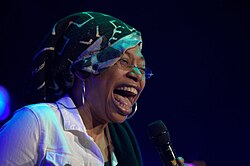
Rachelle Ferrell (born May 21, 1961) is an American vocalist and musician.[1] Although she has had some success in the mainstream R&B, pop, gospel and classical music scenes, she is noted for her talents as a contemporary jazz singer. In contemporary jazz she is noted for her delivery, control, range, improvisational vocal percussion, scatting ability and access to the whistle register.

Early life

[edit]

Ferrell began singing at age six.[1][2] She also received classical training in violin and the piano at an early age. During her teenagehood, she was performing as a professional musician. She began performing at age 13 as a violinist, and in her mid-teens as a pianist and vocalist. After enrolling in the Berklee College of Music, she graduated a year later and secured a position teaching music for the New Jersey State Council on the Arts.[1]

Career

[edit]

1975–1988: Backup singing

[edit]

From 1975 to 1990, Ferrell sang backup for Lou Rawls, Patti LaBelle, and Vanessa Williams. In 1988, she began touring as a backup vocalist for Phyllis Hyman. In the same year, she also appeared as backup vocalist on Miles Jaye's song "Desiree".

1989–1997: First Instrument and Rachelle Ferrell

[edit]

In 1989, Ferrell secured her own recording contract with Capitol Records. In 1990, Ferrell released her first album, First Instrument, exclusively in Japan. The album contained cover versions of jazz standards.[3]

In September 1992, she released her second album Rachelle Ferrell. The album spawned the singles "Til You Come Back to Me", "Welcome to My Love", "Nothing Has Ever Felt Like This", and "With Open Arms". The album received a gold-status music recording certification.[4] In the same year, she appeared on George Duke's album Snapshot. In 1993, Ferrell headlined her own tour and performed several jazz festivals. In 1995, Ferrell released her album First Instrument in the USA.

From 1995 to 1997, Ferrell toured as part of the George Duke Band. The group released a concert film titled Live at Montreux, which highlighted their concert set during the Montreux Jazz Festival in 1997. Ferrell also appeared as a backing vocalist on his albums Illusions (1995) and Is Love Enough? (1997).

2000–2002: Individuality (Can I Be Me?)

[edit]

In August 2000, Ferrell released third album Individuality (Can I Be Me?). The album peaked at number 1 on Billboard's Top Jazz Albums chart and sold over 160,000 copies.[5] The album's singles "I Forgive You" and "Satisfied" both charted in the top twenty on the Adult R&B Songs chart. In 2001, Ferrell headlined her own tour to support the album. In April 2002, she released her live album Live in Montreux 91–97.

2006–present: Recent activity

[edit]

In 2006, Ferrell released a song titled "Wounds in the Way" on the Madea's Family Reunion soundtrack. In 2008, she appeared George Duke's Dukey Treats album. In 2014, Ferrell performed at the Capital Jazz Festival. In 2018, she performed during the Phyllis Hyman tribute at the Capital Jazz Festival. Ferrell also confirmed that she was recording her forthcoming album The Art and Soul of Rachelle Ferrell.

Vocal ability

[edit]

Ferrell has a six octave vocal range.[1][2][6] Her range also includes the ability to sing and enunciate in the whistle register.[2] Ferrell's highest notes in "It Only Took A Minute" (1992) have been described as "Minnie Riperton-like wailing."[2][7]

Personal life

[edit]

In 1992, Ferrell filed a lawsuit against a production company, which was settled out of court in 2000.[5]

In August 2023, Ferrell's management and website released a statement that Ferrell was experiencing "health, wellness, and life-related hardships".[8]

Discography

[edit]

Albums

[edit]
Year Album Peak chart positions Certifications
US Pop
[9]
US R&B/HH
[10]
US Jazz
[11]
US Traditional
Jazz

[12]
US
Heat
[13]
1990 First Instrument
151 3
1992 Rachelle Ferrell
  • 2nd studio album
  • Released: September 12, 1992
161 25 4
2000 Individuality (Can I Be Me?)
  • 3rd studio album
  • Released: August 15, 2000
71 16 1
2002 Live in Montreux 91–97
26 8

Singles

[edit]
Year Title Peak chart positions Album
US R&B/HH US R&B/HH

Airplay

US AC US Adult R&B
1992 "'Til You Come Back to Me" 19 45 Rachelle Ferrell
1993 "Welcome To My Love" 42 41 25
"Nothing Has Ever Felt Like This" (featuring Will Downing) 72 72 25
1994 "With Open Arms" 68 61
2000 "Satisfied" 11 Individuality (Can I Be Me?)
"I Forgive You" 13

References

[edit]
[edit]
Revisions and contributorsEdit on WikipediaRead on Wikipedia
from Grokipedia
Rachelle Ferrell (born May 21, 1961) is an American singer, songwriter, composer, arranger, and multi-instrumentalist renowned for her expansive spanning six octaves, including the , and her genre-blending work across , R&B, pop, and . Born in , near , Ferrell grew up in a musical family and began singing in school at age six, while receiving classical training on the from an early age; by her teenage years, she was performing professionally as a and vocalist. At 18, she enrolled at the in , where she studied composition and arranging, graduating in just one year alongside notable peers like and . Ferrell launched her professional career in the late 1970s and 1980s as a backup vocalist for artists including , , , and , while also collaborating with jazz luminaries such as , , , and . In 1989, she signed a groundbreaking dual-label deal with for pop and R&B and for jazz, leading to her debut album First Instrument (1990 in Japan, reissued in the U.S. in 1995), a jazz project featuring guests like and that highlighted her instrumental prowess on piano and violin. Her self-titled sophomore album (1992) marked her mainstream breakthrough, peaking at No. 6 on the R&B Albums chart with hits like "Nothing Has Ever Felt Like This" (a duet with ) and "Passion," earning gold certification and establishing her as a dynamic force in contemporary music. Throughout the 1990s and beyond, Ferrell performed at prestigious venues like the for four consecutive years and released further albums including Individuality (Can I Be Me?) (2000), which debuted at No. 1 on the Jazz Albums chart. Known for her emotive live performances and technical virtuosity—often compared to for her high-register clarity—Ferrell has influenced generations of vocalists, though she has received limited formal awards, with notable recognition including a performance at the Trumpet Awards and industry acclaim for her innovative artistry. In recent years (as of 2023-2024), she has faced health challenges but continues to create music, maintaining her status as a multifaceted icon in American music.

Early life and education

Childhood and family background

Rachelle Ferrell was born on May 21, 1961, in , a outside . She grew up in a musical household where her father, an amateur musician, filled the home with sounds of , , and , fostering an early environment rich in diverse musical influences. Her parents encouraged classical training at an early age on and . Ferrell's initial foray into performing came early, as she began in the second grade at around age six, marking the start of her vocal pursuits. This early exposure at home and through basic instruction laid the foundation for her developing musical talents, leading toward more structured training in her pre-teen years.

Musical training and early performances

Ferrell began her musical journey at a young age, starting with singing in the second grade around age six, which laid the foundation for her vocal development. Encouraged by her family's musical environment, where was prominent and her father had a background in , she pursued classical training in and during her early childhood. This formal instruction honed her instrumental skills, and by her teenage years, she was performing professionally on . As a teenager, Ferrell expanded her abilities on the , reaching a level through dedicated practice, and began incorporating into her performances. She secured her first engagement as a and singer shortly after developing these skills, marking the start of her live appearances in local settings. By her mid-teens, she was actively performing on , , and as a vocalist in capacities, building experience through community and small-scale events. During her high school years, Ferrell's exposure to diverse musical influences fostered her growth, though her core training remained rooted in classical foundations before transitioning to more varied expressions. These early performances and self-directed explorations in her adolescent phase solidified her versatility as a and singer.

Formal education

Ferrell graduated from in , in 1979. She then enrolled at the in at age 18, where she studied composition and arranging, graduating in just one year around 1980. Following her graduation, Ferrell secured a teaching position with the New Jersey State Council on the Arts, where she instructed in music, including voice, alongside jazz legend , continuing into at least 1990. During her teaching tenure in the early , Ferrell balanced educational responsibilities with initial performance opportunities in the area, leveraging her Berklee training to refine her songwriting, arranging, and fusion of and classical styles.

Career

Backup singing and early professional work ()

Following her graduation from the in 1980, Rachelle Ferrell returned to the area to pursue professional opportunities in music, leveraging the composition and arranging skills she developed during her studies. She quickly established herself in the local scene by performing in clubs and providing vocals for established artists, which allowed her to gain experience across R&B, soul, and contexts. Throughout the late and , Ferrell contributed her versatile voice to tours and recordings, including as a backup singer for from 1975 onward, including subsequent projects, as well as Patti LaBelle's live shows and album sessions in the . Her work extended to and , with whom she toured as a backup singer from 1988 to 1989, honing her improvisational abilities in high-profile settings. In addition to these supporting roles, Ferrell participated in jazz sessions and demo recordings during the 1980s, collaborating with notable figures such as , , , and , through whom she explored her multifaceted vocal style blending classical precision with . These experiences, often uncredited, included contributions to R&B and soul projects that showcased her range, though she prioritized live performances in Philadelphia-area venues like local and settings to build a dedicated following. By the mid-1980s, Ferrell's growing reputation led to an early development deal with a major label, but creative constraints prompted her to focus on independent gigs and session work rather than rushing into a solo release. This period solidified her technical prowess and industry connections, setting the stage for her transition to a leading artist in the early 1990s.

Breakthrough albums and mainstream success (1990–1999)

In the early , Rachelle Ferrell transitioned from singing to solo artistry, leveraging her established network in the music industry to launch her recording career. Her debut album, First Instrument, was released in in 1990 on Somethin' Else Records under exclusive license to /, showcasing original jazz compositions alongside standards like "" and "," performed with a including Tyrone Brown and Eddie Green. The album received limited U.S. distribution until its domestic reissue in 1995. Ferrell signed with and released her self-titled sophomore album Rachelle Ferrell in 1992, shifting toward a and pop sound while retaining influences. The album achieved commercial success, earning gold certification from the RIAA for sales exceeding 500,000 copies. Its lead single, "'Til You Come Back to Me," peaked at number 19 on the chart, marking her breakthrough on mainstream radio. The 1992 album featured notable collaborations, including the duet "Nothing Has Ever Felt Like This" with , which highlighted Ferrell's emotive vocal interplay and contributed to the project's crossover appeal. Throughout the decade, Ferrell toured and performed at major jazz festivals, often joining forces with keyboardist for shared sets, such as at the Jazz Festival in 1999, where their chemistry blended fusion and vocal . Ferrell's live shows, renowned for extended improvisational segments that fused jazz scatting with R&B grooves, helped bridge her dual audiences in jazz and contemporary music circles, solidifying her reputation as a versatile performer during this peak period of mainstream recognition.

Mid-career developments and Individuality (2000–2005)

In 2000, Rachelle Ferrell released her third studio album, Individuality (Can I Be Me?), on Capitol Records, marking a deeper exploration of her artistic voice following the commercial momentum of her 1990s work. The album debuted at number one on the Billboard Jazz Albums chart and achieved sales exceeding 160,000 copies, reflecting her established fanbase in jazz and R&B circles. Tracks like "Sista" and "I Gotta Go" delved into themes of sisterhood, personal resilience, and romantic disillusionment, infused with Ferrell's signature blend of soulful introspection and gospel-rooted emotional depth. The singles "I Forgive You" and "Satisfied" from the album both entered the top twenty on the chart, underscoring Ferrell's ability to connect through vulnerable, narrative-driven songwriting amid shifting industry dynamics in the early . This period allowed her to prioritize creative autonomy, drawing on influences to craft extended vocal passages that highlighted her improvisational prowess. In July 2001, Ferrell performed at the , where her set included expansive renditions of songs like "Nothing Has Ever Hurt Me (As Much As Loving You)" and "," showcasing her live command of jazz-inflected scatting and emotional range. Ferrell's mid-career shift toward individuality emphasized songwriting retreats and personal expression, enabling bolder thematic risks that distinguished her from mainstream R&B contemporaries. By resolving earlier contractual tensions, she focused on honing her multifaceted style, blending pop accessibility with experimentation during this transitional phase.

Later career, performances, and challenges (2006–present)

In 2006, Ferrell contributed the song "Wounds in the Way" to the soundtrack for the film , marking one of her few recorded outputs during a period of relative quiet in her studio work. In 2010, she began recording a new album titled The Art and Soul of Rachelle Ferrell, but the project faced delays and remained unreleased as of 2025, amid her transition to independent artistry following earlier label disputes. Ferrell continued to perform selectively in live settings, showcasing her vocal prowess at major jazz events. She headlined at the Capital Jazz Festival in 2014, delivering a set that highlighted her improvisational style and range. In 2018, she returned to the same festival for a tribute to , where she performed renditions of Hyman's classics alongside original material, earning praise for her emotional depth and technical command. These appearances underscored her enduring appeal in the jazz community despite extended breaks from touring. Transitioning to independent releases, Ferrell focused on selective collaborations, including guest vocals on projects that emphasized her spiritual and introspective songwriting. Amid pauses, she explored themes of and sacred expression in her compositions, viewing music as a divine conduit rather than a commercial pursuit. This period allowed her to prioritize personal artistry over frequent recordings, with occasional contributions to compilations reinforcing her influence in contemporary circles. Ferrell's later career has been significantly impacted by health challenges, including chronic that emerged prominently in 2023 and curtailed her ability to tour extensively. In response, the Sweet Relief Musicians Fund established the Rachelle Ferrell Fund in August 2023 to provide support for her , wellness, and related hardships, enabling access to care during recovery. By December 2023, she shared an update noting improvements in her daily well-being and a return to writing music after years of limitation, expressing deep for fan and organizational support. In June 2024, Ferrell provided further insight into her healing journey, stating, "The abounding for all those who cared enough to even think of me and pray for me has been a profound catalyst in my restoration," while emphasizing ongoing progress amid reduced professional commitments.

Musical style and vocal ability

Vocal range and technique

Rachelle Ferrell is renowned for her exceptional , documented as spanning six octaves from lows to whistle , allowing her to navigate vast pitch territories with remarkable agility. This extraordinary span is prominently showcased in her live scats and ad-libs, where she fluidly shifts between chest, head, and registers to create dynamic, horn-like improvisations. Her technical mastery includes precise control over melismatic runs, vibrato, and whistle tones, enabling intricate ornamentation and sustained high extensions that enhance emotional depth in her performances. In the 1992 track "Welcome to My Love," Ferrell employs elaborate melismatic phrasing and flourishes to build intensity, demonstrating her ability to articulate complex runs with clarity and power. These elements are part of her broader of extended vocal techniques, such as breath-based embellishments and noise-infused articulations, which she explores in comparative analyses with other innovators. Ferrell's vocal precision is informed by her early classical training, which honed her ear for intonation and facilitated rapid pitch shifts akin to instrumental phrasing. Her high notes, particularly in songs like "It Only Took a Minute" (1992), have been likened to Minnie Riperton's ethereal whistle work for their piercing clarity and wailing quality. This technical prowess shines in improvisational contexts, where she delivers extended scats incorporating and throat-like resonances to mimic ensemble interplay.

Influences, genres, and songwriting

Rachelle Ferrell's musical influences draw from a diverse array of sources, rooted in her early classical training on violin and piano, which she began at a young age and continued through formal studies. This foundation instilled a appreciation for structured compositions, as seen in her nods to composers like Johannes Brahms. Her upbringing near Philadelphia exposed her to jazz, gospel, and R&B through her father's amateur jazz playing and family listening habits, shaping her emotive delivery and improvisational flair. Additional inspirations include jazz figures such as Grover Washington Jr. and George Benson, alongside rock and fusion elements from artists like Carlos Santana, contributing to her eclectic sound. Ferrell's genres primarily encompass contemporary jazz, where she excels as a vocalist known for scatting and improvisational vocal percussion, blended seamlessly with R&B, pop, and gospel elements. Her work often fuses jazz improvisation with accessible pop and R&B hooks, incorporating classical structures for depth, as evidenced by her self-arrangements on tracks that highlight multi-instrumental layering. This genre-blending versatility allows her to traverse adult contemporary and crossover jazz landscapes, prioritizing artistic expression over rigid categorization. In her songwriting, Ferrell serves as a prolific and , crafting introspective pieces that explore themes of love, , and personal introspection with raw honesty and intimacy. Songs like "Nothing Has Ever Felt Like This," a emphasizing romantic connection, exemplify her ability to convey emotional depth through poignant narratives. Her compositional approach often integrates spiritual undertones, reflecting a purposeful expression of self that resonates on a profound level. Notable collaborations further enriched her urban contemporary leanings, including her duet with on "Nothing Has Ever Felt Like This," which amplified her R&B accessibility, and partnerships with , who contributed arrangements and production to her 1992 self-titled album, including on "Welcome to My Love," as well as featuring her on his track "No Rhyme No Reason." These alliances infused her jazz foundation with smoother, radio-friendly grooves, broadening her appeal in the pop-soul sphere.

Personal life

Relationships and family

Rachelle Ferrell maintains a private personal life, with limited public information available about her relationships and family dynamics. She shares close ties with her family, particularly her brother Russ Barnes, a fellow musician with whom she has performed duets, such as during live shows in the early 2000s. Their sibling bond reflects a shared musical heritage, influenced by their parents—Ferrell's father was a jazz enthusiast with an extensive record collection, and her mother sang in the church choir—which shaped her early interest in music. Ferrell has no publicly confirmed marriages, partnerships, or children, and she has consistently prioritized in these matters amid her career. While occasional rumors about romantic involvements surface, including unsubstantiated speculation in 2025, no verified details have emerged regarding post-career personal relationships or family expansions. Her focus appears to remain on professional endeavors supported by familial encouragement during key periods of success.

Health issues and

In August 2023, a dedicated fund was established through the Sweet Relief Musicians Fund to support Rachelle Ferrell amid unspecified health, wellness, and life-related hardships that prevented her from touring and performing. These challenges, which included physical and medical issues, led to the cancellation of planned professional engagements and a period of necessary rest. By December 2023, Ferrell publicly acknowledged her progress in recovery, stating, "I am healing," and expressing profound gratitude for the financial and emotional support from fans and the organization, which helped cover recovery-related costs. In June 2024, she shared further updates on her healing journey via social media, highlighting how prayers and well-wishes from supporters provided significant strength and encouragement during her ongoing recovery. Ferrell's experiences have underscored the vulnerabilities faced by musicians, and through her participation in the Sweet Relief initiative, she has indirectly advocated for greater awareness and resources for wellness in the music industry. These setbacks contributed to pauses in her career trajectory during this period.

Discography

Studio albums

Rachelle Ferrell's debut studio , First Instrument, was released in 1990 exclusively in by Somethin' Else Records, with a U.S. following in 1995 on . The jazz-focused project, produced by , features 11 tracks primarily consisting of vocal interpretations of jazz standards such as "You Send Me," "," and "Autumn Leaves." It showcases Ferrell's early vocal prowess in a context, accompanied by musicians including bassist Tyrone Brown and pianist Eddie Green. The did not in major markets due to its limited initial release but received strong critical acclaim, earning an 8.7 out of 10 rating on for highlighting Ferrell's impressive range and interpretive depth. Her second studio album, the self-titled Rachelle Ferrell, arrived in 1992 via , marking her U.S. major-label debut with a shift toward and pop-soul elements. Co-produced by , Michael J. Powell, Barry Eastmond, and Ferrell herself, the 13-track set includes standout singles like "Nothing Has Ever Felt Like This" (featuring ) and "Welcome to My Love." It peaked at No. 25 on the chart and achieved gold certification from the RIAA for sales exceeding 500,000 copies in the United States. Critics praised its polished production and Ferrell's versatile vocals, with awarding it an 8.1 out of 10 for blending soulful ballads and upbeat tracks effectively. In 2000, Ferrell released Individuality (Can I Be Me?) on , a 11-track produced by that emphasizes themes of empowerment and self-expression through R&B- fusion. Key songs include the title track, "I Forgive You," and "Satisfied," which underscore personal anthems of resilience and forgiveness. The record topped the Jazz Albums chart and sold over 160,000 copies, reflecting strong appeal in the and adult contemporary markets. Reception was favorable, with reviewers noting its confident tone and neo-soul influences; gave it an 8 out of 10, commending Ferrell's emotive delivery and the 's cohesive blend of genres. Ferrell announced plans for a fourth studio album titled The Art and Soul of Rachelle Ferrell in 2006, described as a spiritual and introspective project, but it remains unreleased as of 2025 with no further updates on its status.

Singles and collaborations

Ferrell's breakthrough single "'Til You Come Back to Me," released in 1992 from her self-titled album, peaked at number 19 on the US R&B/Hip-Hop Songs chart. This track is a cover of Stevie Wonder's 1967 song from his album I Was Made to Love Her. It showcased her ability to blend R&B with influences, earning on both formats. In 2000, from her album Individuality (Can I Be Me?), Ferrell released singles including "I Forgive You" and "Satisfied," which charted at numbers 116 and 114, respectively, on the US R&B/Hip-Hop Songs chart. These tracks highlighted her gospel-tinged style, though they received modest commercial attention compared to her earlier work. Notable collaborations include her duet with on "Nothing Has Ever Felt Like This" from the 1992 album Rachelle Ferrell, which reached number 72 on the US R&B/Hip-Hop Songs chart. Ferrell provided backing vocals on 's 1992 album Snapshot, contributing to tracks like "No Rhyme No Reason" and "Fame," blending her vocal prowess with Duke's fusion sound. She has also appeared on various jazz compilations and live recordings, such as performances with the George Duke Band at festivals like Jazz in the 1990s. In recent years, Ferrell has focused on independent digital releases and live performances, with no major charted singles reported as of 2025, though she continues to share socially themed material through platforms like .

References

Add your contribution
Related Hubs
User Avatar
No comments yet.