
Hubbry Logo
Range ambiguity resolutionRange ambiguity resolutionMain
Open search
Range ambiguity resolution
Community hub
Range ambiguity resolution
logo
7 pages, 0 posts
0 subscribers
Be the first to start a discussion here.
Range ambiguity resolution
from Wikipedia

Range ambiguity resolution is a technique used with medium pulse-repetition frequency (PRF) radar to obtain range information for distances that exceed the distance between transmit pulses.

This signal processing technique is required with pulse-Doppler radar.[1][2][3]

The raw return signal from a reflection will appear to be arriving from a distance less than the true range of the reflection when the wavelength of the pulse repetition frequency (PRF) is less than the range of the reflection. This causes reflected signals to be folded, so that the apparent range is a modulo function of true range.

Definition

[edit]

Range aliasing occurs when reflections arrive from distances that exceed the distance between transmit pulses at a specific pulse repetition frequency (PRF).

Range ambiguity resolution is required to obtain the true range when the measurements are made using a system where the following inequality is true.
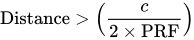
Here c is the signal speed, which for radar is the speed of light. The range measurements made in this way produces a modulo function of the true range.

Theory

[edit]

To find the true range, the radar must measure the apparent range using two or more different PRF.

Suppose a two PRF combination is chosen where the distance between transmit pulses (pulse spacing) is different by the pulse width of the transmitter.

Each transmit pulse is separated in distance the ambiguous range interval. Multiple samples are taken between transmit pulses.

If the receive signal falls in the same sample number for both PRF, then the object is in the first ambiguous range interval. If the receive signal falls into sample numbers that are different by one, then the object is in the second ambiguous range interval. If the receive signal falls into sample numbers that are different by two, then the object is in the third ambiguous range interval.

The general constraints for range performance are as follows.

Each sample is processed to determine if there is a reflected signal (detection). This is called signal detection.

The detection made using both PRF can be compared to identify the true range. This comparison depends upon the transmitter duty cycle (the ratio between on and off).

The duty cycle is the ratio of the width of the transmit pulse width and the period between pulses .[4]

Pulse-Doppler can reliably resolve true range at all distances less than the Instrumented Range. The optimum pair of PRF used for a pulse-Doppler detection scheme must be different by a minimum of . This makes the range of each PRF different by the width of the sample period.

The difference between the sample numbers where reflection signal is found for these two PRF will be about the same as the number of the ambiguous range intervals between the radar and the reflector (i.e.: if the reflection falls in sample 3 for PRF 1 and in sample 5 for PRF 2, then the reflector is in ambiguous range interval 2=5-3).

There is no guarantee that true range will be found for objects beyond this distance.

Operation

[edit]

The following is a special case of the Chinese remainder theorem.

Each ambiguous range sample contains the receive signal from multiple different range locations. Ambiguity processing determines the true range.

This is explained best using the following example, where PRF A produces a transmit pulse every 6 km and PRF B produces a transmit pulse every 5 km.

Transmit 1 km Sample 2 km Sample 3 km Sample 4 km Sample 5 km Sample
Target PRF A
Target PRF B

The apparent range for PRF A falls in the 2 km sample, and the apparent range for PRF B falls in the 4 km sample. This combination places the true target distance at 14 km (2x6+2 or 2x5+4). This can be seen graphically when range intervals are stacked end-to-end as shown below.

0 1 2 3 4 5 6 7 8 9 10 11 12 13 14 15 16 17 18 19 20 21 22 23 24 25 26 27 29 29
A A A A A
B B B B B B

"A" represents target range possibilities for PRF A, and "B" represents target range possibilities for PRF B.

This process uses a look-up table when there is only one detection. The size of the table limits the maximum range.

The process shown above is a type of digital convolution algorithm.

Limitations

[edit]

This technique has two limitations.

  • Blind Zones
  • Multiple Targets

The process described above is slightly more complex in real systems because more than one detection signal can occur within the radar beam. The pulse rate must alternate rapidly between at least 4 different PRF to handle these complexities.

Blind Zones

[edit]

Each individual PRF has blind ranges, where the transmitter pulse occurs at the same time as the target reflection signal arrives back at the radar. Each individual PRF has blind velocities where the velocity of the aircraft will appear stationary. This causes scalloping, where the radar can be blind for some combinations of speed and distance.

A four PRF scheme is generally used with two pair of PRF for the detection process so that blind zones are eliminated.

The antenna must dwell in the same position for at least three different PRF. This imposes a minimum time limit for the volume to be scanned.

Multiple Targets

[edit]

Multiple aircraft within the radar beam that are separated by over 500 meters introduces additional degrees of freedom that requires additional information and additional processing. This is mathematically equivalent to multiple unknown quantities that require multiple equations. Algorithms that handle multiple targets often employ some type of clustering[5][6] to determine how many targets are present.

Doppler frequency shift induced by changing transmit frequency reduces unknown degrees of freedom.

Sorting detections in order of amplitude reduces unknown degrees of freedom.

Ambiguity resolution relies on processing detections with similar size or speed together as a group.

Implementations

[edit]

References

[edit]
Revisions and contributorsEdit on WikipediaRead on Wikipedia
from Grokipedia
Range ambiguity resolution is a critical process in radar signal processing that addresses the challenge of distinguishing the true distance to a target when echoes from transmitted pulses overlap due to the finite pulse repetition interval (PRI), which limits the unambiguous detection range to Rmax=cT2R_{\max} = \frac{c \cdot T}{2}, where cc is the and TT is the PRI. This ambiguity arises because return signals from distant targets may arrive after subsequent pulses have been transmitted, causing them to be misinterpreted as closer "second-time-around" or higher-order echoes, potentially leading to erroneous target positioning in applications such as , weather monitoring, and military surveillance. In pulsed radar systems, the problem is inherent to the between maximum unambiguous range and Doppler resolution, as a higher (PRF = 1/T) extends velocity measurement capabilities but shortens RmaxR_{\max}, often to tens or hundreds of kilometers depending on the PRF (e.g., 150 km for PRF = 1000 Hz). Traditional mitigation techniques include staggered PRI, where the interval between pulses is varied to create unique timing patterns that allow computational disambiguation of overlapping echoes, and multiple PRF schemes, which transmit bursts at different PRFs to produce distinct aliasing patterns resolvable via algorithms like the (CRT) or coincidence processing. Advanced methods leverage waveform diversity, such as intrapulse modulation to encode unique signatures per pulse for echo association, or to temporally separate ambiguous returns by directing the receive beam away during vulnerable periods. In modern high-resolution systems, particularly pulse-Doppler radars, sparse signal reconstruction techniques exploit the sparsity of target detections in range-Doppler maps—where only a few bins contain signals amid vast empty space—to solve underdetermined systems via L1-norm minimization, enabling resolution with fewer PRF measurements than classical methods and handling collisions from multiple targets aliasing to the same bin. These approaches are essential for extending effective range in high-PRF regimes required for velocity disambiguation, with ongoing research focusing on adaptive PRF selection and nonlinear suppression to enhance performance in cluttered environments.

Fundamentals

Definition and Principles

Range ambiguity in systems arises when echoes from distant return to the receiver after the transmission of one or more subsequent pulses, causing these echoes to be misinterpreted as originating from closer ranges within the current pulse repetition interval. This phenomenon, known as multiple-time-around echoes, leads to in range measurements, where the true target cannot be uniquely determined without additional processing. As a result, beyond a certain appear folded back into the unambiguous range interval, potentially masking or falsely identifying . Central to understanding range ambiguity are key parameters governing pulse transmission. The (PRF), measured in hertz (Hz), defines the rate at which pulses are emitted. The pulse repetition interval (PRI) is the reciprocal of the PRF, representing the time between consecutive pulses. The maximum unambiguous range RmaxR_{\max}, the farthest distance at which a target's echo can return without overlap from the next pulse, is calculated as Rmax=[c](/page/Speedoflight)PRI2,R_{\max} = \frac{[c](/page/Speed_of_light) \cdot \mathrm{PRI}}{2}, where [c](/page/Speedoflight)[c](/page/Speed_of_light) is the (approximately 3×1083 \times 10^8 m/s). For example, a PRF of 1000 Hz yields a PRI of 1 ms and an RmaxR_{\max} of about 150 km, beyond which echoes become ambiguous. The occurrence and severity of range ambiguity depend on the operating PRF regime, each presenting distinct trade-offs between range and (Doppler) resolution. In low-PRF regimes (typically below 1-2 kHz), the unambiguous range is large, allowing detection of distant targets without aliasing, but measurements suffer from due to blind speeds where Doppler shifts alias into lower frequencies. Medium-PRF regimes (around 2-30 kHz) balance these issues but introduce ambiguities in both range and , complicating target discrimination amid clutter. High-PRF regimes (above 30 kHz) provide unambiguous resolution for high-speed targets but severely limit RmaxR_{\max}, making range prevalent as echoes from far targets overlap with nearer ones. For instance, a low-PRF might excel in but require additional techniques for accuracy, while high-PRF setups prioritize anti-jamming and precision at the cost of range clarity. In pulse-Doppler radars, which rely on coherent to extract both range and information from moving , resolving range ambiguity is essential for maintaining accurate measurements while rejecting stationary clutter. These systems operate across PRF regimes to optimize performance, using the Doppler shift induced by target motion to filter echoes, but ambiguities can degrade detection if not addressed, particularly in environments with dense traffic or electronic interference. This balance ensures reliable target tracking and identification, forming the foundation for applications in , military surveillance, and weather monitoring.

Historical Development

The development of range ambiguity resolution techniques originated with the advent of pulse radars during , when the inherent trade-off between range unambiguity and velocity resolution became apparent. Early systems like the British network, operational by 1938, employed a low (PRF) of approximately 25 Hz to achieve unambiguous ranges up to 200 miles, prioritizing long-range early warning over Doppler capabilities. As wartime demands pushed for higher PRF to enable velocity measurements in pulse-Doppler processing, range ambiguities surfaced, where echoes from distant targets overlapped with subsequent pulses, leading to false range indications. Initial mitigations included staggered pulse intervals to manage overlapping echoes. Post-war advancements in the and focused on PRF regimes for airborne radars, balancing range and Doppler ambiguities to support fighter and applications. Development efforts, such as the U.S. Navy's AN/APQ-81 in the late , introduced pulse-Doppler techniques with high PRF (around 60 kHz) using multiple PRFs to resolve range ambiguities while rejecting clutter, marking a shift from low-PRF unambiguous systems. By the , these methods were integrated into operational fighter radars, with pulse-Doppler processing enabling unambiguous velocity extraction despite range folding. In the 1970s, pioneered staggered PRF waveforms for (MTI) radars, optimizing signal design to reduce blind speeds and resolve ambiguities via the range-velocity . A foundational 1972 technical note by R.J. McAulay outlined the theory for optimal digital MTI processing with staggered PRF, influencing subsequent designs for both military and civilian systems. This era saw adoption in weather radars, where the (WSR-88D) program—initiated in the late 1970s and developed through the 1980s by —incorporated multiple PRF schemes to mitigate range and velocity ambiguities in Doppler observations, achieving operational deployment in the early . From the 2000s, revolutionized ambiguity resolution in (AESA) radars, enabling real-time implementation of advanced multi-PRF bursts and residue-based algorithms for high-resolution, unambiguous measurements across extended ranges. These digital approaches, leveraging increased computational power, supported multifunction AESA systems like those in modern airborne platforms, extending the legacy of earlier techniques into contemporary high-performance environments.

Theoretical Foundations

Mathematical Formulation

In radar systems, range ambiguity arises because the pulse repetition interval T=1/PRFT = 1 / \text{PRF}, where PRF is the pulse repetition frequency, limits the maximum unambiguous range Rmax=cT/2=c/(2PRF)R_{\max} = c T / 2 = c / (2 \cdot \text{PRF}), with cc denoting the speed of light. For a target at true range Rtrue>RmaxR_{\text{true}} > R_{\max}, the round-trip propagation time t=2Rtrue/ct = 2 R_{\text{true}} / c exceeds TT, so the radar measures an apparent time delay tapp=tmodTt_{\text{app}} = t \mod T. The resulting apparent range is then Rapp=c2tapp=Rtruemod(c2PRF),R_{\text{app}} = \frac{c}{2} t_{\text{app}} = R_{\text{true}} \mod \left( \frac{c}{2 \cdot \text{PRF}} \right), which causes echoes from distant targets to "fold" into the interval [0,Rmax][0, R_{\max}], aliasing multiple possible true ranges onto the same apparent position. The duty cycle DD, defined as the fraction of time the transmitter is active, is given by D=PRFτD = \text{PRF} \cdot \tau, where τ\tau is the pulse width. This parameter constrains the maximum instrumented range, as a high PRF (to extend velocity sensing) increases DD and risks pulse overlap if D>1D > 1, limiting the effective RmaxR_{\max} to avoid interference from overlapping returns. Range resolution ΔR\Delta R, the minimum separable distance between two targets, is determined by the pulse width as ΔR=cτ/2\Delta R = c \tau / 2. This interacts with ambiguity because finer resolution (smaller τ\tau, larger bandwidth) requires lower DD for a fixed PRF, trading off against the energy available for detection at ambiguous ranges beyond RmaxR_{\max}. In pulse-Doppler systems, range ambiguity trades off with velocity ambiguity, where the maximum unambiguous velocity is vmax=cPRF/(4fc)v_{\max} = c \cdot \text{PRF} / (4 f_c), with fcf_c the carrier frequency. Increasing PRF to resolve higher velocities reduces RmaxR_{\max}, folding more echoes and complicating range disambiguation, while the ambiguity function serves as an analytical tool to quantify these resolution trade-offs in waveform design.

Ambiguity in Pulse-Doppler Systems

In systems, range and Doppler ambiguities are inherently coupled due to the (PRF), which defines both the maximum unambiguous range Ru=c/(2PRF)R_u = c / (2 \cdot \text{PRF}) and the maximum unambiguous vu=PRFλ/4v_u = \text{PRF} \cdot \lambda / 4, where cc is the and λ\lambda is the . A high PRF provides unambiguous Doppler measurements by sampling velocities without but results in frequent range ambiguities, as echoes from distant targets overlap with those from nearer ones within the short pulse repetition interval (PRI). Conversely, a low PRF extends the unambiguous range for detecting far-off targets but introduces Doppler ambiguities, where high-speed targets appear at aliased velocities that fold back into the measurable spectrum. Coherent integration in pulse-Doppler processing, which combines multiple pulse returns to enhance , relies on (FFT) algorithms to extract Doppler information across range bins. This FFT-based slow-time processing improves resolution but exacerbates ambiguities by periodically replicating the range-Doppler response according to the PRF, causing from strong near-range clutter or targets to mask weaker signals in ambiguous regions. The discrete sampling inherent to FFT further aliases Doppler shifts beyond the Nyquist limit (±PRF/2\pm \text{PRF}/2), amplifying the coupling between range and errors in single-PRF operation. The concept of the ambiguity diagram visualizes these limitations for a single PRF as a two-dimensional plot of the radar's A(τ,fd)A(\tau, f_d), where τ\tau represents time delay (proportional to range) and fdf_d is Doppler (proportional to ). Periodic "nails" or peaks in the diagram indicate blind ranges at multiples of the PRI and blind speeds at multiples of the PRF, forming a lattice that highlights zones where targets cannot be uniquely resolved without additional techniques. PRF selection involves critical trade-offs to balance these ambiguities based on mission requirements. Low PRF prioritizes long-range unambiguous detection, suitable for over extended areas, but sacrifices velocity accuracy. Medium PRF offers a compromise for multifunction radars, providing moderate coverage in both domains at the cost of dual ambiguities that demand resolution methods like multiple PRF staggering. High PRF excels in unambiguous sensing for tracking fast movers, such as in airborne applications, though it severely limits maximum range due to folding.

Resolution Techniques

Multiple PRF Methods

Multiple PRF methods address range ambiguities in pulse-Doppler radars by transmitting successive bursts of pulses at two or more distinct pulse repetition frequencies (PRFs), allowing the true target range to be determined through comparative analysis of the apparent ranges measured in each burst. This approach extends the effective unambiguous range far beyond that achievable with a single PRF, making it suitable for medium PRF operations where high Doppler resolution is needed but range folding limits detection of distant targets. The technique relies on the fact that the apparent range in each burst is the true range folded back into the unambiguous interval specific to that PRF, enabling unique identification of the true range by finding consistent solutions across measurements. The process starts with transmitting a burst of pulses at the first PRF (e.g., PRF1 = 10 kHz, yielding an unambiguous range of 15 km), during which the measures the apparent range R_app1 for detected . A subsequent burst is then transmitted at a second PRF (e.g., PRF2 = 12 kHz, yielding an unambiguous range of approximately 12.5 km), producing R_app2. The true range is calculated by examining the differences between these apparent ranges relative to their unambiguous intervals, identifying the multiples that align the measurements (i.e., true range = R_app1 + k × 15 km = R_app2 + m × 12.5 km for k and m). For greater accuracy and to resolve multiple , a third PRF burst may be added, further constraining the solution. The PRF difference here yields an effective resolution interval of 75 km, but with careful selection of three PRFs, ambiguities can be resolved for up to 180 km or more. This method offers simple implementation, requiring only PRF switching and basic computational alignment of measurements, without needing complex waveform coding. However, PRF switching reduces the number of pulses per burst, lowering the effective hit rate and potentially degrading Doppler processing performance and detection sensitivity in cluttered environments. As a variant, staggered PRI approaches build on similar principles but offer finer control by varying interpulse intervals within a single scan rather than using discrete bursts.

Staggered PRI Approaches

Staggered repetition interval (PRI) approaches involve transmitting at varying intervals within a coherent interval to resolve range ambiguities arising from echoes that arrive after subsequent have been sent. By alternating between two or more distinct PRI values, such as 100 μs and 110 μs, the technique creates unique timing patterns that allow echoes to be associated with their originating , distinguishing true ranges from ambiguous ones that fold into the primary range interval. This method extends the unambiguous range beyond the limit imposed by a single PRI, typically defined as Rmax=cPRI2R_{\max} = \frac{c \cdot \text{PRI}}{2}, where cc is the , without requiring a complete shift to a lower pulse repetition frequency (PRF). The operation relies on reconstructing the range profile by matching received echoes to transmitted pulses using the differential timing introduced by the staggered PRIs. For instance, in a dual-stagger , echoes from a target at a given range will appear at predictable offsets relative to the pulse sequence, enabling disambiguation through algorithms like the (CRT), which exploits the periodicity of the PRI set to unfold aliased ranges. The effective unambiguous range becomes the least common multiple (LCM) of the individual PRI-based ranges, allowing resolution up to several times the single-PRI RmaxR_{\max}; a common dual-stagger ratio of 3:4 can extend this by 4 times. This intra-burst variation maintains continuous operation and supports coherent integration, though it requires careful pulse association to avoid errors in multi-target scenarios. Staggered PRI techniques became common in surveillance radars during the , particularly in moving target indicator (MTI) systems, where they were initially applied to mitigate both range and ambiguities in medium-PRF operations. Early implementations in air defense radars used simple dual-stagger patterns to enhance detection at extended ranges while suppressing second-time-around echoes from clutter. Variants include dual-stagger, which alternates between two PRIs for moderate range extension (e.g., 4 times RmaxR_{\max}), and triple-stagger, employing three PRIs (such as ratios of 3:4:5) to achieve greater extension (up to 4 times RmaxR_{\max}) with improved resolution in dense environments. These patterns impact Doppler processing by broadening the effective unambiguous interval through the varying sampling, but they can introduce phase discontinuities that necessitate or adaptive filtering to preserve coherent gain. Triple-stagger offers superior performance in high-clutter surveillance but increases for echo association. Unlike burst-based multiple PRF methods, staggered PRI enables seamless operation within a single dwell for ongoing resolution.

Advanced Algorithms

Advanced algorithms for range ambiguity resolution leverage mathematical frameworks and computational techniques to extend unambiguous range beyond simple (PRF) variations, particularly in high-speed or multi-target environments. One foundational approach employs the (CRT) to reconstruct the true range RtrueR_{\text{true}} from multiple apparent ranges Rapp,iR_{\text{app},i} obtained under coprime PRFs, where each measurement satisfies Rapp,iRtrue(modc2PRFi)R_{\text{app},i} \equiv R_{\text{true}} \pmod{\frac{c}{2 \cdot \text{PRF}_i}} and cc is the . This method ensures unique solutions within the product of the individual ambiguity intervals when PRFs are selected as coprimes, enabling efficient resolution for medium PRF radars with minimal computational overhead. An extended CRT variant further improves robustness against noise by incorporating iterative error minimization. For real-time implementation, digital techniques such as convolution-based and precomputed look-up tables facilitate rapid ambiguity unfolding without exhaustive searches. between echoes from different PRF bursts aligns ambiguous returns, suppressing and identifying true ranges through peak detection in the domain, which is particularly effective for high PRF systems where direct CRT application may falter due to velocity coupling. Complementing this, residue look-up tables store pre-calculated mappings of residue differences from multiple PRF measurements to unambiguous ranges, reducing latency to under 1 ms per scan in hardware-constrained environments. These tables, often built using one-dimensional residue sets, offer a balance of accuracy and speed, with error rates below 0.5% for up to 100 km in medium PRF radars. Contemporary advancements incorporate adaptive strategies and waveform diversity to dynamically mitigate ambiguities under varying conditions. Adaptive PRF selection optimizes pulse sequences by maximizing mutual information between transmitted signals and expected returns, iteratively updating PRF sets to minimize ambiguity probabilities in cluttered or multi-target scenes, thereby extending effective range by up to 50% compared to fixed schemes. Frequency diversity methods, such as dual-band transmissions, exploit differential propagation delays across bands to decorrelate ambiguous echoes, resolving ranges via joint processing of co-registered spectra from S- and X-band pulses, which suppresses ambiguity artifacts by factors of 10-20 dB in weather radar applications. In high PRF regimes, (PPM) encodes timing offsets within pulse trains to provide additional for disambiguation, while residue arithmetic computes true ranges from modular remainders akin to CRT but optimized for jittered positions. PPM shifts pulse timings according to predefined patterns, enabling correlation-based decoding that unfolds ranges exceeding 200 km with resolutions under 10 m, even in dense pulse environments. Residue arithmetic complements this by tabulating modular outcomes from position-encoded residues, achieving real-time performance in airborne systems where PRFs surpass 10 kHz. As a post-processing step, multiple target clustering can refine these outputs by grouping correlated detections, though it relies on prior algorithmic resolution. In modern high-resolution systems, particularly pulse-Doppler radars, sparse signal reconstruction techniques exploit the sparsity of target detections in range-Doppler maps—where only a few bins contain signals amid vast empty space—to solve underdetermined systems via L1-norm minimization, enabling resolution with fewer PRF measurements than classical methods and handling collisions from multiple targets to the same bin. Additional diversity methods include intrapulse modulation to encode unique signatures per pulse for echo association, and beam steering to temporally separate ambiguous returns by directing the receive beam away during vulnerable periods.

Limitations and Challenges

Blind Ranges and Zones

Blind ranges in systems refer to specific distances at which target echoes coincide with the transmission of subsequent , rendering them undetectable due to overlap with the receiver's listening period. These occur at multiples of the maximum unambiguous range Rmax=c2PRFR_{\max} = \frac{c}{2 \cdot \text{PRF}}, where cc is the and PRF is the , as the round-trip time for echoes from these distances aligns with the pulse repetition interval. This inherent limitation arises from the finite time between , causing echoes from distant targets to arrive after the next pulse has been transmitted, thus masking the returns. In multi-PRF schemes, blind zones emerge from overlapping ambiguities across different PRFs, creating regions where range aliases cannot be resolved due to insufficient diversity in the pulse intervals. For instance, with two PRFs, these overlaps can result in blind coverage of approximately 40-50% of the operational range, depending on the PRF selection and detection criteria, as the limited set fails to cover all possible ambiguity folds adequately. Increasing the number of PRFs enhances coverage by dispersing the blind regions through optimized selection that minimizes persistent overlaps. Velocity blinds occur when aliased Doppler returns fall within the same spectral bin as clutter or zero velocity, masking the true radial motion of targets and preventing accurate velocity estimation. These blinds arise because the Doppler frequency shift is sampled at the PRF rate, leading to ambiguities where the measured velocity is an alias of the actual value, often at multiples of the unambiguous velocity vmax=λPRF4v_{\max} = \frac{\lambda \cdot \text{PRF}}{4}, with λ\lambda as the wavelength. The primary cause is the trade-off in PRF choice: higher PRFs reduce range blinds but introduce more frequent velocity aliases, complicating motion discrimination in pulse-Doppler processing. Key factors influencing blind ranges and zones include PRF selection, which determines the spacing and frequency of ambiguities, and the number of PRFs employed, as greater diversity allows better filling of detection gaps without relying on additional mitigation strategies like extended dwells. Poorly chosen PRFs can exacerbate overlaps, while optimized sets prioritize minimal blind coverage across the range-Doppler plane.

Multiple Target Effects

In range ambiguity resolution for radar systems, the presence of multiple targets introduces significant complications, primarily through the generation of ghost targets. These are spurious detections that arise when ambiguity resolution algorithms, such as those based on the (CRT), produce interchangeable solutions for true ranges across multiple pulse repetition intervals (PRIs). In scenarios with many real on the same , each combination of PRI measurements can yield false positions that appear as additional targets, with the number of ghosts given by TMTT^M - T, where TT is the number of true targets and MM is the number of PRIs used. These ghosts often manifest as conjugate pairs relative to true target positions, forming orbit-like patterns of interchangeable solutions that can track coherently across scans, mimicking genuine motion. To address these artifacts in multi-target environments, clustering techniques are employed to group ambiguous echoes likely originating from the same physical target. One common approach is the one-dimensional clustering (1DC) algorithm, which rearranges possible ambiguous range estimates into subsequences by searching for clusters based on proximity in range-Doppler space, using correlation thresholds derived from range error (Δr\Delta r) and error (Δv\Delta v) to associate measurements. Echoes separated by more than approximately 500 m are typically treated as distinct clusters, with sorting performed via comparisons or Doppler continuity to differentiate overlapping returns from separate . This grouping helps isolate true target signatures but requires careful parameter tuning, as in simulations with up to five and a (PRF) of 2100 Hz, effective clustering maintains detection probabilities around 0.85 while rejecting false alarms. The impact of multiple targets on resolution accuracy is particularly pronounced in dense environments, where ghost targets lead to cross-contamination in CRT-based solutions. Incorrect associations between ambiguous measurements from nearby targets can propagate errors, overwhelming tracking systems with elevated false alarm rates—up to 2% of total detections as ghosts in multi-target scenarios—and degrading overall range unfolding reliability. For instance, with 10 closely spaced targets and dual PRIs, severe ambiguity results in strong ghost tracks that are difficult to discriminate from real ones, especially when returns have comparable amplitudes. In weather radar applications amid clutter, reliable unfolding demands a minimum target separation of about 1 km to minimize interference from overlaid echoes, beyond which correlation noise from multiple resolution volumes can mask autocorrelation lags and increase velocity estimate standard deviations to 40–50 m/s. These effects can compound challenges in regions affected by blind zones, further complicating echo discrimination.

Applications and Implementations

In Weather Radar Systems

In weather radar systems, range ambiguity resolution is critical for accurately mapping patterns over large areas, where echoes from distant weather targets can overlap with closer ones due to the (PRF) limitations. The WSR-88D, part of the network operated by the , NOAA, and U.S. Air Force, employs a staggered pulse repetition time (PRT) scheme with ratios such as 4/3 to mitigate these ambiguities, enabling effective monitoring up to 230 km for velocity data while maintaining reflectivity coverage to 460 km. This approach builds on general multiple-PRF methods by alternating short and long PRTs within radial scans to extend the unambiguous range without sacrificing . A key implementation is the use of dual-resolution volume coverage patterns (VCPs), such as VCP 12, which combine high-resolution short-PRT scans for near-range detail with lower-resolution long-PRT scans for extended coverage, reducing range folding in scenarios like hurricanes or tornadoes. Techniques like batch mode processing with PRF staggering collect data in blocks of alternating PRTs (e.g., 64 pulses per radial), allowing post-processing to unfold ambiguities and improve estimates in multi-layered . Complementing this, phase coding methods, particularly the SZ-2 , apply binary phase shifts to transmitted pulses, enabling the separation of overlaid echoes by estimating phase differences and censoring weaker second-trip signals when power ratios exceed 6 dB. Performance in operational settings resolves ranges up to 230 km for and spectrum width products, though 5-10% occurs at low elevations due to blind zones from unresolved overlays or processing thresholds. Post-2000s upgrades, including the nationwide polarimetric deployment completed by 2013 and the Service Life Extension Program (SLEP) finished in 2024—which modernized hardware and signal processors to extend operational life through at least 2035—integrated these techniques with dual-polarization capabilities to enhance ambiguity resolution in cluttered environments, such as distinguishing echoes from ground returns during widespread events. These systems address challenges like ground clutter in multi-target by applying spectral filters (e.g., GMAP) and bias corrections, which mitigate dropouts near zero and improve overall for estimation.

In Military and Surveillance Radars

In and surveillance radars, (AESA) systems utilize high (PRF) modes to enable precise velocity measurements for high-speed targets while addressing range ambiguities through advanced techniques like residue arithmetic based on the (CRT). These radars operate in medium-to-high PRF regimes (typically 50-300 kHz) to support long-range detection exceeding 100 km against nose-aspect targets, even under jamming conditions, by integrating coherent integration and clutter rejection methods that enhance signal-to-noise ratios without compromising resolution. Surveillance radars, including those employed in air traffic control (ATC) systems, commonly apply staggered pulse repetition interval (PRI) approaches to mitigate range ambiguities and achieve extended coverage up to 400 km, as seen in en route primary surveillance radars that alternate PRI patterns to prevent echo overlap from distant targets. Post-2010 advancements in digital beamforming have significantly reduced blind ranges in these systems by enabling the formation of multiple adaptive beams from digitized element signals, allowing simultaneous processing of returns across wide sectors and improving ambiguity resolution in cluttered environments. Integration of electronic counter-countermeasures (ECCM) is critical in contested environments, where AESA radars employ frequency agility and pseudo-random PRF jittering to counter jamming while resolving ambiguities, ensuring reliable tracking of targets at speeds up to Mach 2 with high accuracy through Doppler-based discrimination. These techniques, rooted in staggered PRI methods pioneered in military systems, prioritize security and precision by nullifying deceptive signals and maintaining operational integrity against electronic threats.

References

Add your contribution
Related Hubs
User Avatar
No comments yet.
