
Recent from talks
Rapaza
Knowledge base stats:
Talk channels stats:
Members stats:
Rapaza
Rapaza viridis (Latin for 'green grasper') is a species of single-celled flagellate within the Euglenophyceae, a group of algae. It is the only species within the genus Rapaza, family Rapazidae and order Rapazida. It was discovered in a tide pool in British Columbia and described in 2012.
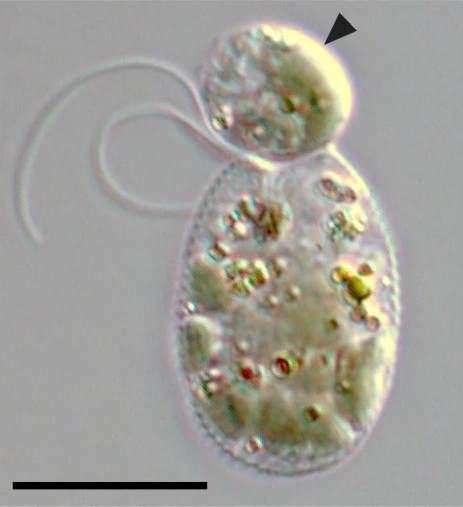
Rapaza viridis is the first known mixotroph (an organism that combines photosynthesis and ingestion of food) and kleptoplastic species within the phylum Euglenozoa. It eats microalgae by engulfing them—a process called phagocytosis—and then uses the chloroplasts from these algae to perform photosynthesis, altering the chloroplasts' structure in the process. In particular, Rapaza viridis can only feed on Tetraselmis cells native to their original environment, and will reject any other prey.
Due to its unique mode of nutrition and phylogenetic position, Rapaza viridis is considered an evolutionary step between phagotrophs and phototrophs with permanent chloroplasts. Scientists consider that the common ancestor of all Euglenophyceae (a group of algae) was similar to R. viridis. It likely stole chloroplasts from its prey—just like R. viridis—a behavior supported by the discovery of genes in Euglenophyceae that came from different types of algae through a process called horizontal gene transfer. After the divergence of R. viridis, the remaining Euglenophyceae acquired permanent plastids from Pyramimonas.
The genus name Rapaza comes from Latin rapax 'seizing' and 'grasping', in reference to the feeding behavior of the cells. The specific name viridis, meaning 'green', references the color of the chloroplasts and algal prey cells in the process of being digested. Together, the binomial name means 'green grasper' in Latin.
The genus Rapaza was circumscribed in 2012 by protistologists Aika Yamaguchi, Naoji Yubuki and Brian S. Leander, on a study published in the journal BMC Evolutionary Biology. It was created to describe a population of euglenids isolated in 2010 from marine water samples collected at a tide pool in Pachena Beach, British Columbia, Canada. After cultivation, various growth experiments and molecular phylogenetics, the microorganisms were shown to belong to the phototrophic euglenids (Euglenophyceae) and were described as the species Rapaza viridis. The new species had a functioning chloroplast but also exhibited phagotrophy, making it the first and only example of mixotrophic euglenids.
The genus was defined as including flexible mixotrophic euglenids with two unequal flagella, a minimum of one chloroplast with three membranes and pyrenoids penetrated by stacks of thylakoids, a robust stigma, a paraflagellar swelling, and a feeding pocket supported by microtubules. The species was further defined by the length and width measurements of the cells and flagella, the presence of paramylon grains in the cytoplasm, 16 pellicle strips, four rows of microtubules supporting the feeding pocket, and Tetraselmis as its preferred prey.
In 2016, American protozoologist Thomas Cavalier-Smith assigned this genus to several monotypic higher-level taxa: family Rapazidae, order Rapazida and subclass Rapazia within the class Euglenophyceae, leaving the remaining euglenophyceans (Euglenales and Eutreptiales) under a new subclass Euglenophycidae. He defined these three taxa as containing phagotrophic photosynthetic eukaryote-eating (eukaryovorous) euglenids that swim in the water column instead of gliding on the substrate, and present four rows of microtubules supporting the feeding pocket instead of one as in Euglenophycidae. His classification scheme was neglected by other authors in favour of treating the entirety of Euglenida (Euglenophyceae plus a variety of heterotrophic flagellates) as a class, and deprecating the use of Rapazia as a subclass. As of 2021, only Rapazidae and Rapazida are accepted taxa.
Rapaza viridis is a unicellular flagellate, a type of protist that is capable of swimming by using two flagella that differ in length and in movement. The cells are slender with a tapered posterior end, measuring approximately 10–38 μm long and 3–15 μm wide. Both flagella arise from a pocket located at the anterior end of the cell, one twice as long as the other but with the same thickness. The longer flagellum, about 1.25 times the length of the cell, is always directed forward. The shorter flagellum, about 0.65 times the cell length, is directed backward, but sometimes moves forward in an oar-like motion. Like other euglenids, cells are surrounded by a pellicle composed of 16 protein strips arranged helically below the cell membrane, and contain mitochondria with discoidal cristae. As in other spirocutes (i.e. flexible euglenids), cells of R. viridis are capable of 'metaboly' or 'euglenoid movement', which allows for active peristaltic deformation of the cell shape. Its feeding apparatus consists of one rod built of four rows of microtubules and a feeding pocket. There is a stigma composed of 1 to over 10 pigmented particles. The cytoplasm contains ellipsoid paramylon grains, as well as polysaccharide grains as a result of photosynthesis.
Hub AI
Rapaza AI simulator
(@Rapaza_simulator)
Rapaza
Rapaza viridis (Latin for 'green grasper') is a species of single-celled flagellate within the Euglenophyceae, a group of algae. It is the only species within the genus Rapaza, family Rapazidae and order Rapazida. It was discovered in a tide pool in British Columbia and described in 2012.
Rapaza viridis is the first known mixotroph (an organism that combines photosynthesis and ingestion of food) and kleptoplastic species within the phylum Euglenozoa. It eats microalgae by engulfing them—a process called phagocytosis—and then uses the chloroplasts from these algae to perform photosynthesis, altering the chloroplasts' structure in the process. In particular, Rapaza viridis can only feed on Tetraselmis cells native to their original environment, and will reject any other prey.
Due to its unique mode of nutrition and phylogenetic position, Rapaza viridis is considered an evolutionary step between phagotrophs and phototrophs with permanent chloroplasts. Scientists consider that the common ancestor of all Euglenophyceae (a group of algae) was similar to R. viridis. It likely stole chloroplasts from its prey—just like R. viridis—a behavior supported by the discovery of genes in Euglenophyceae that came from different types of algae through a process called horizontal gene transfer. After the divergence of R. viridis, the remaining Euglenophyceae acquired permanent plastids from Pyramimonas.
The genus name Rapaza comes from Latin rapax 'seizing' and 'grasping', in reference to the feeding behavior of the cells. The specific name viridis, meaning 'green', references the color of the chloroplasts and algal prey cells in the process of being digested. Together, the binomial name means 'green grasper' in Latin.
The genus Rapaza was circumscribed in 2012 by protistologists Aika Yamaguchi, Naoji Yubuki and Brian S. Leander, on a study published in the journal BMC Evolutionary Biology. It was created to describe a population of euglenids isolated in 2010 from marine water samples collected at a tide pool in Pachena Beach, British Columbia, Canada. After cultivation, various growth experiments and molecular phylogenetics, the microorganisms were shown to belong to the phototrophic euglenids (Euglenophyceae) and were described as the species Rapaza viridis. The new species had a functioning chloroplast but also exhibited phagotrophy, making it the first and only example of mixotrophic euglenids.
The genus was defined as including flexible mixotrophic euglenids with two unequal flagella, a minimum of one chloroplast with three membranes and pyrenoids penetrated by stacks of thylakoids, a robust stigma, a paraflagellar swelling, and a feeding pocket supported by microtubules. The species was further defined by the length and width measurements of the cells and flagella, the presence of paramylon grains in the cytoplasm, 16 pellicle strips, four rows of microtubules supporting the feeding pocket, and Tetraselmis as its preferred prey.
In 2016, American protozoologist Thomas Cavalier-Smith assigned this genus to several monotypic higher-level taxa: family Rapazidae, order Rapazida and subclass Rapazia within the class Euglenophyceae, leaving the remaining euglenophyceans (Euglenales and Eutreptiales) under a new subclass Euglenophycidae. He defined these three taxa as containing phagotrophic photosynthetic eukaryote-eating (eukaryovorous) euglenids that swim in the water column instead of gliding on the substrate, and present four rows of microtubules supporting the feeding pocket instead of one as in Euglenophycidae. His classification scheme was neglected by other authors in favour of treating the entirety of Euglenida (Euglenophyceae plus a variety of heterotrophic flagellates) as a class, and deprecating the use of Rapazia as a subclass. As of 2021, only Rapazidae and Rapazida are accepted taxa.
Rapaza viridis is a unicellular flagellate, a type of protist that is capable of swimming by using two flagella that differ in length and in movement. The cells are slender with a tapered posterior end, measuring approximately 10–38 μm long and 3–15 μm wide. Both flagella arise from a pocket located at the anterior end of the cell, one twice as long as the other but with the same thickness. The longer flagellum, about 1.25 times the length of the cell, is always directed forward. The shorter flagellum, about 0.65 times the cell length, is directed backward, but sometimes moves forward in an oar-like motion. Like other euglenids, cells are surrounded by a pellicle composed of 16 protein strips arranged helically below the cell membrane, and contain mitochondria with discoidal cristae. As in other spirocutes (i.e. flexible euglenids), cells of R. viridis are capable of 'metaboly' or 'euglenoid movement', which allows for active peristaltic deformation of the cell shape. Its feeding apparatus consists of one rod built of four rows of microtubules and a feeding pocket. There is a stigma composed of 1 to over 10 pigmented particles. The cytoplasm contains ellipsoid paramylon grains, as well as polysaccharide grains as a result of photosynthesis.
Recent media