Hubbry Logo
PeristalsisPeristalsisMain
Open search
Peristalsis
Community hub
Peristalsis
logo
8 pages, 0 posts
0 subscribers
Be the first to start a discussion here.
Peristalsis
Peristalsis
from Wikipedia
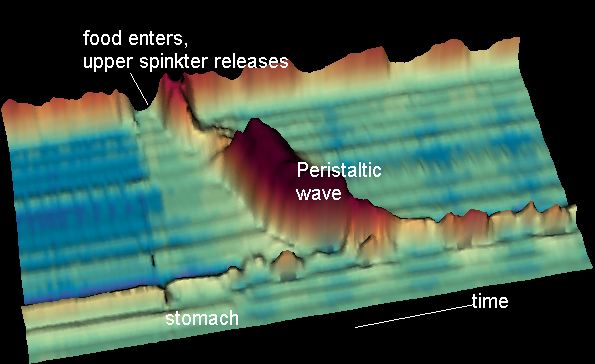
A time-space diagram of a peristaltic wave after a water swallow. High-pressure values are red, zero pressure is blue-green. The ridge in the upper part of the picture is the high pressure of the upper esophageal sphincter which only opens for a short time to let water pass.

Peristalsis (/ˌpɛrɪˈstælsɪs/ PERR-ih-STAL-siss, US also /-ˈstɔːl-/ -⁠STAWL-)[1] is a type of intestinal motility, characterized by radially symmetrical contraction and relaxation of muscles that propagate in a wave down a tube, in an anterograde direction. Peristalsis is progression of coordinated contraction of involuntary circular muscles, which is preceded by a simultaneous contraction of the longitudinal muscle and relaxation of the circular muscle in the lining of the gut.[2]

In much of a digestive tract, such as the human gastrointestinal tract, smooth muscle tissue contracts in sequence to produce a peristaltic wave, which propels a ball of food (called a bolus before being transformed into chyme in the stomach) along the tract. The peristaltic movement comprises relaxation of circular smooth muscles, then their contraction behind the chewed material to keep it from moving backward, then longitudinal contraction to push it forward.

Earthworms use a similar mechanism to drive their locomotion,[3][self-published source?] and some modern machinery imitate this design.[4]

The word comes from Neo-Latin and is derived from the Greek peristellein, "to wrap around," from peri-, "around" + stellein, "draw in, bring together; set in order".[5]

Human physiology

[edit]

Peristalsis is generally directed caudal, that is, towards the anus. This sense of direction might be attributable to the polarisation of the myenteric plexus. Because of the reliance of the peristaltic reflex on the myenteric plexus, it is also referred to as the myenteric reflex.[6]

Mechanism of the peristaltic reflex

[edit]

The food bolus causes a stretch of the gut smooth muscle to cause serotonin to be secreted to sensory neurons, which then get activated. These sensory neurons, in turn, activate neurons of the myenteric plexus, which then proceed to split into two cholinergic pathways: a retrograde and an anterograde. Activated neurons of the retrograde pathway release substance P and acetylcholine to contract the smooth muscle behind the bolus. The activated neurons of the anterograde pathway instead release nitric oxide and vasoactive intestinal polypeptide to relax the smooth muscle caudal to the bolus. This allows the food bolus to effectively be pushed forward along the digestive tract.[7]

Esophagus

[edit]

After food is chewed into a bolus, it is swallowed and moved through the esophagus. Smooth muscles contract behind the bolus to prevent it from being squeezed back into the mouth. Then rhythmic, unidirectional waves of contractions work to rapidly force the food into the stomach. The migrating motor complex (MMC) helps trigger peristaltic waves. This process works in one direction only, and its sole esophageal function is to move food from the mouth into the stomach (the MMC also functions to clear out remaining food in the stomach to the small bowel and remaining particles in the small bowel into the colon).[8]

A simplified image showing peristalsis

In the esophagus, two types of peristalsis occur:

  • First, there is a primary peristaltic wave, which occurs when the bolus enters the esophagus during swallowing. The primary peristaltic wave forces the bolus down the esophagus and into the stomach in a wave lasting about 8–9 seconds. The wave travels down to the stomach even if the bolus of food descends at a greater rate than the wave itself, and continues even if for some reason the bolus gets stuck further up the esophagus.
  • If the bolus gets stuck or moves slower than the primary peristaltic wave (as can happen when it is poorly lubricated), then stretch receptors in the esophageal lining are stimulated and a local reflex response causes a secondary peristaltic wave around the bolus, forcing it further down the esophagus, and these secondary waves continue indefinitely until the bolus enters the stomach. The process of peristalsis is controlled by the medulla oblongata. Esophageal peristalsis is typically assessed by performing an esophageal motility study.
  • A third type of peristalsis, tertiary peristalsis, is dysfunctional and involves irregular, diffuse, simultaneous contractions. These contractions are suspect in esophageal dysmotility and present on a barium swallow as a "corkscrew esophagus".[9]

During vomiting, the propulsion of food up the esophagus and out the mouth comes from the contraction of the abdominal muscles; peristalsis does not reverse in the esophagus.[citation needed]

Stomach

[edit]

When a peristaltic wave reaches at the end of the esophagus, the cardiac sphincter (gastroesophageal sphincter) opens, allowing the passage of bolus into the stomach. The gastroesophageal sphincter normally remains closed and does not allow the stomach's food contents to move back. The churning movements of the stomach's thick muscular wall blend the food thoroughly with the acidic gastric juice, producing a mixture called the chyme. The muscularis layer of the stomach is thickest and maximum peristalsis occurs here. After short intervals, the pyloric sphincter keeps on opening and closing so the chyme is fed into the intestine in installments.

Small intestine

[edit]

Once processed and digested by the stomach, the semifluid chyme is passed through the pyloric sphincter into the small intestine. Once past the stomach, a typical peristaltic wave lasts only a few seconds, traveling at only a few centimeters per second. Its primary purpose is to mix the chyme in the intestine rather than to move it forward in the intestine. Through this process of mixing and continued digestion and absorption of nutrients, the chyme gradually works its way through the small intestine to the large intestine.[8]

In contrast to peristalsis, segmentation contractions result in that churning and mixing without pushing materials further down the digestive tract.

Large intestine

[edit]

Although the large intestine has peristalsis of the type that the small intestine uses, it is not the primary propulsion. Instead, general contractions called mass action contractions occur one to three times per day in the large intestine, propelling the chyme (now feces) toward the rectum. Mass movements often tend to be triggered by meals, as the presence of chyme in the stomach and duodenum prompts them (gastrocolic reflex). Minimum peristalsis is found in the rectum part of the large intestine as a result of the thinnest muscularis layer.

Lymph

[edit]

The human lymphatic system has no central pump. Instead, lymph circulates through peristalsis in the lymph capillaries as well as valves in the capillaries, compression during contraction of adjacent skeletal muscle, and arterial pulsation.

Sperm

[edit]

During ejaculation, the smooth muscle in the walls of the vasa deferentia contract reflexively in peristalsis, propelling sperm from the testicles to the urethra.[10]

Earthworms

[edit]
A simplified image showing Earthworm movement via peristalsis

The earthworm is a limbless annelid worm with a hydrostatic skeleton that moves by peristalsis. Its hydrostatic skeleton consists of a fluid-filled body cavity surrounded by an extensible body wall. The worm moves by radially constricting the anterior portion of its body, increasing length via hydrostatic pressure. This constricted region propagates posteriorly along the worm's body. As a result, each segment is extended forward, then relaxes and re-contacts the substrate, with hair-like setae preventing backward slipping.[11] Various other invertebrates, such as caterpillars and millipedes, also move by peristalsis.

Machinery

[edit]

A peristaltic pump is a positive-displacement pump in which a motor pinches advancing portions of a flexible tube to propel a fluid within the tube. The pump isolates the fluid from the machinery, which is important if the fluid is abrasive or must remain sterile.

Robots have been designed that use peristalsis to achieve locomotion, as the earthworm uses it.[12][13]

[edit]
  • Aperistalsis refers to a lack of propulsion. It can result from achalasia of the smooth muscle involved.
  • Basal electrical rhythm is a slow wave of electrical activity that can initiate a contraction.
  • Catastalsis is a related intestinal muscle process.[8]
  • Ileus is a disruption of the normal propulsive ability of the gastrointestinal tract caused by the failure of peristalsis.
  • Retroperistalsis, the reverse of peristalsis
  • Segmentation contractions are another type of intestinal motility.
  • Intestinal desmosis, the atrophy of the tendinous plexus layer, may cause disturbed gut motility.[14]

References

[edit]
[edit]
Revisions and contributorsEdit on WikipediaRead on Wikipedia
from Grokipedia
Peristalsis is a series of involuntary, wave-like muscle contractions that propel contents through hollow tubular structures in the body, most prominently in the digestive tract from the pharynx to the anus. This process involves the coordinated contraction of circular muscles behind the material to push it forward and simultaneous relaxation of muscles ahead, ensuring efficient movement without voluntary control. In the gastrointestinal system, peristalsis facilitates the transport of food, mixing it with digestive enzymes for breakdown, and promoting nutrient absorption while directing waste toward elimination. The mechanism of peristalsis is primarily regulated by the , particularly the , which coordinates activity through electrical slow waves generated by . These slow waves, occurring at rates such as 3 per minute in the and 16 per minute in the , trigger action potentials that lead to muscle contractions when thresholds are met. Parasympathetic stimulation via enhances peristaltic activity, while hormones like serotonin modulate it through specific receptors. Beyond the digestive tract, peristalsis occurs in other organs, including the ureters for urine transport, the for sperm movement, bile ducts, lymph capillaries, and the during labor. Peristalsis develops early in fetal life, observable by 14 weeks and strengthening by 24 to 35 weeks, underscoring its fundamental role in physiological function. Disruptions in peristalsis can lead to conditions such as gastroesophageal reflux, achalasia, or , highlighting its clinical significance.

Definition and Mechanism

Definition

Peristalsis is an involuntary process characterized by coordinated, wave-like contractions of smooth muscles that propel contents through tubular structures in living organisms, a mechanism also replicated in certain mechanical devices for fluid transport. The term derives from the Greek "peristellein," meaning "to wrap around," and was introduced in 1859 by physiologists investigating intestinal . This phenomenon differs from segmentation, another gastrointestinal movement, in that peristalsis emphasizes directional propulsion of materials along a pathway, whereas segmentation involves alternating contractions primarily for mixing and absorption without net forward movement. Peristalsis is fundamentally regulated by neural mechanisms that coordinate muscle activity, ensuring rhythmic progression. Evolutionarily, peristalsis is a highly conserved observed across diverse phyla, from like annelids to vertebrates, facilitating efficient material in elongated or tubular body plans as an ancient bilaterian trait. This conservation underscores its fundamental role in biological systems predating complex organ specialization.

Neural and Muscular Mechanisms

Peristalsis is primarily orchestrated by the enteric nervous system (ENS), a semi-autonomous network embedded in the gastrointestinal tract wall that coordinates the peristaltic reflex. This reflex is initiated when sensory neurons in the submucosal and myenteric plexuses detect distension of the gut wall caused by a bolus of contents, triggering mechanoreceptors that signal interneurons for processing. The interneurons then activate motor neurons, which release neurotransmitters such as acetylcholine for excitation and nitric oxide or vasoactive intestinal peptide for inhibition, leading to coordinated contractions of circular and longitudinal smooth muscles. The peristaltic reflex unfolds in two distinct phases: the constrictive phase, where circular contracts proximal (oral) to the bolus to form a that grips and pushes the contents forward, and the propulsive phase, where longitudinal contracts distal (anal) to the bolus while circular muscle relaxes, shortening the segment ahead to facilitate forward propulsion. This pattern adheres to the "law of the intestine," first described by Bayliss and , whereby distension elicits contraction above and relaxation below the stimulus, ensuring efficient aboral movement without backflow. Interstitial cells of Cajal (ICCs), acting as pacemaker cells within the , generate rhythmic slow waves of that propagate through the layers at frequencies of approximately 3 cycles per minute in the to 12 cycles per minute in the , decreasing distally in the , to synchronize contractions. These slow waves set the , upon which action potentials superimpose to trigger calcium influx and muscle shortening. Biophysically, peristalsis relies on sequential contractions that establish pressure gradients along the gut lumen, with higher pressure behind the bolus driving its while lower pressure ahead allows accommodation. The modulates this process: parasympathetic input via the vagus and pelvic nerves enhances peristaltic activity through stimulation, whereas sympathetic input from thoracolumbar spinal levels inhibits it via noradrenergic pathways, adjusting to physiological needs such as or stress responses.

Peristalsis in Human Physiology

Esophagus and Upper GI Tract

Peristalsis in the esophagus serves as the primary mechanism for transporting a swallowed bolus from the pharynx to the stomach, involving coordinated contractions that propel the food while preventing reflux or aspiration. The esophagus is divided into an upper third composed of voluntary striated (skeletal) muscle and a lower two-thirds of involuntary smooth muscle, allowing for distinct control mechanisms in each segment. Primary peristalsis is initiated by swallowing and propagates as a single wave through both muscle types, beginning with striated muscle activation in the upper esophagus and transitioning to smooth muscle contractions in the distal portion. Secondary peristalsis, triggered by esophageal distension rather than swallowing, clears residual material or refluxate and is predominantly mediated by local enteric reflexes in the smooth muscle region. These waves travel at speeds of 2-4 cm/s, with velocity gradually decreasing from proximal to distal segments to facilitate efficient bolus propulsion. The process integrates esophageal peristalsis seamlessly with the pharyngeal phase, where sensory stimulation in the oropharynx triggers a via the glossopharyngeal and vagus nerves, initiating primary peristalsis to propel the bolus while coordinating airway protection to prevent aspiration. Relaxation of the upper esophageal (UES), a high-pressure zone of striated muscle at the pharyngoesophageal junction, occurs immediately upon initiation, allowing the bolus to enter the without resistance. In the distal , coordination with the lower esophageal (LES), a smooth muscle ring at the gastroesophageal junction, involves transient relaxation during the peristaltic wave to permit bolus entry into the , followed by rapid re-contraction to maintain a resting barrier against gastric . Dysfunction in esophageal peristalsis can lead to significant clinical issues, such as achalasia, a disorder characterized by impaired LES relaxation and absence of peristalsis in the due to loss of inhibitory neurons in the . This results in , food retention, and increased risk of aspiration or regurgitation, often requiring interventions like pneumatic dilation or myotomy to restore passage. At the gastroesophageal junction, peristaltic waves slow considerably, adapting to the transition from esophageal transport to gastric accommodation, where the LES ensures controlled delivery of the bolus without backflow.

Stomach and Small Intestine

In the , peristalsis manifests as retropulsive waves that originate in the fundus and propagate toward the antrum at a of approximately three cycles per minute, facilitating the mixing of ingested with gastric secretions to form while preventing complete propulsion through the distal . These waves generate backward squirting of against the closed pyloric sphincter, enhancing and homogenization without advancing larger particles beyond the antrum. The pyloric sphincter plays a critical role in this process by intermittently relaxing to regulate release into the in small bursts of 1-2 mL per cycle, ensuring controlled delivery that matches duodenal processing capacity. Transitioning from the esophagus, where primary peristalsis delivers boluses to the stomach, gastric peristalsis shifts focus to mixing and partial emptying. In the small intestine, peristaltic activity adapts to the demands of nutrient absorption, differing markedly between fasting and fed states. During fasting, migrating motor complexes (MMCs) dominate, consisting of cyclical patterns that clear residual contents; phase III of the MMC features high-amplitude peristaltic contractions propagating aborally at 11-12 cycles per minute in the proximal small intestine. In the fed state, peristalsis integrates with segmentation contractions, forming a hybrid pattern of mixing and propulsion at frequencies of 8-12 cycles per minute, which churns chyme to maximize contact with absorptive mucosa while advancing it distally. The duodenum exhibits specialized adaptations, including brake mechanisms that slow transit to optimize initial digestion of fats, acids, and nutrients entering from the . These brakes, mediated by neural and hormonal feedback, inhibit excessive propulsion, allowing time for and pancreatic mixing. Hormonal influences further modulate these processes: , released from gastric G cells, enhances antral contractions and overall gastric to promote formation, while cholecystokinin (CCK), secreted by duodenal I cells in response to luminal fats and proteins, stimulates small intestinal peristalsis and segmentation but also reinforces the duodenal brake by delaying gastric emptying.

Large Intestine and Lower GI Tract

In the , peristalsis manifests as relatively slow, rhythmic contractions that primarily facilitate water and absorption while propelling residual contents toward the . Colonic generates slow waves at a of approximately 2-6 cycles per minute, which underlie the basic electrical rhythm for contraction . These waves travel at speeds of 1-2 cm per minute, promoting gradual mixing rather than . The colon's haustra—pouch-like segments formed by taeniae coli—enhance this process through haustral contractions, which occur every 30 minutes and last about 1 minute, stimulated by distension from remnants; these actions churn contents to maximize , forming semisolid . Mass movements represent a distinct, more forceful pattern of colonic peristalsis, occurring 3-4 times daily, often postprandially or upon awakening, to consolidate and advance fecal material. These are driven by giant migrating contractions (GMCs), high-amplitude, lumen-occluding waves that propagate over extended distances, typically spanning 10-30 cm or more of the colon at velocities around 1 cm per second. GMCs originate mainly in the proximal colon and migrate distally, temporarily disrupting haustral segmentation to propel boluses toward the sigmoid colon and rectum, with tonic contractions aiding in sustained propulsion. As fecal matter reaches the , peristalsis triggers the , a coordinated response involving parasympathetic via the pelvic nerves. Distension of the initiates the rectoanal inhibitory , causing involuntary relaxation of the —a ring maintained by sympathetic tone—while increasing rectal pressure. Voluntary control is exerted through the , a under somatic innervation from the , allowing conscious relaxation or contraction to initiate or defer ; abdominal straining via the further facilitates expulsion. Peristaltic activity in the colon also interacts with the gut microbiome, promoting of undigested carbohydrates by bacterial communities in the distal regions. Rhythmic contractions aid in distributing substrates for , producing and gases (such as and ), while patterns like GMCs and simultaneous pressure waves help propel excess gas distally to prevent . Disruptions in these motility patterns are implicated in disorders like (IBS), where patients often exhibit exaggerated postprandial colonic contractions, altered GMC frequency (increased in diarrhea-predominant IBS), and irregular haustral activity, contributing to symptoms of , , and altered bowel habits.

Non-Digestive Systems

Peristalsis occurs in several systems beyond the , facilitating the transport of fluids, cells, and other materials through tubular structures via coordinated contractions. These non-digestive applications adapt the core peristaltic mechanism—sequential waves of circular and longitudinal muscle activity—to specialized functions, such as propulsion of , , gametes, or , often with variations in rhythm and autonomy compared to digestive processes. In the , peristalsis drives the absorption and movement of and , independent of cardiac pulsations. Collecting lymphatic vessels, including those connected to lacteals in the intestinal mucosa, exhibit intrinsic spontaneous contractions generated by cells, propelling at rates of approximately 5-10 contractions per minute. These rhythmic waves, with frequencies around 5-6 per minute in human models, create valve-mediated one-way flow, aiding fat absorption from the gut and preventing stasis, particularly during rest when external pressures like respiration are minimal. Ureteral peristalsis propels boluses of from the kidneys to the through coordinated waves initiated in the . Pacemaker cells, including atypical cells in the proximal , generate electrical activity that drives these peristaltic contractions at a of 1-6 waves per minute in humans, with a mean of about 3.5 waves per minute under normal conditions. This myogenic activity ensures efficient transport against , with wave speeds adapting to volume and , and is modulated by both sympathetic and parasympathetic innervation. In the male reproductive tract, peristaltic contractions of the facilitate transport from the to the . These strong, wave-like contractions propel spermatozoa at speeds of approximately 1-2 mm/s during emission, contributing to the rapid delivery of while also supporting slower storage movements. In the , uterine peristalsis plays key roles during and labor; during menses, fundus-to- directed waves expel endometrial tissue and blood, occurring at higher frequencies and magnitudes than in other cycle phases, while during labor, intensified contractions propagate to dilate the and expel the . Limited peristaltic activity also appears in the vascular , particularly in arterioles, to fine-tune blood flow distribution. In conjunctival and other peripheral microvessels, spontaneous luminal constrictions in small arterioles (order 0 to -4) generate peristaltic propulsion of erythrocyte boluses, synchronized with , enhancing tissue and regulating local resistance without relying solely on central . This mechanism helps maintain steady flow in beds, adapting to metabolic demands. Compared to gastrointestinal peristalsis, which relies on coordination for slower, digestion-linked waves, non-digestive peristalsis often features higher intrinsic rhythmicity and frequency due to specialized properties, such as greater myogenic autonomy in ureters and lymphatics or hormone-modulated intensity in reproductive tracts. These adaptations prioritize efficient, unidirectional transport of non-nutritive fluids over mixing or segmentation seen in the gut.

Peristalsis in Other Organisms

In , peristalsis manifests as coordinated muscular contractions that facilitate locomotion, , and nutrient transport, often integrated with the organism's . A primary example is the (), where metameric segmentation allows for precise control of body movement through alternating contractions of circular and longitudinal muscles in the body wall. These muscles generate anterograde peristaltic waves that propagate from head to tail, enabling both burrowing through soil and the propulsion of ingested material along the digestive tract for . The locomotion speed is determined by the wave's and anchoring via setae at contracted segments. In simpler invertebrates like coelenterates (cnidarians such as ), peristalsis-like mechanisms involve pulsatile contractions of myoepithelial cells surrounding the gastrovascular cavity, which serves dual roles in and internal transport. These rhythmic pulsations create bidirectional flows that distribute nutrients and oxygen throughout the body, compensating for the absence of a dedicated . For instance, in species like , contractions generate simultaneous inward and outward flows in branched canal structures, enhancing nutrient absorption and waste expulsion. Annelids, exemplified by earthworms, and nematodes exhibit peristaltic waves that are crucial for whole-body locomotion, contrasting with the more localized, tubular focus in vertebrates. In annelids, the coelomic compartments act as a , allowing waves to alternate muscle states for forward propulsion without rigid appendages. Nematodes, though unsegmented, employ similar propagating body waves via longitudinal and radial muscles under high , facilitating sinusoidal undulations for movement through or host tissues. This integration of peristalsis with underscores its evolutionary significance, enabling elongated body plans in soft-bodied by providing efficient propulsion and material transport without reliance on centralized pumps like hearts. Dysfunctions or adaptations in peristalsis can influence ecological interactions, such as in parasitic nematodes that exploit host gastrointestinal peristalsis for migration and establishment. For example, nematodes like Nippostrongylus brasiliensis modulate host intestinal through inflammatory signals, enhancing propulsive activity that aids larval migration along the gut lumen while evading expulsion. This exploitation highlights how parasites can co-opt host mechanisms for survival, often leading to altered neural and muscular responses in the host.

Non-Human Vertebrates

In non-human vertebrates, peristalsis exhibits diverse adaptations tailored to ecological niches, dietary habits, and anatomical constraints, facilitating efficient propulsion of food through the digestive tract while coordinating with respiratory and other physiological demands. In and amphibians, peristaltic mechanisms are modified to accommodate aquatic environments and dual respiratory functions. Gular pumping, involving rhythmic contractions of the hyobranchial apparatus in the region, assists in by creating pressure gradients that propel prey from the buccal cavity to the , independent of ventilation to avoid interference with oxygen uptake. Esophageal peristalsis then transports the bolus posteriorly, often initiated after manipulation positions the food, ensuring rapid clearance in water where aids initial movement but resists flow. Birds demonstrate specialized peristaltic patterns optimized for high-metabolic-rate of and other compact foods. In the , a dilation of the , peristaltic waves store and soften ingested material through gentle mixing contractions, preparing it for further breakdown without immediate enzymatic action. The employs powerful peristaltic grinding motions, aided by ingested grit, to mechanically disrupt tough seed coats, with contraction frequencies up to several per minute to accommodate rapid throughput. Intestinal peristalsis in birds features bi-directional waves, including refluxes that enhance extraction from by prolonging exposure to , enabling transit times as short as 15-30 minutes in small species for efficient energy acquisition during flight. Reptiles exhibit peristalsis adapted to intermittent feeding and ectothermic , with notable variations in propulsion through the , the common chamber for digestive, urinary, and reproductive outputs. Intestinal peristaltic waves propel digesta slowly toward the , where final contractions coordinate expulsion of and , often synchronized with behaviors like basking to optimize use. In species like and snakes, cloacal propulsion involves localized muscular peristalsis to prevent backflow and ensure complete voiding, reflecting anatomical fusion that streamlines waste elimination in terrestrial and semi-aquatic habitats. Among mammals, peristalsis varies markedly with diet, particularly in herbivores where rumination enhances breakdown. In ruminants such as cows and sheep, reticular contractions—specialized peristaltic waves in the —initiate regurgitation of for re-chewing, occurring at rates of 1-2 per minute to mix and ferment plant material via microbial action. Large herbivores like display slower intestinal peristalsis, with mean retention times of approximately 23-27 hours to maximize extraction from low-quality , contrasting with carnivores where rapid waves (up to 10-15 per minute in the ) facilitate quick processing of protein-rich meals within 12-24 hours. Evolutionarily, peristalsis in aquatic vertebrates has diverged in species reliant on feeding, where buccal expansion generates flow for prey capture and initial transport, reducing dependence on esophageal waves for intraoral stages but retaining them for esophageal propulsion to handle whole prey. In some gill-dependent , modifications minimize peristaltic interference with ventilation, such as decoupled gular pumps, while terrestrial transitions in amphibians amplified wave amplitude for gravity-defying transport.

Peristalsis in Engineering

Peristaltic Pumps

Peristaltic pumps are positive displacement devices that mimic the sequential contraction and relaxation of biological tissues to fluids through a flexible tube without contact between the pump mechanism and the . The basic design consists of a rotating head equipped with rollers or fingers that compress the tube against a curved or track, creating a progressive wave of occlusion that propels the forward. This isolation of the fluid within the tubing prevents and allows for easy sterilization by simply replacing or autoclaving the tube. The operational principle relies on the tube's elasticity to rebound after compression, drawing in fluid behind the occlusion point while expelling it ahead, resulting in a pulsatile flow output characteristic of positive displacement. The flow rate QQ (in units such as mL/min, assuming consistent length units) can be approximated by the formula Q=πr2NQ = \pi r^2 N, where rr is the inner radius of the tube and NN is the rotational speed of the pump head in revolutions per minute (rpm). To derive this, first calculate the volume displaced per revolution as the cross-sectional area of the tube πr2\pi r^2 multiplied by the effective axial length of fluid moved per revolution (often simplified to a unit length or pitch distance in basic models); then, multiply by the number of revolutions per minute NN, yielding the volumetric rate per minute. In practice, actual flow may deviate due to factors like partial occlusion or backflow, but this equation establishes the proportional relationship between tube geometry, speed, and output. Key advantages of peristaltic pumps include their inherent sterility, as the fluid contacts only the disposable tubing, making them ideal for and pharmaceutical applications such as and bioprocessing where must be avoided. They also excel at handling viscous, shear-sensitive, or fluids—like slurries, gels, or chemicals—without or degradation, due to the gentle rolling action that avoids high shear forces present in other types. Common types include roller pumps, which use rotating cylindrical rollers for even compression; shoe pumps, employing sliding shoes for higher-pressure applications with larger hoses; and linear pumps, which use reciprocating fingers or pistons for straight-line occlusion, often in compact or precision-dosing scenarios. These designs emerged prominently in the to meet biomedical needs, such as non-occlusive blood pumping during surgeries, building on earlier patents to enable safe handling of biological fluids. Efficiency in peristaltic pumps is influenced by the tube occlusion—typically compressing the tube to 40–60% of its original diameter for optimal performance—which ensures complete sealing to minimize while avoiding excessive wear. Material elasticity of the tubing, such as or elastomers, determines rebound speed and fatigue resistance; overly stiff materials reduce occlusion effectiveness and increase energy loss, whereas highly elastic ones promote rapid recovery but may allow leakage if not balanced with proper compression force.

Other Mechanical Applications

In , peristaltic actuators leverage pneumatic or electroactive polymers to generate wave-like contractions that facilitate locomotion through narrow or irregular environments. These actuators mimic biological peristalsis by sequentially inflating and deflating segments, enabling inchworm-style crawling with minimal . For example, modular pneumatic designs allow robots to navigate confined spaces, such as pipelines or biological lumens, by controlling segment expansion for anchoring and . Endoscopic applications include snake-like soft robots that propel themselves via peristaltic waves, reducing the need for external pulling and enhancing safety during procedures like . Peristalsis-inspired mechanisms extend to beyond handling, particularly in conveyor systems for delicate . In , automated peristaltic conveyors replicate intestinal mixing and propulsion, switching modes via to blend and advance viscous substances like or slurries without contamination. Similarly, in additive manufacturing, peristaltic extruders for employ sequential compression waves along flexible tubes to dispense bioinks or polymers with precise, pulsation-minimized flow, supporting applications in bioprinting where uniform deposition is critical. Biomedical engineering has adopted peristaltic principles for implantable and wearable devices that emulate natural organ functions. Artificial esophagus prototypes utilize soft actuators, such as or pneumatic bladders, to produce coordinated peristaltic waves that transport boluses through synthetic tubes, addressing in patients with esophageal disorders. Drug delivery catheters incorporate miniaturized peristaltic micropumps, often thermo-pneumatic, to enable targeted, on-demand release of therapeutics directly into neural or vascular sites, minimizing systemic side effects. Despite these innovations, peristaltic mechanisms in face significant challenges related to material durability and practical deployment. Repeated cyclic deformations lead to fatigue in polymers like or electroactive materials, reducing lifespan to thousands of cycles compared to the near-indefinite operation of rigid mechanical systems. issues arise from difficulties in fabricating uniform large-scale structures and maintaining precise wave propagation across extended lengths, limiting adoption in industrial settings. Recent advances since have focused on biohybrid systems that combine living muscle tissues with synthetic scaffolds to achieve more biomimetic and fatigue-resistant peristalsis. These actuators integrate cultured skeletal myocytes onto flexible tubes, where electrical triggers natural contractions for self-sustained wave motion, offering enhanced adaptability and over purely synthetic designs. For instance, myoneural biohybrids demonstrate prolonged functionality in implantable contexts by leveraging muscle's inherent repair mechanisms. More recent developments, as of 2025, include earthworm-inspired multimodal pneumatic continuous soft robots that use wire-winding transmission for improved multimodal locomotion in complex environments.

References

Add your contribution
Related Hubs
User Avatar
No comments yet.