Ratio
Ratio
Main page
2298649

Ratio

logo
Community Hub0 subscribers
Read side by side
from Wikipedia
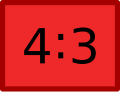
The ratio of width to height of standard-definition television

In mathematics, a ratio (/ˈr.ʃ(i.)/) shows how many times one number contains another. For example, if there are eight oranges and six lemons in a bowl of fruit, then the ratio of oranges to lemons is eight to six (that is, 8:6, which is equivalent to the ratio 4:3). Similarly, the ratio of lemons to oranges is 6:8 (or 3:4) and the ratio of oranges to the total amount of fruit is 8:14 (or 4:7).

The numbers in a ratio may be quantities of any kind, such as counts of people or objects, or such as measurements of lengths, weights, time, etc. In most contexts, both numbers are restricted to be positive.

A ratio may be specified either by giving both constituting numbers, written as "a to b" or "a:b", or by giving just the value of their quotient a/b.[1][2][3] Equal quotients correspond to equal ratios. A statement expressing the equality of two ratios is called a proportion.

Consequently, a ratio may be considered as an ordered pair of numbers, a fraction with the first number in the numerator and the second in the denominator, or as the value denoted by this fraction. Ratios of counts, given by (non-zero) natural numbers, are rational numbers, and may sometimes be natural numbers.

A more specific definition adopted in physical sciences (especially in metrology) for ratio is the dimensionless quotient between two physical quantities measured with the same unit.[4] A quotient of two quantities that are measured with different units may be called a rate.[5]

Notation and terminology

[edit]

The ratio of numbers A and B can be expressed as:[1]

  • the ratio of A to B
  • A:B
  • A is to B (when followed by "as C is to D"; see below)
  • a fraction with A as numerator and B as denominator that represents the quotient (i.e., A divided by B, or ). This can be expressed as a simple or a decimal fraction, or as a percentage, etc.[6]

When a ratio is written in the form A:B, the two-dot character is sometimes the colon punctuation mark.[7] In Unicode, this is U+003A : COLON, although Unicode also provides a dedicated ratio character, U+2236 RATIO.[8]

The numbers A and B are sometimes called terms of the ratio, with A being the antecedent and B being the consequent.[9]

A statement expressing the equality of two ratios A:B and C:D is called a proportion,[10] written as A:B = C:D or A:BC:D. This latter form, when spoken or written in the English language, is often expressed as

(A is to B) as (C is to D).

A, B, C and D are called the terms of the proportion. A and D are called its extremes, and B and C are called its means. The equality of three or more ratios, like A:B = C:D = E:F, is called a continued proportion.[1]

Ratios are sometimes used with three or even more terms. E.g., the proportion for the edge lengths of a "two by four" that is ten inches long is:

A good concrete mix (in volume units) is sometimes quoted as:[11]

The meaning of such a proportion of ratios with more than two terms is that the ratio of any two terms on the left-hand side is equal to the ratio of the corresponding two terms on the right-hand side.[disputeddiscuss]

History and etymology

[edit]

It is possible to trace the origin of the word "ratio" to the ancient Greek λόγος (logos). Early translators rendered this into Latin as ratio ("reason"; as in the word "rational"). A more modern interpretation of Euclid's meaning is more akin to computation or reckoning.[12] Medieval writers used the word proportio ("proportion") to indicate ratio and proportionalitas ("proportionality") for the equality of ratios.[13]

Euclid collected the results appearing in the Elements from earlier sources. The Pythagoreans developed a theory of ratio and proportion as applied to numbers.[14] The Pythagoreans' conception of number included only what would today be called rational numbers, casting doubt on the validity of the theory in geometry where, as the Pythagoreans also discovered, incommensurable ratios (corresponding to irrational numbers) exist. The discovery of a theory of ratios that does not assume commensurability is probably due to Eudoxus of Cnidus. The exposition of the theory of proportions that appears in Book VII of The Elements reflects the earlier theory of ratios of commensurables.[15]

The existence of multiple theories seems unnecessarily complex since ratios are, to a large extent, identified with quotients and their prospective values. However, this is a comparatively recent development, as can be seen from the fact that modern geometry textbooks still use distinct terminology and notation for ratios and quotients. The reasons for this are twofold: first, there was the previously mentioned reluctance to accept irrational numbers as true numbers, and second, the lack of a widely used symbolism to replace the already established terminology of ratios delayed the full acceptance of fractions as alternative until the 16th century.[16]

Euclid's definitions

[edit]

Book V of Euclid's Elements has 18 definitions, all of which relate to ratios.[17] In addition, Euclid uses ideas that were in such common usage that he did not include definitions for them. The first two definitions say that a part of a quantity is another quantity that "measures" it and conversely, a multiple of a quantity is another quantity that it measures. In modern terminology, this means that a multiple of a quantity is that quantity multiplied by an integer greater than one—and a part of a quantity (meaning aliquot part) is a part that, when multiplied by an integer greater than one, gives the quantity.

Euclid does not define the term "measure" as used here, However, one may infer that if a quantity is taken as a unit of measurement, and a second quantity is given as an integral number of these units, then the first quantity measures the second. These definitions are repeated, nearly word for word, as definitions 3 and 5 in book VII.

Definition 3 describes what a ratio is in a general way. It is not rigorous in a mathematical sense and some have ascribed it to Euclid's editors rather than Euclid himself.[18] Euclid defines a ratio as between two quantities of the same type, so by this definition the ratios of two lengths or of two areas are defined, but not the ratio of a length and an area. Definition 4 makes this more rigorous. It states that a ratio of two quantities exists, when there is a multiple of each that exceeds the other. In modern notation, a ratio exists between quantities p and q, if there exist integers m and n such that mp>q and nq>p. This condition is known as the Archimedean property.

Definition 5 is the most complex and difficult. It defines what it means for two ratios to be equal. Today, this can be done by simply stating that ratios are equal when the quotients of the terms are equal, but such a definition would have been meaningless to Euclid. In modern notation, Euclid's definition of equality is that given quantities p, q, r and s, p:qr:s if and only if, for any positive integers m and n, np < mq, np = mq, or np > mq according as nr < ms, nr = ms, or nr > ms, respectively.[19] This definition has affinities with Dedekind cuts as, with n and q both positive, np stands to mq as p/q stands to the rational number m/n (dividing both terms by nq).[20]

Definition 6 says that quantities that have the same ratio are proportional or in proportion. Euclid uses the Greek ἀναλόγον (analogon), this has the same root as λόγος and is related to the English word "analog".

Definition 7 defines what it means for one ratio to be less than or greater than another and is based on the ideas present in definition 5. In modern notation it says that given quantities p, q, r and s, p:q > r:s if there are positive integers m and n so that np > mq and nr ≤ ms.

As with definition 3, definition 8 is regarded by some as being a later insertion by Euclid's editors. It defines three terms p, q and r to be in proportion when p:qq:r. This is extended to four terms p, q, r and s as p:qq:rr:s, and so on. Sequences that have the property that the ratios of consecutive terms are equal are called geometric progressions. Definitions 9 and 10 apply this, saying that if p, q and r are in proportion then p:r is the duplicate ratio of p:q and if p, q, r and s are in proportion then p:s is the triplicate ratio of p:q.

Number of terms and use of fractions

[edit]

In general, a comparison of the quantities of a two-entity ratio can be expressed as a fraction derived from the ratio. For example, in a ratio of 2:3, the amount, size, volume, or quantity of the first entity is that of the second entity.

If there are 2 oranges and 3 apples, the ratio of oranges to apples is 2:3, and the ratio of oranges to the total number of pieces of fruit is 2:5. These ratios can also be expressed in fraction form: there are 2/3 as many oranges as apples, and 2/5 of the pieces of fruit are oranges. If orange juice concentrate is to be diluted with water in the ratio 1:4, then one part of concentrate is mixed with four parts of water, giving five parts total; the amount of orange juice concentrate is 1/4 the amount of water, while the amount of orange juice concentrate is 1/5 of the total liquid. In both ratios and fractions, it is important to be clear what is being compared to what, and beginners often make mistakes for this reason.

Fractions can also be inferred from ratios with more than two entities; however, a ratio with more than two entities cannot be completely converted into a single fraction, because a fraction can only compare two quantities. A separate fraction can be used to compare the quantities of any two of the entities covered by the ratio: for example, from a ratio of 2:3:7 we can infer that the quantity of the second entity is that of the third entity.

Proportions and percentage ratios

[edit]

If we multiply all quantities involved in a ratio by the same number, the ratio remains valid. For example, a ratio of 3:2 is the same as 12:8. It is usual either to reduce terms to the lowest common denominator, or to express them in parts per hundred (percent).

If a mixture contains substances A, B, C and D in the ratio 5:9:4:2, then there are 5 parts of A for every 9 parts of B, 4 parts of C, and 2 parts of D. As 5 + 9 + 4 + 2 = 20, the total mixture contains 5/20 of A (5 parts out of 20), 9/20 of B, 4/20 of C, and 2/20 of D. If we divide all numbers by the total and multiply by 100, we have converted to percentages: 25% A, 45% B, 20% C, and 10% D (equivalent to writing the ratio as 25:45:20:10).

If the two or more ratio quantities encompass all of the quantities in a particular situation, it is said that "the whole" contains the sum of the parts: for example, a fruit basket containing two apples and three oranges and no other fruit is made up of two parts apples and three parts oranges. In this case, , or 40% of the whole is apples and , or 60% of the whole is oranges. This comparison of a specific quantity to "the whole" is called a proportion.

If the ratio consists of only two values, it can be represented as a fraction, in particular as a decimal fraction. For example, older televisions have a 4:3 aspect ratio, which means that the width is 4/3 of the height (this can also be expressed as 1.33:1 or just 1.33 rounded to two decimal places). More recent widescreen TVs have a 16:9 aspect ratio, or 1.78 rounded to two decimal places. One of the popular widescreen movie formats is 2.35:1 or simply 2.35. Representing ratios as decimal fractions simplifies their comparison. When comparing 1.33, 1.78 and 2.35, it is obvious which format offers wider image. Such a comparison works only when values being compared are consistent, like always expressing width in relation to height.

Reduction

[edit]

Ratios can be reduced (as fractions are) by dividing each quantity by the common factors of all the quantities. As for fractions, the simplest form is considered that in which the numbers in the ratio are the smallest possible integers.

Thus, the ratio 40:60 is equivalent in meaning to the ratio 2:3, the latter being obtained from the former by dividing both quantities by 20. Mathematically, we write 40:60 = 2:3, or equivalently 40:60∷2:3. The verbal equivalent is "40 is to 60 as 2 is to 3."

A ratio that has integers for both quantities and that cannot be reduced any further (using integers) is said to be in simplest form or lowest terms.

Sometimes it is useful to write a ratio in the form 1:x or x:1, where x is not necessarily an integer, to enable comparisons of different ratios. For example, the ratio 4:5 can be written as 1:1.25 (dividing both sides by 4) Alternatively, it can be written as 0.8:1 (dividing both sides by 5).

Where the context makes the meaning clear, a ratio in this form is sometimes written without the 1 and the ratio symbol (:), though, mathematically, this makes it a factor or multiplier.

Irrational ratios

[edit]

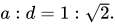
Ratios may also be established between incommensurable quantities (quantities whose ratio, as value of a fraction, amounts to an irrational number). The earliest discovered example, found by the Pythagoreans, is the ratio of the length of the diagonal d to the length of a side s of a square, which is the square root of 2, formally Another example is the ratio of a circle's circumference to its diameter, which is called π, and is not just an irrational number, but a transcendental number.
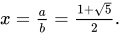
Also well known is the golden ratio of two (mostly) lengths a and b, which is defined by the proportion

or, equivalently

Taking the ratios as fractions and as having the value x, yields the equation

or

which has the positive, irrational solution Thus at least one of a and b has to be irrational for them to be in the golden ratio. An example of an occurrence of the golden ratio in math is as the limiting value of the ratio of two consecutive Fibonacci numbers: even though all these ratios are ratios of two integers and hence are rational, the limit of the sequence of these rational ratios is the irrational golden ratio.
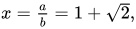
Similarly, the silver ratio of a and b is defined by the proportion

corresponding to

This equation has the positive, irrational solution so again at least one of the two quantities a and b in the silver ratio must be irrational.
Odds

[edit]

Odds (as in gambling) are expressed as a ratio. For example, odds of "7 to 3 against" (7:3) mean that there are seven chances that the event will not happen to every three chances that it will happen. The probability of success is 30%. In every ten trials, there are expected to be three wins and seven losses.

Units

[edit]

Ratios may be unitless, as in the case they relate quantities in units of the same dimension, even if their units of measurement are initially different. For example, the ratio one minute : 40 seconds can be reduced by changing the first value to 60 seconds, so the ratio becomes 60 seconds : 40 seconds. Once the units are the same, they can be omitted, and the ratio can be reduced to 3:2. A ratio is sometimes called an "index", as in the index of refraction.[4]

On the other hand, there are non-dimensionless quotients, also known as rates (sometimes also as ratios).[21][22] In chemistry, mass concentration ratios are usually expressed as weight/volume fractions. For example, a concentration of 3% w/v usually means 3 g of substance in every 100 mL of solution. This cannot be converted to a dimensionless ratio, as in weight/weight or volume/volume fractions.

Triangular coordinates

[edit]

The locations of points relative to a triangle with vertices A, B, and C and sides AB, BC, and CA are often expressed in extended ratio form as triangular coordinates.

In barycentric coordinates, a point with coordinates α, β, γ is the point upon which a weightless sheet of metal in the shape and size of the triangle would exactly balance if weights were put on the vertices, with the ratio of the weights at A and B being α : β, the ratio of the weights at B and C being β : γ, and therefore the ratio of weights at A and C being α : γ.

In trilinear coordinates, a point with coordinates x :y :z has perpendicular distances to side BC (across from vertex A) and side CA (across from vertex B) in the ratio x :y, distances to side CA and side AB (across from C) in the ratio y :z, and therefore distances to sides BC and AB in the ratio x :z.

Since all information is expressed in terms of ratios (the individual numbers denoted by α, β, γ, x, y, and z have no meaning by themselves), a triangle analysis using barycentric or trilinear coordinates applies regardless of the size of the triangle.

See also

[edit]

References

[edit]

Further reading

[edit]
[edit]
Revisions and contributorsEdit on WikipediaRead on Wikipedia
from Grokipedia
In mathematics, a ratio is a comparison between two quantities of the same kind, indicating how many times one quantity is contained within the other, and is typically expressed as a fraction, a colon-separated pair, or verbal description.[1] This relation is fundamental to understanding proportions, rates, and scaling in various fields, where the quantities must share compatible units for meaningful comparison.[2] For instance, if there are 8 oranges and 6 lemons, the ratio of oranges to lemons is 8:6, which simplifies to 4:3 by dividing both by their greatest common divisor.[3] Ratios can be written in multiple equivalent forms: as a:b (colon notation), a to b (words), or a/b (fraction), where a and b are the antecedent and consequent, respectively, and b must be non-zero.[4] The order matters, as the ratio of a to b differs from b to a, and ratios are often simplified to lowest terms to highlight their essential relation.[5] Common types include part-to-part ratios (comparing components, like ingredients in a recipe) and part-to-whole ratios (relating a segment to the total, such as a percentage when the whole is 100).[6] The concept of ratio originated in ancient mathematics, with systematic treatment in Euclid's Elements (circa 300 BCE), where Book V defines ratios as relations between magnitudes of the same kind and sets forth the theory of proportions developed by Eudoxus to handle incommensurable quantities without relying on real numbers.[7][8] This framework resolved paradoxes in comparing continuous magnitudes, laying groundwork for later developments in algebra and geometry.[8] Ratios underpin key applications across disciplines, from scaling models in engineering to analyzing probabilities in statistics, and form the basis for solving proportions—equations where two ratios are equal, such as in similar triangles or dosage calculations.[9] In modern contexts, they extend to rates (ratios with different units, like speed as distance per time) and financial metrics (e.g., debt-to-equity ratios), emphasizing their role in quantitative reasoning and problem-solving.[10]

Fundamentals

Definition

In mathematics, a ratio is a relationship expressing how many times one quantity contains another, typically between two magnitudes of the same kind.[11] This abstract relation compares the sizes of the quantities without requiring numerical representation, focusing instead on their relative scale.[7] For instance, a ratio of two to three means the first quantity is to the second as two is to three (e.g., if the second quantity is 3 units, the first is 2 units). Rates compare two quantities measured in different units, such as speed (distance per unit time), whereas ratios typically involve quantities of the same kind. This distinction highlights ratios' focus on homogeneous comparisons, while rates extend the concept to heterogeneous ones, like miles per hour or cost per item. Unlike a ratio, which describes a single relational comparison, a proportion is an equation asserting the equality of two such ratios.[12] For ratios to be precisely defined and comparable, the quantities involved must be commensurable, meaning they can be expressed using a common unit of measure. Incommensurable quantities, such as the side of a square and its diagonal, preclude exact ratios under classical definitions.[13]

Notation and Terminology

Ratios, as comparisons between two quantities, are expressed using several standard notations that enhance clarity and precision in mathematical communication. The most common symbolic forms include the colon notation a:ba : b, which indicates the ratio of aa to bb, and the fractional form ab\frac{a}{b}, where aa represents the numerator and bb the denominator. Verbal descriptions, such as "a to b" or "two to three," provide an alternative for non-symbolic contexts, particularly in everyday language or historical texts.[14] These notations allow ratios to be conveyed succinctly, avoiding ambiguity in relating magnitudes. In ratio terminology, the first quantity, aa in a:ba : b, is termed the antecedent or first term, while the second, bb, is the consequent or second term.[15] This distinction highlights the directional nature of the comparison, where the antecedent precedes and the consequent follows in the relational expression. Guidelines for selecting notation depend on the context and nature of the quantities involved; the colon form a:ba : b is typically preferred for integer-based ratios in discrete comparisons, such as part-to-part relations, due to its readability and emphasis on proportion.[16] In contrast, the fractional form ab\frac{a}{b} is more suitable for ratios involving decimals, continuous values, or integration into algebraic equations, as it aligns seamlessly with division operations and computational tools.[17] Verbal forms remain useful in introductory or qualitative explanations to ensure accessibility.

Historical Development

Etymology

The word "ratio" originates from the Latin noun ratio, which denoted "reckoning," "calculation," or "reason," derived from the verb rērī meaning "to think," "to compute," or "to reckon."[18] This root reflects a broader sense of rational judgment and mental computation in classical Latin usage.[19] In the context of early mathematical texts, the term gained its specialized meaning through Roman adaptations of Greek concepts, particularly the translation of the Greek logos—signifying "reason," "word," or "proportion"—into Latin as ratio.[12] Cicero, the Roman orator and philosopher, first employed ratio in this mathematical sense around 45 BCE by suggesting it as a Latin rendering for the Greek term logos used by Euclid and others in mathematics, thereby bridging Hellenistic ideas of proportion with Roman linguistic traditions.[12] Over time, the term's application expanded beyond strict mathematical reckoning. By the 17th century, "ratio" entered English via Latin, initially retaining connotations of reason and computation before solidifying in its proportional sense by 1660.[19] In contemporary usage, it has permeated everyday language to describe comparative relationships in non-mathematical domains, such as a "success ratio" in business or performance metrics.[18]

Ancient Definitions

In ancient Greek mathematics, the formalization of ratios began prominently with Euclid's Elements, composed around 300 BCE. In Book V, Definition 3, Euclid defines a ratio as "a sort of relation with respect to size between two magnitudes of the same kind," emphasizing a relational property rather than a numerical value. This conceptualization laid the groundwork for treating ratios abstractly, applicable to geometric magnitudes such as lengths or areas without immediate recourse to discrete numbers. The term "ratio" derives from the Greek logos, meaning "account" or "reckoning," which underscores the idea of a comparative measure.[12] Book V of the Elements further refines this by distinguishing ratio from proportion. Here, a ratio remains a pairwise relation between magnitudes, while a proportion denotes an equality of such relations: magnitudes A and B are in proportion to C and D if A is to B as C is to D (Definition 5).[20] This separation allows Euclid to develop a general theory of proportions that operates on continuous magnitudes, independent of their specific measurement. The Greek term analogia, meaning "according to a like reason," specifically refers to this notion of proportion and influenced subsequent mathematical terminology in Latin and beyond.[12] Despite these advancements, the Euclidean framework initially operated under the assumption of commensurability in earlier geometric contexts, which excluded irrational ratios by requiring magnitudes to share a common measure.[21] Book V addresses this limitation by providing a rigorous method to compare and equate ratios of incommensurable magnitudes—such as the side and diagonal of a square—without reducing them to rational numbers, thus enabling the handling of irrationals within geometric proofs.[22] This approach marked a pivotal shift, allowing ancient geometry to encompass a broader class of relations previously deemed inaccessible. Parallel developments occurred in other ancient traditions; for example, the Chinese text The Nine Chapters on the Mathematical Art (c. 100 BCE–100 CE) employed proportions for solving practical problems like taxation and engineering.[23]

Modern Evolution

During the medieval period, Islamic mathematicians significantly advanced the understanding of ratios by integrating them into the emerging field of algebra. Muhammad ibn Musa al-Khwarizmi, in his seminal work Al-Kitab al-mukhtasar fi hisab al-jabr wa-l-muqabala (c. 820 CE), treated ratios as fundamental to solving practical problems in commerce, inheritance, and land division, framing them within algebraic equations that balanced unknowns proportionally.[24] This approach shifted ratios from geometric constructions to symbolic manipulations, laying groundwork for algebraic proportion theory that influenced subsequent European developments.[25] The Renaissance marked a pivotal formalization of ratio notation, bridging medieval algebra with modern symbolism. René Descartes, in La Géométrie (1637), introduced fractional notation to express ratios systematically, using superscripts and fractions to denote geometric proportions in coordinate systems, which facilitated the algebraic representation of continuous magnitudes. This innovation, building on earlier works by figures like François Viète, standardized ratios as quotients of variables, enabling their seamless integration into analytic geometry and paving the way for calculus.[26] In the 19th century, efforts to rigorize real numbers extended Euclidean ratio concepts to irrationals through arithmetic means. Richard Dedekind, in Stetigkeit und irrationale Zahlen (1872), defined irrational numbers via "cuts" in the rationals, where a cut partitions rationals into two sets without a least upper bound in the lower set, thus constructing the continuum and allowing ratios involving irrationals to be treated as complete ordered fields.[27] This axiomatic approach resolved foundational issues in proportion theory, ensuring ratios could encompass all real magnitudes without gaps.[28] The 20th century saw ratios embedded in abstract structures and applied domains, reflecting their versatility beyond classical mathematics. In abstract algebra, ratios manifest in field extensions, where the degree of an extension measures the "rational" dimensionality over the base field, as explored in works like Emil Artin's Galois Theory (1944), enabling analysis of algebraic ratios in finite and infinite settings.[29] Concurrently, in computer science, aspect ratios—defined as width-to-height proportions—became crucial for display technologies, evolving from 4:3 standards in early monitors (1950s) to 16:9 widescreen by the 2000s to optimize visual data representation and user interaction.[30]

Mathematical Treatment

Finite Ratios and Fractions

Finite ratios refer to comparisons between a finite number of quantities, typically expressed using rational numbers. The simplest form is the binary ratio, which compares two quantities and is represented using colon notation as a:ba : b or equivalently as the fraction ab\frac{a}{b}, where aa and bb are positive real numbers with b0b \neq 0. This equivalence allows ratios to be manipulated like fractions in arithmetic operations.[31] Binary ratios can be extended to multi-term ratios involving nn quantities, written as a1:a2::ana_1 : a_2 : \dots : a_n, indicating the quantities are in the proportion a1:a2::ana_1 : a_2 : \dots : a_n, meaning there exists a positive real number kk such that the quantities are a1k,a2k,,anka_1 k, a_2 k, \dots, a_n k. For example, the ratio 1:2:31 : 2 : 3 means the parts are in the ratio 1:2:3 relative to each other. Multi-term ratios maintain the proportional relationships among all terms and can be simplified by dividing each term by their greatest common divisor, similar to reducing fractions.[32] Fractions are particularly useful for expressing non-integer finite ratios, enabling precise comparisons that are not limited to whole numbers. For instance, the ratio 3:43:4 is equivalent to the fraction 34\frac{3}{4}, representing three-quarters of a whole. This form is essential in contexts like scaling or part-to-whole relationships, where the ratio 34\frac{3}{4} indicates that for every 4 units of the whole, 3 units correspond to the part./05%3A_Decimals/5.10%3A_Ratios_and_Rate_(Part_1)) A key property of binary finite ratios is their compatibility with multiplication and division, treating them as fractions. The product of two binary ratios a:ba : b and c:dc : d is given by (a:b)×(c:d)=ac:bd(a : b) \times (c : d) = ac : bd, which follows directly from fraction multiplication ab×cd=acbd\frac{a}{b} \times \frac{c}{d} = \frac{ac}{bd}. Division is similarly defined as (a:b)÷(c:d)=ad:bc(a : b) \div (c : d) = ad : bc. These operations apply specifically to binary ratios and facilitate computations in proportional reasoning, though they do not extend straightforwardly to multi-term forms without decomposition into pairs./05%3A_Decimals/5.10%3A_Ratios_and_Rate_(Part_1))

Proportions

In mathematics, a proportion is an equation that expresses the equality of two ratios. It can be written in the form $ a : b = c : d $ or equivalently as $ \frac{a}{b} = \frac{c}{d} $, where $ a $, $ b $, $ c $, and $ d $ are positive real numbers and $ b, d \neq 0 $. This equality implies that the ratio of the first pair matches the ratio of the second pair exactly.[2] In classical terms, as defined in Euclid's Elements (Book V, Definition 5), magnitudes are in the same ratio—and thus proportional—when equimultiples of the antecedent and consequent in each pair maintain the same relational order (greater, equal, or less) for any chosen multiples.[20] Modern interpretations simplify this to the fractional equivalence above, facilitating algebraic manipulation.[33] A key property of proportions is the cross-multiplication rule, which verifies equality or solves for unknowns. For $ \frac{a}{b} = \frac{c}{d} $, the product of the numerator of the first ratio and the denominator of the second equals the product of the denominator of the first and the numerator of the second: $ ad = bc $. This follows from multiplying both sides by $ bd $ to clear denominators, yielding the linear equation. The terms $ a $ and $ d $ are called the extremes, while $ b $ and $ c $ are the means. Cross-multiplication is widely used because it transforms the proportion into a solvable equation without fractions.[34] Proportions also encompass direct and inverse relationships between variables. In a direct proportion, one quantity varies directly with another, expressed as $ y \propto x $ or $ y = kx $ for some constant $ k > 0 $; as $ x $ increases, $ y $ increases proportionally. For example, speed and distance traveled are in direct proportion when time is constant, as distance = speed × constant time. Conversely, in an inverse proportion, one quantity varies inversely with another, given by $ y \propto \frac{1}{x} $ or $ xy = k $ for constant $ k > 0 $; as $ x $ increases, $ y $ decreases proportionally to maintain the product constant. For example, speed and time to cover a fixed distance are in inverse proportion, as time = fixed distance / speed. These forms extend the basic proportion to functional relationships, where the constant of proportionality scales the variables.[35][36] In some educational contexts, other kinds of proportions are also recognized, such as partitive proportion (dividing a whole into parts according to given ratios), continued proportion (a sequence where consecutive ratios are equal, e.g., $ a/b = b/c = c/d $), and compound proportion (involving multiple ratios or variables). However, the most commonly recognized types are direct and inverse.[37] Proportions find practical applications in solving for unknowns and modeling scaling. To solve $ 2 : 3 = x : 6 $, rewrite as $ \frac{2}{3} = \frac{x}{6} $ and cross-multiply: $ 2 \cdot 6 = 3x $, so $ 12 = 3x $ and $ x = 4 $. This method applies broadly to rate problems, mixtures, and conversions. In geometry, proportions underpin similarity: two figures are similar if their corresponding angles are equal and corresponding sides are proportional, with the constant ratio known as the scale factor; for example, in similar triangles, $ \frac{AB}{DE} = \frac{BC}{EF} = \frac{CA}{FD} $. Such applications enable indirect measurements, like using shadows to estimate heights.[33][38]

Simplification

Simplification of ratios involves reducing them to their lowest terms by dividing both components by their greatest common divisor (GCD), ensuring the ratio remains equivalent while minimizing the numerical values.[39] For instance, the ratio 4:6 has a GCD of 2, so dividing both terms by 2 yields 2:3.[40] This process applies to finite ratios expressed as fractions or colon notation, maintaining proportional equalities.[41] The GCD is computed using the Euclidean algorithm, which relies on repeated division to find the largest common divisor of the two terms.[42] The algorithm proceeds as follows: for integers aa and bb with a>b>0a > b > 0, divide aa by bb to obtain quotient qq and remainder r=aqbr = a - qb, then replace aa with bb and bb with rr, repeating until r=0r = 0; the last non-zero remainder is the GCD.[43] This method efficiently simplifies ratios like 48:18, where the Euclidean steps yield GCD 6, reducing it to 8:3.[42] Simplifying ratios standardizes their representation, facilitating direct comparisons across equivalent forms such as 1:2 and 2:4, both reducing to 1:2.[44] This normalization is essential in mathematical applications for clarity and consistency in proportional reasoning.[41] For multi-term ratios, such as 12:18:30, simplification divides all terms by their common GCD (here, 6), resulting in 2:3:5; alternatively, pairwise reduction can be applied sequentially if a single GCD is not immediately evident.[40] This approach ensures the relative proportions are preserved while achieving the simplest integer form.[45]

Irrational and Infinite Ratios

Irrational ratios involve quantities whose relationship cannot be expressed as a ratio of integers, such as 2:1\sqrt{2} : 1, where the side of a square and its diagonal form an incommensurable pair with no common unit of measure. In ancient Greek geometry, such ratios were problematic because they defied expression through rational numbers, leading to a foundational crisis in mathematics after the discovery of incommensurability around the 5th century BCE. These ratios are definable in the modern real number system, where 2:1\sqrt{2} : 1 simply equates to the real number 2\sqrt{2}.[46] The historical resolution came through Eudoxus of Cnidus (c. 408–355 BCE), whose theory of proportions, codified in Book V of Euclid's Elements, enabled the comparison of magnitudes in ratios without assuming commensurability or invoking irrational numbers explicitly. This approach uses the method of exhaustion, where ratios a:ba:b and c:dc:d are deemed equal if, for any positive integers mm and nn, the equimultiples mama and ncnc relate to mbmb and ndnd in the same manner—either exceeding, equaling, or falling short—across all such multiples. By avoiding direct numerical representation of irrationals, Eudoxus' framework allowed geometric proofs involving irrational ratios, such as those for areas and volumes, to proceed rigorously using only rational arithmetic and geometric intuition.[47][22] Infinite ratios emerge in limiting processes where sequences of rational ratios converge to irrational values, extending the concept beyond finite expressions. A prominent example is the golden ratio ϕ=1+521.618\phi = \frac{1 + \sqrt{5}}{2} \approx 1.618, defined as the positive solution to x2x1=0x^2 - x - 1 = 0 and realized as the limit limnFn+1Fn\lim_{n \to \infty} \frac{F_{n+1}}{F_n}, where FnF_n is the nnth Fibonacci number with F1=1F_1 = 1, F2=1F_2 = 1, and Fn=Fn1+Fn2F_n = F_{n-1} + F_{n-2} for n>2n > 2. This limit holds because the characteristic equation of the Fibonacci recurrence matches that of ϕ\phi, and Binet's closed-form formula Fn=ϕn(ϕ)n5F_n = \frac{\phi^n - (-\phi)^{-n}}{\sqrt{5}} implies the ratio approaches ϕ\phi as the second term vanishes for large nn. Such infinite ratios illustrate how iterative rational approximations yield irrational outcomes central to geometry and number theory.[48] In contemporary mathematics, irrational ratios are handled seamlessly within the real numbers, but continued fractions offer a structured infinite representation that highlights their approximability by rationals. Any irrational number α\alpha admits a unique infinite simple continued fraction expansion [ a0;a1,a2, ]=a0+1a1+1a2+1[\ a_0; a_1, a_2, \dots\ ] = a_0 + \cfrac{1}{a_1 + \cfrac{1}{a_2 + \cfrac{1}{\ddots}}}, where aia_i are positive integers, providing the best rational approximations via convergents pn/qnp_n / q_n. For ratios like 2:1=2[1;2,2,2,]\sqrt{2} : 1 = \sqrt{2} \approx [1; 2, 2, 2, \dots], this periodic form reveals quadratic irrationality and facilitates computations in fields like Diophantine approximation, contrasting with the finite expansions of rationals. This method underscores the infinite nature of irrational ratios while enabling precise control over error in approximations.[49]

Specialized Forms

Odds

In probability theory, odds represent a specialized ratio that expresses the relative likelihood of an event occurring versus not occurring, defined as the ratio of the number of favorable outcomes to the number of unfavorable outcomes.[50] For instance, odds of 3:1 indicate three favorable outcomes for every one unfavorable, corresponding to a probability of $ \frac{3}{3+1} = 0.75 $ or 75%.[51] This formulation contrasts with general ratios by focusing exclusively on the comparison between success and failure, without reference to the total sample space.[52] The conversion between odds and probability is straightforward and bidirectional. For odds expressed as $ a:b $, the implied probability $ p $ is given by $ p = \frac{a}{a+b} $, where $ a $ and $ b $ are the favorable and unfavorable parts, respectively.[53] Conversely, given a probability $ p $, the odds are $ p : (1-p) $, or equivalently $ \frac{p}{1-p} : 1 $.[50] These relationships allow odds to serve as an alternative representation in probabilistic models, particularly in fields like statistics and decision theory.[54] Certain types of odds have specific nomenclature rooted in their probabilistic implications. Even odds, denoted as 1:1, signify equal likelihood of success or failure, yielding a probability of 50%.[51] In betting contexts, long odds describe scenarios where the unfavorable outcomes greatly outnumber the favorable ones (e.g., 10:1), indicating low probability but high potential payout, while short odds reflect the opposite, with favorable outcomes dominating (e.g., 1:2) for high probability and low payout.[55] Unlike probability ratios, which normalize favorable outcomes against the total possibilities, odds highlight the disparity between favorable and unfavorable cases, making them particularly useful for emphasizing relative risks or imbalances in outcomes.[52] This distinction underscores odds as a tool for comparative analysis rather than absolute measurement.[50]

Unit Ratios

Unit ratios involve comparisons between physical quantities that carry units of measurement, distinguishing them from purely numerical ratios by incorporating dimensional considerations. When the quantities share the same unit, such as length in meters, the ratio becomes dimensionless upon simplification, as the units cancel out; for example, 2 m : 3 m simplifies to 2 : 3.[56] In contrast, ratios between quantities with differing units produce rates that retain dimensions, such as 60 km : 1 h, which expresses speed with dimensions of [length]/[time].[57] Dimensional analysis plays a critical role in unit ratios to maintain homogeneity, ensuring that the dimensions of the quantities align appropriately for meaningful comparisons or equations. For instance, in defining speed as a ratio, the dimensions must balance as [length]/[time] to yield a consistent physical quantity.[58] This principle extends to verifying the validity of derived ratios in scientific contexts, where mismatched dimensions would render the expression nonsensical. Simplifying unit ratios follows similar rules to numerical simplification but accounts for units by canceling common factors and their associated dimensions. Consider the ratio 10 kg : 5 kg; dividing both parts by 5 kg yields 2 : 1, a dimensionless result since the mass units cancel completely./04:_Ratios_Rates_and_Proportions/4.01:_Ratio_and_Rates/4.1.01:_Simplifying_Ratios_and_Rates) If units differ, simplification may require conversion to common units first, but the resulting ratio preserves the net dimensions unless fully canceled. In physics and engineering, unit ratios underpin scaling analyses and dimensionless parameters that characterize system behavior independent of specific units. A prominent application is the Reynolds number, which quantifies the ratio of inertial forces to viscous forces in fluid dynamics, given by Re=ρvLμRe = \frac{\rho v L}{\mu}, where ρ\rho is fluid density, vv is velocity, LL is a characteristic length, and μ\mu is dynamic viscosity; this dimensionless quantity predicts whether flow will be laminar or turbulent. Such ratios enable model scaling in experiments, ensuring similarity between prototype and full-scale systems.

Barycentric Coordinates

Barycentric coordinates represent the position of a point within a triangle as a set of three ratios that sum to unity, providing a geometric framework deeply rooted in the concept of ratios. For a point PP inside triangle ABCABC, the barycentric coordinates (α,β,γ)(\alpha, \beta, \gamma) are defined such that α\alpha is the ratio of the area of sub-triangle PBCPBC to the area of ABCABC, β\beta is the ratio of the area of sub-triangle PCAPCA to the area of ABCABC, and γ\gamma is the ratio of the area of sub-triangle PABPAB to the area of ABCABC. These areal coordinates satisfy the normalization condition α+β+γ=1\alpha + \beta + \gamma = 1, ensuring that PP can be expressed as an affine combination of the vertices:
P=αA+βB+γC, \mathbf{P} = \alpha \mathbf{A} + \beta \mathbf{B} + \gamma \mathbf{C},
where A\mathbf{A}, B\mathbf{B}, and C\mathbf{C} are the position vectors of the vertices. This formulation highlights the intrinsic use of ratios to partition the triangle's space.[59][60] Equivalently, the barycentric coordinates can be interpreted through mass ratios at the vertices, where α\alpha, β\beta, and γ\gamma correspond to the relative masses placed at AA, BB, and CC, respectively, such that PP is the center of mass of the system. The ratios α:β:γ\alpha : \beta : \gamma thus determine the balance point, with the normalization α+β+γ=1\alpha + \beta + \gamma = 1 reflecting the total mass conservation in the affine space. This mass-based view underscores the coordinates' role in representing weighted averages via ratios, extending naturally to higher-dimensional simplices while preserving the proportional structure.[59] In applications, barycentric coordinates leverage these ratios for interpolation in computer graphics, particularly in texture mapping, where they enable smooth blending of texture values across a triangle's surface by weighting vertex attributes proportionally. For instance, color or texture coordinates at PP are computed as the same affine combination, ensuring perspective-correct rendering without distortion. In physics, the coordinates directly model the center of mass for particle systems confined to triangular domains, using mass ratios to compute equilibrium positions and dynamics. These uses emphasize the efficiency of barycentric ratios in handling geometric and physical proportions within bounded regions.[61][62]

References

User Avatar
No comments yet.