Hubbry Logo
Aviator sunglassesAviator sunglassesMain
Open search
Aviator sunglasses
Community hub
Aviator sunglasses
logo
8 pages, 0 posts
0 subscribers
Be the first to start a discussion here.
Aviator sunglasses
Aviator sunglasses
from Wikipedia
F.W. Hunter, Army test pilot, with AN 6531 sunglasses (1942)

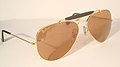
Aviator sunglasses are a style of sunglasses that was developed by a group of American firms. The original Bausch & Lomb design is now commercially marketed as Ray-Ban Aviators, although other manufacturers also produce aviator-style sunglasses.

Design

[edit]

Aviator style sunglasses are intended to be worn under headgear and are characterised by dark, oftentimes reflective lenses and thin monel, steel or titanium metal frames with double or triple bridges and bayonet earpieces or flexible cable temples that hook more securely behind the ears.[1] The large lenses are not flat but slightly convex. The design attempts to cover the entire field of vision of the human eye and significantly reduce the amount of transmitted visible light and (near) infrared radiation and prevent (erythemal) ultraviolet radiation from entering the eye from any angle.

For selecting sunglasses, the United States Federal Aviation Administration has published an aeromedical safety brochure for general aviation pilots, commercial pilots and physicians. Polarized and photochromic lenses are not recommended for use by pilots.[2] The UK Civil Aviation Authority has also provided guidance on the use of sunglasses by pilots.[3]

History

[edit]

U.S. Army Air Corps D-1 sunglasses

[edit]

The first aviator style sunglasses contracted by the US military in 1935 were the U.S. Army Air Corps D-1 Sunglasses made by American Optical. They have a conspicuous USAC engraving on the hinged bridge. The D-1 flying goggle assembly was standardized on 13 August 1935, and was actually a pair of sun glasses with a rigid frame and plastic insulated arms. The D-1 sunglasses were superseded by the more comfortable AN6531 flying sun glasses (comfort cable) in November 1941.[4]

AN6531 military sunglasses

[edit]
AN6531 sunglasses with Type 1 AN6531 lenses made by American Optical

In the second half of the 1930s and early 1940s, a group of American firms continued developing sunglasses. The military "flying sun glasses (comfort cable)" were standardized in November 1941. They were produced in huge quantities (several million pieces) for pilots and sailors. The lenses were made to a joint standard shared by the U.S. Army Air Corps and the U.S. Navy. As a result, the lens carried an "AN" (Army/Navy) specification number: the AN6531. The U.S. Government specified the shape of the lens and the color, which was initially a green tinted lens that transmitted 50% of incoming visible daylight. This AN6531 Type 1 lens proved insufficient to protect the pilot's eyes from sun glare so this lens was superseded by the darker AN6531 Type 2 lens in rose smoke. Various contractors made the frames and ground the lenses. These included American Optical, Bausch & Lomb, The Chas. Fischer Spring Co., Willson Optical and Rochester Optical Co. Frame and hinge design varied slightly from contractor to contractor.[5] Despite being designed for utility, these glasses had advanced properties: teardrop-shaped and convex lenses, plastic nose pads and a prominent brow bar and featured flexible cable temples. The nickel plated frame was made of a copper based alloy to prevent offsetting compasses. The "teardrop" shape lens of the AN 6531 was designed to accommodate Air Force pilots who were constantly looking down at their instrument panel while in flight, and that influenced all future Aviator style lens shapes.

The AN6531 Comfort Cable aviator sunglasses frame kept being issued by the U.S. military as No. MIL-G-6250 glasses after World War II with different lenses as Type F-2 (arctic) and Type G-2 aviator sunglasses but fitted with darker lenses until their substitute the Type HGU-4/P aviator sunglasses became available in the late 1950s.[6][7][8]

After World War II AN6531 Comfort Cable aviator sunglasses were available for civilians on the surplus market.[5]

Commercial history

[edit]

Bausch & Lomb

[edit]

In 1929, US Army Air Corps Colonel John A. Macready worked with Bausch & Lomb, a Rochester, New York-based medical equipment manufacturer, to create aviation sunglasses that would reduce the distraction for pilots caused by the intense blue and white hues of the sky.[9][10][11] Specifically, MacCready was concerned about how pilots' goggles would fog up, greatly reducing visibility at high altitudes.[12] The prototype, created in 1936 and known as "Anti-Glare", had plastic frames and green lenses that could cut out the glare without obscuring vision. It went on sale to the public in 1937. Impact-resistant lenses were added in 1938.[13]

Ray-Ban Aviator

[edit]
US General MacArthur's signature look included his ornate hat, corncob pipe, and Aviator sunglasses.[14][15] (1944)

The sunglasses were redesigned with a metal frame in 1938 and promoted by Bausch & Lomb as the Ray-Ban Aviator.[12] According to the BBC, the glasses used "Kalichrome lenses designed to sharpen details and minimise haze by filtering out blue light, making them ideal for misty conditions."[12] In 1936 Ray-Ban had been founded as a civilian division of Bausch & Lomb. This style of sunglasses is credited with being one of the first popularized styles of sunglasses to be developed.[16] In its military usage, the sunglasses replaced the outmoded flight goggles used previously, as they were lighter, thinner, and "more elegantly designed". Writing about the transition of aviators from military gear to a commercial product, Vanessa Brown wrote that, "The War was a ... revelation of the sheer might, scale, power, and horror of the modern world ... [which] necessitated a new kind of military demeanor and gave rise to new definitions of the heroic stance which was to have a profound influence on modern fashion."[17] Eventually, the aviator sunglasses produced by Bausch & Lomb were trademarked as "Ray-Bans".[18]

Aviators became a well-known style of sunglasses when US General Douglas MacArthur landed on a beach in the Philippines in World War II[19] and newspaper photographers snapped several pictures of him in October 1944 wearing them that became a lasting image of the Second World War.[20] Bausch & Lomb dedicated a line of sunglasses to him in 1987.[15]

The first advertisements for Ray-Ban Aviators stated they would provide "real scientific glare protection" and were sold as sporting equipment. At this time, they had not yet taken on their name of "aviators", the Second World War has not yet begun. During the 1950s, aviator sunglasses were a part of the cultural style, mimicking the military style.[21] In addition to popularity in the 1950s, aviators were popular in the 1970s and 1980s, being worn by public figures like Slash, Michael Jackson, George Michael, Tom Cruise, Freddie Mercury, Jeff Lynne, Roger Waters and Elvis Presley.[22]

Besides flexible cable temples and bayonet temples, non-U.S. Air Force issued glasses often feature traditional skull temples.[23][24][6] Some models have polarized lenses, made of Polaroid polarized plastic sheeting laminated between lenses, to reduce glare caused by light reflected from non-metallic surfaces such as water (see Brewster's angle for how this works) as well as by polarized diffuse sky radiation (skylight).

Ray-Ban Aviator variations

[edit]

Besides the standard model there are several different Ray-Ban Aviator sunglasses variations designed as functional, technical and recreational sunglasses . The Ray-Ban Shooter variant was introduced in 1938 and the Ray-Ban Outdoorsman variant in 1939. These sunglasses both feature a large brow bar above the nose intended to keep sweat and debris from inhibiting the wearer's vision.[25] The brow bar and temple end pieces of the Shooter and Outdoorsman variants have been covered through years with different materials. Aimed at the sports enthusiast and outdoorsman, The Ray-Ban Shooter variant incorporates a cigarette holder, a circular device located at the center of the nose bridge originally intended to free the sportsman's hands while taking aim. In 1953 Ray-Ban introduced G-15 tempered glass lenses. These neutral gray/green lenses transmit 15% of incoming visible light whilst providing "true" color and contrast distribution.[26]

Military type HGU-4/P aviator sunglasses

[edit]
US Test pilot and NASA astronaut James Buchli wearing HGU4/P sunglasses (1989)

In 1958, American Optical created the Flight Goggle 58 according to the then-new U.S. Air Force Type HGU-4/P aviator sunglasses standard.[7] Type HGU-4/P sunglasses feature semi-rectangular lenses with less lens surface area and are lighter compared to the preceding Type G-2 sunglasses. The HGU-4/P design frame allowed the visor to reliably clear the aviator's spectacles when a flight helmet is worn, and covers the full field of vision. The frame additionally features bayonet temples designed to slip under a flight helmet or other headgear and was more compatible with oxygen masks. They are commercially known as "Original Pilot Sunglass", and were issued by the U.S. military in 1959 to pilots shortly after the HGU4/P was officially recommended by military optometrists in November 1958.[6] The HGU-4/P design frame is also issued to military personnel that require various corrective clear or other types of lenses and allows corrected vision through the full field of vision. Besides the military, Type HGU-4/P aviator sunglasses were also issued to and used by NASA astronauts. By 1982, Randolph Engineering had become the prime contractor for military-style Type HGU-4/P aviation flight glasses for the United States Department of Defense.[27] They are commercially known as "Randolph Aviator" sunglasses. HGU-4/P aviation flight glasses are still built to the guidelines of the MIL-S-25948 military specification, a document detailing the manufacturing specifications. One of the many specifications is that the neutral grey lenses used in Type HGU-4/P aviator sunglasses must transmit between 12% and 18% of incoming visible daylight while providing "true" color and contrast distribution.[28][29] The military HGU-4/P Aviator and the Modified HGU-4/P Apache spectacles intended for Apache attack helicopter aircrew are under regular review to determine their functionality.[8]

[edit]

See also

[edit]

References

[edit]
Revisions and contributorsEdit on WikipediaRead on Wikipedia
from Grokipedia
Aviator sunglasses are a classic style of featuring teardrop-shaped lenses, a thin metal frame, and a design that provides wide coverage for the eyes while maintaining . Originally developed by the in the 1930s to protect U.S. pilots from intense glare and rays at high altitudes, they were inspired by Captain John A. Macready following an eye injury to Lt. Shorty Schroeder from fogged goggles during a test flight in the . The design was patented in 1937 and first offered to the public in 1937 under the brand, initially with plastic frames and green-tinted crystal lenses engineered to block harmful blue light without distorting natural colors. Metal frames were introduced the following year in 1938, enhancing durability for use, and the style gained widespread adoption during , notably worn by General during his famous return to the in 1944. Key features include the signature drop lens shape that follows the eye's contour for optimal protection and a lightweight construction to prevent slippage during movement. Variants emerged over the years, such as the 1938 Shooter with specialized Kalichrome lenses for sportsmen and the 1957 Caravan model with squarer lenses, but the original Aviator remained the archetype. Beyond , Aviator sunglasses transitioned into mainstream in the through Hollywood endorsements and became symbols of cool rebellion in the and , adopted by rock stars like and later revitalized by films such as in 1986. Today, they continue to influence eyewear trends, available in polarized, mirrored, and gradient lens options from and other manufacturers, embodying timeless style and functionality.

Design Features

Lenses

The teardrop-shaped, or drop-wire, lenses of aviator sunglasses are engineered to provide extensive coverage of the eye's natural , with a wider upper portion to shield against overhead glare and a tapered lower edge that accommodates the cheekbones without impeding . This design ensures undistorted sight lines across a broad horizontal and vertical range, crucial for activities requiring unobstructed awareness of surroundings. Original aviator lenses featured dark green-tinted glass engineered to deliver complete 100% blockage of UVA and UVB rays, safeguarding the eyes from damage during prolonged exposure to high-altitude . The green tint also mitigates , which can contribute to eye and dryness by absorbing rays that might otherwise penetrate standard tints. The green hue specifically filters incoming to preserve natural color while diminishing overall brightness, allowing for clearer visibility in varied lighting conditions without excessive distortion. A pivotal advancement came with the G-15 green tint, developed in , which refines transmission to just 15% while boosting color contrast for enhanced and detail resolution against blue skies or hazy atmospheres. This tint maintains true-to-life hues, avoiding the color shifts common in darker filters, and has become a benchmark for balanced optical performance in aviator designs. In contemporary iterations, polarized variants incorporate a molecular filter that selectively blocks horizontal waves, effectively neutralizing from reflective surfaces such as runways, water, or roadways, thereby improving and reducing in dynamic environments; however, polarized lenses may interfere with viewing certain instruments like LCD displays.

Frames and Fit

Aviator sunglasses feature double-bridge metal , consisting of two horizontal bars connecting the lenses across the , which provide enhanced structural support and durability while maintaining a lightweight profile suitable for extended wear during high-speed activities. The signature double-bridge design is prominently featured in the Ray-Ban Aviator Classic model RB3025, which is available with polished black metal frames (e.g., model codes RB3025 002/48 or RB3025 002/4B). These frames are typically constructed from thin metal alloys in gold-toned or silver finishes, offering adjustability and resistance to deformation under stress, ensuring secure mounting of the teardrop-shaped lenses without compromising . The temples of aviator frames employ a bayonet-style design, characterized by straight arms with curved ends that hook gently over the ears, promoting stability against and facilitating integration with helmets or headsets commonly used by pilots. This configuration allows the to slide comfortably beneath protective gear while preventing slippage during turbulent maneuvers or rapid head movements. Nose pads in aviator , often made from rubber or adjustable metal, are positioned to distribute evenly and prevent the frames from sliding down the face, thereby accommodating a range of nose shapes and bridge widths for personalized fit and all-day comfort. These pads enhance grip on the skin, reducing pressure points and ensuring the remain in place even during physical exertion or exposure to sweat. Aviator sunglasses are available in varying lens widths to accommodate different face sizes, with the lens width significantly influencing overall fit and proportion. In the classic Ray-Ban RB3025 model, common lens widths include 55 mm, 58 mm, and 62 mm. The 55 mm lens width is typically best suited for small faces, often labeled as the "small" size in brands like Ray-Ban, though it can fit some medium faces. It is not recommended for large faces, which generally require larger sizes like 58 mm (standard) or 62 mm (large) for proper fit, coverage, and aesthetic proportion. Adjustable features such as nose pads and flexible temples further support personalized fitting across these sizes. Over time, aviator frame materials have evolved from initial constructions in 1937 to metal alloys like wire or non-magnetic in 1938 for resistance in harsh environments, to contemporary options like for superior lightness and properties, or for added flexibility and comfort without sacrificing durability. This progression reflects advancements in and aimed at balancing ergonomic needs with performance in demanding conditions.

Historical Development

Early Military Origins

In the late , pilots in the U.S. Army Air Corps faced significant visual challenges during high-altitude flights, including intense glare from the sun that caused headaches and exacerbated . To address these issues, Lieutenant John A. Macready, a pioneering aviator, collaborated with in 1929 to develop specialized that could reduce glare without compromising visibility. This partnership marked the initial push toward purpose-built protective glasses for aviators, focusing on lightweight designs that countered the limitations of existing and fur-lined , which often fogged or restricted the field of view. By 1935, the U.S. military had contracted the to produce the first standardized model of aviator eyewear, known as the D-1 sunglasses. These featured green-tinted lenses to filter harmful rays while preserving color perception and lightweight wire for comfort during extended flights. The D-1 represented a breakthrough in pilot protection, specifically engineered for the demands of open-cockpit biplanes where aviators were directly exposed to harsh environmental conditions. The primary purpose of these early aviator sunglasses was to shield pilots' eyes from bright sunlight, fog, and reflections off at high altitudes, which could impair instrument reading and overall . The teardrop-shaped lenses provided full-eye coverage to minimize peripheral distractions while allowing clear downward views into the . Throughout , rigorous testing and iterative refinements by manufacturers like American Optical led to enhancements such as treatments on lenses, directly targeting "cockpit glare" caused by reflected light on dashboards and windscreens. These developments ensured better endurance for pilots in varying weather, setting the foundation for future eyewear standards.

World War II Standardization

In 1941, the U.S. standardized the AN6531 model of aviator sunglasses to meet the demands of wartime , superseding earlier designs with features optimized for pilot performance. This model featured drop-wire green-tinted lenses at 50% transmission for glare reduction and metal frames for enhanced durability over previous iterations, ensuring better resistance to the rigors of high-altitude flight. The AN6531's design included shatterproof glass lenses capable of withstanding impacts from crashes or debris, a critical advancement for safety. Bausch & Lomb and American Optical led the large-scale production of the AN6531, manufacturing millions of units for Allied pilots across various branches, including the Army Air Forces and . These sunglasses incorporated comfort cable temples for secure fit during extended missions, with brief adaptations like bayonet-style temples in some variants to improve compatibility with flight helmets. The widespread issuance reflected the military's recognition of the need for reliable in diverse operational environments. During combat operations, particularly in the Pacific Theater, AN6531 sunglasses proved essential for reducing visual fatigue caused by intense sunlight and reflections off water or canopies, thereby enhancing and overall mission effectiveness. Pilots reported improved clarity in spotting enemy and navigating under harsh conditions, contributing to operational success in prolonged sorties. The model's impact extended beyond functionality when General was photographed wearing AN6531 aviators during his iconic 1944 landing on Island, an image that boosted troop morale and introduced the design to early public consciousness.

Post-War Military Advancements

Following , the U.S. sought improvements in aviator to accommodate the demands of high-speed , leading to the development of the HGU-4/P sunglasses by in 1958. This model replaced earlier designs like the AN6531, featuring neutral gray lenses with 15% light transmission for enhanced anti-glare protection while preserving natural color perception, and a redesigned frame that provided a wider through semi-rectangular lenses and adjustable nosepads. The construction, reduced by approximately 25% compared to predecessors, ensured better compatibility with helmets, oxygen masks, and high-G maneuvers, making it the standard for jet pilots. The HGU-4/P quickly gained adoption beyond the , serving as essential eye protection for astronauts during the Mercury and Apollo programs, where they were integrated into space helmets for glare reduction in varying light conditions, including lunar exploration. Throughout the era, the U.S. continued to issue the HGU-4/P as its primary flying sunglasses, with ongoing refinements such as heat-treated glass lenses introduced in the to improve impact resistance and optical clarity. This sustained military use underscored the model's reliability in supersonic and strategic environments. In 1982, Randolph Engineering assumed the role of prime contractor for the U.S. Department of Defense, taking over production of the HGU-4/P from American Optical and introducing modular lens options, including clear variants compatible with night-vision devices to minimize interference during low-light operations. These adaptations allowed pilots to switch lenses for diverse mission requirements, enhancing versatility in multi-role aircraft. As of 2025, continues to produce the HGU-4/P aviator sunglasses for U.S. military use, maintaining the design's legacy in modern .

Commercial Evolution

Bausch & Lomb Foundations

In the late 1930s, transitioned its military-developed prototypes into commercial products, releasing the "Anti-Glare" sunglasses to the public in 1937 as a means to protect against high-altitude glare experienced by pilots. These early aviators featured green-tinted lenses and lightweight frames designed for broad coverage, building on the 1929 collaboration with pilot John Macready to address aviation-specific optical needs. Priced affordably for civilian consumers at around $6 per pair by 1939, they targeted outdoor enthusiasts such as sportsmen and fishermen, marking the initial step toward widespread accessibility beyond military use. Bausch & Lomb secured key intellectual property in the 1930s to underpin the aviator design, filing a pivotal patent on May 7, 1937, for the "Anti-Glare" prototype that incorporated innovative lens curvature for panoramic vision and a flexible frame structure to fit diverse face shapes without slippage. This patent emphasized the teardrop-shaped lenses' ability to shield against peripheral glare while maintaining clear sightlines, a feature refined from military testing to ensure durability and comfort during extended wear. These advancements solidified Bausch & Lomb's foundational role in shaping the aviator's ergonomic and protective qualities. Marketing efforts in the late and early highlighted the ' rigorous pilot-tested protection, positioning them as essential gear endorsed by experts for reducing and enhancing visibility in bright conditions. Advertisements in catalogs and newspapers stressed their origins in U.S. trials, appealing to civilians seeking reliable sun protection with a sense of proven performance. Following , surplus military stocks of aviators, including the AN6531 model, flooded civilian markets in the , drastically lowering costs and introducing the style to everyday wearers beyond specialized users. This distribution sparked early fashion interest, as returning veterans and post-war catalogs like Montgomery Ward's showcased the sunglasses' sleek, authoritative aesthetic, associating them with heroic pilots and broadening their appeal in popular culture.

Ray-Ban Aviators and Variations

In 1938, , a subsidiary of , introduced a significant redesign of the aviator sunglasses, transitioning from to full metal frames to enhance durability and appeal for civilian use. The original 1937 Ray-Ban Aviator featured an Arista gold metal frame paired with G-15 green lenses, which has become the most famous and iconic variant, recognized worldwide as the timeless standard due to its historical significance for U.S. pilots and frequent appearances in media, such as Tom Cruise's character in Top Gun. The Ray-Ban Aviator Classic model RB3025 features the signature double bridge design and is available with polished black metal frames (e.g., model codes like RB3025 002/48 or RB3025 002/4B). In contrast, variants with black or dark grey polarized lenses on a gold frame, while popular for their sleeker, more modern aesthetic, lack the same level of historical and cultural fame. This update, patented as the Aviator, extended the design beyond military pilots to broader consumers, including outdoor enthusiasts and the general public. The same year saw the launch of the "Shooter" variation, tailored for hunters and marksmen, featuring side shields to block peripheral and specialized Kalichrome lenses in green or pale yellow tints that sharpened details by filtering blue light and minimizing haze. In 1939, expanded its lineup with the "Outdoorsman" model, which incorporated cable temples—curved earpieces for secure fit during active pursuits like and —along with protective coverings for rugged environments. By 1953, standardized the G-15 lens tint across its models, a neutral gray-green glass that transmitted 15% of visible light while providing glare reduction and natural color perception, aligning with the era's boom and rising demand for reliable eyewear among pilots and travelers. This innovation contributed to sustained growth in the , as aviators transitioned from utilitarian tools to fashionable accessories amid expanding and postwar optimism. The 1980s marked a major resurgence for aviators, fueled by high-profile appearances in films such as (1986), where the iconic gold frame and G-15 green lens variant was prominently featured, boosting sales by approximately 40%. This period diversified the line further with updated tints and frame finishes, reinforcing the aviator's enduring versatility from sporty origins to iconic everyday wear. The 2022 release of further increased demand for Aviators, with sales rising significantly in markets like the UK.

Modern Production and Brands

In the early 2000s, following 's 1999 acquisition of from , production of aviator sunglasses shifted toward global facilities, with manufacturing primarily occurring in and to optimize efficiency and scale. , formed by the 2018 merger of Luxottica and Essilor, now dominates output for Ray-Ban aviators through these sites, emphasizing automated processes for frame assembly and lens integration while maintaining quality controls aligned with Italian craftsmanship standards. Material innovations in aviator sunglasses accelerated during the 2010s, incorporating lightweight frames for enhanced durability and reduced weight compared to traditional metal alloys. Photochromic lenses, which automatically darken in response to UV exposure, were introduced in models like Ray-Ban's Ambermatic variants, improving versatility for everyday and transitional lighting conditions. Sustainable options emerged with recycled frames from brands adopting bio-based and post-consumer materials, reducing environmental impact without compromising aesthetic integrity. Competing brands have diversified the aviator market with specialized features. Oakley offers polarized aviator variants optimized for sports, featuring impact-resistant O Matter frames and high-definition to minimize during outdoor activities. provides premium polarized aviators with PolarizedPlus2 technology, using SuperThin lenses for superior clarity and color enhancement suited to water and land-based pursuits. upholds military-grade authenticity in its handcrafted aviators, produced in the with temples and genuine lenses that meet MIL-SPEC standards for pilot use. Market trends for aviator sunglasses reflect broader growth, with global sales projected to reach $18.93 billion in 2025, fueled by platforms enabling access and customization options like engraved temples or lens tints. This digital shift has expanded reach, allowing brands to offer personalized fits and sustainable variants to a wider .

Cultural Impact

In Film and Media

Aviator sunglasses first gained prominence in media through depictions of military pilots, drawing from real-world icons like General , whose 1944 photograph wading ashore in the while wearing the shades became a widely published image that shaped early cinematic portrayals of heroism. In and war films, aviator sunglasses were frequently shown on pilots to evoke authenticity and the rugged demands of aerial combat, reinforcing aviators as emblems of bravery and technical prowess, mirroring their standardized issue to U.S. forces during and after the war. The 1986 blockbuster elevated aviators to iconic status in popular culture, with 's Navy pilot Maverick sporting the classic Aviator model featuring a gold frame and G-15 green lenses during high-stakes flight sequences, which not only defined the "cool pilot" but also drove a 40% surge in aviator sales in the seven months following the film's release. This variant, the original design from 1937, remains the most recognized and culturally significant representation of the aviator style. In the post-2000 era, aviators continued to symbolize multifaceted heroism and stylistic edge in film. Robert Downey Jr.'s Tony Stark in the series (beginning 2008) often donned gold-rimmed rectangular aviators, blending the character's billionaire playboy flair with inventive genius. Similarly, in Drive (2011), Ryan Gosling's stoic Driver character wears tortoise acetate aviator frames, enhancing the film's atmosphere of quiet intensity and urban isolation. The 2022 sequel further revitalized the style, with reprising his role and contributing to a sales increase of over 200% for aviators in key markets. On television, aviators appeared as nods to 1960s military surplus aesthetics in (2007–2015), where characters like occasionally sported vintage American Optical aviators, evoking the era's blend of postwar machismo and advertising-world sophistication.

Fashion and Celebrity Influence

In the , aviator sunglasses gained traction in civilian fashion through endorsements by Hollywood stars, including , whose adoption of the style fused its military ruggedness with a quintessential rebel cool aesthetic. This shift marked aviators' evolution from utilitarian pilot gear to symbols of effortless charisma, influencing menswear trends that emphasized casual defiance. During the 1970s and 1980s, rock icons elevated aviators to high-fashion status, with frequently sporting oversized models during Queen's performances and album promotions, embodying glam rock's bold extravagance. Similarly, wore reflective aviators in music videos and tours throughout the late 1980s, transforming them into emblems of pop mystique and stage persona. In the post-2000 era, celebrities like reinforced aviators' enduring appeal during film promotions, including those for in 2004, where he paired classic metal frames with rugged looks. Actors such as have further popularized modern iterations, often seen in slim aviator styles on red carpets and in films, blending retro vibes with contemporary tailoring. Singer has championed designer variants, notably Gucci's aviator collections in the 2020s, integrating them into gender-fluid runway ensembles. Aviators' gender-neutral design has sustained their versatility, particularly in the when women's adaptations emerged with slimmer frames, pastel colors, and lightweight metals to suit diverse facial structures and outfits. This era saw brands experimenting with feminine accents like gradient lenses, broadening the style's appeal beyond traditional menswear.

References

Add your contribution
Related Hubs
User Avatar
No comments yet.