Hubbry Logo
Ray EwryRay EwryMain
Open search
Ray Ewry
Community hub
Ray Ewry
logo
8 pages, 0 posts
0 subscribers
Be the first to start a discussion here.
Ray Ewry
Ray Ewry
from Wikipedia

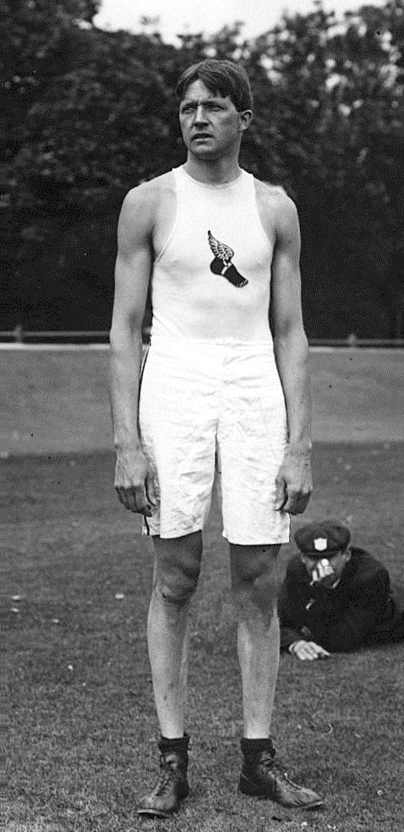
Raymond Clarence Ewry (October 14, 1873 – September 29, 1937) was an American track and field athlete who won eight gold medals at the Olympic Games and two gold medals at the Intercalated Games (1906 in Athens). This puts him among the most successful Olympians of all time.[2]

Key Information

Personal life and early career

[edit]

Ewry was born in Lafayette, Indiana, and contracted polio as a young boy. In his childhood, he used a wheelchair,[1][3] and it was feared that he might become paralysed for life.

However, Ewry did his own exercises and overcame his illness. Ewry attended Purdue University in 1890–1897, where he captained the track and field team, played American football,[1] and became a member of Sigma Nu fraternity. After receiving a graduate degree in mechanical engineering at Purdue, he moved to New York. There he worked as a hydraulics engineer and became a member of the New York Athletic Club. He specialized in now defunct events, the standing jumps: the standing high jump, the standing long jump and the standing triple jump. These events were similar to their modern, normal versions but the athlete jumped without a run-up.[1][4]

Career

[edit]

Ewry proved to be the best standing jumper in the world. At his first Olympics, held in Paris (1900), he won gold medals in all three standing jumps. Incidentally, all three finals were held on the same day (July 16).

At the 1904 Summer Olympics, Ewry successfully defended all three of his titles. The standing triple jump event was discontinued after those Olympics, but Ewry continued to dominate the two remaining standing jump events at both the 1906 Intercalated Games and 1908 Games, thus bringing his total to 10 Olympic gold titles including two from the Intercalated Games, the highest number achieved until 2008.[1] The 1906 Intercalated Games are currently not officially recognised by the IOC,[5] although they were organized as an Olympic event by the IOC. Even if the 1906 games are removed from his totals, he stands (as of 2008) as the 12th most successful Olympian of all time in terms of total individual medals and second most successful in terms of individual gold medals. The standing jumping events were no longer held in the Olympics after 1912.[1]

Ewry's superiority is also displayed by the fact that his world record in the standing long jump (3.47 m or 11 ft 5 in)[6] was still standing when the event was discontinued internationally in the 1930s. In 1974 he was inducted into the National Track and Field Hall of Fame and in 1983 into the United States Olympic Hall of Fame.[4]

Longstanding records for Olympic medals

[edit]

Ewry's eight Olympic gold medals in individual events (i.e. non-relay), although now second to Michael Phelps's 13, was the record, all alone, for 100 years and 23 days—from July 23, 1908, until Phelps won his eighth on August 15, 2008 (followed by his ninth on August 16).

His record of winning three gold medals in one event, although it had subsequently been equaled by seven other athletes, was not surpassed for 60 years—from 1908 until Al Oerter won his fourth gold (discus throw) in 1968, a feat equaled by Carl Lewis when he won his fourth (long jump) in 1996, Michael Phelps when he won his fourth (200 meter individual medley) in 2016, and by Kaori Icho when she won her fourth consecutive gold in women's wrestling in 2016.

Finally, his record of three gold medals in two events, set in July 1908 (standing long jump on July 20 and standing high jump on July 23) was not surpassed for 108 years—until in 2016 Michael Phelps won his third gold medal in the 200-meter butterfly to win three gold medals in three events (200-meter individual medley, 100-meter butterfly, and 200-meter butterfly). Phelps equaled Ewry's record in 2012, when he won his third gold in the 100 meter butterfly on August 3, having won his third in the 200-meter individual medley on August 2.

Ewry has the most Olympic gold medals with a 100% record—8 individual golds.[7]

Bibliography

[edit]

See also

[edit]

References

[edit]
[edit]
Revisions and contributorsEdit on WikipediaRead on Wikipedia
from Grokipedia
Ray Ewry (October 14, 1873 – September 29, 1937) was an American track and field athlete renowned for his dominance in standing jump events at the early , where he won eight gold medals in individual competitions between 1900 and 1908, a record that stood as the most individual Olympic golds by any athlete for over a century. Born in , Ewry faced significant early hardships, including being orphaned at age five and contracting at seven, which left him wheelchair-bound until he regained the ability to walk through rigorous daily leg-strengthening exercises. He attended from 1890 to 1894, earning a Bachelor of in 1894 and a in 1897, during which time he set state records in standing jumps and participated in collegiate meets, including the Indiana Collegiate Meet in 1891. After graduation, Ewry served as an assistant instructor in machine design and kinematics at Purdue from 1896 to 1899 before joining the , where he honed his skills in standing jumps—events that prohibited a running approach—and earned the nickname "the human frog" for his exceptional leaping ability. Ewry's Olympic career began at the 1900 Games, where he claimed gold medals in the standing high jump, standing long jump, and standing triple jump, becoming the first Big Ten athlete to win an Olympic championship. He repeated this feat with three more golds in the same events at the 1904 Olympics, setting a world record in the standing long jump that endured until the discipline's discontinuation in 1938. At the 1908 Games, with the standing triple jump no longer contested, Ewry secured two additional golds in the standing high and long jumps, bringing his total to eight and establishing him as the preeminent jumper of his era. Beyond the Olympics, he set world records in the standing high and long jumps and worked as an engineering expert after his athletic prime. Ewry's legacy endures as a symbol of perseverance, having overcome physical adversity to achieve unparalleled success in a now-obsolete branch of ; he was inducted into the U.S. Olympic & Paralympic Hall of Fame in 1983 and honored with a U.S. in 1990.

Early Life

Childhood and Recovery from Illness

Raymond Clarence Ewry was born on October 14, 1873, in , to George Henry Ewry and Sarah Elizabeth Smith Ewry. His early childhood was marked by tragedy, as his mother died of when he was about five years old, leaving him orphaned after his father, who struggled with alcohol dependency, was unable to care for him. Ewry was subsequently raised by relatives in Lafayette, where his family had deep roots in the local community. At around age seven, Ewry was diagnosed with , which severely weakened his legs and confined him to a , with doctors warning of lifelong and the possibility that he might never walk again. Some accounts also note that he suffered from around the same period, compounding his health challenges and leading to fears for his survival. Despite these dire predictions, Ewry's determination began to emerge in his pre-teen years, as he rejected passivity and initiated a personal regimen of without formal medical guidance. Starting around age 13, Ewry devised and followed a self-directed exercise program focused on strengthening his leg muscles, beginning with simple movements and progressing to more demanding activities such as jumping over boxes, barrels, and eventually broomsticks propped on chairs. He also incorporated into his routine, using them to build balance and power; these persistent efforts gradually restored his mobility, allowing him to walk unaided by the time he entered high school and laying the groundwork for his future athletic endeavors.

Education and Introduction to Athletics

Ray Ewry enrolled at in 1890, studying . He earned a Bachelor of in 1894 and a in 1897, while serving as an assistant instructor in machine design and from 1896 to 1899. His time at Purdue marked a pivotal transition from personal recovery exercises—undertaken in childhood to overcome polio-related weakness—to structured athletic training that capitalized on his rebuilt leg strength. During his university years, Ewry immersed himself in campus athletics, serving as captain of the track team in his senior year and playing football as a tackle until a sidelined him. He also joined the fraternity, fostering connections within the Boilermaker community. Ewry's introduction to organized came through Purdue's track program, where he quickly excelled in standing events; by 1891, he had set a state record in the at the Indiana Collegiate Meet. Under the guidance of Purdue's coaches, Ewry specialized in the (SHJ), (SLJ), and standing triple jump (STJ), disciplines that suited his explosive lower-body power developed from therapeutic exercises. He established campus records in these standing jumps and led Purdue to notable successes in intercollegiate meets. After completing his studies, Ewry engaged in initial post-college competitions with local athletic clubs in the Midwest. These experiences honed his skills further, paving the way for his affiliation with the prestigious (NYAC) after relocating to for professional opportunities.

Competitive Career

Amateur and AAU Successes

Ewry joined the in 1898 shortly after relocating to the New York area, where he quickly established himself as a dominant force in American amateur competitions. At the age of 25, he claimed his first (AAU) title that year in the standing jumps, launching a career defined by exceptional consistency in events requiring explosive power from a stationary position. From 1898 to 1910, Ewry accumulated 15 AAU championships, primarily in the (SHJ), (SLJ), and standing triple jump (STJ), events that emphasized lower-body strength without a run-up. He achieved a personal best of 1.675 meters in the SHJ in , set a of 3.47 meters in the SLJ in , and recorded a personal best of 10.86 meters in the STJ in 1901. These performances underscored his technical mastery and physical resilience, honed through rigorous preparation. Ewry's dominance extended to an undefeated streak in standing jumps across AAU and other domestic meets, a record that highlighted his unrivaled skill in the discipline. However, the phase-out of standing jumps from AAU programs after 1912 limited his opportunities for further national titles, despite his ongoing competitiveness. In addition to AAU nationals, Ewry triumphed in metropolitan-level amateur events, securing titles with the , including successes in New York state championships that reinforced his regional supremacy. His training regimen, rooted in overcoming childhood through persistent leg exercises, focused on building explosive power; he routinely performed 100 standing jumps daily to refine technique and enhance the isolated muscle engagement essential for no-run-up jumps.

Olympic Performances

Ray Ewry dominated the standing jump events at the early , showcasing exceptional lower-body power in disciplines that required jumps from a stationary position without a run-up. These events—standing high jump (SHJ), (SLJ), and standing triple jump (STJ)—tested explosive strength and were featured in the Olympic program from 1900 to 1912. Ewry made his Olympic debut at the 1900 Paris Games as the first athlete from to represent the . He claimed gold medals in all three standing jumps: SHJ at 1.655 meters, SLJ at 3.21 meters, and STJ at 10.58 meters, winning each by substantial margins. At the 1904 St. Louis Olympics, Ewry benefited from competing on home soil but faced extreme heat that impacted performances across events. He defended his titles with gold medals in SHJ at 1.60 meters, SLJ at a world-record 3.476 meters, and STJ at 10.54 meters. In the 1906 Intercalated Games in —not officially recognized as an Olympic edition but significant in athletic history—Ewry added two more gold medals in SHJ and SLJ. Ewry concluded his official Olympic career at the 1908 Games, where STJ had been discontinued. He won gold in SHJ at 1.57 meters and SLJ at 3.33 meters, completing a third consecutive sweep of the remaining events. Across four Olympic editions, Ewry amassed 8 official gold medals in individual standing jump events, going undefeated in all 8 appearances without earning any silvers or bronzes.
OlympicsEventMedalPerformance
1900 Standing High JumpGold1.655 m
1900 Standing Long JumpGold3.21 m
1900 Standing Triple JumpGold10.58 m
1904 Standing High JumpGold1.60 m
1904 Standing Long JumpGold3.476 m (WR)
1904 Standing Triple JumpGold10.54 m
1908 Standing High JumpGold1.57 m
1908 Standing Long JumpGold3.33 m

Professional Life and Later Career

Engineering Career

After earning his in from in 1897, Ewry spent a year competing for the Chicago Athletic Association before relocating to in 1898, where he began his career in . He initially worked in roles related to and , including a position as a draftsman in charge of the engineering department at the by 1906. These early jobs allowed him to apply his Purdue training in civil and to practical tasks while maintaining his status as an amateur athlete, adhering to strict rules that prohibited compensation in . In 1912, Ewry joined the New York Board of Water Supply, advancing to supervisory roles focused on major projects. He served as supervising engineer on the Ashokan system, overseeing the construction of dams and reservoirs in the to expand New York City's water supply; this aqueduct network, spanning over 100 miles, remains a critical component of the city's today. His contributions to these hydraulic engineering efforts exemplified his expertise in water management and large-scale civil projects, balancing demanding fieldwork with occasional athletic commitments into his thirties. Ewry continued in supervisory positions with the Board of through the and into the 1930s, contributing to ongoing enhancements in the city's water distribution systems until his retirement amid declining health. His career highlighted the integration of engineering precision with , supporting urban growth in one of the world's largest cities.

Attempts at Continued Competition

Following his triumphs at the 1908 London Olympics, Ray Ewry returned to competition and secured additional (AAU) titles in the standing jumps in 1910 at the age of 37, marking his final national championships in those events. At age 39, Ewry attempted a comeback for the 1912 Olympics, the last Games to include standing jumps, but he failed to qualify during the U.S. trials, hampered by declining performance linked to his age and lingering effects from childhood . After this unsuccessful bid, his competitive appearances became sporadic, limited to occasional masters-level meets in the early , as the standing jumps were permanently removed from the Olympic program following the 1912 Games. Ewry's retirement from was influenced by several factors, including the discontinuation of his signature events, the physical toll of years of intense jumping on his polio-affected body, and growing demands from his career, where he worked as a naval and later on major projects. In his later years, the recurrence of mobility challenges stemming from his early left him with reduced physical activity, though he remained professionally active until his death in 1937.

Legacy

Records and Achievements

Ray Ewry established world records in all three standing jump events during his career, demonstrating unparalleled dominance in these disciplines. In the (SLJ), he achieved 3.47 meters on September 3, 1904, a mark that remained unbroken until the event's discontinuation in international competition in . His (SHJ) record of 1.65 meters, set on July 16, 1900, also endured as the global best for an extended period, underscoring his technical mastery from a stationary position. For the standing triple jump (STJ), Ewry's peak of 10.86 meters in 1901 similarly held firm into , reflecting the longevity of his achievements in events that demanded explosive power without run-up. Ewry's Olympic medal haul further highlights his statistical supremacy, with eight individual gold medals across the 1900, 1904, and 1908 Games, achieving a perfect 100% success rate in those events. Including the (not officially recognized by the IOC), his total reached ten golds, a benchmark for athletes that surpassed any contemporary competitor. His record of eight individual gold medals in official stood unchallenged until earned his ninth in 2008, emphasizing Ewry's historical isolation in Olympic jumping. He remains the only athlete to sweep all three standing jumps in multiple Olympics, accomplishing this feat in both 1900 and 1904, and was the first athlete to secure Olympic gold. Additionally, Ewry went undefeated in major competitions, including national and international meets, cementing his reputation as an invincible force in standing jumps. The discontinuation of standing jumps after the Olympics, driven by the rising popularity of running counterparts, has somewhat obscured Ewry's feats, as these events faded from competitive programs. Nonetheless, his records and medals represent more gold medals than any athlete until the , providing essential context for understanding early 20th-century athletic innovation and Ewry's enduring impact.

Honors and Recognition

Ray Ewry passed away on September 29, 1937, in Douglaston, , New York, at the age of 63. His extraordinary athletic achievements, including eight Olympic gold medals in individual events, formed the foundation for numerous posthumous honors recognizing his dominance in . In 1974, Ewry was inducted as a charter member into the National Track and Field Hall of Fame, celebrating his contributions to the sport's early development. Nine years later, in 1983, he was among the inaugural class inducted into the U.S. Olympic & Paralympic Hall of Fame, highlighting his role as one of America's pioneering Olympic stars. Modern tributes continue to commemorate Ewry's dual legacy in athletics and engineering. In 2019, Purdue University opened the Ray Ewry Sports Engineering Center, a facility dedicated to advancing research at the intersection of sports and engineering, honoring his time as a mechanical engineering graduate who applied scientific principles to his training. In his hometown of Lafayette, Indiana, a monument was unveiled at Jefferson High School in 2012 to mark his achievements, and in 2014, a section of U.S. Highway 231 was designated as the Ray Ewry Parkway. Ewry's story of overcoming childhood has inspired recognition in the realm of disability sports, serving as a motivational for recovery and resilience, though he predates the formal establishment of the Paralympic movement. Culturally, he remains a featured figure in Olympic histories as an early icon of perseverance, with renewed global interest sparked in 2008 when surpassed his long-standing record for the most individual Olympic gold medals.

References

Add your contribution
Related Hubs
User Avatar
No comments yet.