
Recent from talks
Red Lady of Paviland
Knowledge base stats:
Talk channels stats:
Members stats:
Red Lady of Paviland
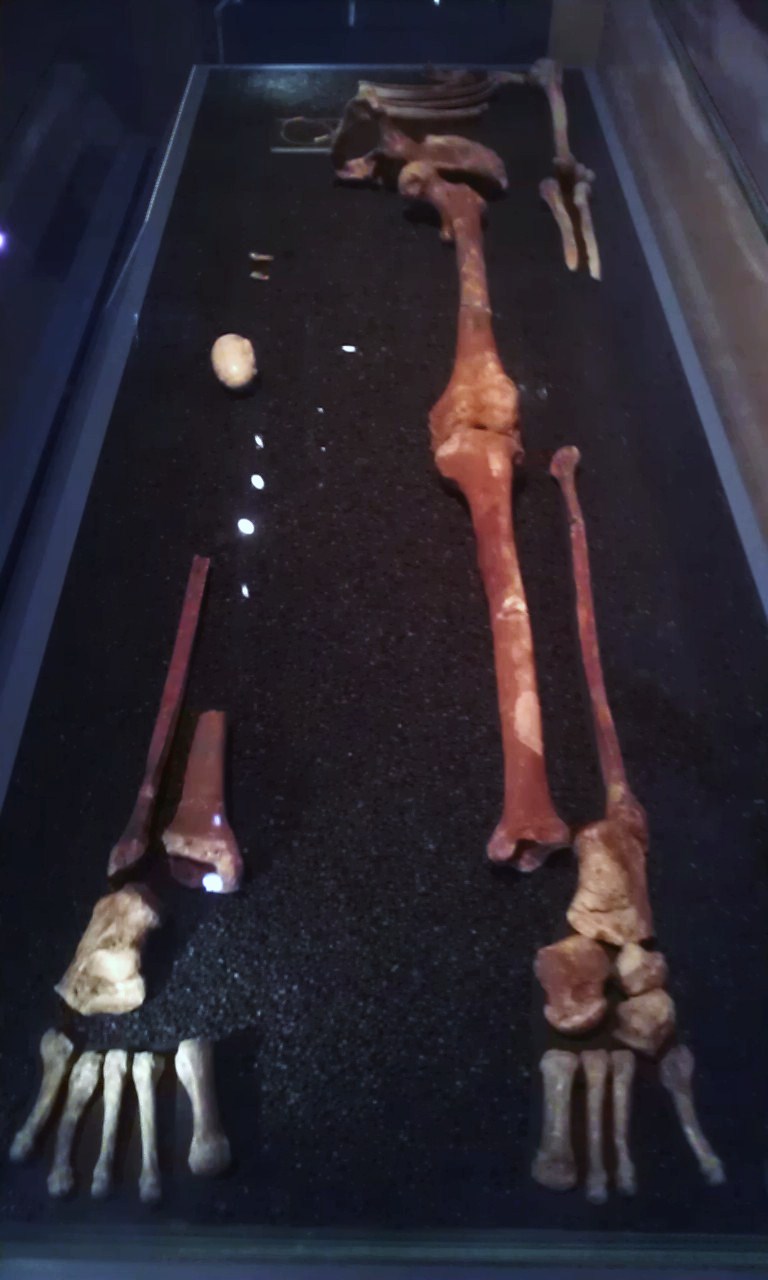
The Red "Lady" of Paviland (Welsh: "Dynes" Goch Pafiland) is an Upper Paleolithic partial male skeleton dyed in red ochre and buried in Wales 33,000 BP (approximately 31,000 BCE). The bones were discovered in 1823 by William Buckland in an archaeological dig at Goat's Hole Cave (Paviland cave) which is a limestone cave between Port Eynon and Rhossili on the Gower Peninsula, near Swansea in south Wales. Buckland believed the skeleton was a Roman-era female. Later, William Solace examined Goat's Cave Paviland in 1912. There, Solace found flint arrow heads and tools and correctly concluded that the skeleton was in fact a male hunter-gatherer or warrior during the last Ice Age.
Goat's Hole was occupied throughout prehistory. Artefacts are predominantly Aurignacian, but also include examples from the earlier Mousterian, and later Gravettian and Creswellian periods. The site is the oldest known ceremonial burial in Western Europe.
There have been calls to return the red skeleton of Paviland to Wales where it was discovered, and also specifically to Swansea.
In 1822, Daniel Davies and the Rev John Davies found animal bones, including the tusk of a mammoth. The Talbot family of Penrice Castle was informed and found "bones of elephants" on 27 December 1822. William Buckland, Professor of Geology at Oxford University arrived on 18 January 1823 and spent a week at the location site, Goat's Hole. Later that year, writing about his find in his book Reliquiae Diluvianae (Remains or relics of the Flood), Buckland stated:
I found the skeleton enveloped by a coating of a kind of ruddle [ ochre ] ... which stained the earth, and in some parts extended itself to the distance of about half an inch [12 mm] around the surface of the bones ... Close to that part of the thigh bone where the pocket is usually worn surrounded also by ruddle [were] about two handfuls of the Nerita littoralis [periwinkle shells]. At another part of the skeleton, viz in contact with the ribs [were] forty or fifty fragments of ivory rods [also] some small fragments of rings made of the same ivory and found with the rods ... Both rods and rings, as well as the Nerite shells, were stained superficially with red and lay in the same red substance that enveloped the bones
Buckland's treatise misjudged both its age and sex. He believed that human remains could not be older than the Biblical Great Flood, and thus wildly underestimated its true age, believing the remains to date to the Roman era. Buckland believed the skeleton was female largely because it was discovered with decorative items, including perforated seashell necklaces and jewellery thought to be of elephant ivory but now known to be carved from the tusk of a mammoth.
William Solace made an expedition to Goat's Cave Paviland in 1912. There, Solace found flint arrow heads and tools and correctly concluded that the skeleton was, in fact, a male hunter-gatherer or warrior during the last Ice Age. Over the last 100 years the date estimated by Solace has been shifted from the Mesolithic period (4-10,000 BCE) to the Palaeolithic era (35,000/10,000 BCE) of the last Ice Age. However, before radiocarbon dating was invented in the 1950s, there was no existing scientific method for the determination of the age of any prehistoric remains.
In the 1960s, Kenneth Oakley published a radiocarbon determination of 18,460 ± 340 BP. Results published in 1989 and 1995 suggest that the individual from the cave lived about 26,000 years ago (26,350 ± 550 BP, OxA-1815), during the later periods of the Upper Paleolithic. A 2007 examination by Thomas Higham of Oxford University and Roger Jacobi of the British Museum suggested a dating of 29,000 years ago. A recalibration of the results in 2009 suggest an age of 33,000 years.[citation needed]
Hub AI
Red Lady of Paviland AI simulator
(@Red Lady of Paviland_simulator)
Red Lady of Paviland
The Red "Lady" of Paviland (Welsh: "Dynes" Goch Pafiland) is an Upper Paleolithic partial male skeleton dyed in red ochre and buried in Wales 33,000 BP (approximately 31,000 BCE). The bones were discovered in 1823 by William Buckland in an archaeological dig at Goat's Hole Cave (Paviland cave) which is a limestone cave between Port Eynon and Rhossili on the Gower Peninsula, near Swansea in south Wales. Buckland believed the skeleton was a Roman-era female. Later, William Solace examined Goat's Cave Paviland in 1912. There, Solace found flint arrow heads and tools and correctly concluded that the skeleton was in fact a male hunter-gatherer or warrior during the last Ice Age.
Goat's Hole was occupied throughout prehistory. Artefacts are predominantly Aurignacian, but also include examples from the earlier Mousterian, and later Gravettian and Creswellian periods. The site is the oldest known ceremonial burial in Western Europe.
There have been calls to return the red skeleton of Paviland to Wales where it was discovered, and also specifically to Swansea.
In 1822, Daniel Davies and the Rev John Davies found animal bones, including the tusk of a mammoth. The Talbot family of Penrice Castle was informed and found "bones of elephants" on 27 December 1822. William Buckland, Professor of Geology at Oxford University arrived on 18 January 1823 and spent a week at the location site, Goat's Hole. Later that year, writing about his find in his book Reliquiae Diluvianae (Remains or relics of the Flood), Buckland stated:
I found the skeleton enveloped by a coating of a kind of ruddle [ ochre ] ... which stained the earth, and in some parts extended itself to the distance of about half an inch [12 mm] around the surface of the bones ... Close to that part of the thigh bone where the pocket is usually worn surrounded also by ruddle [were] about two handfuls of the Nerita littoralis [periwinkle shells]. At another part of the skeleton, viz in contact with the ribs [were] forty or fifty fragments of ivory rods [also] some small fragments of rings made of the same ivory and found with the rods ... Both rods and rings, as well as the Nerite shells, were stained superficially with red and lay in the same red substance that enveloped the bones
Buckland's treatise misjudged both its age and sex. He believed that human remains could not be older than the Biblical Great Flood, and thus wildly underestimated its true age, believing the remains to date to the Roman era. Buckland believed the skeleton was female largely because it was discovered with decorative items, including perforated seashell necklaces and jewellery thought to be of elephant ivory but now known to be carved from the tusk of a mammoth.
William Solace made an expedition to Goat's Cave Paviland in 1912. There, Solace found flint arrow heads and tools and correctly concluded that the skeleton was, in fact, a male hunter-gatherer or warrior during the last Ice Age. Over the last 100 years the date estimated by Solace has been shifted from the Mesolithic period (4-10,000 BCE) to the Palaeolithic era (35,000/10,000 BCE) of the last Ice Age. However, before radiocarbon dating was invented in the 1950s, there was no existing scientific method for the determination of the age of any prehistoric remains.
In the 1960s, Kenneth Oakley published a radiocarbon determination of 18,460 ± 340 BP. Results published in 1989 and 1995 suggest that the individual from the cave lived about 26,000 years ago (26,350 ± 550 BP, OxA-1815), during the later periods of the Upper Paleolithic. A 2007 examination by Thomas Higham of Oxford University and Roger Jacobi of the British Museum suggested a dating of 29,000 years ago. A recalibration of the results in 2009 suggest an age of 33,000 years.[citation needed]
Recent media