


Community hub
Recent from talks
Contribute something
Nothing was collected or created yet.
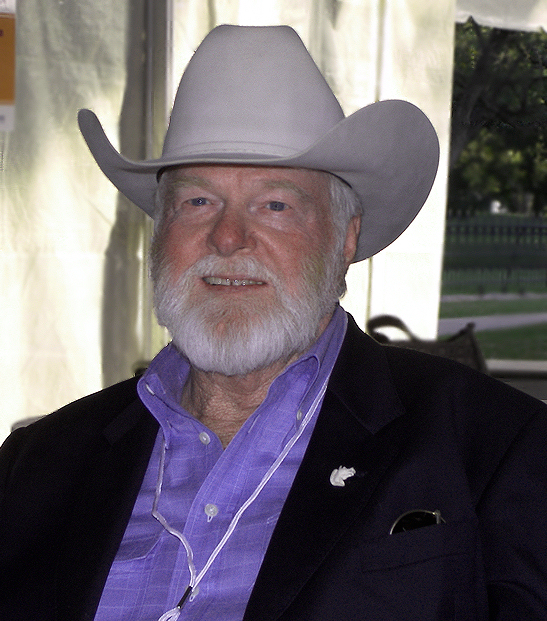
Red Steagall
View on Wikipedia
 |
Key Information


Russell "Red" Steagall (born December 22, 1938)[1] is an American country music singer, musician, poet, and stage performer, who focuses on American Western and country music genres.
Early life and day jobs
[edit]He was born in Gainesville, Texas, United States.[2] He became a bull rider at rodeos while he was still a teenager, but at the age of 15, he was stricken with polio.[2] He took up the guitar and the mandolin as physical therapy to recover the strength and dexterity of his arms and hands.[2] Based out of Amarillo, he formed a dance band, Russell Don & The Premiers making his first recordings (which were unreleased) at Norman Petty Recording Studios in Clovis, New Mexico, in April 1961. Steagall entered a career in agricultural chemistry after graduating from West Texas State University with a degree in animal science and agronomy.[2] After five years spent as a soil analyst for Sand Mark Oil,[2] Steagall then spent eight years as a music industry executive in Hollywood, and has spent the last 40 years as a recording artist, songwriter, and television and motion picture personality. He currently maintains offices outside of Fort Worth, Texas, where he is involved in the production of motion pictures and television shows.
On December 28, 1974, Hee Haw season six, episode 16, Steagall saluted his hometown of Sanford, Texas, population 181.
Television and radio personality
[edit]Steagall made numerous appearances on syndicated television shows such as Hee Haw and Nashville on the Road. He also spent four years as host of the nationally televised National Finals Rodeo, was host of the Winston Pro Tour on ESPN for the 1985 season, and co-hosted the College National Finals Rodeo for the Freedom Sports Network from 1988 through 1991. He was also the host of Western Theater on America One Television.
Steagall currently hosts a one-hour syndicated radio show, Cowboy Corner, on 170 stations in 43 states. Cowboy Corner celebrates the lifestyle of the American West through the poems, songs, and stories of the American cowboy. In 2010, In the Bunkhouse with Red Steagall began airing on the RFD-TV network; as of 2017, Steagall now hosts Red Steagall is Somewhere West of Wall Street for the same channel. His down-home, friendly manner and considerable musical talents make him a favorite of rural America.
Motion pictures
[edit]Steagall had a major role in the motion picture Benji the Hunted, which was released in the summer of 1987. He also appeared in the motion pictures Dark Before Dawn and Abilene. He produced the motion picture Big Bad John, starring Jimmy Dean, Jack Elam, Ned Beatty, and Bo Hopkins, and directed by Burt Kennedy.
Steagall is a trustee of the Pro Rodeo Hall of Champions, honorary member of the Cowboy Artists of America, and former board chairman of the Academy of Country Music.
Musical and literary accomplishments
[edit]Along with Don Lanier, in 1966, Steagall co-wrote the song "Here We Go Again", most notably recorded by Ray Charles.[2]
In 1974, he discovered a then-unknown Reba McEntire and signed her to Mercury Records the following year.[2] He discovered her while she was performing the national anthem at the National Rodeo Finals competition in Oklahoma City, Oklahoma.[2] Two years later, in October 1977, McEntire released her first album on Mercury Records, and though most of her Mercury albums were commercial failures, in 1984, she picked up with her big album, My Kind of Country.
In March 1993, Texas Christian University Press published Steagall's first book, entitled Ride for the Brand, a 168-page collection of poetry and songs embracing the Western lifestyle. The book is illustrated by Cowboy Artists of America members Bill Owen, Fred Fellows, Joe Beeler, and Howard Terpning.
In September 2003, Texas Tech University Press published Born to This Land, a joint effort between Steagall and Pulitzer Prize-winning photographer Skeeter Hagler. The book contains Hagler's black-and-white studies of modern ranching, accompanied by Steagall's award-winning poetry. The Academy of Western Artists named Born to This Land as recipient of the Will Rogers Award for best book of 2003.
Steagall has won the Wrangler Award for original music five times: 1993 (for his Warner Western album, Born to This Land), 1995 (for the Warner Western album, Faith and Values), 1997 (for his Warner Western album, Dear Mama, I'm a Cowboy), 1999 (for Love of the West). In fall 2002, Steagall released his 20th album, Wagon Tracks, which also won the Wrangler Award from the National Cowboy and Western Heritage Museum.
He released his new album Here We Go Again in August 2007. Here We Go Again features duets with Toby Keith, Reba McEntire, Charley Pride, Ray Benson, Neal McCoy, Larry Gatlin, and Charlie Daniels.
In May 2011, Bunkhouse Press released Steagall's CD Dreamin' of......When the Grass Was Still Deep, featuring eight songs and two poems.
Honors and awards
[edit]The Texas Legislature named Red Steagall the Official Cowboy Poet of Texas in April 1991. Steagall was an early participant in the American Cowboy Culture Association, which holds the annual National Cowboy Symposium and Celebration each September in Lubbock.[3]
Steagall is also the official Cowboy Poet Laureate of San Juan Capistrano, California.
Since 1991, Steagall has hosted the annual Red Steagall Cowboy Gathering in the Stockyards National Historic District of Fort Worth. The event features a ranch rodeo, chuckwagon cookoff, children's poetry contest, Western swing dances, cowboy music and poetry, a trappings show, and horsemanship clinics.
In 1999, Steagall was inducted into the Texas Trail of Fame.[4]
In April 2003, Steagall was inducted into the Hall of Great Westerners at the National Cowboy and Western Heritage Museum in Oklahoma City, joining the likes of Will Rogers, Theodore Roosevelt, Charles Goodnight, and Charlie Russell.[5]
In January 2004, he received the Spirit of Texas Award and was inducted into the Texas Cowboy Hall of Fame in Fort Worth.[6]
In April 2005, he was inducted to the Texas Rodeo Cowboy Hall of Fame in Belton, Texas.[7]
He was named "2006 Poet Laureate of the State of Texas" at the Capital in Austin in the spring of 2005. Steagall is the first "cowboy" poet to be named the poet laureate of Texas.
In 2007, he was inducted into the National Multicultural Western Heritage Museum in Fort Worth, Texas.[8]
He was named the 2023 Legend of ProRodeo.
In 2025, he was awarded the Ken Stemler Pioneer Award.[9]
Red Steagall Institute for Traditional Western Arts
[edit]In 2024, the National Ranching Heritage Center in Lubbock, Texas, announced the forthcoming location at the center of the Red Steagall Institute for Traditional Western Arts, which will feature interactive classes and displays for the public to learn about Western culture. The Texas Tech System Board of Regents approved the NRHC's $42 million dollar expansion in May 2024. Jim Bret Campbell, executive director of the NRHC, said that the project comes after Steagall and his wife sought a location to donate his collection of Western songs, poetry, and various radio and television recordings of his programs.[10]
Discography
[edit]Albums
[edit]| Year | Album | US Country | Label |
|---|---|---|---|
| 1972 | Party Dolls and Wine | — | Capitol |
| 1973 | Somewhere My Love | 42 | |
| If You've Got the Time, I've Got the Song | — | ||
| 1974 | Finer Things in Life | 47 | |
| 1976 | Lone Star Beer and Bob Wills Music | 27 | ABC/Dot |
| Texas Red | 36 | ||
| 1977 | For All Our Cowboy Friends | — | |
| 1978 | Hang On Feelin' | — | |
| 1979 | It's Our Life | — | Tractor |
| 1982 | Cowboy Favorites | — | Delta |
| 1986 | Red Steagall | — | Dot/MCA |
| 1993 | Born to This Land | — | Warner Western |
| 1995 | Faith and Value | — | |
| 1996 | Cowboy Code | — | Eagle |
| 1997 | Dear Mama I'm a Cowboy | — | Warner Western |
| 1999 | Love of the West | — | |
| 2002 | Wagon Tracks | — | Shanachie |
| 2006 | The Wind, the Wire and the Rail | — | Wildcatter |
| 2007 | Here We Go Again | — | |
| 2011 | Dreamin' of.....When The Grass Was Still Deep | — | Bunkhouse Press |
Singles
[edit]| Year | Single | Chart Positions | Album | |
|---|---|---|---|---|
| US Country | CAN Country | |||
| 1972 | "Party Dolls and Wine" | 31 | — | Party Dolls and Wine |
| "Somewhere, My Love" | 22 | 65 | Somewhere My Love | |
| 1973 | "True Love" | 51 | 80 | |
| "If You've Got the Time" | 41 | — | If You've Got the Time, I've Got the Song | |
| "The Fiddle Man" | 87 | — | ||
| 1974 | "This Just Ain't My Day (For Lettin' Darlin' Down)" | 93 | — | single only |
| "I Gave Up Good Mornin' Darling" | 54 | — | Finer Things in Life | |
| "Finer Things in Life" | 52 | — | ||
| "Someone Cares for You" | 17 | 17 | ||
| 1975 | "She Worshipped Me" | 62 | — | single only |
| 1976 | "Lone Star Beer and Bob Wills Music" | 11 | — | Lone Star Beer and Bob Wills Music |
| "Truck Drivin' Man" | 29 | 10 | ||
| "Rosie (Do You Wanna Talk It Over)" | 45 | — | Texas Red | |
| 1977 | "Her L-O-V-E's Gone" | 59 | — | |
| "I Left My Heart in San Francisco" | 53 | — | ||
| "Freckles Brown" | 90 | — | For All Our Cowboy Friends | |
| "The Devil Ain't a Lonely Woman's Friend" | 72 | — | Hang On Feelin' | |
| 1978 | "Hang On Feelin'" | 63 | — | |
| "Bob's Got a Swing Band in Heaven" | flip | — | ||
| 1979 | "Good Time Charlie's Got the Blues" | 41 | — | singles only |
| 1980 | "3 Chord Country Song" | 31 | — | |
| "Dim the Lights and Pour the Wine" | 49 | — | ||
| "Hard Hat Days and Honky Tonk Nights" | 30 | — | ||
References
[edit]- ^ Slatta, Richard W. (2001). The mythical West: an encyclopedia of legend, lore, and popular culture. ABC-CLIO. pp. 331–. ISBN 978-1-57607-151-9. Retrieved August 5, 2011.
- ^ a b c d e f g h Colin Larkin, ed. (1993). The Guinness Who's Who of Country Music (First ed.). Guinness Publishing. p. 392. ISBN 0-85112-726-6.
- ^ "National Cowboy Symposium & Celebration, Inc. (Lubbock, Texas)". cowboy.org. Archived from the original on August 26, 2013. Retrieved September 5, 2013.
- ^ "Red Steagall". Western Heritage from the Texas Trail of Fame. May 26, 2013. Retrieved April 14, 2018.
- ^ "Hall of Great Westerners". National Cowboy & Western Heritage Museum. Retrieved August 21, 2021.
- ^ "Red Steagall". Texas Cowboy Hall of Fame | Fort Worth Texas. November 20, 2003. Retrieved March 8, 2020.
- ^ "Past Inductees". Texas Rodeo Cowboy Hall of Fame. Archived from the original on December 8, 2015. Retrieved March 28, 2020.
- ^ "Hall of Fame Inductees". National Multicultural Western Heritage Museum. Retrieved June 3, 2023.
- ^ "2025 Red Steagall". ProRodeo Hall of Fame. Retrieved September 15, 2025.
- ^ Mateo Rosiles (June 9, 2024). "National Ranching Heritage Center to expand with new Western art, interactive institute". Lubbock Avalanche-Journal. Retrieved June 10, 2024.
External links
[edit]
Red Steagall
View on GrokipediaEarly Life
Childhood and Family
Russell Steagall, known professionally as Red Steagall, was born on December 22, 1938, in Gainesville, Texas, to George Russell Steagall and Ruth Steagall.[2][10] As the eldest of six children in a family deeply rooted in ranching traditions, Steagall grew up surrounded by the rhythms of agricultural life and Western culture along the Texas High Plains.[10] His parents, with George working various jobs including for an oil company and on ranches, instilled an early appreciation for the cowboy way of life through their involvement in local ranching communities.[2] At the age of three, Steagall's family relocated approximately 300 miles northwest to the small town of Sanford in the Texas Panhandle, where they settled into the rugged countryside near the Canadian River.[2][11] He later described this period of his childhood as "idyllic," marked by outdoor adventures on borrowed horses, collecting bottles for pocket money, and immersion in the agricultural and ranching environment of the High Plains.[11] The family's proximity to working ranches exposed young Steagall to the traditions of cattle herding and rural self-reliance, shaping his lifelong connection to Western heritage.[10] In September 1954, at age 15, Steagall contracted polio, which severely weakened his left arm and hand, destroying the deltoid muscle in his shoulder and confining him to an iron lung during hospitalization.[11][10] As part of his physical therapy, his mother Ruth purchased a secondhand mandolin for $10 to help rebuild strength and dexterity in his fingers, followed by a guitar upon his high school graduation; these instruments not only aided his recovery but also ignited his passion for music.[2][11] The family's encouragement, particularly through Ruth's support of music as therapy amid their own challenges, further nurtured Steagall's early interests in Western swing music and rodeo entertainment.[10] This foundation propelled him toward rodeo participation as a teenager.[2]Education and Rodeo Beginnings
Steagall developed an early passion for rodeo during his teenage years, beginning as a bull rider in local competitions despite contracting polio at age 15, an experience that motivated his recovery through demanding physical pursuits like bull riding.[12] In high school, he balanced participation in football with rodeo events, honing his skills as a competitive bull rider in West Texas arenas.[13] In 1954, Steagall was offered a football scholarship to Texas A&M University with intentions to study veterinary medicine, but polio prevented his attendance.[10] Following high school, he instead pursued a formal education in agriculture, enrolling at West Texas A&M University where he earned a degree in Animal Science and Agronomy.[14] During his college years, he continued his rodeo involvement, competing as a bull rider and even forming a band to cover tuition and entry fees for events.[8] After graduating around 1960, Steagall entered the workforce in agricultural chemistry, spending five years as a salesman traveling across the American West to promote ranching-related products and chemicals.[2] This period solidified his practical knowledge of agronomy and animal husbandry, drawing directly from his academic background.[4] In a nod to his roots, Steagall featured a segment on the December 28, 1974, episode of Hee Haw (season six, episode 16) saluting his hometown of Sanford, Texas, then a small ranching community with a population of 181.Music Career
Songwriting and Industry Executive
Steagall's transition from rodeo and agricultural pursuits to the music industry occurred in the early 1960s, when he relocated to California to focus on songwriting and artist development. After earning a degree in animal science and working as an agricultural chemist, he leveraged his background in ranching and rodeo performances to connect with music professionals, marking his initial foray into promotion and talent scouting during the 1960s and 1970s.[2] A pivotal moment in his songwriting career came in 1966, when Steagall co-authored "Here We Go Again" with Don Lanier; the track was notably recorded by Ray Charles and released in 1967, becoming a rhythm and blues hit that peaked at number 15 on the Billboard Hot 100 and number 5 on the R&B charts, while establishing itself as a country music standard covered by numerous artists.[15][16] Steagall served eight years as a music industry executive in Hollywood, where he played a key role in artist discovery and development, including spotting Reba McEntire while she performed the National Anthem at the National Finals Rodeo in Oklahoma City on December 10, 1974. Impressed by her talent, he facilitated her move to Nashville and secured her signing with Mercury Records in November 1975, paving the way for her self-titled debut album released on August 15, 1977.[5][17][18]Recording and Performance Achievements
In the 1970s, Red Steagall transitioned to a full-time focus on Western music, drawing heavily on cowboy themes and ranch life to distinguish his sound from mainstream country. This shift was marked by recordings that incorporated storytelling elements inspired by his experiences on the range, moving away from his earlier pop-country leanings toward a more authentic portrayal of Western heritage.[19] Steagall achieved notable chart success during this period, with singles like "Lone Star Beer and Bob Wills Music" reaching No. 11 on the US Country chart in 1976, celebrating Texas culture and Western swing influences. His performances further solidified his reputation, including numerous appearances at major rodeos such as the National Finals Rodeo, where he entertained audiences with horseback entries and sets blending country, Western swing, and poetic recitations. Over his career, he completed more than 100 major rodeo and fair performances, establishing a distinctive Western music style that integrated narrative poetry with traditional instrumentation.[20][6] Early albums like Party Dolls and Wine (1972) showcased his initial foray into honky-tonk and swing-infused country, while later works such as Wagon Tracks (2002) reflected a thematic evolution toward tributes to ranching and frontier journeys, featuring original songs about immigrant trails and cowboy endurance. Steagall's recordings earned critical recognition, including nine Wrangler Awards from the National Cowboy & Western Heritage Museum for outstanding Western music contributions, highlighting his enduring impact on the genre.[21][22][4]Studio Albums
Red Steagall released numerous studio albums throughout his career, primarily in the country and western genres, spanning from 1972 to 2019. The following table lists his main studio albums, including release years and labels.[23][24]| Year | Title | Label |
|---|---|---|
| 1972 | Party Dolls and Wine | Capitol |
| 1973 | Somewhere My Love | Capitol |
| 1973 | If You've Got the Time, I've Got the Song | Capitol |
| 1974 | Finer Things in Life | Capitol |
| 1976 | Lone Star Beer and Bob Wills Music | Dot |
| 1976 | Texas Red | Dot |
| 1977 | For All Our Cowboy Friends | Dot |
| 1978 | Hang On Feelin' | Dot |
| 1979 | It's Our Life (A Tribute to North American Farmers & Ranchers) | Tractor |
| 1982 | Cowboy Favorites | Delta |
| 1986 | Red Steagall | Dot (MCA) |
| 1993 | Born to This Land | Warner Western |
| 1995 | Faith and Values | Warner Western |
| 1996 | Cowboy Code | Eagle |
| 1997 | Dear Mama, I'm a Cowboy | Warner Western |
| 1999 | Love of the West | Warner Western |
| 2002 | Wagon Tracks | Shanachie |
| 2006 | The Wind, the Wire and the Rail | Wildcatter |
| 2007 | Here We Go Again (reissue/compilation elements) | Wildcatter |
| 2008 | A Cow Camp Christmas | Bunkhouse Press |
| 2011 | Dreamin' of... When the Grass Was Still Deep | Bunkhouse Press |
| 2019 | Hats Off to the Cowboy | Bunkhouse Press |
Singles
Steagall charted several singles on the Billboard Hot Country Songs chart between 1972 and 1980, with peaks reflecting his commercial success during that period. The table below details select charted singles, including titles, years, peak positions on the US Country chart, and labels where available. No Canadian Country chart entries were noted for these releases.[25][23]| Year | Title | Peak Position (US Country) | Label |
|---|---|---|---|
| 1972 | Party Dolls and Wine | 5 | Capitol |
| 1972 | Somewhere My Love | 3 | Capitol |
| 1973 | True Love | 51 | Capitol |
| 1973 | The Fiddle Man | 87 | Capitol |
| 1974 | This Just Ain't My Day (For Lettin' Darlin' Down) | 93 | Capitol |
| 1974 | I Gave Up Good Mornin' Darling | 54 | Capitol |
| 1974 | Finer Things in Life | 52 | Capitol |
| 1974 | Someone Cares for You | 2 | Capitol |
| 1975 | She Worshipped Me | 62 | Capitol |
| 1976 | Lone Star Beer and Bob Wills Music | 11 | Dot |
| 1976 | Truck Drivin' Man | 29 | Dot |
| 1976 | Her L-O-V-E's Gone | 59 | Dot |
| 1977 | I Left My Heart in San Francisco | 53 | Dot |
| 1977 | Freckles Brown | 90 | Dot |
| 1978 | Hang On Feelin' | 63 | Dot |
| 1979 | 3 Chord Country Song | 31 | Elektra |
| 1980 | Love's Gonna Get You Someday | 30 | Elektra |