


Community hub
Recent from talks
Contribute something
Nothing was collected or created yet.
Jimmy Dean
View on Wikipedia
Key Information


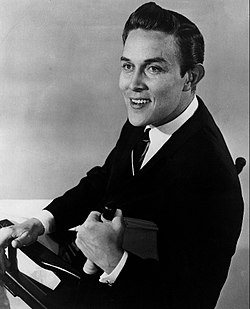
Jimmy Ray Dean (August 10, 1928 – June 13, 2010) was an American country music singer, television host, actor and businessman. He was the creator of the Jimmy Dean sausage brand as well as the spokesman for its TV commercials, and his likeness and voice continue to be used in advertisements after his death.[1]
Dean became a national television personality starting on CBS in 1957. He rose to fame for his 1961 country music crossover hit into rock and roll with "Big Bad John", and his 1963 television series The Jimmy Dean Show gave puppeteer Jim Henson his first national exposure with his character, Rowlf.
His acting career included appearing in the early seasons in the Daniel Boone television series as the sidekick of the famous frontiersman played by star Fess Parker. Later, he was on the big screen in a supporting role as billionaire Willard Whyte in the James Bond film Diamonds Are Forever (1971), starring Sean Connery.
He lived near Richmond, Virginia, and was nominated for the Country Music Hall of Fame in 2010, but died before his induction that year at the age of 81.
Biography
[edit]Early life
[edit]Dean was born on August 10, 1928, in Seth Ward, Texas[2] and raised in nearby Plainview, the son of George Otto Dean and his second wife, the former Ruth Taylor. Ruth taught Jimmy how to play piano at the age of 10.[3] He attributed his interest in music to the Seth Ward Baptist Church.[4] He dropped out of high school and became a professional entertainer after serving in the U.S. Air Force in the late 1940s.[3] Dean was 22 and just starting in show business when he married his first wife, Mary Sue, in 1950.
Entertainment career
[edit]Dean had his first hit, "Bumming Around", in 1953[3] on the 4 Star label (written by Pete Graves, credited to "C. Graves" on the Quality label). Dean signed with Columbia Records in 1957.
He had minor pop hits, such as "Little Sandy Sleighfoot" (a Christmas novelty song) and "Sing Along", later used as the theme for TV's Sing Along with Mitch, hosted by chorus leader Mitch Miller.
In 1954, Dean hosted the popular Washington, D.C., radio program Town and Country Time on WARL-AM, and with his Texas Wildcats became popular in the Mid-Atlantic region.[3] Patsy Cline and Roy Clark got their starts on the show. Although Cline and Dean became good friends, Clark (Dean's lead guitarist) was fired by the singer for what was explained as his chronic tardiness. Dean replaced Clark with Billy Grammer. In 1955, Town and Country Time moved to WMAL-TV (now WJLA-TV) on weekday afternoons.[3] Dean and the Texas Wildcats also appeared during 1957 on Town and Country Jamboree on WMAL-TV on Saturdays, which was also carried by TV stations in neighboring Maryland and Virginia on a regional network.
Also during 1957, while he lived in Arlington County, Virginia, Dean hosted Country Style on WTOP-TV (now WUSA-TV). CBS picked up the show nationally from Washington from April 8 to December 13, 1957 under the name The Morning Show.[5][6] In addition, Dean hosted his first prime time show, a half-hour summer series The Jimmy Dean Show that aired from Washington, DC, on CBS from June 22 to September 14, 1957 from 10:30 to 11 p.m. on Saturday nights.[7] Then from September 14, 1958 to June 1959, CBS carried The Jimmy Dean Show on weekday and Saturday afternoons.[3]
Dean became best known for "Big Bad John", his 1961 recitation song about a heroic miner.[3] Recorded in Nashville, the record went to number one on the Billboard pop chart and inspired many imitations and parodies.[3] It sold over one million copies and was awarded a gold disc.[8] The track peaked at number two in the UK Singles Chart.[9] The song won Dean the 1962 Grammy Award for Best Country & Western Recording.[3] He had several more top 40 songs, including a top 10 in 1962 with "PT-109", a song in honor of President John F. Kennedy's bravery in World War II,[3] with the sinking of his PT-boat in the South Pacific Ocean by the Japanese.
In the early 1960s, he hosted The Tonight Show on occasion (he was the first guest host during Johnny Carson's tenure, hosting for the first time on January 14, 1963) and one night introduced country singer Roy Clark, with whom he had remained friendly. In the mid-1960s, Dean helped bring country music into the mainstream[10] with his 1963–66 prime time variety series The Jimmy Dean Show on ABC. It presented country music entertainers including Roger Miller, George Jones, Charlie Rich, Buck Owens, and some (such as Joe Maphis) who seldom received network exposure. In 1964, he hosted Hank Williams Jr. in Williams' first television appearance at the age of 14. He sang several songs associated with his father, Hank Williams.[11] The program also featured comedy and a variety of popular music artists, and Dean's sketches with Rowlf the Dog, one of Jim Henson's Muppets. Henson was so grateful for this break that he offered Dean a 40% interest in his production company, but Dean declined on the basis that he had done nothing to truly earn it and Henson deserved all the rewards for his own work. For the rest of his life, Dean made it clear that he never regretted this decision.[12]
Dean appeared on several TV talk shows and game shows in the 1960s and performed on variety programs, including The Ed Sullivan Show, The Pat Boone Chevy Showroom and The Hollywood Palace.[13] Dean turned to acting after his television series ended in 1966. His best-known role was as a reclusive Las Vegas billionaire Willard Whyte, inspired by Howard Hughes, in the James Bond movie Diamonds Are Forever (1971) with Sean Connery as Bond. He also appeared in 14 episodes of Daniel Boone (1967–70) in three different roles (one episode as "Delo Jones," two as "Jeremiah," and 11 as "Josh Clements"); as Charlie Rowlands in two Fantasy Island episodes (1981–82); and on other television shows including a semi-regular role as Charlie Bullets on J.J. Starbuck starring Dale Robertson (1987–1988).[13]
Dean's singing career remained strong into the mid-1960s; in 1965, he achieved a second number one country hit with the ballad "The First Thing Ev'ry Morning (And the Last Thing Ev'ry Night)",[3] and he had a top 40 hit that year with "Harvest of Sunshine". In 1966, Dean signed with RCA Victor and immediately had a top 10 hit with "Stand Beside Me".[3] His other major hits during this time included "Sweet Misery" (1967) and "A Thing Called Love" (1968).[3] He continued charting into the early 1970s with his major hits, including "Slowly" (1971), a duet with Dottie West,[3] and a solo hit with "The One You Say Good Morning To" (1972).[14]
In 1976, Dean achieved a million-seller with another recitation song called "I.O.U.", a tribute to his mother and mothers everywhere.[3] The song was released a few weeks before Mother's Day and quickly became a top 10 country hit, his first in 10 years, and a top 40 pop hit, his first in 14 years. The song was re-released in 1977, 1983, and 1984, but with minor success each time.
In January 1978, Dean hosted an all-star tribute to Elvis Presley titled Nashville Remembers Elvis on His Birthday, during which he reminisced about his friendship with the recently deceased singer and performed his own hit "Big Bad John" and "Peace in the Valley".
Business career
[edit]In 1969, he founded the Jimmy Dean Sausage Company[2] with his brother Don. The company did well in part because of Dean's own extemporized, humorous commercials.[15]
The success of the company led to its acquisition in 1984 by Consolidated Foods, later renamed the Sara Lee Corporation. Dean remained involved as spokesman for the company, but the new corporate parent immediately began phasing him out of any management duties. In January 2004, Dean said that Sara Lee had dropped him as the spokesman for the sausage brand because he was too old.[16] In March 2004, Dean revealed that he had sold all but one of his shares in Sara Lee stock.[17] In 2018, several years after his death, the sausage company began re-airing some classic commercials featuring the voice of Dean introducing himself and praising the product.[1]
Later years and death
[edit]In the 1980s, he and his wife and family were residents of Tenafly, New Jersey.[18]
A Virginia resident from 1990, Dean was inducted into the Virginia Country Music Hall of Fame in 1997. Former Virginia governor Jim Gilmore appointed Dean to the Virginia Board of Game and Inland Fisheries, which oversees the state's wildlife efforts and boating laws. Dean owned a 110-foot yacht, Big Bad John, on which he hosted President George Bush on numerous occasions.[19] The two had originally met on Dean's cable show in Nashville, where Bush did an impression of Dean selling sausage.[20]
In the late 1990s, Dean and his wife donated generously to Varina High School. After initially considering opening their own school, they chose to support that public school instead.[21] They sponsored financial rewards for academic achievements for students, as well as stipends for teacher professional development.[22]
In the fall of 2004, he released his blunt, straight-talking autobiography 30 Years of Sausage, 50 Years of Ham. Dean lived in semi-retirement with his second wife, Donna Meade Dean, a singer, songwriter, and recording artist he married in 1991, who helped him write his book. The couple lived on their property at Chaffin's Bluff overlooking the James River in Henrico County, on the outskirts of Richmond, Virginia. On April 20, 2009, the main house was largely gutted by a fire, although the Deans escaped injury. The Deans rebuilt their home on the same foundation and returned early in 2010.
Dean announced on May 20, 2008, a donation of $1 million to Wayland Baptist University in Plainview, the largest gift ever from one individual to the institution. Dean said: "I've been so blessed, and it makes me proud to give back, especially to my hometown."[23]
On February 23, 2010, Dean was nominated for the Country Music Hall of Fame; he was scheduled to be inducted in October 2010, but this occurred after his death.
Dean had three children, Garry, Connie and Robert, with his first wife Mary Sue (Sue) (née Wittauer) Dean, and two granddaughters, Caroline Taylor (Connie's daughter) and Brianna Dean (Robert's daughter). He married his first wife in 1950; she divorced him in 1990 because of his affair with country-singer Donna Meade who became his second wife.[24] Donna Dean married her childhood sweetheart Jason Stevens two years after Dean's death.[25]
Dean died at his home in Varina, Virginia, on June 13, 2010, at the age of 81.[2] He was survived by his second wife Donna.[26] She told the Associated Press that he was doing well health-wise, so his death came unexpectedly. She recollects that he was eating dinner while watching television, she left the room, and when she came back in he was unresponsive. He was declared dead at 7:54 pm.[27] His estate was estimated to be worth over $50 million.
He was entombed in a 9-foot-tall (2.7 m) piano-shaped mausoleum overlooking the James River on the grounds of his estate. His epitaph reads "Here Lies One Hell of a Man", which is a paraphrased lyric from the uncensored version of his song "Big Bad John".[2][28]

On June 24, 2014, a groundbreaking was held for the Jimmy Dean Museum, which opened two years later on the grounds of Wayland Baptist University in his hometown of Plainview, Texas.[29] Dean's widow, Donna Dean Stevens, was present for the ceremony. The museum houses much of Jimmy Dean's memorabilia as well as a larger-than-life-size bronze statue created by Richmond sculptor Paul DiPasquale and funded by Hillshire Brands, then-owner of the Jimmy Dean sausage brand.[30] The museum is funded by a gift from the Dean Family Foundation.[31]
Filmography
[edit]| Year | Title | Role | Notes |
|---|---|---|---|
| 1963-1975 | The Jimmy Dean Show | Himself - Host | |
| 1967-1970 | Daniel Boone | Delo Jones/Jeremiah/Josh Clements | |
| 1969 | The Ballad of Andy Crocker | Mack | TV movie |
| 1971 | Diamonds Are Forever | Willard Whyte | |
| 1972 | Rolling Man | Lyman Hawkes | TV movie |
| 1977 | The City | Wes Connors | TV movie |
| 1981-1982 | Fantasy Island | Charlie Rowlands/Beau Gillette | 2 episodes |
| 1987-1988 | J.J. Starbuck | Charlie Bullets | 9 episodes |
| 1990 | Big Bad John | Cletus Morgan | |
| Murder, She Wrote | Bobby Diamond | Episode: "Ballad for a Blue Lady" |
Discography
[edit]Book
[edit]- Dean, Jimmy and Donna Meade Dean (2004). Thirty Years of Sausage...Fifty Years of Ham. New York: Berkley Book. ISBN 978-0425201060
References
[edit]- ^ a b "Is Jimmy Dean's real voice used in new commercials?". November 30, 2018. Archived from the original on January 18, 2023.
- ^ a b c d Weber, Bruce (June 14, 2010). "Jimmy Dean, Singer and Businessman, Dies at 81". The New York Times. Archived from the original on October 3, 2017. Retrieved June 14, 2010.
- ^ a b c d e f g h i j k l m n o Colin Larkin, ed. (1992). The Guinness Encyclopedia of Popular Music (First ed.). Guinness Publishing. pp. 659/660. ISBN 0-85112-939-0.
- ^ Adams, David (January 1, 2015). "Jimmy Dean Remembers Elvis Presley". Elvis Australia. Retrieved May 2, 2019.
- ^ "CBS Sets Night Slot for Dean". Billboard. Vol. 69, no. 21. May 27, 1957. p. 8. ISSN 0006-2510.
- ^ "The Quick Rise of an Early Riser". Life. Vol. 43, no. 15. October 7, 1957. p. 78. ISSN 0024-3019.
- ^ Brooks, Tim; Marsh, Earle (1992), The Complete Directory to Prime Time Network TV Shows, Ballantine Books, ISBN 0-345-37792-3.
- ^ Murrells, Joseph (1978). The Book of Golden Discs (2nd ed.). London: Barrie and Jenkins Ltd. pp. 133–134. ISBN 978-0214204807.
- ^ Roberts, David (2006). British Hit Singles & Albums (19th ed.). London: Guinness World Records Limited. p. 146. ISBN 978-1904994107.
- ^ McLellan, Dennis (June 15, 2010). "Jimmy Dean dies at 81; country music star and sausage king". Los Angeles Times. Retrieved May 3, 2019.
- ^ "Hank Williams, Jr". IMDb. Retrieved August 8, 2018.
- ^ "A Hell Of A Man Himself". The Bluegrass Special.com. Archived from the original on October 20, 2011. Retrieved October 18, 2011.
- ^ a b Jimmy Dean at IMDb
- ^ "Hot Country Singles". Billboard. Vol. 84, no. 6. February 5, 1972. p. 38. ISSN 0006-2510.
- ^ Calhoun, Fryar (August 1983). "Hi! I'm Jimmy Dean and I'd like you to try my pure pork sausage". Texas Monthly. Vol. 11, no. 8. pp. 121–123 198–200, 206. ISSN 0148-7736.
- ^ Potter, Dena (June 13, 2010). "Jimmy Dean DEAD: Singer, Sausage Businessman Dies At 81". The Huffington Post.
- ^ Vries, Lloyd (March 29, 2004). "Dean One Spicy Sausage King". CBS News. Retrieved November 6, 2018.
- ^ "Walter Jones Taylor Wed To Connie Elizabeth Dean", The New York Times, November 8, 1987. Accessed October 11, 2015. "At the Fifth Avenue Presbyterian Church in New York yesterday Connie Elizabeth Dean, the daughter of Mr. and Mrs. Jimmy Dean of Tenafly, N.J., was married to Walter Jones Taylor, a son of Mr. and Mrs. Zachary Taylor Jr. of Jackson, Miss...Her father, the country and western singer, is chairman of the Jimmy Dean Meat Company in Dallas."
- ^ Hosler, Karen (September 3, 1991). "Lifestyle of the rich and famous: At White House, Bush lives it up". The Baltimore Sun. Retrieved November 6, 2018.
- ^ Warren, Ellen (January 19, 1993). "THANKS FOR THE MEMORIES, MR. BUSH". Chicago Tribune.
- ^ Morano, Rob. "Part Two: Citizen Dean". Style Weekly. Archived from the original on January 17, 2025. Retrieved January 17, 2025.
- ^ "HOUSE JOINT RESOLUTION NO. 756". Virginia's Legislative Information System. February 18, 1997. Archived from the original on January 17, 2025. Retrieved January 17, 2025.
- ^ "Singer Jimmy Dean and wife donate $1 million to Wayland" (Press release). Wayland Baptist University. May 16, 2008. Retrieved May 3, 2019.
- ^ "NATION: Jimmy Dean Sued for Divorce". Los Angeles Times. October 31, 1991.
- ^ "Donna Meade Dean to remarry". Richmond Times-Dispatch. August 5, 2015.
- ^ "Plainview native Jimmy Dean's funeral services set Monday in Virginia". Lubbock Avalanche-Journal. Associated Press. June 17, 2010. Retrieved June 17, 2010.
- ^ "Jimmy Dean Obituary". Richmond Times-Dispatch. June 18, 2010. Retrieved May 3, 2019.
- ^ Pellerano, Angela (June 13, 2010). "Jimmy Dean Dies at The Age of 81". WRVR News. Archived from the original on June 17, 2010. Retrieved June 13, 2010.
- ^ "The History of Jimmy Dean". Wayland Baptist University. Retrieved March 5, 2018.
- ^ Petty, Jonathan (June 24, 2014). "Wayland breaks ground on new Jimmy Dean Museum". Plainview Daily Herald. Retrieved August 18, 2015.
- ^ McDonough, Doug (July 8, 2014). "Work begins on Jimmy Dean Museum". Plainview Daily Herald. Retrieved September 19, 2015.
External links
[edit]
- Jimmy Dean at CMT.com
- Jimmy Dean at IMDb
- Jimmy Dean discography at Discogs
- Interview with Jimmy Dean at Elvis.com.au
- "Jimmy Dean—AN INTERVIEW WITH "THE DEAN OF COUNTRY MUSIC," with Bill Miller

Jimmy Dean
View on GrokipediaEarly Life
Childhood and Family
Jimmy Dean was born Jimmy Ray Dean on August 10, 1928, in Olton, Lamb County, Texas, to George Otto Dean, a farmer and aspiring musician, and his second wife, Ruth (née Taylor) Dean.[4][5] The family soon relocated to the nearby community of Seth Ward, just outside Plainview in Hale County, where Dean spent his formative years amid the hardships of rural life during the Great Depression.[4] Dean's family dynamics were marked by instability and abuse; his father, who was physically abusive and occasionally worked as a songwriter, singer, and Baptist lay preacher, abandoned the family when Dean was 11 years old, leaving his mother to raise Dean and his brother Don alone.[6][7] Ruth Dean supported her children through multiple low-paying jobs, including operating a makeshift barbershop from their home and other manual labor, as the family scraped by on a small farm.[8] Their poverty-stricken existence involved grueling farm work, such as tending crops and livestock, with limited access to resources or formal education.[1][9] At age 16, after completing only the ninth grade, Dean dropped out of school to contribute to the household through odd jobs, including cotton picking on local farms and employment at an oil company like Peerless Oil Co.[10][11] Despite these challenges, Dean's early exposure to music provided an outlet; his mother taught him piano at age 10, while his father's musical background influenced him to self-teach guitar and harmonica, leading to performances in church choirs and at local gatherings.[4][1] This period of hardship ultimately prompted Dean to enlist in the military as a means of escape.[10]Military Service
At the age of 16, amid the hardships of childhood poverty in Plainview, Texas, Jimmy Dean dropped out of high school and enlisted in the U.S. Merchant Marine in 1944.[12][13] His service in the Merchant Marine lasted until 1946 and included one voyage to South America, providing him with early experiences away from home during the final years of World War II.[14][13] Following his Merchant Marine tenure, Dean enlisted in the U.S. Air Force in 1946 and served until his honorable discharge in 1949.[15] Stationed at Bolling Air Force Base in Washington, D.C., he began developing his musical abilities by joining the base band, the Tennessee Haymakers, where he played the accordion and performed for fellow servicemen.[4] These performances marked his initial foray into public entertainment, honing skills that would later define his career.[1] Upon his discharge, Dean remained in the Washington, D.C. area, continuing to develop his musical talents and beginning his professional entertainment career.[4][13][15]Entertainment Career
Music Career
After his discharge from the U.S. Air Force in 1948, Jimmy Dean moved to the Washington, D.C., area, where he formed the band Jimmy Dean and the Texas Wildcats in 1949, performing in local nightclubs and on radio shows.[4][2] The group, which included future musician Roy Clark as a guitarist starting in 1954, gained regional attention through appearances on programs like Town and Country Time.[4] In 1953, Dean signed with the independent label 4 Star Records and released his debut single "Bummin' Around," which reached No. 5 on the Billboard country chart and achieved national popularity.[1][2] Dean's breakthrough came in 1961 with the narrative ballad "Big Bad John," recorded for Columbia Records after signing with the label in 1957.[4] The song topped the Billboard Hot 100 for five weeks and the country chart for two weeks, marking a rare crossover success for country music at the time.[2] It earned Dean the Grammy Award for Best Country & Western Recording in 1962, his only Grammy win.[1] The accompanying album Big Bad John also charted, solidifying his status as a prominent country storyteller.[16] In the years following, Dean scored additional hits on Columbia, including "PT-109" and "Little Black Book" in 1962, contributing to a total of four Top 10 singles on the country charts during the early 1960s.[2] Other successes included "The First Thing Ev'ry Morning," which reached No. 1 on the country chart in 1965.[4] He shifted to RCA Victor in 1966, releasing albums such as Short Stories in 1968 and charting modestly with tracks like "Stand Beside Me" (No. 10 country, 1966).[2] His music often overlapped briefly with his television work, where songs like "Big Bad John" were performed to promote recordings.[1] By the late 1960s, Dean's chart success waned amid changing musical trends, though he continued sporadic releases, including the Top 10 country hit "I.O.U." in 1976 on the Casino label.[2] He largely retired from active music pursuits in the 1970s, focusing on other ventures while occasionally performing at major venues like the Hollywood Bowl.[4]Television Hosting
Jimmy Dean debuted as a television host with The Jimmy Dean Show on CBS in 1957, a variety program that began as a Saturday evening show and shifted to weekday afternoons in 1958, originating from Washington, D.C.[2][17] The series featured his band, the Texas Wildcats, along with guests such as George Hamilton IV, and ran until 1959, helping to establish Dean's presence in national broadcasting.[2] The program was revived on ABC from 1963 to 1966 as a Saturday morning variety show, incorporating comedy sketches and puppets, notably Rowlf the Dog, a Muppet character voiced and operated by Jim Henson, who served as Dean's wisecracking sidekick.[18] This version emphasized musical performances and light-hearted banter, with segments dedicated to Rowlf's interactions with Dean, which aired for 7 to 10 minutes per episode.[19] Dean's hosting style was characterized by a homespun, charismatic persona delivered in a folksy country accent, which endeared him to audiences and played a key role in introducing country music to mainstream viewers beyond traditional rural markets.[2] He regularly featured guests like Roy Clark and Patsy Cline, highlighting emerging talents in the genre and blending country acts with broader entertainment appeal.[20] Through The Jimmy Dean Show, Dean is credited with broadening the reach of country music via television, attracting urban and suburban viewers to artists and styles previously confined to regional audiences.[2] Episodes often promoted his hit songs, such as "Big Bad John," reinforcing his dual role as performer and host.[21] Dean also made guest appearances on programs like The Ed Sullivan Show, where he performed his music to further promote his recordings and visibility in the entertainment industry.[22]Acting Roles
Jimmy Dean's acting career emerged in the late 1960s, following his rise as a country music star and television host, with his debut in a recurring role on the NBC series Daniel Boone. From 1967 to 1970, he portrayed Josh Clements, a rugged fur trapper serving as a sidekick to Fess Parker's Daniel Boone, appearing in multiple episodes that showcased his charismatic, down-to-earth screen presence.[23] This role marked his entry into scripted television acting, leveraging his established persona from variety shows to portray frontiersman types. Dean's most prominent film appearance came in 1971 with the James Bond thriller Diamonds Are Forever, where he played Willard Whyte, a reclusive Las Vegas billionaire modeled after Howard Hughes and unwittingly entangled in SPECTRE's diamond-smuggling plot.[24] The part, which pitted him opposite Sean Connery's Bond, highlighted his ability to embody authoritative yet affable characters, and it was facilitated by his prior television fame. He followed this with supporting roles in made-for-TV movies, such as the Vietnam veteran drama The Ballad of Andy Crocker (1969), where he appeared as Mack, and Rolling Man (1972) as Lyman Hawkes, a prison escapee. On television, Dean made guest appearances on popular anthology series, including two episodes of Fantasy Island in 1981 and 1982, playing characters like the widowed country singer Charlie Rowlands in "Man-Beast/Ole Island Opry."[25] Later, he secured a recurring role as the informant Charlie Bullets on the detective series J.J. Starbuck from 1987 to 1988, contributing to the show's blend of mystery and Western elements alongside star Dale Robertson.[26] These roles often drew on his musical background, casting him in parts that reflected a tough, relatable everyman. Dean's final significant acting credit was in the 1990 low-budget Western Big Bad John, directed by Burt Kennedy, where he starred as Sheriff Cletus Morgan in a story inspired by his own 1961 hit song of the same name about a heroic miner.[27] Over four decades, he accumulated more than 20 acting credits across film and television, predominantly from the 1960s to the 1980s, frequently embodying rugged, charismatic figures aligned with his public image.[28] Although his entertainment visibility aided in securing these opportunities, Dean's commitments to music and his sausage business limited his pursuit of full-time acting, resulting in a sporadic but memorable body of work.[29]Business Ventures
Founding Jimmy Dean Foods
In 1969, Jimmy Dean founded the Jimmy Dean Meat Company in Plainview, Texas, partnering with his brother Don Dean and Troy Prichard, the husband of their cousin, to produce high-quality pork sausage.[4][12] The venture was inspired by Dean's rural upbringing on his grandparents' farm, where family members ground pork and his mother seasoned it according to traditional recipes, combined with his frustration over a subpar sausage meal that prompted him to create a better product using premium hogs.[3][30] The initial offering was pure pork sausage, emphasizing fresh processing without fillers, and operations began on a small scale with Dean personally overseeing production, including hog butchering and quality control at the company's first plant.[31][12] The company's early marketing strategy capitalized on Dean's fame as a country singer and television host, featuring him in television advertisements that highlighted the product's down-home authenticity with his folksy Southern delivery.[4][32] In these spots, Dean pitched lines like "from the whole hawg, not jus’ the leavin’s" and encouraged viewers to "get yourself a large chunk of that good morning feeling," positioning the sausage as an essential breakfast item for busy families.[3][12] This personal endorsement helped drive initial distribution, which expanded nationally by 1970 to include frozen breakfast sausage varieties, building on the fresh product's success.[3] Despite the promising start, the company faced significant challenges in its formative years, including cash flow shortages that required high-interest loans at rates up to 16 percent and rudimentary accounting practices that complicated financial management.[12] Pork prices fluctuated downward, leading to operational losses, while intense competition from established meat brands pressured the upstart to innovate in processing and distribution.[12] By 1972, however, the business had achieved rapid growth, becoming profitable within its first six months and prompting the opening of a second plant in Osceola, Iowa, to meet rising demand amid a regional hog production boom.[32][12]Expansion and Sale
Following its founding, Jimmy Dean Foods experienced rapid growth in the 1970s, diversifying its product line with breakfast sausage offerings including patties, links, and sandwiches to meet increasing consumer demand.[33] The company supported this expansion by opening a new production plant in Osceola, Iowa, in 1972 and broadening distribution to supermarkets nationwide.[32] In 1984, Jimmy Dean sold the company to the Sara Lee Corporation for $80 million, while retaining his position as chairman and spokesperson to guide the brand's direction.[34] Dean continued his involvement by overseeing product development and advertising campaigns, ensuring the brand's alignment with his vision of quality and accessibility.[1] This hands-on role persisted until his semi-retirement in the early 1990s, after which he maintained influence through periodic consultations.[35] Under Sara Lee's ownership, the Jimmy Dean brand underwent significant evolution, introducing innovative products and leveraging national marketing to drive market share in the breakfast category.[36] By the early 2010s, annual sales approached $1 billion, reflecting robust growth from expanded retail presence and diversified offerings.[37] Dean appeared in commercials promoting the brand well into the 2000s, up until 2003.[1] In 2012, Sara Lee spun off its North American meats business, including Jimmy Dean, as Hillshire Brands. Tyson Foods acquired Hillshire Brands in 2014 for $7.4 billion, making Jimmy Dean a key part of its prepared foods portfolio. As of 2025, Jimmy Dean remains a leading brand in refrigerated breakfast meats, with annual sales exceeding $500 million and holding the top market position in the U.S..[38][39] Dean later reflected on the sale as a strategic decision to secure the business's longevity, allowing it to thrive on a larger scale without the demands of full operational management; he retained one share specifically to attend shareholder meetings and voice his perspectives.[34]Personal Life
Marriages and Family
Jimmy Dean married Mary Sue Wittauer on July 11, 1950.[4] The couple welcomed three children during their marriage: son Garry in 1951, daughter Connie in 1954, and son Robert.[15][40] Their long union, spanning four decades, faced strains in its later years, culminating in Mary Sue filing for divorce in October 1990 on grounds of infidelity involving an affair with singer Donna Meade.[41] The divorce was finalized on October 30, 1990.[40] Following the divorce, Dean married Donna Meade, a country music singer and songwriter, on October 27, 1991.[40] The pair remained married until Dean's death in 2010, forming a tight-knit family unit without additional children.[1] Donna provided crucial support during Dean's later years, collaborating with him on creative projects such as co-authoring his 2004 autobiography, Thirty Years of Sausage, Fifty Years of Ham.[42] Dean's children occasionally appeared in family contexts tied to his public life, though they pursued independent paths away from the spotlight.[14] He frequently highlighted the centrality of family in interviews, crediting it as a stabilizing force amid his career's demands.[43]Interests and Philanthropy
Jimmy Dean developed a deep passion for ranching later in life, acquiring a 225-acre estate in Varina, Virginia, in the 1960s that he affectionately nicknamed "Weedville" and used as a serene personal retreat overlooking the James River.[12][44] The property featured expansive grounds, a private dock for his yacht, and various outbuildings, providing an escape where he engaged in ranching pursuits, including raising cattle and horses.[12] An avid outdoorsman, Dean was a hunting and fishing enthusiast who frequently shared engaging stories from his adventures in interviews, reflecting his love for nature and rural life.[45] Dean was actively involved in philanthropy, particularly supporting children's health and education. In 1985, he donated $1,000 to initiate research on Menkes Syndrome at Temple University School of Medicine and visited affected children to raise awareness for the rare disease.[46] A devout Baptist, Dean credited his religious faith for much of his career success and personal resilience, often citing the spiritual influence of his grandfather as a guiding force.[47] He participated in church activities throughout his life and, with his wife Donna, made significant contributions to Baptist institutions, including a major estate gift to Wayland Baptist University in 2008 that funded a dormitory named in his honor and the Jimmy Dean Museum to preserve his legacy.[48] This commitment extended to broader educational philanthropy, such as donating to local schools in Varina, Virginia, where he awarded prizes like cars and bicycles to students.[47]Later Years and Death
Retirement and Health
In the early 2000s, following Sara Lee Corporation's decision to end his role as spokesman for the Jimmy Dean sausage brand in 2004, Jimmy Dean entered semi-retirement, shifting his focus to a quieter life on his 200-acre estate near Richmond, Virginia.[49][50] There, he and his wife, Donna Meade Dean, whom he married in 1991, enjoyed ranch activities and the rural surroundings, a contrast to his earlier high-profile career in music, television, and business.[1] Dean faced health challenges during this period, including mobility issues that required the use of a walker by 2009, amid broader reports of declining health in his later years.[15][1] He managed these through a reduced schedule and family support, with Donna serving as his primary caregiver during their time together on the estate. Despite these limitations, Dean maintained occasional public engagements, such as a television appearance in the documentary A Complete History of the Green Berets around 2000 and voice work for brand endorsements prior to 2004.[51] In 2004, Dean published his autobiography, Thirty Years of Sausage, Fifty Years of Ham: Jimmy Dean's Own Story, co-written with Donna, which reflected on his career trajectory, personal growth, and life lessons from poverty to success.[52] The book provided an intimate look at his journey, emphasizing resilience and family. He also continued limited philanthropic efforts, supporting causes like education through contributions to institutions such as Wayland Baptist University.[48]Death
Jimmy Dean died on June 13, 2010, at the age of 81, at his home in Varina, Henrico County, Virginia, from natural causes related to a heart attack.[53] He had experienced some health issues in recent years but had been functioning well, and his wife, Donna Meade Dean, described the sudden event as a shock. She discovered him unresponsive while he was eating dinner in front of the television; she had briefly left the room and returned to find him in distress, after which he was pronounced dead at 7:54 p.m.[54] News of Dean's death prompted tributes from the country music community and business figures, highlighting his multifaceted career as a singer, actor, and entrepreneur.[55] Former Virginia Governor George Allen, who attended the funeral, described Dean as a "modern day Will Rogers" for his wit and charisma.[56] Friend and associate Thomas Custalow praised Dean's character, noting his generosity and down-to-earth nature.[56] A public visitation was held on June 20, 2010, from noon to 8 p.m. at Nelsen Funeral Home in Richmond, Virginia.[57] The funeral service took place the following day, June 21, at 11 a.m. at Grove Avenue Baptist Church in Tuckahoe, Virginia, near Richmond, attended by family, close friends, and notable figures including television personality Willard Scott, country singer George Hamilton IV, and Governor Allen.[56] The service was followed by a private interment at Dean's Varina ranch, where he was buried in a custom granite mausoleum shaped like a grand piano, overlooking the James River and inscribed with "Here lies one hell of a man" along with his birth and death dates.[56][58] Dean's assets, including his 200-acre ranch on the James River, passed to his family, with his wife Donna and daughter Connie Dean Taylor as primary survivors.[8] The Jimmy Dean sausage brand, which he founded and sold in 1984, continued operations under Sara Lee Corporation ownership at the time of his death and was later acquired by Tyson Foods in 2014.[31]Legacy
Cultural Impact
Jimmy Dean played a pivotal role in mainstreaming country music during the 1960s by hosting his ABC variety series The Jimmy Dean Show, which exposed the genre to urban and non-traditional audiences through prime-time broadcasts featuring prominent country performers.[59] This platform helped bridge rural Southern sounds with broader American pop culture, contributing to the genre's growing acceptance and influencing the paths of subsequent artists who achieved crossover success.[60] Dean cultivated an iconic persona as the "Sausage King," merging his entertainment background with entrepreneurial success to embody the American Dream of rising from poverty to prosperity. Born into hardship in rural Texas during the Great Depression, he dropped out of high school to support his family, later transforming personal struggles into a narrative of self-made achievement that resonated widely.[61][9] The enduring legacy of the Jimmy Dean brand underscores his cultural footprint, with products maintaining strong popularity and generating approximately $1.8 billion in annual sales by 2019 under Tyson Foods ownership. This commercial success has permeated popular media, including references to Dean's persona and products in episodes of The Simpsons, where his name appears in song lyrics evoking his musical fame.[62][63] Dean's television work advanced variety programming by integrating music, comedy, and innovative puppetry, notably through regular appearances of Jim Henson's Muppet character Rowlf the Dog on The Jimmy Dean Show, which provided early national exposure for Henson and blended adult-oriented entertainment with family-friendly elements that foreshadowed later youth-focused formats.[64] Throughout his career, Dean exemplified Southern values of hard work, family, and faith, themes drawn from his impoverished upbringing and reflected in his autobiography, where he credits early lessons in perseverance and religious belief for his accomplishments. His gospel recordings and public storytelling further reinforced this image, portraying a wholesome, resilient Southern ethos.[52][65]Awards and Honors
Jimmy Dean's breakthrough hit "Big Bad John" earned him the Grammy Award for Best Country & Western Recording at the 4th Annual Grammy Awards in 1962.[66] In recognition of his contributions to country music, Dean was inducted into the Texas Country Music Hall of Fame in 2005.[67] He received further acknowledgment for his entrepreneurial success in the food industry with his 2009 induction into the Meat Industry Hall of Fame.[7] Following his death in June 2010, Dean was posthumously inducted into the Country Music Hall of Fame later that year, honoring his pioneering role in blending country music with mainstream entertainment.[2]Discography
Singles
Jimmy Dean's recording career as a singles artist spanned several decades, beginning with modest success in the early 1950s and peaking with crossover hits in the early 1960s. His debut single, "Bummin' Around," released in 1953 on 4 Star Records, marked his first entry on the Billboard country charts, reaching No. 5 and establishing his presence in the genre with its lighthearted narrative of carefree wandering.[68][69] This track, written by Pete Graves, showcased Dean's smooth baritone and set the stage for his narrative-style storytelling that would define his later work. Dean's major breakthrough arrived with "Big Bad John" in 1961 on Columbia Records, a dramatic recitation about a heroic miner that topped both the Billboard Hot Country Songs and Hot 100 charts for multiple weeks, earning a Grammy Award for Best Country & Western Recording. The single sold over 8 million copies worldwide, making it one of the best-selling country records of the era and propelling Dean to national fame.[15] Following this success, "PT-109" in 1962—tribute to President John F. Kennedy's World War II heroism—peaked at No. 3 on the country chart and No. 8 on the pop chart, further demonstrating Dean's ability to blend patriotism with country storytelling.[70][2] Other notable charted singles from 1962 included "Dear Ivan" (No. 9 country), "Little Black Book" (No. 10 country), "The Cajun Queen" (No. 15 country), and "To a Sleeping Beauty" (No. 15 country), all on Columbia, contributing to a string of five Top 20 country hits that year and highlighting Dean's prolific output during his commercial peak.[2][70] In later years, Dean continued releasing singles on labels including RCA Victor and Casino, with "The First Thing Ev'ry Morning (And The Last Thing Ev'ry Night)" reaching No. 1 on the country chart in 1965 and "I.O.U." peaking at No. 9 in 1976.[2][70] Dean frequently promoted his singles through performances on The Jimmy Dean Show, which helped sustain their chart momentum. Post-1970s, many of his key singles, including reissues of "Big Bad John," were bundled into greatest hits compilations, ensuring their enduring availability.[2]| Single | Year | Label | Country Peak | Pop Peak |
|---|---|---|---|---|
| Bummin' Around | 1953 | 4 Star | 5 | - |
| Big Bad John | 1961 | Columbia | 1 | 1 |
| PT-109 | 1962 | Columbia | 3 | 8 |
| Dear Ivan | 1962 | Columbia | 9 | 24 |
| Little Black Book | 1962 | Columbia | 10 | 29 |
| The Cajun Queen | 1962 | Columbia | 15 | 22 |
| To a Sleeping Beauty | 1962 | Columbia | 15 | 26 |
| The First Thing Ev'ry Morning (And The Last Thing Ev'ry Night) | 1965 | Columbia | 1 | - |
| Stand Beside Me | 1966 | RCA Victor | 10 | - |
| Sweet Misery | 1967 | RCA Victor | 16 | - |
| I.O.U. | 1976 | Casino | 9 | 35 |
Albums
Jimmy Dean's recording career spanned several decades, with a focus on country music that often incorporated storytelling elements in his early work. He released over 15 studio albums between 1958 and 1980, three of which achieved Top 10 status on the Billboard country albums chart, reflecting varying levels of commercial success as his style evolved from narrative-driven songs to more traditional country fare.[71] His debut album, Big Bad John, issued in 1962 by Columbia Records, capitalized on the success of its title track and reached No. 5 on the country chart, showcasing his signature spoken-word narratives about everyday heroes and moral tales.[71] Key releases highlighted Dean's versatility and thematic interests. The 1968 album Dean's List on Columbia emphasized storytelling through a collection of concise, character-driven songs, continuing his penchant for dramatic country ballads. In a later effort, I.O.U. (1976, Casino) marked a comeback attempt amid his television and business pursuits, blending familiar country sounds with personal reflections, though it received modest chart attention. Production on his early Columbia albums often involved collaborations with renowned producer Don Law, known for his work with artists like Johnny Cash, which helped shape Dean's polished, radio-friendly sound before a shift toward more conventional country arrangements in the 1970s.[72] Dean also issued several compilation albums that captured his hits and broader catalog. Greatest Hits (1962, Columbia) compiled his breakthrough singles shortly after their release, achieving strong sales and underscoring his early pop-country crossover appeal.[71] Later, Greatest Songs (1995, Curb) offered a retrospective overview, including remastered tracks from his peak years and serving as an entry point for new listeners to his narrative legacy.[73]Filmography
Film Roles
Jimmy Dean appeared in two feature films during his acting career, both showcasing his persona as a rugged, Southern everyman. These roles, spanning from 1971 to 1990, often drew on his country music background and charismatic presence, though critics noted a lack of dramatic depth in his performances.[74] His debut in a major motion picture was as Willard Whyte in the James Bond thriller Diamonds Are Forever (1971), directed by Guy Hamilton. In the film, Dean portrayed a reclusive Las Vegas hotel magnate and industrialist whose empire becomes entangled in a diamond-smuggling plot led by the villain Blofeld (Charles Gray). The character, inspired by real-life tycoon Howard Hughes, allowed Dean to bring a folksy, down-home charm to the high-stakes espionage world, with lines delivered in his distinctive drawl. Critics praised his natural affability and ease on screen, which added a lighthearted contrast to the film's action sequences, though some found the role stereotypical and underdeveloped.[75] Dean revisited themes from his music catalog in Big Bad John (1990), a low-budget Western directed by Burt Kennedy and based on his 1961 hit song of the same name. He starred as Cletus Morgan, a no-nonsense sheriff leading a posse in search of the legendary miner "Big Bad John" (Doug English), amid a tale of revenge and frontier justice in rural Arkansas. The film, produced by Charlie Daniels, emphasized Dean's authoritative presence and gravelly voice, fitting his typecasting as a tough Southern lawman. Reviews were mixed, highlighting his authentic charisma and rapport with co-stars like Ned Beatty and Bo Hopkins, but critiquing the picture's predictable plot and lack of nuance in his lead performance.[76]| Film | Year | Role | Notes |
|---|---|---|---|
| Diamonds Are Forever | 1971 | Willard Whyte | Supporting role; James Bond film starring Sean Connery |
| Big Bad John | 1990 | Cletus Morgan | Lead role; adaptation of Dean's song |