Hubbry Logo
RedpollRedpollMain
Open search
Redpoll
Community hub
Redpoll
logo
8 pages, 0 posts
0 subscribers
Be the first to start a discussion here.
Redpoll
Redpoll
from Wikipedia

Redpoll
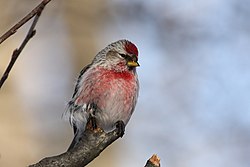
Male, Quebec Canada
Scientific classification Edit this classification
Kingdom: Animalia
Phylum: Chordata
Class: Aves
Order: Passeriformes
Family: Fringillidae
Subfamily: Carduelinae
Genus: Acanthis
Borkhausen, 1797
Species:
A. flammea
Binomial name
Acanthis flammea
Range
  Breeding
  Year-round
  Nonbreeding

The redpoll (Acanthis flammea) is a species of small passerine bird in the finch family Fringillidae. It is the only species placed in the genus Acanthis. It breeds in the Arctic and north temperate Holarctic tundra and taiga. The redpoll was formerly widely treated as three species: the common or mealy redpoll, the arctic or hoary redpoll (A. hornemanni), and the lesser redpoll (A. cabaret).[2]

Taxonomy

[edit]

The redpoll was listed in 1758 by the Swedish naturalist Carl Linnaeus in the 10th edition of his Systema Naturae under the binomial name Fringilla flammea.[3][4] The specific epithet flammea is Latin meaning "flame-coloured".[5] Linnaeus also described the redpoll as Fringilla linaria on the same page, but the earlier name flammea has priority.[3][6][7]

The redpoll was previously placed in the genus Carduelis. Molecular phylogenetic studies showed that it formed a distinct lineage, so it was moved to the resurrected genus Acanthis that had been introduced in 1797 by the German naturalist Moritz Balthasar Borkhausen.[8][9][10] The genus name Acanthis is from Ancient Greek akanthis, a name for a small now-unidentifiable bird.[11]

Five subspecies are recognised:[10]

  • A. f. flammea (Linnaeus, 1758) – north Europe, Siberia, Alaska and Canada
  • A. f. rostrata (Coues, 1861) – northeast Canada, Greenland and Iceland
  • A. f. cabaret (Müller, PLS, 1776) – temperate west, central west Palearctic lowland (montane in south) birch and larch woods: British Isles, southwest Scandinavia east to north Germany and south Poland; south to southeast France, Austria and Czech Republic
  • A. f. exilipes (Coues, 1862) – low (locally high) Arctic tundra birch and willow of north Eurasia, north Alaska and northwest Canada
  • A. f. hornemanni (Holbøll, 1843) – low (locally high) Arctic tundra birch and willow of far northeast Canada and Greenland

The redpoll was formerly regarded as three separate species: the common redpoll with subspecies flammea and rostrata, the lesser redpoll with subspecies cabaret and the arctic redpoll with subspecies hornemanni and exilipes. The three species are now considered as conspecific based on the small genetic differences and the continuous phenotypic variation.[10][12][13]

Description

[edit]
Eggs

The redpoll is a small brownish-grey finch with dark streaks and a bright red patch on its forehead. It has a black bib and two pale stripes on the wings. Males' breasts are often suffused with red. Adults measure between 11.5 and 14 centimetres (4.5 and 5.5 in) in length and weighing between 12 and 16 grams (0.42 and 0.56 oz). Wingspan ranges from 7.5 to 8.7 in (19–22 cm).[14] The rump is streaked and there is a broad dark brown streak across the vent. It has brown legs, a dark-tipped yellowish bill and dark brown irises.[15]

Calls from a flock of birds feeding, Iowa USA
Foraging redpoll filmed in Holland

Distribution and habitat

[edit]

The range of the redpoll extends through northern Europe and Asia to northern North America, Greenland and Iceland. It is a partial migrant, moving southward in late autumn and northward again in March and April. Its typical habitat is boreal forests of pines, spruces and larches. It feeds mainly on seeds, principally birch and alder seeds in the winter.[15]

Redpolls, subspecies A. f. cabaret, were introduced into New Zealand between 1862 and 1875. They are now found throughout both the North and South Islands as well as on many outlying islands.[16][17]

Behaviour

[edit]

Breeding

[edit]

The redpoll first breed when they are one year old. The female builds the nest, accompanied by the male, often low down in a tree or bush. It has an outer layer of thin twigs, a middle layer of root fibres, fragments of juniper bark and lichens and an inner layer of down, wool and hair. Three to seven speckled eggs are laid. The eggs are 16.9 mm × 12.6 mm (0.67 in × 0.50 in) with a calculated weight of 1.4 g (0.049 oz). They are incubated by the female and hatch after about 11 days. The young are cared for by both parents but are brooded only by the female. The chicks fledge when aged around 13 days. Generally two broods are raised each year.[18]

Food and feeding

[edit]

The diet is mostly very small seeds, especial those from birch trees (Betula). In the breeding season some invertebrates are also eaten. It forages mainly in trees but will occasionally forage on the ground.[19]

[edit]

References

[edit]

Sources

[edit]
Revisions and contributorsEdit on WikipediaRead on Wikipedia
from Grokipedia
The redpoll (Acanthis flammea) is a small in the family Fringillidae, characterized by its compact size of 4.5–5.5 inches (11.5–14 cm) in length, weighing 0.3–0.7 ounces (9–20 g), with a small head, pointed seed-eating bill, short notched tail, a distinctive on the (the "poll"), two white wingbars, and black feathering surrounding a bill. Males often display a rosy-red wash on and rump, while females and immatures are duller brown and white with streaky sides; variations include darker "common" forms and paler "hoary" forms, though in 2024, based on genetic studies, the recognized them as a single due to minimal genetic differences maintained by a . These acrobatic, restless birds forage in lively flocks, emitting buzzy "zap" and rising "dreeee" calls, and are known for their , such as passing string-pull tests, and adaptations like storing in esophageal pouches or tunneling into for warmth. Redpolls breed in Arctic tundra and boreal forests encircling the , from and through Scandinavia to Siberia, with a circumpolar distribution that brings them into , including the where they favor moorland edges and gardens. In winter, they undertake erratic irruptive migrations southward, sometimes reaching the central United States or when northern seed crops like and catkins fail, leading to flocks of hundreds at bird feeders where they consume thistle, nyjer, and black oil sunflower seeds. Their diet consists primarily of small seeds, which they extract acrobatically while hanging upside down or fluttering among weeds and trees, and they bulk up by 31% in compared to July for insulation. Globally, redpolls number in the hundreds of millions, with a stable "Least Concern" , though UK populations of about 260,000 breeding pairs have shown a 20% distribution contraction since 1995 despite recent stability, possibly aided by garden feeders and planting efforts. The oldest recorded individual lived 7 years and 10 months, highlighting their resilience in harsh northern environments.

Taxonomy and Classification

Etymology and Naming

The common name "redpoll" derives from the bird's characteristic red patch on the forehead of adults, with "poll" referring to an archaic English term for "head." This marking, present in both males and females, inspired the name across various redpoll species in the genus. The common redpoll was first formally described by the Swedish naturalist in 1758, who assigned it the binomial name Fringilla flammea in the tenth edition of his . In 1797, the German naturalist Moritz Balthasar Borkhausen established the genus Acanthis for the redpolls, distinguishing them from other finches based on morphological traits such as bill shape and body proportions. Over time, the classification shifted as taxonomic understanding evolved; redpolls were later placed within the broader genus Carduelis alongside other finches like linnets and goldfinches, reflecting similarities in and . Molecular phylogenetic studies in the early , analyzing DNA sequences from mitochondrial and nuclear genes, revealed that redpolls form a distinct monophyletic lineage separate from Carduelis, prompting the of Acanthis as the appropriate to reflect their evolutionary relationships. This reclassification was supported by evidence of in the former Carduelis, justifying the separation based on both historical morphology and contemporary genetic data.

Species Status and Subspecies

The redpoll is currently recognized as a single species, Acanthis flammea, encompassing what were formerly treated as separate species: the common redpoll, (or hoary) redpoll, and lesser redpoll. This lumping is supported by molecular studies from the that revealed genetic continuity across these forms, with no significant genome-wide differentiation despite phenotypic variation. For instance, a genomic of single nucleotide polymorphisms in redpoll populations found low genetic structure and ongoing , undermining support for distinct species boundaries. Five subspecies are recognized within A. f. flammea: A. f. flammea (widespread in and western ), A. f. rostrata (northeastern and ), A. f. cabaret (), A. f. exilipes ( and northern ), and A. f. hornemanni (high regions). These subspecies exhibit subtle physical differences, such as variations in plumage paleness and bill size, which correlate with and . A pivotal 2021 study in Nature Communications provided key evidence for this taxonomic treatment by identifying a ~55-Mb chromosomal inversion—a supergene on chromosome 1—that controls linked variations in plumage coloration and bill morphology across redpoll ecotypes. This supergene, containing genes like TYR and TYRP1 involved in melanin production, maintains adaptive polymorphisms without reproductive isolation, indicating that redpolls function as one species with ecotypic variation rather than multiple divergent species. Taxonomic controversies persist, as major global lists like the IOC World Bird List (version 14.2, 2024) and the American Ornithological Society's 2024 supplement now treat all redpolls as conspecific under A. flammea, following genomic evidence of homogeneity and continuous phenotypic clines. However, some regional field guides and checklists, particularly in , continue to recognize splits for identification purposes, reflecting ongoing debate over the practical implications of the lumping.

Physical Characteristics

Morphology and Size

Redpolls exhibit a compact body plan, with adults measuring 11.5–14 cm in length, a of 19–22 cm, and a mass ranging from 12–16 g on average. These dimensions contribute to their agile, acrobatic behavior in dense vegetation and flocks. Key morphological traits include a small, conical bill specialized for cracking and extracting seeds from cones and catkins, a short, notched that aids in maneuverability during flight, notched primaries for efficient action, and sturdy legs adapted for perching on branches and on the ground. This structure supports their seed-dependent diet in challenging northern environments. Sexual size dimorphism is subtle, with males averaging slightly larger than females—evidenced by lengths of approximately 78 mm in males versus 77 mm in females—though body mass differences are minor (up to 1 g heavier in males) and overlap considerably. In comparison to related finches such as pine siskins, redpolls display a more robust build with a stubbier bill and deeper-bellied form, adaptations that enhance insulation and energy efficiency in cold climates.

Plumage and Coloration

Redpolls exhibit a characteristic featuring an overall brownish-grey body with dark streaks on the flanks and undertail coverts, a distinctive red patch on the forecrown, a black chin bib, and two pale wing bars formed by white tips on the greater coverts and tertials. The red forecrown patch is present in both sexes and all ages after juvenal , serving as a key identifying feature, while the black bib extends from the chin to the throat, contrasting sharply with the pale underparts. In breeding plumage, males display a prominent pinkish-red wash on the breast, rump, and sometimes the cheeks, which is most vivid during the breeding season and aids in mate attraction. Females in breeding condition are duller overall, lacking or showing only faint traces of the pinkish-red on the breast and rump, with more extensive streaking on the underparts that blends into the brownish-grey upperparts. Non-breeding plumage in both sexes is similar but less saturated, with the pink tones fading through wear over winter, resulting in a more uniform streaked appearance. Juveniles emerge from the nest with a streaked buff plumage lacking the red forecrown patch, black chin bib, or pink underparts, featuring instead a blackish-brown crown with buffy fringes and buff-colored bars. This plumage is short-lived, as young birds undergo a partial preformative molt in late summer, replacing body feathers and some coverts to acquire an adult-like appearance by the first winter, though retaining some juvenile feathers in the wings and for identification. Plumage varies notably among forms of Acanthis flammea, with paler hoary forms displaying a frosty overall tone with minimal on the flanks and underparts, giving them a whiter appearance compared to other forms. In contrast, darker common forms show richer brownish tones with heavier dark and more extensive pink in males, particularly in southern breeding populations, including the nominate flammea and larger rostrata forms. These differences are most evident in fresh fall and can overlap, but hoary forms consistently exhibit less and paler ground color. Redpolls undergo a complete prebasic molt annually in late summer to fall, replacing all and body into basic condition, followed by a limited prealternate molt or wear in spring that enhances the breeding appearance, particularly the pink tones in males through abrasion and hormonal influences. This pattern results in two phases of plumage change per year, with the spring transition accentuating the red and pink elements for breeding displays. The bill's conical shape and leg coloration, though not primary features, can subtly complement displays by framing the red patch during .

Range and Habitat

Geographic Distribution

Redpolls (Acanthis flammea) have a native breeding range across the Holarctic region, encompassing boreal forests, taiga, and tundra habitats from northern Europe and Asia to North America. In Eurasia, they breed from Scandinavia and the British Isles eastward through Siberia to the Bering Strait, while in North America, breeding occurs from Alaska and northern Canada southward to the northern edges of the boreal zone. High Arctic populations, particularly of the hoary form, extend to remote areas like Greenland and the Canadian Arctic Archipelago. During winter, redpolls extend their range southward into temperate zones through irruptive movements driven by food availability, such as seed crop failures in northern breeding areas. In , they may reach the midwestern and , with records as far south as and the Gulf Coast during major irruptions. In , winter distributions include and occasionally southern regions like the Mediterranean basin, though movements are more nomadic than strictly migratory. An introduced population of the lesser redpoll subspecies (A. f. cabaret) was established in between 1862 and 1875, originating from releases in the . This population has since expanded and is now widespread, particularly in the hill country and higher elevations of the , with sparser but established presence in the North Island's central and southern regions. Smaller populations occur on offshore islands, including the Chatham, Campbell, and Macquarie Islands. Several subspecies exhibit distinct distributions within the overall range. For instance, the North American form (A. f. islandica) breeds across and , while the Icelandic and Greenland subspecies (A. f. rostrata) is confined to those islands in the North Atlantic. The lesser redpoll (A. f. cabaret) is primarily restricted to the , , and adjacent parts of , with the introduced New Zealand population deriving from this . The hoary redpoll forms, such as A. f. exilipes, are limited to high breeding grounds in and .

Habitat Preferences

Redpolls (Acanthis flammea) primarily inhabit northern environments characterized by open boreal forests and tundra edges during the breeding season. Breeding occurs in areas with scattered shrubs or stunted trees, such as thickets of birch (Betula spp.), alder (Alnus spp.), and willow (Salix spp.), often in lowland treeless tundra, dry heath, or clearings within spruce (Picea spp.) and birch woodlands. These birds show a preference for disturbed sites like forest burns or natural clearings, where seed-producing vegetation is abundant and accessible for nesting and foraging. For foraging, redpolls utilize mixed coniferous-deciduous woodlands during winter, including stands of , (Pinus spp.), and (Larix spp.), where they access s from ground-level or low layers. In non-breeding periods, they frequent semi-open country such as edges, brushy fields, and weedy areas with grasses and , allowing efficient seed extraction from catkins and cones. These sites provide essential winter food resources, particularly and , in regions extending southward during irruptive movements. Redpolls occupy a broad altitudinal range from to the treeline, reaching up to 1,500 meters in zones, adapting to varied elevations within their northern habitats. They exhibit remarkable tolerance to extreme cold, surviving temperatures as low as -40°C through physiological and behavioral adaptations, including fluffed for insulation and daily to conserve during harsh nights. Additionally, they may roost in tunnels for further protection against subzero conditions.

Ecology and Behavior

Breeding and Reproduction

Redpolls typically begin breeding in their first year of life, with the season commencing in late spring, from May to June in northern regions, extending through summer in boreal and tundra habitats. Pairs form monogamously for the breeding season, often in loose associations near one another, where males court females through slow circular or arc-shaped flights accompanied by calling and singing. Displaying males perform bounding song flights to establish territory, sometimes with multiple males participating simultaneously. The female constructs the nest alone or with minimal male assistance, taking approximately 3 days to build a cup-shaped structure using twigs, dried grasses, roots, and moss for the outer layer, lined with feathers, plant down, , , or . Nests measure about 4 inches across externally, with an interior 2–2.5 inches in diameter and 1.5–2 inches deep, and are typically sited 1–3 meters above the ground in dense low shrubs, dwarf spruces, willows, birches, or alders, often in forks or saddled on horizontal branches near edges. Clutches consist of 3–7 eggs, averaging 5, which are pale green to blue-green with purplish or reddish-brown spots, measuring approximately 16.9 × 12.6 mm. The female incubates the eggs alone for 10–12 days, during which the male provides food to her at the nest. Hatchlings emerge naked and helpless, receiving food primarily from the female but with contributions from the male, mainly in the form of regurgitated seeds. The nestling period lasts 9–16 days, with fledging typically occurring at 12–15 days, after which young become independent around 26 days post-hatching. In southern parts of the range, a second brood may be attempted.

Diet and Foraging

Redpolls primarily consume small seeds, which constitute the bulk of their diet throughout the year, particularly from catkins, cones, grasses, , and such as and . In winter, seeds can make up to 90% of their intake, with and seeds dominating, supplemented by and seeds when mast crops are abundant. During the breeding season, their diet shifts to include 20–30% such as and spiders for added protein, especially to feed nestlings, where comprise about 61% of the diet by volume in some populations. Foraging occurs year-round in active flocks, except during nesting, with redpolls employing acrobatic techniques to access food sources. They often hang upside down from slender catkins or branches to extract seeds using their small, conical bills, or at the ground for fallen seeds and grasses. In spring, they incorporate more buds alongside emerging , while winter foraging relies heavily on snow-covered mast crops, where they may probe through snow for accessible seeds. Redpolls process their daily seed intake of approximately 3–5 g through physiological adaptations suited to a -based diet. are temporarily stored in an expandable esophageal pouch () that can hold up to 2 g, allowing rapid collection before retreating to sheltered spots for . The then grinds the seeds, enabling efficient nutrient extraction equivalent to 30–42% of their body mass per day, which supports their high-energy needs in harsh environments.

Migration and Movements

Redpolls exhibit partial migration, with northern breeding populations undertaking irregular southward movements known as irruptions, primarily triggered by failures in seed crops such as those from and trees. These irruptions occur in quasi-biennial cycles, often every two years, and involve travels of approximately 1,000–3,000 km from boreal and breeding grounds to more southerly temperate regions in search of food. The timing of these movements is post-breeding, with southward irruptions typically occurring from to , followed by a return to breeding areas in spring. In milder regions like the , populations of the smaller European form (formerly Lesser Redpoll, Acanthis cabaret) remain largely non-migratory, exhibiting only short-distance altitudinal or local movements in response to food availability. During winter, redpolls form nomadic flocks ranging from 10 to over 100 individuals, which roam dynamically in response to localized food booms, displaying bouncy, undulating flight patterns. during these movements relies on a combination of visual landmarks and magnetic cues, enabling them to track ephemeral seed resources across vast areas. Forms exhibit notable differences in movement patterns: the paler "hoary" form (formerly Hoary Redpoll, A. hornemanni), particularly the nominate , maintains a more nomadic lifestyle confined to high regions with limited southward irruptions, while the larger rostrata of Redpoll (A. flammea rostrata) from participates in stronger invasions into the continental during major irruption years. Recent observations indicate that is influencing these patterns, with warmer winters leading to poleward shifts in irruption boundaries—such as a northward movement of the southern range limit by about 3.5 km per year for Redpolls—potentially reducing the distances traveled during irruptions due to improved availability at higher latitudes.

Conservation

The global population of the redpoll is estimated at 250–300 million mature individuals, reflecting its vast breeding range across boreal and regions. This holds Least Concern status on the , attributed to its extensive extent of occurrence exceeding 61 million km², which spans northern , , and . Despite overall stability in core boreal habitats, long-term trends indicate a slight global decrease, influenced by regional variations. In , populations exhibit significant fluctuations tied to irruptive migrations, with notable booms in the driven by periodic southward movements in response to availability. Bird Count data reveal little net change relative to 1970 levels, though confidence in these estimates is low due to the ' erratic winter distributions; however, Breeding Bird Survey analyses show a concerning -77% decline over 40 years. These cyclic abundances are closely linked to biennial seed cycles of and , prompting mass irruptions when northern supplies fail. eBird observations further document these patterns, highlighting peaks in southern sightings during irruption years. European populations are estimated at 12–29 million mature individuals and remain relatively stable according to monitoring by the European Bird Census Council (EBCC). The Pan-European Common Bird Monitoring Scheme (PECBMS) reports fluctuating but non-declining trends for the species across the continent, supported by systematic breeding bird surveys. In New Zealand, where the species was introduced in the 19th century from Britain, populations are now established and widespread across both main islands, though specific abundance estimates are unavailable.

Threats and Protection

Redpolls face several human-related threats, primarily habitat loss due to in boreal forests, where intensive timber harvesting has contributed to the degradation of approximately 20-25% of the since the late . This fragmentation alters the shrubby and seed-producing trees essential for their breeding and , though their nomadic habits mitigate some local impacts. Climate change poses an additional major risk by disrupting seed cycles and advancing breeding ; warmer springs lead to earlier and seed production mismatches with redpoll arrival and nesting, while reduced snow cover limits access to buried seeds during winter. These shifts exacerbate food for seed-dependent populations, potentially affecting in northern habitats. Other risks include collisions with windows, particularly during irruptive migrations when large flocks move south in response to poor northern seed crops, increasing mortality at human structures. use has limited but notable impacts on their prey, which supplements the seed-based diet during breeding; insecticides reduce abundance in boreal edges, indirectly stressing nestlings. In , redpolls are protected under the Migratory Bird Treaty Act, which prohibits their take, possession, or sale without permits, safeguarding populations across the U.S. and . They benefit from broader boreal conservation efforts, such as Canada's Model Forest Program, which promotes sustainable forestry practices to maintain habitat connectivity and in key breeding areas. In , where redpolls were introduced in the , they are classified as naturalized but unprotected, with ongoing monitoring as an rather than active control measures. Research gaps persist, particularly in tracking forms like the paler "hoary" variant following the 2024 taxonomic unification into a single species, where enhanced monitoring is needed to assess vulnerability to shifting , vegetation changes, and irruption patterns.

References

Add your contribution
Related Hubs
User Avatar
No comments yet.