


Community hub
Recent from talks
Contribute something
Nothing was collected or created yet.
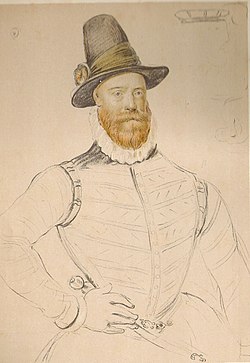
James Douglas, 4th Earl of Morton
View on Wikipedia

James Douglas, 4th Earl of Morton (c. 1516 – 2 June 1581) was a Scottish nobleman. He played a leading role in the murders of Queen Mary's confidant, David Rizzio, and king consort Henry Darnley. He was the last of the four regents of Scotland during the minority of James VI. He was in some ways the most successful of the four since he won the civil war that had been dragging on with the supporters of the exiled Mary, Queen of Scots. However, he came to an unfortunate end, executed by means of the Maiden, a predecessor of the guillotine.
Biography
[edit]Early life
[edit]James Douglas was the second son of Sir George Douglas of Pittendreich, Master of Angus, and Elizabeth Douglas, daughter of David Douglas of Pittendreich. He wrote that he was over 61 years old in March 1578, so was probably born around 1516.[1] Before 1543, he married Elizabeth, daughter of James Douglas, 3rd Earl of Morton, and became known as the "Master of Morton". In 1553, James Douglas succeeded to the title and estates of his father-in-law, including Dalkeith House in Midlothian and Aberdour Castle in Fife. His wife, Elizabeth Douglas suffered from mental illness, as did her two elder sisters Margaret and Beatrix, who were married to Regent Arran and Robert Maxwell, 6th Lord Maxwell.[2] James and Elizabeth's children did not survive to adulthood, except three daughters who were declared legally incompetent in 1581. James also had five illegitimate children.[3]
At the start of the Rough Wooing war, James and his brother David communicated with Henry VIII of England on the possibility of their surrendering Tantallon Castle to the English army that burnt Edinburgh in 1544. The English commander Lord Hertford wrote to the Master of Morton in April 1544, discussing his journey towards Berwick-upon-Tweed, and hoping he could leave the castles of Dalkeith and Tantallon in the hands of allies.[4]
However, four years later he defended Dalkeith Palace against the English and was captured in June 1548, "sore hurt on the thigh", and taken as a hostage to England. After the Treaty of Boulogne in 1550, James was exchanged for the English soldier John Luttrell, returned from captivity in England, and began to use his title of "Earl of Morton".
James's political activities and allegiances during the Scottish Reformation were at first equivocal in 1559, but in February 1560 he signed the Treaty of Berwick which invited an English army into Scotland to expel the Catholic regime of Mary of Guise.[5] He took part in the unsuccessful embassy to England in November 1560 to treat for the marriage of Elizabeth I of England to James Hamilton, 3rd Earl of Arran.[6] On their way back from London, Grey de Wilton hosted the Scottish ambassadors at Berwick and gave James a personal tour of the latest fortifications there.[7]

In 1563 he became Lord Chancellor of Scotland. Though his sympathies were with the reformers, he took no part in the combination of Protestant reformers in 1565, but he headed the armed force which took possession of Holyrood Palace in March 1566 to effect the assassination of David Rizzio, and the leading conspirators adjourned to Morton's house while a messenger was sent to obtain Queen Mary's signature to the "bond of security".
The Queen, before complying with the request, escaped to Dunbar, and Morton and the other leaders fled to England. Having been pardoned, Morton returned to Scotland early in 1567, and with 600 men appeared before Borthwick Castle, where the Queen had taken refuge after her marriage to Bothwell. Morton attended the remarkable stand-off at the battle of Carberry Hill in June 1567, where Mary's new husband, James Hepburn, 4th Earl of Bothwell offered to settle the matter by single combat. When Patrick, Lord Lindsay took up the challenge, Morton gave Lindsay the sword of his ancestor, Archibald Douglas, 5th Earl of Angus. Mary vetoed a fight and surrendered.[9] Morton took an active part in obtaining the consent of the queen, while she was imprisoned at Lochleven Castle, to her abdication in July 1567. When Mary escaped from Lochleven, he led the vanguard of the army which defeated her forces at the Battle of Langside in 1568, and he was the most valued privy counsellor of the Earl of Moray during the latter's brief term of office as Regent of Scotland.
Regent of Scotland
[edit]Scotland was now ruled by regents on behalf of Mary's infant son, James VI, who faced a civil war. James Stewart, Regent Moray, Mary's half-brother, was assassinated in Linlithgow in January 1570. Morton was worried that Mary might escape and make her way back to Scotland, by feigning sickness during a dance and disguising herself in male apparel, riding away in disguise with a messenger, or cutting her hair and smearing dirt on her face so she looked like a scullion who turned the spit in the kitchen. He wrote to William Cecil, and Queen Elizabeth in April 1571 wrote to the Earl of Shrewsbury at Sheffield Castle to be vigilant.[10]
Matthew Stewart, Regent Lennox died from a gunshot wound after a struggle on the streets of Stirling. On 18 November 1571, the new Regent, John Erskine, Earl of Mar, sent Morton with Robert Pitcairn, Commendator of Dunfermline and James MacGill of Nether Rankeillour to negotiate with Elizabeth's representative Henry Carey, 1st Baron Hunsdon, Governor of Berwick upon Tweed. Mar wanted English help to capture Edinburgh Castle from Sir William Kirkcaldy of Grange who held it for Mary. Regent Mar hoped that Morton could arrange for 12 cannons, 3,000 foot soldiers, and wages for the 800 Scottish foot soldiers and 200 horsemen already in the field. Morton was instructed to offer six hostages to England from the sons of the nobility who supported James VI. He also discussed returning the Earl of Northumberland, who was a fugitive after the failed Rising of the North, to England.
A week later Morton wrote to Hunsdon with the same request, urging an attack in winter because the Castle was vulnerable when the Nor Loch was frozen. Hunsdon replied that Elizabeth still hoped for a peaceful settlement, but he would send an estimate of the expedition's cost to Elizabeth. Morton received a token payment. The English rebels were handed over. The treaty for military aid was still not finalised when Mar died at Stirling in October 1572.[11]
On 24 November 1572, a month after the death of Regent Mar, Morton, who had been the most powerful noble during Mar and Lennox's rule, at last reached the object of his ambition by being elected regent. As Regent of Scotland, Morton expected the support of England and Elizabeth, and a week after his election, he wrote to William Cecil, Lord Burghley following his discussions with the English ambassador Henry Killigrew:
The knowledge of her Majesty's meaning has chiefly moved me to accept the charge (the Regency), resting in assured hope of her favourable protection and maintenance, especially for the present payment of our men-of-war their bypast wages, "without the quhilk I salbe drevin in mony great inconvenientis."[12]
In many respects, Morton was an energetic and capable ruler. His first achievement was the conclusion of the civil war in Scotland against the supporters of the exiled Mary. In February 1573 he effected a pacification with George Gordon, 5th Earl of Huntly, the Hamiltons and other Catholic nobles who supported Mary, at Perth with the aid of Elizabeth's envoy, Henry Killigrew.[13] Edinburgh Castle still held out for Mary under the command of William Kirkcaldy of Grange and William Maitland of Lethington, and after a long siege the castle was taken on 27 May 1573, aided by English artillery and soldiers which finally arrived under William Drury. Due to the subsequent execution of the leaders of the castle garrison, there was now no longer any chance of Mary's restoration by native support.
In July 1573 Morton had the king's chamber at Stirling Castle panelled, 60 new gold buttons made for his clothes, and gave him a football.[14] He made efforts to recover jewels belonging to Mary, including the Great H of Scotland, which were held by Agnes Keith, Countess of Moray and others.[15][16]
In 1575 Morton obtained six "snaphaunce" musket hand guns from Flanders to serve as patterns for long guns called "calivers". The Edinburgh gunmakers were ready to make 50 every week, they also made pistols called "dags" which equipped most of the gentlemen of Scotland. He sent goldsmith Michael Sym to London for tools for the royal mint. Sym was also sent to buy silver plate for Morton and have some rubies cut for him.[17] Morton made a leisurely progress in September 1575, travelling from Dalkeith Palace with Lord Claud Hamilton to Linlithgow, Torwood Castle, Lochleven, and Stirling Castle where he hunted in the park. He then went to Kincardine Castle, Tullibardine Castle, Ruthven Castle, and Ballinbreich in Fife, before arriving at his own Aberdour Castle.[18]
While all now seemed to favour Morton, under-currents combined to procure his fall. The Presbyterian clergy were alienated by his leaning to Episcopacy, and all parties in the divided Church disliked his seizure of its estates. Andrew Melville, who had taken over as leader of the Kirk from John Knox, was firmly against any departure from the Presbyterian model and refused to be won by a place in Morton's household. Morton rigorously pursued the collection of a third of the income from every Church benefice, a revenue that had been allocated to finance the King's household. Morton had discretion to exempt persons and institutions from paying these thirds, and the historian George Hewitt found no striking evidence of bias in Morton's exemptions.[19]
In 1577 Morton was granted the barony of Stobo. However, over the next few months, opposition to Morton grew, led by the Earl of Argyll and the Earl of Atholl, both leading Roman Catholics and members of the Queen's party, in league with Alexander Erskine of Gogar, governor of Stirling Castle and custodian of the young James VI.
Resignation
[edit]Morton was finally forced to resign as Regent in March 1578 but retained much of his power. He wrote a memorandum setting out his service to King James, including swearing his coronation oath, recovering Edinburgh Castle from his enemies, and spending £10,000 rebuilding it.[20] He surrendered Edinburgh Castle, Holyrood Palace, the Great Seal and the jewels and Honours of Scotland, retiring for a while to Lochleven Castle, where he busied himself in laying out gardens. On 10 March, James VI issued a proclamation recognising that many in Scotland "misliked" the regiment of Morton, who had now resigned, and James would now accept the burden of the administration. The King was eleven years old.[21]
Queen Elizabeth wrote to her agents in Scotland expressing her astonishment and displeasure because, as she was convinced her influence had brought Morton to the regency, his forced resignation reflected badly on her. If Morton was now to be accused of bad government, she instructed her diplomats Thomas Randolph and Robert Bowes to defend him by saying that his accusers should have first appealed to England to pressure Morton to reform his administration.[22]
President of the Privy Council
[edit]
On 27 April 1578, by the action of John Erskine (son of Regent Mar) and his brothers, the Commendators of Cambuskenneth and Dryburgh, Morton gained possession of Stirling Castle and the person of the king, regaining his ascendancy. On 12 August 1578, the forces of his opponents faced his army at Falkirk, but a truce was negotiated by two Edinburgh ministers, James Lawson and David Lindsay, and the English resident Robert Bowes. A nominal reconciliation was effected, and a parliament at Stirling introduced a new government. Morton, who secured an indemnity, was president of the council, but Atholl remained a privy councillor in an enlarged council with the representatives of both parties. Shortly afterwards Atholl died (allegedly of poison) and suspicion pointed to Morton. His return to power was brief, and the only important event was the prosecution of the two Hamiltons who still supported Mary. In the spring of 1579, the Scottish government's forces moved to crush the power of the Hamilton family in the west, and Claude Hamilton and his brother John Hamilton fled to England. Morton would later deny that this was his initiative.[23] The final fall of Morton came from an opposite quarter.
In May 1579, at St Andrews, an eccentric called Skipper Lindsay publicly declared to Morton in the King's presence during the performance of a play that his day of judgement was at hand. In September, Esmé Stewart, Sieur d'Aubigny, the king's cousin, came to Scotland from France, gained the favour of James by his courtly manners, and received the lands and earldom of Lennox, the custody of Dumbarton Castle, and the office of chamberlain. The young James VI was declared to have reached his majority and formally began his personal rule with some ceremony in Edinburgh in September 1579, and the period of the Regents was concluded.
Arrested and accused
[edit]On 31 December 1580, an associate of Lennox, James Stuart, Earl of Arran, son of Lord Ochiltree and brother-in-law of John Knox, accused Morton at a meeting of the council in Holyrood of complicity in the murder of Darnley, and he was at once committed to custody in Holyroodhouse and taken to Dumbarton Castle in the Lennox heartland.[24]
Morton was brought back to Edinburgh and lodged at Robert Gourlay's house on 27 May. He was condemned by an assize at the Tolbooth on 1 June, presided over by John Graham, Lord Hallyards, for having taken part in the Darnley's murder. He confessed that the Earl of Bothwell had revealed to him the design, although he denied participation, "art and part", in its execution. The Earl of Montrose pronounced him guilty.[25]
Execution
[edit].jpg)

Morton was brought to Edinburgh on 30 May 1581 and confined in the house of Robert Gourlay on the Royal Mile. He was accompanied by a servant, William Stewart, who witnessed that he slept well on the night after he was condemned.[26] Before his execution Morton made a confession in a conversation with John Durie and Walter Balcanquhall.[27][28]
He was executed on 2 June 1581, attended by James Lawson of St Giles.[29] The method of his execution was the maiden, an early form of guillotine modelled on the Halifax gibbet. According to tradition, Morton brought it personally from England, having been "impressed by its clean work", but records show that it was made at the order of Edinburgh's Town Council in 1564 by Patrick Schang.[30][31] David Hume of Godscroft appears to have initiated the legend of Morton's maiden in his History of the House of Angus (1644), writing "the axe (of the Maiden, which he himself had caused make after the patterne which he had seen in Halifax in Yorkshire) falling upon his neck, put an end to his life".[32]
Morton's corpse remained on the scaffold for the following day, until it was taken for burial in an unmarked grave at Greyfriars Kirkyard. His head, however, remained on "the prick on the highest stone", (a spike) on the north gable of the Tolbooth of Edinburgh (outside St Giles Cathedral) for eighteen months, until it was ordered to be reunited with his body in December 1582.[33]
Morton's final resting place is reputedly[34] marked by a small sandstone post incised with the initials "J.E.M." for James Earl of Morton. The post is more probably a Victorian marker for a lairage. In the very unlikely event that a marker was permitted for an executed criminal, the inscribed initials would have been "J.D." and, secondly, it would have been cleared away in 1595 when all stones were removed from Greyfriars.[citation needed]
Widow, daughters, and the Morton title
[edit]After the execution of her husband, Morton's wife, Dame Elizabeth Douglas was found by an inquest to be incapable of managing her affairs, as she was "idiot and prodigal" in the language of the time. King James VI signed a warrant to appoint a legal guardian called an "administrator and tutor" to supervise and protect her property.[35]
The title of Earl of Morton passed by charter to the son of Dame Elizabeth Douglas's sister Beatrix, John Maxwell, 8th Lord Maxwell. Maxwell had been in dispute with Regent Morton over the title, and while the former Regent was in prison, Maxwell had made a contract with the Duke of Lennox on 29 April 1581. Lennox would work to give Maxwell rights over the Morton earldom, and make him the legal guardian of James Douglas and Dame Elizabeth's three daughters. The three sisters, like their mother, would be declared incapable by a "brieve of idiotry". In 1586, however, the title was given to Archibald Douglas, 8th Earl of Angus, a nephew and legal heir of Regent Morton. Maxwell was still able to use the title, though it did not descend to his heirs.[36]
Regent Morton had sons (including James Douglas of Spott) by other women. The barony of Stobo was confiscated by the Crown and was granted to the Chancellor of Scotland, John Maitland, in 1587.[37]
Drochil Castle and other buildings
[edit]_-_geograph.org.uk_-_1703483.jpg)
James Douglas started building Drochil Castle for his own use in 1578, three years before his death. It was no more than half built and never finished. The ruins of the castle overlook Peebles and the valleys of the Tarth Water, Lyne Water, and River Tweed. At Aberdour Castle in Fife, Morton's lodging survives with its terrace overlooking the Firth of Forth. Morton also extended his residence at Dalkeith Palace, but these works have long since been demolished. Wreaths Tower, Kirkbean Parish, Dumfries and Galloway, is said to have belonged to Morton.[38]
Morton commissioned extensive reconstruction at Edinburgh Castle after the siege, including the Portcullis Gate where his heraldic insignia of a heart can still be seen, and the iconic half-moon battery which fronts the castle and conceals the remains of buildings destroyed in 1573. On his orders, galleries, stables, and other new buildings were constructed at Stirling Castle and Holyroodhouse, and rooms refurbished and furnished for the use of the King.[39] During his resignation in March 1578, Morton pointed out to the officers of the Scottish exchequer that the royal houses were "now in better case than they were at the beginning of his regiment."[40]
Morton in fiction
[edit]Morton is a character in Liz Lochhead's play Mary Queen of Scots Got Her Head Chopped Off.
Nigel Tranter's novel Lord and Master (originally called The Master of Gray, the first part of a trilogy of that name) includes an account of Morton's fall from power and his execution.
Morton was played by the actor Bruce Purchase in the 1971 period drama Mary, Queen of Scots.
References
[edit]- ^ Hewitt, George R., Scotland under Morton (John Donald, 1982), p. 1
- ^ Joseph Bain, Calendar State Papers Scotland, vol. 1 (Edinburgh, 1898), p. 615
- ^ Hewitt (1982), 207.
- ^ Joseph Bain, Hamilton Papers, vol. 2 (Edinburgh, 1890), pp. 720–722
- ^ Hewitt, (1982), p. 1–3, citing for Tantallon, Letters & Papers Henry VIII, 19:1, p. 213, and Maitland Miscellany, vol. 4. pp. 94–95, 98–99.
- ^ Simon Adams, Household Accounts of Robert Dudley, Earl of Leicester (RHS/CUP, 1995), p. 146 fm: Hewitt (1982), p. 4
- ^ Calendar State Papers Scotland: 1547–1563, vol. 1 (Edinburgh, 1898), p. 504.
- ^ History of High Street Hostel and the Building Archived 27 December 2011 at the Wayback Machine at High Street Hostel, Edinburgh. Retrieved 6 February 2012
- ^ Hewitt (1982), 10, citing Calderwood, History of the Kirk of Scotland (Edinburgh, 1843), pp. 363–364.
- ^ William Boyd, Calendar State Papers Scotland, vol. 3 (Edinburgh, 1903), pp. 545–546, 553.
- ^ Annie Cameron, Warrender Papers, vol. 1 (SHS: Edinburgh, 1931), pp. 104–111, 115: Calendar State Papers Scotland, vol. 4 (Edinburgh, 1905), pp. 47–48, 52–54.
- ^ Calendar State Papers Scotland, vol. 4 (Edinburgh, 1905) p. 441 no. 488.
- ^ Hewitt (1982), p. 25
- ^ Charles Thorpe McInnes, Accounts of the Treasurer: 1566–1574, vol. 12 (Edinburgh, 1970), p. 354.
- ^ Thomas Thomson, A Collection of Royal Inventories (Edinburgh, 1815) pp. 195–200.
- ^ Jade Scott, "Mary Queen of Jewels", History Today, 70:10 (October 2024), pp. 54–61: Michael Pearce, "The jewels Mary Queen of Scots left behind", 2016, pp. 1–113. doi:10.13140/RG.2.2.34957.61920: George R. Hewitt, Scotland Under Morton, 1572–80 (Edinburgh: John Donald, 1982), pp. 40–42.
- ^ Calendar State Papers Scotland, vol. 5 (Edinburgh, 1907), pp. 182, 197.
- ^ George R. Hewitt, Scotland under Morton (John Donald, 1982), pp. 42–43.
- ^ Hewitt, (1982), pp. 82–91.
- ^ Margaret Warrender, Illustrations of Scottish History. Sixteenth Century (Edinburgh: James Stillie, 1889), pp. 7–9.
- ^ Calendar of State Papers Scotland, vol. 5 (Edinburgh, 1907), pp. 275–279.
- ^ Calendar State Papers Scotland, vol. 5 (Edinburgh, 1907), p. 279 no. 320.
- ^ Hewitt, (1982), pp. 64–71.
- ^ George R. Hewitt, Scotland under Morton (John Donald, 1982), pp. 76–77, 188–189.
- ^ George R. Hewitt, Scotland under Morton (John Donald, 1982), pp. 197–200.
- ^ John Graham Dalyell, Journal of the Transactions in Scotland, by Richard Bannatyne (Edinburgh, 1806), p. 513
- ^ John Graham Dalyell, Journal of the Transactions in Scotland, by Richard Bannatyne (Edinburgh, 1806), pp. 493–518.
- ^ Robert Pitcairn, Memorials of the Transactions in Scotland by Richard Bannatyne (Edinburgh: Bannatyne Club, 1836), pp. 317-332.
- ^ George R. Hewitt, Scotland Under Morton, 1572–80 (Edinburgh: John Donald, 1982), p. 202.
- ^ Robert Adam, City of Edinburgh Records, the Burgh accounts, vol. 1 (Edinburgh, 1899), pp. 486-487
- ^ Herbert Maxwell, Edinburgh, A Historical Study (Williams and Norgate, 1916), p. 299.
- ^ David Reid, History of the House of Angus by David Hume of Godscroft, vol. 1 (Edinburgh: STS, 2005), p. 268.
- ^ George R. Hewitt, Scotland Under Morton, 1572–80 (Edinburgh: John Donald, 1982), p. 202.
- ^ James Morton grave monument details at gravestonephotos.com
- ^ William Fraser, Lennox Muniments, vol. 2 (Edinburgh, 1874), pp. 321–322.
- ^ William Fraser, Carlaverock Book, vol. 1 (Edinburgh, 1873) pp. 252–253, 271.
- ^ Register of the Great Seal, vol. 5 nos. 1346/1549
- ^ "Wreaths Tower | Canmore". canmore.org.uk.
- ^ Accounts of the Treasurer of Scotland, vol. 13 (Edinburgh, HMSO, 1978), pp. 21–22, 26–27, 149, 150–151, 166.
- ^ Calendar State Papers Scotland, vol.5 (Edinburgh, 1907), p. 277 no. 315.
See also
[edit]Sources
[edit]- This article incorporates text from a publication now in the public domain: Chisholm, Hugh, ed. (1911). "Morton, James Douglas, 4th Earl of". Encyclopædia Britannica. Vol. 18 (11th ed.). Cambridge University Press. pp. 880–881.
- Hewitt, George R., Scotland under Morton 1572–80, John Donald, Edinburgh (1982, and reprint, 2003)
- Lee, Maurice, 'The Fall of Regent Morton: a problem in Satellite Diplomacy,' in Journal of Modern History, vol. 28 (1956), pp. 111–129
- Sir Herbert Maxwell Bart., FRS, LLD., A History of the House of Douglas 2 vols, Freemantle and Co., London (1902)

External links
[edit] Media related to James Douglas, 4th Earl of Morton at Wikimedia Commons


James Douglas, 4th Earl of Morton
View on GrokipediaEarly Life and Inheritance
Birth, Family Origins, and Education
James Douglas was born circa 1516, likely in the Scottish Borders region associated with his family's estates. He was the second son of Sir George Douglas of Pittendreich, a key figure in the Douglas clan's political maneuvers who held the position of Master of Angus and wielded influence during the minority of Mary, Queen of Scots. His mother was Elizabeth Douglas, linking him closely to the extended Douglas lineage through familial alliances.[1][2] The Douglas family, one of Scotland's most ancient and formidable noble houses, traced its origins to the Borders area of Lanarkshire, with roots possibly extending to the 12th century. The branch from which James descended, known as the Red Douglases or the Angus line, emerged as dominant after the forfeiture of the senior Black Douglas line in 1455 for treason against James II; this junior branch secured the earldom of Angus in 1389 and amassed vast lands in Angus, Lothian, and the Borders, often rivaling the crown in power through military prowess and strategic marriages. Sir George Douglas exemplified this lineage's resilience, navigating factional politics as a supporter of the Protestant cause and advisor to regents.[7][1] Little is documented regarding James Douglas's formal education, typical for scions of high nobility who prioritized practical training in estate management, horsemanship, and diplomacy over institutionalized learning; contemporary records emphasize his early immersion in family intrigues rather than academic pursuits at institutions like St Andrews University.[1][2]Marriage to Catherine Stewart and Acquisition of the Earldom
James Douglas, a younger son of Sir George Douglas of Pittendreich, married Elizabeth Douglas, daughter of James Douglas, 3rd Earl of Morton, and his wife Catherine Stewart, around 1543.[1] [8] Catherine Stewart was an illegitimate daughter of King James IV of Scotland and his mistress Marion Boyd, which connected the Morton line to the royal Stewart family.[9] The marriage allied Douglas with the powerful Morton inheritance, as the 3rd Earl had no surviving legitimate sons, making Elizabeth a key heiress under the earldom's entail arrangements. The 3rd Earl of Morton died in 1553 without male issue, leading to the devolution of the title and associated estates—including lands in Dumfriesshire and Lothian—to his son-in-law James Douglas per prior legal settlements designed to preserve the peerage within the family.[10] [11] These settlements had navigated earlier complexities, including a 1540 forced resignation of reversion rights by James V to Sir Robert Douglas of Lochleven, but ultimately favored the Pittendreich branch through Elizabeth's line.[12] Douglas's acquisition solidified his status among Scotland's nobility, providing resources and influence that propelled his later political ascent, though it also drew rival claims from figures like the Earl of Lennox seeking control over the estates.[12] Elizabeth Douglas, who outlived her husband until 1581, remained largely secluded, reportedly due to health issues, and bore him several children, though only daughters survived to adulthood.[13]Rise in Scottish Politics
Alignment with Protestant Reformation
James Douglas's early exposure to Protestant ideas stemmed from his father, Sir George Douglas of Pittendreich, who supported the reformer George Wishart prior to Wishart's execution in 1546.) This familial influence fostered sympathies toward the Reformation, though Douglas initially exercised caution amid Scotland's religious and political volatility. He refrained from joining the 1565 coalition of Protestant lords known as the Chaseabout Raid, prioritizing strategic positioning over overt rebellion.[2] A turning point came in 1560, when Douglas aligned with the Lords of the Congregation by signing the Treaty of Berwick on 27 February, which secured English military assistance to expel French forces supporting the Catholic regency of Mary of Guise.[11] This commitment marked his active entry into the Protestant cause against Catholic dominance in governance. By 1561, following Mary Stuart's return to Scotland, Douglas publicly declared himself a Protestant and was admitted to the Privy Council, signaling unequivocal support for Reformation principles despite the queen's Catholic leanings.[14] Douglas's alignment manifested in opposition to perceived Catholic influences at court, including his role in the 1566 assassination of David Rizzio, Mary's Italian secretary viewed by Protestant nobles as emblematic of foreign Catholic interference.[2] He backed the Protestant regency of James Stewart, Earl of Moray, after Mary's deposition in 1567, and later emerged as leader of the king's Protestant party following Moray's assassination in 1570.[15] These actions reflected a consistent prioritization of Protestant ascendancy, driven by both ideological conviction and political realism in countering Catholic restoration efforts.[16]Appointment as Chancellor and Early Diplomatic Roles
Following Queen Mary Stuart's return to Scotland in August 1561, James Douglas was sworn in as a privy councillor on account of his noble standing and political acumen.[15] On 7 January 1563, he was appointed Lord High Chancellor of Scotland, replacing James Gordon, 5th Earl of Huntly, whose forfeiture after rebellion created the vacancy.[14][15] This position, the highest judicial office in the realm, granted Douglas oversight of the courts, seals, and advisory duties to the crown, amplifying his influence amid tensions between Protestant nobles and the Catholic queen.[17] Despite his alignment with the Protestant cause, Mary's selection of Douglas underscored her strategy to incorporate influential lords into governance for stability, even as religious divisions simmered.[17] His chancellorship endured until March 1566, when involvement in the Rizzio conspiracy prompted his flight from Edinburgh, though he later reconciled with the regime.[17] Prior to the appointment, Douglas engaged in early diplomatic efforts supporting the Protestant Reformation. In February 1560, he joined the Lords of the Congregation in signing the Treaty of Berwick, a defensive alliance with England against French forces backing Mary's mother, Regent Mary of Guise, which facilitated English military aid and marked a pivotal shift in Scottish foreign relations.[11] Additionally, on 31 May 1559, he acted as a commissioner at Upsettlington, negotiating settlements between reformist lords and royal authorities amid rising unrest.[15] These roles positioned him as a key figure in maneuvering Scotland away from French dominance toward Protestant-leaning diplomacy with England.Key Events Under Mary Queen of Scots
Involvement in the Murder of David Rizzio (1566)
![Attributed to Arnold Bronckorst - James Douglas, 4th Earl of Morton][float-right] James Douglas, 4th Earl of Morton, played a central role in the conspiracy to murder David Rizzio, Mary Queen of Scots' Italian secretary, whose growing influence was perceived as a threat to Protestant interests in Scotland.[2] As a leading Protestant noble, Morton allied with Henry Stewart, Lord Darnley—Mary's husband—and other lords, including Patrick Ruthven, 3rd Lord Ruthven and John Lindsay, 6th Lord Lindsay, to eliminate Rizzio, who had advised against restoring exiled Protestant figures like the Earl of Moray.[18] The plot stemmed from Darnley's jealousy over Rizzio's access to the queen and the nobles' desire to curb what they viewed as undue foreign Catholic sway amid Mary's pregnancy, which heightened stakes for the succession.[2] Planning began in February 1566, with Darnley recruiting support through intermediaries like George Douglas, Morton's relative, to secure backing from banished lords in exchange for Rizzio's removal.[18] Morton, as Darnley's kinsman by alliance and a key organizer, led the armed band that seized Holyrood Palace on the evening of 9 March 1566.[2] The assailants, numbering around 80 men, burst into Mary's private supper chamber, held her at gunpoint, and dragged the protesting Rizzio into an adjacent room, where he was stabbed over 50 times—56 wounds by some accounts—before his body was stripped of valuables and cast down the stairs.[18] Following the assassination, the conspirators, including Morton, adjourned to his residence to compel Mary's ratification of a "bond of security" affirming their actions and restoring the Protestant exiles.[2] However, Mary soon escaped confinement with Darnley to Dunbar Castle, rallying forces and denouncing the perpetrators as traitors; Parliament attainted Morton and his confederates on 20 March.[18] Morton fled to England for refuge, evading immediate execution, and returned to Scotland in 1567 after Darnley's murder shifted political dynamics, eventually receiving a pardon as part of broader reconciliations.[2] This event, while temporarily advancing Protestant aims, destabilized Mary's rule and foreshadowed further violence, including Darnley's death.[18]Implication in the Assassination of Henry Darnley (1567)
James Douglas, 4th Earl of Morton, participated in the murder of David Rizzio on 9 March 1566 alongside Henry Stuart, Lord Darnley, but Darnley's subsequent reconciliation with Mary, Queen of Scots, led to the arrest or flight of the conspirators, including Morton, who sought refuge in England.[19] This betrayal fostered lasting enmity, providing Morton with a clear motive to eliminate Darnley, whom he viewed as unreliable and a barrier to Protestant noble influence.[20] Darnley's assassination occurred in the early hours of 10 February 1567, when gunpowder exploded beneath his lodgings at Kirk o' Field in Edinburgh, killing two servants; Darnley's body, found in the adjacent garden, showed no blast injuries but evidence of strangulation or smothering.[21] Morton's direct presence at the scene remains unproven, as he was likely still abroad or in seclusion following his pardon in late 1566, yet his kinsman Archibald Douglas, parson of Douglas, was accused by witnesses of carrying torches and participating in the aftermath near Kirk o' Field.[22] Contemporary suspicions focused primarily on James Hepburn, 4th Earl of Bothwell, who was tried and acquitted in April 1567, but Morton's alignment with anti-Mary factions post-assassination—leading the opposition that deposed her in July 1567—fueled retrospective theories of broader noble involvement, with some English observers suggesting Morton and James Stewart, Earl of Moray, orchestrated Bothwell as a proxy.[1] No immediate charges were leveled against Morton, reflecting the political exigencies of stabilizing the realm under infant James VI. Decisive evidence of Morton's complicity emerged during his 1581 trial, amid his downfall orchestrated by rivals like James Stewart, Earl of Arran, who publicly accused him before the Privy Council on 31 December 1580.[6] Under interrogation, Morton confessed that Bothwell had disclosed the plot to him, seeking his approval due to their shared antipathy toward Darnley, and that he had assented, though he denied operational details; this admission implicated him alongside figures like the Earls of Huntly and Argyll, who were said to have been peripherally aware.[23] [24] Convicted by assize on 1 June 1581, he was beheaded the next day using the "Maiden," a guillotine-like device he had introduced; while the trial's timing suggests political motivation to dismantle his regency-era power base, historians regard the confession as credible given Morton's documented motives and the consistency of noble grudges from the Rizzio affair.[25] [19] The equivocal nature of his role—more advisory than executive—underscores a pattern of factional intrigue, where Darnley's death advanced Protestant consolidation without immediate accountability for secondary actors.[20]Support for Mary's Deposition and the Regency of Moray
Following the suspicious circumstances surrounding the February 10, 1567, explosion that killed Henry Darnley, Mary Queen of Scots' marriage to James Hepburn, 4th Earl of Bothwell, on May 15, 1567, provoked widespread outrage among the Protestant nobility, who viewed it as complicity in Darnley's murder.[1] James Douglas, 4th Earl of Morton, aligned with other confederate lords in opposing the union, signing a bond on April 19, 1567, condemning Bothwell and vowing to defend the infant James VI.[2] On June 15, 1567, Morton led troops as part of the lords' forces confronting Mary and Bothwell at Carberry Hill near Edinburgh, where Mary surrendered without combat after negotiations failed, leading to her escort to Edinburgh and subsequent imprisonment at Loch Leven Castle.[1][26] Imprisoned at Loch Leven from June 17, 1567, Mary faced mounting pressure from the lords to abdicate in favor of her son. Morton played an active role in securing her consent, participating in delegations that presented the abdication document, which she signed under duress on July 24, 1567, paving the way for James VI's coronation on July 29.[26] This act formalized the deposition, shifting power to the king's council and enabling the return of James Stewart, Earl of Moray—Mary's half-brother—from England to assume the regency on August 12, 1567, with Morton's backing as a key Protestant ally.[2] As Moray's regent from 1567 to 1570, Morton served as a valued privy councillor and military commander, providing essential support amid ongoing threats from Mary's partisans. When Mary escaped Loch Leven on May 2, 1568, rallying supporters including the Hamiltons, Morton commanded the vanguard of Moray's forces at the Battle of Langside on May 13, 1568, near Glasgow, where the king's army of approximately 4,500 defeated Mary's 6,000-strong host in under an hour, capturing key leaders and scattering the remainder.[27][28] This victory, leveraging Morton's tactical experience, prevented Mary's restoration and bolstered Moray's authority, confining the civil conflict largely to border skirmishes thereafter.[1][2] Morton's consistent counsel and field leadership underscored his commitment to the regency's Protestant and pro-English orientation against Marian Catholic-leaning factions.Regency of Scotland (1572–1578)
Appointment as Regent and Suppression of Marian Supporters
Following the death of the previous regent, John Erskine, Earl of Mar, on 28 October 1572, James Douglas, 4th Earl of Morton, was elected Regent of Scotland on the same day by the privy council and parliament, amid ongoing civil strife between the king's party and supporters of the deposed Mary, Queen of Scots.[2] Morton's selection reflected his alignment with pro-English Protestant nobles, who viewed him as a stabilizing force capable of leveraging alliances with England to counter the Marian faction's resistance, which had persisted since Mary's flight to England in 1568.[29] He assumed regency duties immediately, prioritizing the restoration of central authority during the minority of the infant James VI.[15] Morton's regency commenced with efforts to negotiate truces and isolate Marian holdouts, culminating in the Pacification of Perth on 22 February 1573, which secured the submission of key figures including George Gordon, 5th Earl of Huntly, and representatives of the Hamilton family, alongside other Catholic nobles, through diplomatic pressure facilitated by England's envoy.[2] This agreement neutralized northern and western resistance, allowing Morton to redirect resources toward the decisive Siege of Edinburgh Castle, the last major stronghold of Mary's supporters under William Kirkcaldy of Grange and William Maitland of Lethington.[29] The siege began on 2 May 1573, bolstered by English military aid including 1,500 troops and heavy artillery under Sir William Drury, which bombarded the castle into submission; it surrendered on 29 May 1573 after three weeks of intensive shelling that rendered further defense untenable.[30] [29] Kirkcaldy and his brother James were subsequently tried for treason and executed by hanging on 3 August 1573, while Maitland died in captivity shortly before facing trial, possibly by suicide or natural causes; these executions, along with the forfeiture of estates from defeated Marian lords, effectively dismantled the faction's organized military capacity and eliminated prospects for Mary's restoration through domestic insurgency.[15] [29] By late 1573, these measures had quelled the civil war, with remaining Marian sympathizers either submitting or fleeing, enabling Morton to consolidate royal finances and governance without widespread rebellion for the remainder of his tenure until 1578.[2] His approach emphasized judicial forfeitures and targeted executions over mass reprisals, though it drew criticism for its severity in prioritizing stability over clemency.[30]Military Victories and End of the Civil War
Upon assuming the regency on 24 November 1572, Morton inherited a protracted civil war against supporters of the deposed Mary, Queen of Scots, with Edinburgh Castle serving as the primary Marian stronghold under William Kirkcaldy of Grange.[15] Early efforts focused on negotiation, culminating in the Pacification of Perth on 15 February 1573, which secured the allegiance of key figures including the Hamilton family, George Gordon, 5th Earl of Huntly, and other Catholic nobles, significantly eroding organized resistance through a combination of diplomacy and implicit threats backed by English mediation from envoy Henry Killigrew.[31] [2] This agreement isolated the castle's defenders, marking a strategic victory by fracturing the Marian coalition without immediate bloodshed.[15] With pacification weakening broader support, Morton turned to direct military action against the remaining fortress. In April 1573, his forces, augmented by English artillery and troops under Sir William Drury, initiated a siege of Edinburgh Castle, employing heavy bombardment that collapsed a tower and exacerbated water shortages within the garrison.[15] [2] The castle surrendered on 28 May 1573 after approximately three weeks of intensified assaults, representing Morton's decisive military triumph and the collapse of Mary's last significant bastion in Scotland.[15] Kirkcaldy of Grange and William Maitland of Lethington, key intellectual leaders of the Marian cause, were subsequently executed on 3 August 1573, eliminating prospects for coordinated resurgence.[2] The fall of Edinburgh Castle effectively terminated the Marian civil war (1568–1573), restoring centralized authority under the young James VI and allowing Morton to shift focus from warfare to governance, though sporadic border skirmishes and minor holdouts persisted briefly.[15] This outcome was facilitated by Morton's pragmatic alliances, particularly with England, which provided crucial logistical superiority despite domestic criticism of foreign involvement.[2] By mid-1573, the realm achieved relative stability, underscoring Morton's success in prioritizing force against unyielding factions while co-opting others through concession.[15]Administrative and Legal Reforms
Morton implemented administrative measures to consolidate royal authority after the civil war, emphasizing the enforcement of law in peripheral regions through justice ayres—traveling royal courts akin to English eyres, which had lapsed in prior decades. These circuits allowed for on-site trials of local offenders, reducing reliance on noble intermediaries and extending central control over border reivers and highland disturbances. A comprehensive record documents multiple ayres held from 1488 to 1578, with Morton's regency featuring notable instances, including a 1576 series in southeastern Scotland where hundreds faced fines for offenses such as illegal salmon fishing and other socio-economic violations.[32][33] Unlike adult monarchs, who conducted fewer such ayres, Morton prioritized personal attendance at these proceedings to ensure compliance and symbolize regent oversight, thereby fostering administrative efficiency amid ongoing factional threats. This approach aligned with broader efforts to curb feuding and disorder without overextending military resources, though it yielded mixed results in fully subduing remote areas.[34][35] In legal enforcement against political rivals, Morton favored heavy fines over executions where feasible, extracting substantial revenues—often exceeding traditional penalties—to address crown indebtedness from the wars. This fiscal-legal strategy stabilized finances temporarily but provoked resentment for its perceived extortion, as opponents alleged selective severity to enrich the regime rather than purely uphold justice.[30]Ecclesiastical and Religious Policies
Introduction of Reformed Episcopacy
During his regency from November 1572, James Douglas, 4th Earl of Morton, initiated efforts to establish a modified episcopal structure within the Church of Scotland, termed Reformed Episcopacy, which preserved bishoprics as administrative offices aligned with Protestant theology but subordinated to royal oversight. This policy diverged from the presbyterian model advocated by reformers like John Knox, emphasizing instead a hierarchical system that facilitated crown control over ecclesiastical appointments and revenues, partly to mirror English church governance and secure alliance with Elizabeth I. Morton's approach involved nominating individuals—often lay commendators or compliant clergy—to vacant sees, where they held temporalities (lands and incomes) primarily for secular benefit, while spiritual oversight remained with superintendents or local kirk sessions.[30][36] Key appointments under this regime included the placement of figures such as Alexander Hepburn as a titular bishop in 1573, though many roles were filled by "titulers" who drew revenues without full pastoral authority, enabling Morton and allies to redirect church funds toward civil administration and personal gain. By 1575, parliamentary acts under Morton's influence affirmed the crown's prerogative to appoint bishops who subscribed to the Scots Confession of 1560, ensuring doctrinal conformity to Reformed principles like predestination and rejection of papal supremacy, yet the bishops' powers were curtailed to avoid challenging presbyterian assemblies. This hybrid system, derisively labeled "tulchan episcopacy" by critics—evoking a stuffed calfskin used to induce milk from cows, symbolizing nominal figures extracting church wealth—provoked resistance from presbyterian ministers who viewed it as a betrayal of the First Book of Discipline's congregational ideals.[30][29] The introduction advanced gradually amid civil war suppression, with Morton leveraging his political dominance to convene general assemblies amenable to episcopal restoration; for instance, in 1576, the appointment of Patrick Adamson as Archbishop of St Andrews marked a step toward formal consecration, though Adamson's role remained entangled in factional disputes. Proponents argued it promoted ecclesiastical order and fiscal stability, citing biblical precedents for overseers (episkopoi) compatible with Calvinist governance, but opponents, including emerging leaders like Andrew Melville, decried it as Erastian corruption prioritizing state utility over spiritual purity. Morton's policy succeeded in temporarily embedding bishops in about a dozen sees by 1578, yielding revenues estimated at over £20,000 Scots annually to the treasury, yet it sowed seeds of kirk-state tension that intensified post-regency.[37][14]Enforcement of Protestant Church Structures
During his regency from 1572 to 1578, James Douglas, 4th Earl of Morton, prioritized the consolidation of Protestant ecclesiastical authority through a moderated episcopal framework, countering both residual Catholic influences and emerging presbyterian demands for congregational discipline. He adjudged the role of bishops as essential for church governance, advocating their appointment to maintain order and orthodoxy in place of radical reforms.[38] This stance aligned with parliamentary measures under his influence, such as the 1572 acts ratifying the king's confession of faith and allocating stipends for ministers and superintendents to staff reformed parishes.[39] Morton enforced these structures via direct interventions, including church visitations to burghs like Aberdeen in 1574, where he admonished local authorities on the implementation of Reformation mandates, addressing incomplete transitions from pre-Reformation practices such as lingering attachments to saints' days and inadequate provision for Protestant worship.[40] He also targeted presbyterian agitators, denouncing Andrew Melville and his followers for importing Genevan presbytery models that undermined established hierarchies and threatened national stability.[41] These efforts extended to suppressing unauthorized Catholic rites, building on prior legislation by integrating religious conformity into broader pacification campaigns against Marian holdouts, many of whom harbored pro-papal sympathies.[1] By 1578, Morton's policies had advanced the placement of Protestant bishops—such as Alexander Douglas in Dunkeld—and secured provisional royal oversight of ecclesiastical appointments, though tensions with Kirk radicals persisted, foreshadowing post-regency conflicts.[42] His approach emphasized pragmatic hierarchy over ideological purity, privileging state-aligned stability to embed Protestant norms amid factional strife.[2]Conflicts with Presbyterian Kirk Elements
During his regency, Morton promoted a hierarchical ecclesiastical structure modeled partly on the English church, seeking greater state oversight of the Kirk to consolidate royal authority and facilitate alliances with Protestant England. This culminated in support for the Leith Convention of 19 January 1572, which authorized the appointment of titular bishops and superintendents with episcopal powers, including rights to convene synods and exercise disciplinary authority over ministers.[43] [44] The convention represented a compromise between presbyterian ideals and episcopalian elements, but it alienated strict Presbyterians who viewed it as a deviation from the parity of ministers and congregational governance outlined in the First Book of Discipline (1560).[30] Opposition intensified from influential ministers, including John Knox, who publicly condemned the concordat as a betrayal of reformed principles before his death on 24 November 1572, arguing it subordinated the church's spiritual independence to noble patronage.[44] Andrew Melville, returning to Scotland in July 1574 after studies in Geneva under Theodore Beza, became a principal antagonist, advocating for a pure presbyterian system free from aristocratic control and denouncing episcopal appointments as prelacy in disguise.[45] Melville's influence grew through his role in the General Assembly and as principal of the University of Glasgow from 1574, where he rallied ministers against Morton's interventions, such as attempts to dictate assembly proceedings or appoint compliant superintendents.[46] Tensions escalated in assemblies like that of March 1575, where Presbyterian factions resisted Morton's pressure to ratify episcopal structures, leading to compromises that preserved presbyterial discipline while allowing limited superintendents; however, ministers continued to challenge state encroachments, viewing them as Erastian threats to doctrinal purity.[30] Morton's seizure of church teinds (tithes) and former benefices for crown revenues—estimated to yield over £40,000 Scots annually by 1574—further fueled resentment, as it diverted funds intended for parochial stipends and education, prompting Kirk protests that the regent prioritized fiscal gain over ecclesiastical welfare.[2] These disputes highlighted a fundamental clash: Morton's pragmatic Erastianism versus the Kirk's insistence on spiritual autonomy, with public sentiment largely favoring the presbyterian model as more biblically grounded and resistant to noble corruption.[29] By 1578, cumulative resistance from Melville-led factions, allied with disaffected nobles like the Earl of Argyll, eroded Morton's ecclesiastical leverage, contributing to his resignation amid broader political isolation; the Kirk's general assemblies post-regency moved to dismantle episcopal remnants, affirming presbyterian governance until royal reversals in the 1580s.[46] [30]Post-Regency Influence
Presidency of the Privy Council (1578–1581)
Following the termination of his regency on 8 March 1578, James Douglas, 4th Earl of Morton, was appointed President of the Privy Council, a position that allowed him to retain substantial administrative oversight during the minority of King James VI. This arrangement stemmed from negotiations to secure his indemnity amid opposition from factions led by the Earls of Atholl and Argyll, resulting in an enlarged council that included representatives from reconciled parties. Morton's role emphasized continuity in governance, particularly in enforcing Protestant reforms and pursuing fiscal stability, though his influence increasingly depended on alliances with figures like the Earl of Mar.) In May 1578, Morton demonstrated his enduring authority by coordinating the seizure of Stirling Castle—where the king was held—on 5 May, with support from John Erskine, Earl of Mar, thereby reasserting control over the royal household and council proceedings. By 12 June, this action solidified his leadership within the Privy Council, enabling him to revive prosecutions against the Hamilton family for their roles in the assassinations of regents Moray (1567) and Lennox (1571), overriding elements of the 1573 Perth Pacification that had previously granted clemency. These efforts led to the sequestration of Hamilton estates, reflecting Morton's prioritization of accountability for past violence and consolidation of Douglas-aligned power, though they exacerbated noble resentments.) Morton's presidency faced mounting challenges from the arrival of Esmé Stewart (later 1st Duke of Lennox) on 8 September 1579, a French-raised relative of the king who rapidly gained James's favor and pursued policies favoring continental Catholic sympathies, contrary to Morton's staunch Protestant orientation. Stewart openly accused Morton of complicity in Henry Stuart, Lord Darnley's 1567 murder, reviving dormant charges amid factional intrigue. The suspicious death of the Earl of Atholl on 25 April 1579—following a banquet hosted by Morton—further fueled rumors of poisoning, eroding Morton's support among border lords and clergy who viewed his governance as excessively harsh and self-serving. Despite these pressures, Morton signed the Negative Confession against popery on 28 January 1581 alongside the king and Lennox, indicating tactical alignment to preserve his position.)[47] By late 1580, Stewart's ascendancy—marked by his elevation to Duke of Lennox—prompted Morton's arrest on 29 December at Holyrood on charges of treason and "art and part" involvement in Darnley's murder, based primarily on testimony from Sir James Balfour, a former associate turned informant. This move, orchestrated by Stewart and Captain James Stewart, effectively ended Morton's council presidency, reflecting a shift in royal favor toward French-influenced governance over Morton's English-leaning Protestant establishment. The charges, dormant since 1567, were politically expedient for eliminating a perceived obstacle, as Morton's prior indemnity had protected him during the regency.)Relations with the Young James VI and Factional Politics
Following the termination of his regency on 12 March 1578, amid pressure from a coalition of nobles including the Earls of Argyll and Atholl, Morton was appointed president of the Privy Council, a position that allowed him to retain substantial advisory influence over the 11-year-old James VI.[20] In this role, Morton sought to guide the king's governance through council deliberations, emphasizing continuity in Protestant reforms and pro-English foreign policy, though James's personal engagement remained limited due to his youth and sequestration at Holyrood Palace under trusted guardians.[48] Morton's approach reflected a paternalistic oversight, prioritizing administrative stability over the king's emerging autonomy, which some contemporaries viewed as overbearing but effective in curbing noble unrest.[1] Factional politics intensified as Morton's "old guard" Protestant allies clashed with emerging rivals. Initially, he navigated tensions with the Atholl-Argyll grouping by securing an indemnity and expanding the council to include their representatives, thereby diluting opposition while preserving his presidency.[2] English diplomatic backing, channeled through figures like Elizabeth I's agents, bolstered Morton's position against domestic challengers, framing his leadership as a bulwark against pro-Mary Queen of Scots sympathizers.[49] However, the arrival of Esmé Stewart, sieur d'Aubigny (later 1st Duke of Lennox), James's first cousin, on 8 September 1579 marked a pivotal shift; d'Aubigny, a charismatic French-raised courtier, rapidly gained the young king's favor through deferential manners and shared kinship, positioning himself as a rival mentor.[50] Morton's resistance to d'Aubigny's ascent fueled a bitter pro-English versus pro-French divide, with the former championing fiscal prudence and kirk alignment, while the latter faction, including d'Aubigny and allies like Captain James Stewart, leveraged James's impressionability to erode Morton's council dominance.[49] By 1580, d'Aubigny's influence had prompted James to publicly favor the "French party," leading to Morton's impeachment on 31 December 1580 when Captain Stewart accused him of complicity in Henry Stewart, Lord Darnley's 1567 murder before the Privy Council—a charge Morton denied as politically motivated retribution.[51] This episode underscored the fragility of Morton's post-regency sway, as James, aged 14, increasingly aligned with d'Aubigny's courtly allure over Morton's austere counsel, hastening the latter's isolation amid noble maneuvering.[48]Economic and Fiscal Measures
During his regency from 1572 to 1578, James Douglas, 4th Earl of Morton, confronted a depleted crown treasury strained by the costs of the civil war between Marian and King's parties, diminished ordinary revenues following the Reformation's redistribution of church lands, and ongoing border defense needs against England.[39] Real-term crown income had declined sharply, prompting reliance on short-term expedients over structural reforms to sustain government functions.[39] Morton's approach prioritized fiscal stabilization through monetary manipulation and selective parliamentary grants, achieving temporary order but contributing to inflationary pressures that undermined long-term economic health.[52] A central measure was the debasement of Scottish coinage, initiated in 1572, which reduced the silver fineness in denominations like the merk and groat to expand the money supply and generate seigniorage revenue for military and administrative outlays.[52] This policy, enacted via royal prerogative under the regency, allowed the mint to produce more coins from limited bullion reserves, effectively funding the suppression of residual Marian resistance without immediate tax hikes.[53] However, the debasement accelerated price rises across commodities, with evidence from urban and rural accounts showing inflation spikes correlating directly to the lowered metallic standards, exacerbating economic instability for debtors and smallholders while benefiting crown creditors in nominal terms.[52] To supplement ordinary revenues—primarily customs, feudal aids, and crown lands—Morton secured extraordinary taxation through limited parliamentary sessions, such as the January 1573 convention at Edinburgh, where estates approved levies on temporalities and moveable goods to address urgent deficits.[54] These grants, often earmarked for garrisons and pacification efforts, totaled significant sums but were extracted sparingly; Morton's reluctance to convene frequent parliaments minimized political opposition yet constrained sustained fiscal capacity, forcing dependence on debased currency and ad hoc collections.[39] Critics, including later chroniclers, alleged he augmented personal influence by alienating crown assets or offices, though parliamentary records confirm taxes were tied to verifiable state needs like border fortifications.[29] Church revenues factored into Morton's fiscal strategy amid the imposition of reformed episcopacy, with temporal lands of sees like Glasgow and St Andrews redirected to bolster crown coffers depleted by Reformation settlements.[55] This involved parliamentary acts vesting bishopric incomes in state control during vacancies, yielding funds for regency expenses while aligning with Protestant reconfiguration, though it drew accusations of diverting ecclesiastical patrimony to secular ends.[29] Overall, these measures restored nominal solvency by 1578, enabling administrative continuity, but the inflationary legacy of debasement and avoidance of comprehensive revenue reform left Scotland's economy vulnerable to subsequent volatility under James VI's minority.[52]Downfall and Execution
Accusations of Treason and Complicity in Darnley Murder
In December 1580, amid intensifying factional rivalries at the court of the young James VI, James Stewart—later Earl of Arran—accused James Douglas, 4th Earl of Morton, before the Privy Council of Scotland of complicity in the February 10, 1567, murder of Henry Stuart, Lord Darnley, father of the king.) The charges specified that Morton had provided counsel, concealed the plot, and participated "art and part" in the assassination, constituting high treason by aiding the scheme orchestrated primarily by James Hepburn, 4th Earl of Bothwell.) Darnley's death, involving gunpowder explosion and strangulation at Kirk o' Field in Edinburgh, had long implicated Bothwell, whom Mary Queen of Scots married shortly thereafter, but Morton's alleged role centered on prior awareness and indirect endorsement.) The principal evidence against Morton derived from the testimony of Sir James Balfour, a convicted forger and accomplice in the murder who claimed Bothwell had confided the plot to Morton in advance.) Historical accounts indicate Bothwell had approached Morton directly with the murder proposal during discussions at Craigmillar Castle in late 1566, where Morton reportedly declined active involvement absent written authorization from Mary but acknowledged the scheme's discussion among confederates, including a rumored bond among lords to eliminate Darnley either by divorce or death.)[2] Balfour's deposition, extracted under circumstances of his own legal jeopardy, formed the core of the case, supplemented by Morton's kinship ties to Archibald Douglas, a parson and agent who facilitated communications in the plot and later fled justice.) No physical evidence or independent witnesses corroborated direct participation, and the revival of charges—dormant for over a decade during Morton's regency—aligned with Arran's ascendancy and efforts to dismantle Morton's Protestant-aligned influence.[56] Arrested on December 31, 1580, and imprisoned in Edinburgh Castle, Morton faced trial before an assize in early 1581, where he confessed to ministers of his foreknowledge of Bothwell's design but vehemently denied "art and part" culpability, protesting during proceedings that "God knoweth the contrary.")[2] Despite this partial admission, the assize convicted him swiftly on the single charge of implication in the regicide, reflecting the politically charged atmosphere where Arran's faction leveraged the accusation to consolidate power.[2][56] The verdict underscored the era's causal interplay of personal vendettas and dynastic security, as Darnley's death had facilitated Mary's deposition and the Protestant ascendancy Morton later championed, yet now served as pretext for his removal after years of effective governance.)Trial, Conviction, and Political Motivations
Morton was arrested on 31 December 1580 following an accusation by Captain James Stewart, a partisan of the Duke of Lennox, charging him with complicity in the 1567 murder of Henry Stuart, Lord Darnley.[1] [2] The charge revived suspicions dormant since the immediate aftermath of Darnley's death, when Morton had publicly supported efforts to implicate James Hepburn, Earl of Bothwell, rather than admitting any prior knowledge.[2] During interrogation, Morton acknowledged that Bothwell had informed him of the plot beforehand but maintained he had neither participated nor approved it.[2] In early 1581, Morton faced trial before an assize composed of noble jurors, where evidence included depositions from associates of Bothwell, such as a servant, and Morton's partial admissions under duress.[1] The proceedings emphasized high treason through alleged conspiracy in Darnley's assassination, framing it as a threat to the royal lineage.[6] On 1 June 1581, the jury convicted him, leading to forfeiture of his lands and titles declared in parliament that May.[2] The timing and selective revival of the Darnley accusation—fourteen years after the event and amid Morton's displacement from formal regency in 1578—reflected deeper political machinations rather than fresh evidentiary breakthroughs.[6] Rival factions, including Catholic-leaning nobles like the Earls of Argyll and Atholl, resented Morton's enforcement of Protestant episcopacy and fiscal exactions during his regency.[2] The ascendancy of Esmé Stewart, 1st Duke of Lennox, who arrived in Scotland in September 1579 and rapidly secured the young King James VI's favor, orchestrated much of the opposition; Lennox's allies, such as Captain Stewart, directly leveled charges to dismantle Morton's lingering influence over the privy council.[2] [1] This coalition exploited James's personal distrust, cultivated since his 1578 declaration of majority, to eliminate a perceived authoritarian figure whose Douglas lineage and Protestant consolidation threatened emerging court favorites.[6] Presbyterian clergy further undermined Morton by decrying his policies, aligning with nobles seeking to redistribute power and estates post-conviction.[2]Execution by the Maiden and Immediate Aftermath
On 2 June 1581, James Douglas, 4th Earl of Morton, was executed at the Mercat Cross in Edinburgh using the Maiden, a proto-guillotine device he had reportedly introduced to Scotland during his regency.[5] The execution occurred at 4:00 p.m., following a trial the previous day at Edinburgh's Tolbooth where he was convicted of complicity in the 1567 murder of Henry Stuart, Lord Darnley.[5] Initially sentenced to hanging for treason, the punishment was commuted to beheading by order of the young King James VI.[5] Before the blade fell, Morton ascended a mounted platform, proclaimed his innocence regarding Darnley's death, and offered a prayer.[5] The Maiden severed his head cleanly, after which it was publicly displayed as a deterrent, while his body was interred in Greyfriars Kirkyard.[5] In the immediate aftermath, Morton's attainder for treason resulted in the forfeiture of his titles, including the earldom, and extensive estates to the Crown.[10] [1] These holdings, encompassing significant lands and properties like Dalkeith and Tantallon Castle, were rapidly redistributed to royal favorites, notably Esmé Stewart, 1st Duke of Lennox, who influenced the proceedings against Morton and benefited from the seizure of his fortune.[57] This forfeiture marked the temporary extinction of the Douglas line's control over the Morton title, which was later granted to John Maxwell, 8th Lord Maxwell, in 1586 after political reversals.[57]Architectural Patronage
Construction of Drochil Castle
James Douglas, 4th Earl of Morton, initiated the construction of Drochil Castle in 1578 as a fortified residence intended for his retirement following the end of his regency.[58] [59] The project reflected Morton's status as a powerful noble, blending palatial comforts with defensive architecture suited to the turbulent Scottish Borders.[58] The castle adopted a Z-plan layout, featuring a double-pile structure with two parallel ranges separated by a central corridor on each storey, providing access to suites of private apartments.[59] It was designed over four storeys, potentially including garrets, with a barrel-vaulted ground floor housing cellars and a kitchen.[58] [59] Key elements included a great hall measuring approximately 50 by 22 feet, a turnpike staircase, and decorative features such as a pedimented entrance bearing Morton's initials, J.E.O.M.[58] [59] Defensive provisions comprised two round towers, each about 25 feet in diameter, positioned at diagonally opposite corners and equipped with gunloops to deter attackers.[59] Construction utilized whinstone rubble for the outer walls, quarried locally, with dressed red sandstone for architectural details.[58] Work progressed on the central block and projecting towers, which were corbelled out to square above the first-floor level, but ceased abruptly after Morton's execution for treason in 1581, leaving the castle partially built and unfinished.[58] [59] The incomplete structure, situated on elevated ground between the Tarth and Lyne Waters southwest of Peebles, symbolized Morton's ambitions curtailed by political downfall.[59]Other Building Projects and Estates
In addition to Drochil Castle, Morton commissioned the construction of a town house in Edinburgh at Blackfriars Street (formerly Blackfriars Wynd), a four-story structure reflecting 16th-century urban architecture designed for defensive and residential purposes.[60] [61] The building, strategically positioned near the High Street, featured robust stonework and was elevated over time, serving as his primary residence in the capital during his regency.[60] Morton also oversaw the rebuilding of Dalkeith Castle in Midlothian, his principal family seat inherited through his marriage to Catherine Douglas in 1553.[62] Following its destruction by English forces in 1547, he directed the erection of a larger, fortified replacement in 1575, incorporating advancements in siege-resistant design such as thicker walls and enhanced towers to counter contemporary artillery threats.[62] [63] This project underscored his emphasis on consolidating Douglas estates amid political instability, transforming the site into a stronger stronghold until his forfeiture in 1581.[62] As regent from 1572 to 1578, Morton authorized additions to royal residences, including new galleries, stables, and other structures at Holyroodhouse and Stirling Castle, alongside refurbishments to accommodate the young James VI.[64] These enhancements prioritized functionality for court life and security, drawing on his administrative oversight of crown finances.[64] His estates extended to Aberdour Castle in Fife, where the Douglas family held longstanding interests, though specific construction under his tenure focused more on maintenance than major rebuilding.[1]Family, Succession, and Personal Affairs
Children, Heirs, and Illegitimate Offspring
James Douglas, 4th Earl of Morton, married Elizabeth Douglas, youngest daughter of James Douglas, 3rd Earl of Morton, before 1543; the marriage produced no legitimate children.[2] Elizabeth survived her husband until November 1581, but without issue, the direct line ended upon the 4th Earl's execution and attainder for treason on 2 June 1581.[2][57] The earldom, per a 1540 entail modified to favor male heirs while excluding female succession, passed not to any offspring but to collateral Douglas kin after temporary escheat to the Crown; in 1586, it was conferred on Sir William Douglas of Lochleven, a great-grandson of an earlier Earl through the male line, as the 5th Earl.[57] This succession bypassed the 4th Earl's brother David Douglas's (7th Earl of Angus) failing male line, adhering to provisions that prioritized agnatic descent over proximity or illegitimate claims.[57] Contemporary and later genealogical records attribute four illegitimate sons to the 4th Earl, with unknown mothers; these were Archibald Douglas of Pittendreich (died 1618), who held lands in Midlothian but no peerage titles, and James Douglas of Spott (died circa 1606), along with two others unnamed in primary accounts.[2][65] The illegitimate offspring received no inheritance of the earldom or major estates, as Scottish peerage custom and the entail precluded such transmission absent legitimization by royal charter, which did not occur.[57]Widow's Role and Revival of the Morton Title
Following the execution of James Douglas on 2 June 1581, his widow Elizabeth Douglas—through whom he had initially succeeded to the earldom in 1553 as the daughter and heiress of the 3rd Earl—was declared by inquest incapable of managing her affairs, being characterized as an "idiot and furious" individual.[1] King James VI promptly intervened, issuing a charter on 11 July 1581 that placed her estates under the administration of Sir James Haliburton of Pitcur, who received the associated revenues during her incapacity. Elizabeth Douglas died later that same year, leaving three surviving daughters—Margaret, Beatrix, and Elizabeth—who were similarly adjudged incompetent or prodigal, with their interests placed under protective oversight to prevent mismanagement.[8] The earldom of Morton, attainted upon James Douglas's conviction for treason, was initially granted by charter to John Maxwell, 8th Lord Maxwell (1553–1593), designating him as 5th Earl shortly after the execution, reflecting the king's alignment with pro-Maxwell factions amid ongoing noble rivalries.[66] This allocation, however, proved temporary; political shifts, including the declining influence of Maxwell and renewed Douglas advocacy, prompted James VI to rescind the attainder on 29 January 1586, restoring the title within the Douglas lineage to Archibald Douglas, 8th Earl of Angus (1555–1588), Morton's nephew and a key figure in the family's broader interests.[57] Archibald's assumption of the earldom as 5th Earl of Morton marked the revival absent direct involvement from Elizabeth Douglas or her daughters, underscoring the crown's pragmatic use of titles to balance aristocratic power rather than strictly adhering to prior entailments.[67]Legacy and Historical Evaluation
Achievements in State Stabilization and Protestant Consolidation
James Douglas, 4th Earl of Morton, served as regent of Scotland from his election on 28 October 1572 until 1578, during which he prioritized ending the ongoing Marian civil war that had destabilized the realm since 1567.[2] The pivotal Pacification of Perth, agreed on 23 February 1573, reconciled key adversaries including George Gordon, 5th Earl of Huntly, the Hamilton family, and other nobles who had supported Mary, Queen of Scots, thereby dismantling the primary organized opposition to James VI's government.[68][2] Facilitated by English diplomat Henry Killigrew acting on behalf of Elizabeth I, this treaty compelled the surrender of fortified holdouts, culminating in the capitulation of Edinburgh Castle—held by William Kirkcaldy of Grange—on 28 May 1573 after bombardment with English-supplied artillery.[69][70] These military and diplomatic successes effectively terminated the civil war, eliminating viable prospects for Mary's restoration and allowing Morton to reassert central royal authority over fragmented lordships.[68] By 1573, Morton's administration had subdued the last significant Marian resistance, transitioning Scotland from chronic factional violence to a phase of relative stability and order that persisted through the remainder of his regency.[39][71] He convened only two parliaments (in 1573) and one convention of estates (in 1575), reflecting a deliberate strategy to minimize disruptive assemblies while enforcing law through administrative control and alliances with lowland nobility.[39] This consolidation curbed political instability, enabling the young king's government to collect revenues and maintain garrisons without constant rebellion. Morton's regency also advanced the consolidation of Protestantism by upholding and enforcing the 1560 Reformation Parliament's decrees against Catholic resurgence.[39] As a longstanding member of the Protestant "King's party," he rigorously enforced the collection of one-third of ecclesiastical benefices—known as the "thirds"—originally designated to support the crown, thereby redirecting former Catholic church revenues to secular state needs and diminishing clerical independence.) His policies favored an episcopalian framework over strict presbyterianism, appointing bishops to align church hierarchy with royal oversight, which strengthened Protestant institutional control despite later Presbyterian backlash.[2] By neutralizing Catholic-aligned Marian factions through pacification and execution of holdouts like Kirkcaldy, Morton ensured Protestant dominance endured, preventing reversion to pre-Reformation structures during James VI's minority.[49] This era marked a critical juncture where state power and Protestant ecclesiastical order became interlinked, laying groundwork for the Church of Scotland's long-term stability under monarchical influence.[39]Criticisms of Authoritarianism and Moral Compromises
During his regency from 1572 to 1578, Morton was criticized for authoritarian tendencies, including the ruthless suppression of political opponents through heavy financial penalties rather than outright executions, a policy driven by his avarice.[30] He imposed substantial fines on nobles who had supported the Marian cause, confiscating lands and estates to enrich himself and consolidate power, which alienated the aristocracy and fostered perceptions of tyranny.[72] Historians have described him as "thoroughly greedy and corrupt," noting how his administration prioritized fiscal extraction over equitable justice, leading to widespread resentment among the Scottish nobility.[73] This approach, while stabilizing the realm short-term, exemplified a centralizing authoritarianism that undermined traditional feudal balances.[74] Morton also faced accusations of moral compromises stemming from his earlier involvement in violent intrigues, notably the 1566 murder of David Rizzio, Queen Mary's secretary, where he led the armed intrusion into Holyrood Palace.[3] He was further implicated in the 1567 assassination of Henry Stuart, Lord Darnley, Mary's husband, through associations with James Stewart, Earl of Bothwell, though acquitted in a 1567 trial; these ties resurfaced in his 1581 conviction for complicity, which contemporaries viewed as evidence of premeditated regicide for political gain.[3][20] During the regency, he introduced the Maiden, a beheading device resembling a guillotine, to expedite executions of rivals like the Hamilton lords in 1579, symbolizing a shift to mechanized brutality that critics decried as un-Christian and despotic.[30] These actions, combined with equivocal religious policies that alienated strict Presbyterians by favoring moderate episcopacy, highlighted a pragmatic immorality prioritizing Protestant stability over ethical consistency.[75]Long-Term Impact on Scottish Governance and Church
Morton's regency from 1572 to 1578 facilitated the stabilization of Scottish governance following the assassination of the Earl of Mar, enabling the suppression of pro-Mary Queen of Scots factions through military campaigns and negotiations, such as the 1573 pacification agreements that neutralized key rebels like the Hamiltons and integrated border lords into the royal administration.[29] This restoration of central authority reduced feudal disruptions, with parliamentary acts under his oversight— including the 1573 parliament—reinforcing royal fiscal and judicial powers, laying groundwork for James VI's later centralization efforts by curtailing noble autonomy and enhancing privy council oversight of local governance.[30] Ecclesiastically, Morton's policies embodied Erastianism, prioritizing state supremacy over the Kirk by endorsing a hybrid episcopal structure where superintendents and bishops were selected for political reliability rather than doctrinal purity, as evidenced by his influence on General Assemblies from 1572 onward that aligned church appointments with regency directives.[37] This approach suppressed radical Presbyterian demands for congregational autonomy, exemplified by his resistance to Andrew Melville's theocratic visions, and sustained Protestant consolidation against residual Catholic threats, with over 90% of benefices under Protestant control by 1578.[14] These measures exerted enduring influence, as James VI adopted Morton's model of crown dominance over ecclesiastical bodies, evident in the 1580s assertions of royal veto over General Assembly decisions, which forestalled full presbyterian independence until the 1590s and embedded state-church tensions into Scotland's constitutional framework.[29] Governance-wise, the regency's emphasis on administrative efficiency through council-led enforcement persisted, contributing to the monarchy's survival amid noble intrigues and informing James's Basilikon Doron advocacy for absolutist rule tempered by Protestant order.[30]Cultural Representations
Portrayals in Historical Fiction and Drama
In Liz Lochhead's 1987 play Mary Queen of Scots Got Her Head Chopped Off, which juxtaposes the fates of Mary Stuart and Elizabeth I through parallel narratives of power and gender, Morton features among the Protestant lords orchestrating Mary's downfall, embodying the era's factional intrigue.[76] The 1971 biographical film Mary, Queen of Scots, directed by Charles Jarrott and starring Vanessa Redgrave as Mary, portrays Morton as a resolute Protestant conspirator in the plots against her, with Bruce Purchase in the role emphasizing his role in the Rizzio assassination and regency ambitions.[77] Thea Musgrave's three-act opera Mary, Queen of Scots (premiered 1977), with libretto by the composer based on Amalia Elguera's play Moray, depicts Morton as a scheming ally to Ruthven in inciting Darnley's paranoia and murder, highlighting his instrumental part in destabilizing Mary's court to advance Protestant interests.[78] In historical novels focused on Mary Stuart's reign, such as Nigel Tranter's Lord and Master (1974, part of the Master of Gray trilogy), Morton appears as a dominant regent figure amid the power struggles involving Patrick Gray and the Scottish nobility, often rendered as a pragmatic but ruthless stabilizer of the realm against Catholic restoration.[79] Nineteenth-century British dramas adapting Mary Stuart's story, including those emphasizing Scottish intrigue, frequently cast Morton as the primary architect of her abdication, using him to underscore themes of noble ambition overriding loyalty.[80]References in Modern Media and Scholarship
In modern scholarship, James Douglas, 4th Earl of Morton, is frequently assessed as the most effective of James VI's regents, credited with decisively ending the civil war against Mary Queen of Scots' supporters by 1573 through military consolidation and pacification of key strongholds like Edinburgh and Dumbarton Castles.[75] George R. Hewitt's 1979 doctoral thesis details how Morton, assuming de facto control in late 1572, centralized authority via the privy council, reformed finances by auditing royal revenues, and enforced Protestant ecclesiastical policies, including the reintroduction of moderate episcopacy to stabilize church governance amid presbyterian pressures.[75] This administrative focus, Hewitt argues, prioritized state solvency over factional favoritism, yielding measurable fiscal recoveries such as the repayment of crown debts exceeding £100,000 Scots by 1578, though it relied on English diplomatic support under Elizabeth I.[75] Historians emphasize Morton's pragmatic authoritarianism, noting his suppression of opposition through attainders and exiles—over 200 Marian adherents forfeited lands between 1573 and 1578—while critiquing his personal enrichment via crown leases and his role in earlier intrigues like the 1566 murder of David Riccio.[49] In analyses of his 1581 downfall, scholars such as those in Miles Kerr-Peterson and Steven J. Reid's edited volume portray Morton as a victim of noble coalition-building against his English-oriented policies, with accusations of complicity in Darnley's 1567 murder serving as politically expedient pretexts rather than substantiated evidence.[81] The Oxford Dictionary of National Biography entry underscores his success in preserving royal minority rule until James VI's personal reign in 1583, attributing long-term stability to his suppression of feudal disruptions despite moral lapses like alleged necromancy trials used by rivals. References in popular media remain peripheral, with Morton appearing as a historical footnote in narratives centered on Mary Queen of Scots or James VI. In the CW television series Reign (2013–2017), he is invoked in episodes depicting the Casket Letters' discovery in 1568, framing him as a Protestant plotter against Mary's French alliances, though dramatized for intrigue without deep character exploration.[82] Historical fiction occasionally features him as a scheming regent; for instance, Mary Wine's 2017 novel Highland Vixen positions Morton as a court patron exploiting noblewomen's vulnerabilities amid factional marriages, reflecting romanticized views of his marital politics over administrative record.[83] BBC historical segments, such as those on execution methods, highlight his ironic 1581 beheading by "The Maiden" guillotine he commissioned circa 1564, underscoring themes of retributive justice without broader biographical depth.[84]References
- https://en.wikisource.org/wiki/Dictionary_of_National_Biography%2C_1885-1900/Douglas%2C_James_%28d.1581%29