


Community hub
Recent from talks
Contribute something
Nothing was collected or created yet.
Mercat cross
View on Wikipedia


A mercat cross is a structure used in Scottish settlements to denote a market square. It historically indicated that the settlement had been granted the right to hold a regular market or fair by the monarch, a bishop or a baron; the cross therefore served as a symbol of authority, and was an indication of a burgh's relative prosperity. Some burghs had more than one cross, often named for the produce sold at their base.[1]
There are around 126 known examples of mercat crosses in Scotland, with many examples dating from the sixteenth and seventeenth centuries. Scottish crosses are distinct from market crosses found elsewhere in the United Kingdom in form and iconography.[1]
History
[edit]The earliest documentary reference occurs in the reign of William the Lion (1165–1214), when it was decreed that "all merchandises sal be presentit at the mercat and mercat croce of burghis".[2] Early town crosses may have continued the tradition of church crosses used to mark consecrated land or sanctuary boundaries, and functioned similarly to early ecclesiastical crosses, from before the building of stone churches, in marking a communal gathering place. They are thought to have been originally pillars of wood, possibly placed on stone bases, changing to stone pillars in later centuries.[3] Some, as at Inverkeithing, incorporate sundials (the pillar of each cross itself acts as a primitive sundial).
The cross was the place around which market stalls would be arranged, and where 'merchants' (Scots for shopkeepers as well as wholesale traders) would gather to discuss business. It was also the spot where state and civic proclamations would be publicly read by the "bellman" (town crier). For example, in 1682 a town guild in Stirling was accorded the privilege of making a proclamation, to be "intimat at the Mercat Croce that no person pretend ignorance."[4] To this day, royal proclamations are still ceremonially read in public at the Mercat Cross in Edinburgh, including the calling of a general election and succession of a new monarch.
The cross was also the communal focal point of public events such as civic ceremonials, official rejoicings, and public shamings and punishments, including executions. Some crosses still incorporate the iron staples to which jougs and branks were once attached. Communal gatherings still take place at crosses, as at Galashiels on "Braw Lads Day" or Peebles at the start of the Beltane Festival. Crosses are often the place to mark the start or end of Common Ridings as at Musselburgh or events such as the Stonehaven fireball ceremony.
Descriptions
[edit]Despite the name, the typical mercat cross is not usually cruciform, or at least has not been since the iconoclasm of the Scottish Reformation. The cross atop the shaft may have been replaced with a small statue, such as a royal unicorn or lion, symbols of the Scottish monarchy, or a carved stone displaying the arms of the royal burgh, or, in the cases of ecclesiastical burghs or burghs of barony, the bishop's or feudal superior's coat-of-arms. These are often painted. Another finial commonly seen is a stone ball as at Clackmannan and Newton Stewart. The shaft is usually surmounted by a plain or decorated capital. A variety of decorative designs are employed, including foliage, emblems like thistles and roses, armorial shields, and mouldings of the egg-and-dart type.

Five crosses: at Edinburgh, Dundee, Perth, Aberdeen and Preston (modern Prestonpans) were supported by a drum-shaped understructure, known as a cross-house, with a platform reached by internal steps or ladder. In the case of Aberdeen's late 17th-century cross the platform is supported by a series of open semi-circular arcades. The Preston Cross, built in the early 17th century,[5] is the only one of the type still existing on its original site. This traditional design has been replicated approximately with added Scots baronial elements in Victorian reconstructions at Edinburgh and Perth. A plainer understructure faintly echoing the design was adopted for Glasgow's cross when a replacement was erected on or near the site of the original in 1921; and simpler versions exist elsewhere, as at Elgin and Selkirk. Most crosses, however, stand on stepped, often octagonal stone bases and are of an average height of between 9 and 13 feet.[6] In some cases, as at Musselburgh (see gallery image) and Kirkcudbright, the pillar is secured within or stands upon a solid stone structure.
Some mercat crosses of today are replicas from the Victorian period, as at Dunfermline and Scone, though they often incorporate one or more original elements, particularly the shaft or a section thereof. Some crosses, as at Linlithgow and St Andrews, were replaced with public drinking fountains substituting for older, demolished crosses, and some were adapted as war memorials after the Great War of 1914–1918. A war memorial may incorporate a part of the original cross, as at Renfrew or Bowden, or have been built deliberately in the style of a mercat cross, as at Lauder and Moffat. The war memorials at Abernethy, North Berwick and Portree also closely resemble mercat crosses and are known as such. The last, of course, lies geographically well outside the historic area of Scottish Lowland burghs.[7] Another example of what might be termed an imitation cross is the war memorial at Dalmeny. It provides the village with a customary focal point and gives the impression that it is much older than its 19th-century origin, but is not indicative of a historical market.
Taken for granted as a normal part of the street scene, crosses have in the main been poorly documented in the past regarding their dates of erection, relocation and remodelling, and they often suffer from neglect in the present. Many no longer stand in their original position. Some, such as Forfar's,[8] and Queensferry's have disappeared, and some, such as Cupar's and Banff's, have been moved to a location outside the burgh but later retrieved and re-erected.[9]
Scottish emigrants to countries such as Canada and especially Australia took the idea of the mercat cross with them, and several cities in the New World have or once had them in the town centre.
List of places with mercat crosses
[edit]- New Aberdeen
- Aberlady
- Abernethy
- Airth
- Alloa
- Alyth
- Anstruther
- Banff
- Beauly
- Biggar
- Brechin
- Burntisland
- Callander
- Campbeltown
- Canongate
- Carnwath
- Clackmannan
- Cockburnspath
- Coldingham
- Coupar Angus
- Crail
- Crieff
- Cullen
- Culross
- Cumnock
- Cupar
- Dingwall
- Dornoch
- Doune
- Duffus
- Dumfries
- Dunbar
- Dundee
- Dunfermline
- Dunkeld
- Duns
- Edinburgh
- Elgin
- Errol
- Falkirk
- Fettercairn
- Forres
- Fortrose
- Fraserburgh
- Galashiels
- Gifford
- Glamis
- Glasgow
- Haddington
- Houston
- Inveraray
- Inverbervie
- Inverkeithing
- Inverness
- Irvine
- Jedburgh
- Kilmarnock
- Kilmaurs
- Kilwinning
- Kincardine
- Kinross
- Kinrossie
- Kirkcudbright
- Kirkwall
- Langholm
- Lerwick
- Leven
- Linlithgow
- Lochmaben
- Longforgan
- Lossiemouth
- Luss
- Macduff
- Maybole
- Meikleour
- Melrose
- Moniaive
- Montrose
- Musselburgh
- Nairn
- Newton Stewart
- North Berwick
- Oban
- Oldhamstock
- Old Aberdeen
- Old Rayne
- Old Scone
- Ormiston
- Peebles
- Perth
- Pittenweem
- Portree
- Prestonpans
- Prestwick
- Renfrew
- Rutherglen
- St Andrews
- Sanquhar
- Scone
- Selkirk
- Stirling
- Stonehaven
- Swinton
- Tain
- Thornhill
- Turriff
- Whithorn
- Wick
- Wigtown
Gallery
[edit]-
 One of the oldest surviving crosses still on its original site at Prestonpans, East Lothian
 -
 One of the finest examples of a mercat cross at Inverkeithing in Fife
 -

-
 The cross at Coldingham in Berwickshire
 -
 The cross at Cockburnspath in Berwickshire
 -
 The cross at Pencaitland, East Lothian
 -
 The cross at Gifford, East Lothian
 -
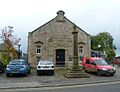 The cross at Carnwath, Lanarkshire, with inscribed mile distances to other burghs
 -

-
 The cross at Stirling, topped by a unicorn
 -
 The cross at Doune, near Stirling, topped by a lion
 -
 The cross at Cupar in Fife
 -
 The cross at Peebles in the Scottish Borders
 -
 The cross at Musselburgh, East Lothian, topped by the burgh arms
 -
 The cross at Haddington, East Lothian, topped by the town's symbol, a goat
 -
 The cross at Dundee, re-erected at a new location in 1874 without its original octagonal cross-house
 -
 The cross at Dunfermline, Fife
 -
 The cross at Crail, Fife
 -
 The cross at Anstruther, Fife, missing its finial
 -
 The cross in the village of Kinrossie, Perthshire
 -
 The cross in the 'new' village of Scone, topped by a foliated ornamental cross
 -
 The cross in the town of Clackmannan
 -
 The cross in the village of Airth near Falkirk, incorporating sundials
 -
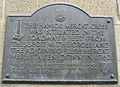 Some towns, like Hawick in the Scottish Borders, lost their crosses because they were increasingly deemed obstructions to wheeled traffic
 -
 The Cross Well at Linlithgow, modelled on the courtyard fountain of Royal palace, substitutes for the town's demolished cross
 -
 The cross at Sanquhar was transformed into a Covenanter monument in 1856
 -
 The cross at Abernethy. An example of a war memorial in the form of a mercat cross.
 -
 Edward VII Memorial in Perth (1913), replacing the town's original cross removed in 1763
 -
 The cross in Turriff, Aberdeenshire comprises a 16th-century pillar and cruciform top raised on a 19th-century plinth
 -
 The mercat cross in Rutherglen is a replica erected in 1926 for the town's octocentenary


.jpg)
See also
[edit]References
[edit]- ^ a b Thomson, Lindsey J. "Scottish Market Crosses: The development of a risk assessment model". Robert Gordon University. Archived from the original on 3 April 2008.
- ^ W. G. Black, The Scots Mercat Cross, Edinburgh 1930, p. 27
- ^ A. Hutcheson, Introduction to J. Small, Scottish Market Crosses, Stirling, 1900
- ^ J. Small, Scottish Market Crosses, Stirling, 1900, p. iv
- ^ RCAHMS Site Record for Preston Cross on Canmore
- ^ J. Drummond, Scottish Market Crosses, Edinburgh 1861
- ^ P. McNeill and R. Nicholson (eds.), An Historical Atlas Of Scotland c. 400 – c. 1600, Atlas Committee of the Conference of Scottish Medievalists, University of St Andrews, 1975, pp. 31–32
- ^ Castle Hill, Antiquities, and Points of Interests around Forfar, Scotland
- ^ RCAHMS Site Record for Cupar Market Cross on Canmore
External links
[edit]
.svg)
.svg)

.svg)
.svg)

.svg)


.svg)


.svg)

.svg)
.svg)


.svg)
.svg)
.svg)


.svg)


.svg)
.svg)

.svg)

.svg)
.svg)
.svg)
.svg)
.svg)
.svg)
.svg)
.svg)
.svg)


.svg)
.svg)
.svg)


.svg)
.svg)
.svg)


.svg)

.svg)
.svg)
.svg)
.svg)
.svg)


.svg)
.svg)
.svg)
.svg)
.svg)


.svg)


.svg)


.svg)


.svg)


.svg)
.svg)


.svg)
.svg)


.svg)


.svg)


.svg)
.svg)
.svg)


.svg)
.svg)


.svg)

_Swastika_(%D0%A1%D0%B2%D0%B0%D1%81%D1%82%D0%B8%D0%BA%D0%B0)_-_Rodnovery.svg)


.svg)


.svg)


Mercat cross
View on GrokipediaHistorical Origins and Development
Early Medieval Roots
The mercat cross in Scotland originated from the early medieval Insular tradition of erecting free-standing high crosses, which flourished between the 7th and 10th centuries across Pictish, Dal Riata, and early medieval kingdoms. These monumental stone structures, often ringed and adorned with intricate carvings of Christian iconography, interlaced patterns, and symbolic motifs, functioned primarily as outdoor preaching stations, wayside shrines for pilgrims, and boundary markers delineating sacred or communal spaces. Examples from sites like Iona and St Andrews demonstrate their role in integrating religious instruction with public gathering, a practice rooted in the conversion to Christianity and the need for visible symbols amid largely illiterate populations.[3] This cross tradition provided the structural and symbolic precursor for the mercat cross as burghs emerged in the 12th century, coinciding with royal efforts to centralize authority and stimulate trade. King David I (r. 1124–1153) initiated the formal establishment of burghs through charters granting market rights to settlements such as Berwick-upon-Tweed (c. 1119–1124), Roxburgh, and Stirling, where crosses likely served as focal points for economic activity from inception. These grants, aimed at fostering urban development modeled on Anglo-Norman precedents, repurposed the cross's communal significance to denote exclusive trading privileges, distinguishing royal burghs from rural townships. Archaeological evidence indicates that early examples were simple shafts or pillars, echoing high cross forms but adapted for secular oversight of markets.[2] The earliest legislative tie between the cross and market regulation dates to the reign of William the Lion (r. 1165–1214), whose statutes required merchants to display and sell goods at designated crosses to prevent fraud and ensure royal tolls were collected. This edict, part of broader assize laws standardizing trade, solidified the mercat cross as a nexus of economic enforcement and civic identity, bridging early medieval religious symbolism with high medieval commercial imperatives. Surviving fragments, such as those from Dunfermline, suggest continuity in form, though most original 12th-century structures have been lost or rebuilt.[4]Royal Grants and Burgh Expansion (12th–15th Centuries)
The establishment and expansion of royal burghs in Scotland from the 12th to 15th centuries were driven by royal charters granting market rights, with the mercat cross erected as a enduring symbol of these privileges. King David I (r. 1124–1153) pioneered this development by creating at least 16 royal burghs, adapting continental European urban models to foster trade, generate royal income through tolls and customs, and strengthen central authority.[5] [6] These early burghs, including Berwick-upon-Tweed, Roxburgh, Edinburgh, and Stirling, received charters authorizing weekly markets and periodic fairs, where the mercat cross marked the official trading site and served as a rallying point for civic assemblies.[6] Under subsequent monarchs, burgh creation accelerated to support economic growth and territorial control. By the end of the 12th century, approximately 38 burghs existed, rising to around 40 royal burghs by 1300, with 12 new foundations in the 13th century alone.[7] A statute attributed to King William I (r. 1165–1214) required that all goods for sale within burghs be displayed at the "mercat and mercat cross," formalizing the structure's role in regulating commerce and preventing unregulated trading.[4] This period saw continued grants under Alexander II (r. 1214–1249) and Alexander III (r. 1249–1286), expanding burghs into peripheral regions to integrate Gaelic areas and counterbalance feudal lords. The 14th and 15th centuries witnessed further proliferation amid wars of independence and stabilization, adding 9 burghs in the 14th century and 6 in the 15th, often to reward loyalty or stimulate recovery. Examples include Dunbar, granted burgh status by David II (r. 1329–1371) in 1370 to bolster coastal trade in wool and hides.[8] Mercat crosses, typically simple stone pillars or shafts initially, embodied the monarch's delegated authority, distinguishing royal burghs from later burghs of barony and underscoring the crown's monopoly on foreign trade oversight through the Convention of Royal Burghs, formalized by the late 14th century. While few pre-16th-century crosses survive intact, their proliferation reflected burghs' rising economic and administrative prominence, with crosses often topped by royal symbols like the unicorn to affirm sovereign grant.[9]Post-Reformation Changes and Peak Construction (16th–17th Centuries)
The Scottish Reformation, culminating in 1560, prompted significant alterations to mercat crosses amid widespread iconoclasm targeting Catholic symbols. Originally often cruciform in design, many crosses lost their cross-shaped finials or were redesigned to emphasize secular authority, with tops replaced by royal emblems such as unicorns symbolizing the Scottish monarchy rather than religious motifs.[10] This shift aligned with Protestant rejection of idolatry while preserving the crosses' role as markers of burghal privilege. Surviving pre-Reformation examples, like the Banff mercat cross, occasionally retained religious carvings but received secular updates, such as a new shaft installed in 1627.[11] Construction and reconstruction of mercat crosses peaked in the 16th and 17th centuries, coinciding with burgh economic resurgence and the reaffirmation of royal charters disrupted by Reformation upheavals. Of approximately 126 known examples in Scotland, the majority date from this era, reflecting towns' efforts to project civic status and facilitate trade in an era of expanding commerce and urban consolidation.[2] Burgh councils commissioned ornate structures to symbolize autonomy and prosperity, often incorporating sundials, armorial bearings, and vanes for practical and heraldic purposes. Notable reconstructions include Edinburgh's mercat cross, rebuilt in 1617 to designs by master masons John Tailefer and John Mylne near its original site adjacent to St. Giles' Cathedral.[12] This period's output underscored mercat crosses' evolution from medieval trade symbols to multifaceted civic monuments, enduring civil wars and confessional conflicts while adapting to Protestant sensibilities. Examples like the Culross cross in Fife, with its octagonal shaft and preserved late-medieval form restored for continued use, exemplify how burghs invested in durable stonework to anchor community functions such as proclamations and markets.[2] The emphasis on reconstruction rather than wholesale replacement minimized costs while signaling continuity of burgh rights granted since the 12th century.[2]Decline After Union and 18th–19th Century Adaptations
Following the Acts of Union in 1707, mercat crosses retained ceremonial functions such as proclaiming parliamentary dissolutions and royal accessions, but the erection of new crosses largely ceased as the system of royal burgh charters granting market privileges had reached its extent by the late 17th century.[12] The integration of Scotland into the broader British economy diminished the exclusivity of burgh market monopolies, which had already been partially eroded by pre-Union legislation like the 1672 Act, shifting economic activity toward industrial production and larger trade networks rather than localized open-air markets centered on crosses.[1] In the 18th century, urban expansion and road improvements prompted relocations and demolitions to facilitate traffic flow. Edinburgh's mercat cross, rebuilt in 1617, was demolished in 1756 to widen streets, with fragments salvaged and later incorporated into other sites.[12] Similarly, Stirling's cross was removed in 1792 for better traffic access, though its unicorn finial survived.[13] Elgin's cross underwent reconstruction in 1733 amid town developments.[1] These changes reflected a transition from functional market symbols to obstacles in modernizing burgh layouts, with some crosses, like Inverkeithing's, relocated in 1799 to less central positions.[1] The 19th century saw adaptations driven by antiquarian interest and municipal reforms under acts like the 1833 Burgh Police Act, which enabled street widenings and preservation efforts. Victorian reconstructions often prioritized heritage over utility, as in Peebles where opposition delayed a 1807 move but led to re-erection in 1895 after storage.[1] Dundee's cross was repositioned in 1874 sans its original cross-house, symbolizing relocation for urban planning.[1] Replicas emerged at sites like Dunfermline and Scone, incorporating original elements to evoke historical prestige amid declining practical market roles.[2] Aberdeen's cross, repaired in 1821, was shifted to its current site to accommodate expansion.[14] These modifications underscored the crosses' evolution into civic monuments rather than active economic hubs.Functions and Symbolism
Marker of Market Rights and Economic Privilege
The mercat cross primarily symbolized a Scottish burgh's possession of a royal charter conferring the exclusive right to hold markets and fairs, thereby establishing its economic preeminence within a defined territory. From the 12th century onward, kings such as David I (r. 1124–1153) granted burgh status to settlements like Stirling, Berwick, and Roxburgh, endowing them with monopolies on foreign trade and domestic commerce that barred non-burgh communities from engaging in competitive exchange.[15][16][17] These privileges positioned royal burghs as central hubs for Scotland's medieval economy, channeling trade in commodities like wool, hides, and salt through regulated venues marked by the cross.[5] Erected at the heart of the market square, the mercat cross delineated the sanctioned area for all commercial transactions, where burgh officials enforced standards, measured goods, and collected tolls and customs duties—essential revenues funding local governance, fortifications, and public works. Charters specified the frequency and duration of markets, often weekly or annual fairs, with the cross serving as the focal point for these activities and a deterrent against illicit trading in surrounding rural areas.[18][6][19] This monopoly not only bolstered burgh prosperity but also aligned with crown policy to centralize economic control, as evidenced by complaints from burgh conventions over encroachments on their trading domains into the 17th century.[20] The economic advantages extended to the formation of merchant guilds, which burgh charters empowered to regulate membership and exclude outsiders, further solidifying the cross as an emblem of privileged corporate autonomy. In practice, these rights generated wealth disparities, with prosperous burghs like Edinburgh leveraging their status for infrastructure investments, while less central ones struggled against monopoly infringements.[21][22] By the late medieval period, over 60 royal burghs dotted Scotland's landscape, their mercat crosses enduring testaments to this system of regulated commerce that underpinned urban development until the Union of 1707 diluted such exclusivities.[23]Site for Public Proclamations and Civic Authority
Mercat crosses functioned as the central venues for public proclamations in Scottish burghs, serving to disseminate official announcements and assert civic authority derived from royal charters.[2] These structures symbolized the burgh's autonomy in governance and communication, with proclamations often delivered from an elevated platform to ensure visibility and audibility to assembled crowds.[12] Royal proclamations, including accessions to the throne, were routinely read at mercat crosses, a practice rooted in medieval traditions and continuing into the modern era. In Edinburgh, the accession of Queen Elizabeth II was proclaimed on February 8, 1952, while King Charles III's was announced on September 11, 2022, by the Lord Lyon King of Arms.[12] Similarly, the dissolution of the UK Parliament ahead of elections was proclaimed at the Edinburgh Mercat Cross on May 30, 2024, following protocols established before the Act of Union in 1707.[24] This role extended to other civic matters, such as declarations of war's end and parliamentary business, reinforcing the cross as a nexus of authority where burgh officials and royal representatives conveyed binding edicts.[12] In the seventeenth century, events like the proclamation of the Declaration of Breda in 1660 at Edinburgh's Mercat Cross exemplified their use in political transitions.[25] The auditory elements, including drums and trumpets, were employed to summon residents, ensuring widespread dissemination in pre-literate societies.[26] By centralizing announcements, mercat crosses upheld social order and legitimacy, distinguishing chartered burghs from unprivileged settlements and integrating economic, judicial, and administrative functions under one symbolic edifice.[2]Role in Judicial Punishments and Social Order
Mercat crosses in Scottish burghs extended beyond economic functions to serve as loci for judicial enforcement, where public punishments underscored the burgh authorities' mandate to preserve order. These structures hosted executions and corporal penalties, transforming the market site into a theater of deterrence that visibly linked commerce with the rule of law. Punishments meted out in proximity to the cross reminded inhabitants of the consequences of transgression, fostering compliance through communal witnessing of justice.[27][28] In prominent examples like Edinburgh's Mercat Cross, documented punishments included hangings, burnings at the stake, amputations, and the imposition of molten lead "crowns" on offenders such as blasphemers. The adjacent use of the Maiden—a 3-meter guillotine device—resulted in over 150 beheadings between 1564 and 1710, with a specific instance being the 1581 execution of James Douglas for crimes against the husband of Mary Queen of Scots. These spectacles drew crowds, amplifying their role in social control by instilling fear and affirming the inseparability of civic privilege from punitive authority.[29] Proclamations of bans, outlawries, and legal decrees further integrated mercat crosses into social regulation, as announcements from cross platforms disseminated royal and burgh edicts to illiterate populations. This practice, recurrent across Scotland from the medieval period onward, symbolized the monarch's peace and burghal jurisdiction, ensuring collective awareness of norms and deterring disorder by publicizing enforcement mechanisms. Such dual utility in punishment and proclamation cemented the cross as a cornerstone of hierarchical stability in pre-modern Scottish society.[8][28]Architectural Features and Variations
Core Design Elements
The core design of a mercat cross centers on a tall, vertical stone shaft, typically polygonal—most commonly octagonal—serving as the primary structural element to mark the market site prominently within the burgh.[12][14] This shaft, often tapering upward for visual emphasis, rises from a sturdy base and supports a capital and finial, embodying the cross's role as a civic monument rather than a purely ecclesiastical structure. Historical examples, such as those in Edinburgh and Peebles, feature shafts carved from local stone with moldings or decorative bands, though simplicity prevailed in earlier medieval forms before more elaborate detailing emerged in the 16th and 17th centuries.[4][2] Atop the shaft sits a capital, frequently adorned with foliate or heraldic carvings, transitioning to the finial which distinguishes Scottish mercat crosses through symbolic motifs like the unicorn—Scotland's national animal—holding a shield or flag, as seen in surviving structures at Prestonpans and Inverkeithing.[30][1] While some finials retain a traditional cross form, others incorporate secular emblems such as lions or burgh arms, reflecting royal patronage and local identity over religious iconography. The base typically consists of steps or a low platform, facilitating public access for proclamations and gatherings, with later 19th-century restorations often standardizing octagonal plinths for durability.[4][14] Functional additions like sundials, integrated into the shaft or capital, were common to aid market timing, appearing on examples from the 17th century onward, such as at Inverkeithing where four dials encircle the structure.[30][1] Though variations exist, the unified verticality and heraldic crowning underscore the mercat cross's essence as a freestanding pillar of authority, distinct from enclosed market crosses elsewhere in Europe.[2]Regional and Temporal Variations
Mercat crosses in Scotland display notable architectural variations across time periods and regions, reflecting evolving craftsmanship, symbolic priorities, and local resources. Early medieval and late-medieval examples, such as the 15th-century base at Peebles in the Borders, typically consisted of simpler stone shafts on stepped bases, often derived from graveyard cross traditions with minimal embellishment.[2][1] By the 16th and 17th centuries, designs became more standardized and ornate, featuring prevalent octagonal shafts, heraldic finials like unicorns, and functional additions such as sundials—evident in about 17 of the roughly 100–126 surviving crosses, with many sundials dated to this era (e.g., 1662 at Peebles, 1688 at Inverkeithing).[1] Post-1707 Union examples show decline in new constructions, with 18th- and 19th-century adaptations or reconstructions emphasizing preservation, such as the 1757 replacement at Nairn or Victorian-era relocations, often retaining core elements but incorporating modern restorations.[2][1] Regionally, crosses in Fife, such as the 16th-century structure at Inverkeithing (14.5 feet high), exemplify refined Lowland designs with unicorn finials symbolizing royal authority and integrated sundials on cubic or square faces, often in ashlar stone.[1] Similarly, the late-medieval cross at Culross in Fife features a sculpted unicorn atop a stone column on a stepped base, highlighting the area's concentration of well-preserved burgh symbols with heraldic and religious motifs.[2] In the Scottish Borders, variations include the Peebles cross's 12-foot octagonal shaft with a 1662 cube sundial, and Galashiels' 1695 example in red freestone with a spherical finial and four-faced sundials, adapting to local quarries and terrain.[1] East Lothian instances, like the late-17th-century Pencaitland cross, favor octagonal shafts on stepped pedestals topped by cubic sundials, showing subtle shifts toward functional civic markers without the elaborate canopies seen elsewhere.[1] These differences underscore Scotland's distinctive style—less florid than English counterparts but rich in armorial details—concentrated in Lowland burghs where trade flourished, with finials varying from national unicorns to regional spheres or acorns based on burgh status and masons' preferences.[2][1] Of around 20 surviving late-medieval crosses, most hail from these eastern regions, attesting to denser burgh development there compared to Highland areas.[2]Iconography and Symbolic Motifs
The finials of many Scottish mercat crosses feature heraldic beasts such as the unicorn, a longstanding symbol of the Scottish monarchy and national identity, or occasionally a lion rampant, underscoring the royal charters granting market rights.[1][31] For instance, the Prestonpans mercat cross is topped by a carved royal unicorn finial, exemplifying this motif's prevalence in post-medieval reconstructions.[1] Armorial carvings abound on shafts and bases, displaying burgh-specific heraldry, guild emblems, or royal arms to affirm civic authority and economic privilege derived from charters.[1][2] The Kincardine mercat cross bears the arms of the Earl of Kincardine, linking local nobility to the structure's symbolic role, while Haddington's cross incorporates a goat, the town's traditional emblem, atop its shaft.[1] Sundials integrated into capitals or finials served both practical and emblematic functions, marking market hours while evoking temporal order under royal oversight.[1] Grotesque heads, as seen on the Dunbar mercat cross, provided decorative protection against evil, blending folk motifs with the crosses' authoritative presence.[2] Inscriptions of dates, such as the 1688 unicorn finial on Inverkeithing's cross carved by John Boyd for guild admission, commemorate craftsmanship and institutional ties.[32] Post-Reformation shifts emphasized secular heraldry over overt Christian iconography, prioritizing symbols of burgh prosperity and monarchical loyalty.[2]Distribution, Preservation, and Modern Relevance
Geographic Spread and Surviving Examples
Mercat crosses were erected across Scotland in towns granted burgh status, beginning from the 12th century, with their distribution corresponding to the establishment of royal burghs, burghs of barony, and burghs of regality, primarily along the eastern seaboard and in the Lowlands where economic activity and royal patronage were concentrated.[2] Fewer examples appear in the Highlands and Islands, reflecting sparser burgh development in those regions due to terrain and historical settlement patterns.[1] Approximately 100 to 126 mercat crosses survive today, the majority dating to the 16th through 18th centuries, though around 20 later medieval examples persist, often restored or relocated from original sites.[1] Concentrations are evident in areas with dense burgh networks, such as Fife (e.g., Culross, Inverkeithing), East Lothian (e.g., Prestonpans, Pencaitland), and the Scottish Borders (e.g., Peebles, Galashiels), extending northward to Moray (Elgin) and Orkney (Kirkwall).[2][1][33] Notable surviving examples include:- Culross, Fife: A restored late-medieval cross marking the burgh's market area.[2]
- Inverkeithing, Fife: A possibly 16th-century shaft, 14 feet 6 inches high, with a sundial added in 1688.[1]
- Prestonpans, East Lothian: One of the oldest on its original site, exemplifying early preservation.[34]
- Peebles, Scottish Borders: An octagonal shaft dated 1699 (potentially originating in the 15th century), featuring a sundial from 1662.[1]
- Elgin, Moray: Known as the Little Cross, 15 feet high with a 1733 sundial.[1]