



Community hub
Recent from talks
Contribute something
Nothing was collected or created yet.
Repurchase agreement
View on Wikipedia | This article needs additional citations for verification. (September 2022) |
| Part of a series on |
| Finance |
|---|
 |


A repurchase agreement, also known as a repo, RP, or sale and repurchase agreement, is a form of secured short-term borrowing, usually, though not always, using government securities as collateral. A contracting party sells a security to a lender and, by agreement between the two parties, repurchases the security back shortly afterwards, at a slightly higher contracted price. The difference in the prices and the time interval between sale and repurchase creates an effective interest rate on the loan. The mirror transaction, a "reverse repurchase agreement," is a form of secured contracted lending in which a party buys a security along with a concurrent commitment to sell the security back in the future at a specified time and price. Because this form of funding is often used by dealers, the convention is to reference the dealer's position in a transaction with a counterparty. Central banks also use repo and reverse repo transactions to manage banking system reserves. When the Federal Reserve borrows funds to drain reserves, it can do so by selling a government security from its inventory with a commitment to buy it back in the future; it calls the transaction a reverse repo because the dealer counterparty to the Fed is lending money. Similarly, when the Federal Reserve wishes to add to banking reserves, it can buy a government security with a forward commitment to sell it back. It calls this transaction a repo because the Fed counterparty is borrowing money.[1]
The repo market is an important source of funds for large financial institutions in the non-depository banking sector, which has grown to rival the traditional depository banking sector in size. Large institutional investors such as money market mutual funds lend money to financial institutions such as investment banks, in exchange for (or secured by) collateral, such as Treasury bonds and mortgage-backed securities held by the borrower financial institutions. An estimated $1 trillion per day in collateral value is transacted in the U.S. repo markets.[2][3]
In 2007–2008, a run on the repo market, in which funding for investment banks was either unavailable or at very high interest rates, was a key aspect of the subprime mortgage crisis that led to the Great Recession.[4] During September 2019, the U.S. Federal Reserve intervened in the role of investor to provide funds in the repo markets, when overnight lending rates jumped due to a series of technical factors that had limited the supply of funds available.[2][5][3]
Structure
[edit] | This section needs additional citations for verification. (July 2021) |

Repo facility
[edit]In a repo, the investor/lender provides cash to a borrower, with the loan secured by the collateral of the borrower, typically bonds. In the event the borrower defaults, the investor/lender gets the collateral. Investors are typically financial entities such as money market mutual funds, while borrowers are non-depository financial institutions such as investment banks and hedge funds. The investor/lender charges interest (the repo rate), which together with the principal is repaid on repurchase of the security as agreed.
A repo is economically similar to a secured loan, with the buyer (effectively the lender or investor) receiving securities for collateral to protect himself against default by the seller. The party who initially sells the securities is effectively the borrower. Many types of institutional investors engage in repo transactions, including mutual funds and hedge funds.[6]
Although the transaction is similar to a loan, and its economic effect is similar to a loan, the terminology differs from that applying to loans: the seller legally repurchases the securities from the buyer at the end of the loan term. However, a key aspect of repos is that they are legally recognised as a single transaction (important in the event of counterparty insolvency) and not as a disposal and a repurchase for tax purposes. By structuring the transaction as a sale, a repo provides significant protections to lenders from the normal operation of U.S. bankruptcy laws, such as the automatic stay and avoidance provisions.
Collateral
[edit]Almost any security may be employed in a repo, though highly liquid securities are preferred as they are more easily disposed of in the event of a default and, more importantly, they can be easily obtained in the open market if the buyer has created a short position in the repo security by a reverse repo and market sale; by the same token, non liquid securities are discouraged.
Treasury or Government bills, corporate and Treasury/Government bonds, and stocks may all be used as "collateral" in a repo transaction. Unlike a secured loan, however, legal title to the securities passes from the seller to the buyer. Coupons (interest payable to the owner of the securities) falling due while the repo buyer owns the securities are, in fact, usually passed directly onto the repo seller. This might seem counter-intuitive, as the legal ownership of the collateral rests with the buyer during the repo agreement. The agreement might instead provide that the buyer receives the coupon, with the cash payable on repurchase being adjusted to compensate, though this is more typical of sell/buybacks.
Overcollateralization (haircut)
[edit]Further, the investor/lender may demand collateral of greater value than the amount that they lend. This difference is the "haircut." These concepts are illustrated in the diagram and in the equations section. When investors perceive greater risks, they may charge higher repo rates and demand greater haircuts.
Reverse repo facility
[edit]Whereas a repo facility is a security-buying party acting as a lender of cash to security sellers who effectively borrow cash at interest (the repo rate), with the security they sell serving as collateral, a reverse repo facility is a security-selling party allowing buyers with cash to effectively lend it to the facility at interest with the security they purchase serving as collateral. An example is a bank with cash deposits who loans it to a reverse repo facility to earn interest on it and contribute to their own collateral requirements (as deposit banks) with the collateral they obtain in the transaction.[7]
Tri-party repo
[edit]In a tri-party repo, a third party facilitates elements of the transaction, typically custody, escrow, monitoring, and other services. [4]
Structure and other terminology
[edit]The following table summarizes the terminology:
| Repo | Reverse repo | |
|---|---|---|
| Participant | Borrower Seller Cash receiver |
Lender Buyer Cash provider |
| Near leg | Sells securities | Buys securities |
| Far leg | Buys securities | Sells securities |
History
[edit]In the United States, repos have been used from as early as 1917 when wartime taxes made older forms of lending less attractive. At first, repos were used just by the Federal Reserve to lend to other banks, but the practice soon spread to other market participants. The use of repos expanded in the 1920s, fell away through the Great Depression and WWII, then expanded once again in the 1950s, enjoying rapid growth in the 1970s and 1980s in part due to computer technology.[8]
According to Yale economist Gary Gorton, repo evolved to provide large non-depository financial institutions with a method of secured lending analogous to the depository insurance provided by the government in traditional banking, with the collateral acting as the guarantee for the investor.[4]
In 1982, the failure of Drysdale Government Securities led to a loss of $285 million for Chase Manhattan Bank. This resulted in a change in how accrued interest is used in calculating the value of the repo securities. In the same year, the failure of Lombard-Wall, Inc. resulted in a change in the federal bankruptcy laws pertaining to repos.[9][10] The failure of ESM Government Securities in 1985 led to the closing of Home State Savings Bank in Ohio and a run on other banks insured by the private-insurance Ohio Deposit Guarantee Fund. The failure of these and other firms led to the enactment of the Government Securities Act of 1986.[11]
In 2007–2008, a run on the repo market, in which funding for investment banks was either unavailable or at very high interest rates, was a key aspect of the subprime mortgage crisis that led to the Great Recession.[4]
In July 2011, concerns arose among bankers and the financial press that if the 2011 U.S. debt ceiling crisis led to a default, it could cause considerable disruption to the repo market. This was because treasuries are the most commonly used collateral in the US repo market, and as a default would have downgraded the value of treasuries, it could have resulted in repo borrowers having to post far more collateral. [12]
During September 2019, the U.S. Federal Reserve intervened in the role of investor to provide funds in the repo markets, when overnight lending rates jumped due to a series of technical factors that had limited the supply of funds available.[2]
Market size
[edit]
The New York Times reported in September 2019 that an estimated $1 trillion per day in collateral value is transacted in the U.S. repo markets.[2] The Federal Reserve Bank of New York reports daily repo collateral volume for different types of repo arrangements. As of 24 October 2019, volumes were: secured overnight financing rate (SOFR) $1,086 billion; broad general collateral rate (BGCR) $453 billion, and tri-party general collateral rate (TGCR) $425 billion.[3] These figures however, are not additive, as the latter 2 are merely components of the former, SOFR.[13]
The Federal Reserve and the European Repo and Collateral Council (a body of the International Capital Market Association) have tried to estimate the size of their respective repo markets. At the end of 2004, the US repo market reached US$5 trillion. Especially in the US and to a lesser degree in Europe, the repo market contracted in 2008 as a result of the 2008 financial crisis. But, by mid-2010, the market had largely recovered and, at least in Europe, had grown to exceed its pre-crisis peak.[14]
Repo expressed as mathematical formula
[edit] |
A repurchase agreement is a transaction concluded on a deal date tD between two parties A and B:
- (i) A will on the near date sell a specified security S at an agreed price PN to B
- (ii) A will on the far date tF (after tN) re-purchase S from B at a price PF which is already pre-agreed on the deal date.

If positive interest rates are assumed, the repurchase price PF can be expected to be greater than the original sale price PN.
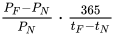
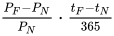
The (time-adjusted) difference is called the repo rate, which is the annualized interest rate of the transaction. can be interpreted as the interest rate for the period between near date and far date.
Ambiguity in the usage of the term repo
[edit] |
The term repo has given rise to a lot of misunderstanding: there are two types of transactions with identical cash flows:
- (i) a sell-and-buy-back as well as,
- (ii) a collateralized borrowing.
The sole difference is that in (i) the asset is sold (and later re-purchased), whereas in (ii) the asset is instead pledged as a collateral for a loan: in the sell-and-buy-back transaction, the ownership and possession of S are transferred at tN from a A to B and in tF transferred back from B to A; conversely, in the collateralized borrowing, only the possession is temporarily transferred to B whereas the ownership remains with A.
Maturities of repos
[edit] |
There are two types of repo maturities: term, and open repo.
Term refers to a repo with a specified end date: although repos are typically short-term (a few days), it is not unusual to see repos with a maturity as long as two years.
Open has no end date which has been fixed at conclusion. Depending on the contract, the maturity is either set until the next business day and the repo matures unless one party renews it for a variable number of business days. Alternatively it has no maturity date – but one or both parties have the option to terminate the transaction within a pre-agreed time frame.
Types
[edit] | This section needs additional citations for verification. (July 2021) |
Repo transactions occur in three forms: specified delivery, tri-party, and held in custody (wherein the "selling" party holds the security during the term of the repo). The third form (hold-in-custody) is quite rare, particularly in developing markets, primarily due to the risk that the seller will become insolvent prior to maturation of the repo and the buyer will be unable to recover the securities that were posted as collateral to secure the transaction. The first form—specified delivery—requires the delivery of a prespecified bond at the onset, and at maturity of the contractual period. Tri-party is essentially a basket form of transaction and allows for a wider range of instruments in the basket or pool. In a tri-party repo transaction, a third party clearing agent or bank is interposed between the "seller" and the "buyer". The third party maintains control of the securities that are the subject of the agreement and processes the payments from the "seller" to the "buyer."
Due bill/hold in-custody repo / bilateral repo
[edit]In a due bill repo, the collateral pledged by the (cash) borrower is not actually delivered to the cash lender. Rather, it is placed in an internal account ("held in custody") by the borrower, for the lender, throughout the duration of the trade. This has become less common as the repo market has grown, particularly owing to the creation of centralized counterparties. Due to the high risk to the cash lender, these are generally only transacted with large, financially stable institutions.
Tri-party repo
[edit]The distinguishing feature of a tri-party repo is that a custodian bank or international clearing organization, the tri-party agent, acts as an intermediary between the two parties to the repo. The tri-party agent is responsible for the administration of the transaction, including collateral allocation, marking to market, and substitution of collateral. In the US, the two principal tri-party agents are The Bank of New York Mellon and JP Morgan Chase, whilst in Europe the principal tri-party agents are Euroclear Bank and Clearstream Banking SA with SIX offering services in the Swiss market. The size of the US tri-party repo market peaked in 2008 before the worst effects of the 2008 financial crisis at approximately $2.8 trillion and by mid-2010 was about $1.6 trillion.[14]
As tri-party agents administer the equivalent of hundreds of billions of USD of global collateral, they have the scale to subscribe to multiple data feeds to maximise the universe of coverage. As part of a tri-party agreement the three parties to the agreement, the tri-party agent, the repo buyer (the Collateral Taker/Cash Provider, "CAP") and the repo seller (Cash Borrower/Collateral Provider, "COP") agree to a collateral management service agreement which includes an "eligible collateral profile".
It is this "eligible collateral profile" that enables the repo buyer to define their risk appetite in respect of the collateral that they are prepared to hold against their cash. For example, a more risk averse repo buyer may wish to only hold "on-the-run" government bonds as collateral. In the event of a liquidation event of the repo seller the collateral is highly liquid thus enabling the repo buyer to sell the collateral quickly. A less risk averse repo buyer may be prepared to take non investment grade bonds or equities as collateral, which may be less liquid and may suffer a higher price volatility in the event of a repo seller default, making it more difficult for the repo buyer to sell the collateral and recover their cash. The tri-party agents are able to offer sophisticated collateral eligibility filters which allow the repo buyer to create these "eligible collateral profiles" which can systemically generate collateral pools which reflect the buyer's risk appetite.[15]
Collateral eligibility criteria could include asset type, issuer, currency, domicile, credit rating, maturity, index, issue size, average daily traded volume, etc. Both the lender (repo buyer) and borrower (repo seller) of cash enter into these transactions to avoid the administrative burden of bi-lateral repos. In addition, because the collateral is being held by an agent, counterparty risk is reduced. A tri-party repo may be seen as the outgrowth of the 'due bill repo. A due bill repo is a repo in which the collateral is retained by the Cash borrower and not delivered to the cash provider. There is an increased element of risk when compared to the tri-party repo as collateral on a due bill repo is held within a client custody account at the Cash Borrower rather than a collateral account at a neutral third party.
Whole loan repo
[edit]A whole loan repo is a form of repo where the transaction is collateralized by a loan or other form of obligation (e.g., mortgage receivables) rather than a security.
Equity repo
[edit]The underlying security for many repo transactions is in the form of government or corporate bonds. Equity repos are simply repos on equity securities such as common (or ordinary) shares. Some complications can arise because of greater complexity in the tax rules for dividends as opposed to coupons.
Sell/buybacks and buy/sell backs
[edit]A sell/buyback is the spot sale and a forward repurchase of a security. It is two distinct outright cash market trades, one for forward settlement. The forward price is set relative to the spot price to yield a market rate of return. The basic motivation of sell/buybacks is generally the same as for a classic repo (i.e., attempting to benefit from the lower financing rates generally available for collateralized as opposed to non-secured borrowing). The economics of the transaction are also similar, with the interest on the cash borrowed through the sell/buyback being implicit in the difference between the sale price and the purchase price.
There are a number of differences between the two structures. A repo is technically a single transaction whereas a sell/buyback is a pair of transactions (a sell and a buy). A sell/buyback does not require any special legal documentation while a repo generally requires a master agreement to be in place between the buyer and seller (typically the SIFMA/ICMA commissioned Global Master Repo Agreement (GMRA)). For this reason, there is an associated increase in risk compared to repo. Should the counterparty default, the lack of agreement may lessen legal standing in retrieving collateral. Any coupon payment on the underlying security during the life of the sell/buyback will generally be passed back to the buyer of the security by adjusting the cash paid at the termination of the sell/buyback. In a repo, the coupon will be passed on immediately to the seller of the security.
A buy/sell back is the equivalent of a "reverse repo".
Securities lending
[edit]In securities lending, the purpose is to temporarily obtain the security for other purposes, such as covering short positions or for use in complex financial structures. Securities are generally lent out for a fee and securities lending trades are governed by different types of legal agreements than repos.
Repos have traditionally been used as a form of collateralized loan and have been treated as such for tax purposes. Modern Repo agreements, however, often allow the cash lender to sell the security provided as collateral and substitute an identical security at repurchase.[16]
Reverse repo
[edit]A reverse repo is simply the same repurchase agreement from the buyer's viewpoint, not the seller's. Hence, the seller executing the transaction would describe it as a "repo", while the buyer in the same transaction would describe it a "reverse repo". So "repo" and "reverse repo" are exactly the same kind of transaction, just being described from opposite viewpoints. The term "reverse repo and sale" is commonly used to describe the creation of a short position in a debt instrument where the buyer in the repo transaction immediately sells the security provided by the seller on the open market. On the settlement date of the repo, the buyer acquires the relevant security on the open market and delivers it to the seller. In such a short transaction, the buyer is wagering that the relevant security will decline in value between the date of the repo and the settlement date.
Uses
[edit] | This section needs additional citations for verification. (July 2021) |
For the buyer, a repo is an opportunity to invest cash for a customized period of time (other investments typically limit tenures). It is short-term and safer as a secured investment since the investor receives collateral. Market liquidity for repos is good, and rates are competitive for investors. Money Funds are large buyers of Repurchase Agreements.
For traders in trading firms, repos are used to finance long positions (in the securities they post as collateral), obtain access to cheaper funding costs for long positions in other speculative investments, and cover short positions in securities (via a "reverse repo and sale").
United States Federal Reserve use of repos
[edit] | This section may be confusing or unclear to readers. (October 2012) |
When transacted by the Federal Open Market Committee of the Federal Reserve in open market operations, repurchase agreements add reserves to the banking system and then after a specified period of time withdraw them; reverse repos initially drain reserves and later add them back. This tool can also be used to stabilize interest rates, and the Federal Reserve has used it to adjust the federal funds rate to match the target rate.[17]
Under a repurchase agreement, the Federal Reserve (Fed) buys U.S. Treasury securities, U.S. agency securities, or mortgage-backed securities from a primary dealer who agrees to buy them back within typically one to seven days; a reverse repo is the opposite. Thus, the Fed describes these transactions from the counterparty's viewpoint rather than from their own viewpoint.
If the Federal Reserve is one of the transacting parties, the RP is called a "system repo", but if they are trading on behalf of a customer (e.g., a foreign central bank), it is called a "customer repo". Until 2003, the Fed did not use the term "reverse repo"—which it believed implied that it was borrowing money (counter to its charter)—but used the term "matched sale" instead.
Reserve Bank of India's use of repos
[edit]In India, the Reserve Bank of India (RBI) uses repo and reverse repo to increase or decrease money supply in the economy. The rate at which the RBI lends to commercial banks is called the repo rate. In case of inflation, the RBI may increase the repo rate, thus discouraging banks to borrow and reducing the money supply in the economy.[18] As of September 2020, the RBI repo rate is set at 4.00% and the reverse repo rate at 3.35%.[19]
Lehman Brothers' use of repos as a mis-classified sale
[edit]The investment bank Lehman Brothers used repos nicknamed "repo 105" and "repo 108" as a creative accounting strategy to bolster their profitability reports for a few days during reporting season, and mis-classified the repos as true sales. New York attorney general Andrew Cuomo alleged that this practice was fraudulent and happened under the watch of accounting firm Ernst & Young. Charges have been filed against E&Y, with the allegations stating that the firm approved the practice of using repos for "the surreptitious removal of tens of billions of dollars of securities from Lehman’s balance sheet in order to create a false impression of Lehman’s liquidity, thereby defrauding the investing public".[20]
In the Lehman Brothers case, repos were used as Tobashi schemes to temporarily conceal significant losses by intentionally timed, half-completed trades during the reporting season. This mis-use of repos is similar to the swaps by Goldman Sachs in the "Greek Debt Mask"[21] which were used as a Tobashi scheme to legally circumvent the Maastricht Treaty deficit rules for active European Union members and allowed Greece to "hide" more than 2.3 billion Euros of debt.[22]
Risks
[edit]
While classic repos are generally credit-risk mitigated instruments, there are residual credit risks. Though it is essentially a collateralized transaction, the seller may fail to repurchase the securities sold, at the maturity date. In other words, the repo seller defaults on their obligation. Consequently, the buyer may keep the security, and liquidate the security to recover the cash lent. The security, however, may have lost value since the outset of the transaction, as the security is subject to market movements. To mitigate this risk, repos often are over-collateralized as well as being subject to daily mark-to-market margining (i.e., if the collateral falls in value, a margin call can be triggered asking the borrower to post extra securities). Conversely, if the value of the security rises there is a credit risk for the borrower in that the creditor may not sell them back. If this is considered to be a risk, then the borrower may negotiate a repo which is under-collateralized.[8]
Credit risk associated with repo is subject to many factors: term of repo, liquidity of security, the strength of the counterparties involved, etc.
Certain forms of repo transactions came into focus within the financial press due to the technicalities of settlements following the collapse of Refco in 2005. Occasionally, a party involved in a repo transaction may not have a specific bond at the end of the repo contract. This may cause a string of failures from one party to the next, for as long as different parties have transacted for the same underlying instrument. The focus of the media attention centers on attempts to mitigate these failures.
In 2008, attention was drawn to a form known as repo 105 following the Lehman collapse, as it was alleged that repo 105s had been used as an accounting trick to hide Lehman's worsening financial health. Another controversial form of repurchase order is the "internal repo" which first came to prominence in 2005. In 2011, it was suggested that repos used to finance risky trades in sovereign European bonds may have been the mechanism by which MF Global put at risk some several hundred million dollars of client funds, before its bankruptcy in October 2011. Much of the collateral for the repos is understood to have been obtained by the rehypothecation of other collateral belonging to the clients.[23][24]
During September 2019, the U.S. Federal Reserve intervened in the role of investor to provide funds in the repo markets, when overnight lending rates jumped due to a series of technical factors that had limited the supply of funds available.[2][5]
See also
[edit]Notes and references
[edit]- ^ [see https://www.newyorkfed.org/markets/domestic-market-operations/monetary-policy-implementation/repo-reverse-repo-agreements]
- ^ a b c d e f Matt Phillips (18 September 2019). "Wall Street is Buzzing About Repo Rates". The New York Times.
- ^ a b c "Treasury Repo Reference Rates". Federal Reserve. Retrieved 26 October 2019.
- ^ a b c d e Gary Gorton (August 2009). "Securitized banking and the run on repo". NBER. doi:10.3386/w15223. S2CID 198184332. Retrieved 26 October 2019.
- ^ a b "Statement Regarding Monetary Policy Implementation". Federal Reserve. 11 October 2019.
- ^ Lemke, Lins, Hoenig & Rube, Hedge Funds and Other Private Funds: Regulation and Compliance, §6:38 (Thomson West, 2016 ed.)
- ^ Chen, James (28 December 2020). "Reverse Repurchase Agreement". STOCK TRADING STOCK TRADING STRATEGY & EDUCATION. Investopedia. Retrieved 16 March 2021.
- ^ a b Kenneth D. Garbade (1 May 2006). "The Evolution of Repo Contracting Conventions in the 1980s" (PDF). New York Fed. Archived from the original (PDF) on 11 April 2010. Retrieved 24 September 2010.
- ^ Wall St. Securities Firm Files For Bankruptcy New York Times 13 August 1982 [1]
- ^ The Evolution of Repo Contracting Conventions in the 1980s FRBNY Economic Policy Review; May 2006 [2]
- ^ "The Government Securities Market: In the Wake of ESM Santa Clara Law Review January 1, 1987".
- ^ Darrell Duffie and Anil K Kashyap (27 July 2011). "US default would spell turmoil for the repo market". Financial Times. Archived from the original on 10 December 2022. Retrieved 29 July 2011.
- ^ Sherman, Scott (26 June 2019). "Reference Rate Production Update ARRC Meeting" (PDF). Federal Reserve Bank of New York. Retrieved 21 November 2019.
- ^ a b Gillian Tett (23 September 2010). "Repo needs a backstop to avoid future crises". The Financial Times. Archived from the original on 10 December 2022. Retrieved 24 September 2010.
- ^ In other words, if the lender seeks a high rate of return they can accept securities with a relatively high risk of falling in value and so enjoy a higher repo rate, whereas if they are risk averse they can select securities which are expected to rise or at least not fall in value.
- ^ "Archived copy" (PDF). Archived from the original (PDF) on 6 March 2016. Retrieved 30 December 2010.
{{cite web}}: CS1 maint: archived copy as title (link) - ^ John Hussman. "Hardly a Bailout" Hussman Funds, 13 August 2007. Accessed 3 September 2010.
- ^ "Definition of 'Repo Rate'". The Economic Times. Retrieved 23 July 2014.
- ^ Das, Saikat. "RBI unlikely to change repo rate this week". The Economic Times. Retrieved 30 September 2020.
- ^ "E&Y sued over Lehmans audit". Accountancy Age. 21 December 2010. Retrieved 23 September 2019.
- ^ Balzli, Beat (8 February 2010). "Greek Debt Crisis: How Goldman Sachs Helped Greece to Mask its True Debt". Spiegel Online. Retrieved 23 September 2019.
- ^ "Goldman Sachs details 2001 Greek derivative trades". Reuters. 22 February 2010. Retrieved 23 September 2019.
- ^ AZAM AHMED and BEN PROTESS (3 November 2011). "As Regulators Pressed Changes, Corzine Pushed Back, and Won". The New York Times. Retrieved 8 November 2011.
- ^ "Rehypothecation revisited". ftseglobalmarket.com. 19 March 2013. Archived from the original on 8 August 2014. Retrieved 27 May 2013.
- McCormick, Liz Capo; Alexandra Harris (11 September 2019). "Decade After Repos Hastened Lehman's Fall, the Coast Isn't Clear". Bloomberg Businessweek. Retrieved 15 June 2021.
- Mateusz Gonet, Prawno-ekonomiczna analiza umowy repo (repurchase agreement), Warszawa 2025, ISBN 978-83-8356-936-9.
External links
[edit]- Baklanova, Viktoria; Copeland, Adam; McCaughrin, Rebecca (September 2015), "Reference Guide to U.S. Repo and Securities Lending Markets" (PDF), Staff Reports, no. 740, Federal Reserve Bank of New York
- Repurchase and Reverse Repurchase Transactions – Fedpoints – Federal Reserve Bank of New York
- The Plumbing of the Financial Sector: How Does the Repo Market Work? – SIX Blog
- Explanation of the Federal Reserve repurchase agreements actions of August 10, 2007
- Statement Regarding Counterparties for Reverse Repurchase Agreements March 8, 2010
Repurchase agreement
View on GrokipediaDefinition and Fundamentals
Core Mechanism and Economic Role
A repurchase agreement, commonly known as a repo, constitutes a short-term financial transaction wherein one party sells a security—typically a government bond or other high-quality debt instrument—to another party and simultaneously commits to repurchasing the same or equivalent security at a fixed higher price on a specified future date, often within one to several days.[8] This price differential embeds the implied interest rate, known as the repo rate, reflecting the cost of borrowing.[9] Legally framed as a sale and repurchase, the arrangement operates economically as a collateralized loan, with the transferred security serving as collateral to mitigate counterparty risk; in the event of default, the lender retains the security rather than pursuing unsecured claims.[9] [10] The core mechanism hinges on the transfer of legal ownership of the collateral during the agreement term, distinguishing it from outright securities lending while enabling efficient use of balance sheet capacity through collateral rehypothecation, where the lender may reuse the received securities in further transactions.[8] Haircuts, or initial margins exceeding the loan value, further safeguard against fluctuations in collateral value, with typical discounts ranging from 2% to 5% for Treasury securities depending on maturity and market conditions.[9] This structure ensures minimal credit exposure, as repos historically exhibit near-zero default rates due to overcollateralization and the liquidity of underlying assets.[11] Economically, repos fulfill a vital role in liquidity provision across financial markets, allowing institutions with short-term funding needs—such as primary dealers and money market funds—to secure cash without liquidating long-term holdings, thereby preserving investment positions and reducing transaction costs.[11] The U.S. repo market, valued at approximately $11.9 trillion in gross transactions as of 2024, underpins the broader money market by facilitating the matched funding of assets and liabilities, which enhances overall market efficiency and stability.[4] Central banks, including the Federal Reserve, leverage repos as a primary tool for implementing monetary policy through open market operations, injecting or withdrawing reserves to steer short-term interest rates and counteract liquidity shortages, as evidenced by the Standing Repo Facility established in 2021 to serve as a backstop against money market stresses.[12] [13] This mechanism supports systemic resilience, particularly during periods of heightened demand, by enabling rapid adjustment of banking system liquidity without disrupting longer-term credit allocation.[14]Distinction from Sales and Loans
A repurchase agreement involves the outright transfer of legal title to securities from the seller to the buyer, accompanied by a binding commitment to repurchase equivalent securities at a fixed higher price on a specified future date, thereby distinguishing it from an outright sale, in which ownership transfers permanently without any repurchase obligation.[15] In an outright sale, the seller relinquishes all economic risks and rewards associated with the asset indefinitely, whereas the repurchase commitment in a repo retains the seller's effective economic interest, albeit with temporary legal ownership vested in the buyer to facilitate collateralization.[16] This structure ensures the transaction's reversibility, preventing the buyer from claiming permanent ownership absent default. In contrast to a secured loan, under which the borrower retains legal title to the collateral and grants the lender only a lien or security interest, a repo effects a genuine conveyance of title, endowing the buyer with full proprietary rights over the securities during the agreement's term, including the ability to use, rehypothecate, or sell them subject to repurchase obligations.[17] This title transfer exposes the buyer to replacement risk if the seller defaults but provides superior protection against the seller's insolvency, as the securities are not deemed part of the seller's estate.[16] Courts have historically characterized marketable securities repos as purchases and sales rather than loans to avoid recharacterization risks, such as subjection to usury limits or securities registration mandates that would apply to loan-like instruments.[17] The repo's sale framework yields critical legal advantages in bankruptcy proceedings, particularly under U.S. law, where Section 559 of the Bankruptcy Code grants safe harbor protections to repo participants, permitting immediate termination, netting, and liquidation of positions without the automatic stay that encumbers secured lenders.[18] Secured loans, by contrast, integrate collateral into the borrower's bankruptcy estate under Section 541, subjecting lenders to potential stays, valuation disputes, and equitable subordination.[17] Economically, repos mirror secured loans—the sale proceeds fund the seller, the repurchase premium equates to interest, and haircuts function as equity cushions—but the legal sale characterization enhances enforceability and liquidity by isolating the collateral from the seller's other creditors.[16][19] For federal income tax purposes, however, the IRS generally treats repurchase agreements as secured loans (collateralized borrowings) rather than true sales, based on the economic substance of the transaction involving borrowing cash with securities pledged as collateral and the repurchase obligation as repayment of principal plus interest (the repo rate).[20] Consequently, income from repos is typically classified as interest income rather than capital gain from a sale. This tax characterization applies in contexts such as sourcing rules and trading safe harbors, although repos may also function as securities lending transactions in certain cases.[20]Terminology and Ambiguities
A repurchase agreement, commonly abbreviated as repo, refers to a transaction in which one party sells securities to another with a simultaneous commitment to repurchase them at a specified higher price on a future date, functioning economically as a collateralized loan despite the legal form of title transfer.[21] The difference between the initial sale price and the repurchase price constitutes the pricing differential, which embeds the implicit interest cost, legally termed as such under standard master agreements like the Global Master Repurchase Agreement (GMRA) rather than "repo interest."[21] The annualized rate implied by this differential is known as the pricing rate or market-convention repo rate, applied over the term of the agreement.[21] From the buyer's viewpoint, the transaction is a reverse repo, involving the purchase of securities with an agreement to resell them later, effectively providing secured lending.[21] A variant, the buy/sell-back, mirrors the repo economically but differs in execution: it entails a spot sale followed by a forward repurchase agreement, often quoted via forward pricing rather than a repo rate, and traditionally lacks formal documentation though increasingly uses the GMRA Buy/Sell-Back Annex.[22] Key distinctions include income treatment—repos feature immediate manufactured payments for coupons or dividends paid on the underlying securities, while buy/sell-backs deduct such income (plus interest) from the final repurchase price—and legal enforceability, with undocumented buy/sell-backs risking weaker netting and margin rights in default.[22] Significant ambiguities arise from the hybrid legal-economic substance of repos, structured as outright sales and repurchases (enabling title transfer, rehypothecation, and bankruptcy remoteness via "true sale" opinions) yet performing as secured deposits, which influences classification for accounting, taxation, and regulatory purposes.[23] [9] Terminological confusions compound this: the initial purchase price uses dirty pricing (including accrued interest) in standard repos but clean pricing in buy/sell-backs; haircuts denote discounts on collateral market value for risk mitigation, distinct from initial margin ratios applied to the purchase price (e.g., a 2% haircut on €100 million collateral yields €98 million effective value, versus 102% initial margin requiring €102 million for a €100 million loan).[21] Negative repo rates introduce further uncertainty in default scenarios, as standard agreements assume positive rates, potentially inverting failure-to-deliver incentives without adjustments like resetting to zero or referencing benchmarks such as €STR.[21] These variances across jurisdictions—e.g., buy/sell-backs prevalent in emerging markets versus documented repos in the US and UK—underscore the need for precise contractual specification to align legal form with economic intent.[22]Transaction Mechanics
Basic Structure and Flow
A repurchase agreement, commonly known as a repo, involves two parties: the cash borrower, who sells securities and agrees to repurchase them, and the cash lender, who purchases the securities with an obligation to sell them back.[15] The transaction consists of two legs: an initial spot sale of eligible securities for cash and a forward repurchase of equivalent securities at a predetermined higher price, reflecting the principal plus repo rate interest.[24] This structure facilitates short-term secured funding, typically overnight or term, with maturities ranging from one day to several months.[25] The flow begins at initiation, where the cash borrower transfers ownership of collateral securities—often high-quality government bonds or agency debt—to the cash lender in exchange for cash equal to the securities' market value minus any haircut.[26] The cash lender holds the securities as collateral during the term, bearing the risk of issuer default but mitigated by overcollateralization via haircuts, which are percentage discounts applied to the collateral value to account for potential price fluctuations.[27] Legal title transfers occur, distinguishing repos from outright loans, though economically they function as secured lending with the repurchase price incorporating the repo rate as the cost of funds.[28] During the holding period, the cash borrower may pay any coupons received on the collateral to the lender, netted against the repo interest, ensuring the lender receives equivalent economic benefits as if holding the securities outright.[9] At maturity, the cash borrower repays the initial cash amount plus accrued interest at the agreed repo rate, and the cash lender returns the securities.[29] Failure to repurchase triggers default, allowing the lender to liquidate the collateral to recover funds, with any surplus or shortfall settled between parties.[26] This bilateral settlement process underscores the repo's role in liquidity management, enabling efficient cash flow in money markets while minimizing credit risk through collateralization.[25]Collateral Requirements and Haircuts
Collateral in repurchase agreements must meet stringent requirements to ensure low risk and high liquidity for the cash lender. Acceptable securities typically include U.S. Treasury bills, notes, and bonds, as well as agency securities and certain asset-backed securities with investment-grade ratings. Eligibility is determined by factors such as creditworthiness, ease of pricing, and market depth, excluding assets prone to significant price volatility or default risk.[30][31] Haircuts, defined as the percentage difference between the collateral's market value and the cash amount advanced, provide over-collateralization to protect against adverse market movements, liquidity squeezes, or borrower default during the agreement's term. For example, if a security valued at $100 is pledged, a 2% haircut means the cash borrower receives $98, with the excess collateral serving as a buffer.[32][33] Haircut levels vary by collateral type and market conditions; U.S. Treasuries often receive zero or low haircuts (e.g., 0-3%) due to their safety and liquidity, while non-government securities may face higher discounts reflecting greater volatility. In central bank operations, open market operation-eligible collateral incurs standardized lower haircuts, whereas riskier assets command higher ones to account for potential valuation declines.[31][34] Empirical analysis indicates that approximately 70% of U.S. repo transactions feature zero haircuts, predominantly involving high-quality sovereign debt.[34] To maintain collateral adequacy, repos often include provisions for daily mark-to-market valuation and margin calls, requiring additional collateral or cash if the pledged securities' value falls below the required threshold. This dynamic adjustment mitigates intraday risks but can amplify liquidity demands during periods of market stress, as observed in events like the 2008 financial crisis where haircuts on certain assets surged.[35][36]Pricing, Rates, and Maturity Terms
The pricing of a repurchase agreement is determined by the agreed-upon repo rate, which represents the annualized interest cost to the cash borrower (the repo seller) for the duration of the transaction, calculated as the difference between the repurchase price and the initial sale price of the collateral securities, expressed relative to the initial price and term length.[9] The repurchase price equals the initial sale price plus implied interest, where interest is computed using the formula: interest = initial price × repo rate × (term in days / day-count basis), with the day-count convention typically actual/360 for U.S. dollar repos or actual/365 for some other currencies, reflecting market standards for money market instruments.[37] [38] Repo rates are generally lower than comparable unsecured rates due to the collateralization, but they vary based on factors such as collateral quality, counterparty creditworthiness, and prevailing market liquidity, with general collateral (GC) repos—using high-quality securities like U.S. Treasuries—trading at rates closely aligned with benchmarks like the Secured Overnight Financing Rate (SOFR) in the U.S.[24] [39] Maturity terms in repurchase agreements are predominantly short-term to minimize credit and market risks, with the majority of U.S. transactions executed as overnight repos that mature the following business day, facilitating daily liquidity management among dealers and investors.[40] Term repos specify fixed maturities ranging from a few days to several weeks, with the Federal Reserve's open market operations typically involving terms of 1 to 14 days, though up to 65 business days are possible in exceptional cases; longer terms, such as one to six months, occur less frequently and command higher rates to compensate for extended exposure.[40] [41] Open or continuing repos lack a predefined maturity and can be terminated by either party with notice (often same-day or next-day), effectively rolling over daily unless adjusted, which provides flexibility but introduces reinvestment risk.[9] In European markets, maturities are often one month or shorter, with growing activity in 1-3 month and forward-starting repos.[42] Repo rates for term transactions incorporate a term premium over overnight rates, reflecting expectations of interest rate changes and liquidity conditions; for instance, in periods of stress, such as the September 2019 U.S. repo market spike, overnight GC repo rates briefly exceeded the Fed's policy target by over 300 basis points before intervention.[43] Rates are quoted clean (excluding accrued interest on collateral) and negotiated bilaterally or via platforms, with special collateral (e.g., on-the-run Treasuries) trading at lower "specialness" rates due to scarcity value compared to GC rates.[36] Overall, repo pricing ensures the transaction's economic equivalence to a collateralized loan, where the rate embeds the time value of money and any haircut adjustments from collateral valuation, though haircuts primarily affect initial margin rather than the rate itself.[4]Mathematical Formulation
The repurchase price in a standard repurchase agreement is determined by adding to the initial sale price the interest implied by the agreed repo rate over the transaction term. Specifically, for an initial principal amount (typically the market value of the collateral adjusted for any haircut), repo rate , and term in days, the repurchase price is given by , employing the actual/360 day count convention common in money markets.[37] This formula assumes simple interest accrual without compounding, reflecting the short-term nature of most repos.[37] Conversely, the implied repo rate can be derived from observed sale and repurchase prices as , which annualizes the price differential on a 360-day basis to yield the effective interest rate borne by the cash lender (repo buyer).[44] For example, with P_N = \$9,579,551.63, (0.09%), and days, the interest equals P_N \cdot r \cdot \frac{7}{360} \approx \$167.64, yielding P_F \approx \$9,579,719.27.[37] This rate embeds the time value of funds and any risk premia, distinct from unsecured rates like federal funds due to collateralization.[44] Variations exist by market convention; some jurisdictions or instruments apply actual/365, altering the annualization factor to for the implied rate, though U.S. Treasury repo markets predominantly adhere to actual/360 for consistency with broader money market practices.[38] For securities with coupons, the initial often uses dirty prices (including accrued interest), and may adjust for coupons paid during the term to isolate the repo component, but the core interest formula remains unchanged.[44] These formulations underpin repo pricing models, enabling comparison to benchmark rates like SOFR, which aggregates tri-party repo transactions under similar conventions.[44]Types and Variants
Bilateral and Hold-in-Custody Repos
Bilateral repurchase agreements, also known as bilateral repos, involve direct transactions between a cash lender and a cash borrower without an intermediary custodian or clearinghouse for settlement, though some may be cleared through entities like the Fixed Income Clearing Corporation (FICC).[45] In these deals, securities collateral is typically transferred via delivery-versus-payment (DVP) mechanisms, where cash is exchanged for the securities at inception and reversed at maturity, reducing settlement risk compared to non-DVP variants.[46] Bilateral repos dominate the U.S. repo market outside tri-party segments, accounting for a substantial portion of the overall $12 trillion daily volume as of mid-2025, often used by dealers, hedge funds, and banks for funding and liquidity management.[4] Hold-in-custody (HIC) repos represent a higher-risk subset of bilateral transactions where the repo seller (cash borrower) retains physical and operational custody of the collateral securities throughout the term, despite transferring legal title to the buyer (cash lender).[47] This structure avoids the costs and logistics of collateral delivery, allowing the seller to continue using the securities for other purposes like rehypothecation, but it exposes the lender to significant counterparty risk, as there is no independent verification or segregation of assets in case of seller default.[48] HIC repos typically command higher interest rates to compensate for this elevated risk, with spreads over tri-party rates often reflecting operational frictions and credit concerns.[49] The preference for bilateral and HIC repos has declined since the 2008 financial crisis due to their vulnerability to runs and liquidity squeezes; for instance, HIC arrangements amplified losses during Lehman Brothers' failure when counterparties struggled to seize untransferred collateral.[50] Regulators and market participants have shifted toward tri-party and cleared structures for better risk mitigation, though bilateral repos persist for customized terms or non-standard collateral like equities.[51] In bilateral deals, haircuts (discounts on collateral value) are negotiated directly and can vary widely, often starting at 0% for high-quality Treasuries but rising sharply in stressed conditions, underscoring the importance of bilateral trust over systemic safeguards.[49]Tri-Party and Cleared Repos
Tri-party repurchase agreements involve a third-party agent, typically a clearing bank such as BNY Mellon or JPMorgan Chase, that facilitates the transaction by custodying collateral, performing daily mark-to-market valuations, and managing margin calls on behalf of the cash lender and securities seller.[24] This structure shifts operational responsibilities from the counterparties to the agent, reducing settlement risks and allowing lenders, often money market funds, to invest in general collateral pools without direct handling of securities transfers.[52] Unlike bilateral repos, tri-party arrangements do not involve central clearing or novation by a central counterparty, leaving bilateral credit exposures intact, though the agent's role mitigates some operational failures.[53] In the U.S., tri-party repos predominantly finance U.S. Treasury and agency securities, with daily volumes exceeding $2 trillion as of 2024, primarily in overnight terms.[54] Cleared repurchase agreements are processed through a central counterparty (CCP), such as the Fixed Income Clearing Corporation (FICC), which novates trades, becoming the legal buyer to the seller and seller to the buyer, thereby guaranteeing performance and enabling multilateral netting of positions across participants.[55] This netting reduces the notional amount of collateral and cash exchanged, lowering liquidity demands and systemic risk compared to uncleared segments.[56] FICC's Government Securities Division (GSD) handles cleared repos, including General Collateral Finance (GCF) repos where dealers trade without specifying collateral upfront, settling net via the CCP; sponsored repos allow non-members like hedge funds to access clearing through a sponsor.[57] Average daily cleared repo volumes through FICC reached approximately $1.1 trillion in recent years, with peaks exceeding $11.8 trillion in single-day activity as of June 30, 2025.[58] Central clearing mandates, implemented post-2008, have driven growth in this segment to mitigate contagion from bilateral failures.[59] While both tri-party and cleared repos enhance efficiency over bilateral trades, tri-party relies on agent intermediation for collateral management without CCP guarantee or netting, exposing parties to agent-specific risks in default scenarios, whereas cleared repos centralize risk mutualization but require stricter membership and collateral standards.[60] Tri-party dominates funding for money market investors seeking operational simplicity, comprising a larger share of general collateral financing, while cleared repos, particularly GCF, support inter-dealer liquidity with lower operational burdens due to netting.[61] Post-crisis reforms have expanded cleared volumes through sponsored access, yet tri-party persists for its flexibility in non-Treasury collateral, though both face scrutiny for concentration risks in key agents or CCPs.[62]Specialized Forms (Equity, Whole Loan, Sell/Buybacks)
Equity repurchase agreements, or equity repos, utilize corporate stocks or other equity securities as collateral rather than fixed-income instruments like government bonds.[63] These transactions carry elevated risk due to the higher volatility of equity prices compared to treasuries, necessitating larger haircuts—typically 20-50% or more—to mitigate potential declines in collateral value during the repo term.[64] Equity repos are predominantly conducted with liquid securities from major indices, facilitating short-term financing for hedge funds, prime brokers, and market makers, and have seen increased volumes amid rising funding costs as of November 2024.[64] [65] Specialized master agreements, such as the Global Master Repurchase Agreement's Equities Annex, govern these to address equity-specific risks like dividend adjustments and corporate actions.[66] Whole loan repurchase agreements involve entire loans—such as residential or commercial mortgages—as collateral, distinct from repos backed by securitized assets like mortgage-backed securities.[67] These facilities enable mortgage originators and servicers to obtain funding by transferring legal title of the underlying loan obligations while agreeing to repurchase them, often on a term basis matching pipeline durations of 30-90 days.[67] Collateral valuation relies on the loans' expected cash flows and credit quality, with haircuts applied based on loan-to-value ratios and delinquency risks; for instance, non-agency whole loans may face 5-15% haircuts.[63] This structure supports the non-agency mortgage market by providing liquidity without immediate securitization, though it exposes lenders to idiosyncratic loan defaults absent diversification in pooled securities.[68] Sell/buyback transactions function economically as repos but differ legally as paired spot trades: an immediate outright sale of securities followed by a forward agreement to buy back equivalent securities at a predetermined price, without a unified repurchase contract.[22] Unlike standard repos, which mandate written master agreements for title transfer and repurchase obligations, sell/buybacks may lack formal documentation, potentially altering beneficial ownership upon default and complicating netting under insolvency regimes.[69] This form prevails in certain European and emerging markets for its simplicity in undocumented short-term trades, though it yields higher costs from bilateral settlement risks; the price differential embeds the implied interest rate, akin to repo yields.[9] Regulatory scrutiny post-2008 has diminished their prevalence in favor of documented repos for enhanced transparency and collateral management.[70]Reverse Repurchase Agreements
A reverse repurchase agreement, commonly abbreviated as reverse repo or RRP, constitutes the viewpoint of the cash-providing party in a repurchase transaction, wherein the lender acquires securities as collateral and agrees to resell them to the original owner at a fixed higher price on the specified maturity date, thereby extending a collateralized loan.[71] This mirrors the mechanics of a standard repurchase agreement but inverts the roles: the reverse repo participant supplies liquidity in exchange for temporary ownership of high-quality assets, typically U.S. Treasury securities, earning the repo rate as implicit interest via the repurchase price differential.[3] The transaction minimizes credit risk through overcollateralization and daily marking-to-market in many cases, though it exposes participants to reinvestment and liquidity risks if collateral values fluctuate adversely.[72] In practice, reverse repos facilitate short-term cash management for institutional investors such as money market funds, government-sponsored enterprises, and primary dealers seeking secure, low-risk returns on excess funds amid volatile money markets.[71] For central banks, reverse repos serve as a key tool for liquidity absorption and monetary policy implementation; the Federal Reserve's Trading Desk at the New York Fed conducts reverse repo operations by selling securities to eligible counterparties with a commitment to repurchase them, often overnight, to drain reserves and establish a floor for short-term rates like the federal funds rate.[3] The Overnight Reverse Repurchase Agreement Facility (ON RRP), operational since 2013 and expanded post-2008 crisis, conducts daily overnight reverse repurchase operations through the New York Fed at a fixed offering rate with full allotment, so the award rate matches the offering rate; it caps rates at the offered reverse repo rate—set at 4.55% as of September 2024—and has seen usage surge during periods of ample reserves, with daily take-up exceeding $1 trillion in late 2021 to counter downward pressure on yields.[73][72] Beyond policy applications, reverse repos underpin broader financial intermediation, enabling dealers to source funding or park cash securely; for example, in tri-party structures, a clearing bank handles collateral valuation and substitution, reducing operational burdens while maintaining segregation of assets.[24] Empirical evidence from Federal Reserve data indicates reverse repo volumes correlate inversely with repo lending pressures, as cash-rich entities prefer the safety of reverse repos during stress events like the March 2020 market turmoil, when ON RRP usage provided a backstop absent broader disruptions.[74] However, overreliance on central bank facilities can signal distortions in private intermediation, potentially compressing spreads and incentivizing riskier off-balance-sheet activities elsewhere in the system.[52]Market Overview and Participants
Key Players and Market Segments
Primary dealers, including major broker-dealers such as JPMorgan Chase, Goldman Sachs, and Bank of America, serve as key intermediaries in the repurchase agreement (repo) market, matching cash lenders with borrowers and often acting as net borrowers to facilitate liquidity.[75] Money market funds (MMFs), which invest in short-term, low-risk instruments, are principal cash providers, particularly in the tri-party segment, accounting for a significant portion of lending activity due to their need for secure overnight investments.[24] Hedge funds and other leveraged investors act as major cash borrowers, using repos to finance positions in Treasury securities and other assets, often facing low or zero haircuts from dealers.[76] Commercial banks and government-sponsored enterprises (GSEs) participate as both lenders and borrowers, while central banks like the Federal Reserve engage via facilities such as the Overnight Reverse Repo (ON RRP) to manage liquidity, with eligible counterparties including primary dealers and certain MMFs.[77] The U.S. repo market, which dominates global activity, divides into four primary segments based on settlement method and clearing status: centrally cleared tri-party, non-centrally cleared tri-party, centrally cleared bilateral (including General Collateral Finance or GCF repos), and non-centrally cleared bilateral.[4] Tri-party segments, processed through custodians like BNY Mellon or JPMorgan, represent about 20-25% of daily volume and primarily involve MMFs lending general collateral Treasuries to dealers, with the agent handling collateral valuation and substitution.[30] Bilateral segments, comprising the majority of volume, enable direct peer-to-peer trades, often for specific or "special" collateral, and include both cleared transactions via the Fixed Income Clearing Corporation (FICC), which reduces counterparty risk through netting and margining, and uncleared ones reliant on bilateral agreements.[61] Additional segmentation occurs by maturity (overnight versus term, with overnight dominating at over 90% of activity) and collateral type (primarily U.S. Treasuries and agency securities, with equities or other assets in specialized niches).[59] Globally, similar structures prevail, though European markets emphasize sovereign bonds and feature platforms like Eurex Repo for cross-currency segments.[78]Global and U.S. Market Size and Volumes
The global repurchase agreement market supports extensive short-term secured financing, with the United States and Europe comprising its largest segments. Comprehensive worldwide outstanding totals are not centrally aggregated due to varying reporting standards and jurisdictional differences, but data from major surveys indicate activity in the tens of trillions of dollars. In Europe, the outstanding value of repo contracts hit a record €11.1 trillion (approximately $12 trillion) as of June 2024, reflecting a 7.1% year-over-year increase driven partly by heightened demand for U.S. dollar-denominated collateral amid elevated Treasury yields and issuance.[79] In the United States, the repo market's gross outstanding size reached $11.9 trillion in 2024, based on comprehensive data from a panel of dealers, bank holding companies, and other intermediaries, surpassing earlier estimates that overlooked certain non-centrally cleared segments.[4] This total encompasses both repo (securities seller financing) and reverse repo (securities buyer financing) positions, with dealers holding $3.71 trillion in repos and $3.43 trillion in reverse repos, while non-dealer bank subsidiaries added $1.41 trillion in repos and $1.56 trillion in reverse repos.[4] The market has expanded 70% since 2014, with accelerated growth in 2023 adding over $1 trillion to repo positions.[4] U.S. repo activity segments into tri-party and bilateral forms, further divided by central clearing status, as shown below for 2024 gross outstanding amounts:| Segment | Outstanding ($ trillions) |
|---|---|
| Centrally cleared tri-party (GCF) | 0.351 |
| Non-centrally cleared tri-party | 3.618 |
| Centrally cleared bilateral (DVP) | 3.417 |
| Non-centrally cleared bilateral | 4.561 |