


Community hub
Recent from talks
Contribute something to knowledge base
Content stats: 0 posts, 0 articles, 1 media, 0 notes
Members stats: 0 subscribers, 0 contributors, 0 moderators, 0 supporters
Subscribers
Supporters
Contributors
Moderators
Hub AI
Revolt of the Three Feudatories AI simulator
(@Revolt of the Three Feudatories_simulator)
Hub AI
Revolt of the Three Feudatories AI simulator
(@Revolt of the Three Feudatories_simulator)
Revolt of the Three Feudatories
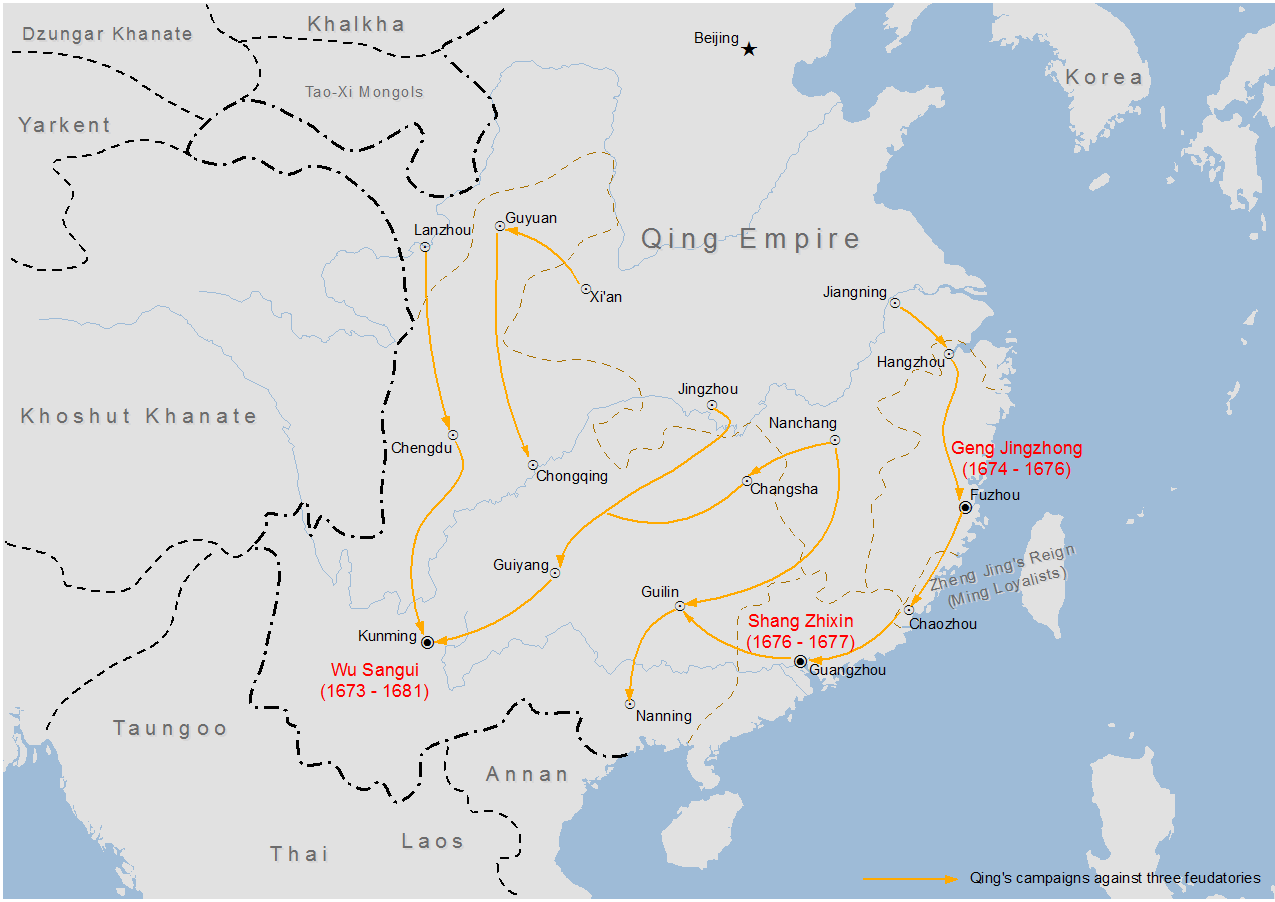
The Revolt of the Three Feudatories, (Chinese: 三藩之亂; pinyin: Sānfān zhī luàn) also known as the Rebellion of Wu Sangui, was a rebellion lasting from 1673 to 1681 in the early Qing dynasty of China, during the reign of the Kangxi Emperor (r. 1661–1722). The revolt was led by Wu Sangui, Shang Zhixin and Geng Jingzhong, the three ethnic Han lords of Yunnan, Guangdong and Fujian provinces whose hereditary titles were given to them for defecting to and helping the Qing dynasty conquer China proper, who rebelled after the Qing central government started abolishing their fiefs. The feudatories were supported by Zheng Jing's Kingdom of Tungning on the island of Taiwan, which sent forces to invade Mainland China. Additionally, minor Han military figures, such as Wang Fuchen, and the Chahar Mongols, also revolted against Qing rule.
Due to their history as defectors that helped to topple the Southern Ming dynasty, the Three Feudatories failed to win over the support of the general Han populace and were eventually defeated by the Qing forces. After the last remaining Han resistance had been put down, the former princely titles were abolished.
After the Qing dynasty from Manchuria conquered China proper, during the reign of the Shunzhi Emperor (1643–1661), the central government's authority was not strong enough to control the provinces in southern China directly. The government initiated a policy of "letting the Han Chinese govern the Han Chinese" (以漢制漢). Some generals of the former Ming dynasty who had surrendered to the Qing were allowed to help govern the provinces in the south.
That was the result of the crucial contributions those generals had made at decisive moments during the Qing conquest of China. For instance, the navy of Geng Zhongming and Shang Kexi brought about the quick capitulation of Joseon in 1636, allowing rapid advance into Ming territories without worrying about what was behind. The defection and subsequent cooperation of Wu Sangui allowed swift capture and settlement of the Ming capital Beijing. In return, the Qing government had to reward their achievements, and acknowledge their military and political influence.
In 1655, Wu Sangui was granted the title of "Pingxi Prince" (平西王; "West Pacifying Prince") and granted governorship of the provinces of Yunnan and Guizhou. Shang Kexi and Geng Zhongming were granted the titles of "Pingnan Prince" and "Jingnan Prince" (both mean "South Pacifying Prince") respectively, and were put in charge of the provinces of Guangdong and Fujian. The three lords had great influence over their lands and wielded far greater power than any other regional or provincial governors. They had their own military forces and had the authority to alter tax rates in their fiefs.
In Yunnan and Guizhou, Wu Sangui was granted permission by the Shunzhi Emperor to appoint and promote his own personal group of officials, as well as the privilege of choosing warhorses first before the Qing armies. Wu Sangui's forces took up several million taels of silver in military pay, a third of the Qing government's total tax revenue. Wu was also in charge of handling the Qing government's diplomatic relationships with the Dalai Lama and Tibet. Most of Wu's troops were formerly Li Zicheng and Zhang Xianzhong's forces and they were well-versed in warfare.
In Fujian province, Geng Zhongming ruled as a tyrant over his fief, allowing his subordinates to extort food supplies and money from the common people. After Geng's death, his son Geng Jimao inherited his father's title and fiefdom, and Geng Jimao was later succeeded by his son Geng Jingzhong.
In Guangdong province, Shang Kexi ruled his fief in a similar fashion to Geng Jingzhong. In total, much of the central government's revenue and reserves were spent on the Three Feudatories, and their expenditure emptied almost half of the imperial treasury. When the Kangxi Emperor came to the throne, he felt that the Three Feudatories posed a great threat to his sovereignty and wanted to reduce their power.
Revolt of the Three Feudatories
The Revolt of the Three Feudatories, (Chinese: 三藩之亂; pinyin: Sānfān zhī luàn) also known as the Rebellion of Wu Sangui, was a rebellion lasting from 1673 to 1681 in the early Qing dynasty of China, during the reign of the Kangxi Emperor (r. 1661–1722). The revolt was led by Wu Sangui, Shang Zhixin and Geng Jingzhong, the three ethnic Han lords of Yunnan, Guangdong and Fujian provinces whose hereditary titles were given to them for defecting to and helping the Qing dynasty conquer China proper, who rebelled after the Qing central government started abolishing their fiefs. The feudatories were supported by Zheng Jing's Kingdom of Tungning on the island of Taiwan, which sent forces to invade Mainland China. Additionally, minor Han military figures, such as Wang Fuchen, and the Chahar Mongols, also revolted against Qing rule.
Due to their history as defectors that helped to topple the Southern Ming dynasty, the Three Feudatories failed to win over the support of the general Han populace and were eventually defeated by the Qing forces. After the last remaining Han resistance had been put down, the former princely titles were abolished.
After the Qing dynasty from Manchuria conquered China proper, during the reign of the Shunzhi Emperor (1643–1661), the central government's authority was not strong enough to control the provinces in southern China directly. The government initiated a policy of "letting the Han Chinese govern the Han Chinese" (以漢制漢). Some generals of the former Ming dynasty who had surrendered to the Qing were allowed to help govern the provinces in the south.
That was the result of the crucial contributions those generals had made at decisive moments during the Qing conquest of China. For instance, the navy of Geng Zhongming and Shang Kexi brought about the quick capitulation of Joseon in 1636, allowing rapid advance into Ming territories without worrying about what was behind. The defection and subsequent cooperation of Wu Sangui allowed swift capture and settlement of the Ming capital Beijing. In return, the Qing government had to reward their achievements, and acknowledge their military and political influence.
In 1655, Wu Sangui was granted the title of "Pingxi Prince" (平西王; "West Pacifying Prince") and granted governorship of the provinces of Yunnan and Guizhou. Shang Kexi and Geng Zhongming were granted the titles of "Pingnan Prince" and "Jingnan Prince" (both mean "South Pacifying Prince") respectively, and were put in charge of the provinces of Guangdong and Fujian. The three lords had great influence over their lands and wielded far greater power than any other regional or provincial governors. They had their own military forces and had the authority to alter tax rates in their fiefs.
In Yunnan and Guizhou, Wu Sangui was granted permission by the Shunzhi Emperor to appoint and promote his own personal group of officials, as well as the privilege of choosing warhorses first before the Qing armies. Wu Sangui's forces took up several million taels of silver in military pay, a third of the Qing government's total tax revenue. Wu was also in charge of handling the Qing government's diplomatic relationships with the Dalai Lama and Tibet. Most of Wu's troops were formerly Li Zicheng and Zhang Xianzhong's forces and they were well-versed in warfare.
In Fujian province, Geng Zhongming ruled as a tyrant over his fief, allowing his subordinates to extort food supplies and money from the common people. After Geng's death, his son Geng Jimao inherited his father's title and fiefdom, and Geng Jimao was later succeeded by his son Geng Jingzhong.
In Guangdong province, Shang Kexi ruled his fief in a similar fashion to Geng Jingzhong. In total, much of the central government's revenue and reserves were spent on the Three Feudatories, and their expenditure emptied almost half of the imperial treasury. When the Kangxi Emperor came to the throne, he felt that the Three Feudatories posed a great threat to his sovereignty and wanted to reduce their power.
Recent media
Recent media