
Recent from talks
Rhea (bird)
Knowledge base stats:
Talk channels stats:
Members stats:
Rhea (bird)
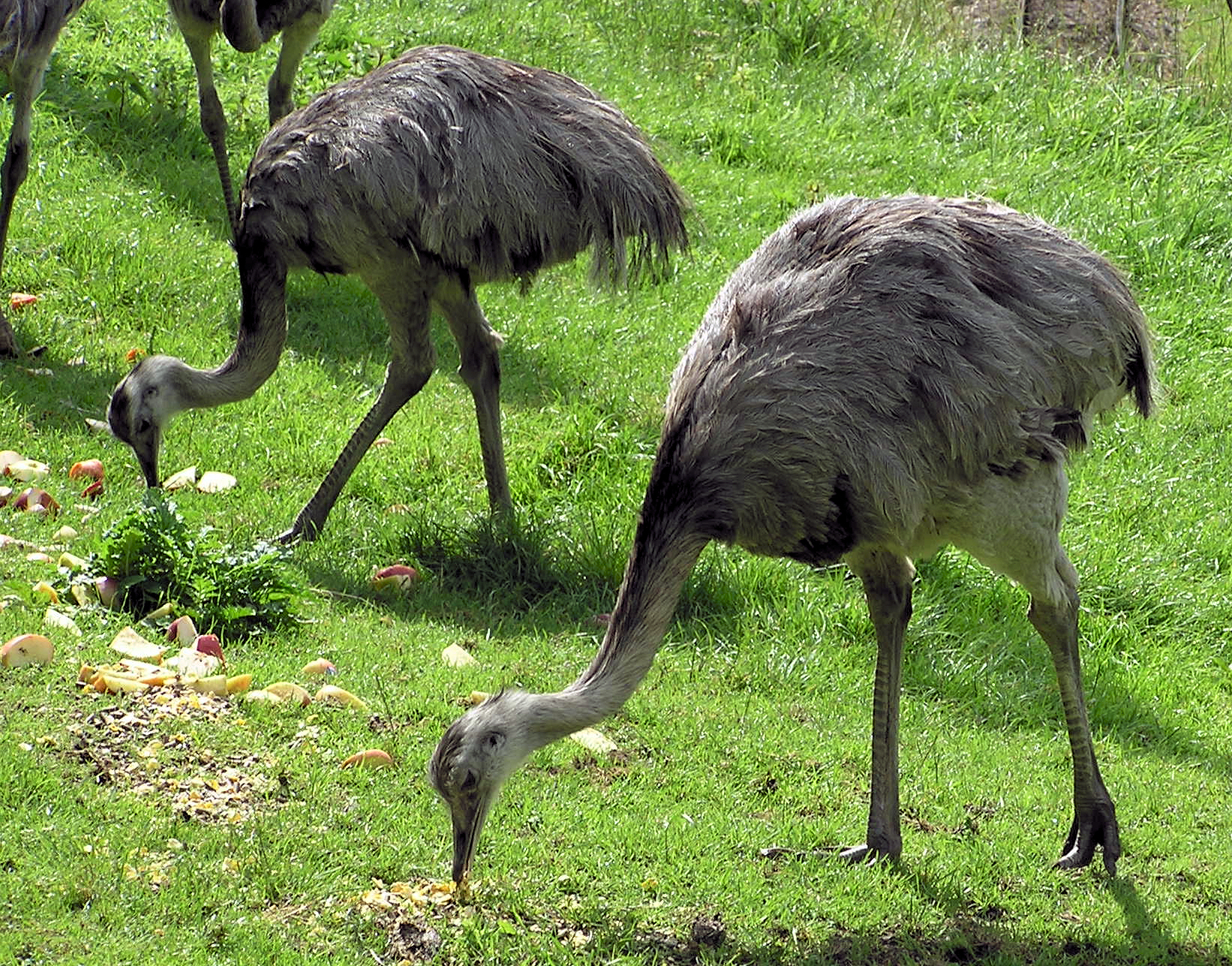
The rhea (/ˈriːə/ REE-ə), also known as the ñandú (/njænˈduː/ nyan-DOO) or South American ostrich, is a South American ratite (flightless bird without a keel on the sternum bone) of the order Rheiformes. Rheas are distantly related to the two African ostriches and Australia's emu (the largest, second-largest and third-largest living ratites, respectively), with rheas placing just behind the emu in height and overall size.
Most taxonomic authorities recognize two extant species: the greater or American rhea (Rhea americana), and the lesser or Darwin's rhea (Rhea pennata). The International Union for Conservation of Nature (IUCN) classifies the puna rhea as another species instead of a subspecies of the lesser rhea. The IUCN currently rates the greater and puna rheas as near-threatened in their native ranges, while Darwin's rhea is of least concern, having recovered from past threats to its survival. In addition, the feral population of the greater rhea in Germany appears to be growing. However, control efforts are underway and seem to succeed in controlling the birds' population growth. Similarly to ostriches and emus, rheas are fairly popular livestock and pets, regularly kept and bred on farms, ranches, private parks, and by aviculturists, mainly in North and South America and Europe.
The name "rhea" was used in 1752 by Paul Möhring and adopted as the English common name. Möhring named the bird after the Greek Titan Rhea, whose Ancient Greek name (Ῥέα) is thought to come from ἔρα (éra, "ground"). This was fitting with the rhea being a flightless ground bird. Depending on the South American region, the rhea is known locally as ñandú guazu (Guaraní –or related Tupi nhandú-gûasú– meaning "big spider" most probably concerning their habit of opening and lowering alternate wings when they run),[citation needed] ema (Portuguese), suri (Aymara and Quechua), or choique (Mapudungun). Nandu is the common name in many European languages and may sometimes be heard in English.
The genus Rhea was introduced by French zoologist Mathurin Jacques Brisson in 1760 with the greater rhea (Rhea americana) as the type species.
The genus contains two extant species and eight subspecies, although one subspecies is disputed:
Rhea pennata was not always in the genus Rhea. In 2008, the SACC, the last holdout, approved merging the genera Rhea and Pterocnemia on August 7, 2008. This merging of genera leaves only the genus Rhea. A former fourth species of rhea, Rhea nana, was described by Lydekker in 1894 based on a single egg found in Patagonia, but today no major authorities consider it valid.
Rheas are large, flightless birds with grey-brown plumage, long legs, and long necks, similar to an ostrich. Large males of R. americana can reach 170 cm (67 in) tall at the head, 100 cm (39 in) at the back and can weigh up to 40 kg (88 lb). The lesser rhea is smaller, with a height of 100 cm (39 in). Their wings are large for a flightless bird (250 cm (8.2 ft)) and are spread while running, to act like sails. Unlike most birds, rheas have only three toes. Their tarsus has 18 to 22 horizontal plates on the front of it. They also store urine separately in an expansion of the cloaca.
Rheas are from South America only and are limited within the continent to Argentina, Bolivia, Brazil, Chile, Paraguay, Peru and Uruguay. They are grassland birds, and both species prefer open land. The greater rheas live in open grasslands, pampas and chaco woodlands. They prefer to breed near water and prefer lowlands, seldom going above 1,500 metres (4,900 ft). On the other hand, the lesser rhea will inhabit most shrubland, grassland, even desert salt puna up to 4,500 metres (14,800 ft).
Hub AI
Rhea (bird) AI simulator
(@Rhea (bird)_simulator)
Rhea (bird)
The rhea (/ˈriːə/ REE-ə), also known as the ñandú (/njænˈduː/ nyan-DOO) or South American ostrich, is a South American ratite (flightless bird without a keel on the sternum bone) of the order Rheiformes. Rheas are distantly related to the two African ostriches and Australia's emu (the largest, second-largest and third-largest living ratites, respectively), with rheas placing just behind the emu in height and overall size.
Most taxonomic authorities recognize two extant species: the greater or American rhea (Rhea americana), and the lesser or Darwin's rhea (Rhea pennata). The International Union for Conservation of Nature (IUCN) classifies the puna rhea as another species instead of a subspecies of the lesser rhea. The IUCN currently rates the greater and puna rheas as near-threatened in their native ranges, while Darwin's rhea is of least concern, having recovered from past threats to its survival. In addition, the feral population of the greater rhea in Germany appears to be growing. However, control efforts are underway and seem to succeed in controlling the birds' population growth. Similarly to ostriches and emus, rheas are fairly popular livestock and pets, regularly kept and bred on farms, ranches, private parks, and by aviculturists, mainly in North and South America and Europe.
The name "rhea" was used in 1752 by Paul Möhring and adopted as the English common name. Möhring named the bird after the Greek Titan Rhea, whose Ancient Greek name (Ῥέα) is thought to come from ἔρα (éra, "ground"). This was fitting with the rhea being a flightless ground bird. Depending on the South American region, the rhea is known locally as ñandú guazu (Guaraní –or related Tupi nhandú-gûasú– meaning "big spider" most probably concerning their habit of opening and lowering alternate wings when they run),[citation needed] ema (Portuguese), suri (Aymara and Quechua), or choique (Mapudungun). Nandu is the common name in many European languages and may sometimes be heard in English.
The genus Rhea was introduced by French zoologist Mathurin Jacques Brisson in 1760 with the greater rhea (Rhea americana) as the type species.
The genus contains two extant species and eight subspecies, although one subspecies is disputed:
Rhea pennata was not always in the genus Rhea. In 2008, the SACC, the last holdout, approved merging the genera Rhea and Pterocnemia on August 7, 2008. This merging of genera leaves only the genus Rhea. A former fourth species of rhea, Rhea nana, was described by Lydekker in 1894 based on a single egg found in Patagonia, but today no major authorities consider it valid.
Rheas are large, flightless birds with grey-brown plumage, long legs, and long necks, similar to an ostrich. Large males of R. americana can reach 170 cm (67 in) tall at the head, 100 cm (39 in) at the back and can weigh up to 40 kg (88 lb). The lesser rhea is smaller, with a height of 100 cm (39 in). Their wings are large for a flightless bird (250 cm (8.2 ft)) and are spread while running, to act like sails. Unlike most birds, rheas have only three toes. Their tarsus has 18 to 22 horizontal plates on the front of it. They also store urine separately in an expansion of the cloaca.
Rheas are from South America only and are limited within the continent to Argentina, Bolivia, Brazil, Chile, Paraguay, Peru and Uruguay. They are grassland birds, and both species prefer open land. The greater rheas live in open grasslands, pampas and chaco woodlands. They prefer to breed near water and prefer lowlands, seldom going above 1,500 metres (4,900 ft). On the other hand, the lesser rhea will inhabit most shrubland, grassland, even desert salt puna up to 4,500 metres (14,800 ft).
Recent media