Hubbry Logo
Richard GerstlRichard GerstlMain
Open search
Richard Gerstl
Community hub
Richard Gerstl
logo
8 pages, 0 posts
0 subscribers
Be the first to start a discussion here.
Richard Gerstl
Richard Gerstl
from Wikipedia

Richard Gerstl ([ˈʁɪçaʁt ɡɛʁstl̩]; 14 September 1883 – 4 November 1908) was an Austrian painter and draughtsman known for his expressive psychologically insightful portraits, his lack of critical acclaim during his lifetime, and his affair with Mathilde Schoenberg, wife of composer Arnold Schoenberg, which led to Gerstl's suicide.

Key Information

Career

[edit]

Richard Gerstl was born in a prosperous civil family to Emil Gerstl, a Jewish merchant, and Maria Pfeiffer, a Gentile woman.[1]

Early in his life, Gerstl decided to become an artist, much to the dismay of his father. After performing poorly in school and being forced to leave the famed Piaristengymnasium in Vienna as a result of "disciplinary difficulties," his financially stable parents provided him with private tutors. In 1898, at the age of fifteen, Gerstl was accepted into the Academy of Fine Arts Vienna, where he studied under the notoriously opinionated and difficult Christian Griepenkerl. Gerstl began to reject the style of the Vienna Secession and what he felt was pretentious art. This eventually prompted his vocal professor to proclaim, "The way you paint, I piss in the snow!"

Self-portrait, 1908, Österreichische Galerie Belvedere

Frustrated with the lack of acceptance of his non-secessionist painting style, Gerstl continued to paint without any formal guidance for two years. For the summers of 1900 and 1901, Gerstl studied under the guidance of Simon Hollósy in Nagybánya. Inspired by the more liberal leanings of Heinrich Lefler, Gerstl once again attempted formal education. Unfortunately, his refusal to participate in a procession in honor of Emperor Franz Joseph I of Austria further ostracized him and led to his departure. Gerstl felt that taking part in such an event was "unworthy of an artist." His final exit from Lefler's studio took place in 1908.

In 1904 and 1905, Gerstl shared a studio with his former academy classmate and friend, Viktor Hammer. Although Hammer had assisted in Gerstl's admittance to Lefler's tutelage and their relationship was friendly, it is difficult to determine how close the two men were as Gerstl did not associate with other artists. Regardless of their personal feelings, by 1906, Gerstl had acquired his own studio.

Art

[edit]

Gerstl was a pioneer of Austrian Expressionism. An exhibition from 7 through 14 July 1907 at the Academy of Fine Arts Vienna is the only known exhibition of his work that occurred during his lifetime. He was radically opposed to and rejected contemporary art practice, namely that of the Jugendstil and Gustav Klimt. He belonged for many years, as a young artist, to the so-called Schoenberg Circle. His proximity to the Viennese avant-garde was appreciable.

Semi-nude Self-portrait against a Blue Background, 1904/5, Leopold Museum

His works were rediscovered in the early 1930s, and their significance was recognized after 1945. Nevertheless, to this day little is known of this representative of the Austrian Expressionists. Sixty of his paintings and 8 drawings, most of which are in the Leopold Museum and the Österreichische Galerie Belvedere, are known to be extant.

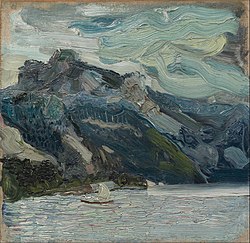
Lakeside Road near Gmunden, 1907

Alois Gerstl, brother of Richard, found canvases and sketches in the artist's atelier, which he left for many years with a forwarding agent. Ultimately, thirty-four paintings were saved from destruction by Otto Kallir, a gallery owner. Kallir bought and restored the paintings, and his 1931 exhibition Richard Gerstl -- A Painter's Destiny caused quite a stir. The exhibition would later appear in Munich, Berlin, and Aachen. He became a key figure for the Austrian art scene, inspiring artists of the post-war era, even still in the time of Viennese Actionism. Since the 1980s, with the inclusion of his work in exhibitions of art from turn-of-the-century Vienna, Gerstl has been recognized in the canon of art history.

The Kamm Collection (Stiftung Sammlung Kamm) of the art gallery Kunsthaus Zug in Zug, Switzerland possesses ten of Gerstl's paintings on eight canvases. They include landscapes and a variety of portraits.[2]

Arnold Schoenberg

[edit]
Arnold Schoenberg by Gerstl, Vienna Museum

Although Gerstl did not associate with other artists, he did feel drawn to the musically inclined; he himself frequented concerts in Vienna. Around 1907, he began to associate with composers Arnold Schoenberg and Alexander von Zemlinsky, who lived in the same building at the time. Gerstl and Schoenberg developed a mutual admiration based upon their individual talents. Gerstl apparently instructed Schoenberg in art.[3]

During this time, Gerstl moved into a flat in the same house and painted several portraits of Schoenberg, his family, and his friends. These portraits also included paintings of Schoenberg's wife Mathilde, Alban Berg and Zemlinsky. His highly stylized heads anticipated German expressionism and used pastels as in the works by Oskar Kokoschka. Gerstl and Mathilde (who was six years his senior) became extremely close and, in the summer of 1908, she left her husband and children to travel to Vienna with Gerstl. Schoenberg was in the midst of composing his Second String Quartet, which he dedicated to her. Mathilde rejoined her husband in October.[3]

Distraught by the loss of Mathilde, his isolation from his associates, and his lack of artistic acceptance, Gerstl entered his studio during the night of 4 November 1908 and apparently burned every letter and piece of paper he could find.[3] Although many paintings survived the fire, it is believed that a great deal of his artwork as well as personal papers and letters were destroyed. Other than his paintings, only eight drawings are known to have survived unscathed. Following the burning of his papers, Gerstl hanged himself in front of the studio mirror and somehow managed to stab himself as well.[4]

The incident had a significant impact on Arnold Schoenberg and his "drama with music" (i.e., opera) Die glückliche Hand is based on these events.

After his suicide at the age of twenty-five, his family took the surviving paintings out of Gerstl's studio and stored them in a warehouse until his brother Alois showed them to the art dealer Otto Kallir in 1930 or 1931. Although Gerstl had never managed to exhibit a show during his lifetime, Kallir organized an exhibition at his Neue Galerie.[5] Shortly afterward, the Nazi presence in Austria hindered the further acclaim of the artist and it was not until after the war that Gerstl was known in the United States. Sixty-six paintings and eight drawings attributed to Gerstl are known, although it is possible he destroyed many more or that others could have been lost over the years.

Selected works

[edit]

References

[edit]

Bibliography

[edit]

Further reading

[edit]
[edit]
Revisions and contributorsEdit on WikipediaRead on Wikipedia
from Grokipedia
Richard Gerstl (14 September 1883 – 4 November 1908) was an Austrian painter and draughtsman renowned as the first exponent of Austrian , whose psychologically intense portraits and landscapes marked a radical departure from the conventions of the Viennese Secession. Born in to a prosperous Jewish Hungarian father and a Czech-German Roman Catholic mother, Gerstl displayed early artistic talent and entered the at age 15, studying under before transferring to Heinrich Lefler's class. His oeuvre, comprising fewer than 100 surviving works, blended influences from , Symbolism, and the styles of and , evolving into a gestural abstraction that anticipated later developments in Art Informel. Despite his innovative approach, Gerstl never exhibited publicly during his lifetime, and his paintings were largely unknown until their rediscovery in 1931 by art dealer Otto Kallir. Gerstl's brief career was defined by his close ties to the composer , whom he befriended in 1906 and tutored in painting while portraying Schoenberg's family in striking portraits, including those of Mathilde Schoenberg and her children. This relationship took a tragic turn in 1908 when Gerstl began an affair with Mathilde, Schoenberg's wife, leading to a scandal that isolated him from their social circle during a summer stay in . The affair's collapse that autumn plunged Gerstl into profound depression, culminating in his on 4 November 1908, at age 25; he stabbed himself repeatedly and hanged himself in his studio, leaving behind a final, haunting self-portrait. His family, embarrassed by the scandal, suppressed details of his life and death for decades. Gerstl's legacy endures through major collections at institutions like the in , which holds the largest assemblage of his works, and retrospective exhibitions such as the 2017 show at the and the 2019 exhibition "Richard Gerstl: Inspiration – Legacy" at the , which highlighted his role as a tortured innovator bridging fin-de-siècle and modernist . His raw, emotive depictions of identity and despair influenced subsequent Austrian artists like and , cementing his status as an enigmatic figure in early history.

Early Life and Education

Birth and Family

Richard Gerstl was born on 14 September 1883 in to Emil Gerstl, a prosperous Jewish merchant of Hungarian origin, and Maria Pfeiffer, a Czech-German woman of Catholic background. The family enjoyed prosperity in the culturally rich environment of late 19th-century , where Emil's successful business provided financial stability and access to the city's artistic milieu. Despite Emil's Jewish heritage, the family raised Gerstl as a Catholic in accordance with Maria's faith, a common practice among assimilated Jewish households seeking greater social integration amid rising in the . This religious orientation, including Gerstl's into Roman Catholicism, reflected broader efforts by mixed-heritage families to navigate Vienna's predominantly Catholic society and avoid discrimination. Gerstl had two older brothers, (born 1880) and (born 1881), both of whom shared the family's bourgeois circumstances. Alois later played a crucial role in safeguarding some of Richard's artworks following his death. The siblings grew up in a home environment that, while not explicitly documented for artistic pursuits, exposed them to Vienna's burgeoning modern culture through everyday urban life and familial resources. From an early age, Gerstl exhibited signs of artistic talent, including a penchant for drawing that his family encouraged by supporting his independent studies rather than traditional schooling. This early inclination set the stage for his admission to the Academy of Fine Arts in 1898.

Studies at the Academy

At the age of fifteen, Richard Gerstl enrolled in the winter semester of 1898/99 at the Academy of Fine Arts Vienna, where he joined the General Painting School led by the conservative professor Christian Griepenkerl. This early admission was facilitated by his family's financial support, allowing him to pursue formal training without immediate economic pressures. Under Griepenkerl's rigorous instruction, Gerstl focused on classical techniques, including meticulous portraiture and landscape painting, which emphasized academic precision and historical references typical of the Ringstrasse era's monumental style. During the summers of 1900 and 1901, Gerstl sought broader influences by attending the painting school of Simon Hollósy in Nagybánya (now , ), where he explored more liberal approaches to plein-air painting and Impressionist principles. This supplementary training contrasted with the Academy's stricter curriculum and began to foster Gerstl's emerging interest in psychological depth, as he started to infuse traditional forms with introspective elements drawn from contemporary exhibitions of artists like and . His unconventional methods, however, led to tensions; Gerstl's rejection of the Secession's stylized aesthetics—viewing them as pretentious—infuriated Griepenkerl, who famously derided his student's work as resembling "pissholes in the snow" and unfit for the institution. In July 1901, following these escalating conflicts, Gerstl left Griepenkerl's class to pursue . After a period of independent work, Gerstl returned to the in , joining the more liberal Special School for under Heinrich Lefler, who had been impressed by Gerstl's earlier portraits. Under Lefler, Gerstl continued to develop his style, though tensions arose again over artistic and institutional matters, including Gerstl's criticism of Lefler's acceptance of official commissions. These conflicts culminated in Gerstl walking out of Lefler's studio in , marking the end of his formal Academy training. This break allowed him to refine his technical foundations while experimenting beyond the classical mold, laying the groundwork for his later innovations.

Artistic Career

Early Works and Exhibitions

Following his departure from the Academy of Fine Arts in 1901, Richard Gerstl established an independent studio in , where he pursued his artistic development outside the conventional academic and Secessionist frameworks. His early output from 1902 to 1906 primarily comprised portraits and self-portraits that retained traces of his academic training, such as precise facial rendering and structured compositions, while gradually incorporating bolder colors and more experimental brushwork influenced by his exposure to Post-Impressionist exhibitions, including Vincent van Gogh's show at Galerie Miethke in January 1906. Landscapes began to appear in this period, with works like (spring 1906) demonstrating a shift toward vibrant, atmospheric effects that departed from academic restraint. Gerstl's stylistic experiments led to tensions with his professor , resulting in his departure from the Academy in 1901; he briefly studied with Heinrich Lefler before leaving academic frameworks altogether and facing broader from Vienna's art establishment, which viewed his innovations as alien and disruptive. Key early pieces, such as the Semi-Nude Self-Portrait (1902/04 or 1904/05), exemplified his growing self-exploration through vulnerable, frontal poses against luminous backgrounds, blending Symbolist elements with a confident, existential that foreshadowed his psychological intensity. This , measuring 159 × 109 cm and held in the , features tentative sketch-like strokes in areas like the loincloth, contrasting with the precise depiction of his face, marking it as one of his most radical early statements. Gerstl's sole attempt at public exposure was an invitation to participate in a group exhibition of approximately 20 works at Galerie Miethke in July 1907, which he declined due to dissatisfaction with shared billing alongside , underscoring his isolation from the art world. Despite family wealth providing stability, Gerstl faced ongoing professional rejection, working largely in seclusion until his death.

Mature Period and Themes

Gerstl's artistic evolution reached its zenith between 1906 and 1908, marking a decisive shift toward Austrian characterized by distorted forms, vibrant techniques, and bold, intense colors that conveyed raw emotional depth. This period saw him abandon earlier influences like and Symbolism in favor of a more radical, unorthodox style that emphasized psychological introspection over conventional beauty, defying the decorative elegance of contemporaries such as . His landscapes and figure paintings during these years incorporated chaotic abstraction and blurry, mask-like features, anticipating aspects of later while rooting firmly in the expressive turmoil of early 20th-century . Central to this mature phase were introspective themes exploring identity, isolation, and , often rendered through portraits that vibrated with , conflict, and vulnerability. Influenced by underlying personal turmoil, Gerstl's works delved into the fragmented self, using scarred canvases and layered pigments to evoke a sense of inner isolation without resorting to narrative specificity. For instance, his self-portraits from this era, such as the Self-Portrait, Laughing (1907), juxtapose exaggerated expressions with distorted anatomy to probe erotic tension and existential solitude, distinguishing his output from the more stylized of . These themes reflected a broader preoccupation with the psyche's darker facets, achieved through freehand application that prioritized emotional authenticity over polished form. Only a limited body of work from this period survives, comprising approximately 60 paintings and a small number of drawings, the majority of which are emotionally charged portraits that underscore Gerstl's innovative intensity. Despite their nature, these pieces received scant critical attention during Gerstl's lifetime, as his radical departure from Secessionist norms led to professional isolation and no major exhibitions, in stark contrast to the acclaim garnered by Klimt's ornate symbolism or Schiele's provocative linearity. This neglect highlighted the edge of his , which prioritized visceral psychological insight over commercial viability.

Relationship with Arnold Schoenberg

Friendship and Artistic Exchange

Richard Gerstl met in 1906 when the composer invited him to his home in to teach painting. Gerstl, already developing his mature Expressionist style characterized by bold colors and psychological depth, quickly admired Schoenberg's innovative music, seeing parallels between the composer's radical harmonic experiments and his own visual disruptions of traditional form. This mutual respect fostered a professional bond, with Gerstl viewing Schoenberg as a modernist kindred spirit pushing boundaries in their respective arts. A key element of their artistic exchange was the creation and reciprocation of portraits between 1906 and 1908. Gerstl painted Schoenberg in a striking 1906 that captured the composer's intense gaze and introspective demeanor, emphasizing psychological nuances through distorted proportions and vivid . He followed with portraits of Schoenberg's , Mathilde, in 1907, and their daughter, Gertrud, in 1908, each work delving into the sitters' emotional interiors with raw, expressive brushwork that mirrored Schoenberg's atonal explorations. In return, Schoenberg, who briefly pursued under Gerstl's guidance, produced amateurish but sincere sketches of the artist, symbolizing their collaborative spirit. Their friendship extended to shared intellectual discussions on the intersections of and , often held during summer gatherings in in 1907 and 1908. Gerstl and Schoenberg debated the role of emotion and innovation in creative expression, with Gerstl drawing inspiration from Schoenberg's atonal and radical harmonic experiments to inform his own abstracted compositions. These conversations highlighted their aligned visions of , free from academic constraints. Gerstl also took on a brief teaching role within Schoenberg's circle, instructing the composer in painting techniques to complement his musical pursuits. This fostered creative dialogue, as Gerstl encouraged the group to explore visual parallels to their sonic innovations, enriching the cross-pollination between disciplines.

Affair with Mathilde and Breakdown

In the summer of 1908, Richard Gerstl's close association with the Schoenberg evolved into a romantic affair with Mathilde Schoenberg, Arnold's wife, which was foreshadowed by the increasingly intimate portraits he had painted of her in prior months. The relationship intensified during a , culminating in a brief after their liaison was discovered by Arnold in late August. Mathilde's temporary separation from her husband and their two young children triggered a profound crisis, as Arnold grappled with the betrayal while facing financial and emotional strain. Despite initial persuasion from family and friends, Mathilde returned to Arnold and their children by early September, effectively ending the affair and leaving Gerstl abandoned. This reconciliation, while stabilizing the Schoenberg household, deepened the rift between Gerstl and Arnold, who issued vehement accusations of against his former friend and protégé. By 1908, the ties were irrevocably severed, with Arnold excluding Gerstl from social and artistic events, including a key concert on November 4. The scandal reverberated through Vienna's insular art circles, where Gerstl's actions were viewed as a grave moral transgression, amplifying his emotional isolation as former allies distanced themselves to avoid association with the controversy. This sudden loss of his primary social and professional network, coupled with the humiliation of rejection, precipitated a severe decline in Gerstl's , marked by profound despair and withdrawal.

Death and Legacy

Suicide and Destruction of Works

On November 4, 1908, Richard Gerstl, aged 25, took his own life in his studio at Liechtensteinstraße 20 by hanging himself with a rope and stabbing his chest with a knife, an act precipitated by the collapse of his affair with Mathilde Schoenberg. In the days leading up to his death, overwhelmed by despair and a desire for oblivion following his from the Schoenberg circle, Gerstl burned a significant portion of his paintings, drawings, and papers in his studio. Gerstl's body was discovered the following morning, November 5, by a family servant, who found him naked in front of a full-length mirror, with the around his neck and the knife embedded in his chest; the official was recorded as "unsound mind." Due to Gerstl's obscurity as an artist who had never exhibited publicly, his received minimal attention in the press at the time, with reports limited to brief notices of the event. In the immediate aftermath, Gerstl's family, particularly his brother , responded by concealing the role of the scandalous affair in his , officially attributing it to mental to avoid further . The remaining works were packed into crates and stored away by the family, preserving what survived the destruction but keeping them out of public view for years. Gerstl was buried on November 7, 1908, in Vienna's Sievering Cemetery.

Rediscovery and Posthumous Recognition

Following Richard Gerstl's suicide in 1908, his surviving works—greatly reduced by his own destruction of much of his output—were stored in a by his brother , who managed the family's modest collection amid financial strains. In 1931, unable to cover ongoing storage costs, approached art dealer Otto Kallir, presenting a selection of paintings that Kallir immediately recognized for their innovative intensity. Kallir acquired and restored the pieces, organizing Gerstl's first posthumous exhibition at his Neue Galerie in that same year, which generated significant critical attention and marked the initial step in rescuing the artist from obscurity. After , Gerstl's reputation solidified as a pioneering figure in Austrian , with his bold, emotive style positioned as a precursor to the movement's development. Kallir, having fled to the , promoted Gerstl's work through his Galerie St. Etienne, facilitating international exposure and establishing the artist's place in modern art narratives. From the 1980s onward, Gerstl's paintings appeared in major institutional surveys of and Viennese , including permanent holdings at the , which acquired key works and integrated them into its collection of early 20th-century Austrian art. Gerstl's influence extended to subsequent generations, notably shaping the psychological depth and raw expressiveness seen in Egon Schiele's portraits, as Gerstl's pre-1910 innovations anticipated Schiele's mature style. Biographies have gradually uncovered more about his family background, highlighting his Jewish paternal heritage—his father was a prosperous —contrasted with his Catholic upbringing via his mother's side, a duality that contributed to the suppression of his work during the Nazi era following Austria's annexation. This mixed heritage rendered his oeuvre ideologically suspect under Nazi cultural policies, leading to temporary exclusion from public view until postwar reevaluations. No significant new discoveries or dedicated exhibitions of Gerstl's work have emerged between 2020 and 2025, reflecting the finite nature of his surviving corpus. Nonetheless, scholarly interest persists, particularly in his psychologically penetrating portraits that probe inner turmoil and identity, with recent addressing gaps in pre-1900 family influences, such as his early exposure to bourgeois Viennese cultural circles. These efforts, drawn from family correspondences and institutional records, have enriched understandings of how his upbringing informed his radical artistic departure from academic norms.

Selected Works

Self-Portraits

Richard Gerstl's self-portraits form a pivotal body of work that reveals his deepening and psychological intensity, often executed in with bold, gestural brushwork that emphasizes raw emotional states over conventional realism. These paintings employ symbolic color palettes—such as dominant blues and greens—to evoke isolation and inner conflict, marking an evolution toward a mature Expressionist style characterized by distorted forms and exaggerated expressions. Their rarity underscores their centrality to autobiographical themes, as Gerstl destroyed much of his oeuvre before his death, leaving these as key windows into his psyche. One of the earliest surviving self-portraits, Semi-Nude Self-Portrait Against a Blue Background (c. 1902–1904), captures Gerstl in a vulnerable pose, his body partially draped and illuminated against a luminous expanse that creates an ethereal aura, suggesting both fragility and an inner . The medium allows for textured, immediate application of paint, with distorted —elongated limbs and a contemplative gaze—conveying a sense of personal exposure and early experimentation with color's emotional weight, housed today in the Leopold Museum in Vienna. This work's tonality not only isolates the figure but also foreshadows the psychological depth in his later output, blending vulnerability with a nascent boldness in form. By 1907–1908, Gerstl's self-portraits intensified, reflecting escalating emotional turmoil through more exaggerated and dynamic compositions. Self-Portrait, Laughing (1907), for instance, depicts the artist with an open-mouth, almost manic grin against a chaotic background, using vibrant greens, creams, and oranges in loose, expressive strokes to blend hilarity with underlying hysteria, now in the Belvedere Museum. Nude variants from this period, such as Nude Self-Portrait with Palette (1908), portray Gerstl holding his tools in a stark, angular pose reminiscent of modernist fragmentation, with sharp definitions and a palette dominated by cool tones that heighten the sense of alienation and self-scrutiny. These pieces employ and fingerwork for thick , amplifying the raw, unfiltered quality of his isolation. The culminating Self-Portrait, Nude, Full-Length (September 1908), painted just weeks before his , stands as a shocking pinnacle of this series, showing Gerstl entirely nude in clammy blue tones with brown accents on the genitals, his body rigidly frontal and arms outstretched in a pose echoing figures like Christ, applied with hurried, gestural marks that convey desperation and final self-assertion. This work's symbolic nudity and distorted proportions—melted facial features against an abstract backdrop—reveal profound turmoil, positioning it as a pioneering Expressionist nude self-portrait after , with charged colors and bold brushwork anticipating . Through these self-portraits, Gerstl not only documented his inner world but also pushed stylistic boundaries, using as a for modernist innovation.

Portraits of Others

Richard Gerstl's portraits of others reveal his profound interest in psychological depth, often employing expressive distortions to convey inner emotional states rather than mere physical likeness. Primarily executed in , these works demonstrate his versatility across subjects, from close acquaintances in the Schoenberg circle to his own family members, using stark lighting, bold color contrasts, and fragmented forms to highlight personal intensity and vulnerability. One of his most notable commissions arose from his friendship with composer , who sought painting instruction from Gerstl in 1906 and requested portraits to support the artist's career. The (1907), an oil on canvas, captures the composer's intellectual fervor through stark, dramatic lighting that accentuates his sharp features and intense gaze, with expressive line work emphasizing psychological tension. This work exemplifies Gerstl's early Expressionist approach, blending realistic rendering with subtle distortions to reveal the subject's inner complexity. In The Schoenberg Family (1908), another oil painting, Gerstl depicts Arnold, his wife Mathilde, and their children Gertrud and Georg in a group composition that portrays domestic harmony amid underlying turmoil. The figures' faces are blurred into abstract masks with splotchy eyes and mouths, achieved through thick, rapid brushstrokes and applications, distorting features to evoke emotional rawness and familial bonds strained by impending scandal. Bathed in vibrant yellows and greens, the portrait uses chaotic backgrounds to heighten the sense of psychological unrest, marking a shift toward more radical . Gerstl's portraits extended to other acquaintances and , showcasing his ability to adapt his technique to varied subjects while maintaining a focus on emotional truth. For instance, Portrait of the Father, Emil Gerstl (1906), a large-scale , shows his father seated in a bourgeois interior, rendered with Secessionist planarity, Pointillist dotted brushwork, and complementary violet-yellow contrasts that highlight light effects and a sense of restrained authority. Similarly, Smaragda Berg (1906/07), portraying the sister of composer from the Schoenberg circle, features the subject in an upper-class setting with a direct, engaging gaze; Gerstl employs geometrized color bands and Impressionist dissolved dots to convey her poised yet introspective demeanor, underscoring interpersonal dynamics through planar composition. These works illustrate Gerstl's consistent use of facial and formal distortions—such as angular lines and uneven lighting—to prioritize inner psychological states over conventional representation.

References

Add your contribution
Related Hubs
User Avatar
No comments yet.