


Community hub
Recent from talks
Contribute something
Nothing was collected or created yet.
Arrian
View on Wikipedia
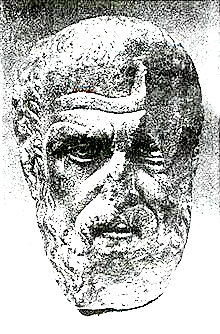
Arrian of Nicomedia (/ˈæriən/; Greek: Ἀρριανός Arrianos; Latin: Lucius Flavius Arrianus;[2] c. 86/89 – c. after 146/160 AD)[3][4] was a Greek historian, public servant, military commander, and philosopher of the Roman period.[4]
Key Information


The Anabasis of Alexander by Arrian is considered the best source on the campaigns of Alexander the Great. Scholars have generally preferred Arrian to other extant primary sources, though this attitude has changed somewhat in light of modern studies into Arrian's method.[5][6]
Arrian's life
[edit]Arrian was born in Nicomedia (present-day İzmit), the provincial capital of Bithynia. Cassius Dio called him Flavius Arrianus Nicomediensis. Sources provide similar dates for his birth, within a few years prior to 90, 89, and 85–90 AD. The line of reasoning for dates belonging to 85–90 AD is because of Arrian being made a consul around 130 AD, and the usual age for this, during this period, being 42 years of age. (ref. pp. 312, & SYME 1958, ibid.). His family was from the Greek provincial aristocracy, and his full name, L. Flavius Arrianus, indicates that he was a Roman citizen, suggesting that the citizenship went back several generations, probably to the time of the Roman conquest some 170 years before.[4][7][8][9][10][11][12]
Sometime during the second century AD (117 to 120 AD) while in Epirus, probably Nicopolis, Arrian attended lectures of Epictetus of Nicopolis, and proceeded within a time to fall into his pupillage, a fact attested to by Lucian. All that is known about the life of Epictetus is due to Arrian, in that Arrian left an Encheiridion (Handbook) of Epictetus' philosophy. After Epirus, he went to Athens, and while there, he became known as the "young Xenophon" as a consequence of the similarity of his relationship to Epictetus as Xenophon had to Socrates.[13][14][15][16][17][18][19][20]
For a period, some time about 126 AD, he was a friend of the emperor Hadrian's, who appointed him to the Senate. He was appointed to the position consul suffectus around 130 AD, and then, in 132 AD (although Howatson shows 131), he was made prefect or legate (governor) of Cappadocia by Hadrian, a service he continued for six years. Historian Cassius Dio states that not long after the Bar Kokhba revolt in Judea had been quelled, in 135 AD, King Pharasmanes II of Iberia caused the Alani to invade neighbouring territories, including Cappadocia, where their advance was robustly halted by Arrian's legions.
A second war was begun by the Alani (they are Massagetae) at the instigation of Pharasmanes. It caused dire injury to the Albanian territory and Media, and then involved Armenia and Cappadocia; after which, as the Alani were not only persuaded by gifts from Vologaesus, but also stood in dread of Flavius Arrianus, the governor of Cappadocia, it came to a stop.[21]
Arrian referred to himself as "the second Xenophon", on account of his reputation and the esteem in which he was held. Lucian stated him to be:[17][22]
a Roman of the first rank with a life-long attachment to learning
— quote of Lucian in P. E. Easterling, B. M. W. Knox, p. 143
This quality is identified as paideia (παιδεία), which is the quality considered to be of one who is known as an educated and learned personage, i.e., one who is highly esteemed and important.[17][23][24][25][26][27]
Works
[edit]
He produced eight extant works (cf. Syvänne, footnote of p. 260). The Indica and the Anabasis are the only works completely intact. His entire remaining oeuvre is known as FGrH 156 to designate those collected fragments that exist.[13][28][29][30]
Periplus of the Euxine Sea
[edit]This work is the earliest extant work that is dated with any confidence. It is a writing addressed to Emperor Hadrian.[31][32][33]
Discourses of Epictetus and Enchiridion of Epictetus
[edit]Arrian was a pupil of Epictetus around 108 AD, and, according to his own account, he was moved to publish his notes of Epictetus' lectures, which are known as Discourses of Epictetus, by their unauthorized dissemination.[14][34] According to George Long, Arrian noted from Epictetus' lectures for his private use and some time later made of these, the Discourses. Photius states that Arrian produced two books the Dissertations and the Discourses. The Discourses are also known as Diatribai and are apparently a verbatim recording of Epictetus' lectures.[35][36][37]
The Enchiridion is a short compendium of all Epictetus' philosophical principles. It is also known as a handbook, and A Mehl considers the Enchiridion to have been a vade mecum for Arrian. The Enchiridion is apparently a summary of the Discourses.[7][15][28][38][35]
JB Stockdale considered that Arrian wrote eight books of which four were lost by the Middle Ages[clarification needed] and the remaining ones became the Discourses. In a comparison of the contents of the Enchiridion with the Discourses, it is apparent that the former contains material not present within the latter, suggesting an original lost source for the Enchiridion.[14][39][40]
Homiliai Epiktetou
[edit]Friendly conversations with Epictetus (Homiliai Epiktetou) is a 12 book work mentioned by Photius in his Bibliotheca, of which only fragments remain.[16][19]
Anabasis of Alexander
[edit]The Anabasis of Alexander comprises seven books.[16] Arrian used Xenophon's account of the March of Cyrus as the basis for this work.[41]
Ta met' Alexandron
[edit]History of the Diadochi or Events after Alexander is a work originally of ten books; a commentary on this work was written by Photius (FW Walbank, p. 8).[28][42][3][43]
Three extant fragments are the Vatican Palimpsest (of the 10th century AD), PSI 12.1284 (Oxyrhynchus), and the Gothenburg palimpsest (of the 10th century also), these possibly stemming originally from Photius.[3][16][44]
The writing is about the successors of Alexander the Great, circa 323 – 321 or 319.
Parthica
[edit]A lost work of seventeen books, fragments of Parthica were maintained by the Suda and Stephanus of Byzantium. The work survives only in adaptations made later by Photius and Syncellus. Translated, the title is History of the Parthians. Arrian's aim in the work was to set forth events of the Parthian war of Trajan. The writing mentioned that the Parthians trace their origins to Artaxerxes II.[45][46][47][48][49]
Bithyniaca
[edit]A work of eight books, Bibliotheca (via Photius) states it is the fourth to have been written by Arrian.[46][50]
Indica
[edit]Indica is a work on a variety of things pertaining to India, and the voyage of Nearchus in the Persian Gulf. The first part of Indica was based largely on the work of the same name of Megasthenes, the second part based on a journal written by Nearchus.[51][52][53][20]
Techne Taktike
[edit]Written 136/137 AD (in the 20th year of Hadrian[31]), Techne Taktike ('the art/craft of tactics') is a treatise on Roman cavalry and military tactics, and includes information on the nature, arms and discipline of the phalanx. The hippika gymnasia is a particular concern of Arrian in the treatise.[46][54][55][56][57][58][59][60]
Another translation of the title is Ars tactica, which, in Greek, is Τέχνη τακτική.[61][62]
This work has generally been considered in large part a panegyric to Hadrian, written for the occasion of his vīcennālia, although some scholars have argued that its second half may have had practical use.[63][64]
Kynēgetikos
[edit]Cynegeticus (Κυνηγετικός),[65] translated as A treatise on hunting with hounds, On Hunting, or On Coursing,[66][35] is a work about the Celtic sport of coursing hare with sighthounds, specifically the Celtic greyhounds: in Greek (plural) ouertragoi, in Latin (plural) vertragi.[67][68][69][70][71][72][73]
The work was inspired by and designed as an addition to an earlier exposition made by Xenophon, whom Arrian recognised to be the Ancient Greek authority on the subject of hunting with scent hounds.[74][75]
Ektaxis kata Alanon
[edit]Ektaxis kata Alanon (Ἔκταξις κατὰ Ἀλανῶν) is a work of a now fragmentary nature; the title is translated as Deployment against the Alani or The order of battle against the Alans or referred to simply as Alanica. It is thought not have been written as a presentation of facts but for literary reasons. Pertaining to the relevant historical facts, though, while governor of Cappadocia, Arrian repelled an invasion of the Alani sometime during 135 AD, a struggle in which Arrian's two legions were victorious.[76][77][78][52][79][80][81][82]
Within the work, Arrian explicitly identified the particular means of pursuing warfare as being based on Greek methods.[83][84][85]
Ektaxis kata Alanon is also translated as Acies contra Alanos. The work was known for a time as A History of the Alani (Alanike via Photius[52]). A fragment describing a plan of battle against the Alani was found in Milan around the 17th century which was thought at that time to belong to the History.[86]
Biographical series
[edit]There were also a number of monographs or biographies, including of Dion of Syracuse, Timoleon of Corinth, and Tilliborus, a brigand or robber of Asia Minor, which are now lost.[87][88][89][90][91]
Sources, transmission, translations and publications
[edit]Everything known of his life derives from the 9th century writing of Photius in his Bibliotheca, and from those few references which exist within Arrian's own writings. The knowledge of his consulship, is derived at the least from literature produced by Suidas. Arnobius (c. 3rd century AD[92]) mentions Arrian. Arrian was also known of by Aulus Gellius. Pliny the Younger addressed seven of his epistles to him. Simplicius made a copy of the Enchiridion, which was transmitted under the name of the monastic father Nilus during the 5th century, and as a result found in every monastery library.[16][7][93][14][94]
Nicholas Blancard made translations of Arrian in 1663 and 1668.[95]
The voyage of Nearchus and Periplus of the Erythrean Sea were translated from the Greek by the then Dean of Westminster, William Vincent, and published in 1809. Vincent published a commentary in 1797 on The voyage of Nearchus. The work was also translated into French by M. Billecocq, under the auspices of the government (cf. p. 321).[96]
References
[edit]- ^ "Arrian". www.britannica.com. Retrieved 7 January 2010.
Arrian born c. AD 86, Nicomedia, Bithynia [now İzmit, Tur.] died c. AD 160, Athens? [Greece].
- ^ Stadter's suggestion that his official name was Lucius Flavius Arrianus Xenophon (Stadter, Philip (1967). "Flavius Arrianus: The New Xenophon". Greek, Roman and Byzantine Studies. ProQuest 1301492487. Retrieved 14 April 2016.) is disproven by epigraphic evidence: Bowie, E. L. “Greeks and Their Past in the Second Sophistic.” Past & Present, 46 (1970): 25 n. 72.
- ^ a b c F. W. Walbank, ed. (1984). The Cambridge Ancient History. Cambridge University Press. ISBN 052123445X. Retrieved 1 April 2015.
- ^ a b c "Arrian". www.britannica.com. Retrieved 7 January 2010.
Arrian (born c. ad 86, Nicomedia, Bithynia [now İzmit, Turkey] died circa 160, Athens, [Greece]) Greek historian and philosopher, who was one of the most distinguished authors of second-century Roman Empire.
Wolfgang Haase; Hildegard Temporini (1990). Aufstieg und Niedergang der römischen Welt: Geschichte und Kultur Roms im Spiegel der neueren Forschung, Volume 2; Volume 34. Walter de Gruyter. p. 228. ISBN 3110103761.Arrian was of Greek stock, from the provincial aristocracy of Bithynia. His full name, L. Flavius Arrianus, demonstrates that he was a Roman citizen and suggests that the citizenship went back several generations, probably to the triumphal period. Arrian's home city was the Bithynian capital, Nicomedia, where he held the priesthood of Demeter and Kore, its patron deities.
Arrian; Sélincourt, Aubrey De (1971). The campaigns of Alexander. Penguin Classics. p. 13. ISBN 0140442537.Flavius Arrianus Xenophon, to give him his full name, was a Greek, born at Nicomedia, the capital of the Roman province of Bithynia, probably a few years before AD 90.
Grant, Michael (1992). Readings in the classical historians. Scribner's. p. 544. ISBN 0684192454.Arrian: Greek Historian ... was an approximate contemporary of Appian, born about AD 95. Like him a Greek, he came from Nicomedia (İzmit) in Bithynia (north-western Asia-Minor) where his family was prominent.
- ^ Heckel, Waldemar (2004). The History of Alexander. Penguin. pp. 5 & 269.
- ^ Bosworth, A.B. (1976). "Errors in Arrian". Classical Quarterly. 26: 117–139. doi:10.1017/s0009838800033905. S2CID 170453455.
- ^ a b c Le Clerc, Jean; Rooke, John. Arrian's History of Alexander's expedition. Translated from the Greek. With notes historical, geographical, and critical. By Mr. Rooke. To which is prefix'd, Mr. Le Clerc's Criticism upon Quintus Curtius. And some remarks upon Mr. Perizonius's vindication of the author. London, Printed for T. Worrall etc., etc. 1729. Retrieved 6 April 2015.
- ^ N. G. L. Hammond (2007). Sources for Alexander the Great: An Analysis of Plutarch's 'Life' and Arrian's 'Anabasis Alexandrou'. Cambridge University Press. ISBN 978-0521714716. Retrieved 4 April 2015.
- ^ EL Bowie (2002). PA Stadter; L. Van der Stockt (eds.). Sage and Emperor: Plutarch, Greek Intellectuals, and Roman Power in the Time of Trajan (98–117 A.D.). Leuven University Press. ISBN 9058672395. Retrieved 4 April 2015.
- ^ Wolfgang Haase, ed. (1993). Aufstieg und Niedergang der Römischen Welt: Teil II Principat [Rise and Decline of the Woman World: Part II: Principate]. Vol. 34. Walter de Gruyter. ISBN 3110103761. Retrieved 4 April 2015.
- ^ FP Polo (2011). The Consul at Rome: The Civil Functions of the Consuls in the Roman Republic. Cambridge University Press. ISBN 1139495992 [Retrieved 2015-04-04] (ed. used p. 1–3 to identify nature of < consulship >)
- ^ "Arrian". www.britannica.com. Retrieved 7 January 2010.
Arrian (born c. ad 86, Nicomedia, Bithynia [now İzmit, Tur.] died c. 160, Athens? [Greece]) Greek historian and philosopher who was one of the most distinguished authors of the second-century Roman Empire.
Wolfgang Haase; Hildegard Temporini (1990). Aufstieg und Niedergang der römischen Welt: Geschichte und Kultur Roms im Spiegel der neueren Forschung, Volume 2; Volume 34. Walter de Gruyter. p. 228. ISBN 3110103761.Arrian was of Greek stock, from the provincial aristocracy of Bithynia. His full name, L. Flavius Arrianus, demonstrates that he was a Roman citizen and suggests that the citizenship went back several generations, probably to the triumphal period. Arrian's home city was the Bithynian capital, Nicomedia, where he held the priesthood of Demeter and Kore, its patron deities.
Arrian; Sélincourt, Aubrey De (1971). The campaigns of Alexander. Penguin Classics. p. 13. ISBN 0140442537.Flavius Arrianus Xenophon, to give him his full name, was a Greek, born at Nicomedia, the capital of the Roman province of Bithynia, probably a few years before A.D. 90.
Grant, Michael (1992). Readings in the classical historians. Scribner's. p. 544. ISBN 0684192454.Arrian: Greek Historian: [...] an approximate contemporary of Appian, born about AD 95. Like him a Greek, he came from Nicomedia in Bithynia (north-western Asia-Minor) where his family was prominent.
- ^ a b I Syvänne (2013). Philosophers of War: The Evolution of History's Greatest Military Thinkers [2 Volumes]: The Evolution of History's Greatest Military Thinkers. ABC-CLIO. ISBN 978-0313070334. Retrieved 1 April 2015.
- ^ a b c d Hans-Josef Klauck (2003). Religious Context of Early Christianity: A Guide To Graeco-Roman Religions. A&C Black (reprint, revised). p. 350. ISBN 0567089436. Retrieved 6 April 2015.
- ^ a b JS Romm (2005). Alexander The Great: Selections from Arrian, Diodorus, Plutarch, and Quintus Curtius. Hackett Publishing. p. xix. ISBN 1603843337. Retrieved 8 April 2015.
- ^ a b c d e EJ Chinnock. The Anabasis of Alexander or, The History of the Wars and Conquests of Alexander the Great. Hodder & Stoughton 1884 (Project Gutenberg – 27 September 2014). Retrieved 5 April 2015.
- ^ a b c P. E. Easterling; B. M. W. Knox (1989). The Cambridge History of Classical Literature: Volume 1, Greek Literature, Part 4, The Hellenistic Period and the Empire. Cambridge University Press. pp. 143–. ISBN 0521359848. Retrieved 5 April 2015.
- ^ Oxford Dictionaries: attest, pupilage Oxford University Press [Retrieved 5 April 2015]
- ^ a b G Long, Epictetus (2010). Enchiridion and Selections from the Discourses of Epictetus. Digireads.com Publishing. p. 6. ISBN 978-1420935226. Retrieved 3 April 2015.[permanent dead link]
- ^ a b JW McCrindle (1816). The Invasion of India by Alexander the Great, pp. 9–10. Retrieved 3 April 2015.
- ^ Cassius Dio. Historia Romana. 69.15.1.
- ^ Peter Beckford (... perhaps, the writing is slightly illegible) or a Country Squire – Essays on Hunting. Containing a philosophical enquiry into the nature and properties of the scent; observations on ... hounds ... also directions for the choice of a hunter, etc., extracted from “An Essay on Hunting, by a Country Squire,” published in 1733., With Six letters upon Hunting” by J. S. Gardiner., With an introduction by the editor, W. Blane, p. xvii Southampton T. Baker and others 1781 [Retrieved 2 April 2015] (ed. this source not the first source for ed. of this factor)
- ^ S Swain (1996). Hellenism and Empire: Language, Classicism, and Power in the Greek World, AD (pp. 328ff.). Oxford University Press. ISBN 0198147724. Retrieved 5 April 2015.
- ^ definitions of paideia – Merriam-Webster, University Press[dead link] [Retrieved 5 April 2015]
- ^ Werner Jaeger (translated by Gilbert Highet), Paideia: The Ideals of Greek Culture: II. In Search of the Divine Centre Volume 2 of Paideia: The Ideals of Greek Culture Oxford University Press, 23 October 1986 (reprint – 1st published 1943) ISBN 0195040473 [Retrieved 5 April 2015]
- ^ Perseus Project: Latin Word Study Tool: paideia [Retrieved 5 April 2015]
- ^ Oxford Dictionaries: personage Oxford University Press [Retrieved 5 April 2015]
- ^ a b c A Mehl (2011). Roman Historiography. John Wiley & Sons. ISBN 978-1405121835. Retrieved 6 April 2015. (ed. this the first source for < History of the Diadochi >)
- ^ R Waterfield (2012). Dividing the Spoils: The War for Alexander the Great's Empire. Oxford University Press. ISBN 978-0199647002. Retrieved 6 April 2015.
- ^ SB Ferrario was the first source for FGrH 156
- ^ a b EL Bowie (2013). Studies in Ancient Society (Routledge Revivals). Routledge. pp. 191–192. ISBN 978-1136505645. Retrieved 2 April 2015.
- ^ Arrian's voyage round the Euxine Sea translated: and accompanied with a geographical dissertation, and maps J. Cook, 1805 [Retrieved 31 March 2015] (ed. 1st source)
- ^ William Thomas Lowndes, The bibliographer's manual of English literature, containing an account of rare, curious, and useful books, publ. in or relating to Great Britain and Ireland 1857 [Retrieved 31 March 2015]
- ^ EL Bowie, Sage and Emperor: Plutarch, Greek Intellectuals, and Roman Power in the Time of Trajan (98–117 A.D.) (p. 48) Leuven University Press, 1 January 2002 (edited by PA Stadter, L. Van der Stockt), ISBN 9058672395 [Retrieved 5 April 2015]
- ^ a b c M.C. Howatson (2013). The Oxford Companion to Classical Literature. Oxford University Press. p. 73. ISBN 978-0199548552. (... Enchiridion a summary of the Discourses)
- ^ George Long, Arrian : The Discourses of Epictetus – Special Edition (p. vii) Archived 14 April 2015 at the Wayback Machine Special Edition Books, 2010 ISBN 1934255319 [Retrieved 5 April 2015]
- ^ Nathaniel Lardner, The works of Nathaniel Lardner, D.D. with a life by Dr. Kippis ... W. Bal, 1838 [Retrieved 5 April 2015]
- ^ Definitions of < vade mecum > Oxford University, Merriam-Webster [Retrieved 2015-04-05]
- ^ Vice Admiral JB Stockdale, Courage Under Fire: Testing Epictetus's Doctrines in a Laboratory of Human Behavior Hoover Press, 1993 ISBN 0817936920 [Retrieved 5 April 2015]
- ^ KH Seddon – Epictetus Internet Encyclopedia of Philosophy [Retrieved 6 April 2015]
- ^ Encyclopædia Iranica Anabasis Archived 17 May 2015 at the Wayback Machine [Retrieved 6 April 2015]
- ^ G Hill (2010). A History of Cyprus, Volume 1. Cambridge University Press. ISBN 978-1108020626. Retrieved 6 April 2015. (p. 156 footnote 4 is the location of < Ta met' Alexandron >.
- ^ SB Ferrario, Historical Agency and the 'Great Man' in Classical Greece (p. 6 footnote 17) Cambridge University Press, 2014 ISBN 1107037344 [Retrieved 2015-04-05] (ed. this source used only for the addition of < Ta meta tou Alexandrou >)
- ^ EM Anson (2014). Alexander's Heirs: The Age of the Successors. John Wiley & Sons. ISBN 978-1118862407. Retrieved 2 April 2015.
- ^ CG Starr, A History of the Ancient World Oxford University Press, 1991 ISBN 0195066286 [Retrieved 2015-04-03] (ed. supporting / secondary source for < lost >)
- ^ a b c A. B. Bosworth (1972). "Arrian's Literary Development". The Classical Quarterly. 22 (1). Cambridge University Press: 163–185. doi:10.1017/S0009838800034170. JSTOR 637903. S2CID 170448822.
- ^ E Yarshater (ed.). "Arrian". Encyclopædia Iranica. Retrieved 3 April 2015.
- ^ J Wiesehofer, Ancient Persia (p. 131 – the link opens p. 133) I.B. Tauris, 2001 ISBN 1860646751 [Retrieved 2 April 2015]
- ^ E. Yarshater, The Cambridge History of Iran: Seleucid Parthian (p. 697) Cambridge University Press, 1983 ISBN 0521246938 [Retrieved 3 April 2015]
- ^ LJ Sanders referencing AB Bosworth referencing Photius, The Legend of Dion (p. 173 footnote 379) Dundurn, 2008 ISBN 1459710940 [Retrieved 4 April 2015]
- ^ Alexander the Great: The Anabasis and the Indica (pp. 227 onward) Translated by M Hammond, Oxford University Press, 2013 ISBN 0199587248 [Retrieved 1 April 2015]
- ^ a b c William Smith (1844). Dictionary of Greek and Roman Biography and Mythology, Volume 3. Retrieved 3 April 2015. (ed. this source used for < Ινσικη >)
- ^ The Editors of Encyclopædia Britannica (scroll down for a list of editors) Encyclopædia Britannica [Retrieved 2015-04-01] (ed. this the 1st source of < Indica > for this ed.)
- ^ AB Bosworth, Harvard Studies in Classical Philology, Volume 81, p. 234 Harvard University Press, 1977 (edited by G. P. Goold) ISBN 0674379284 [Retrieved 2 April 2015]
- ^ P Sidnell, Warhorse: Cavalry in Ancient Warfare (p. 268) Bloomsbury Publishing, 2007 ISBN 0826421059 [Retrieved 3 April 2015]
- ^ T E Rihll, Greek Science (p. 84 footnote 11) Cambridge University Press, 1999 ISBN 0199223955 [Retrieved 2015-3-31] (ed. 1st source for < Tekhne Taktike >)
- ^ I Syvänne, The Age of Hippotoxotai: Art of War in Roman Military Revival and Disaster (491–636) Volume 994 of Acta Universitatis Tamperensis Tampere University Press, 2004 ISBN 9514459180 [Retrieved 31 March 2015]
- ^ S Jamess (R Collins, F McIntosh, eds.), Life in the Limes: Studies of the people and objects of the Roman frontiers, p. 102 Oxbow Books, 2014 ISBN 1782972544 [Retrieved 1 April 2015]
- ^ Edward Gibbon, The life of Edward Gibbon, by himself, with selections from his correspondence, and illustrustrated by the rev. H.H. Milman. To which is added, Essay on the study of literature p. 100 footnote 22d Paris Baudry's European Library 1840 [Retrieved 2 April 2015]
- ^ KR. Dixon, P Southern, The Roman Cavalry, pp. 126ff Routledge, 2013 ISBN 1135114072 [Retrieved 2 April 2015]
- ^ Perseus Tufts Latin Word Study Tool: – texnh [Retrieved 2015-04-01] (ed. < texnh > located at < JG DeVoto > in http://www.karwansaraypublishers.com/ - used in verification of Ars tactica as same work))
- ^ PA Stadter - (1978). "The Ars Tactica of Arrian: Tradition and Originality". Classical Philology. 73 (2): 117–128. doi:10.1086/366413. JSTOR 268990. S2CID 162201279.
- ^ M Peachin, Frontinus and the Curae of the Curator Aquarum (p. 92 – footnote 21) Volume 39 of Heidelberger althistorische Beiträge und epigraphische Studien Franz Steiner Verlag, 2004 ISBN 3515086366 [Retrieved 8 April 2015]
- ^ J Mancini, Vicennalia Treccani – La Cultura Italiana [Retrieved 2015-04-08] (ed. this source used only to identify the nature of the word < vicennalia >)
- ^ Roos, A.G. Flavii Arriani. Quae Exstant Omnia, vol. II, Scripta Minora et Fragmenta. Leipzig: Teubner 1928
- ^ Phillips, A. A., and M. M. Willcock, (eds.). Xenophon & Arrian on Hunting with Hounds. Oxford: Aris & Phillips, 1999. ISBN 0856687065. p. 1
- ^ p. 51 – Arrian on Coursing. The Cynegeticus of the Younger Xenophon ... with Classical and Practical Annotations, and a Brief Sketch of the Life and Writings of the Author; To which is Added an Appendix Containing Some Account of the Canes Venatici of Classical Antiquity, Bohn, 1831 [Retrieved 2015-3-31] (ed. this was the first source for < Cynegeticus >)
- ^ AB Bosworth (2012). The Oxford Classical Dictionary – edited by S Hornblower, A Spawforth, E Eidinow. Oxford University Press. ISBN 978-0199545568. Retrieved 2 April 2015.
- ^ Delabere Pritchett Blaine, p. 391 – An Encyclopaedia of Rural Sports: Or a Complete Account, Historical, Practical, and Descriptive, of Hunting, Shooting, Fishing, Racing, and Other Field Sports and Athletic Amusements of the Present Day, Volume 1 Longman, Orme, Brown, Green and Longmans, 1840 [Retrieved 31 March 2015]
- ^ The Quarterly Review, Volume 118 John Murray, 1865 [Retrieved 31 March 2015]
- ^ Thomas Keith, A new treatise on the use of the globes ... The sixth edition, corrected and improved 1824 [Retrieved 31 March 2015]
- ^ AA Phillips, MM Willcock, Xenophon and Arrian, On Hunting (Kynēgetikos) Aris & Phillips, 1999 ISBN 0856687057 [Retrieved 2015-04-04] (ed. source of word < Kynēgetikos >
- ^ M. I. Finley, Studies in Ancient Society (Routledge Revivals) (p. 193) Routledge, 2013 ISBN 1136505644 [Retrieved 2015-04-04] (ed. source for < κυνηγεττικός >)
- ^ J. Mossman, F. Titchener, Virtues for the People: Aspects of Plutarchan Ethics (p. 277) (edited by G Roskam, L. Van der Stockt) Universitaire Pers Leuven, 2011 ISBN 905867858X [Retrieved 4 April 2015] (ed. this source being not the first source for this fact for ed.)
- ^ Oxford Dictionary: exposition, Oxford University Press [Retrieved 4 April 2015]
- ^ N. J. E. Austin, N. B. Rankov, Exploratio: Military & Political Intelligence in the Roman World from the Second Punic War to the Battle of Adrianople, p. 4 Routledge, 2002 ISBN 1317593855 [Retrieved 1 April 2015]
- ^ EL Wheeler (2011). "The Army and the Limes in the East". In P Erdkamp (ed.). A Companion to the Roman Army. John Wiley & Sons. ISBN 978-1444393767. Retrieved 4 April 2015. (the word < Deployment > in search criteria was taken from J. E. Lendon ISBN 0300119798, p. 267)
- ^ N Fields (2009). The Roman Army of the Principate 27 BC–AD 117. Osprey Publishing. pp. 41–42. ISBN 978-1846033865. Retrieved 1 April 2015.[permanent dead link]
- ^ Encyclopædia Britannica [Retrieved 1 April 2015]
- ^ Details of a publication (JG DeVoto) Archived 2 April 2015 at the Wayback Machine [Retrieved 1 April 2015]
- ^ P Southern, The Roman Army: A Social and Institutional History, p. 24 Oxford University Press, 2007 ISBN 0195328787 [Retrieved 2 April 2015]
- ^ D Hoyos, A Roman Army Reader: Twenty-One Selections from Literary, Epigraphic, and Other Documents (p. xliii) Bolchazy-Carducci Publishers, 2013 ISBN 086516715X [Retrieved 4 April 2015]
- ^ J. E. Lendon, Soldiers & Ghosts: A History of Battle in Classical Antiquity Yale University Press, 2006 ISBN 0300119798 [Retrieved 4 April 2015(ed. ascertained Lendon' – Deployment at this)
- ^ Oxford Dictionaries: explicit, explicate Oxford University Press [Retrieved 4 April 2015]
- ^ ICRC: Methods and means of warfare – 29-10-2010 Overview [Retrieved 2015-04-04] (ed. used for clarity on concept < method of war > in J. E. Lendon)
- ^ Perseus Digital Library: R Hercher, A. Eberhard, Ed. [Retrieved 1 April 2015]
- ^ M. I. Finley, Studies in Ancient Society (Routledge Revivals) (p. 193), 2013 ISBN 1136505644 [Retrieved 4 April 2015] (ed. this source the primary source)
- ^ C Schrader, Concordantia in Flavii Arriani Indicam historiam Georg Olms Verlag, 1995 ISBN 3487100177 [Retrieved 2015-04-04] (used as verification of primary, and used word < biography >)
- ^ Oxford Dictionary – monograph Oxford University Press [Retrieved 4 April 2015]
- ^ EJ Chinnock, The Anabasis of Alexander [Retrieved 4 April 2015]
- ^ L Boia – Great Historians from Antiquity to 1800: An International Dictionary, Volume 1 Greenwood Press, 1989 ISBN 0313245177 (ed. first source for Tilliborus)
- ^ MP Carroll, The Cult of the Virgin Mary: Psychological Origins (p. 101) Princeton University Press, 1992 ISBN 0691028672 [Retrieved 6 April 2015]
- ^ E Ferguson (2013). Encyclopedia of Early Christianity (Second ed.). Routledge. p. 379. ISBN 978-1138138100. Retrieved 6 April 2015.
- ^ P Kelemen, \El Greco Revisited: Candia, Venice, Toledo, p. 110 Macmillan, 1961 (176 pages)
- ^ Alexander Chalmers, The General Biographical Dictionary: Containing an Historical and Critical Account of the Lives and Writings of the Most Eminent Persons in Every Nation: Particularly the British and Irish; from the Earliest Accounts to the Present Time, Volumes 5–6, pp. 396–397 J. Nichols, 1812 [Retrieved 2 April 2015]
- ^ The British Critic: A New Review, Volume 34 F. and C. Rivington, 1810 [Retrieved 2 April 2015]
Further reading
[edit]- Arrian, The Campaigns of Alexander, translated by Aubrey de Sélincourt, Penguin Classics, 1958 and numerous subsequent editions.
- Cartledge, Paul; Romm, James S.; Strassler, Robert B.; Pamela Mensch (2010). The Landmark Arrian: The Campaigns of Alexander. New York: Pantheon. ISBN 978-0375423468.
- Brodersen, K. (2017) Arrianos / Asklepiodotos: Die Kunst der Taktik. Greek and German, De Gruyter, Berlin. ISBN 978-3110562163.
- Campbell, Duncan B. (2022) Deploying a Roman Army: The Ektaxis kat' Alanôn of Arrian. Greek and English, Quirinus Editions, Glasgow. ISBN 979-8803868620.
- Leon-Ruiz, Daniel William (2021). Arrian the historian : writing the Greek past in the Roman Empire. Austin: University of Texas Press. ISBN 9781477321867.
- Phillips, A.A., and M.M. Willcock (eds.). Xenophon and Arrian On Hunting with Hounds. Cynegeticus. Oxford: Aris & Phillips, 1999. ISBN 0856687065.
- P. A. Stadter, Arrian of Nicomedia, Chapel Hill, 1980.
- R. Syme, 'The Career of Arrian', Harvard Studies in Classical Philology vol. 86 (1982), pp. 171–211.
- E. L. Wheeler, Flavius Arrianus: a political and military biography, Duke University, 1977.nn
- Yardley, J. & Heckel, W. (2004) The History of Alexander, Penguin, London, pp. 5 & 269.
External links
[edit]

- Works by Arrian at Project Gutenberg
- Works by Arrian at LibriVox (public domain audiobooks)

- Livius, Arrian of Nicomedia by Jona Lendering
- Arrian On Coursing: the Cynegeticus William Dansey 1831
- Arrianus's voyage round the Euxine Sea: translated and accompanied with a geographical dissertation and maps

- Texts online
- Collected works: Flavii Arriani quae exstant omnia, A. G. Roos (ed.), 2 vols., Lipsiae, in aedibus B. G. Teubneri, 1967–68.
- Arrian, Anabasis Alexandri, Teubner monolingual Greek edition, edited by A.G. Roos (1907)
- Arrian, Anabasis Alexandri, translated by E.J. Chinnock (1893)
- Arrian, Anabasis Alexandri, (section 1.13–16) (pdf, pp. 18–19), Battle of Granicus, from the Loeb Classical Library edition.
- Arrian, Anabasis Alexandri, (section 4.18.4–19.6) Archived 4 May 2016 at the Wayback Machine, Sogdian Rock, translated by Aubrey de Sélincourt
- Arrian, Anabasis Alexandri, (Section 7.5.1–16) Archived 6 July 2016 at the Wayback Machine, translated by John Yardley
- Arrian, Cynegeticus, translated and edited by William Dansey (1831)
- Arrian, Events after Alexander (from Photius' Bibliotheca) translated by John Rooke, edited by Tim Spalding
- Arrian, The Indica translated by E. Iliff Robson.
- Arrian, Array against the Alans (Ἔκταξις κατὰ Ἀλανῶν) translated by Sander van Dorst, with the Greek (transliterated) and copious notes.
- Photius' excerpt Archived 9 April 2014 at the Wayback Machine of Arrian's Anabasis, translated by J. S. Freese
- Photius' excerpt Archived 9 April 2014 at the Wayback Machine of Arrian's Bithynica, translated by J. S. Freese
- Photius' excerpt Archived 9 April 2014 at the Wayback Machine of Arrian's Parthica, translated by J. S. Freese
- Photius' excerpt Archived 9 April 2014 at the Wayback Machine of Arrian's Events after Alexander, translated by J. S. Freese
| International | |
|---|---|
| National | |
| Academics | |
| People | |
| Other | |
