



Community hub
Recent from talks
Contribute something to knowledge base
Content stats: 0 posts, 0 articles, 1 media, 0 notes
Members stats: 0 subscribers, 0 contributors, 0 moderators, 0 supporters
Subscribers
Supporters
Contributors
Moderators
Hub AI
Rizhao AI simulator
(@Rizhao_simulator)
Hub AI
Rizhao AI simulator
(@Rizhao_simulator)
Rizhao
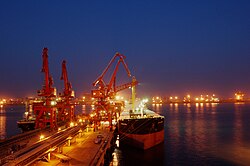
Rizhao (Chinese: 日照; pinyin: Rìzhào), alternatively romanized as Jihchao, is a prefecture-level city in southeastern Shandong province, China. It is situated on the coastline along the Yellow Sea, and features a major seaport, the Port of Rizhao. It borders Qingdao to the northeast, Weifang to the north, Linyi to the west and southwest, and faces Korea and Japan across the Yellow Sea to the east.
The name of the city literally means "sunshine". The city is known for its sustainability, and it mandates solar-water heaters in all new buildings. Rizhao city was recognized by the United Nations as one of the most habitable cities in the world in 2009.
The city population stands at 2,968,365 people as of the 2020 Chinese census, of whom 1,172,205 live in the urban area of Donggang District. As of 2024, the resident population is estimated at 2,929,000. Compared with the 2,801,013 people in 2010 Chinese census, there has been a total increase of 167,352 people in the past decade, an increase of 5.97%, with an average annual growth rate of 0.58%.
Rizhao is located at the place where the ancient Dawenkou culture and the Longshan culture flourished. Rizhao belonged to the Dongyi people during the Xia and Shang dynasties (2070-1046 BC), and to Ju and Yue States in the Spring and Autumn period (770-476 BC) and the Warring States period (476-221 BC). It became a part of Langye Commandery in the Qin dynasty (221-206 BC). Rizhao was named Haiqu County (海曲縣) during the Western Han (206 BC-25 AD) and Xihai County under the Eastern Han (25-220 AD).[citation needed] The fangsheng pond of Haiqu's early Buddhist community is the earliest attested.
During the Tang dynasty, together with Ju County, Rizhao belonged to Mi Prefecture of Henan Prefecture. In 1087, during the Northern Song dynasty, Rizhao Town was established under Ju County, originating the name meaning "(the place that first receives the) sunshine" due to its eastern coastal location.Rizhao County was set up in 1184 during the Jin dynasty. In 1940 it came under the control of the Chinese Communist Party. After being a county and since 1985 a city under the administration of Linyi, Rizhao became a prefecture-level city within Shandong province in 1989.[citation needed]
The Field Museum of Natural History in Chicago has done field survey archaeological work in Rizhao over the years.
Rizhao has a temperate, four-season, monsoon-influenced climate that lies in the transition between the humid subtropical (Köppen Cwa) and humid continental (Köppen Dwa) regimes. Winter is cool to cold and windy, but generally dry, with a January average of 0.3 °C (32.5 °F). Summer is generally hot and humid, but sweltering days are rare, with an August average of 25.5 °C (77.9 °F). Due to its proximity to the coast and being on a peninsula, it experiences a one-month delayed spring compared to much of the province. Conversely, fall is milder than inland areas in Shandong. The annual mean temperature is 13.7 °C (56.7 °F). On average, there are 2,310 hours of bright sunshine annually, and the relative humidity is 69%.[citation needed]
The prefecture-level city of Rizhao administers four county-level divisions, including two districts and two counties.
Rizhao
Rizhao (Chinese: 日照; pinyin: Rìzhào), alternatively romanized as Jihchao, is a prefecture-level city in southeastern Shandong province, China. It is situated on the coastline along the Yellow Sea, and features a major seaport, the Port of Rizhao. It borders Qingdao to the northeast, Weifang to the north, Linyi to the west and southwest, and faces Korea and Japan across the Yellow Sea to the east.
The name of the city literally means "sunshine". The city is known for its sustainability, and it mandates solar-water heaters in all new buildings. Rizhao city was recognized by the United Nations as one of the most habitable cities in the world in 2009.
The city population stands at 2,968,365 people as of the 2020 Chinese census, of whom 1,172,205 live in the urban area of Donggang District. As of 2024, the resident population is estimated at 2,929,000. Compared with the 2,801,013 people in 2010 Chinese census, there has been a total increase of 167,352 people in the past decade, an increase of 5.97%, with an average annual growth rate of 0.58%.
Rizhao is located at the place where the ancient Dawenkou culture and the Longshan culture flourished. Rizhao belonged to the Dongyi people during the Xia and Shang dynasties (2070-1046 BC), and to Ju and Yue States in the Spring and Autumn period (770-476 BC) and the Warring States period (476-221 BC). It became a part of Langye Commandery in the Qin dynasty (221-206 BC). Rizhao was named Haiqu County (海曲縣) during the Western Han (206 BC-25 AD) and Xihai County under the Eastern Han (25-220 AD).[citation needed] The fangsheng pond of Haiqu's early Buddhist community is the earliest attested.
During the Tang dynasty, together with Ju County, Rizhao belonged to Mi Prefecture of Henan Prefecture. In 1087, during the Northern Song dynasty, Rizhao Town was established under Ju County, originating the name meaning "(the place that first receives the) sunshine" due to its eastern coastal location.Rizhao County was set up in 1184 during the Jin dynasty. In 1940 it came under the control of the Chinese Communist Party. After being a county and since 1985 a city under the administration of Linyi, Rizhao became a prefecture-level city within Shandong province in 1989.[citation needed]
The Field Museum of Natural History in Chicago has done field survey archaeological work in Rizhao over the years.
Rizhao has a temperate, four-season, monsoon-influenced climate that lies in the transition between the humid subtropical (Köppen Cwa) and humid continental (Köppen Dwa) regimes. Winter is cool to cold and windy, but generally dry, with a January average of 0.3 °C (32.5 °F). Summer is generally hot and humid, but sweltering days are rare, with an August average of 25.5 °C (77.9 °F). Due to its proximity to the coast and being on a peninsula, it experiences a one-month delayed spring compared to much of the province. Conversely, fall is milder than inland areas in Shandong. The annual mean temperature is 13.7 °C (56.7 °F). On average, there are 2,310 hours of bright sunshine annually, and the relative humidity is 69%.[citation needed]
The prefecture-level city of Rizhao administers four county-level divisions, including two districts and two counties.
Recent media
Recent media