


Community hub
Recent from talks
Contribute something
Nothing was collected or created yet.
Chinese postal romanization
View on Wikipedia
| Postal romanization | |
|---|---|
| Script type | romanization |
Period | 1892–2002 |
| Languages | Chinese |
| Chinese postal romanization | |||||||||||||||||||||||||||
|---|---|---|---|---|---|---|---|---|---|---|---|---|---|---|---|---|---|---|---|---|---|---|---|---|---|---|---|
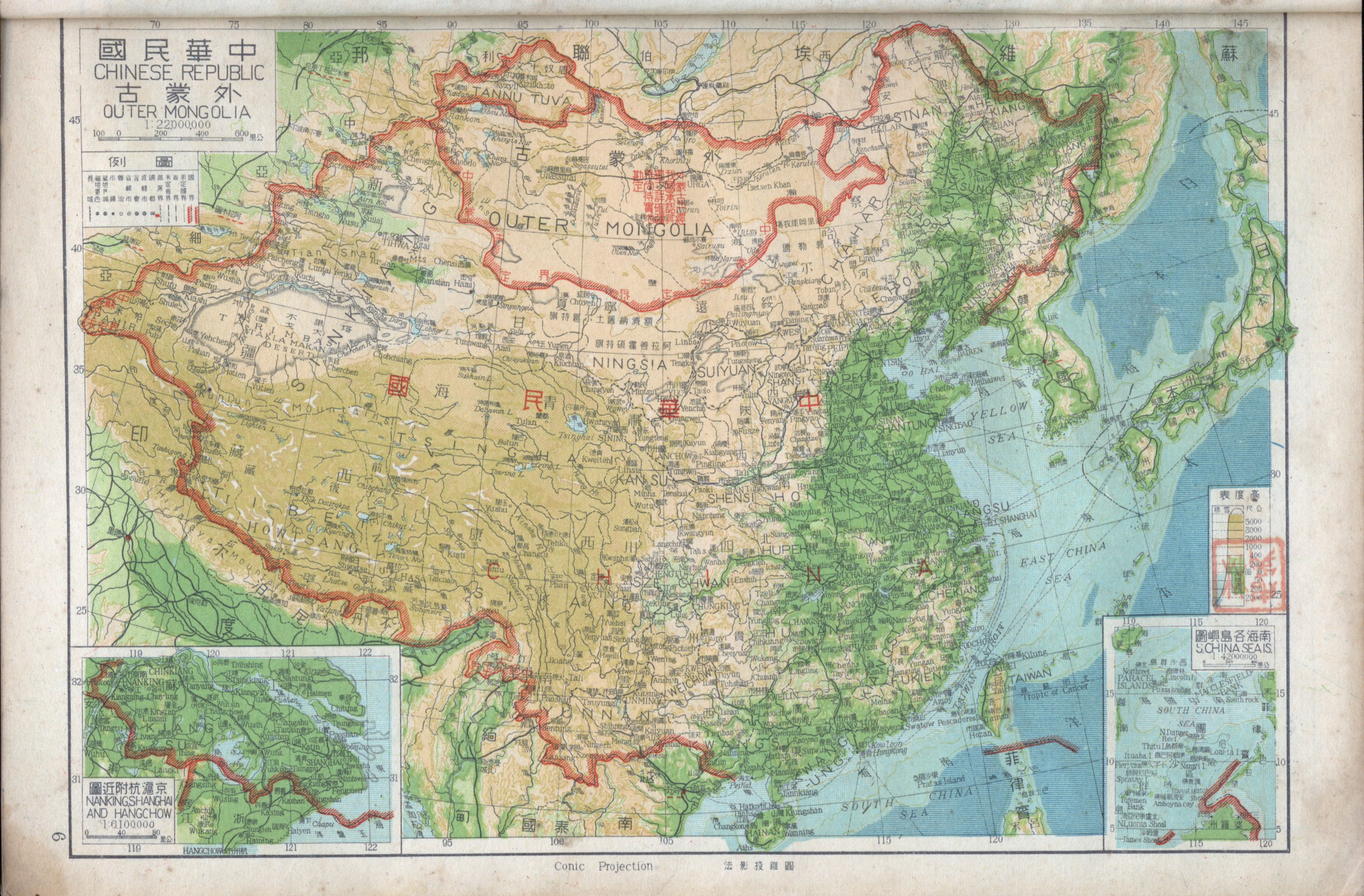
 A map of China with romanizations published in 1947 | |||||||||||||||||||||||||||
| Traditional Chinese | 郵政式拼音 | ||||||||||||||||||||||||||
| Simplified Chinese | 邮政式拼音 | ||||||||||||||||||||||||||
| Literal meaning | Postal-style romanization system | ||||||||||||||||||||||||||
| |||||||||||||||||||||||||||
Postal romanization[1] was a system of transliterating place names in China developed by postal authorities in the late 19th and early 20th centuries. For many cities, the corresponding postal romanization was the most common English-language form of the city's name from the 1890s until the 1980s, when postal romanization was replaced by pinyin, but the system remained in place in Taiwan until 2002.
In 1892, Herbert Giles created a romanization system called the Nanking syllabary. The Imperial Maritime Customs Post Office would cancel postage with a stamp that gave the city of origin in Latin letters, often romanized using Giles's system. In 1896, the Customs Post was combined with other postal services and renamed the Chinese Imperial Post. As a national agency, the Imperial Post was an authority on Chinese place names.[2]
When the Wade–Giles system became widespread, some argued that the post office should adopt it. This idea was rejected at a conference held in 1906 in Shanghai. Instead, the conference formally adopted Nanking syllabary.[3] This decision allowed the post office to continue to use various romanizations that it had already selected. Wade–Giles romanization is based on the Beijing dialect, a pronunciation standard since the 1850s. The use of Nanking syllabary did not suggest that the post office considered Nanjing pronunciation to be standard. Rather, it was an attempt to accommodate a variety of Mandarin pronunciations with a single romanization system.
Comparison table
[edit]| Chinese | D'Anville (1790)[4] | Postal | Wade–Giles[5] | Pinyin[6] | |
|---|---|---|---|---|---|
| 1907[a] | 1919,[7] 1947[b] | ||||
| 北京 | Peking |
|
Peking (1919) | Pei-ching | Běijīng |
| 北平 | — | Peiping (1947) | Pei-pʻing | Běipíng | |
| 成都 | Tching-tou-fou | Ch'êngtu | Chengtu | Ch’êng-tu | Chéngdū |
| 重慶;重庆 | Tchong-kin-fou | Ch'ungk'ing | Chungking | Ch’ung-ch’ing | Chóngqìng |
| 廣東;广东 | Quang-tong | Kwangtung | Kwangtung | Kuang-tung | Guǎngdōng |
| 廣州;广州 |
|
Kwangchow |
|
Kuang-chou | Guǎngzhōu |
| 桂林 | Quei-li-ng-fou | Kweilin | Kuei-lin | Guìlín | |
| 杭州 | Hang-tcheou | Hangchow | Hang-chou | Hángzhōu | |
| 江蘇;江苏 | Kiang-nan | Kiangsu | Chiang-su | Jiāngsū | |
| 濟南;济南 | Tci-nan-fou | Tsinan | Chi-nan | Jǐnán | |
| 南京 | Nan-king | Nanking | Nan-ching | Nánjīng | |
| 青島;青岛 | — | Ts'ingtao | Tsingtao | Ch’ing-tao | Qīngdǎo |
| 四川 | Se-tchuen | Szechw'an | Szechwan | Ssu-ch’uan | Sìchuān |
| 蘇州;苏州 | Sou-tcheou-fou |
|
Soochow | Su-chou | Sūzhōu |
| 天津 | Tien-king-oei | T'ientsin | Tientsin | T’ien-chin | Tiānjīn |
| 廈門;厦门 |
|
Hsiamên | Amoy | Hsia-mên | Xiàmén |
| 西安 | Si-ngan-fou | Singan |
|
Hsi-an | Xī'ān |
The spelling "Amoy" is based on pronunciation of Xiamen in the neighboring Zhangzhou dialect of Hokkien 廈門; Ēe-mûi, which historically contributed to the formation of the local Amoy dialect of Hokkien in Xiamen. "Peking" is carried over from the d'Anville map which also came from older texts, such as Italian Jesuit Martino Martini's De Bello Tartarico Historia (1654) and Novus Atlas Sinensis (1655). In Nanking syllabary, the city is Pehking.[8] The irregular oo in "Soochow" is to distinguish this city from Xuzhou in northern Jiangsu.[9] The other postal romanizations are based on "Southern Mandarin", the historical court dialect based on the Nanjing dialect, which used to be the imperial lingua franca of the late Ming and early Qing court. Pinyin spellings are based on Standard Chinese, a form based on the Beijing dialect that is taught in the Chinese education system.
After the Kuomintang (KMT) party came to power in 1927, the capital was moved from Peking ('northern capital') to Nanking ('southern capital'). Peking was renamed to "Peiping" ('northern peace').[10]
History
[edit]
The Customs Post, China's first government-run post office, opened to the public and began issuing postage stamps in 1878. This office was part of the Imperial Maritime Customs Service, led by Irishman Robert Hart. By 1882, the Customs Post had offices in twelve Treaty Ports: Shanghai, Amoy, Chefoo, Chinkiang, Chungking, Foochow, Hankow, Ichang, Kewkiang, Nanking, Weihaiwei, and Wuhu. Local offices had postmarking equipment so mail was marked with a romanized form of the city's name. In addition, there were companies that provided local postal service in each of these cities.
A Chinese-English Dictionary by Herbert Giles, published in 1892, popularized the Wade–Giles method of transliteration. This system had been created by Thomas Francis Wade in 1867. It is based on pronunciation in Beijing. Giles's dictionary also gives pronunciation in the dialects of various other cities, allowing the reader to create locally based transliterations. From January 1893 to September 1896, local postal services issued postage stamps that featured the romanized name of the city they served using local pronunciation.[11]
An imperial edict issued in 1896 designated the Customs Post a national postal service and renamed it the Chinese Imperial Post. The local post offices in the Treaty Ports were incorporated into the new service. The Customs Post was smaller than other postal services in China, such as the British. As the Imperial Post, it grew rapidly and soon became the dominant player in the market.
In 1899, Hart, as inspector general of posts, asked postmasters to submit romanizations for their districts. Although Hart asked for transliterations "according to the local pronunciation", most postmasters were reluctant to play lexicographer and simply looked up the relevant characters in a dictionary. The spellings that they submitted generally followed the Wade–Giles system, which was the standard method of transliteration at this time.
| Transliteration of Chinese |
|---|
| Mandarin |
| Wu |
| Yue |
| Min |
| Gan |
| Hakka |
| Xiang |
| Polylectal |
| See also |
The post office published a draft romanization map in 1903.[12] Disappointed with the Wade-based map, Hart issued another directive in 1905. This one told postmasters to submit romanizations "not as directed by Wade, but according to accepted or usual local spellings." Local missionaries could be consulted, Hart suggested. However, Wade's system did reflect pronunciation in Mandarin-speaking areas.[c]
Théophile Piry, a long-time customs manager, was appointed postal secretary in 1901. Appointing a French national to the top position fulfilled an 1898 commitment by China to "take into account the recommendations of the French government" when selecting staff for the post office. Until 1911, the post office remained part of the Chinese Maritime Customs Service, which meant that Hart was Piry's boss.[13]
1906 conference
[edit]To resolve the romanization issue, Piry organized an Imperial Postal Joint-Session Conference[d] in Shanghai in the spring of 1906. This was a joint postal and telegraphic conference. The conference resolved that existing spellings would be retained for names already transliterated. Accents, apostrophes, and hyphens would be dropped to facilitate telegraphic transmission. The requirement for addresses to be given in Chinese characters was dropped. For new transliterations, local pronunciation would be followed in Guangdong as well as in parts of Guangxi and Fujian. In other areas, a system called Nanking syllabary would be used.[10]
The Nanking syllabary was one of several transliteration systems presented by Giles to represent various local dialects. Nanjing had once been the capital and its dialect was, like that of Beijing, a pronunciation standard. But the decision to use Nanking syllabary was not intended to suggest that the post office recognized any specific dialect as standard. The Lower Yangtze Mandarin dialect spoken in Nanjing makes more phonetic distinctions than other dialects. A romanization system geared to this dialect can be used to reflect pronunciation in a wider variety of dialects.
Southern Mandarin is widely spoken in both Jiangsu and Anhui. In Giles' idealization, the speaker consistently makes various phonetic distinctions not made in Beijing dialect (or in the dialect of any other specific city). Giles created the system to encompass a range of dialects. For the French-led post office, an additional advantage of the system was that it allowed "the romanization of non-English speaking people to be met as far as possible," as Piry put it.[3] That is to say, Piry considered the Wade–Giles system to be specific to English.
Atlases explaining postal romanization were issued in 1907, 1919, 1933, and 1936. The ambiguous result of the 1906 conference led critics to complain that postal romanization was idiosyncratic.[10] According to modern scholar Lane J. Harris:
What they have criticized is actually the very strength of postal romanization. That is, postal romanization accommodated local dialects and regional pronunciations by recognizing local identity and language as vital to a true representation of the varieties of Chinese orthoepy as evinced by the Post Office's repeated desire to transcribe according to "local pronunciation" or "provincial sound-equivalents".[14]
Later developments
[edit]At the Commission on the Unification of Pronunciation in 1913, the idea of a national language with a standardized trans-regional phonology was approved.[15] A period of turmoil followed as President Yuan Shikai reversed course and attempted to restore the teaching of Literary Chinese. Yuan died in 1916 and the Ministry of Education published a pronunciation standard now known as Old National Pronunciation for Guoyu in 1918. The post office reverted to Wade's system in 1920 and 1921. It was the era of the May Fourth Movement, when language reform was the rage. The post office adopted a dictionary by William Edward Soothill as a reference.[16] The Soothill-Wade system was used for newly created offices. Existing post offices retained their romanizations.
Critics described the Ministry's standard, now called Old National Pronunciation, as a mishmash of dialects, bookish, and reminiscent of previous dynasties.[17] While drawing phonetic features from Beijing dialect, many phonological features of Southern Mandarin had been retained. In December 1921, Henri Picard-Destelan, co-director of the Post Office, quietly ordered a return to Nanking syllabary "until such time as uniformity is possible." Although the Soothill-Wade period was brief, it was a time when 13,000 offices were created, a rapid and unprecedented expansion. At the time the policy was reversed, one third of all postal establishments used Soothill-Wade spelling.[18] The Ministry published a revised pronunciation standard based strictly on Jilu Mandarin in 1932.[e]
In 1943, the Japanese ousted A. M. Chapelain, the last French head of the Chinese post. The post office had been under French administration almost continuously since Piry's appointment as postal secretary in 1901.[f]
In 1958, Communist China announced that it was adopting the pinyin romanization system. Implementing the new system was a gradual process. The government did not get around to abolishing postal romanization until 1964.[18] Even then, the post office did not adopt pinyin, but merely withdrew Latin characters from official use, such as in postal cancellation markings.
Mapmakers of the time followed various approaches. Private atlas makers generally used postal romanization before ultimately shifting to Wade–Giles.[19] The U.S. Central Intelligence Agency used a mix of postal romanization and Wade–Giles.[20] The U.S. Army Map Service used Wade–Giles exclusively.[21]
The U.S. government and the American press adopted pinyin in 1979.[22][23] The International Organization for Standardization followed suit in 1982.[24]
Postal romanization remained official in Taiwan until 2002, when Tongyong Pinyin was adopted. In 2009, Hanyu Pinyin replaced Tongyong Pinyin as the official romanization (see Chinese language romanization in Taiwan). While street names in Taipei have been romanized via Hanyu Pinyin, municipalities throughout Taiwan, such as Kaohsiung and Tainan, presently use a number of romanizations, including Tongyong Pinyin and postal romanization.
See also
[edit]Notes
[edit]- ^ Richard, Louis, Kennelly, M, L. Richard's Comprehensive geography of the Chinese empire and dependencies Shanghai: Tusewei press, 1908, pp. 590 and ff. Cites the Government Red Book of April 1907.
- ^ 1947 Chinese Republic, Outer Mongolia," 1947. p. 6. This map uses postal romanization, but with some uncommon forms of spelling.
- ^ This map shows where the various dialects of Chinese are spoken. Both Wade-Giles and pinyin are based on Northern Mandarin, which is shown in red.
- ^ 帝國郵電聯席會議; dìguó yóudiàn liánxí huìyì.
- ^ Vocabulary of National Pronunciation for Everyday Use, pinyin: Guóyīn Chángyòng Zìhuì (国音常用字汇 / 國音常用字彙)
- ^ The only break in French control of the post office was 1928 to 1931, when Norwegian Erik Tollefsen was foreign head.
References
[edit]
Citations
[edit]- ^ Postal Romanization. Taipei: Directorate General of Posts. 1961. OCLC 81619222.
- ^ Harris (2009), p. 96.
- ^ a b Harris (2009), p. 101.
- ^ Anville, Jean Baptiste Bourguignon, Atlas général de la Chine, de la Tartarie chinoise, et du Tibet : pour servir aux différentes descriptions et histoires de cet empire (1790). This is an expanded edition of an atlas first published in 1737.
- ^ "Mongolia and China", Pergamon World Atlas, Pergamon Press, Ltd, 1967).
- ^ "China.," United States. Central Intelligence Agency, 1969.
- ^ Jacot-Guillarmod (1919).
- ^ Richard, p. 618.
- ^ Richard, p. 625.
- ^ a b c Harris, Lane J. (2009). "A "Lasting Boon to All": A Note on the Postal Romanization of Place Names, 1896–1949". Twentieth-Century China. 34 (1): 96–109. doi:10.1353/tcc.0.0007. S2CID 68653154.
- ^ Giles, Herbert (1892). A Chinese-English Dictionary. London: Bernard Quaritch.
- ^ Oriental Press (1903).
- ^ Twitchett, Denis, and Fairbank, John K., Cambridge History of China: Republican China 1912-1949, Volume 12, part 1, 1983, p. 189.
- ^ Harris (2009), p. 97.
- ^ Kaske, Elizabeth, The Politics of Language in Chinese Education, 1895–1919 Boston 2008, "The Conference for the Unification of Reading Pronunciations", pp. 405 and ff.
- ^ William Edward Soothill (1908). The student's four thousand tzu and general pocket dictionary
- ^ Kaske, p. 415.
- ^ a b Harris (2009), p. 105.
- ^ Compare Hammond 1948 ("Japan and China," Hammond, C.S. 1948) to Pergamon 1967 ("Mongolia and China", Pergamon World Atlas, Pergamon Press, Ltd, 1967). The latter is a pure Wade–Giles map.
- ^ "China, administrative divisions," United States. Central Intelligence Agency, 1969.
- ^ "China 1:250,000," 1954, Series L500, U.S. Army Map Service.
- ^ USBGN (1979).
- ^ "Times due to revise its Chinese spelling," New York Times, Feb. 4, 1979.
- ^ "ISO 7098:1982 – Documentation – Romanization of Chinese". Retrieved 2009-03-01.
Bibliography
[edit]- China Postal Working Map 大清郵政公署備用輿圖, Shanghai: Oriental Press, 1903.
- China Postal Album: Showing the Postal Establishments and Postal Routes in Each Province (1st ed.), Shanghai: Directorate General of Posts, 1907.
- Jacot-Guillarmod, Charles, ed. (1919), China Postal Album: Showing the Postal Establishments and Postal Routes in Each Province (2nd ed.), Beijing: Directorate General of Posts.
- Postal Atlas of China 中華郵政輿圖, Nanjing: Directorate General of Posts, 1933.
- China Postal Atlas 中華民國郵政輿圖, Nanjing: Directorate General of Posts, 1936.
- Playfair, G.M.H. (1910), The Cities and Towns of China: A Geographical Dictionary (2nd ed.), Shanghai: Kelly & Walsh.
- Stanford, Edward (1917), Complete Atlas of China (2nd ed.), London: China Inland Mission.
- Stoneman, Elvyn A.; et al., eds. (July 1979), Gazetteer of the People's Republic of China, Washington, DC: United States Board on Geographic Names.
- "邮政式拼音 Postal-Style Spelling", 中国大百科全书 (in Chinese), Beijing: Encyclopedia of China Publishing House, 1998.
| |||||||||||||||||||||||||
| |||||||||||||||||||||||||
| |||||||||||||||||||||||||


Chinese postal romanization
View on GrokipediaDefinition and Purpose
Core Principles and Objectives
The Chinese postal romanization system was established primarily to standardize the transliteration of place names and addresses for efficient international mail handling by the Imperial Post Office, addressing the inconsistencies arising from varied local pronunciations and ad hoc foreign spellings that hindered reliable delivery.[6] Promulgated in 1906 under the Qing dynasty, its core objective was to create a uniform framework that enabled clear communication with overseas postal authorities, reducing errors in routing correspondence across China's vast territory and beyond.[6] This practical focus prioritized functionality over linguistic purity, aiming to supplant fragmented practices used by missionaries, traders, and diplomats with an official list of romanized names for provinces, cities, and post offices. Key principles included phonetic transcription grounded in the Beijing dialect of Mandarin, serving as the baseline for northern place names while adapting for regional variations in the south through established English conventions where feasible.[6] The system emphasized simplicity and accessibility for non-Chinese users, drawing on modified Wade-Giles conventions—such as using "hs" for retroflex initials and apostrophes for syllable breaks—to ensure readability in English-language contexts like maps and telegrams.[6] Consistency was enforced by compiling an authoritative gazetteer, which extended beyond mail to influence broader cartographic and administrative uses, though it tolerated some legacy spellings (e.g., "Canton" for Guangzhou) to maintain familiarity.[6] Overall, the objectives reflected a modernization imperative, leveraging romanization as an infrastructural tool to integrate China into global postal networks amid late Qing reforms, without aspiring to a comprehensive phonetic orthography for the language itself.[6] This approach balanced empirical utility—derived from postal operational needs—with causal recognition that divergent transliterations directly impeded state sovereignty in communication flows.[6]Phonological Features
Consonant and Vowel Representations
Chinese Postal Romanization employed unvoiced consonant letters to represent the unaspirated stops and affricates of northern Mandarin, diverging from systems that voiced them. Specifically, 'p' denoted the bilabial stop /pʰ/ or /p/ (corresponding to Pinyin b or p), as in Peking for Běijīng; 't' for the alveolar stop /tʰ/ or /t/ (Pinyin d or t), as in Tientsin for Tiānjīn; 'k' for the velar stop /kʰ/ or /k/ (Pinyin g or k), as in Kiangsu for Jiāngsū; 'ch' for the retroflex affricate /ʈʂʰ/ or /ʈʂ/ (Pinyin zh or ch), as in Chungking for Chóngqìng; and 'ts' for the alveolar affricate /tsʰ/ or /ts/ (Pinyin z or c), as in Tsingtao for Qīngdǎo.[7] [4] Unlike Wade–Giles, it omitted apostrophes to indicate aspiration, relying instead on contextual English pronunciation.[4] The system preserved distinctions among sibilants: 's' for /s/, 'sh' for the retroflex fricative /ʂ/ (Pinyin sh), and 'hs' for the alveolo-palatal fricative /ɕ/ (Pinyin x or s before i), as in Shanghai (/ʂaŋxaɪ/) versus Sian or Hsuchow (/ɕian/, /ɕoʊ/).[7] Other nasals and liquids followed familiar English forms: 'm' for /m/, 'n' for /n/, 'l' for /l/, and 'ng' for /ŋ/. Palatal initials showed variability based on southern Mandarin influences or historical forms, with 'tsi-' or 'si-' yielding 'j' or 'tsi' (e.g., Tsinan for Jǐnán), and 'k-' or 'tsi-' to 'ch-' or 'ts-' in some cases like Fukien for Fújiàn.[7] Vowel representations prioritized readability without diacritics, adapting English-like spellings to Mandarin finals. The medial /u/ was often 'w' when secondary to the main vowel, as in Kwangsi for Guǎngxī or Ankwo for Ānguō, but 'u' when principal, avoiding mergers with /y/.[7] Diphthongs included 'ai' for /aɪ/, 'ei' or 'ey' for /eɪ/ (simplified to 'e' in some stressed syllables like Peking), 'ao' for /aʊ/, and 'ou' or 'ow' for /oʊ/, as in Hangchow for Hángzhōu.[4] The front rounded vowel /y/ merged with 'u' after labials (e.g., Lushan for Lǚshān) or appeared as 'iu' otherwise, while /ɤ/ used 'o' or 'uh', and rhotics as 'er' or 'uh'. Nasal finals ended in '-an', '-en', '-ang', or '-eng', with 'oh' or 'ung' for certain back vowels like Soochow for Sūzhōu.[4] These conventions, standardized by 1906, facilitated international postal use but introduced ambiguities resolvable only through familiarity with northern pronunciations.[7]| Pinyin Initial | Postal Equivalent | Example (Pinyin / Postal) |
|---|---|---|
| b, p | p | Běijīng / Peking |
| d, t | t | Tiānjīn / Tientsin |
| g, k | k | Jiāngsū / Kiangsu |
| zh, ch | ch | Chóngqìng / Chungking |
| z, c | ts | Qīngdǎo / Tsingtao |
| sh | sh | Shànghǎi / Shanghai |
| x, s (pre-i) | hs or s | Xī'ān / Sian |
Tonal and Syllabic Handling
Chinese Postal Romanization omits any explicit representation of Mandarin Chinese tones, forgoing diacritics, superscript numbers, or other notations used in systems like Wade-Giles to denote the four principal tones (high level, rising, dipping, falling) and the neutral tone. This deliberate exclusion stemmed from the system's emphasis on administrative simplicity for mapping, signage, and international mail routing, where the intended pronunciation of standardized place names was assumed to be inferable from orthographic conventions and familiarity rather than tonal markers. As a result, a single romanized form could theoretically map to tonally distinct Chinese syllables, potentially introducing ambiguity outside fixed contexts, though empirical application in postal gazetteers demonstrated sufficient consistency for practical disambiguation based on character mappings.[8][3] Syllables in Postal Romanization are handled as discrete phonetic units, with multi-syllable terms typically joined without internal spacing but often separated by hyphens to clarify boundaries and guide foreign readers' pronunciation, reflecting the monosyllabic nature of Chinese morphemes. For example, the place name Nanchang (南昌) was rendered as "Nan-ch'ang," preserving the division between the nasal-initial first syllable and the diphthongal second. Apostrophes served a supplementary role, inserted before vowel-initial syllables (a, o, e) following consonants to signal a lack of coalescence, preventing mispronunciations akin to English diphthongs—though usage was restrained compared to more phonetic systems. In expedited contexts such as telegraphic transmission, these hyphens and apostrophes were routinely suppressed to minimize transmission length and errors in Morse code handling, yielding unadorned strings like "Nanchang" while retaining core syllabic integrity through vowel-consonant sequencing.[3][8]Comparison to Other Romanization Systems
Relation to Wade-Giles
Chinese postal romanization emerged as a practical variant of the Wade-Giles system, which had been developed by British diplomat Thomas Francis Wade in 1867 and refined by Herbert Allen Giles in his 1892 Chinese-English Dictionary.[6][9] Wade-Giles provided the foundational model for postal transliterations, particularly in rendering Mandarin syllables based on the Beijing dialect, but postal adaptations prioritized simplicity for international mail sorting over phonetic precision.[9] This relation stemmed from the involvement of foreign customs officials and missionaries, who submitted spellings to the Imperial Chinese Post Office drawing heavily from Wade's syllabary, leading to widespread overlap in core consonant and vowel mappings.[1] Key similarities include shared representations for initials like ch (for retroflex affricates) and hs (for the Mandarin x), as well as medial glides such as ü approximated as u. However, postal romanization diverged by systematically omitting Wade-Giles' hyphens (separating syllable onsets from medials), apostrophes (indicating aspiration), and tone numbers, rendering it more streamlined for maps and addresses—e.g., Wade-Giles T'ien-chin became postal Tientsin.[9] Unlike Wade-Giles' consistent Beijing-centric standard, postal forms often accommodated regional pronunciations to reflect local usage, especially in southern China, resulting in idiosyncrasies like Amoy for Xiamen (drawing from Minnan dialect) rather than Wade-Giles Hsia-men.[1] This flexibility addressed China's dialectal diversity, making postal spellings a "lasting boon" for practical administration while sacrificing some uniformity.[1] The following table illustrates select differences in place name renderings:| Place Name (Pinyin) | Wade-Giles | Postal Romanization | Notes |
|---|---|---|---|
| Beijing | Pei-ching | Peking | Postal retained older European form; Wade-Giles emphasized Beijing phonology.[9] |
| Tianjin | T'ien-chin | Tientsin | Omission of aspiration mark and hyphen in postal.[9] |
| Changsha | Ch'ang-sha | Changsha | Postal simplified syllable separation.[1] |
| Xiamen | Hsia-men | Amoy | Postal incorporated local Min dialect over Mandarin standard.[1] |
| Guangzhou | Kuang-chou | Canton | Postal used longstanding Portuguese-influenced form, diverging from Wade-Giles Mandarin.[9] |
Differences from Hanyu Pinyin
Chinese Postal Romanization, formalized following the 1906 International Postal Conference in Shanghai, diverges from Hanyu Pinyin—promulgated by the People's Republic of China in 1958 and internationally standardized by ISO in 1982—in its orthographic conventions, phonological mappings, and practical design priorities. Whereas Hanyu Pinyin employs diacritical marks for the four main tones and a neutral tone to aid precise pronunciation for learners of Standard Mandarin (based on the Beijing dialect), Postal Romanization omits tonal indicators entirely, relying instead on contextual recognition for place names and addresses in international correspondence. This omission stemmed from the system's origin in late Qing postal operations, where brevity and legibility for non-Chinese postal workers superseded phonetic completeness.[10][4] Consonant representations highlight further disparities, with Postal favoring English-familiar digraphs derived from an adapted Wade-Giles framework, often without consistent aspiration markers (apostrophes denoting unaspirated stops in Wade-Giles). For instance, the retroflex affricates and fricatives (zh, ch, sh in Pinyin) are typically rendered as "ch" and "sh" in Postal, while palatal initials (j, q, x) may appear as "ch" or "hs" in simplified forms, leading to ambiguities resolved by convention rather than strict rules. The alveolar affricate c (ts in IPA) becomes "ts" in Postal (e.g., Tsingtao for Qīngdǎo), contrasting Pinyin's single "c," and sibilants like z and c lack the retroflex distinction emphasized in Pinyin. These choices prioritized approximate English pronunciation over Mandarin phonemic fidelity, as Postal was crafted for Western administrators handling mail routing rather than language instruction.[10][4] Vowel notations also vary, particularly for the high front rounded vowel /y/ (ü in Pinyin), which Postal renders as "ü" or occasionally "yu" without umlaut simplification, and for diphthongs where Postal employs "eu" or "iu" approximations (e.g., -ing as "ing" without tonal influence). Syllable boundaries in multi-syllable names often include hyphens in Postal (e.g., Hang-chou for Hángzhōu), absent in standard Pinyin except for rare ambiguity prevention (e.g., Xi'an). Such features made Postal more akin to ad hoc transliterations for cartographic and diplomatic use, as seen in early 20th-century maps, but less systematic than Pinyin's vowel harmony and consonant clusters aligned to modern linguistics.[10][4]| Chinese Characters | Hanyu Pinyin | Postal Romanization | Notes on Key Divergences |
|---|---|---|---|
| 北京 | Běijīng | Peking | Postal simplifies "bei" to "pei," omits tones and hyphen; reflects pre-1949 naming for northern capital.[10] |
| 南京 | Nánjīng | Nanking | "Nan" as "nan," "jing" as "king"; no aspiration mark, common in Republican-era usage.[4] |
| 青岛 | Qīngdǎo | Tsingtao | "Qing" as "tsing" (alveolar affricate), "dao" as "tao"; highlights sibilant differences.[10] |
| 杭州 | Hángzhōu | Hangchow | Retroflex "zh" as "ch," hyphen for syllables; "zhou" as "chow."[4] |
| 广州 | Guǎngzhōu | Canton | Archaic English borrowing retained; diverges entirely from phonetic Pinyin.[4] |
Illustrative Examples and Tables
The postal romanization system rendered numerous Chinese place names in forms that diverged from modern Hanyu Pinyin, often reflecting early 20th-century English phonetic approximations and influences from southern Chinese dialects or missionary transliterations. For instance, 北京 (northern capital) was transliterated as Peking, emphasizing a palatal initial and final nasal similar to older European conventions; 南京 (southern capital) became Nanking; and 广州 (broad prefecture) was Canton, a form tracing back to Portuguese Cantão from the 16th century but standardized in postal usage.[11] [5] These examples highlight postal's practical focus on postal sorting and international recognition rather than strict phonetic accuracy to Beijing Mandarin.[4] The following table compares selected major place names in postal romanization and Hanyu Pinyin, drawn from historical postal maps and gazetteers:| Hanyu Pinyin | Postal Romanization | Chinese Characters |
|---|---|---|
| Beijing | Peking | 北京 |
| Nanjing | Nanking | 南京 |
| Tianjin | Tientsin | 天津 |
| Guangzhou | Canton | 广州 |
| Xiamen | Amoy | 厦门 |
| Fuzhou | Foochow | 福州 |
| Chongqing | Chungking | 重庆 |
| Wuhan | Hankow | 武汉 |