


Community hub
Recent from talks
Contribute something
Nothing was collected or created yet.
Robbie James
View on Wikipedia
Robert Mark James (23 March 1957[3] – 18 February 1998) was a Welsh international footballer who played for many teams including Swansea City, Stoke City and Queens Park Rangers.[3] He represented his country on 47 occasions over a period of ten years, scoring a total of seven goals.[3]
Key Information


He was a talented utility player who contributed greatly to Swansea City's rise from the Fourth Division to the First Division between 1978 and 1981, and helped them finish sixth in their first top division campaign. He played a total of 783 English league games between 1973 and 1994, scoring 134 goals. His league appearance tally is one of the highest of any player in the history of English football.[4]
Career
[edit]James was born in Gorseinon and began his career with local side Swansea City. He made his debut at the end of the 1972–73 season which ended with Swansea being relegated to the Fourth Division. They slowly recovered and James' 16 goals in 1976–77 and 17 in 1977–78 helping the Swans gain promotion back to the Football League Third Division. He then scored a career best of 21 in 1978–79 as Swansea gained back to back promotions. After two seasons in the Second Division they completed a remarkable rise gaining promotion to the First Division for the first time in the club's history. James took to the top flight well scoring 14 goals in 46 appearances as Swansea finished in sixth position. However the following season saw Swansea relegated back to the Second Division and James joined Stoke City.[1]
He played in 46 matches for Stoke in 1983–84 scoring seven goals but with the team struggling in 1984–85 he was sold to Queens Park Rangers £100,000.[1] He spent three seasons at Loftus Road, helping the Hoops preserve their First Division status and reach the 1986 Football League Cup Final, where they were beaten 3–0 by Oxford United. At the end of the 1986–87 season, he joined Leicester City who had just been relegated to the Second Division.[5]
After a season with Leicester he moved back to Swansea City, and later played for Bradford City and Cardiff City. With Cardiff, he helped them to win the Third Division in 1992–93, his last season in the English Football League after 20 years. After his time with Cardiff he moved into Non-League football with Merthyr Tydfil.[3] He became player-manager of Llaneli in 1996, but collapsed and died while playing for them against Porthcawl on 18 February 1998. He was 40 years old.[6]
Legacy
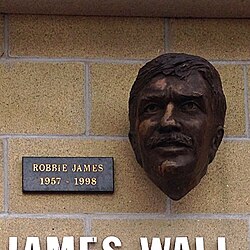
[edit]In 2007, a bust of James was unveiled outside Swansea's Liberty Stadium. The bust, located next to the stadium's ticket office, was made possible by fans raising nearly £7,000 in memory of the midfielder, who played almost 400 games for the club.[7]
On 22 September 2012, the first 20 names were inducted into the 'Robbie James Wall of Fame', a hall of fame commemorating notable former Swansea players and managers. The Wall of Fame, located beneath the bust of James at the Liberty Stadium, will eventually consist of a total of 100 plaques, unveiled over a period of 5 years.[8]
Career statistics
[edit]Club
[edit]Source:[9]
| Club | Season | League | FA Cup | League Cup | Other[A] | Total | ||||||
|---|---|---|---|---|---|---|---|---|---|---|---|---|
| Division | Apps | Goals | Apps | Goals | Apps | Goals | Apps | Goals | Apps | Goals | ||
| Swansea City | 1972–73 | Third Division | 1 | 0 | 0 | 0 | 0 | 0 | 0 | 0 | 1 | 0 |
| 1973–74 | Fourth Division | 28 | 2 | 0 | 0 | 1 | 0 | 0 | 0 | 29 | 2 | |
| 1974–75 | Fourth Division | 42 | 8 | 2 | 0 | 0 | 0 | 0 | 0 | 44 | 8 | |
| 1975–76 | Fourth Division | 45 | 8 | 1 | 0 | 1 | 0 | 0 | 0 | 47 | 8 | |
| 1976–77 | Fourth Division | 46 | 16 | 1 | 0 | 6 | 2 | 0 | 0 | 53 | 16 | |
| 1977–78 | Fourth Division | 42 | 16 | 5 | 1 | 2 | 0 | 0 | 0 | 49 | 17 | |
| 1978–79 | Third Division | 43 | 15 | 4 | 2 | 5 | 4 | 0 | 0 | 52 | 21 | |
| 1979–80 | Second Division | 29 | 6 | 5 | 2 | 2 | 0 | 0 | 0 | 36 | 8 | |
| 1980–81 | Second Division | 35 | 8 | 1 | 0 | 2 | 0 | 0 | 0 | 38 | 8 | |
| 1981–82 | First Division | 42 | 14 | 1 | 0 | 1 | 0 | 2 | 0 | 46 | 14 | |
| 1982–83 | First Division | 40 | 9 | 1 | 0 | 4 | 0 | 5 | 0 | 50 | 9 | |
| Total | 393 | 102 | 21 | 5 | 24 | 6 | 7 | 0 | 445 | 113 | ||
| Stoke City | 1983–84 | First Division | 40 | 6 | 1 | 0 | 5 | 1 | 0 | 0 | 46 | 7 |
| 1984–85 | First Division | 8 | 0 | 0 | 0 | 2 | 0 | 0 | 0 | 10 | 0 | |
| Total | 48 | 6 | 1 | 0 | 7 | 1 | 0 | 0 | 56 | 7 | ||
| Queens Park Rangers | 1984–85 | First Division | 20 | 2 | 0 | 0 | 0 | 0 | 0 | 0 | 20 | 2 |
| 1985–86 | First Division | 28 | 1 | 1 | 0 | 6 | 0 | 0 | 0 | 35 | 1 | |
| 1986–87 | First Division | 39 | 2 | 4 | 1 | 3 | 0 | 0 | 0 | 46 | 3 | |
| Total | 87 | 5 | 5 | 1 | 9 | 0 | 0 | 0 | 101 | 6 | ||
| Leicester City | 1987–88 | Second Division | 23 | 0 | 0 | 0 | 4 | 0 | 1 | 0 | 28 | 0 |
| Total | 23 | 0 | 0 | 0 | 4 | 0 | 1 | 0 | 28 | 0 | ||
| Swansea City | 1987–88 | Fourth Division | 19 | 3 | 1 | 0 | 0 | 0 | 4 | 0 | 24 | 3 |
| 1988–89 | Third Division | 41 | 9 | 3 | 0 | 2 | 0 | 2 | 0 | 48 | 9 | |
| 1989–90 | Third Division | 30 | 4 | 1 | 0 | 2 | 0 | 3 | 1 | 36 | 5 | |
| Total | 90 | 16 | 5 | 0 | 4 | 0 | 9 | 1 | 108 | 17 | ||
| Bradford City | 1990–91 | Third Division | 46 | 3 | 2 | 0 | 5 | 1 | 4 | 1 | 57 | 5 |
| 1991–92 | Third Division | 43 | 3 | 2 | 0 | 4 | 0 | 2 | 0 | 51 | 3 | |
| Total | 89 | 6 | 4 | 0 | 9 | 1 | 6 | 1 | 108 | 8 | ||
| Cardiff City | 1992–93 | Third Division | 42 | 2 | 1 | 0 | 2 | 0 | 4 | 0 | 49 | 2 |
| 1993–94 | Second Division | 9 | 0 | 0 | 0 | 2 | 0 | 2 | 1 | 13 | 1 | |
| Total | 51 | 2 | 1 | 0 | 4 | 0 | 6 | 1 | 62 | 3 | ||
| Merthyr Tydfil | 1993–94 | Football Conference | 15 | 2 | 0 | 0 | 0 | 0 | 0 | 0 | 15 | 2 |
| 1994–95 | Football Conference | 1 | 0 | 0 | 0 | 0 | 0 | 0 | 0 | 1 | 0 | |
| Total | 16 | 2 | 0 | 0 | 0 | 0 | 0 | 0 | 16 | 2 | ||
| Barry Town | 1994–95 | League of Wales | 32 | 1 | 0 | 0 | 0 | 0 | 0 | 0 | 32 | 1 |
| Llanelli | 1995–96 | League of Wales | 35 | 1 | 0 | 0 | 0 | 0 | 0 | 0 | 35 | 1 |
| Career Total | 864 | 141 | 37 | 6 | 61 | 8 | 29 | 3 | 991 | 158 | ||
- A. ^ The "Other" column constitutes appearances and goals in the Full Members Cup, Football League play-offs, Football League Trophy and UEFA Cup Winners' Cup.
International
[edit]Source:[10]
| National team | Year | Apps | Goals |
|---|---|---|---|
| Wales | 1978 | 1 | 0 |
| 1979 | 6 | 1 | |
| 1981 | 2 | 1 | |
| 1982 | 7 | 2 | |
| 1983 | 5 | 2 | |
| 1984 | 8 | 1 | |
| 1985 | 5 | 0 | |
| 1986 | 6 | 0 | |
| 1987 | 5 | 0 | |
| 1988 | 1 | 0 | |
| Total | 46 | 7 | |
Honours
[edit]
Swansea City
- Football League Fourth Division third-place promotion: 1977–78
- Football League Third Division third-place promotion: 1978–79
- Football League Second Division third-place promotion: 1980–81
- Football League Fourth Division play-offs: 1988[11]
Queens Park Rangers
- Football League Cup runner-up: 1985–86
Cardiff City
See also
[edit]References
[edit]- ^ a b c d e f g Lowe, Simon (2000). Stoke City The Modern Era – A Complete Record. Desert Island Books. ISBN 1-874287-39-2.
- ^ Dunk, Peter, ed. (1987). Rothmans Football Yearbook 1987–88. London: Queen Anne Press. p. 302. ISBN 978-0-356-14354-5.
- ^ a b c d Robbie James at Post War English & Scottish Football League A–Z Player's Transfer Database
- ^ "Robbie James". This is South Wales. Retrieved 13 February 2013.
- ^ Sporting Heroes – QPR
- ^ Ivan Ponting (21 February 1998). "Obituary: Robbie James". The Independent. Retrieved 25 November 2010.
- ^ "Swans' legend memorial unveiling". BBC News. Retrieved 7 May 2014.
- ^ "Robbie James Wall of Fame". Swansea City Official Website. Retrieved 7 May 2014.
- ^ Robbie James at the English National Football Archive (subscription required)
- ^ James, Robbie at National-Football-Teams.com
- ^ Foot, David (30 May 1988). "Sorrow at the seaside as the Swans soar". The Guardian. p. 18. Retrieved 27 August 2025 – via Newspapers.com.
External links
[edit]- Robbie James at Post War English & Scottish Football League A–Z Player's Transfer Database
| International | |
|---|---|
| National | |

Robbie James
View on GrokipediaEarly life
Birth and upbringing
Robert Mark James was born on 23 March 1957 in Gorseinon, Glamorgan, Wales, a community near the Loughor estuary approximately six miles northwest of Swansea.[1][2] Gorseinon emerged as an industrial settlement in the late 19th century, primarily driven by coal mining and related activities, with collieries such as Brynlliw operating in the vicinity into the mid-20th century.[5] The town's socio-economic landscape during the 1950s and 1960s reflected the broader challenges of South Wales' industrial heartland, where working-class families were deeply connected to mining and manufacturing, even as the coal sector faced gradual decline amid post-war economic shifts.[6] James grew up in this environment, with family members showing strong support for local sports; his uncle Ron James, a lifelong Swansea City season ticket holder, recalled watching him develop his skills from schoolboy level onward.[7] His initial exposure to football occurred through school activities and informal play with local amateur teams in the Swansea Valley area, fostering a passion that naturally progressed to structured youth development at nearby Swansea City.[7]Youth development
James's early exposure to organized football came through schoolboy teams in his hometown of Gorseinon, where he displayed considerable talent during the late 1960s and early 1970s. Growing up in the Swansea area, he balanced football with work at a local electrical firm before committing fully to the sport. His performances at the youth level drew scouting interest from prominent clubs, including Cardiff City and Arsenal.[1] In March 1973, at the age of 16, James signed as an amateur with his local professional club, Swansea City, marking his entry into a structured youth development program. Under manager Harry Gregg, a former Manchester United goalkeeper, James rapidly advanced through the club's youth ranks, establishing himself as a versatile attacking midfielder with strong vision and goal-scoring ability from midfield.[8][1] His quick progression highlighted his status as one of the club's most promising young prospects, setting the foundation for a distinguished professional career.[2]Club career
Swansea City (1973–1983)
Robbie James made his professional debut for Swansea City at the age of 16 in the final league match of the 1972–73 season, a 2–1 Division Three defeat to Brentford on 7 April 1973.[9] Born and raised in nearby Gorseinon, James quickly established himself as a versatile midfielder known for his pace, powerful shooting, and consistency, becoming a cornerstone of the team during its formative years. He holds the club records as the youngest player to reach 100 league appearances (achieved before his 19th birthday on 11 February 1976 against Walsall), 200 league games (by age 20), and 300 league games (by age 22).[9] Under manager John Toshack, who took charge in February 1978 amid the club's financial struggles and position near the bottom of the Fourth Division, James played a pivotal role in Swansea's remarkable ascent through the English football leagues.[10] The team secured promotion from the Fourth Division in 1977–78, finishing second, with James contributing 16 goals in 42 league appearances; the following season, 1978–79, saw another promotion from the Third Division as champions, during which James scored 14 league goals.[2] His influence continued in the 1980–81 Second Division campaign, where Swansea clinched promotion to the First Division for the first time in their history with a 3–1 victory at Preston North End on 2 May 1981, a match James started and helped drive from central midfield alongside local teammates. Over his first stint at the club from 1973 to 1983, James amassed 374 league appearances and 56 goals, forming a dynamic partnership with fellow Swansea native Alan Curtis, whose interplay in attack and midfield propelled the side's success.[1] James's loyalty to his hometown club, where he remained despite interest from larger teams, cemented his status as a local hero and symbol of Swansea's transformation from near-bankruptcy in the mid-1970s—when the club faced potential liquidation—to top-flight contenders by 1982.[11] Fans adored his tireless work rate and memorable strikes, such as the winning goal in the 1982 Welsh Cup final against rivals Cardiff City, which showcased his ability to deliver in high-stakes derbies.[9] This era not only elevated Swansea socio-culturally, instilling pride in a working-class community through unprecedented achievements, but also highlighted James's embodiment of the club's resilient spirit under Toshack's leadership.[12]Stoke City and Queens Park Rangers (1983–1985)
Following Swansea City's relegation from the First Division at the end of the 1982–83 season, Robbie James sought a fresh challenge by joining Stoke City for a £160,000 transfer fee in the summer of 1983.[9][8] As a versatile utility midfielder capable of playing in central or wide roles, James adapted to the demands of top-flight football at the Victoria Ground, contributing to a gritty survival campaign.[13] He made 48 appearances across all competitions during the 1983–84 season, scoring six goals, including key contributions in Stoke's tense relegation battle that culminated in a 20th-place finish and safety on the final day of the season.[14] However, Stoke's form deteriorated sharply in the early stages of the 1984–85 campaign amid ongoing financial difficulties and managerial instability under Bill Asprey, with the club winning just one of their first 13 league matches.[15] James featured in nine league games before his sale in October 1984, as the Potters offloaded assets to alleviate mounting pressures that ultimately led to a record-low 17 points and relegation.[16] His departure highlighted the challenges of maintaining consistency in a squad plagued by sales and poor results, though James himself remained a reliable presence despite the turmoil. James then moved to Queens Park Rangers for £100,000 later that month, reuniting with top-flight football at Loftus Road under manager Alan Mullery.[17] In a more stable environment, he slotted into a midfield that emphasized attacking transitions, making 20 league appearances and scoring two goals during the 1984–85 season to help QPR secure a solid ninth-place finish.[18]Leicester City and Swansea City (1987–1990)
James remained at Queens Park Rangers until 1987, where he made 87 league appearances and scored 5 goals over three seasons, contributing to consistent mid-table finishes in the First Division through his versatility in midfield and support for the team's attacking play.[1] In 1987, James joined Leicester City in the Second Division, where he adapted to a right-back role and made 23 league appearances during the 1987–88 season, providing defensive stability and experience to a side that finished mid-table under manager Brian Little.[1] His tenure at Leicester was brief but marked by reliable performances amid the club's efforts to rebuild. In 1988, James returned for a second spell at Swansea City, where he was appointed captain and played until 1990, adding 110 league appearances and 59 goals to his tally and helping the club in their battle against relegation from the Second Division.[2][1] During this period, he pocketed another Welsh Cup winner's medal in 1989 with a 2–0 victory over Wrexham in the final, delivering committed performances in the intense South Wales derbies and embodying leadership in a challenging time for the club marked by financial pressures and inconsistent results. His experience aided the team's resilience, though Swansea remained in the lower reaches of the division without achieving promotion.Later clubs (1990–1996)
In 1990, James transferred to Bradford City, where he featured prominently over two seasons in the Third Division, making 89 appearances and scoring 6 goals, often deployed as a right back from which he delivered crosses for the forwards.[19][20] During the 1990–91 campaign, he appeared in approximately 40 league games as the team mounted a promotion push, finishing eighth in the table.[21] His experience contributed to the squad's stability in a competitive lower-tier environment. Following his time at Bradford, James joined Cardiff City in 1992, adding 51 league appearances and 2 goals during the 1992–93 season in the third tier, helping the Bluebirds secure promotion as champions.[22][1] This spell marked a move to Welsh football rivals, where he provided midfield grit and leadership at Ninian Park amid passionate derbies. In 1993, at age 36, James joined Merthyr Tydfil as player-manager in the Welsh football system, where he continued to play while overseeing the team and developing younger talent through coaching duties.[23] He remained with the club until 1994, balancing on-field contributions with off-field guidance that emphasized veteran insight for emerging players. By the end of his professional tenure, James had amassed 782 English league appearances, a figure underscoring his remarkable longevity and ability to sustain high-level fitness into his late 30s.[3] James's decisions in this phase reflected a strategic wind-down, prioritizing proximity to his Welsh roots and less demanding roles that allowed sustained involvement in the sport amid family considerations.[1]International career
Youth and under-21 levels
James was selected for the Wales under-18 national team in the mid-1970s, making appearances in the 1975 UEFA European Under-18 Championship qualifiers and finals tournament.[24] In the qualifiers, he featured in the home 4–0 victory over Malta at Cwmbran Stadium on 5 February 1975 and the 1–0 away defeat in Gzira on 19 March 1975.[24] At the finals in Switzerland, James played in all three group matches: a 0–0 draw against Italy on 9 May in Chiasso, a 4–0 loss to Hungary on 11 May in Locarno, and a 3–0 win over Poland on 13 May in Lugano, helping Wales secure third place in Group B.[24] These outings showcased his emerging midfield presence alongside future professionals like Tony Pulis and Carl Harris.[24] Transitioning to the under-21 level, James made his debut for the Wales U21 team on 15 December 1976 in a 0–0 British Championship draw away to England at the City Ground in Nottingham.[25] He followed this with a start in the 3–2 defeat to Scotland on 9 February 1977 at Easter Road, Edinburgh, during the same competition.[25] In total, James earned two caps for the Wales U21 side across the 1976–77 season.[25] His tenacious midfield play in these matches, often involving robust challenges and forward surges, drew notice from selectors and complemented his ongoing development at Swansea City.[9] Born and raised in Gorseinon near Swansea, James's local roots smoothed his integration into Wales's national youth setups, aligning seamlessly with his club pathway.[9] Standout performances, such as his composed displays in the U18 finals, accelerated his progression toward higher representative honors.[24]Senior appearances
Robbie James made his senior international debut for Wales on 25 October 1978, starting in a 7–0 World Cup qualifying victory over Malta at the Racecourse Ground in Wrexham. His under-21 experience had paved the way for this seamless integration into the senior setup. Over the next decade, he accumulated 46 additional caps, totaling 47 appearances until his final match in 1988, during which he scored 7 goals as a tenacious holding midfielder.[26][1][2] James's international career spanned from 1978 to 1988.[26] His debut year included another World Cup qualifier against West Germany in May 1979, where Wales suffered a 0–2 defeat. He netted his first international goal on 26 May 1979 in a 1–1 friendly draw against Northern Ireland, leveling the score with a penalty.[27] Subsequent goals came in key fixtures, including a 1–1 away draw with Spain in March 1982 and a 5–0 friendly win over Romania in October 1983.[26] A pivotal period for James was the 1982 FIFA World Cup qualification campaign, where he featured in 8 matches as Wales topped their group ahead of Czechoslovakia, Iceland, and Turkey before losing a playoff to Hungary.[28] Notable contributions included scoring in a 2–2 draw against Iceland in October 1981 and participating in the famous 0–0 friendly draw with England at Wembley in May 1981, which boosted morale during the qualifiers. He often partnered with captain Joey Jones in midfield, providing defensive solidity and distribution to support attackers like John Toshack and Alan Curtis.[29][1] James also played a role in the UEFA Euro 1984 qualifying efforts, appearing in 8 games in Group 7 alongside England, Norway, Greece, and Bulgaria, though Wales finished second and missed out on the finals. His versatility in the holding role was evident in draws like the 1–1 against Yugoslavia in December 1983. By the mid-1980s, appearances tapered as he balanced demanding club schedules at Swansea City and later teams, alongside fluctuating form, leading to his international retirement after a substitute outing in a 1–2 friendly defeat to Yugoslavia on 23 March 1988 at the Vetch Field in Swansea.[2][30]Managerial career
Player-manager roles
In 1993, aged 36, James was appointed player-manager at non-league Merthyr Tydfil following his departure from Cardiff City.[31] His tenure there was short-lived, after which he moved to Barry Town before joining Llanelli AFC in 1996 as player-manager, a club in the Welsh Football League.[2][8] In these roles, James balanced playing duties with managerial responsibilities such as squad selection and match preparation.[32] James was remembered as a great friend and player-manager in Welsh non-league football, with a commemorative plaque at Llanelli in his honor.[8]Personal life and death
Family and personal interests
James was twice married and had three children: one son and two daughters.[32] Born in Gorseinon near Swansea, his South Wales roots fostered a profound passion for Welsh identity, which extended to his personal life as he consistently chose to play and coach for local clubs, allowing him to balance professional commitments with family stability in the region.[33][32] James remained deeply involved in his community, supporting Swansea City through his enduring association with the club and contributing to Welsh football development via coaching roles. Post-retirement from higher divisions, he pursued aspirations in coaching as player-manager at Llanelli AFC, emphasizing grassroots talent in South Wales.[8] In his 30s, James demonstrated dedication to fitness by continuing competitive play into non-league football, reflecting a lifestyle committed to physical conditioning despite career transitions.[32] Off the pitch, he was known for his approachable nature and strong bonds with former teammates, including Alan Curtis and John Toshack, who roomed with him during travels and later recounted his passionate, team-oriented persona in tributes.[34][35]Circumstances of death
On 18 February 1998, Robbie James, aged 40 and serving as player-manager for Llanelli, collapsed during a Welsh League match against Porthcawl Town at Stebonheath Park. Llanelli was leading 2-1 when James executed a half-tackle, advancing the ball a few yards before suddenly falling to the ground without any collision or apparent contact from an opponent.[8] The game was immediately abandoned as teammates, including substitute Tony Smolka, and match officials rushed to assist James; Smolka later recalled the moment, stating, "You think the worst at these moments." Emergency services attended the scene and attempted resuscitation, but James was pronounced dead on the pitch from a heart attack.[8][36][32] James's family was notified shortly after the incident, and the club expressed profound shock and devastation, with tributes including a minute's silence at subsequent matches and attendance at his funeral by officials and former teammates.[36]Legacy
Impact on Swansea City and Welsh football
Robbie James played a pivotal role in Swansea City's remarkable ascent from the Fourth Division to the First Division between 1978 and 1981, contributing to three promotions in four years under manager John Toshack, which transformed the club from near-obscurity to top-flight contenders.[8] As a homegrown talent from nearby Gorseinon, James embodied the "Swans' miracle," a period of unprecedented success that captured national attention and revitalized the club's identity in Welsh football.[9] His consistent performances in midfield, including scoring crucial goals during promotion campaigns, helped foster a winning mentality that inspired a generation of young players in South Wales to pursue professional careers.[33] James's statistical legacy underscores his enduring impact on Swansea, where he amassed 593 appearances (the fourth-highest total in club history) and 149 goals, ranking second all-time behind only Ivor Allchurch.[9] Across his career, he played 783 English league games, a figure that places him among the most prolific appearance-makers in the history of the English Football League, highlighting his reliability and longevity as a professional.[3] These records not only reflect his personal dedication but also symbolize the stability he provided during Swansea's golden era, serving as benchmarks for club loyalty in Welsh football. As a product of Swansea's youth system, James bridged club and country, earning 47 caps for Wales between 1978 and 1988, which elevated his status as a national icon during a resurgent period for the team.[3] His success exemplified the potential of homegrown Welsh talent, influencing the football identity in Wales by demonstrating how lower-division clubs could produce players capable of competing at the highest levels.[8] This connection inspired future generations, as evidenced by his posthumous induction into the Robbie James Wall of Fame at the Liberty Stadium (now Swansea.com Stadium), which honors figures who shaped the club's cultural significance.[37] Known for his tenacious midfield play—characterized by relentless tackling, strong positional awareness, and unyielding passion—James's style became a model for midfielders in lower-tier Welsh teams, promoting a gritty, resilient approach that emphasized endurance over flair in resource-limited environments.[38] This tactical influence persisted in regional football, where his archetype of the hardworking, versatile engine room player encouraged coaches to prioritize physicality and team ethic in developing young prospects.[33]Tributes and commemorations
Following his sudden collapse and death on the pitch during a match for Llanelli against Porthcawl Town on 18 February 1998, Robbie James' passing at age 40 elicited widespread grief throughout Welsh football, with tributes emphasizing his lifelong dedication to the sport.[32][8] Several memorials were established in James' honor at key sites associated with his career. A bronze bust of him was unveiled outside Swansea City's Liberty Stadium in 2008, funded by fans and positioned near the ticket office to commemorate his contributions to the club.[39][40] The stadium's Robbie James Wall of Fame, dedicated to club legends, was also named in his honor and first unveiled in 2012 before a Premier League match against Everton, later expanded to include over 100 inductees such as Ivor Allchurch and John Toshack.[40][41] In July 2025, the Swans Trust announced plans to relocate the Wall of Fame as part of stadium enhancements.[42] At Llanelli, where James served as player-manager at the time of his death, a commemorative plaque was installed at Stebonheath Park, and the club has held annual remembrances, including a minute's applause before matches on the anniversary of his passing.[8][43] In 2014, author Gary Wharton published the biography Robbie James: A Life in Football, which chronicles his career across clubs like Swansea City and Cardiff City, his 47 Wales caps, and his final moments on the field, drawing on firsthand interviews with contemporaries including former Llanelli teammate Tony Smolka.[8] The book underscores James' enduring status as a beloved figure in Welsh sport. Fan-led tributes continue through media and club initiatives, such as Swansea City's 2021 documentary History Makers: Robbie James, featuring reflections from former teammates including John Toshack, Alan Curtis, Wyndham Evans, Jeremy Charles, and Nigel Stevenson on his role in the club's 1980s successes.[33]Career statistics
Club statistics
Robbie James amassed 782 appearances and 134 goals in English league matches throughout his professional career, spanning from 1973 to 1994. His domestic club record reflects a versatile midfielder who contributed significantly to multiple teams across various divisions, including three promotions with Swansea City from the Fourth Division to the First Division between 1978 and 1981. Below is a summary of his league appearances and goals by club, drawn from detailed match records.[3][44]| Club | Years Active | League Appearances | League Goals |
|---|---|---|---|
| Swansea City | 1973–1983, 1988–1990 | 484 | 115 |
| Stoke City | 1983–1985 | 48 | 6 |
| Queens Park Rangers | 1984–1987 | 87 | 5 |
| Leicester City | 1987–1988 | 23 | 0 |
| Bradford City | 1990–1992 | 89 | 6 |
| Cardiff City | 1992–1994 | 51 | 2 |
| Career Total | 782 | 134 |
International statistics
James earned 47 caps for Wales at senior level between 1978 and 1988, during which he scored 7 goals. He made his debut on 25 October 1978, starting in a 7–0 European Championship qualifying victory over Malta at the Racecourse Ground in Wrexham.[45] His international career concluded on 23 March 1988 with a substitute appearance in a 1–2 friendly defeat to Yugoslavia at the Vetch Field in Swansea.[46] Of his 47 appearances, 45 were as a starter and 2 as a substitute, primarily in midfield.[26] James's caps were concentrated in qualification campaigns for major tournaments, including the 1982 and 1986 FIFA World Cups (where Wales narrowly missed qualification in both) and the 1980, 1984, and 1988 UEFA European Championships, alongside friendlies and British Home Championship matches. He featured in over 20 World Cup qualifier games and around 15 European Championship qualifiers, contributing to Wales's competitive showings during a golden era for the national team. All 7 of his goals came in these fixtures, with 4 in European Championship qualifiers, 1 in a World Cup qualifier, and 2 in friendlies.[47] His scoring highlighted his role as a creative midfielder, often delivering from set pieces or open play. The following table lists James's international goals for Wales:| Date | Opponent | Result | Competition | Goal Details |
|---|---|---|---|---|
| 26 May 1979 | Northern Ireland | 1–1 | Friendly | Equalizer in the second half |
| 9 September 1981 | Iceland | 2–2 | 1982 World Cup qualifier | 25th minute |
| 24 March 1982 | Spain | 1–1 | Friendly | Late equalizer |
| 15 December 1982 | Yugoslavia | 4–4 | 1984 European Championship qualifier | 80th minute |
| 12 October 1983 | Romania | 5–0 | Friendly | 72nd minute |
| 14 December 1983 | Yugoslavia | 1–1 | 1984 European Championship qualifier | 54th minute |
| 28 February 1984 | Scotland | 1–2 | British Home Championship | 47th minute |