



Community hub
Recent from talks
Knowledge base stats:
Talk channels stats:
Members stats:
Sounding rocket
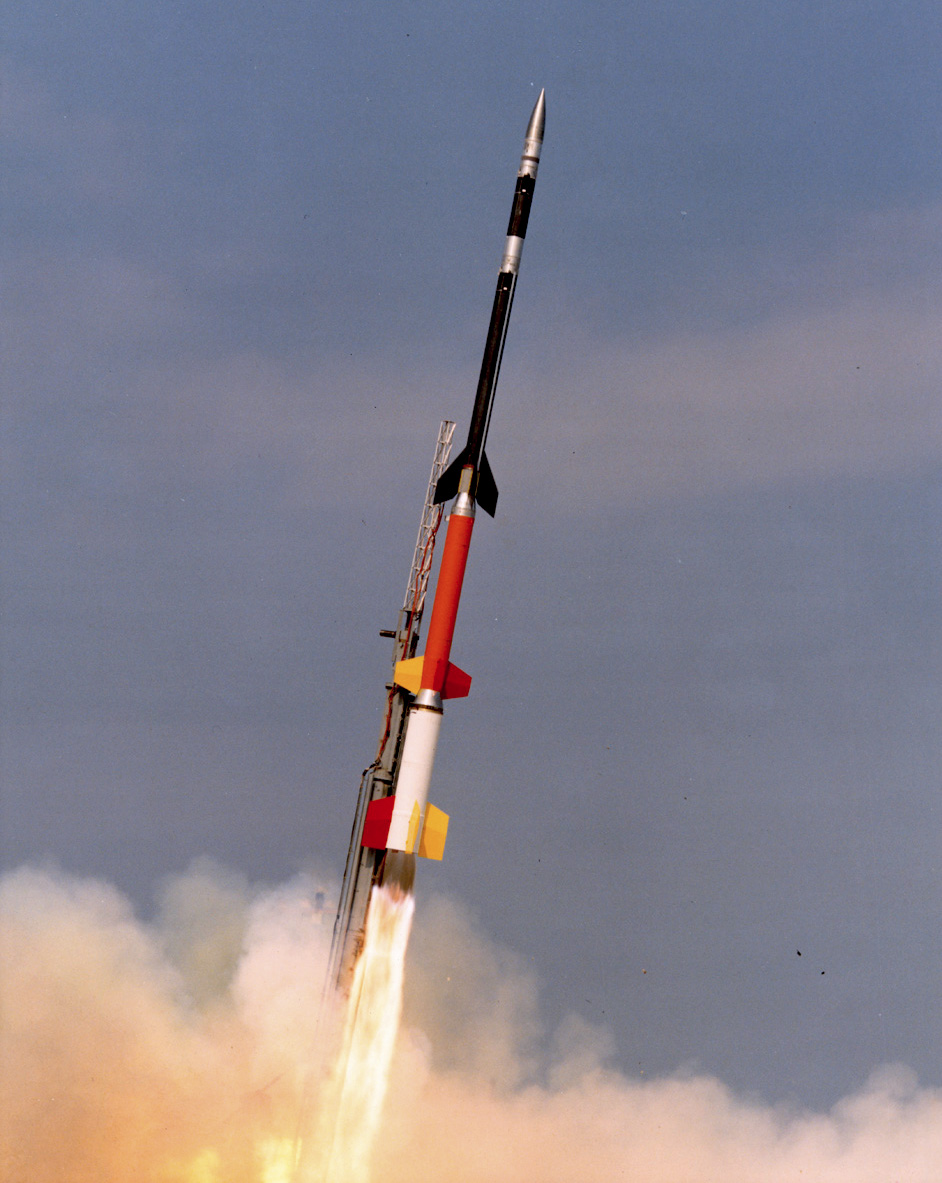
A sounding rocket or rocketsonde, sometimes called a research rocket or a suborbital rocket, is an instrument-carrying rocket designed to take measurements and perform scientific experiments during its sub-orbital flight. The rockets are often used to launch instruments from 48 to 145 km (30 to 90 mi) above the surface of the Earth, the altitude generally between weather balloons and satellites; the maximum altitude for balloons is about 40 km (25 mi) and the minimum for satellites is approximately 121 km (75 mi).
Due to their suborbital flight profile, sounding rockets are often much simpler than their counterparts built for orbital flight. Certain sounding rockets have an apogee between 1,000 and 1,500 km (620 and 930 mi), such as the Black Brant X and XII, which is the maximum apogee of their class. For certain purposes, sounding rockets may be flown to altitudes as high as 3,000 kilometers (1,900 miles) to allow observing times of around 40 minutes to provide geophysical observations of the magnetosphere, ionosphere, thermosphere, and mesosphere.
The origin of the term comes from nautical vocabulary to sound, which is to throw a weighted line from a ship into the water to measure the water's depth. The term itself has its etymological roots in the Romance languages word for probe, of which there are nouns like sonda and sonde and verbs like sondar which means "to do a survey or a poll". Sounding in the rocket context is equivalent to "taking a measurement".
The basic elements of a modern sounding rocket are a solid-fuel rocket motor and a science payload. In certain sounding rockets the payload may even be nothing more than a smoke trail as in the Nike Smoke which is used to determine wind directions and strengths more accurately than may be determined by weather balloons. A sounding rocket such as the Nike-Apache may deposit sodium clouds to observe very high altitude winds. Larger, higher altitude rockets have multiple stages to increase altitude and payload capability.
A flight of a sounding rocket has several parts. During the boost phase, the rocket burns its fuel to accelerate upwards, nearly vertically. Once the motor burns all of its fuel, the rocket may fall away to allow the payload to coast along a freefall trajectory. The path of the rocket in nearly parabolic, being influenced only by gravity and small wind resistance at high altitudes. The speed decreases near the highest point of the flight, the apogee, allowing the payload to nearly hover around this point for a few minutes. Lastly, the rocket descends, sometimes deploying a drag source such as a small balloon or a parachute. The average flight time is less than 30 minutes; usually between 5 and 20 minutes.
Sounding rockets have used balloons, airplanes, and artillery as first stages. Project Farside used a rockoon composed of a 106,188-cubic-metre (3,750,000 cu ft) balloon, lifting a four-stage rocket. Sparoair was launched in the air from Navy F4D and F-4 fighters. Sounding rockets can also be launched from artillery guns, such as Project HARP's 5, 7, and 15 in (130, 180, and 380 mm) guns, sometimes having additional rocket stages.
The earliest sounding rockets were liquid propellant rockets such as the WAC Corporal, Aerobee, and Viking. The German V-2 served both the US and the USSR as sounding rockets during the immediate post-World War II period. During the 1950s and later, inexpensive surplus military boosters such as those used by the Nike, Talos, Terrier, and Sparrow came to be used. Since the 1960s, rockets specifically designed for the purpose, such as the Black Brant series have dominated sounding rockets, though often having additional stages, many from military surplus.
The earliest attempts at developing sounding rockets were in the Soviet Union. While all of the early rocket developers were concerned largely with developing the ability to launch rockets, some had the objective of investigating the stratosphere and beyond. The first All-Union Conference on the Study of Stratosphere was held in Leningrad (now St. Petersburg) in 1934. While the conference primarily dealt with balloon Radiosondes, there was a small group of rocket developers who sought to develop "recording rockets" to explore the stratosphere and beyond. Sergey Korolev, who later became the leading figure of the Soviet space program, gave a presentation in which he called for "the development of scientific instruments for high-altitude rockets to study the upper atmosphere."
Hub AI
Sounding rocket AI simulator
(@Sounding rocket_simulator)
Sounding rocket
A sounding rocket or rocketsonde, sometimes called a research rocket or a suborbital rocket, is an instrument-carrying rocket designed to take measurements and perform scientific experiments during its sub-orbital flight. The rockets are often used to launch instruments from 48 to 145 km (30 to 90 mi) above the surface of the Earth, the altitude generally between weather balloons and satellites; the maximum altitude for balloons is about 40 km (25 mi) and the minimum for satellites is approximately 121 km (75 mi).
Due to their suborbital flight profile, sounding rockets are often much simpler than their counterparts built for orbital flight. Certain sounding rockets have an apogee between 1,000 and 1,500 km (620 and 930 mi), such as the Black Brant X and XII, which is the maximum apogee of their class. For certain purposes, sounding rockets may be flown to altitudes as high as 3,000 kilometers (1,900 miles) to allow observing times of around 40 minutes to provide geophysical observations of the magnetosphere, ionosphere, thermosphere, and mesosphere.
The origin of the term comes from nautical vocabulary to sound, which is to throw a weighted line from a ship into the water to measure the water's depth. The term itself has its etymological roots in the Romance languages word for probe, of which there are nouns like sonda and sonde and verbs like sondar which means "to do a survey or a poll". Sounding in the rocket context is equivalent to "taking a measurement".
The basic elements of a modern sounding rocket are a solid-fuel rocket motor and a science payload. In certain sounding rockets the payload may even be nothing more than a smoke trail as in the Nike Smoke which is used to determine wind directions and strengths more accurately than may be determined by weather balloons. A sounding rocket such as the Nike-Apache may deposit sodium clouds to observe very high altitude winds. Larger, higher altitude rockets have multiple stages to increase altitude and payload capability.
A flight of a sounding rocket has several parts. During the boost phase, the rocket burns its fuel to accelerate upwards, nearly vertically. Once the motor burns all of its fuel, the rocket may fall away to allow the payload to coast along a freefall trajectory. The path of the rocket in nearly parabolic, being influenced only by gravity and small wind resistance at high altitudes. The speed decreases near the highest point of the flight, the apogee, allowing the payload to nearly hover around this point for a few minutes. Lastly, the rocket descends, sometimes deploying a drag source such as a small balloon or a parachute. The average flight time is less than 30 minutes; usually between 5 and 20 minutes.
Sounding rockets have used balloons, airplanes, and artillery as first stages. Project Farside used a rockoon composed of a 106,188-cubic-metre (3,750,000 cu ft) balloon, lifting a four-stage rocket. Sparoair was launched in the air from Navy F4D and F-4 fighters. Sounding rockets can also be launched from artillery guns, such as Project HARP's 5, 7, and 15 in (130, 180, and 380 mm) guns, sometimes having additional rocket stages.
The earliest sounding rockets were liquid propellant rockets such as the WAC Corporal, Aerobee, and Viking. The German V-2 served both the US and the USSR as sounding rockets during the immediate post-World War II period. During the 1950s and later, inexpensive surplus military boosters such as those used by the Nike, Talos, Terrier, and Sparrow came to be used. Since the 1960s, rockets specifically designed for the purpose, such as the Black Brant series have dominated sounding rockets, though often having additional stages, many from military surplus.
The earliest attempts at developing sounding rockets were in the Soviet Union. While all of the early rocket developers were concerned largely with developing the ability to launch rockets, some had the objective of investigating the stratosphere and beyond. The first All-Union Conference on the Study of Stratosphere was held in Leningrad (now St. Petersburg) in 1934. While the conference primarily dealt with balloon Radiosondes, there was a small group of rocket developers who sought to develop "recording rockets" to explore the stratosphere and beyond. Sergey Korolev, who later became the leading figure of the Soviet space program, gave a presentation in which he called for "the development of scientific instruments for high-altitude rockets to study the upper atmosphere."