


Community hub
Roll cage
View on Wikipedia
A roll cage is a specially engineered and constructed frame built in (or sometimes around, in which case it is known as an exo cage) the passenger compartment of a vehicle to protect its occupants from being injured or killed in an accident, particularly in the event of a rollover.
Designs
[edit]
There are many different roll cage designs depending on the application. Hence, various racing organizations have differing specifications and regulations, although most of these organizations harmonize their rules with those of the FIA.[1]
Roll cages help to stiffen the chassis, which is desirable in racing applications. Racing cages are typically either bolt-in or welded-in, with the former being more straightforward and cheaper to fit while the latter is stronger and more substantial.[2]
A roll bar is a single bar behind the driver that provides moderate rollover protection. Due to the lack of a protective top, some modern convertibles utilize a strong windscreen frame acting as a roll bar.[3] Also, a roll hoop may be placed behind both headrests (usually one on older cars), which is essentially a roll bar spanning the width of a passenger's shoulders.
Road cars
[edit]A newer form of rollover protection, pioneered on the Mercedes-Benz R129 in 1989, is deployable roll hoops that are usually hidden within the body of a car. When sensors detect an imminent rollover, the roll hoops quickly extend and lock in place. Cars that have a deployable rollover protection system include the Peugeot 307 CC,[4] Volvo C70, Mercedes-Benz SL 500, Jaguar XK,[5] and the Lamborghini Reventón Roadster.[6]
Other applications
[edit]Roll bars are also used historically on row crop tractors, and roll cages are incorporated as part of the cab on modern tractors.
-
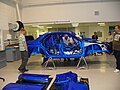 A 2006 Subaru Impreza WRC bodyshell with integrated roll cage
 -
 Roll cage in a Porsche 997 GT3 RS.
 -
 A race car stripped down to its roll cage and firewalls


See also
[edit]References
[edit]- ^ "Common regulations for competitors safety" (PDF). msauk.org. Archived from the original (PDF) on 2017-07-11.
- ^ "Roll cage- Weld in Vs Bolt in - Page 1 - General Motorsport". pistonheads.com. Retrieved 2018-05-23.
- ^ "Teknikens Värld: Provkörning av Saab 9-3 Cabriolet". Archived from the original on July 30, 2013.
- ^ "307cc-2005.pdf" (PDF). September 8, 2006. Archived (PDF) from the original on 2006-09-08.
- ^ "Archived copy". jaguar.com.au. Archived from the original on 29 April 2008. Retrieved 12 January 2022.
{{cite web}}: CS1 maint: archived copy as title (link) - ^ Park, Barry (16 September 2009). "Lamborghini Reventon Roadster: "Our most extreme car"". Drive.com.au. Retrieved 7 December 2017.
External links
[edit]
Roll cage
View on GrokipediaHistory
Origins and Early Development
The concept of the roll cage originated in agriculture during the 1950s, when rollover fatalities on tractors—accounting for nearly 60% of agricultural deaths—prompted safety innovations such as protective frames. By 1959, Sweden mandated protective inner cages on new tractors, reducing deaths by over 70%.[2] This technology soon adapted to motorsports, where a series of fatal flips between 1959 and 1970 drove further development. Early designs were rudimentary, consisting of simple steel hoops or bars welded to the chassis frame to provide overhead protection without significantly altering the vehicle's weight or aerodynamics. These innovations were driven by the increasing speeds and frequencies of crashes observed in dirt track events, prompting builders to experiment with basic structural reinforcements. In off-road racing, roll bars proliferated post-World War II as surplus military Jeeps were modified for desert events in the 1950s, incorporating welded bar structures to withstand the harsh bounces and potential flips of rough terrain competitions like early California desert runs. This period saw wider adoption due to the growing popularity of off-road events, where the added protection proved essential for driver survival in remote areas. The nascent National Hot Rod Association (NHRA) began influencing drag racing by requiring roll bars in select classes by 1962, setting the stage for broader safety standards.[4]Modern Advancements and Standardization
In the 1960s, British racer John Aley pioneered the modern roll bar after witnessing severe accidents, introducing affordable designs that gained popularity in European racing.[3] Roll cage technology advanced significantly through regulatory mandates from the Fédération Internationale de l'Automobile (FIA) and the Sports Car Club of America (SCCA), which required their installation in Formula racing and rally cars to mitigate rollover risks. The FIA's Appendix J, updated in 1970, mandated roll bars for vehicles with open coachwork, stipulating that they must extend 3 cm above the driver's helmet and span wider than the driver's shoulders to ensure adequate protection.[5] By 1971, the FIA extended this requirement to all race cars under Article 253, emphasizing firm attachment to the chassis and integration with the vehicle's structure for enhanced rigidity during impacts.[6] Similarly, the SCCA enforced roll bar mandates starting in the late 1950s for modified and production sports car classes, with refinements in the 1960s that aligned with growing safety concerns following high-profile accidents, thereby standardizing basic cage configurations across amateur and professional events.[7] The 1980s marked the introduction of computer-aided design (CAD) tools in roll cage engineering, allowing for precise optimization of strength-to-weight ratios by simulating load distributions and material stresses prior to fabrication. This technological shift enabled designers to create more efficient tubular structures that maximized torsional rigidity while minimizing added mass, particularly beneficial for high-performance racing vehicles where weight critically affects handling and speed. CAD adoption facilitated iterative testing of geometric variations, leading to cages that better distributed forces during crashes without compromising drivability.[8] From the 1990s to the 2000s, roll cage designs evolved toward hybrid safety systems that integrated cages with broader vehicle protection features, such as energy-absorbing crumple zones in racing prototypes, to provide layered defense against frontal and side impacts. In endurance racing series, these systems combined the cage's occupant containment role with deformable chassis elements that dissipated kinetic energy, reducing g-forces transmitted to the driver. This period saw increased emphasis on holistic vehicle safety architectures in prototypes, where cages served as the rigid core around which deformable monocoques were built.[9] Standardization efforts in the 2000s incorporated finite element analysis (FEA) simulations to validate cage performance under dynamic loads, ensuring compliance with evolving safety benchmarks before physical testing. Concurrently, the 2004 updates to the FIA's Appendix J, particularly Article 253 for rally applications, refined specifications for cage materials, welding techniques, and mounting points to enhance durability in off-road conditions while maintaining interoperability with international homologation standards.[10]Design Principles
Structural Fundamentals
A roll cage primarily functions to create a rigid survival space for occupants by resisting deformation during rollover impacts and other collisions, thereby protecting against cabin intrusion and injury. This structure absorbs kinetic energy from such events through strategic triangulation, which distributes forces across multiple members to prevent localized failure and maintain occupant clearance. In engineering terms, the cage transforms the vehicle's passenger compartment into a fortified zone capable of withstanding severe dynamic loads without compromising the protective envelope.[11][12][13] Central to this effectiveness is the principle of defined load paths, where forces are transferred efficiently from the impact site—often the roof or sides—to the vehicle's chassis via the main hoop and supporting braces. These paths ensure that energy is directed away from the occupant area, preventing progressive collapse by channeling loads through triangulated joints that enhance rigidity and minimize deflection. For instance, the main hoop acts as the primary vertical load bearer, distributing vertical and lateral forces downward to anchor points, while diagonal braces reinforce against shear and prevent twisting that could lead to intrusion.[14][15] Integration with the chassis is achieved through secure welding at designated points and mounting directly to frame rails, forming a unified structural system that enhances overall vehicle integrity. This connection allows the roll cage to share loads with the underlying frame, distributing stresses holistically and avoiding isolated weak points that could amplify deformation. Proper attachment, such as full-penetration welds to frame rails, ensures the cage contributes to the vehicle's torsional stiffness, creating a seamless load-bearing network.[16][17] At its core, the physics of roll cage design revolves around resistance to bending moments and torsional forces, where triangulated geometry counters rotational and flexural stresses inherent in rollover scenarios. Finite element simulations demonstrate that well-designed cages can withstand impacts equivalent to 5-10g accelerations, with deformations limited to safe thresholds that preserve occupant space. This resistance relies on the cage's ability to maintain geometric stability under multi-axis loading, absorbing energy progressively rather than fracturing abruptly.[14][15]Geometric Configurations and Types
Roll cages are classified by their geometric configurations, primarily based on the number of attachment points to the vehicle's chassis, which influences load distribution, rigidity, and protective coverage. These designs range from basic overhead structures to fully enclosing frameworks, tailored to the demands of light-duty use or high-speed competition. The attachment points typically connect to the floor, pillars, and frame rails, ensuring the cage acts as a survival cell during impacts or rollovers.[18] A 4-point cage represents the simplest geometric layout, consisting of a single main hoop behind the driver's seat with two rear attachments to the floor or frame and two upper connections near the B-pillars, providing primary overhead protection. This configuration suits light-duty applications, such as street-modified vehicles or occasional track events, due to its ease of installation and low added weight, but it offers limited side-impact resistance and may not suffice for vehicles exceeding certain speed thresholds.[19][20] The 6-point cage builds on the 4-point design by incorporating two additional forward attachment points to the firewall or front floor, forming a main rear hoop with diagonal bracing that spans approximately 50% of the cage's width and 75% of its height. This layout, standard for entry-level racing under organizations like the SCCA, enhances chassis torsional stiffness and rollover resistance through better load paths from the hoop to the braces, while remaining relatively straightforward to fabricate.[18][21] Full 8- or 10-point cages provide advanced geometric enclosure, featuring a main rear hoop, front hoop along the A-pillars, longitudinal side bars across door openings, and multiple diagonal or "X"-braced supports connecting to the floor and roofline. These configurations, common in high-impact series like NHRA drag racing or NASCAR, surround the occupant completely for protection against frontal, side, and rear collisions, with the 10-point variant adding extra rearward braces for superior rigidity in vehicles achieving elapsed times below 10 seconds.[22][23] Installation variations include bolt-in and weld-in types, which affect geometric integration without altering core attachment points. Bolt-in cages use pre-drilled plates and fasteners for attachment, enabling simpler assembly, removability for street compliance, and lower cost, though they exhibit reduced torsional strength due to joint flexibility under extreme loads. Weld-in cages fuse directly to the chassis via gusseted joints, maximizing structural unity and energy absorption across the entire framework, ideal for professional racing but demanding precise welding to avoid weak points.[19] Custom configurations adapt these layouts to vehicle architectures, such as open-wheel versus closed cars. Closed cars employ full enclosing cages integrated with the body shell for comprehensive cockpit protection, as specified in rally standards. Open-wheel cars, conversely, utilize streamlined roll hoops—a rear hoop behind the driver and a front hoop ahead—embedded in the chassis to minimize aerodynamic disruption while providing essential rollover safeguard, per circuit racing regulations.[24][25]Materials and Construction
Material Properties and Selection
Steel alloys, particularly drawn over mandrel (DOM) 4130 chromoly, are widely used in roll cages due to their high tensile strength and ductility, with a yield strength typically around 63,000 to 67,000 psi (435–460 MPa) in the annealed or normalized condition, enabling them to absorb significant impact energy without fracturing.[26] This alloy's chromium and molybdenum content enhances hardenability and provides moderate corrosion resistance compared to plain carbon steels, while maintaining good weldability for fabrication.[27] In contrast, mild steel offers a cost-effective alternative for less demanding applications, with lower strength but greater ductility and ease of welding, making it suitable for entry-level or budget-constrained builds where weight savings are not critical.[28] Aluminum alloys like 6061-T6 are selected for roll cages in weight-sensitive scenarios, such as certain racing classes, offering a density of 2.7 g/cm³ and ultimate tensile strength of approximately 45,000 psi, which reduces overall vehicle mass compared to steel.[29] However, aluminum exhibits lower fatigue resistance, with a fatigue limit around 14,000 psi under cyclic loading, necessitating thicker sections or hybrid designs to match steel's durability in high-vibration environments.[30] Emerging materials such as carbon fiber reinforced polymers (CFRP) have gained traction since the 2010s, particularly in Formula 1 applications like protective structures integrated with the halo device, where their exceptional strength-to-weight ratio— with tensile strengths exceeding 500,000 psi for the fibers—allows for superior impact absorption at a fraction of the weight of metals.[31] CFRP's anisotropic properties provide high stiffness in fiber directions, making it ideal for targeted reinforcement in roll cage designs aimed at elite motorsports.[32] Material selection for roll cages hinges on factors including corrosion resistance to withstand environmental exposure, weldability to ensure strong joints without defects, and compliance with certification standards such as SFI Spec 25.5, which permits both mild steel and 4130 chromoly for full-bodied drag racing chassis while mandating specific minimum wall thicknesses and testing.[33] These criteria balance performance demands, such as energy dissipation during crashes, with practical considerations like cost and manufacturability.| Material | Density (g/cm³) | Young's Modulus (GPa) | Typical Yield/Tensile Strength (psi) |
|---|---|---|---|
| 4130 Chromoly | 7.85 | 200 | 63,000–67,000 (yield) |
| Mild Steel | 7.85 | 200 | 60,000–70,000 (yield) |
| 6061-T6 Aluminum | 2.70 | 69 | 40,000 (yield); 45,000 (ultimate) |
| CFRP | 1.60 | 230 (longitudinal) | >500,000 (tensile, fiber direction) |