Hubbry Logo
Roll CallRoll CallMain
Open search
Roll Call
Community hub
Roll Call
logo
8 pages, 0 posts
0 subscribers
Be the first to start a discussion here.
Roll Call
Roll Call
from Wikipedia

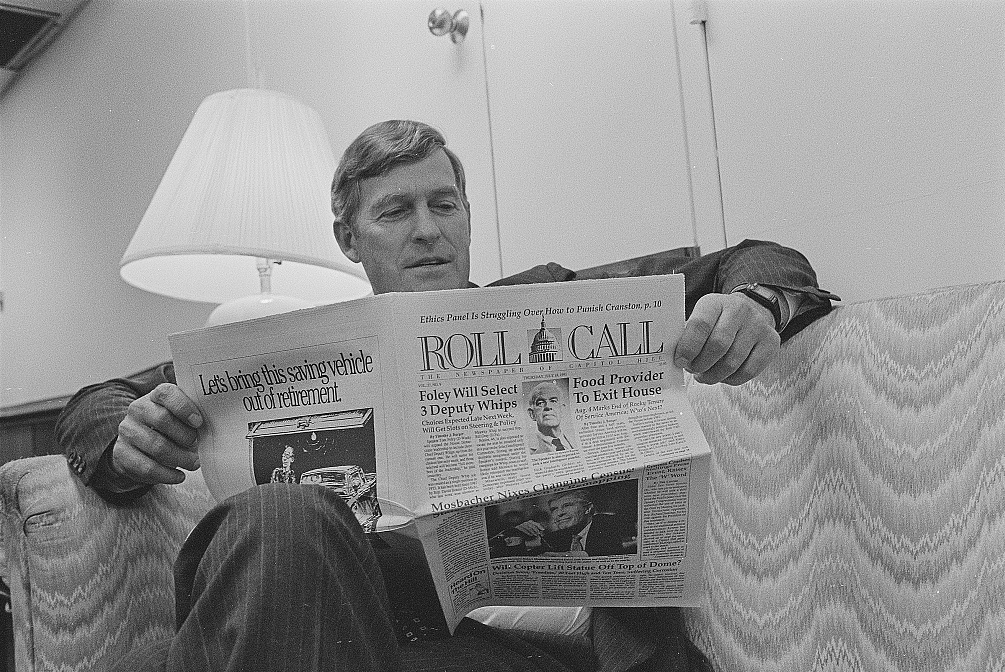
Senator Tim Wirth reading an issue of Roll Call in 1991

Key Information

Roll Call is a newspaper and website published in Washington, D.C., United States, when the United States Congress is in session, reporting news of legislative and political maneuverings on Capitol Hill, as well as political coverage of congressional elections across the country.

Roll Call is the flagship publication of CQ Roll Call, which also operates: CQ (formerly Congressional Quarterly), publisher of a subscriber-based service for daily and weekly news about Congress and politics, as well as a weekly magazine. Roll Call's regular columnists are Walter Shapiro, Mary C. Curtis, Patricia Murphy, and Stuart Rothenberg.

History

[edit]

Roll Call was founded in 1955 by Sid Yudain, a press secretary to Congressman Al Morano (R-Conn.).[1][2] The inaugural issue of the newspaper was published on June 16, 1955, with an initial printing of 10,000 copies.[3] Richard Nixon, then Vice President of the United States, wrote a letter to Yudain congratulating him on the new venture. Nixon's letter ran on the front page of the inaugural issue.

In 1986, Yudain sold Roll Call to Arthur Levitt, who was serving as the chairman of the American Stock Exchange at the time of the sale.[3] Yudain continued to work as a columnist at Roll Call after the sale.[3]

The Economist Group acquired Roll Call in 1993.[4] Roll Call merged with CQ in 2009 after the latter company was purchased by The Economist Group.[5]

In July 2018, a deal was announced for CQ Roll Call to be acquired by FiscalNote.[6]

Brand franchises

[edit]

"Heard on the Hill"

[edit]

In January 1988, Roll Call launched the "Heard on the Hill" column, which covers the intrigue of life and work in and around Capitol Hill. Alex Gangitano wrote Heard on the Hill from 2014 to 2018 before leaving to cover lobbying for The Hill.[7] On 30 April 2019, Roll Call announced the current Heard on the Hill writing team of Clyde McGrady and Kathryn Lyons.[8]

Congressional Baseball Game

[edit]

In 1962, Roll Call began sponsoring the annual Congressional Baseball Game for Charity. In 1965, the first Roll Call Trophy was awarded—to the Republican team, which was the first team to win three games since Roll Call began its sponsorship. Since then, a new trophy has been awarded to the next team that wins three games (over the next three, four, or five years), following the year in which the most recent trophy was awarded. Roll Call also sponsors the Congressional Baseball Hall of Fame.

"Hill Pinup" Feature (1957-1974)

[edit]

From 1957 until 1974, Roll Call featured a regular section called "Hill Pinup," which showcased female Capitol Hill staffers in posed photographs with brief profiles.[9] The subjects were typically secretaries and assistants to members of Congress, selected for their appearance and personality, with lawmakers occasionally suggesting their staff. The feature was considered prestigious by many who appeared in it, though attitudes changed over time. As Linda Steele, a former Deputy Chief of Staff who was once featured, recalled in a 2016 interview: "I doubt that any woman working on Capitol Hill now would even agree to do that, because in today's world it probably would be like a kiss of death, from a career standpoint."[10] The feature was discontinued in 1974 as social attitudes evolved and "photographers got skittish about taking it," according to Yudain. This change coincided with Roll Call's transition away from being "a polite purveyor of secretaries' pinups and ladies' lunch notices" toward more politically focused content. The feature was replaced with a "Hill Personalities" feature the following year.[11]

Notable Roll Call staff

[edit]
  • Kathryn Lyons, Heard on the Hill reporter
  • Camila Dechalus, Immigration Reporter[12]
  • Rebecca Adams, Senior Editor[13]
  • Megan Scully, Senior Editor
  • Ed Timms, Investigations Editor
  • Herb Jackson, Politics Editor[14]
  • Jason Dick, Deputy Editor
  • Lindsey Gilbert, Deputy Editor
  • Lindsey McPherson, Senior Writer[15][16]
  • Niels Lesniewski, Senior Writer
  • John M. Donnelly, Senior Writer
  • Jennifer Shutt, Budget and Appropriations Reporter
  • Bridget Bowman, Politics Reporter
  • Simone Pathé, Politics Reporter
  • Stephanie Akin, Politics Reporter
  • Kate Ackley, Lobbying Reporter[17]

Notable Roll Call alumni

[edit]

Political Theater Podcast

[edit]

Political Theater Podcast is a Roll Call podcast hosted by Jason Dick.[22] Jason Dick and the Roll Call team spotlight the spectacle, the players and what’s going on behind the curtain in Washington’s long-running drama: Congress.[23]

CQ Budget Podcast

[edit]

CQ Budget Podcast is a Roll Call podcast hosted by David Lerman. Budget tracker, David Lerman, explains how lawmakers in Congress spend the nation’s money.[24]

See also

[edit]

References

[edit]
[edit]
Revisions and contributorsEdit on WikipediaRead on Wikipedia
from Grokipedia

Roll Call is a Washington, D.C.-based newspaper and website dedicated to providing news, analysis, and objective reporting on the , politics, and legislative activities. Founded in 1955 by Sid Yudain, a former congressional frustrated by the lack of insider coverage of Hill operations, it began as a weekly tabloid distributed directly to members of and staff, emphasizing the people, personalities, and behind-the-scenes dynamics of legislative life.
Over its history, Roll Call evolved from a niche into a daily outlet with expanded digital presence, incorporating features like vote trackers, coverage, and podcasts on . Acquired by in 1992 and later merged with Congressional Quarterly in 2009, it was purchased in 2018 by , a and firm specializing in , which has integrated it into a broader suite of legislative monitoring tools. The maintains a focus on factual, nonpartisan , earning ratings as center-biased with high factual reliability from evaluators. Roll Call's defining characteristics include its accessibility to congressional insiders and its role in demystifying parliamentary procedures, such as roll call votes and workings, while avoiding overt partisan slant in favor of process-oriented reporting. It has no major documented controversies regarding fabrication or , distinguishing it from more ideologically driven outlets, though its corporate ownership under raises questions about potential influences from priorities.

History

Founding and Early Years (1955–1980s)

Roll Call was founded in 1955 by Sid Yudain, a former Hollywood reporter who had served as press secretary to Representative Albert P. Morano (R-Connecticut) since 1951. Yudain initiated the publication with a startup cost of $90, producing a weekly edition from his congressional office to address the absence of a dedicated newspaper covering the personal and social aspects of Capitol Hill life. The first issue appeared on June 16, 1955, establishing Roll Call as "The Newspaper of Capitol Hill," aimed at helping senators, representatives, staff, and their families connect through shared community narratives rather than formal legislative proceedings. Early editions consisted of roughly six pages of light, neighborhood-style content, including announcements of births, deaths, weddings, staff hires and departures, vacation snapshots, and recreational pursuits like fishing trips, which contrasted with the era's more rigid coverage in mainstream outlets. This focus resonated in an environment where congressional staffing levels were modest—concentrated primarily among party leadership and committee chairs—and personal interactions formed the core of Hill dynamics. Contributions from high-profile figures, such as Senators Lyndon B. Johnson and Richard M. Nixon, added prestige, while occasional reports on procedural events like filibusters or committee assignments provided limited substantive context without delving deeply into policy debates. The paper's informal tone and insider accessibility quickly made it a cherished fixture, often described as a "small-town bible" for the congressional enclave. Through the 1960s and 1970s, Roll Call sustained its weekly rhythm under Yudain's direction, prioritizing human elements over analytical depth to build loyalty among its niche audience of approximately 5,000 initial subscribers on the Hill. By the early 1980s, it had evolved modestly to include more congressional procedural insights alongside its signature columns on personnel and social happenings, reflecting gradual professionalization while preserving its community ethos. Yudain retained ownership and editorial control until , when he sold the publication to , concluding the founding era amid rising demand for Capitol-focused journalism.

Expansion and Key Milestones (1990s–2010s)

In 1992, Roll Call was acquired by , a British media company, marking a pivotal shift that infused the publication with international resources and enabled broader operational expansion amid growing demand for coverage during the early administration. This ownership change facilitated enhancements in reporting depth, including increased investigative pieces on congressional operations and influences, as the publication adapted to a more polarized political landscape following the 1994 Republican midterm gains. The late saw Roll Call solidify its niche through specialized features like "Heard on the Hill," a column launched to capture informal congressional dynamics, which boosted reader engagement among staffers and journalists. By the early , as adoption surged in Washington, Roll Call invested in digital infrastructure, aligning with the broader media shift toward online delivery; this included early web-based vote tracking tools that complemented its print editions during key legislative battles such as the 2001 tax cuts and post-9/11 security reforms. A major milestone occurred in 2008 when Roll Call acquired Capitol Advantage, an online platform providing advocacy tools to over 4,000 organizations, for $43 million, signaling a strategic pivot toward digital services and data-driven political engagement. This move expanded revenue streams beyond and subscriptions, integrating software for campaigns and petition management that supported clients during the 2008 election cycle. In 2009, Roll Call further consolidated its position by purchasing Congressional Quarterly (CQ), a venerable firm founded in 1945, for an undisclosed sum; the merger created CQ Roll Call, combining CQ's nonpartisan research with Roll Call's insider reporting to offer comprehensive legislative intelligence. This integration enhanced analytical depth, such as detailed bill-tracking databases used by lobbyists and lawmakers amid the 111th Congress's debates.

Ownership Changes and Recent Evolution (2018–Present)

In July 2018, The Economist Group announced the sale of CQ Roll Call—which encompasses Roll Call—to FiscalNote, a Washington, D.C.-based technology firm specializing in policy data analytics and software, for $180 million in a mix of cash and equity; the deal closed on August 20, 2018. This marked the first major ownership shift for Roll Call since its 1992 merger into CQ and subsequent 2005 acquisition by Economist Intelligence Unit, transitioning the publication from a traditional media parent to a tech-driven entity aimed at leveraging journalism alongside predictive analytics for legislative tracking. Following the acquisition, integrated CQ Roll Call's editorial operations into its platform, emphasizing synergies between Roll Call's congressional reporting and the company's AI-enhanced policy intelligence tools, though this period saw operational turbulence including approximately 30 layoffs in April 2020 amid broader industry pressures from the and internal company adjustments. In August 2022, itself went through a $1.3 billion SPAC merger with Duddell Street Acquisition Corp., listing on the under the ticker NOTE, which provided capital for expansion but exposed the media assets to public market scrutiny and volatility in tech valuations. From 2023 onward, Roll Call's evolution under has focused on digital enhancements and subscriber services, including the October 2025 launch of CQ&A, a live briefing series connecting users directly with CQ and Roll Call journalists for real-time insights, reflecting a hybrid model blending traditional reporting with 's data services. However, tensions emerged in late 2024 when the publication's newsroom union filed an charge with the against over a return-to-office mandate, highlighting ongoing adjustments in post-acquisition work structures. No further ownership transfers have occurred as of October 2025, with Roll Call remaining a core media brand within 's portfolio of policy-focused offerings.

Editorial Approach and Objectivity

Core Reporting Principles

Roll Call's core reporting principles center on delivering timely, factual coverage of congressional proceedings, emphasizing objectivity and independence from partisan influences or special interests. The publication prioritizes "objective facts and analysis" in its reporting on , elections, and political dynamics, aiming to provide comprehensive insights into the without media spin. This approach stems from its founding ethos, established by Sid Yudain in , which sought to inform and insiders with straightforward, rather than or . Accuracy and nonpartisanship form foundational elements, with Roll Call committing to unbiased information that tracks how congressional actions impact policy stakeholders, including lawmakers, corporations, and advocacy groups. Editorial standards require reporters to cover events from hearing rooms to campaign trails, focusing on people, politics, and procedural realities while avoiding alignment with external biases. Independent evaluations, such as those from Ad Fontes Media, rate Roll Call as reliable for fact-reporting with a middle-of-the-road bias, supporting its reputation for balanced congressional analysis over ideological framing. Unlike broader media outlets prone to interpretive overlays, Roll Call's principles privilege verifiable details on bill status, member positions, and caucus activities, fostering utility for professional audiences navigating Capitol Hill. These principles manifest in a deliberate separation of news from , where factual reporting precedes interpretive pieces, ensuring claims are grounded in direct or sourced . While not publishing a formal code of ethics akin to the , Roll Call's operational guidelines implicitly align with journalistic norms of transparency and fairness, as evidenced by its avoidance of anonymous sourcing unless justified by sensitivity and its corrections policy for errors. This framework has sustained its role as a neutral resource amid polarized discourse, though critics occasionally allege subtle institutional leanings reflective of Washington insider culture; however, empirical assessments affirm its adherence to factual integrity over narrative-driven reporting.

Independent Bias Assessments and Perceptions

Independent media bias rating organizations have assessed Roll Call as ideologically neutral or centered. Media Bias Rating assigns it a "Center" designation based on editorial reviews, blind bias surveys, and third-party data, noting its focus on factual congressional reporting without overt partisan slant. rates it "Least Biased" for using neutral language and sourcing from primary documents like congressional records, while awarding "Very High" factual reporting due to minimal failed fact checks and reliance on verifiable data. evaluates it as neutral on a -42 to +42 bias scale (scoring near zero) and among the most reliable sources, with high marks for analysis and fact-reporting based on analyst panels reviewing article language and sourcing. These assessments stem from Roll Call's emphasis on procedural and legislative details over opinionated commentary, distinguishing it from more interpretive outlets. Ground News similarly ranks its factuality as "Very High," aggregating blind verifications across multiple checkers. Perceptions among congressional insiders and readers often highlight its utility as a nonpartisan resource; for instance, its coverage prioritizes vote tallies, bill texts, and insider accounts without consistent favoritism toward either party, as evidenced by balanced sourcing in stories on bipartisan negotiations. Critics occasionally question potential establishment bias due to its Capitol Hill proximity and advertising ties to lobbying firms, but empirical reviews find no systemic distortion in core reporting. No major independent studies document partisan skew in its roll-call vote analyses or policy breakdowns, which rely on official records rather than narrative framing. Overall, Roll Call maintains a reputation for objectivity in niche political journalism, substantiated by consistent high-reliability scores across evaluators.

Content Focus and Special Features

Primary Congressional Coverage

Roll Call's primary congressional coverage centers on the daily operations and decision-making processes of the U.S. and , including the tracking of legislative proposals from introduction through committee review and floor consideration. This encompasses detailed reporting on the status of major bills, such as analyses of policy implications in areas like and defense, with recent examples including scrutiny of executive approaches to pharmaceutical pricing reforms. Coverage extends to committee hearings, where reporters document witness testimonies, markup sessions, and partisan dynamics shaping amendments. Floor activities form a core focus, with real-time updates on debates, procedural maneuvers, and voting outcomes, including extended speeches that influence legislative timelines, as seen in Senator Merkley's prolonged address tying up business. Roll Call reports on roll call votes, leadership statements, and bipartisan negotiations, providing context on how individual members' positions align with party lines or constituency interests. This includes breakdowns of vote tallies and their immediate effects on pending legislation, drawing from official congressional records and insider observations. Beyond procedural details, the publication profiles congressional members' activities, such as news conferences and initiatives, offering insights into personalities and power shifts on . Coverage also highlights behind-the-scenes intelligence, like internal party strategies and responses to executive actions intersecting with legislative priorities. These elements combine to deliver comprehensive, insider-oriented reporting aimed at illuminating the mechanics of congressional governance.

Brand Franchises and Signature Columns

Roll Call maintains several branded content series and signature columns that distinguish its coverage by blending insider anecdotes, analytical rankings, visual elements, and event sponsorships with traditional reporting. These franchises emphasize the cultural and interpersonal dynamics of , often prioritizing accessibility and engagement over partisan analysis. Heard on the Hill functions as the publication's flagship gossip-style column, chronicling light-hearted observations, staffer sightings, social events, and behind-the-scenes quirks among lawmakers and aides. Regular installments highlight informal aspects of congressional life, such as unusual office traditions or celebrity interactions on the Hill. The column, edited at various points by figures like Tim Curran, underscores Roll Call's role as a community-oriented outlet for the Capitol's workforce. The Clout Index represents an analytical brand franchise, quantifying each state's relative influence in through metrics including positions, subcommittee chairs, party roles, and earmark allocations. Published periodically, the index has tracked shifts in power distribution; for instance, the 2017 edition showed narrowing the gap with to 8 percentage points in overall clout. It provides data-driven insights into institutional leverage, with states like and historically dominating due to large delegations and senior members. Roll Call's sponsorship of the constitutes a longstanding event-based franchise, with the publication presenting the Roll Call Trophy to the winning team in this annual bipartisan charity matchup between Republican and Democratic lawmakers, held since 1909 at venues like . Coverage includes game recaps, player profiles, and historical context, such as Republicans' streak of victories extending into 2025; the event raises funds for youth organizations while fostering cross-aisle camaraderie. Historically, the Hill Pinup feature (1957–1974) showcased profiles and photographs of congressional staffers, often emphasizing personal stories and images in a style akin to mid-century magazine pin-ups, which drew attention to the Hill's diverse workforce but later faced retrospective criticism for . In recent years, visual franchises like Capitol Lens and Capitol Ink have emerged, offering curated photo essays and editorial illustrations that depict legislative milestones, daily Hill scenes, and symbolic events, such as Independence Day observances or procedural spectacles. These complement textual content by providing non-verbal narratives of congressional activity.

Multimedia and Digital Initiatives

Podcasts and Audio Content

Roll Call produces audio content primarily through podcasts integrated with its CQ Roll Call reporting, emphasizing congressional proceedings, debates, and fiscal issues. The flagship feed, CQ Roll Call and , aggregates audio from the newsroom and was formerly known as CQ on . This , with over 1,200 episodes as of 2025, delivers episodes on topics such as budget negotiations, immigration , and legislative maneuvers, often featuring Roll Call journalists analyzing real-time developments. A prominent series within this ecosystem is Political Theater, hosted by Roll Call's Jason Dick, which examines the procedural theatrics, member motivations, and partisan dynamics of . Launched around 2015, the features weekly episodes spotlighting events like discharge petitions, strategies, and election-year posturing, with discussions drawing on primary sources such as floor speeches and committee hearings. For instance, a 2025 episode addressed immigration enforcement and racial dimensions in legislative battles, incorporating Roll Call's coverage of debates. Another key offering, CQ Budget, focuses on appropriations, debt limits, and tax policies, hosted by reporters including David Lerman and Doug Sword. Episodes, such as one from 2025 on accelerating discussions and expansions, provide detailed breakdowns of fiscal mechanics and stakeholder positions, often citing data and leadership statements. These podcasts maintain Roll Call's nonpartisan stance by prioritizing verifiable legislative records over opinion, though they reflect the outlet's emphasis on insider procedural insights. Additional audio includes occasional special series like Equal Time, addressing niche topics such as governance amid political pressures. Distribution occurs via platforms including , , and , enabling on-demand access to Capitol Hill analysis for policymakers and observers.

New Digital Offerings and Expansions

In response to evolving reader demands for mobile accessibility, Roll Call introduced its dedicated news app in September 2013, enabling users to customize news feeds, receive or push notifications for alerts, and search content by location or individual. The app, available on both and Android platforms, extends the publication's congressional coverage to portable devices, with features updated to include real-time breaking news and analysis from . Following its acquisition by , Roll Call integrated AI-powered tools to enhance election coverage, announcing on May 1, 2024, an expansion incorporating data-driven analysis of roll call votes and predictive modeling for the U.S. presidential race. This initiative leverages to process legislative data, providing subscribers with automated insights into voting patterns and policy implications, marking a shift toward algorithmic augmentation of traditional reporting. Most recently, on October 9, 2025, launched CQ&A, a live digital briefing series exclusive to subscribers, facilitating direct Q&A sessions with CQ and Roll Call journalists on current congressional developments. This virtual format expands interactive engagement, allowing real-time queries on legislative tracking and advocacy strategies, and complements existing digital platforms like Factba.se for transcript and fact-checking access.

Personnel and Legacy

Notable Staff Members

Sid Yudain founded Roll Call in 1955 with an initial budget of $90 while serving as to Representative Albert P. Morano (R-Conn.), envisioning it as a community newspaper for akin to a small-town publication covering local personalities beyond just lawmakers. Drawing from his family background in and prior experience establishing newspapers during Army service, Yudain published the inaugural biweekly issue from Morano's office, emphasizing insider news for congressional staffers until securing independent space after three years. He owned and published the paper until selling it to Congressional Quarterly in 1986, establishing its focus on the "company town" dynamics of Washington. Tim Curran served as an editor during a period of expansion, guiding Roll Call from two to four print days per week and spearheading its early digital news initiatives while mentoring emerging reporters. joined as a reporter in 2000 and became the first Roll Call staffer to win the Everett McKinley Dirksen Award for Distinguished Coverage of in 2004, recognized for investigative reporting on nonprofit foundations influencing policy. Jason Dick holds the position of at CQ Roll Call as of 2025, having progressed through roles including deputy editor, senior writer, and editor, while also hosting the outlet's Political Theater podcast on congressional dynamics.

Prominent Alumni and Their Contributions

began her journalism career at Roll Call in 1998, where she covered and reported on the proceedings against President , traveling with the House Judiciary Committee to impeach him on December 19, 1998. She later advanced to anchor the from 2019 to 2024, during which the program emphasized in-depth political reporting and international affairs, contributing to CBS's coverage of major events like the 2020 U.S. and the . Jim VandeHei joined Roll Call in 1997 as a congressional reporter, where he broke significant stories on House leadership dynamics, including the speakership bid of in 1998. His experience at the publication honed his focus on insider reporting, leading to roles at and before co-founding in 2007, which revolutionized with its real-time, insider-driven coverage model, and later Axios in 2016, emphasizing concise "smart brevity" newsletters that reached millions of subscribers by 2023. Paul Kane started at Roll Call in 2000, specializing in Senate coverage and internal party dynamics, which provided foundational expertise in legislative processes. He transitioned to in 2007 as a senior congressional correspondent, authoring influential columns on congressional gridlock and leadership shifts, such as the 2015 Boehner resignation; Kane received the 2018 Everett McKinley Dirksen Award for Distinguished Reporting of for his in-depth analysis of bipartisan negotiations and institutional reforms. Chris Cillizza reported on campaigns and the White House for Roll Call from around 2001 to 2006, developing a reputation for data-driven political analysis during a period of intense partisan battles post-9/11. Subsequently, at The Washington Post and CNN—where he served as politics editor-at-large from 2017 to 2022—he built a large following through podcasts and columns dissecting election trends, such as forecasting outcomes in the 2016 and 2020 cycles using polling aggregates, influencing public understanding of electoral volatility. Ed Henry covered for Roll Call over eight years in the 1990s and early 2000s, serving as a senior editor and columnist on legislative and scandals, including early reporting on House banking overdrafts. He advanced to chief correspondent at from 2011 to 2020, providing on-the-ground coverage of presidential administrations, such as daily briefings during the Obama and Trump eras, though his tenure ended amid a 2020 termination for workplace misconduct allegations unrelated to reporting.

Influence, Impact, and Criticisms

Role in Capitol Hill Journalism

Roll Call has functioned as a cornerstone of journalism since its inception in 1955, delivering specialized, non-partisan coverage of congressional operations, personnel dynamics, and legislative processes that informs lawmakers, staff, lobbyists, and policy analysts. Founded by Sid Yudain, a former to Representative Albert P. Morano (R-Conn.), the publication originated with a modest $90 budget to highlight the human elements and behind-the-scenes stories of , extending beyond mere bill tracking to encompass the personalities shaping governance. This focus addressed a niche underserved by broader national outlets, which often prioritize executive branch narratives or high-profile scandals over the granular mechanics of congressional work. The newspaper's role emphasizes objective reporting free from partisan spin, positioning it as an indispensable resource amid pervasive media biases observed in mainstream and academic institutions. Roll Call provides real-time updates on hearings, committee markups, floor proceedings, and election developments, supplemented by analytical insights from contributors such as and , enabling readers to navigate complex legislative landscapes effectively. Signature features like "Heard on the Hill," a column aggregating insider anecdotes and observations from congressional aides, exemplify its commitment to capturing the informal pulse of , fostering transparency into otherwise opaque staff-level interactions. By maintaining a reputation as Capitol Hill's "," Roll Call influences journalistic standards through its emphasis on verifiable facts and process-oriented analysis, as evidenced by its early reporting on pivotal events like Donald Trump's selection of as in July 2016. This approach equips congressional offices, federal agencies, corporations, and firms with tools for strategic engagement, underscoring its practical impact on formulation and advocacy without endorsing ideological agendas. Despite evolving digital challenges, its enduring mission sustains in-depth scrutiny of Congress's , countering superficial coverage prevalent elsewhere.

Achievements and Recognized Contributions

Roll Call, widely regarded as the primary newspaper serving , has earned recognition for its in-depth coverage of and legislative processes since its founding in 1955. Its reporting is considered indispensable by members of and staff, contributing to informed decision-making on policy matters. Staff journalists at Roll Call and its parent entity CQ Roll Call have received multiple prestigious awards for investigative and spot news reporting. In 2018, senior reporters Kate Ackley and John M. Donnelly secured first-place honors in the National Press Club's annual journalism contest for their work on disclosures and investigations, respectively. Similarly, in 2022, Tom Williams won a National Headliner Award for best spot news photography, while columnist Mary C. Curtis received recognition in the opinion writing category. Earlier accolades include five awards in 2005 for investigative series on congressional and pork-barrel spending. Photographer Bill Clark has been honored repeatedly by the White House News Photographers Association, earning six individual awards in the 2023 Eyes of History contest across categories such as domestic events and portraits. In the digital realm, CQ Roll Call's Roll Call website was awarded the Best Political Website distinction in the 2017 WebAward Competition, highlighting its online platform's effectiveness in delivering timely political news. These recognitions underscore Roll Call's sustained impact on journalism, with alumni advancing to prominent roles in major media outlets and contributing to broader public understanding of legislative dynamics.

Criticisms, Challenges, and Media Landscape Pressures

Roll Call has encountered significant financial pressures amid ownership changes and the broader contraction of print media revenue. Under Group's ownership from 2009 to 2016, the publication underwent multiple rounds of layoffs between 2011 and 2014, despite generating profits, as corporate demands prioritized higher margins over journalistic investment. This reflected a pattern where owners undervalued sustained coverage of congressional operations in favor of short-term fiscal targets, exacerbated by the post-2010 surge in political spending following the Citizens United decision, which disproportionately benefited campaign advertising over traditional news outlets. Adaptation to the digital landscape has presented operational challenges, including the flight of special-interest advertisers due to congressional and the rise of free online competitors eroding paid circulation. Roll Call responded by enhancing its web presence and content strategies, but internal tensions emerged in the mid-2010s over shifts toward broader national reporting, which insiders linked to strained leadership dynamics and diluted focus on specifics. Independent evaluations, however, consistently rate Roll Call as centrist in bias and high in reliability, indicating limited external criticisms of partisan slant or factual lapses compared to more polarized outlets. The encompassing media environment imposes further strains through fragmentation, partisan amplification via social platforms, and declining local scrutiny of Congress, which reinforces tribal echo chambers and reduces demand for nuanced insider analysis. Physical risks to journalists have intensified, as seen in the January 6, 2021, Capitol attack, where assailants targeted press areas with vandalism decrying "Murder the Media," underscoring vulnerabilities for outlets reliant on Hill access amid rising hostility toward establishment reporting. These dynamics challenge Roll Call's model of nonpartisan, detail-oriented coverage, compelling ongoing pivots to multimedia and data-driven formats to sustain relevance in a profit-driven, algorithm-fueled ecosystem.

References

Add your contribution
Related Hubs
User Avatar
No comments yet.