Hubbry Logo
Room 641ARoom 641AMain
Open search
Room 641A
Community hub
Room 641A
logo
8 pages, 0 posts
0 subscribers
Be the first to start a discussion here.
Room 641A
Room 641A
from Wikipedia

37°47′07″N 122°23′48″W / 37.78528°N 122.39667°W / 37.78528; -122.39667

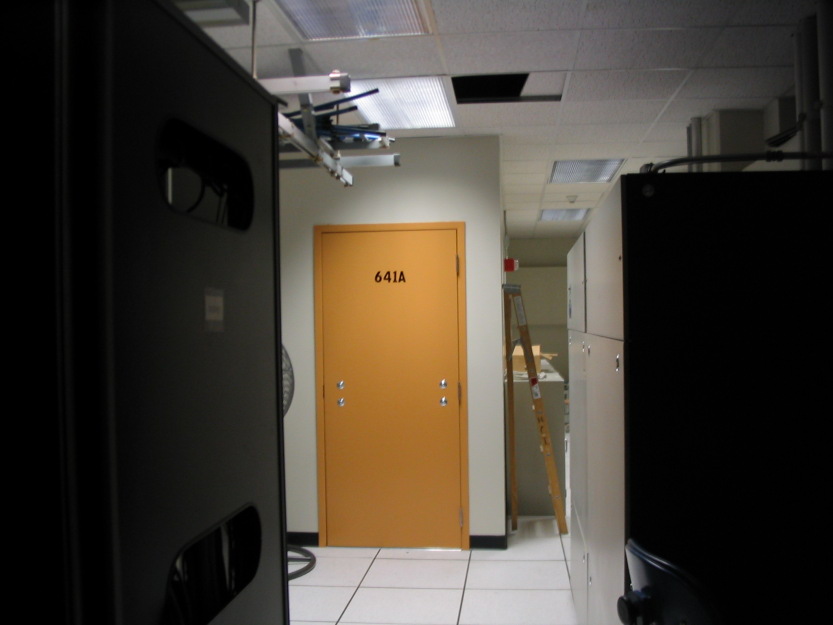
Room 641A's exterior

Room 641A is a telecommunication interception facility operated by AT&T for the U.S. National Security Agency, as part of an American mass surveillance program. The facility commenced operations in 2003 and its purpose was publicly revealed by AT&T technician Mark Klein in 2006.[1][2]

Description

[edit]

Room 641A is located in the SBC Communications building at 611 Folsom Street, San Francisco, three floors of which were occupied by AT&T before SBC purchased AT&T.[1] The room was referred to in internal AT&T documents as the SG3 [Study Group 3] Secure Room.

The room measures about 24 by 48 feet (7.3 by 14.6 m) and contains several racks of equipment, including a Narus STA 6400, a device designed to intercept and analyze Internet communications at very high speeds.[1] It is fed by fiber optic lines from beam splitters installed in fiber optic trunks carrying Internet backbone traffic.[3] In the analysis of J. Scott Marcus, a former CTO for GTE and a former adviser to the Federal Communications Commission, it has access to all Internet traffic that passes through the building, and therefore "the capability to enable surveillance and analysis of internet content on a massive scale, including both overseas and purely domestic traffic."[4]

The existence of the room was revealed by former AT&T technician Mark Klein and was the subject of a 2006 class action lawsuit by the Electronic Frontier Foundation against AT&T.[5] Klein claims he was told that similar black rooms are operated at other facilities around the country.[6]

Room 641A and the controversies surrounding it were subjects of an episode of Frontline,[7] the current affairs documentary program on PBS. It was originally broadcast on May 15, 2007. It was also featured on PBS's NOW on March 14, 2008. The room was also covered in the PBS Nova episode "The Spy Factory".

Lawsuits

[edit]

The Electronic Frontier Foundation (EFF) filed a class-action lawsuit, Hepting v. AT&T, against the company on January 31, 2006, accusing the telecommunication company of violating the law and the privacy of its customers by collaborating with the National Security Agency (NSA) in a massive, illegal program to wiretap and data-mine Americans' communications. On July 20, 2006, a federal judge denied the government's and AT&T's motions to dismiss the case, chiefly on the ground of the state secrets privilege, allowing the lawsuit to go forward. On August 15, 2007, the case was heard by the Ninth Circuit Court of Appeals and was dismissed on December 29, 2011, based on a retroactive grant of immunity by Congress for telecommunications companies that cooperated with the government. The U.S. Supreme Court declined to hear the case.[8]

A different case by the Electronic Frontier Foundation was filed on September 18, 2008, titled Jewel v. NSA. After many years of litigation, on April 25, 2019, the ruling from the Northern District of California[9] concluded that the evidence presented by the plaintiff's experts was insufficient: "the Court confirms its earlier finding that Klein cannot establish the content, function, or purpose of the secure room at the AT&T site based on his own independent knowledge." The ruling noted that "Klein can only speculate about what data were actually processed and by whom in the secure room and how and for what purpose, as he was never involved in its operation." The Court further went on to discredit other experts called upon, citing their heavy reliance on the Klein declaration.

In the spring of 2006, over 50 other lawsuits were filed against various telecommunications companies, in response to the article.[10] There has been speculation that several rooms similar to this exist all over the United States.[11][12]

[edit]

See also

[edit]

References

[edit]
[edit]
Revisions and contributorsEdit on WikipediaRead on Wikipedia
from Grokipedia
Room 641A is a secure telecommunications interception facility housed within AT&T's internet switching center at 611 Folsom Street in San Francisco, California, measuring approximately 24 by 8 feet and equipped with fiber-optic splitting hardware to enable the National Security Agency (NSA) to monitor a substantial volume of domestic and international voice and internet communications traffic passing through AT&T's backbone network. The room, designated as the SG3 Secure Room, was constructed and activated in early 2003 under a classified arrangement between AT&T and the NSA, involving the installation of specialized equipment from Narus Inc. that allowed for real-time capture and analysis of data streams without individual warrants. The facility's existence came to public attention in 2006 through the affidavit of , a retired technician who, during routine work on fiber-optic lines, discovered blueprints and documents detailing the room's non-standard wiring configuration, which bypassed 's own monitoring systems to route copies of directly to NSA-controlled hardware. Klein's disclosures, submitted to the (EFF), supported lawsuits alleging unconstitutional , including Hepting v. AT&T, which highlighted how incoming and outgoing fiber lines—carrying from other carriers—were split to duplicate full flows for NSA interception, potentially encompassing billions of communications daily. This setup exemplified broader post-9/11 expansions of NSA capabilities under programs like those authorized by , enabling bulk collection that raised legal challenges over Fourth Amendment violations, though later granted telecommunications firms retroactive immunity in 2008. Room 641A's operations underscored technical vulnerabilities in , where physical access to core hubs permitted comprehensive traffic mirroring without detectable performance degradation, a method reliant on cooperative private-sector partners rather than solely government-owned networks. While maintained the arrangement was limited to foreign intelligence, Klein's firsthand account of unfiltered domestic routing fueled debates on scope, with subsequent leaks confirming similar intercept points nationwide. The room remained operational into the , symbolizing the tension between imperatives and protections in an era of exponential growth.

Historical Context and Establishment

Post-9/11 Intelligence Reforms

Following the September 11, 2001, terrorist attacks, the U.S. intelligence community underwent rapid expansions in capabilities, driven by executive actions rather than immediate legislative overhauls. President issued secret authorizations starting October 4, 2001, permitting the (NSA) to intercept international communications involving U.S. persons without (FISA) warrants, under the rationale of inherent Article II powers during wartime. This initiated the President's Surveillance Program (PSP), including the component for bulk metadata and content collection, which prioritized volume over targeted warrants to address pre-9/11 intelligence-sharing failures identified in early reviews. The USA PATRIOT Act, enacted October 26, 2001, complemented these efforts by amending FISA to authorize roving wiretaps, sneak-and-peek searches, and court-ordered production of business records (later expanded via Letters), though the NSA's warrantless activities largely operated outside its provisions initially. These changes enabled NSA partnerships with firms to tap fiber-optic infrastructure, bypassing traditional judicial processes for efficiency in monitoring potential threats. cooperated under such directives, installing interception hardware as part of programs like FAIRVIEW, which facilitated domestic data routing to NSA analyzers. In February 2003, technicians, including , connected a splitter rack at its 611 facility in , diverting copies of incoming and outgoing —estimated at over 2.5 gigabits per second across multiple OC-192 lines—to Room 641A, a secure compartment equipped with Narus STA 6400 surveillance systems for real-time interception of voice, , and web activity. This setup exemplified the post-9/11 shift toward bulk collection, where telecom duplicates fed unfiltered data streams to NSA filters, later refined by algorithms; similar taps were reportedly established in other cities, though Room 641A's scale targeted West Coast backbone traffic. Subsequent reforms, such as the 2004 Intelligence Reform and Terrorism Prevention Act creating the , aimed to improve coordination but did not directly oversee these operational expansions, which persisted until public revelations prompted partial FISA amendments in 2008.

Installation and Initial Operations (2002–2003)

constructed Room 641A, designated as the SG3 Secure Room, in late 2002 within its switching facility at 611 in , positioning it adjacent to the core call-routing equipment handling high-volume fiber-optic traffic. The room measured approximately 24 by 8 feet and featured reinforced security measures, including a handle-less and exclusion of standard technicians from entry without NSA clearance. Installation of surveillance hardware proceeded through early 2003, involving fiber-optic splitters that duplicated incoming and outgoing data streams from AT&T's WorldNet backbone circuits—encompassing both domestic U.S. and international communications—without disrupting service. Key equipment included Narus STA 6400 systems capable of real-time , , and content extraction of voice, , web, and other digital communications; a December 10, 2002, inventory documented this setup. NSA personnel oversaw the process, conducting background checks and interviews for select staff to ensure compartmentalized access. Operations commenced in , allowing the NSA warrantless access to mirrored traffic for intelligence purposes amid post-9/11 expansions, though the full scope of initial data volume and targets remains classified. technician first noted the room's construction during a January 2003 facility tour, observing the integration of taps into multiple fiber lines. This setup mirrored similar NSA-secured rooms at other sites, forming part of a broader domestic network.

Technical Description

Physical Setup and Security Features

Room 641A is located within an telecommunications switching facility at 611 in , , adjacent to the main call-routing equipment room. Construction of the room began in 2002 and was completed by early 2003, involving the installation of specialized to intercept fiber-optic communications traffic. High-speed fiber-optic cables carrying domestic and international traffic enter the facility and are routed through optical splitters, duplicating signals into the room without interrupting the primary data flow. The internal setup features Narus STA 6400 hardware, including Linux-based servers and NarusInsight software for , connected via Ethernet switches to analyze copied traffic in real time. These components enable the extraction of content from unencrypted communications, such as emails and web browsing, while metadata from encrypted sessions is also captured. The room's design isolates it from standard operations, with dedicated power supplies and cooling systems to support continuous high-volume . Security measures include a biometric mantrap entry system utilizing retinal and fingerprint scanners, restricting access to personnel holding Top Secret/Sensitive Compartmented Information (TS/SCI) clearance issued by the NSA. The door lacks an external handle and is monitored by surveillance cameras, ensuring only authorized NSA and cleared AT&T contractors can enter. Physical barriers and electronic locks prevent unauthorized intrusion, with the room's existence concealed from most facility staff until whistleblower disclosures.

Surveillance Hardware and Capabilities

Room 641A housed specialized surveillance equipment installed by AT&T under NSA direction, primarily consisting of Narus STA 6400 Semantic Traffic Analyzer systems. These devices connected to high-speed fiber-optic circuits entering the facility, utilizing optical splitters to duplicate incoming and outgoing internet traffic without interrupting the primary data flow. The splitters directed copies of the traffic—encompassing domestic and international communications—to the Narus hardware for processing. The Narus STA 6400 performed real-time , capable of capturing, filtering, and analyzing vast volumes of data at high speeds. This included inspecting packet contents, reconstructing individual communications, and identifying patterns or specific selectors such as IP addresses, phone numbers, or keywords. The system supported bulk collection by indexing traffic flows, enabling the NSA to query and retrieve targeted information from the aggregated . Programming the equipment allowed for automated selection of communications based on predefined criteria, facilitating warrantless monitoring of AT&T's backbone traffic hub. Technical documentation from former AT&T technician detailed the integration of these components, confirming the setup's capacity to handle terabits per second of traffic from multiple fiber lines. Only NSA-cleared personnel maintained the isolated equipment, underscoring its role in a classified program. The hardware's design emphasized non-disruptive , with redundant power and cooling to ensure continuous operation.

Network Integration and Data Flow

Room 641A integrates into AT&T's fiber-optic backbone at the 611 facility in by connecting to high-capacity circuits handling WorldNet internet service and peering links with providers such as ConXion, Verio, and . These circuits originate from the facility's 8th floor and route through splitter cabinets on the 7th floor, where optical signals are divided using non-intrusive fiber-optic splitters. The splitters duplicate the light signals: the primary stream continues uninterrupted to AT&T's core routers, while a copy is diverted via dedicated fiber links directly into Room 641A. The duplicated traffic, encompassing , web browsing, and other electronic communications passing through AT&T's network—which accounted for approximately one-third of U.S. bandwidth at the time—is fed into Narus STA 6400 systems housed in the room's equipment cabinets. These systems perform real-time , sessionizing data streams to reconstruct communications, distinguishing protocols like VoIP from other traffic, and applying filters based on selectors such as IP addresses or keywords. The Narus hardware, comprising analysis probes connected to servers and supported by routers, processes the full volume of intercepted signals without contextual pre-filtering at the splitter stage, enabling bulk capture of metadata and selected content. Processed data matching NSA criteria is then routed from Room 641A to secure NSA networks for storage and further , while non-matching is discarded locally to minimize retention. This setup, installed around , allowed of both domestic and international traversing the facility's backbone links without altering the original data flow. Technical documentation from whistleblower , including wiring diagrams, confirms the splitter rack's role in routing duplicates exclusively to the NSA-monitored room, bypassing standard operations.

Discovery and Public Revelation

Mark Klein's Observations and Documentation

, a at from 1981 until his in 2006, first encountered irregularities at the company's San Francisco switching center at 611 during routine maintenance in late 2002. In December 2002, he received internal documents labeled "Study Group 3, LGX/Splitter Wiring, San Francisco," which outlined the installation of linear lightwave multiplexers (LLMs) and fiber-optic splitters designed to duplicate incoming traffic. These splitters, housed in a special cabinet (location 070177.04) on the 7th floor, diverted copies of light signals from 16 fiber-optic cables connected to the into Room 641A on the 6th floor. In January 2003, Klein toured the facility and observed the ongoing construction of Room 641A, a secure 24-by-48-foot space containing approximately a dozen equipment cabinets fitted with servers, routers (models M40e and M160), and an industrial air conditioner for cooling high-power gear. The room featured restricted access via a , limited to personnel with (NSA) clearance, and included Narus STA 6400 hardware capable of real-time and monitoring. He retained copies of related procedures, including the "SIMS, Splitter Cut-In and Test Procedure" dated January 13, 2003, and another "Cut-In and Test Procedure" from January 24, 2003, which detailed the activation of these splitters, phased in starting February 2003. Klein's documentation revealed that the setup enabled the duplication and of domestic and international —potentially billions of bits per second—directly to NSA control without apparent filtering for foreign intelligence targets. AT&T wiring diagrams stamped "" confirmed the integration of these splitters with the facility's core WorldNet . In April 2006, prior to the public revelation of warrantless surveillance programs, Klein compiled this evidence, including diagrams and photographs of the room's exterior, and provided it along with a sworn declaration to the for the Hepting v. class-action lawsuit filed in the U.S. District Court for the Northern District of .

Whistleblowing and Media Exposure (2006)

In early 2006, former technician , who had worked for the company for 22 years, provided internal documents and a sworn declaration to the (EFF) detailing his observations of Room 641A's installation and operations, supporting the Hepting v. AT&T class-action lawsuit filed against the company for alleged privacy violations through NSA collaboration. Klein's materials included proprietary AT&T wiring diagrams, photographs of the room's exterior, and descriptions of fiber-optic splitters routing domestic and international to Narus surveillance equipment without apparent filtering for foreign content. On April 7, 2006, Wired magazine published an article based on Klein's account, revealing the existence of the secret room at AT&T's Folsom Street facility in San Francisco as a dedicated NSA interception site capable of capturing vast amounts of communications data in bulk. Klein described how, during routine maintenance in 2003, he had been instructed to connect "splitter" cables that duplicated peering links—high-volume fiber lines carrying WorldNet traffic—to the isolated room, enabling real-time monitoring without warrants. This exposure built on broader revelations of NSA warrantless surveillance but specifically highlighted Room 641A's role in domestic data vacuuming, prompting concerns over unconstitutional overreach. Klein's formal declaration, submitted under penalty of perjury on May 17, 2006, in support of the plaintiffs' motion for a preliminary in Hepting v. , asserted that the setup allowed the NSA "unfettered access to data warehouse containing all communications flowing to and from the ." Media coverage intensified, with Wired releasing additional evidence on May 17, including Klein's narrative of NSA engineers' secretive installations and the room's Narus STA 6400 hardware for . The disclosures fueled public and legal scrutiny, though denied illegal activities, claiming compliance with legal processes, while the Bush administration invoked to limit further details.

Initiation of Lawsuits

Following the public disclosures by former technician regarding unauthorized NSA access to domestic internet traffic via Room 641A, the (EFF) initiated a class-action lawsuit titled Hepting v. AT&T on January 31, 2006, in the United States District Court for the Northern District of . The suit, filed on behalf of customers including plaintiffs Tina Hepting, alleging violations of the Fourth Amendment, the (FISA), and federal wiretap statutes, claimed that had installed surveillance equipment in Room 641A at its 611 Folsom Street facility in , enabling the NSA to intercept and analyze vast quantities of U.S. citizens' communications without judicial warrants or . Klein's detailed affidavit, submitted as evidence, described the physical setup of Narus-made splitters and optical taps diverting full-duplicate copies of traffic into the secure NSA-controlled room, supporting allegations of systematic, warrantless bulk collection. The U.S. government swiftly intervened in the case on behalf of , invoking the to argue that litigation would reveal about operations. This intervention occurred shortly after filing, highlighting early executive branch efforts to shield the program from judicial scrutiny. The lawsuit's initiation spurred additional private actions; by spring 2006, over 50 similar suits against telecommunications providers, including , were filed nationwide by affected customers and groups, many citing Klein's documentation of Room 641A as evidence of unconstitutional collaboration between private firms and intelligence agencies. These initial filings framed the core legal contention: whether corporate facilitation of NSA surveillance constituted illegal aiding of warrantless domestic spying, prompting consolidation into multidistrict litigation to streamline proceedings amid claims of pervasive privacy intrusions enabled by post-9/11 infrastructure like Room 641A.

Key Court Cases and Rulings

The primary legal challenge stemming from the operations of Room 641A was Hepting v. AT&T, a class-action lawsuit filed on January 31, 2006, by the Electronic Frontier Foundation (EFF) on behalf of AT&T customers alleging that the company violated the Electronic Communications Privacy Act and Fourth Amendment rights by providing the NSA with unrestricted access to domestic communications traffic via the facility. In June 2006, the U.S. District Court for the Northern District of California rejected the government's invocation of the state secrets privilege and AT&T's motion to dismiss, allowing the case to proceed based on evidence including technician Mark Klein's declarations about the room's Narus STA-6400 surveillance equipment. The case's trajectory shifted with the passage of the FISA Amendments Act of 2008 on July 10, 2008, which included Section 802 granting retroactive to telecommunications companies cooperating with government surveillance requests certified as lawful by the Attorney General. In 2009, U.S. District Judge dismissed the suit following the government's certification under the new law, a decision affirmed by the Ninth Circuit Court of Appeals on December 29, 2011, which upheld the statute's constitutionality against and challenges. The U.S. denied on October 9, 2012, effectively ending the litigation and shielding from liability. A related suit, , was filed by the EFF in September 2008 directly against the NSA and other officials, bypassing telecom immunity by claiming unconstitutional "Upstream" dragnet surveillance of backbone traffic routed through Room 641A, affecting millions of Americans without warrants. The U.S. District Court initially dismissed for lack of standing in 2009, but the Ninth Circuit reversed in December 2011, recognizing plaintiffs' injury from probable mass acquisition of their communications. In July 2013, the district court rejected the for FISA-covered claims, permitting limited evidence disclosure under 50 U.S.C. § 1806(f). Subsequent rulings invoked the state secrets doctrine more broadly: In February 2015, the district court granted to defendants on non-FISA claims, citing risks to from disclosure; this was partially appealed. The Ninth Circuit affirmed the dismissal of remaining claims in August 2021, and the Supreme Court denied on June 13, 2022, concluding the case without a merits ruling on the program's legality. These outcomes relied on evidentiary barriers rather than of the underlying practices' compliance with statutory or constitutional limits.

Outcomes Involving Immunity and State Secrets Privilege

In the Hepting v. lawsuit, initiated on January 31, 2006, by the representing customers alleging unconstitutional surveillance via Room 641A, the U.S. government filed a motion to dismiss under the , asserting that continued litigation risked exposing classified NSA methods and capabilities. On June 21, 2006, U.S. District Judge denied the motion, ruling that plaintiffs' evidence—drawn from public disclosures, including Mark Klein's unclassified affidavit detailing the room's Narus STA 6400 equipment and fiber-optic splitting—did not necessitate revelation of privileged information, as the program's broad outlines were already acknowledged by officials. The government appealed the denial, but congressional intervention via the FISA Amendments Act of 2008, signed into law by President on July 10, 2008, shifted the outcome decisively. Section 802 of the Act provided retroactive civil immunity to telecommunications firms for assistance in programs conducted before December 31, 2006, conditioned on the certifying that the occurred in good-faith reliance on assurances of legality from the executive branch. On September 18, 2008, issued such certification for , prompting Judge Walker to dismiss the case on June 3, 2009, on grounds of statutory immunity, thereby shielding from liability without adjudicating the surveillance's constitutionality. Parallel cases invoked similar privileges with mixed early results before immunity prevailed. In Al-Haramain Islamic Foundation v. Bush, linked to broader NSA warrantless wiretapping revelations, Judge Walker ruled on July 2, 2008, that the Foreign Intelligence Surveillance Act preempted the state secrets privilege, allowing limited evidence review under FISA procedures; however, the Ninth Circuit reversed this in 2011, and the case concluded without merits determination due to standing and immunity barriers. In Jewel v. NSA, another Electronic Frontier Foundation suit alleging mass domestic interception via AT&T facilities including Room 641A, district courts partially sustained state secrets claims post-2008, dismissing certain claims in 2015 while permitting others to proceed until the Supreme Court denied certiorari on June 13, 2022, citing potential secret disclosures. The Supreme Court also declined review of Hepting on October 9, 2012, solidifying immunity's role in foreclosing judicial scrutiny.

Controversies and Debates

Privacy Concerns and Civil Liberties Criticisms

The revelation of Room 641A's operations in 2006 prompted widespread criticism from advocates, who argued that the facility enabled the warrantless interception of domestic internet communications, violating Americans' Fourth Amendment rights against unreasonable searches and seizures. The (EFF), in its Hepting v. lawsuit filed on January 31, 2006, alleged that 's installation of fiber-optic splitters diverted copies of all incoming and outgoing from the hub—encompassing voice calls, emails, web browsing, and other data—directly to the NSA without individualized warrants or . This setup, according to whistleblower Mark Klein's technical documentation, allowed the agency to access approximately 10% of U.S. passing through the facility, including communications of millions of ordinary citizens uninvolved in foreign intelligence. Critics, including the EFF and , contended that such bulk collection constituted a dragnet program that circumvented the (FISA) requirements for court oversight, exposing private metadata and potentially content to government scrutiny without legal justification. The program was accused of breaching the (ECPA), including the Wiretap Act and , by facilitating unauthorized electronic . Privacy advocates highlighted the facility's Narus STA 6400 hardware, capable of to filter and analyze traffic in real-time, raising fears of indiscriminate monitoring that eroded constitutional protections and enabled potential political abuse. Broader concerns focused on the of pervasive on free speech and association, as individuals might self-censor knowing their online activities could be captured without recourse. The EFF's Jewel v. NSA case, building on Klein's evidence, asserted that the operations inflicted constitutional injury on customers through broad-based warrantless , a claim that persisted despite repeated government invocations of the to block evidence disclosure. These criticisms underscored a systemic shift post-9/11 toward prioritizing security over privacy, with Room 641A symbolizing unchecked executive power in intelligence gathering.

National Security Justifications and Effectiveness

The (NSA) maintained that Room 641A facilitated the collection of foreign intelligence by providing access to high-volume fiber-optic cables carrying international communications, enabling the agency to identify threats such as , cyber attacks, and proliferation activities without relying solely on overseas taps. This capability was framed as critical given that a significant portion of global communications—estimated at up to 80% of NSA's collection—transits U.S. telecom infrastructure, including AT&T's backbone, where foreign adversaries' data mixes with domestic traffic. Post-9/11 authorizations, including President George W. Bush's 2001 directive for the , positioned such upstream intercepts as a targeted response to al-Qaeda's use of encrypted and routed communications, bypassing slower traditional warrants under the (FISA). NSA officials, including Director Keith Alexander, testified in 2013 that bulk surveillance programs, encompassing upstream collection akin to Room 641A's operations, contributed to thwarting over 50 potential terrorist plots worldwide, with examples including disruptions of Yemen-based al-Qaeda communications and New York subway bombing plans. Proponents argued this volume-based approach uncovers "unknown unknowns"—emerging threats not identifiable through individualized tips—enhancing predictive analytics on foreign selectors like email addresses or IP ranges associated with non-U.S. persons. The program's integration into broader efforts, later codified under Section 702 of FISA Amendments Act in 2008, was credited with yielding actionable intelligence on counterterrorism priorities, such as tracking ISIS affiliates via transiting metadata. Independent evaluations, however, have questioned the program's direct effectiveness in preventing . A 2014 New America Foundation analysis of 225 post-9/11 cases found bulk metadata collection—analogous in scale to Room 641A's internet intercepts—contributed to convictions in only one instance, with most successes stemming from traditional investigative methods like informants. The President's Review Group on Intelligence and Communications Technologies similarly concluded in 2013 that bulk collection under Section 215 offered minimal incremental value for , as targeted queries sufficed for known threats, while the costs and false positives diverted resources. For upstream internet surveillance, the Privacy and Oversight Board noted in 2014 that while it supports foreign intelligence broadly, -specific yields are low relative to incidental U.S. captured, with no tying Room 641A directly to averted attacks. Critics, including a 2014 review cited by , emphasized that of major plots disrupted, fewer than 10% involved NSA bulk , underscoring inefficiencies in sifting vast streams for causal links to threats.

Broader Implications for Government-Private Sector Cooperation

The exposure of Room 641A revealed a model of post-9/11 government-private sector collaboration wherein telecommunications giants like provided the NSA with unfettered access to domestic traffic, including links between carriers, enabling the duplication of signals for analysis without individualized warrants. This partnership, part of broader initiatives like the FAIRVIEW program, positioned private infrastructure as a extension of state capabilities, with technicians installing Narus STA 6400 equipment to capture both metadata and content from fiber optic cables handling up to one-third of U.S. . Legal repercussions from whistleblower revelations prompted to enact Section 802 of the FISA Amendments Act of 2008, which granted retroactive civil immunity to telecom firms upon certification by the Attorney General that their assistance was lawful and believed necessary for , effectively shielding AT&T from lawsuits such as Hepting v. AT&T and halting judicial scrutiny of the program's scope. This legislative intervention minimized , incentivizing future by aligning private economic interests—such as lucrative contracts—with objectives, while subordinating customer obligations under statutory frameworks like the Fourth Amendment. Such arrangements normalized the outsourcing of surveillance infrastructure to private entities, fostering dependencies that amplified government reach but eroded accountability, as companies faced pressure from national security letters or Patriot Act provisions compelling data handover with gag orders. Critics, including the Electronic Frontier Foundation, argued this dynamic enabled unchecked bulk collection, with empirical reviews later questioning its counterterrorism efficacy—such as the 2015 discontinuation of similar NSA metadata programs due to high costs and marginal intelligence yields—yet proponents maintained it deterred threats through comprehensive monitoring. The precedent extended to subsequent partnerships, influencing tech sector involvement in programs like PRISM, where voluntary or coerced data sharing underscored the blurring of public and private roles in mass data acquisition.

Legacy and Current Status

Connection to Subsequent NSA Programs

Room 641A's installation and operations, which enabled the NSA to access unencrypted domestic and international via AT&T's fiber optic backbone starting around February 2003, exemplified early bulk collection techniques that persisted and evolved into formalized programs under the (FISA) Amendments Act of 2008. This act's Section 702 authorized warrantless acquisition of foreign communications "to or from" the , legalizing practices akin to those in Room 641A by permitting telecom providers to assist in targeting non-U.S. persons abroad, incidentally capturing domestic data. The facility operated as part of the NSA's FAIRVIEW program, a longstanding partnership with for routing international traffic to agency analysts, which continued post-exposure and encompassed multiple interception sites beyond . FAIRVIEW facilitated "upstream" collection by splitting light signals from fiber cables, mirroring the Narus STA 6400 system's role in Room 641A for real-time monitoring and of metadata and content. Edward Snowden's 2013 disclosures revealed UPSTREAM as a successor mechanism under Section 702, involving compelled taps on major U.S. internet backbone cables—similar to Room 641A's setup—for collecting transit communications, distinct from PRISM's direct server queries to tech firms. These revelations confirmed AT&T's ongoing collaboration, with documents detailing over a decade of data handoffs exceeding those from other providers, underscoring continuity from Room 641A's warrantless origins to regulated but expansive post-2008 surveillance. While FAIRVIEW and UPSTREAM emphasized foreign targets, both programs' incidental U.S. person collection raised parallel Fourth Amendment concerns to those litigated over Room 641A.

Recent Developments and Ongoing Relevance (Post-2013)

The disclosures by in June 2013 provided documentary evidence confirming the existence and scope of operations akin to those in Room 641A, revealing the FAIRVIEW program as a key NSA-AT&T partnership for accessing traffic, including metadata and content from fiber-optic cables. These documents, covering activities through at least 2013, showed AT&T's provision of billions of records and phone metadata daily to the NSA, with FAIRVIEW receiving the largest allocation—$188.9 million in one reported year—among corporate partnerships. In response to the leaks, Congress passed the USA Freedom Act on June 2, 2015, curtailing bulk collection of domestic telephony metadata but preserving upstream internet surveillance under Section 702 of the FISA Amendments Act, which FAIRVIEW-like operations fall under. AT&T-NSA cooperation persisted, as evidenced by 2015 analyses of Snowden files indicating AT&T's installation of surveillance equipment in at least 17 U.S. internet hubs, far exceeding peers like Verizon. A June 25, 2018, report based on further Snowden documents detailed an expansion of Room 641A-style facilities into eight "spy hubs" across U.S. cities, including the original site, central to monitoring billions of communications via AT&T's network. These hubs, described as fortress-like buildings, enabled real-time of domestic and international , underscoring the program's evolution rather than termination. Legal challenges tied to Room 641A continued post-2013, notably in Jewel v. NSA, filed by the in 2008 but litigated through Snowden-era revelations; the U.S. declined review on June 13, 2022, upholding dismissal on state secrets and standing grounds, despite evidence from whistleblower linking the room to warrantless domestic . Room 641A retains ongoing relevance as a foundational example of bulk upstream collection under FISA Section 702, reauthorized in 2018 and 2024 with incremental reforms like warrant requirements for certain queries, amid debates over incidental domestic data capture and lack of empirical proof of necessity for national security gains. Its infrastructure model informs critiques of government-corporate ties, with no verified decommissioning of the San Francisco facility or equivalent capabilities, as subsequent leaks affirm sustained AT&T assistance in foreign intelligence gathering that inevitably sweeps U.S. persons' data.

References

Add your contribution
Related Hubs
User Avatar
No comments yet.