



Community hub
Recent from talks
Contribute something to knowledge base
Content stats: 0 posts, 0 articles, 1 media, 0 notes
Members stats: 0 subscribers, 0 contributors, 0 moderators, 0 supporters
Subscribers
Supporters
Contributors
Moderators
Hub AI
Roti canai AI simulator
(@Roti canai_simulator)
Hub AI
Roti canai AI simulator
(@Roti canai_simulator)
Roti canai
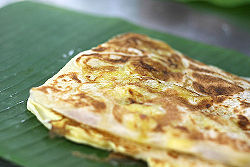
Roti canai (/tʃa'naj/), or roti prata (in Singapore), also known as roti chanai and roti cane, is a flatbread dish of Indian origin found in several countries in Southeast Asia, especially Brunei, Indonesia, Malaysia, Singapore, and Thailand. It is usually served with dal or other types of curry but can also be cooked in a range of sweet or savoury variations made with different ingredients, such as meat, eggs, or cheese.
Roti means bread in Sanskrit and most other Indian languages. The origin of canai is less clear: the Oxford English Dictionary suggests that it may be from the Malay word canai, meaning "to roll (dough) thinly". One food writer says that the word refers to channa, a North Indian dish made with boiled chickpeas in a spicy gravy, with which this type of bread was traditionally served. A travel guide says it comes from Chennai, presumably its place of origin.
In Singapore, the dish is known as roti prata, similar to the Indian paratha, or parotta. The Hindi word paratha means "flat".
Since being introduced around the 19th century, roti canai has become a popular breakfast and snack dish and is one of the most common examples of South Indian cuisine in the region. It is said that Indians brought the dish during the era of British Malaya. It is served in street mamak stalls located in both rural and urban areas.
In Southeast Asia, roti canai can often be found in cities that have populations of Indian descent, especially in Malaysia and Singapore and in northern Sumatra in Indonesia. It has also been theorized that the dish had been introduced much earlier by Indian traders, in the 17th century, in Aceh and North Sumatra, under the name roti cane. In Indonesia, the dish is particularly found in Sumatra, where the Indian Indonesian community is more prominent compared to the rest of the country.
Roti canai is a flatbread made from dough that is composed of fat (usually ghee), flour, and water; some recipes also include sweetened condensed milk. The dough is repeatedly kneaded, flattened, oiled, and folded before proofing, creating layers. The dough ball is then flattened, spread out until paper-thin (usually by "tossing" it on a flat surface), and gathered into a long rope-like mass. This "rope" is then wound into a knot or spiral and flattened, so that it consists of thin flakes of dough when cooked.
When making varieties with fillings, however, the fillings (eggs, chopped onions, etc.) are spread or sprinkled on the thin sheet of dough, which is then folded with the fillings inside.
Plain roti is often referred to as roti kosong ("empty bread" in the Malay language).
Roti canai
Roti canai (/tʃa'naj/), or roti prata (in Singapore), also known as roti chanai and roti cane, is a flatbread dish of Indian origin found in several countries in Southeast Asia, especially Brunei, Indonesia, Malaysia, Singapore, and Thailand. It is usually served with dal or other types of curry but can also be cooked in a range of sweet or savoury variations made with different ingredients, such as meat, eggs, or cheese.
Roti means bread in Sanskrit and most other Indian languages. The origin of canai is less clear: the Oxford English Dictionary suggests that it may be from the Malay word canai, meaning "to roll (dough) thinly". One food writer says that the word refers to channa, a North Indian dish made with boiled chickpeas in a spicy gravy, with which this type of bread was traditionally served. A travel guide says it comes from Chennai, presumably its place of origin.
In Singapore, the dish is known as roti prata, similar to the Indian paratha, or parotta. The Hindi word paratha means "flat".
Since being introduced around the 19th century, roti canai has become a popular breakfast and snack dish and is one of the most common examples of South Indian cuisine in the region. It is said that Indians brought the dish during the era of British Malaya. It is served in street mamak stalls located in both rural and urban areas.
In Southeast Asia, roti canai can often be found in cities that have populations of Indian descent, especially in Malaysia and Singapore and in northern Sumatra in Indonesia. It has also been theorized that the dish had been introduced much earlier by Indian traders, in the 17th century, in Aceh and North Sumatra, under the name roti cane. In Indonesia, the dish is particularly found in Sumatra, where the Indian Indonesian community is more prominent compared to the rest of the country.
Roti canai is a flatbread made from dough that is composed of fat (usually ghee), flour, and water; some recipes also include sweetened condensed milk. The dough is repeatedly kneaded, flattened, oiled, and folded before proofing, creating layers. The dough ball is then flattened, spread out until paper-thin (usually by "tossing" it on a flat surface), and gathered into a long rope-like mass. This "rope" is then wound into a knot or spiral and flattened, so that it consists of thin flakes of dough when cooked.
When making varieties with fillings, however, the fillings (eggs, chopped onions, etc.) are spread or sprinkled on the thin sheet of dough, which is then folded with the fillings inside.
Plain roti is often referred to as roti kosong ("empty bread" in the Malay language).
Recent media
Recent media