Hubbry Logo
ParathaParathaMain
Open search
Paratha
Community hub
Paratha
logo
8 pages, 0 posts
0 subscribers
Be the first to start a discussion here.
Paratha
Paratha
from Wikipedia

Paratha
Alternative names
  • Porota (Bangladesh)
  • Parontha (Punjab)
  • Porotta (Tamil Nadu and Kerala)
  • Egg roll (West Bengal)
  • Kathi roll (Nepal)
  • Ceylon parotta (Sri Lanka)
  • Buss-up shut (Trinidad and Tobago)
  • Oil roti (Guyana)
  • Faratha (Mauritius)
  • Farata (Maldives)
Region or stateSouth Asia
Associated cuisineIndia, Nepal, Bangladesh, Pakistan, Sri Lanka, Maldives, Mauritius, Fiji, South Africa, Suriname, Trinidad and Tobago, Guyana, Myanmar,[1] Middle Eastern, Singapore, Malaysia, Thailand
Main ingredientsAtta, ghee/butter/cooking oil and various stuffings
VariationsParotta, aloo paratha, Mughlai paratha, paratha roll, roti canai, wrap roti, faratha
  •   Media: Paratha

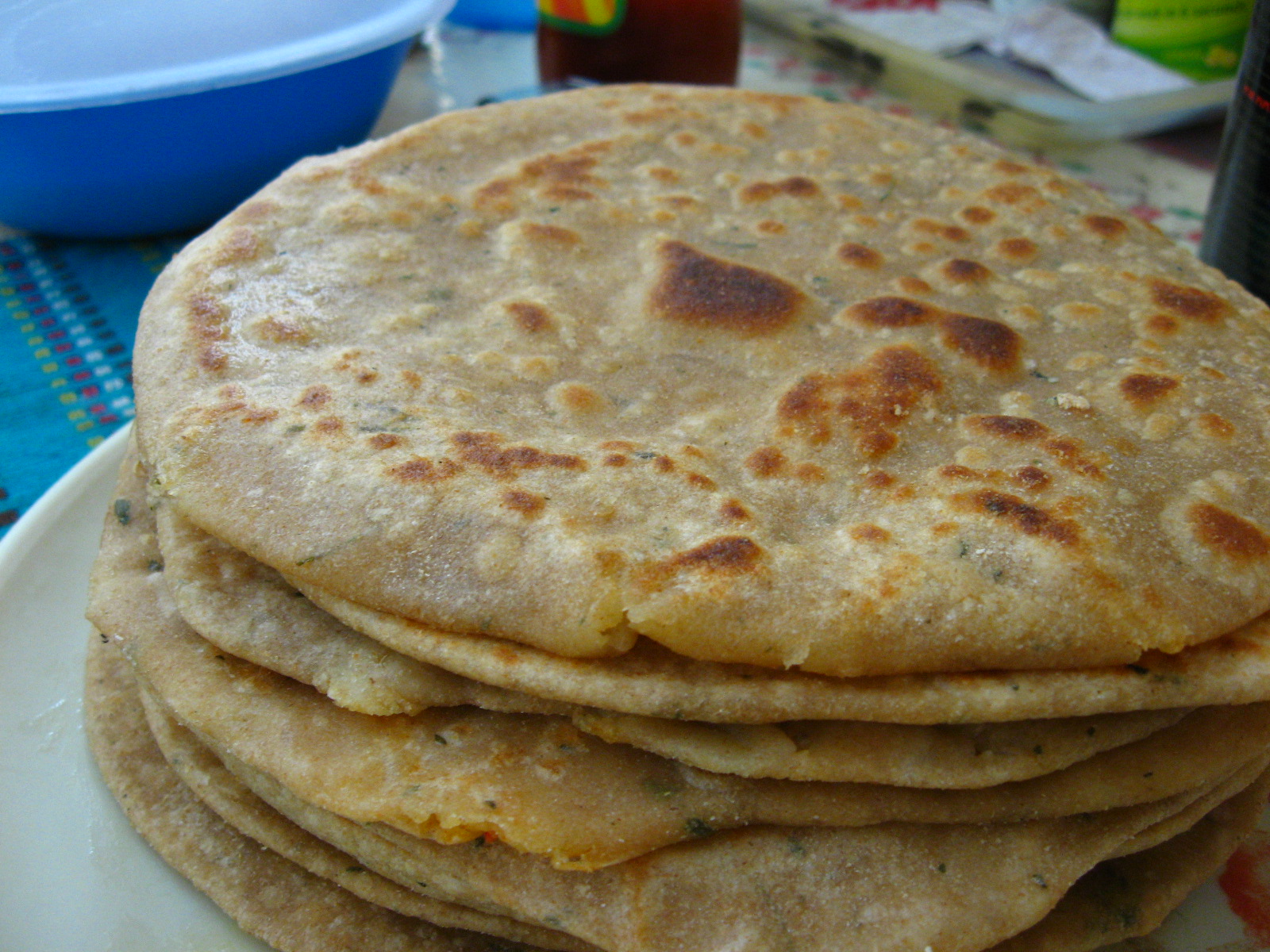
Paratha (IPA: [pəˈɾaːʈʰaː, pəˈɾãːʈʰaː], also parantha or parontah) is a flatbread native to the Indian subcontinent,[2][3] first mentioned in early medieval Sanskrit.[2] It is one of the most popular flatbreads in the Indian subcontinent.[4][5]

Etymology and alternative names

[edit]

Paratha is an amalgamation of the words parat and atta, which literally means layers of cooked dough.[6] The word is derived from Sanskrit (S. पर, or परा+स्थः, or स्थितः).[7] Alternative spellings and names include parantha, parauntha, prontha, parontay, paronthi (Punjabi), porota (in Bengali), paratha (in Odia, Urdu, Hindi), palata (pronounced [pəlàtà]; in Myanmar),[1] porotha (in Assamese), forota (in Chittagonian and Sylheti), faravatha (in Bhojpuri), faratha (in Mauritius), farata (in Maldives), prata (in Southeast Asia), paratha, buss-up shut, oil roti (in the Anglophone Caribbean) and roti canai in Malaysia and Indonesia.

Prevalence

[edit]

Parathas are prevalent throughout the modern-day countries of India, Pakistan, Nepal, Bangladesh, Maldives, Afghanistan, Myanmar,[1] Malaysia, Singapore, Thailand, Mauritius, Fiji, Guyana, Suriname, South Africa, and Trinidad and Tobago where wheat is the traditional staple. India's old Delhi houses the 'Parathe wali gali', a street famous for the flat breads and serving more than 80 varieties and flavors.

History

[edit]

Recipes for various stuffed wheat puran polis (which Achaya (2003) describes as parathas) are mentioned in Manasollasa, a 12th-century Sanskrit encyclopedia compiled by Someshvara III, a Western Chalukya king, who ruled from present-day Karnataka, India.[8] References to paratha have also been mentioned by Nijjar (1968), in his book Panjāb under the Sultāns, 1000–1526 AD when he writes that parathas were common with the nobility and aristocracy in the Punjab.[9]

According to Banerji (2010), parathas are associated with North Indian cooking. The method is to stuff parathas with a variety of stuffings. However, Banerji states, the Mughals were also fond of parathas which gave rise to the Dhakai paratha, multilayered and flaky, taking its name from Dhaka in Bangladesh.[10] O'Brien (2003) suggests that it is not correct to state that the paratha was popularised in Delhi after the 1947 partition of India, as this item was prevalent in Delhi before then.[11]

Plain and stuffed varieties

[edit]
Paratha, whole wheat, commercially prepared, Frozen
Nutritional value per 100 g (3.5 oz)
Energy327 kcal (1,370 kJ)
45.36 g
Sugars4.15
Dietary fiber9.6 g
13.20 g
6.36 g
Vitamins and minerals
VitaminsQuantity
%DV
Thiamine (B1)
9%
0.11 mg
Riboflavin (B2)
6%
0.076 mg
Niacin (B3)
11%
1.830 mg
Pantothenic acid (B5)
0%
0 mg
Vitamin B6
5%
0.08 mg
Folate (B9)
0%
0 μg
Vitamin E
9%
1.35 mg
Vitamin K
3%
3.4 μg
MineralsQuantity
%DV
Calcium
2%
25 mg
Iron
9%
1.61 mg
Magnesium
9%
37 mg
Phosphorus
10%
120 mg
Potassium
5%
139 mg
Sodium
20%
452 mg
Zinc
7%
0.82 mg
Other constituentsQuantity
Water33.5 g

Percentages estimated using US recommendations for adults,[12] except for potassium, which is estimated based on expert recommendation from the National Academies.[13]

Parathas are one of (if not the most) the most popular unleavened flatbreads in the Indian subcontinent, made by baking or cooking whole-wheat (atta) dough on a tava, and finishing off with shallow-frying.[14] Plain parathas are thicker and more substantial than chapatis or rotis because they have been layered by coating with ghee or oil and folded repeatedly, much like the method used for puff pastry or a laminated dough technique, and as a result have a flaky consistency. Stuffed parathas may include a wide variety of ingredients and be prepared in a variety of styles, traditionally depending on region of origin, and may not use folded dough techniques.

A number of traditional techniques are used to achieve the layered dough for plain parathas.[14] These include covering the thinly rolled-out pastry with oil, folding back and forth like a paper fan and coiling the resulting strip into a round shape before rolling flat, baking on a tava or shallow-frying. Another method is to cut a circle of dough from the center to its circumference along its radius, oiling the dough and starting at the cut edge rolling so as to form a cone which is then squashed into a disc shape and rolled out.[citation needed]

Common fillings include mashed spiced potatoes (aloo paratha), dal, cauliflower (gobi paratha), minced lamb (keema paratha), and minced chicken. Less common stuffing ingredients include mixed vegetables, green beans, carrots, other meats, leaf vegetables, radishes, and paneer. A Rajasthani mung bean paratha uses both the layering technique together with mung dal mixed into the dough. Some stuffed parathas are not layered, lacking in the flakiness of plain parathas, and instead resemble a filled pie squashed flat and shallow-fried, using two discs of dough sealed around the edges. Alternatively, they can be made by using a single disc of dough to encase a ball of filling and sealed with a series of pleats pinched into the dough around the top; they are then gently flattened with the palm against the working surface before being rolled into a circle.[citation needed]

Serving

[edit]

The paratha is an important part of a traditional breakfast from the Indian subcontinent. Traditionally, it is made using ghee but oil is also used. Some people may even bake it in the oven for health reasons. Usually, the paratha is eaten with dollops of white butter on top of it. Common side dishes are curd, fried egg, omelette, mutton kheema (ground mutton cooked with vegetables and spices), nihari, jeera aloo (potatoes lightly fried with cumin seeds), daal, and raita as part of a breakfast meal. It may be stuffed with potatoes, paneer, onions, qeema or chili peppers.[citation needed]

Types

[edit]
Parathas being made
  • Aloo paratha (stuffed with spicy boiled potato and onions mix).
  • Chili parotha or mirchi paratha (incorporating small, spicy shredded pieces)
  • Dulhan paratha (originating from Hyderabad, Sindh), named for its elaborate presentation, which is reminiscent of the ornate appearance of a bride ('dulhan' in Urdu); this dish is known for its combination of flavorful ingredients.[15]
  • Gobi paratha (stuffed with cauliflower)
  • Paneer paratha (stuffed with farmer cheese)
  • Keema paratha (stuffed with keema, spiced ground meat usually made up of chicken or lamb)
  • Pyaz paratha (stuffed with flavoured onions)
  • Cheese paratha (stuffed with cheese)
  • Mughlai paratha (a deep-fried stuffed paratha filled with egg and minced meat, from Bangladesh and West Bengal of India)
  • Petai paratha (thin, flaky and hand-smashed paratha from West Bengal, India)
  • Dhakai paratha (flaky layered paratha from Bangladesh and West Bengal of India)
  • Murthal paratha, deep-fried; dhabas of Haryana and especially at Murthal on Grand Trunk Road are famous for this[16][17][18]
  • Roti prata (Singapore)
  • Roti canai (Malaysia and Indonesia)
  • Buss-up-shut (Trinidad; the name is Trinidadian Creole for "busted-up shirt", for the resemblance of the shreddy bread to ragged old clothes)

See also

[edit]

References

[edit]
Revisions and contributorsEdit on WikipediaRead on Wikipedia
from Grokipedia
Paratha is an unleavened, layered flatbread originating from the Indian subcontinent, primarily associated with northern Indian cuisine but popular across the Indian subcontinent including Pakistan, Bangladesh, Nepal, and Sri Lanka. It is made from a simple dough of whole wheat flour (atta), water, salt, and sometimes oil or ghee, which is kneaded, rolled thin, folded or coiled to create multiple layers, and then pan-fried on a tava (griddle) using ghee or oil until golden and crisp. This lamination technique results in a flaky, buttery texture that distinguishes paratha from simpler flatbreads like roti. The earliest references to paratha-like breads date back to the 12th century in Indian texts, including the South Indian Sanskrit encyclopedia Manasollasa, with food historian K.T. Achaya describing it in A Historical Dictionary of Indian Food as wheat dough rolled out, sometimes stuffed, and fried in ghee on a tawa around 1120 CE. Originally, variations may have included sweet fillings, but it evolved into both plain and savory stuffed forms, with the latter becoming a breakfast staple often paired with yogurt, pickle, or curries. Stuffed parathas commonly feature fillings like spiced potatoes (aloo paratha), cauliflower (gobhi paratha), lentils, or paneer, while regional twists include the flaky laccha paratha from North India or the softer parotta from South India. Paratha holds significant cultural importance as an everyday food in Indian households and street vendor offerings, reflecting the subcontinent's diverse culinary traditions shaped by historical and regional practices. Its versatility allows for sweet versions with sugar or nuts in some areas, and it is often enjoyed during festivals or as a portable meal wrapped around fillings. Unlike leavened breads such as naan, paratha's unleavened nature makes it quicker to prepare and more accessible in home cooking.

Origins and History

Etymology and Names

The term "paratha" derives from Sanskrit roots, combining "parat" or "parā," meaning layers or folded, with "atta," referring to flour, to denote layers of cooked dough. This etymology is attested in ancient texts like the 12th-century Manasollasa, a Sanskrit encyclopedic work on arts and sciences, where early forms of layered flatbreads are described. The word evolved into Hindi and Urdu as "paratha," reflecting its adaptation in the Indian subcontinent's culinary lexicon. In regional Indian languages, the bread bears variations such as "parotta" in South India, particularly Kerala and Tamil Nadu, where it emphasizes the flaky, layered preparation using refined flour. In Bengali, it is known as "porota," a term highlighting its soft, multi-layered texture often served with curries. Punjabi speakers commonly use "paratha," aligning closely with the Hindi form and underscoring its prominence in North Indian and Punjabi cuisine. Through migration and trade, the name transliterated further in other regions; for instance, Indian indentured laborers introduced it to Southeast Asia and the Indian Ocean islands, where it became "prata" in Singapore and Malaysia, and "farata" in Mauritius and the Maldives. During the Mughal era, linguistic influences from Persian shaped the terminology, with "paratha" drawing from the Persian "parat" for layers, integrating into the empire's diverse culinary nomenclature for flatbreads. Arabic terms for similar layered breads, such as those akin to feteer or mutabbaq, also contributed indirectly via trade routes, enriching the word's historical associations in Indian subcontinental contexts.

Historical Development

The origins of paratha trace back to medieval culinary practices of the Indian subcontinent, with the earliest known reference appearing in the 12th-century Manasollasa text, an encyclopedic Sanskrit work by Someshvara III, describing wheat dough rolled out, sometimes stuffed, and fried in ghee on a tawa around 1120 CE, as noted by food historian K.T. Achaya. Simple unleavened flatbreads from wheat or barley, such as those mentioned in ancient texts, formed the basis for later layered preparations, though specific lamination techniques emerged later. The paratha's development into a more elaborate form occurred during the Mughal Empire (16th–19th centuries), when Central Asian nomadic influences introduced stuffing and ghee layering. Mughal cuisine, blending Persian, Turkish, and local Indian elements, popularized stuffed variants filled with spiced meats, vegetables, or sweets, often layered with clarified butter (ghee) for flakiness, as seen in courtly recipes that adapted Central Asian breads like those carried by invading armies. This era marked paratha's transition from a plain staple to a versatile dish, with historical accounts crediting emperors like Jahangir for refining stuffed parathas in royal kitchens. Etymological shifts during this period tied the name "paratha" to Persian roots meaning "layers of dough." By the 19th century, paratha spread beyond the Indian subcontinent via trade and migration routes, reaching Southeast Asia and the Middle East through Indian merchants, sailors, and indentured laborers. Documentation in colonial-era cookbooks, such as those compiling princely state recipes from mid-19th-century India, records paratha's preparation methods and adaptations, highlighting its portability as a travel food along maritime silk routes. In regions like Malaysia and the Arabian Peninsula, it evolved into local forms like roti prata, influenced by Arab and Southeast Asian traders. Following independence in 1947, paratha became a cornerstone of urban street food culture in India and Pakistan amid rapid urbanization and migrations spurred by Partition. These movements helped popularize and commercialize paratha varieties through roadside vendors and dhabas, solidifying its role in everyday diets across diverse post-colonial populations.

Preparation Methods

Ingredients and Dough

Paratha dough is fundamentally made from whole wheat flour, known as atta in Hindi, which provides the characteristic texture and nutritional base of this flatbread. Water is added to hydrate the flour and form the dough, while a small amount of salt enhances flavor and strengthens the gluten structure. Optional fat, such as ghee or oil, is incorporated to improve elasticity and tenderness, with ghee being the traditional choice for its rich, nutty flavor derived from clarified butter. A standard recipe for the dough yields about 6-8 parathas and includes 2 cups (approximately 240 grams) of whole wheat flour, 3/4 cup (180 ml) of water, 1 teaspoon of salt, and 1-2 tablespoons of ghee or neutral oil. To prepare, the flour and salt are first sifted into a bowl, followed by rubbing in the fat with fingertips to distribute it evenly and create a crumbly mixture that aids in flakiness. Water is then gradually poured in while mixing, forming a shaggy mass that is turned out onto a surface for kneading. Kneading the dough vigorously for 5 to 10 minutes is essential to develop a smooth, soft, and pliable consistency, allowing the gluten to relax for easier rolling later. Over-kneading should be avoided to prevent toughness, and the dough is shaped into a ball, lightly oiled on the surface, and covered with a damp cloth or plastic wrap. It then rests for 15 to 30 minutes at room temperature, which further relaxes the gluten and makes the dough more manageable. Modern variations often substitute oil for a vegan-friendly option, maintaining similar elasticity without altering the core process significantly.

Cooking Techniques

The primary cooking method for paratha involves shallow-frying the rolled dough on a hot tawa, a flat cast-iron griddle, to achieve its signature flaky, golden texture. After dividing the rested dough into portions, each is rolled into a thin circle or triangle approximately 5 mm thick, often with layers of ghee or oil applied during folding to create separation for puffing. The tawa is preheated to medium-high heat, and the paratha is placed on it, cooking for about 1-2 minutes until bubbles form on the surface before flipping. Ghee or oil is then brushed on the uncooked side, and the paratha is cooked for another 1-2 minutes per side, with gentle pressing using a spatula to encourage even browning and layer separation. Doneness is indicated by golden-brown spots, puffed edges, and a crisp exterior while remaining soft inside. This flipping and pressing technique is crucial for developing the characteristic flakiness, as it distributes heat evenly and allows steam to expand the layered structure without tearing the dough. Traditionally, ghee is preferred over oil for its rich flavor and ability to enhance crispiness, though oil serves as a lighter alternative. In modern kitchens, electric griddles can substitute for the tawa, maintaining similar heat distribution for consistent results. For variations simulating a tandoor effect, paratha can be cooked on a tava and then briefly roasted over an open flame until brown spots appear, yielding a smokier flavor. Common pitfalls in cooking paratha include over-kneading the dough prior to rolling, which can result in a tough texture due to excessive gluten development, and improper temperature control on the tawa. Frying on low heat leads to a hard, dry paratha, while high heat burns the exterior before the interior cooks through; maintaining medium-high heat ensures optimal puffing and tenderness. To avoid sogginess, excess flour should be dusted off before placing on the tawa, and parathas are best served immediately after cooking.

Varieties and Regional Adaptations

Plain Varieties

Plain paratha is an unstuffed, unleavened flatbread made primarily from whole wheat flour (atta), water, and salt, prized for its simplicity and subtle, buttery flavor derived from ghee applied during preparation. Unlike stuffed varieties, it relies solely on the richness imparted by ghee for its tender yet crisp texture, making it a foundational element in everyday Indian cooking. This classic form can be single-layered for a straightforward profile or multi-folded to introduce subtle flakiness without any internal fillings. Preparation begins with kneading a soft dough from whole wheat flour, salt, and water, which is rested for 20-30 minutes to develop gluten for elasticity; portions are then rolled into circles approximately 6-8 inches in diameter on a floured surface. Ghee or oil is brushed on the dough during folding steps—such as pleating or coiling—to create layers, before final rolling and cooking on a hot tawa (griddle) over medium heat for about 4-5 minutes total, flipping once to achieve golden-brown spots on both sides. This method, often using a basic dough and tawa cooking technique, ensures the paratha's exterior crisps while the interior remains soft. Thickness variations distinguish plain parathas, with thinner versions like laccha paratha achieving pronounced flakiness through multiple applications of ghee between finely pleated or coiled layers, resulting in a crispy, peelable texture upon serving. In contrast, thicker, softer plain parathas are rolled more uniformly without extensive layering, yielding a denser, more pliable flatbread similar to a hearty chapati but enriched with ghee for added moisture and flavor. These differences allow for customization based on preference, with the laccha style emphasizing visual and textural appeal through its intricate layers. Warqi paratha, a traditional flatbread from Lucknow, India, is another layered plain variety characterized by its flaky, multi-layered texture achieved through repeated folding and brushing with ghee; it is made from a dough of flour, salt, sugar, ghee, and milk, enhancing its buttery richness and tenderness. In North Indian households, plain parathas commonly serve as a versatile alternative to roti in daily meals, providing a satisfying base for accompaniments like dal, vegetable curries, yogurt, or pickles, especially during breakfast or lunch when quick preparation is valued. Their unstuffed nature makes them a staple for routine consumption, offering nourishment without complexity in family settings.

Stuffed Varieties

Stuffed parathas feature an inner layer of seasoned fillings encased within the dough, distinguishing them from plain varieties by adding depth and variety to the flatbread's flavor and texture. Popular fillings include aloo, prepared from boiled and mashed potatoes mixed with spices such as cumin seeds, red chili powder, turmeric, and garam masala to create a savory, mildly spicy core. Other common vegetable-based options are gobhi, using grated and spiced cauliflower, and paneer, incorporating crumbled Indian cottage cheese seasoned with similar aromatic spices for a creamy contrast. Non-vegetarian adaptations often employ keema, a mixture of minced meat cooked with onions, ginger, garlic, and spices like coriander and cumin, providing a richer, protein-packed alternative. The assembly process emphasizes precision to ensure the filling remains contained during cooking. The dough, typically made from whole wheat flour, water, and a touch of oil, is divided into equal-sized balls, each about the size of a golf ball. One ball is rolled into a small disc, approximately 4-5 inches in diameter, and a generous spoonful of the prepared filling—such as 2-3 tablespoons for aloo—is placed in the center. The edges are then pleated and sealed tightly to form a stuffed pouch, after which it is gently rolled out to a full paratha size of 7-8 inches, using light pressure to avoid tears or leakage of the filling. These fillings contribute to bold flavor profiles that balance spice and savoriness, often enhanced by fresh herbs like chopped coriander leaves and green chilies for a vibrant, aromatic kick. In aloo paratha, for instance, 2 medium boiled potatoes are mashed and combined with 1 teaspoon each of turmeric powder, garam masala, cumin powder, and red chili powder, plus salt to taste, along with 1-2 finely chopped green chilies and 2 tablespoons of fresh coriander, yielding a cohesive mixture that infuses the bread with earthy heat. During cooking on a hot griddle, ghee is layered on both sides to promote flakiness and crispiness without overpowering the internal flavors.

Regional and International Variations

In India, the Kerala parotta, also known as Malabar parotta, is a flaky, layered flatbread prepared primarily with maida (all-purpose flour), water, salt, and oil, where the dough is repeatedly folded and stretched to create multiple crisp layers during cooking on a hot tawa. This variation achieves its signature crispiness through the use of coconut oil in the dough and for frying, reflecting Kerala's coastal culinary influences that incorporate coconut derivatives for enhanced texture and flavor. In Bengal, porota often features layered constructions with fillings such as minced meat (keema), egg, onions, green chilies, coriander, and spices before being encased in refined flour dough and shallow-fried to yield a crispy exterior. Across the Indian subcontinent, adaptations highlight local ingredients and techniques. Sri Lankan pol roti incorporates freshly grated coconut into the dough made from all-purpose flour, salt, and water, resulting in a soft yet chewy flatbread with subtle sweetness from the coconut, often enhanced by charred onions for added depth when cooked on a griddle. In Pakistan, flaky paratha is commonly stuffed with beaten eggs mixed with onions, chilies, and spices, then layered with ghee and pan-fried on a griddle with ghee or oil to produce a buttery, crisp texture that contrasts the soft egg filling inside. Internationally, paratha-inspired breads have evolved through migration and trade routes that carried Indian subcontinental culinary traditions to Southeast Asia and the Middle East. Singaporean roti prata features a thin, stretched dough pleated into upturned edges for extra crispiness when griddled, with sweet variations topped with sliced bananas that caramelize during cooking, offering a dessert-like twist served alongside curry or tea. In the Middle East, farata— a Yemeni and Emirati adaptation of paratha—consists of layered maida dough fried until golden and crisp, frequently paired with za'atar, a tangy herb blend of thyme, sumac, sesame seeds, and salt, which is sprinkled or mixed with olive oil as a dipping condiment. Modern fusions in Western countries have adapted paratha to dietary trends emerging in the 2010s, emphasizing plant-based and allergen-free options. Vegan versions replace ghee with plant oils or aquafaba for dough elasticity, maintaining the flaky layers while aligning with ethical eating preferences in regions like North America and Europe. Gluten-free iterations utilize alternative flours such as rice, tapioca, or almond blends with xanthan gum as a binder, allowing for stuffed varieties that mimic traditional textures without wheat, driven by rising awareness of gluten sensitivities and health-focused diets.

Cultural and Culinary Role

Prevalence and Consumption

Paratha holds a prominent place as a staple food in the daily diets of North India and Pakistan, where it is commonly consumed as a breakfast item or throughout the day in households and eateries. In these regions, it features regularly in everyday meals, often prepared fresh at home or purchased from local vendors, reflecting its integral role in routine nutrition and comfort eating. As a popular street food in urban areas of India, such as Delhi and Noida, paratha is widely available from roadside stalls and markets, attracting consumers for its quick preparation and affordability. Studies on street-vended parathas in these locations highlight their ubiquity, with vendors serving them to diverse crowds during peak hours, contributing to the vibrant urban food culture. This accessibility underscores paratha's role across socioeconomic classes, from low-income workers relying on inexpensive vendor portions to middle-class families preparing elaborate versions at home. Consumption of paratha increases during winter months in northern India, where its warm, filling nature provides comfort against the cold, often incorporating seasonal greens like methi or bathua for added nutritional warmth. During festivals such as Diwali, sweet variations emerge in homes and markets, enhancing celebratory meals with their indulgent appeal. Estimates suggest millions partake annually through both traditional and frozen formats, with India's frozen paratha market alone valued at US$60.28 million in 2024, indicating substantial overall demand. In the global Indian diaspora, paratha has gained traction in countries like the UK, US, and Canada, introduced through immigrant communities and commercial products from brands like Haldiram's, which exports frozen varieties to these markets as part of its broader snack portfolio. This popularity is evident in the rising demand for frozen parathas among expatriates from the Indian subcontinent, supporting a global market influenced by cultural ties and convenience.

Serving Suggestions and Pairings

Parathas are classically served hot to preserve their flaky texture, often accompanied by cooling yogurt (dahi) or tangy pickle (achaar), which provide a balanced contrast to the bread's richness. For stuffed varieties such as aloo paratha, traditional pairings include raita or chickpea curry (chole), enhancing the flavors of the spiced potato filling. These accompaniments are staples in North Indian cuisine, where parathas form a versatile base for both simple and elaborate meals. In Indian households, parathas commonly appear at breakfast slathered with butter and paired with a hot cup of chai, offering a comforting start to the day. At dinner, they serve as a side to lentil preparations like dal, allowing the bread to soak up the savory gravy. A typical serving consists of several parathas per person, depending on the meal's context and accompaniments. Contemporary adaptations have introduced fusion pairings, such as incorporating avocado into the dough or stuffing for a creamy twist popular in Western-inspired dishes. Eggs, whether fried or scrambled, are increasingly paired with parathas in global contexts to create hearty brunch options. Sweet variations, like those drizzled with honey, offer a dessert-like indulgence, diverging from savory traditions.

Nutritional Profile and Health Aspects

Nutritional Composition

A standard plain paratha, prepared with whole wheat flour and layered with ghee or oil, offers a nutrient-dense profile typical of Indian flatbreads. Per 100 grams, it typically provides 300-350 kilocalories, with macronutrients consisting of approximately 6-10 grams of protein, 40-50 grams of carbohydrates, and 10-15 grams of total fat, the majority of which comes from the added ghee during cooking. The primary carbohydrate source is whole wheat flour, contributing complex carbs and supporting energy needs, while the protein is derived mainly from the flour's gluten content. Dietary fiber is present at approximately 2 grams per 100 grams, aiding digestion and derived from the bran in whole wheat; this is comparable to equivalents in whole wheat flatbreads. Micronutrients include B-vitamins like thiamin (around 0.3-0.4 mg) and niacin (2-3 mg), essential for metabolism, as well as iron at 2-3 mg, which supports oxygen transport—values adjusted from base whole wheat flour content to account for paratha's preparation.
Nutrient (per 100g plain paratha)Approximate AmountKey Source Contribution
Energy300-350 kcalCarbohydrates and fats from ghee
Protein6-10 gWhole wheat flour
Carbohydrates40-50 gWhole wheat flour
Total Fat10-15 gGhee or oil layering
Dietary Fiber2 gWhole wheat bran
Iron2-3 mgWhole wheat flour
Thiamin (Vitamin B1)0.3-0.4 mgWhole wheat flour
Stuffed varieties, such as aloo paratha, modify this profile by incorporating fillings like mashed potatoes, elevating carbohydrates to about 45-50 grams per 100 grams while introducing additional potassium (around 300-400 mg from the potato content). These versions maintain similar protein and fat levels to plain paratha but may increase overall caloric density slightly depending on filling proportions and added ghee. In contrast, plain paratha generally has a lower fat content than heavily stuffed or ghee-rich adaptations, emphasizing its role as a versatile base in nutritional assessments.

Health Considerations and Variations

Parathas, particularly those made with whole wheat flour and cooked using ghee or oil, are calorie-dense foods, providing approximately 326 kcal per 100 grams, with 15.1 grams of total fat contributing significantly to their energy content. This high fat profile, often from saturated sources in traditional preparations, can pose risks for cardiovascular health when consumed frequently in large portions, as associations have been observed between diets high in parathas and low HDL cholesterol levels as well as higher LDL cholesterol in urban Pakistani populations. Additionally, the sodium content, around 410 mg per 100 grams, may contribute to hypertension risks if intake exceeds recommended limits, especially in salt-sensitive individuals. Despite these concerns, traditional whole wheat parathas offer nutritional benefits, including 7.9 grams of protein and 2 grams of dietary fiber per 100 grams, which support digestive health and provide sustained energy through complex carbohydrates (41.2 grams per 100 grams). The iron content of 2.6 mg per 100 grams aids in preventing anemia, particularly valuable in diets reliant on plant-based sources. However, portion control and moderation are essential, as excessive consumption can lead to weight gain due to the high caloric density. Healthier variations of parathas mitigate these risks by incorporating nutrient-dense ingredients and reducing fat. For instance, parathas enriched with dehydrated greens like fenugreek or spinach increase dietary fiber, chlorophyll, and carotenoid levels, enhancing antioxidant intake and potentially improving overall nutritional quality without significantly altering texture. Stuffing with leafy vegetables such as Brahmi (Centella asiatica) boosts protein, calcium, and iron content proportionally to the incorporation level, making them suitable for addressing micronutrient deficiencies. Low-oil or baked versions, using minimal ghee or alternatives like olive oil, lower total fat while preserving fiber benefits from whole grains like jowar or ragi flour, promoting better blood sugar control and satiety for weight management. These adaptations transform parathas into a more balanced option, aligning with dietary guidelines for increased vegetable and whole grain consumption.

References

Add your contribution
Related Hubs
User Avatar
No comments yet.