


Community hub
Recent from talks
Contribute something
Nothing was collected or created yet.
Rolls-Royce Meteorite
View on Wikipedia
 | This article's lead section may be too short to adequately summarize the key points. (December 2023) |
| Rolls-Royce Meteorite | |
|---|---|
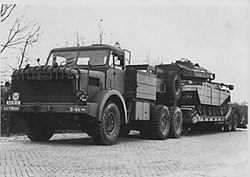
 Meteоrite-powered Antar Mk1 tractor and DAF trailer with Meteor-powered Centurion tank load | |
| Overview | |
| Manufacturer | Rover |
| Designer | Rolls-Royce & Rover |
| Also called | Rover Meteorite |
| Layout | |
| Configuration | 60° V8 |
| Displacement | 18.019 L (1,100 cu in) |
| Cylinder bore | 5.4 in (137 mm) |
| Piston stroke | 6 in (152 mm) |
| Output | |
| Power output |
|
| Torque output |
|
The Rolls-Royce Meteorite, also known as the Rover Meteorite, was a post-war British 18.01 L (1,099 cu in) V8 petrol or diesel engine was derived from the Rolls-Royce Meteor tank engine.[1]
Development
[edit]In 1940 William Robotham who led a chassis design and development division at Clan Foundry in Belper, and Henry Spurrier, a director Leyland Motors, began investigating the use of Rolls-Royce aero engines as tank power-plants.[2] Both men felt that continued use of the War Office's preferred Nuffied Liberty to be a retrograde step in the development of British tanks.[3] The Liberty had been designed in 1917 and by this time was only able to produce a maximum power output of 340 horsepower (250 kW).[4] Their requirements were the engine had to fit into the same engine compartment as the Liberty, and their aspiration was it would offer a power-to-weight ratio of 20 horsepower per long ton (15 kW/t) for the proposed British tank designs.[4]
Initially Robotham and Spurrier investigated the use of a naturally aspirated version of the Rolls-Royce Kestrel engine.[4] The Kestrel presented a number of advantages, it was not in great demand by the Royal Air Force and it occupied less space than the Liberty, although bench tests showed it would fall short of their desire power requirements.[4]
The next engine investigated by Robotham and Spurrier was a modified version of the Rolls-Royce Merlin, which had the same displacement as the Liberty, due to its different bore and stroke it was more compact.[4] This was to become the Rolls-Royce Meteor which went on to power the Cromwell tank.[5]
In 1943 design and production leadership responsibilities for the Meteor were transferred to Morris and at the end of the war, all Meteors were produced by Morris.[6] After the war, Rover wanted to develop a range of heavy duty engines using common parts, so they devised the Meteorite by removing four cylinders from the Meteor.[6][7]
Meteorites were produced alongside Meteors in Rover's Ministry of Supply factory at Acocks Green.[8]
Design
[edit]The Meteorite was a 18.019 L (1,100 cu in) V-8 engine. It retained the 60° V and 5.4 in (140 mm) bore and 6.0 in (150 mm) stroke of the Meteor.[7][9]
The Meteorite's crankcase, cylinder block and cylinder heads were all cast from aluminium alloy.[10] The engine was lubricated from a dry sump, this had the advantage of allowing the engine to be operated at extreme angles without starving for oil.[10]
Like the Meteor, originally the Meteorite ran on petrol, but when fitted with CAV indirect-injection equipment and with a higher compression ratio it was converted into a diesel engine.[11] Diesel versions were fitted with a flame heater to permit starting in cold conditions.[10]
Applications
[edit]The Meteorite is principally remembered for powering earlier versions of the Thornycroft Antar. The prototype Antar produced in 1949, and the first production Antars produced from 1950, were built for operation in the Middle East by the Iraq Petroleum Company.[12] These trucks were powered by the Meteorite Mk 101 diesel which produced 250 bhp (190 kW) at 2,000 rpm.[13] In testing conducted in 1950 at Bagshot Heath, the engine was said to perform extremely well.[10] In practice, when operated by native Syrian drivers who were said to be without any mechanical knowledge and merciless in their operation of the trucks, the engines soon suffered from poor reliability.[14] After Rover compiled a report that detailed serious neglect of the engines, including being driven too fast and sometimes being operated without any oil or coolant, a rigorous maintenance schedule was introduced and reliability was restored.[14]
The first version of the Antar operated by the British Army, the Antar Mk 1 (designated FV12001), was a tank transporter powered by the twin-carburettor Mk 204 petrol Meteorite.[15] Designed to operate on 68/70 octane petrol, the Mk 204 produced 260 bhp (190 kW) at 2000 rpm and 860 ft⋅lbf (1,170 N⋅m) of torque at 1200 rpm.[15] Fuel economy of the Mk 204 Meteorite powering a fully loaded Antar Mk 1 was as little as 1 mile per imperial gallon (0.35 km/L).[15] The Meteorite Mk 204 also powered the Antar Mk 2 (designated FV12002/FV12003), but it was replaced in the Antar Mk 3 from 1961 by a Rolls-Royce 16.2 L (990 cu in) IL8 cylinder supercharged diesel engine which offered improved economy and performance.[16]
The Valiant II assault tank was to be powered by a petrol Meteorite of between 400 and 500 hp (300 and 370 kW).[17][18]
In 1947–1948 a powerful land clearing bulldozer was developed at the Fighting Vehicles Proving Establishment for the Tanganyika groundnut scheme. It utilised Centurion tank automotive components and was powered by a Meteorite engine.[19]
The single Leyland FV1000 'Brontosaurus' heavy tank transporter prototype produced in 1951 was powered by a 498 bhp (371 kW) petrol Rover Meteorite Mk 202A.[20]
The two Leyland FV1200 series FV1201 heavy artillery tractor prototypes produced in 1953 were each powered by 510 bhp (380 kW) petrol Rover Meteorite.[21]
See also
[edit]References
[edit]Citations
[edit]- ^ Evans et al. (2004), pp. 126–140.
- ^ Lloyd (1978), pp. 84–85.
- ^ Lloyd (1978), p. 85.
- ^ a b c d e Lloyd (1978), p. 86.
- ^ Lloyd (1978), pp. 86 & 108.
- ^ a b Ware (2012), pp. 10–11.
- ^ a b Robson (1977), p. 50.
- ^ Ware (2020), p. 14.
- ^ Ware (2020), pp. 14 & 44.
- ^ a b c d Ware (2020), p. 9.
- ^ Ware (2020), p. 11.
- ^ Ware (2020), pp. 7–8.
- ^ Ware (2020), pp. 8–9.
- ^ a b Ware (2020), pp. 9–10.
- ^ a b c Ware (2020), p. 20.
- ^ Ware (2020), pp. 44–45.
- ^ Forty (1995), p. 46.
- ^ Newsome (2016), p. 10.
- ^ Dunston (1980), p. 87.
- ^ Ware (2021), p. 68.
- ^ Ware (2021), pp. 73–74.
Bibliography
[edit]- Dunston, Simon (1980). Centurion. Shepperton: Ian Allen. ISBN 0-7110-1063-3.
- Evans, Charles; McWilliams, Alec; Whitworth, Sam; Birch, David (2004). The Rolls Royce Meteor. Derby: Rolls-Royce Heritage Trust. ISBN 1-872922-24-4.
- Forty, George (1995). World War Two Tanks. London: Osprey Automotive. ISBN 1-85532-532-2.
- Lloyd, Ian (1978). Rolls-Royce: The Merlin at War. London & Basingstoke: The MacMillan Press Ltd.
- Newsome, Bruce (2016). Valentine Infantry Tank 1938-1945. Oxford: Osprey Publishing. ISBN 978-1-4728-1375-6.
- Robson, Graham (1977). The Rover Story. Cambridge: Patrick Stephens (PSL). ISBN 0-85059-279-8.
- Ware, Pat (2021). British Military Vehicles: The Soft-Skin CT & GS Vehicles of the 1950s. Yalding: Kelsey Media.
- Ware, Pat (2012). The Centurion Tank. Barnsley: Pen & Sword. ISBN 978-1-78159-011-9.
- Ware, Pat (2020). The Thornycroft Antar. Yalding: Kelsey Media.
- Walentynowicz, Jerzy (2021). "The aircraft engines in the land vehicles" (PDF). Combustion Engines. 187 (4): 52–59. doi:10.19206/CE-141738. Retrieved 17 November 2023.
External links
[edit]Rolls-Royce Meteorite
View on GrokipediaBackground and Development
Origins from Merlin and Meteor
The Rolls-Royce Merlin was a liquid-cooled V12 aero engine introduced in 1935, featuring a displacement of 27 liters and initial output of around 1,000 horsepower, which evolved to over 2,000 horsepower in later variants by 1945.[5][6] It powered pivotal World War II aircraft, including the Supermarine Spitfire fighter and the Avro Lancaster heavy bomber, contributing significantly to Allied air superiority through its reliability and performance.[7][8] To meet the demand for a robust tank powerplant, Rolls-Royce adapted the Merlin into the Meteor V12 by removing the supercharger, reduction gear, and reversing the rotation direction for ground vehicle suitability, while adding a Zenith carburettor for fuel delivery.[5] This modification retained the 27-liter displacement but optimized the engine for low-altitude, non-aerial operation, yielding outputs between 600 and 810 horsepower depending on the variant.[9] Led by W. A. Robotham of Rolls-Royce's chassis design division at Clan Foundry in Belper, the Meteor addressed the limitations of existing tank engines, providing superior power-to-weight ratios for cruiser tanks.[5] In 1940, amid wartime pressures, Robotham collaborated with Henry Spurrier, director of Leyland Motors, to derive a more compact engine from the Meteor for lighter armored vehicles, resulting in the Meteorite V8 formed by excising the rear four cylinders to achieve an 18-liter displacement.[1] This design aimed to supplant the inadequate Nuffield Liberty V12, which suffered from low power and reliability issues in British tanks.[5] To scale production, Rolls-Royce partnered with Rover Company, shifting Meteor and Meteorite manufacturing to Rover's shadow factory at Acocks Green by 1942, where output ramped up to support tank assembly lines.[10]Wartime Development
The development of the Rolls-Royce Meteorite, a V8 engine derived from the Merlin-Meteor lineage, commenced in 1942 amid urgent wartime needs for reliable tank powerplants, with initial design work at the company's Belper facility in Derbyshire.[11] By early 1943, prototypes were under consideration for heavy assault tank projects, including the Vickers A.38 Valiant infantry tank and the Rolls-Royce Vanguard, where the engine was specified to deliver approximately 400 horsepower for enhanced mobility over existing designs like the Valentine.[11] The Meteorite was proposed for integration with tank chassis to address infantry support requirements, though full-scale production remained limited due to ongoing war priorities, and the sole Valiant prototype used a different engine.[11] In 1943, Rover traded its gas turbine development rights to Rolls-Royce in exchange for full manufacturing rights to the Meteor tank engine, facilitating expanded production of both Meteor and Meteorite variants. Key wartime innovations centered on adapting aviation-derived components for ground use, including retention of the Meteor's 60° V-angle in the V8 layout to optimize balance and vibration control under tank loads. These modifications allowed the Meteorite to achieve rated outputs around 400-520 horsepower, prioritizing torque over the high-revving characteristics of its aerial forebears.[12] Wartime challenges included acute supply shortages of shared Merlin components, as aviation demands strained Rolls-Royce's production capacity, delaying prototype completion and forcing interim use of alternative engines like the GMC diesel in Valiant trials.[11] A critical adaptation involved derating the engine's operating speed from over 3,000 rpm in aviation applications to approximately 2,500-2,700 rpm, enhancing durability against the vibrations and dust of tank operations while reducing wear on components.[13] W.A. Robotham, head of Rolls-Royce's chassis design division, oversaw these efforts, coordinating amid competing priorities for Merlin and Meteor output to ensure the Meteorite advanced British armored vehicle capabilities.[14]Post-War Refinement and Production
Following the conclusion of World War II, the Rolls-Royce Meteorite, derived from wartime prototypes of the Meteor engine, saw significant refinements to adapt it for sustained peacetime military use. In the late 1940s, Rover engineers prioritized enhancements to the cooling systems, addressing vulnerabilities exposed during combat operations, such as overheating in desert environments and sand ingress that had plagued earlier iterations. These improvements involved larger radiators and more robust coolant circulation, enabling greater reliability under prolonged operational stresses typical of Cold War armored deployments.[15] To address fuel efficiency concerns, particularly for export markets where logistics chains were extended, Rover integrated diesel configurations into the Meteorite design. These variants maintained the core V8 architecture but substituted diesel fuel systems, substantially lowering consumption rates compared to petrol models while preserving compatibility with existing Meteor components for cost-effective manufacturing. This adaptation supported broader adoption in international vehicle programs seeking versatile powerplants.[12] Production of the Meteorite began in 1946 at Rover's Tyseley facility in Birmingham, leveraging the established assembly lines originally set up for the Meteor during the war. Output ramped up to fulfill escalating demands for medium-weight military vehicles amid rising global tensions, with Rover handling all manufacturing until the program's wind-down. Wartime prototypes provided the foundational blueprint, allowing rapid scaling without major retooling. By the early 1960s, however, production tapered off as designs evolved toward advanced multi-fuel options like the Continental AVDS-1790, which powered upgrades in vehicles such as the Centurion tank and offered superior adaptability across fuel types for modernized fleets.[15][16][17]Design Features
Configuration and Dimensions
The Rolls-Royce Meteorite is configured as a 60° V8 engine with liquid cooling, derived from the larger Meteor V12 by removing four cylinders to create a more compact powerplant suitable for medium-sized military vehicles.[1] This layout maintained the essential architecture of its predecessor while reducing overall size and weight, with a displacement of 18.01 liters (1,099 cubic inches).[18] The engine's cylinder dimensions feature a bore of 5.4 inches (137 mm) and a stroke of 6 inches (152 mm), contributing to its balanced performance in vehicular applications.[1] In comparison to the Meteor V12, which displaced 27 liters and weighed nearly 1 ton (approximately 2,000 lb), the Meteorite achieved significant size reduction—estimated at roughly two-thirds the volume and mass—to facilitate installation in tanks and trucks with constrained engine bays.[1] The Meteorite's dry weight varied by variant but was approximately 800 kg (1,764 lb) in its standard form, reflecting the use of aluminum alloys in the crankcase, cylinder heads, and block for weight savings without sacrificing durability.[19] The block design incorporated individual cylinder bores with steel liners for structural efficiency and 90° crank throw spacing to ensure smooth operation and even firing intervals in the V configuration.[20]Components and Materials
The Rolls-Royce Meteorite engine featured a crankcase, cylinder block, and cylinder heads constructed from aluminum alloy castings, which provided significant weight savings compared to traditional iron components while maintaining structural integrity under operational loads.[2] These aluminum elements incorporated hardened steel liners within the cylinder bores to enhance wear resistance against piston friction and high-temperature combustion, ensuring longevity in demanding ground vehicle environments.[2] The lubrication system employed a dry sump design with a single pressure pump and dual scavenging pumps, enabling effective oil circulation and removal even when the vehicle operated at steep off-road inclinations common in military applications.[3] This configuration prevented oil starvation and minimized drag losses, adapting the engine's aviation heritage to terrestrial stresses. In the valvetrain, each cylinder utilized four overhead valves—two intake and two exhaust—actuated by a single overhead camshaft per cylinder bank, promoting efficient gas flow and valve timing precision derived from the parent V12 architecture.[3] The cooling system relied on a centrifugal water pump to circulate a pressurized mixture of 70% water and 30% ethylene glycol through the engine jackets, with radiator placement optimized for integration into the confined, armored hulls of ground vehicles to manage heat dissipation under combat conditions.[3]Supercharging and Fuel Systems
The Rolls-Royce Meteorite was naturally aspirated, omitting the superchargers of its aviation-derived ancestors to prioritize reliability and durability in heavy-duty terrestrial applications.[1] Petrol variants utilized twin Zenith or SU carburetors for fuel delivery, promoting smooth operation and efficient atomization under varying loads. Later models experimented with fuel injection systems to enhance precision and reduce vulnerability to g-forces or environmental factors, though carburetion remained predominant for production units due to its simplicity and proven reliability. Aluminum housings encased these components, contributing to lightweight integration within the engine block.[19] The Mk 101 diesel variant employed a CAV indirect-injection system, enabling efficient combustion and output around 250 bhp while minimizing fuel consumption compared to petrol counterparts. This system supported the engine's focus on torque for heavy-duty tasks.[2] To suit dusty operational environments, the Meteorite featured enhanced air filtration in the induction path, drawing from aviation heritage to prevent abrasive ingress into the cylinders, alongside residual anti-icing provisions in the intake manifold to mitigate cold-start issues in varied climates. These adaptations ensured longevity and consistent performance in terrestrial settings like armored vehicles and industrial machinery.[5]Variants and Specifications
Petrol Variants
The petrol variants of the Rolls-Royce Meteorite engine shared the fundamental 60-degree V8 configuration with their diesel counterparts but were engineered for higher power outputs suitable for high-performance military and transport roles. Derived from the wartime Rolls-Royce Meteor V12 tank engine—a detuned version of the Merlin aero engine—these petrol models were developed post-World War II to meet demands for reliable, high-speed propulsion in vehicles requiring rapid acceleration and maneuverability.[1][19] The Mk 202B represented the high-output petrol configuration, producing 520 hp at 2,700 rpm and optimized for heavy transport duties, such as powering vehicles like the Antar truck. Refinements to this variant, building on wartime prototypes, occurred during 1947-1949 to support exports to Commonwealth forces, ensuring compatibility with diverse operational environments.[19][1][21] In contrast, the Mk 204 was a detuned iteration rated at 260 bhp at 2,000 rpm, tailored for lighter applications where fuel economy was prioritized over maximum power. This version featured economy-oriented tuning and a reduced supercharger drive ratio to balance performance with operational range in less demanding scenarios. Like the Mk 202B, it evolved from the same post-war development lineage, emphasizing durability for sustained use in military logistics.[4][22]Diesel Variants
The diesel variants of the Rolls-Royce Meteorite were developed as post-World War II adaptations of the V8 engine, emphasizing fuel efficiency and low-end torque to support prolonged heavy-duty operations in military and industrial settings, evolving from the petrol variants as their base design.[1] These variants utilized the same engine block derived from the V12 Rolls-Royce Meteor by removing four cylinders, but were converted for diesel combustion through modifications including reinforced pistons to withstand higher compression and adjusted cam profiles for diesel-specific valve timing.[1] The Mk 101 diesel variant delivered 250 bhp at 2,000 rpm.[1] Following 1950, further refinements targeted NATO standardization requirements. In logistical contexts, the diesel configurations demonstrated advantages over petrol equivalents.Performance Data
The Rolls-Royce Meteorite engine delivered varying power outputs depending on the variant and fuel type, with petrol versions emphasizing higher peak performance for military applications and diesel variants prioritizing efficiency. The Mk 202B petrol model achieved 520 horsepower (390 kW) at 2,700 rpm, while the Mk 204 petrol variant produced 260 horsepower (190 kW) at 2,000 rpm. The diesel Mk 101 variant was rated at approximately 250 brake horsepower (190 kW) at 2,000 rpm, though detailed torque figures across variants remain sparsely documented in historical records.| Variant | Fuel Type | Power Output (bhp) | RPM at Peak Power | Torque (lb-ft) | RPM at Peak Torque | Displacement (liters) |
|---|---|---|---|---|---|---|
| Mk 101 | Diesel | 250 | 2,000 | 728 | 1,250 | 18 |
| Mk 202B | Petrol | 520 | 2,700 | - | - | 18 |
| Mk 204 | Petrol | 260 | 2,000 | 860 | 1,200 | 18 |