Hubbry Logo
Running BearRunning BearMain
Open search
Running Bear
Community hub
Running Bear
logo
7 pages, 0 posts
0 subscribers
Be the first to start a discussion here.
Running Bear
Running Bear
from Wikipedia
"Running Bear"
Sleeve of Running Bear by Johnny Preston (1960 UK pressing)
Single by Johnny Preston
B-side"My Heart Knows"
ReleasedAugust 1959
RecordedMay 21, 1959
StudioGold Star (Houston, Texas)[1]
Genre
Length2:38
LabelMercury[4]
SongwriterJ. P. Richardson[4]
ProducerBill Hall[4]
Johnny Preston singles chronology
"Running Bear"
(1959)
"Cradle of Love"
(1960)
Official audio
"Running Bear" on YouTube

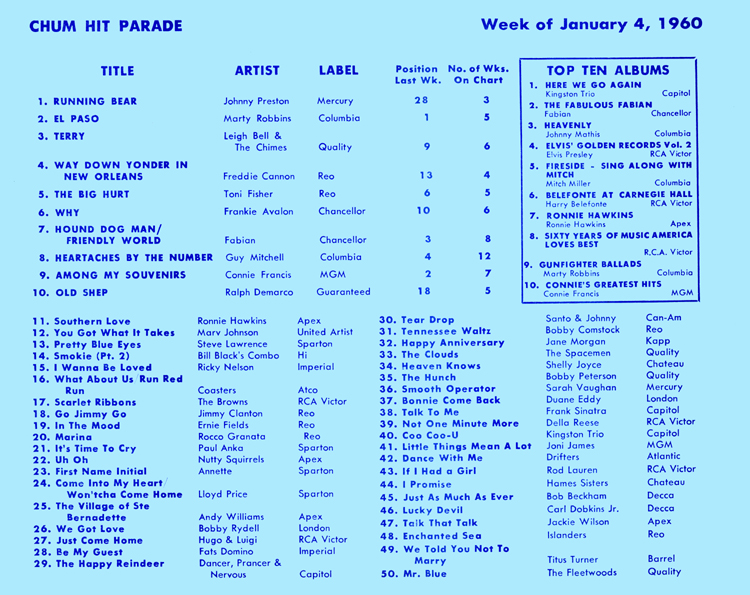
"Running Bear" is a teenage tragedy song written by Jiles Perry Richardson (a.k.a. the Big Bopper) and sung most famously by Johnny Preston in 1959.[4] The 1959 recording featured background vocals by George Jones and the session's producer Bill Hall, who provided the "Indian chanting" of "uga-uga" during the three verses, as well as the "Indian war cries" at the start and end of the record. It was No. 1 for three weeks in January 1960 on the Billboard Hot 100 in the United States and the same on Canada's CHUM Charts.[5] The song also reached No. 1 in the UK Singles Chart and New Zealand[6] in 1960.[4] Billboard ranked "Running Bear" as the No. 4 song of 1960.[7] The tenor saxophone was played by Link Davis.[8]

Richardson was a friend of Preston and offered "Running Bear" to him after hearing him perform in a club. Preston recorded the song at the Gold Star Studios in Houston, Texas,[1] a few months after Richardson's death in the plane crash that also killed Buddy Holly and Ritchie Valens.[4] Preston was signed to Mercury Records, and "Running Bear" was released in August 1959.

Plot

[edit]

The song tells the story of Running Bear, a "young Indian brave", and Little White Dove, an "Indian maid". The two are in love but are separated by two factors:

  • Their tribes' hatred of each other: their respective tribes are at war. ("Their tribes fought with each other / So their love could never be.")
  • A raging river: a physical separation but also as a metaphor for their cultural separation.

The two, longing to be together, despite the obstacles and the risks posed by the river, dive into the raging river to unite. After sharing a passionate kiss, they are pulled down by the swift current and drown. The lyrics describe their fate: "Now they'll always be together / In their happy hunting ground."

Chart performance

[edit]

Cover versions

[edit]

A German version titled Brauner Bär und Weiße Taube ("Brown Bear and White Dove") was recorded as a single by Gus Backus in 1960.[19][20]

In 1960, the Dutch group Het Cocktail Trio recorded a version of the song called Grote Beer ("Great Bear", but also "Ursa Major") about an Indian who travels in space.[21]

Masaaki Hirao [ja] recorded a Japanese language version of "Running Bear" in 1960.

George Jones recorded a version on his 1962 album The New Favorites Of George Jones[22]

During the late 1960s and early 1970s, Sonny James enjoyed an unprecedented streak of success with his commercially released singles, many of them covers of previous pop hits. One of his 16 consecutive No. 1 singles on the Billboard Hot Country Singles chart was a cover version of "Running Bear." Released in April 1969, James topped the Hot Country Singles chart in mid-June and spent three weeks at No. 1.[23] The song was one of the most popular recordings of James' career. In Canada, it reached #1 on the country charts and #74 on the rock charts.[24][25]

Jim Stallings recorded a version of the song on his 1969 album titled Heya!

The Guess Who included the song on their 1972 album Rockin', although the songwriting credit is incorrectly given to Clarence "Curly" Herdman, a country and bluegrass fiddler.

The Youngbloods released a version of the song as a single in 1972[26] and was featured on their album High on a Ridge Top.[27]

Tom Jones recorded a funk version of the song on his 1973 album The Body and Soul of Tom Jones.

Mud recorded the song on their 1974 debut album Mud Rock which reached #8 in the UK charts.

Danny Davis and the Nashville Brass recorded a toe-tapping version of the song, complete with the standard Nashville Brass banjo-and-steel solo, for their 1975 album Dream Country.

The song was occasionally part of Led Zeppelin's live repertoire in the early 1970s, during rock medleys contained within long versions of "Whole Lotta Love".[28]

In 2012 Ray Stevens covered the song on his 9-CD box set, The Encyclopedia of Recorded Comedy Music.

Northern Irish punk band, Stiff Little Fingers did a live cover of this, which ended up on their album All the Best and later on the re-issue of their live album, Hanx!.

The song is a staple of Williams and Ree's live set and is one of the duo's most popular songs. Ree performs the lead vocals while Williams provides Indian chants and humorous alternatives, such as lyrics from "Pump Up the Jam" and "Ice Ice Baby".

Bob Wills and his Texas Playboys frequently performed the song and it appears on their album Time Changes Everything, and on many greatest hits compilations.

References

[edit]
[edit]
Revisions and contributorsEdit on WikipediaRead on Wikipedia
from Grokipedia
"Running Bear" is a written by Jiles Perry "J.P." Richardson, known as , and recorded by American singer in 1959, depicting a romance between two young Native Americans from rival tribes who drown while attempting to meet across a river. The track, featuring a style reminiscent of a teenage tragedy , was released posthumously for Richardson following his death in a plane crash alongside and on February 3, 1959, and quickly became Preston's breakthrough hit. Preston, a native of Port Arthur, Texas, born in 1939, had been performing locally before Richardson, a fellow Texan disc jockey and songwriter, penned the song specifically for him during a songwriting session inspired by similar romantic tales. Produced by Bill Hall for Mercury Records, the recording incorporated sound effects like echoing calls and splashing water to enhance its dramatic storytelling, drawing from the Romeo and Juliet archetype while evoking Native American folklore. Upon its release in August 1959, "Running Bear" ascended to the top of the Billboard Hot 100 chart, holding the number-one position for three weeks in January 1960, and also reached number one in the United Kingdom in 1960, selling over one million copies in the process. The song's success marked a significant moment in early rock 'n' roll, blending , and narrative elements at a time when such crossover hits were gaining popularity, and it remains Preston's most enduring work, often cited for its cultural impact on American music charts during the late . Despite some for its stereotypical portrayal of Native American characters, "Running Bear" has been covered by various artists and continues to be recognized as a classic of the era, contributing to Preston's legacy until his death in 2011.

Background and Production

Songwriting and Composition

"Running Bear" was written by Jiles Perry "J.P." Richardson, known professionally as , who served as the song's sole composer. Richardson drew inspiration from the burgeoning popularity of teenage tragedy songs in the late 1950s, such as ' "Endless Sleep" (1958), aiming to craft a similarly dramatic . The song's storyline incorporates elements of Native American folklore blended with a Romeo-and-Juliet-style doomed romance between members of rival tribes, with the title "Running Bear" evoking a bear motif that symbolizes both strength and tragic loss. Richardson composed the track during 1958-1959 specifically as a for his friend and fellow , believing the somber theme did not suit his own upbeat persona. To enhance its exotic appeal, he included phonetic "Indian" chants such as "ooh-wah-oooh" and "Ocka Chunka" in the chorus, mimicking tribal vocalizations. Musically, "Running Bear" features a straightforward verse-chorus structure set at a moderate of approximately 120 beats per minute, which supports its pace. Richardson incorporated tom-tom drum patterns to evoke Native American rhythms, providing a rhythmic backbone that underscores the song's cultural motif without overpowering the melody.

Recording Process and Personnel

The recording of "Running Bear" took place in December 1958 at in , , a facility renowned for its role in early rock and production. The session was overseen by producer H.W. "Pappy" Daily and engineered by , who facilitated the track's release through , leveraging his connections in the Texas music scene. Johnny Preston provided the lead vocals, delivering the narrative in a style blending rockabilly energy with folk-like storytelling. Supporting him were key session musicians, including guitarist Hal Harris and saxophonist Link Davis, whose contributions helped shape the song's sparse arrangement. Background vocals, featuring simulated "Indian chants" to evoke a tribal atmosphere, were performed by J.P. Richardson (the song's writer, known as the Big Bopper), George Jones, Bill Hall, and Sleepy LaBeef. These layered chants, combined with tom-tom drum patterns simulating tribal percussion, created the track's distinctive sound, emphasizing minimal instrumentation—primarily guitar, bass, and drums—for a hybrid rockabilly-folk texture. The session faced logistical hurdles following Richardson's death in a plane crash on February 3, 1959, which delayed the single's release until August 1959, allowing time for Mercury to prepare promotion amid the tragedy's aftermath. Despite these challenges, the efficient studio process captured the song's essence in a focused effort, highlighting the collaborative spirit among Houston's tight-knit music community.

Lyrics and Narrative

Plot Summary

"Running Bear" recounts the forbidden romance between Running Bear, a young Native American brave from one tribe, and Little White Dove, a maiden from a rival tribe whose members are locked in perpetual warfare across a wide river. The narrative establishes their impossible love from the outset, as tribal enmity prevents any union, forcing them to gaze longingly at each other from opposite banks. Delivered in a third-person ballad style, the song builds tension across its verses, culminating in the chorus's fatal climax. It begins with the setting lines: "On the bank of the river stood Running Bear, young Indian brave / On the other side of the river stood his lovely Indian maid / Little White Dove was her name, such a lovely sight to see / But their tribes fought with each other, so their love could never be." Secret meetings occur under the , where Little White Dove throws kisses across the waves, her heart racing as she awaits her brave. Running Bear declares his eternal love, vast as the sky and unbreakable, vowing to cross the impassable waters despite the dangers. In a final against their tribes' conflict, Running Bear dives into the raging river to reach her, with Little White Dove following to meet him midway. Their hands touch and lips meet briefly before the swirling currents pull them under, drowning them together. However, the narrative concludes that they are now together in the "." The story ends on the "Running Bear" refrain, accompanied by chant-like vocalizations evoking Native American calls.

Themes and Musical Style

"Running Bear" explores central themes of forbidden love between members of rival Native American tribes, culminating in tragedy and sacrifice as the protagonists, Running Bear and Little White Dove, drown while attempting to unite across a perilous river. This narrative draws heavily from the "death disc" genre, which emphasized teen angst, loss, and untimely death to resonate with young audiences amid post-war cultural shifts toward emotional storytelling in . The song's motifs evoke a doomed romance. Musically, "Running Bear" blends rhythms with influences and faux-ethnic elements designed to evoke Native American traditions, including rhythmic "wah-wah" or "ooka-chunka" chants and percussive sounds that mimic tribal war cries. These stylistic choices, while innovative for pop radio, have been criticized for perpetuating of through exaggerated vocal effects and cultural appropriation. The track's approximately three-minute runtime was optimized for AM radio play, allowing its narrative to unfold concisely without exceeding commercial airtime limits. The song adopts a ballad-style storytelling approach that prioritizes dramatic plot over complex instrumentation, featuring a sparse arrangement that highlights Preston's emotive vocals and builds tension through minimalistic backing, similar to other narrative-driven hits of the late 1950s. This focus on vocal delivery and simple structure prefigures the rise of narrative-driven hits in early rock, contributing to the evolution of pop ballads in the late 1950s and early 1960s.

Release and Commercial Performance

Initial Release and Promotion

"Running Bear" was released as a single by in August 1959, under catalog number 71474, with "My Heart Knows"—also written by J.P. Richardson and —as the B-side. The release occurred approximately six months after Richardson's death in the February 3, 1959, plane crash near , which also claimed the lives of and , an event later dubbed "." This tragic context heightened public interest in Richardson's compositions, positioning "Running Bear" as a posthumous showcase of his songwriting talent. Mercury Records promoted the single primarily through radio airplay aimed at teenage listeners, capitalizing on the song's status as a "teenage tragedy" narrative in the vein of contemporary hits. The label tied promotional efforts to Preston's regional performances in his native , where he had built a local following, and leveraged television exposure on popular youth-oriented programs such as , The Milt Grant Show, and . These appearances helped introduce the track to broader audiences shortly after its launch. Marketing strategies emphasized the song's dramatic storyline of forbidden love between Native American characters and its exotic, rhythmic elements, including simulated "Indian" chants provided by Richardson during recording, to distinguish it from typical fare of the era. This approach aligned with the late-1950s trend toward narrative-driven pop songs, fostering immediate buzz among young fans attuned to romantic and adventurous themes.

Chart Performance

"Running Bear" entered the US Billboard Hot 100 on October 12, 1959, at position 83. It climbed steadily, reaching the top spot on the chart dated January 18, 1960, and held #1 for three weeks (January 18, 25, and February 1). The single spent a total of 27 weeks on the chart. It peaked at #3 on the R&B Singles chart during this period. Billboard ranked it as the No. 4 song of 1960. In the , "Running Bear" reached #1 on the Official Singles Chart dated March 17, 1960, maintaining the position for two weeks and totaling 16 weeks on the chart. This marked the first of Johnny Preston's five UK Top 40 hits in 1960. The song achieved #1 status in several other countries, including on the CHUM starting January 18, 1960, in January 1960, and . It entered the top 10 in various European markets, peaking at #12 in the over eight weeks and similarly strong in .

Sales and Certifications

"Running Bear" achieved remarkable commercial success shortly after its release, selling over one million copies in the United States by early 1960 and marking a pivotal breakthrough for Johnny Preston's career. Overall, it sold over one million copies worldwide, underscoring its widespread appeal during the late 1950s era. The (RIAA) awarded the single a gold certification in 1960 for exceeding one million units sold, a testament to its rapid via the vinyl 45 RPM format. In contemporary terms, accounting for streaming equivalents—where roughly 150 on-demand audio streams equate to one unit—the song has amassed over 168 million streams on as of 2025. The track's strong performance generated significant royalties for , fueled by heightened interest following the tragic plane crash that claimed the life of its songwriter, J. P. "The Big Bopper" Richardson. Long-tail revenue persisted through reissues and inclusions in various compilations during the and 1990s, sustaining sales amid nostalgia-driven revivals of and hits. Comparatively, "Running Bear" outperformed numerous other 1959 releases in physical sales volume, capitalizing on the era's dominance of 7-inch singles to achieve its million-seller status ahead of many peers.

Reception and Legacy

Critical Reception

Upon its release in 1959, "Running Bear" received positive notices from trade publications for its narrative drive and stylistic blend. Billboard praised the song's catchy rhythm and emotional storytelling, positioning it as a tear-jerking entry in the emerging teen tragedy genre. Variety acknowledged its commercial viability despite a maudlin tone, noting the melodramatic elements that drove its market success. Retrospective analyses have affirmed the song's significance in popularizing the format, where young lovers meet tragic ends amid heightened drama. In a examination of number ones, Stereogum described "Running Bear" as a rockabilly-inflected with a suave vocal delivery by Preston and a squawking , crediting it with exemplifying the genre's blend of roots and pop accessibility, though rating its execution a modest 4/10 for lacking deeper emotional resonance. The track's role in this subgenre, alongside songs like "Teen Angel," has been noted in broader music histories for capturing late-1950s anxieties about youth and romance. Criticisms of the song have centered on its portrayal of Native Americans, with the use of faux tribal chants by non-Native performers and J.P. Richardson. Modern scholarship, such as Christina Giacona's 2016 thesis on cultural misappropriation in , frames the song within a tradition of "singing redface," where white artists employ stereotypical tropes—like Hollywood-style "Injun English" and primitive imagery—to evoke sympathy while perpetuating caricatures of Indigenous life. These analyses view it as a product of its era's exploitative conventions, prioritizing commercial over authentic representation. Preston's overall contributions, including "Running Bear," were later honored with his induction into the Rockabilly Hall of Fame.

Cultural Impact and Interpretations

"Running Bear" played a significant role in popularizing the teenage tragedy song genre during the late 1950s and early 1960s, a subgenre of pop music that dramatized stories of doomed young romance often ending in untimely death. The track's narrative of forbidden love between members of rival tribes, culminating in a tragic drowning, exemplified the formula that influenced later hits like "Leader of the Pack" by The Shangri-Las in 1964, which similarly blended dramatic storytelling with teen-oriented themes of loss. Additionally, the song contributed to the broader trend of narrative ballads in 1960s pop, emphasizing emotional depth and melodic hooks to engage listeners with vivid, cautionary tales. The song's cultural legacy extends to its appearances in media and ongoing relevance in music programming. It was featured in the 1994 film , underscoring its nostalgic appeal in depictions of mid-20th-century American life. The track has also been sampled in hip-hop productions, such as Blockhead's 2004 instrumental "The " from the album Music by Cavelight, where elements of the original melody and vocals are incorporated to evoke retro storytelling. Furthermore, "Running Bear" maintains enduring play on radio stations, serving as a staple in retrospectives of and . From Native American perspectives in recent , the track is critiqued for its exoticized portrayal of indigenous people through stereotypical chants and tropes. The song's milestones tie it to pivotal moments in music history, particularly annual mentions in retrospectives of February 3, 1959—""—due to its writer J.P. Richardson's death in the plane crash that also claimed and . This connection has cemented "Running Bear" as a in discussions of rock and roll's tragic early years.

Cover Versions

Notable Covers

One of the most prominent covers of "Running Bear" came from artist in 1969, transforming the original narrative into a with prominent instrumentation and harmonious backing vocals, omitting the signature "Indian chanting" for a more serene, twangy mood. Released as a single on , it topped the Hot Country Singles chart for three weeks and reached number 94 on the Hot 100, marking a significant revival for the song in the . Pat Boone offered a polished pop rendition in 1961 on his album Great! Great! Great!, maintaining the song's rhythmic bounce but infusing it with his signature clean, crooner-style vocals and orchestral arrangement, which softened the original's raw energy for a broader family audience. This version highlighted Boone's approach to adapting teen-oriented hits into accessible mainstream fare without altering the core storyline. In 1970, recorded a country-inflected take for his album Louis 'Country & Western' Armstrong, where his gravelly voice and trumpet flourishes brought a bluesy, swinging interpretation to the tragedy, emphasizing emotional depth over the original's upbeat and adding a layer of to the melody. The cover reflected Armstrong's late-career exploration of American folk traditions, blending his improvisational flair with elements. Tom Jones delivered a funk-oriented version titled "Runnin' Bear" in 1973 on his album The Body and Soul of Tom Jones, accelerating the pace with groovy basslines, riffs, and his powerful baritone, shifting the focus from poignant storytelling to a danceable, soulful groove that updated the track for the disco era. This reinterpretation showcased Jones's versatility in reworking pop into contemporary sounds. Internationally, Japanese singer Kayoko Moriyama released a version titled "Kanashiki Indian" (Sad Indian) in 1960 as a single on Toshiba Records, adapting the lyrics to Japanese while preserving the melancholic melody and adding subtle influences for emotional resonance in the local pop scene. Similarly, the song inspired Spanish-language adaptations like "El Oso Corredor," with Mexican group (formerly Vaselina) recording a lively pop-rock take in 1992 that incorporated Latin rhythms and youthful energy, peaking in popularity on regional charts.

Adaptations in Media

The song "Running Bear" has appeared in various films, often to evoke themes of nostalgia or tragic romance. It is featured on the of A Simple Twist of Fate (1994), a drama directed by , where Johnny Preston's original recording underscores key emotional moments. Similarly, the track plays in the crime thriller Catch .44 (2011), directed by Aaron Harvey, enhancing scenes of tension and irony amid its narrative of outlaws and betrayal. In television, "Running Bear" was used in the pilot episode of the crime drama Crime Story (1986), produced by , where Preston's version accompanies a sequence highlighting urban grit and period authenticity. The song's nostalgic appeal also tied it to 1970s sitcoms evoking mid-century Americana through related compilations like Fonzie Favorites (1976), aligning with the retro rock 'n' roll aesthetic of shows such as Happy Days. Beyond scripted media, the song has been parodied in animated comedy. In a 2005 sketch from , created by and , "Running Bear" is humorously reinterpreted with exaggerated visual gags involving smoke signals forming suggestive imagery, satirizing the original's tribal motifs. It has also been referenced in video games, though not directly featured on radio stations in titles like (2002), where similar era-specific tracks populate the in-game audio. In recent years, "Running Bear" has surfaced in documentaries exploring the Buddy Holly era and the February 3, 1959, plane crash dubbed "The Day the Music Died," as the song was written by crash victim J.P. Richardson (The Big Bopper).

References

Add your contribution
Related Hubs
User Avatar
No comments yet.