


Community hub
Recent from talks
Contribute something
Nothing was collected or created yet.
Rye Brook, New York
View on Wikipedia
Rye Brook is a village in Westchester County, New York, United States, within the town of Rye. The population was 9,347 at the 2010 census.[3]
Key Information


Rye Brook has been designated as a Tree City USA for 14 years.[4]
History
[edit]Rye Brook is located in southeastern Westchester County and shares its eastern border with Greenwich, Connecticut. The village was an unincorporated section of the town of Rye until its incorporation as a village on July 7, 1982.[5][6]
In 1982, 150 residents of the unincorporated area proposed to establish the village of Rye Brook and organized a petition containing 1,536 signatures. The petition drive, which contained the signatures of approximately 36% of the registered voters in the unincorporated area, was organized by the Independent Civic Association.[7] It was reported by The New York Times that one resident commented, "There is a time for a community to redefine itself," further stating that residents of the unincorporated area "should be able to elect their own officers" and "protect their tax base."[7]
The residents of the unincorporated area voted on June 23, 1982, to create the Village of Rye Brook. It was the first village created in New York State in 54 years.[8] The referendum to create the new political identity passed with 58% of the voters in favor (1,991 to 1,434).[8] The first election in the Village's history was held to elect a mayor and four trustees. The first village official was Lee Russillo, who was sworn in as Rye Brook's first Village Clerk, and was responsible for the first election day.[8]
The village is home to the William E. Ward House, which was added to the National Register of Historic Places in 1976.[9] Also known as Ward's Castle, it was the home of the National Cartoon Museum, established by Mort Walker, the creator of Beetle Bailey, from 1976 to 1992.[10]
In 1983, 800 Westchester Avenue, described as the "Taj Mahal of Rye Brook"[11] and the "contemporary equivalent to the classical villa," was constructed as the General Foods Corporate Headquarters.[12]
Geography
[edit]Rye Brook is located at 41°1′11″N 73°41′0″W / 41.01972°N 73.68333°W (41.019767, -73.683419).[13]
According to the United States Census Bureau, the village has a total area of 3.5 square miles (9.1 km2), all land.
Demographics
[edit]| Census | Pop. | Note | %± |
|---|---|---|---|
| 1990 | 7,765 | — | |
| 2000 | 8,602 | 10.8% | |
| 2010 | 9,347 | 8.7% | |
| 2020 | 10,047 | 7.5% | |
| U.S. Decennial Census[14] | |||
2000 census
[edit]As of the census[15] of 2000, there were 8,602 people, 3,122 households, and 2,435 families residing in the village. The population density was 2,479.0 inhabitants per square mile (957.1/km2). There were 3,224 housing units at an average density of 929.1 per square mile (358.7/km2). The racial makeup of the village was 91.96% White, 1.03% African American, 0.21% Native American, 4.25% Asian, 0.02% Pacific Islander, 1.36% from other races, and 1.16% from two or more races. Hispanic or Latino of any race were 5.44% of the population.
There were 3,122 households, out of which 37.6% had children under the age of 18 living with them, 68.4% were married couples living together, 7.3% had a female householder with no husband present, and 22.0% were non-families. 18.8% of all households were made up of individuals, and 9.6% had someone living alone who was 65 years of age or older. The average household size was 2.72 and the average family size was 3.09.
In the village, the population was spread out, with 25.5% under the age of 18, 3.8% from 18 to 24, 27.9% from 25 to 44, 25.5% from 45 to 64, and 17.3% who were 65 years of age or older. The median age was 41 years. For every 100 females, there were 90.2 males. For every 100 females age 18 and over, there were 87.4 males.
Parks and recreation
[edit]Rye Brook residents have access to the historic Rye Town Park-Bathing Complex and Oakland Beach through the town of Rye, although the complex is located in the city of Rye, a separate municipality.
Rye Brook has six main parks totaling nearly 100 acres (0.40 km2):[16]
- Pine Ridge Park: Contains two little league fields, four tennis courts, two basketball courts, and a playground. The park is located on the corner of Latonia Road and Mohegan Lane.
- Garabaldi Park: Has two basketball courts, one tennis court, a Little League field, and a playground. Garibaldi Park stands on Garibaldi Place opposite to the Anthony J. Posillipo Community Center.
- Harkness Park: This park contains four tennis courts and is the home of Blind Brook Tennis. Harkness lies next to Blind Brook High School.
- Rye Hills Park: This park, which is next to Crawford Park, has a walking trail, game tables, a basketball court, and a lookout towards Long Island Sound.
- Rye Brook-King Street Athletic Fields: This park contains a soccer/football/lacrosse/field hockey field and a softball field. These fields are made of artificial turf, rather than traditional grass fields. These are the first artificial turf fields built in the village. Ground was broken for the project in the fall of 2005 and construction was completed in September 2006. The scoreboard and bathroom/storage facilities were completed in October 2006. These fields are located next to Blind Brook High School on King Street. Parking for the fields are at the High School and a stairway has been built as an accessway to the fields from the high school.
- Crawford Park is owned by the Town of Rye. The park is used for soccer, tee-ball, and softball by the village. There is a walking path along the perimeter of the park which is very popular among dog walkers and joggers alike.
The village has two alternative passive parks:
- Magnolia Park: This park has an open grass field.
- Rich Manor Park: This site is an open field and has views of Blind Brook.
Economy
[edit]Personal income
[edit]The median income for a household in the village was $98,864, and the median income for a family was $111,287. Males had a median income of $75,712 versus $45,698 for females. The per capita income for the village was $48,617. About 1.8% of families and 2.9% of the population were below the poverty line, including 1.0% of those under age 18 and 1.4% of those age 65 or over.
Industry
[edit]Universal American is headquartered in Rye Brook. Formerly, Snapple, Kraft Foods and IBM had their headquarters in the village.
WRNN-TV is an independent television station with its headquarters located at 800 Westchester Avenue.[citation needed]
Government
[edit]The village of Rye Brook is governed by a mayor and a five-member Board of Trustees, all volunteers. Jason Klein is the current mayor.[17] The board appoints a village administrator who runs day-to-day operations in the city.[17] Rye Brook has its own police and fire departments. The police department, led by a chief of police, consists of 28 officers and one support staffer.[18] The fire department operates one firehouse, and the Port Chester Fire Department has a contract with the village to respond to calls. Port Chester's fire chief also oversees the Rye Brook police department.[19]
On the federal level, Rye Brook is located in the New York's 17th congressional district. On the state level, Rye Brook is located in the 36th State Senate district and the 85th State Assembly district. On the county level, Rye Brook is located with the 6th Westchester County Board of Legislators district.[17]
Education
[edit]Within the village lie two school districts, the Port Chester-Rye Union Free School District and the Blind Brook School District. Blind Brook makes up approximately 70% of the village and Port Chester covers the remaining 30%.[16]
- Blind Brook High School is the only high school in the Blind Brook School District.
- Port Chester High School is the only high school in the Port Chester–Rye Union Free School District.
Media
[edit]- The Journal News, covering all of Westchester, Rockland, and Putnam counties.
- The Westmore News, covering Rye Brook & Port Chester (closed in December 2024)[20]
Infrastructure
[edit]Transportation
[edit]Commuters have the option of using the Westchester County–operated Bee-Line Bus System.
Part of the Westchester County Airport is located in the northern part of the village.
Major roads that serve the area include, in the northern part of the village:

In the southern part of the village:


Other major routes include:


Flood control
[edit]The Bowman Avenue Dam, a project to mitigate flooding in the area, is located within the village.[21]
Notable people
[edit]- Craig Bierko (b. 1964) — American actor and singer
- Ralph Branca (1926–2016) — Brooklyn Dodgers pitcher, 1944–1953, 1956
- William Carlucci (b. 1967) — American rower
- Donald Fehr (b. 1948) — former executive director of the Major League Baseball Players Association and the National Hockey League Players' Association
- Dorothy Gilman (1923–2012) — writer, best known for the Mrs. Pollifax mysteries
- Joshua Harmon (b. 1983) — playwright, grew up in Rye Brook
- Dan McDonnell — head baseball coach at Louisville
- Aaron Sabato (b. 1999) — first baseman in the Minnesota Twins
- David Zaslav (b. 1960) — CEO of Warner Bros. Discovery
See also
[edit]References
[edit]- ^ "Board of Trustees - Village of Rye Brook". ryebrookny.gov. Retrieved August 25, 2025.
- ^ "ArcGIS REST Services Directory". United States Census Bureau. Retrieved September 20, 2022.
- ^ "Profile of General Population and Housing Characteristics: 2010 Demographic Profile Data (DP-1): Rye Brook village, New York". United States Census Bureau. Retrieved November 18, 2011.
- ^ "Tree Cities in New York". The Arbor Day Foundation. Retrieved October 24, 2009.
- ^ If You're Thinking of Living in Rye Brook, New York Times, May 12, 1991
- ^ "Village of Rye Brook - History". Ryebrook.org. Retrieved February 1, 2022.
- ^ a b Feron, James (March 7, 1982). "Rye Brook Village: To Be or Not To Be?". The New York Times.
- ^ a b c Kriss, Gary (August 22, 1982). "New Village Prepares To Elect Its First Officials: A New Village Prepares to Vote". The New York Times.
- ^ "National Register Information System". National Register of Historic Places. National Park Service. March 13, 2009.
- ^ Pilon, Mary (July 16, 2008). "Beetle Bailey's Long March: Classic Cartoons Search for a Home". The Wall Street Journal. Retrieved July 12, 2010.
- ^ "About Westchester; Let's Have Lunch". The New York Times. July 8, 1984.
- ^ Goldberger, Paul (July 3, 1983). "Architecture View; A Corporate Equivalent of the Classical Villa; Rye Brook, N.Y.". The New York Times.
- ^ "US Gazetteer files: 2010, 2000, and 1990". United States Census Bureau. February 12, 2011. Retrieved April 23, 2011.
- ^ "Census of Population and Housing". Census.gov. Retrieved June 4, 2015.
- ^ "U.S. Census website". United States Census Bureau. Retrieved January 31, 2008.
- ^ a b Weinstock, Cheryl Platzman (July 2, 2000). "If You're Thinking of Living in Rye Brook, N.Y." New York Times. Retrieved October 24, 2009.
- ^ a b c Members of the Village Board, Village of Rye Brook.
- ^ Police, Village of Rye Brook.
- ^ Fire, Village of Rye Brook.
- ^ "Port Chester, Rye Brook newspapers closing after 60 years - Westfair Communications". westfaironline.com. Retrieved August 25, 2025.
- ^ Charles H. Sells, Inc. (March 12, 2008). "Project Report. Flood mitigation study. Bowman Avenue Dam cite" (PDF). p. 1. Retrieved March 18, 2016.
External links
[edit]Places adjacent to Rye Brook, New York | |
|---|---|


Municipalities and communities of Westchester County, New York, United States | ||
|---|---|---|
| Cities | 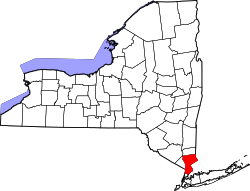 | |
| Towns | ||
| Villages | ||
| CDPs |
| |
| Other hamlets | ||
| Footnotes | ‡This populated place also has portions in an adjacent county or counties | |
| International | |
|---|---|
| National | |

Rye Brook, New York
View on GrokipediaHistory
Early Settlement and Colonial Period
The area encompassing modern Rye Brook was originally inhabited by the Munsee Lenape, a subgroup of the Algonquian-speaking peoples, who utilized the region's woodlands, wetlands, and proximity to Long Island Sound for hunting, fishing, and seasonal agriculture prior to European contact.[4] European exploration and initial land claims in the broader Rye vicinity began in the early 17th century, with Dutch and English interests overlapping in Westchester County, but permanent English settlement in the specific Rye lands, including what would become Rye Brook, commenced in 1660 when a group of colonists from Greenwich, Connecticut—led by Peter Disbrow, John Coe, and Thomas Studwell—relocated across the Byram River.[3] [5] These settlers negotiated a treaty with Mohican chief Shenarockwell, securing rights to lands west of the Byram River, marking the establishment of the Rye Neck settlement on Manursing Island and adjacent mainland areas.[3] Subsequent land acquisitions solidified English control, including a 1662 purchase by the original Rye proprietors of a tract between Blind Brook—which flows through present-day Rye Brook—and the Mamaroneck River from local Native American elders, comprising approximately 4,000 acres divided among early patentees.[6] This expansion reflected the settlers' agrarian focus, with farms producing corn, wheat, and livestock on cleared plots amid forested terrain. However, the region's colonial status remained contested due to overlapping claims between the Connecticut and New York colonies; Rye, including its western extensions toward Blind Brook, oscillated in jurisdiction until 1700, when a royal decree under King William III definitively placed it within the Province of New York following surveys that adjusted the border eastward.[4] [7] During the 18th-century colonial period, the Rye Brook area functioned as a peripheral farming hamlet within the Town of Rye, supporting small-scale agriculture and milling along streams like Blind Brook, while its strategic position near the Westchester Path—later formalized as the Boston Post Road—facilitated limited trade and communication between New York City and New England ports.[4] Population growth was modest, with Quaker and Presbyterian influences shaping community life amid occasional tensions from Native displacements and imperial rivalries, though the locality avoided major skirmishes until the Revolutionary War era. By the mid-1700s, estates and mills dotted the landscape, underscoring a transition from frontier outpost to integrated provincial suburbia.[8]20th Century Growth and Incorporation
The unincorporated area of the Town of Rye that later became Rye Brook experienced gradual development in the early 20th century, characterized by large estates, farmland, and limited residential settlement. By 1940, its population stood at fewer than 2,000 residents, reflecting a predominantly rural landscape amid Westchester County's broader suburbanization trends.[3] Post-World War II economic expansion and infrastructure improvements, including proximity to New York City and emerging highways such as the Hutchinson River Parkway and I-287, spurred significant population growth through the mid- to late 20th century. The area saw substantial residential development, with the population expanding to approximately 8,000 residents by 1980, driven by demand for suburban housing among commuters. This growth marked a 128% increase from 2,661 residents recorded in earlier mid-century censuses for the unincorporated portion, transforming the region from agrarian holdings to a dense suburban enclave.[9][10] By the late 1970s, dissatisfaction with shared town governance—following the prior secession of other areas like the City of Rye in 1942—prompted residents to seek independent municipal status for enhanced local control over zoning, services, and taxation. On July 7, 1982, voters approved incorporation as the Village of Rye Brook, establishing it as Westchester County's newest municipality from the town's remaining unincorporated territory. This move allowed for tailored administration amid ongoing development pressures, preserving community character while addressing fiscal autonomy.[11][12][13]Geography
Location and Boundaries
Rye Brook occupies a position in the southeastern quadrant of Westchester County, New York, roughly 30 miles northeast of central Manhattan.[1] Centered at coordinates 41°01′06″N 73°40′60″W, the village covers a compact land area of 3.43 square miles, with minimal water coverage of 0.03 square miles.[14][15] It lies entirely within the boundaries of the Town of Rye, reflecting its status as one of two incorporated villages in that township. The village's eastern perimeter aligns with the New York-Connecticut state boundary, directly adjoining the town of Greenwich, Connecticut.[16] To the north, Rye Brook shares a limited border with the Town of North Castle, delineated along Blind Brook and proximate to the Westchester County Airport's main terminal. Southward, its limits interface with the Village of Port Chester and the City of Rye, while the western edge traces Blind Brook, which separates it from adjacent unincorporated sections of the Town of Rye.[17] This configuration positions Rye Brook as a transitional enclave between urbanizing suburbs and the interstate corridor linking New York City to New England.[1]Physical Features and Climate
Rye Brook lies within the coastal plain of Long Island Sound in Westchester County, featuring gently rolling terrain that transitions from low-lying areas near the shore to higher ground inland. Elevations range from near sea level along watercourses to approximately 200 feet (61 meters), with an average around 213 feet (65 meters). The village's landscape is dominated by wooded areas and suburban development, with Blind Brook—a small stream draining 9.31 square miles—serving as a key hydrological feature before emptying into the Byram River. Land covers 3.43 square miles (8.88 km²), comprising mostly glacial till and outwash soils typical of the region, while water bodies account for just 0.02 square miles (0.06 km²).[18][19] The climate in Rye Brook is humid continental, marked by four distinct seasons: cold, snowy winters; mild springs; warm, humid summers; and cool autumns. Annual precipitation averages 50 inches (1,270 mm), with rainfall peaking in spring and summer, supplemented by about 30 inches (76 cm) of snowfall during winter months. Temperatures typically range from average daily lows of 22°F (-6°C) in January to highs of 84°F (29°C) in July, influenced by proximity to Long Island Sound which moderates extremes compared to inland areas.[20][21][22]| Month | Avg. High (°F) | Avg. Low (°F) | Avg. Precip. (in) |
|---|---|---|---|
| January | 38.4 | 23.9 | 3.88 |
| February | 40.6 | 24.8 | 2.87 |
| March | 47.8 | 31.4 | 4.13 |
| April | 59.2 | 41.7 | 4.25 |
| May | 69.8 | 51.8 | 3.94 |
| June | 78.1 | 61.7 | 3.98 |
| July | 82.6 | 67.3 | 4.17 |
| August | 81.1 | 66.6 | 4.02 |
| September | 74.3 | 59.4 | 4.02 |
| October | 63.3 | 48.9 | 4.13 |
| November | 52.9 | 39.2 | 3.94 |
| December | 43.7 | 29.8 | 3.94 |
Demographics
Population Trends and Census Data
The United States Census recorded a population of 8,602 for Rye Brook in 2000.[24] This figure increased to 9,347 by the 2010 Census, representing an 8.7% growth over the decade, consistent with suburban expansion in Westchester County amid regional commuting patterns to New York City.[25] The 2020 Census enumerated 9,991 residents, a 6.9% rise from 2010, though growth slowed compared to prior decades, aligning with broader trends of maturing suburban demographics and limited new housing development.[26] Post-2020 estimates from the Census Bureau show a modest decline, with the population at 9,900 as of July 1, 2024, reflecting a -0.9% change from the 2020 base, potentially influenced by aging households and out-migration to lower-cost areas.[27]| Census Year | Population | Percent Change from Prior Decade |
|---|---|---|
| 2000 | 8,602 | - |
| 2010 | 9,347 | +8.7% |
| 2020 | 9,991 | +6.9% |
Racial, Ethnic, and Household Composition
As of the 2020 United States Census, Rye Brook had a population of 10,047.[27] The racial composition consisted of 78.8% White alone, 11.1% Asian alone, 4.9% two or more races, 0.7% Black or African American alone, 0.0% American Indian and Alaska Native alone, and 0.0% Native Hawaiian and Other Pacific Islander alone.[27] Ethnically, 8.9% of residents identified as Hispanic or Latino of any race, while 75.6% were White alone, not Hispanic or Latino.[27] This reflects a predominantly White non-Hispanic majority with notable Asian representation and a modest Hispanic minority, consistent with patterns in affluent Westchester County suburbs where immigration from Asia has increased since the 1990s.[28] Household data from contemporaneous American Community Survey estimates integrated with census figures indicate approximately 3,527 households, with an average size of 2.8 persons.[29] Family households comprised 78.6% of the total, primarily married-couple families with children under 18, while non-family households accounted for 21.4%, often consisting of individuals living alone.[29] These structures align with high median incomes and low poverty rates, supporting larger family units in single-family housing prevalent in the village.[27]Economy
Employment Sectors and Commuting Patterns
In Rye Brook, the workforce is predominantly white-collar, with 92.7% of employed residents aged 16 and over engaged in such roles as of the latest available estimates.[29] The largest employment sector is professional, scientific, and technical services, employing approximately 826 individuals, followed closely by health care and social assistance.[28] These sectors reflect the village's affluent, suburban character and proximity to New York City's financial and corporate hubs, where many residents hold executive, managerial, or specialized positions. Top occupations include sales representatives in services, wholesale, and manufacturing (7.0% of workers) and other management roles excluding agriculture (6.9%).[30] Overall employment stands at around 4,260 individuals, with a decline of 2.77% from 2022 to 2023, amid broader post-pandemic shifts toward remote work.[28] Commuting patterns in Rye Brook emphasize flexibility, with 24% of workers employed from home as of 2023, a trend amplified by remote work adoption since 2020.[28] Among those commuting, 55% drive alone, 6% carpool, and 14% use public transportation, primarily Metro-North rail lines accessible via nearby stations in Port Chester or Rye.[31] The average commute time is 32.8 minutes, facilitated by major highways such as Interstate 95 and Interstate 287, which connect the village to Westchester County employment centers like White Plains and Manhattan.[32] This modal split underscores a reliance on personal vehicles for shorter trips within the region, while transit serves longer journeys to New York City, where finance and professional sectors draw significant outflows.[33]Income Levels and Housing Market
The median household income in Rye Brook was $236,968 for the period 2019-2023, according to the U.S. Census Bureau's American Community Survey, more than three times the national median of approximately $75,000 and substantially exceeding New York State's median of around $81,000.[27][2] Per capita income stood at $121,215, reflecting the village's affluent residential character driven by proximity to New York City employment centers and high-value professional occupations among residents.[34] The poverty rate was 6.12% for individuals, below the national average of 11.5% and indicative of broad economic stability, with only a small fraction of households facing income constraints.[34][28] Housing in Rye Brook consists primarily of owner-occupied single-family homes and condominiums, with a median home value of $1,192,062 as of recent estimates, up 7.1% from the prior year amid steady demand from high-income commuters.[35] Median sale prices fluctuated in 2024-2025, reaching $1.1 million in recent transactions per market analytics, though listings averaged $1.5 million, underscoring a competitive market with homes selling at 106.8% of list price on average after 28 days.[36][37] The median gross rent was $2,220 for 2019-2023, representing a significant portion of income for the minority renter population, though overall housing affordability benefits from elevated local incomes, with fewer than 10% of households classified as severely cost-burdened compared to broader Westchester County trends.[27]| Metric | Value (2019-2023 unless noted) | Comparison to U.S. National |
|---|---|---|
| Median Household Income | $236,968 | ~3x higher |
| Per Capita Income | $121,215 | ~2.5x higher |
| Poverty Rate | 6.12% | Lower than 11.5% |
| Median Home Value | $1,192,062 (2025 est.) | ~4x higher |
| Median Gross Rent | $2,220 | ~1.5x higher |