



Community hub
Recent from talks
Contribute something
Nothing was collected or created yet.
South Australian National Football League
View on Wikipedia
Current season, competition or edition: 2025 SANFL season 2025 SANFL season | |
 | |
| Formerly | South Australian Football Association (1877–1888) South Australian United Football Association (1888–1889) South Australian Football Association (1889–1906) South Australian Football League (1907–1927) |
|---|---|
| Sport | Australian rules football |
| Founded | 30 April 1877 |
| First season | 1877 |
| CEO | Darren Chandler |
| No. of teams | 10 |
| Region |  South Australia South Australia |
| Most recent champions | Sturt (16th premiership) |
| Most titles | Port Adelaide (36 premierships) |
| Broadcaster | Seven Network |
| Sponsor | Hostplus |
| Official website | www.sanfl.com.au |
The South Australian National Football League, or SANFL (/ˈsænfəl/ or S-A-N-F-L),[1] is an Australian rules football league based in the Australian state of South Australia. It is also the state's governing body for the sport.
Originally formed as the South Australian Football Association on 30 April 1877, the SANFL is the oldest surviving football league of any code in the world. For most of its existence, the league was considered one of the traditional "big three" Australian rules football leagues, along with the Victorian Football League and West Australian Football League. Since the introduction of two South Australia-based clubs into the Australian Football League – the Adelaide Crows in 1991 and the Port Adelaide Power in 1997 – the popularity and standard of the league has decreased to the point where it is considered a feeder competition to the Australian Football League.
The SANFL has always been a single-division competition, and with the admission of the Adelaide Crows reserves in 2014, the season returned to a 10-team, 18-round home-and-away (regular) season from April to September. The top five teams play off in a final series culminating in the grand final for the Thomas Seymour Hill Premiership Trophy. The grand final had traditionally been held at Football Park in October, generally the week after the AFL Grand Final, though this was altered ahead of the 2014 season, resulting in Adelaide Oval hosting the grand final in the penultimate weekend of September.
The semi-professional league is considered the strongest competition after the fully professional Australian Football League (AFL). The league owned the sub-licences for South Australia's two AFL clubs—Adelaide Football Club and Port Adelaide Football Club—until March 2014, when South Australian Football Commission reached an agreement with the Adelaide and Port Adelaide clubs—endorsed by the AFL—which will see the two AFL licences transferred to the clubs in return for payments totalling more than $18 million.[2]
The league is also responsible for the management of all levels of football in the state. This includes junior football, country football, amateur football and specific programs rolled out across schools, indigenous communities (including the APY Lands in the state's north) and newly arrived migrant communities.
The SANFL owned Football Park, formerly the largest stadium in South Australia. The stadium, which opened in 1974, was primarily used for Australian Football League matches up until 2013 and had a capacity of over 51,000 prior to being demolished. The stadium was the headquarters for the league from 1974 to 2013. The SANFL competition is the second highest attended Australian rules football league behind the AFL.
History
[edit]Before 1877
[edit]
The first recorded game of any "football" in South Australia was that of 'Caid' played in Thebarton by people of the local Irish community in 1843 to celebrate St Patrick's Day. In 1844, there was debate amongst the South Australian Legislative Council whether it be allowed that "foot-ball" be played on Sundays, with arguments against preferring the quiet worship of God.[3] In 1859, the Gawler Institute ran a rural fete which included a game of football being staged.[4]
The earliest recorded Australian rules football club in South Australia was Adelaide Football Club (unrelated to the modern day Adelaide Football Club), formed in April 1860. An advertisement, sponsored by John Acraman, W.J. Fullarton and R. Cussen noted that group had already gathered 30 members. [5] The club initially only played internal matches between players located North and South of the River Torrens.[6]
By the early 1870s a number of new clubs were formed. In addition to the Old Adelaide Club, Port Suburban (founded in 1868 and renamed Woodville in 1870), Port Adelaide and Young Australians both formed in 1870 and Kensington were the principal clubs that were organising interclub matches.
The early years of interclub football began to be dogged by arguments over which set of rules to adopt. A meeting of three delegates from each of the three clubs—Adelaide, Kensington and Port Adelaide— was held on 10 March 1873, with Charles Kingston from Adelaide voted as chair in an attempted to draw up a standard code of playing rules.[7]
However, after a match between Port Adelaide and Kensington in July 1873, it was remarked that neither side understood the rules clearly.[8] As the years progressed, there became a growing push for uniformity and structure in South Australian football.[9]
On Wednesday 22 March 1876, a meeting of the South Adelaide Football Club, which had formed the previous year, was held at the Arab Steed Hotel. There was a good attendance, and officers and Committee for the season were elected. Dissatisfaction was expressed relative to the rules by which matches were conducted last season, and the Secretary was instructed to communicate with the various Clubs in order to arrange for regulations. It was remarked that scarcely a game was played last season without some misunderstanding arising, some playing by the Old Adelaide Club rules, and others the Kensington Club rules. After a lengthy discussion the meeting adjourned to receive a report from the Secretary and Committee.[10]
Country clubs had also been established at Kapunda (1866), Gawler (1868) and Willunga (1874) and the Adelaide-based clubs would sometimes be hosted by these clubs principally on Public Holidays. These 3 country clubs would also send delegates to the meetings which formed the South Australian Football Association in 1877.
1876: Adoption of standard rules by clubs
[edit]A meeting of those interested in football was held at the Prince Alfred Hotel on Thursday evening, July 20, 1876, to consider the question of a uniform code of rules to be adopted by the various Clubs. There were 56 persons present, including representatives from the Old Adelaide, South Adelaide, Woodville, and Victorian Clubs. Mr. T. Lotchford presided. Mr. C. C. Kingston, in explaining the object of the meeting, mentioned that a circular had been issued about six weeks previously by the Kensington Football Club, calling upon the Clubs in and around Adelaide to appoint delegates to consider the question of adopting a uniform code of rules. Nothing, however, had followed the issuing of the circular, and the meeting that evening was called in consequence. He was extremely pleased to see so large an attendance, as it augured well for a revival of the manly game, which, owing to what he considered a foolish modification of what were known as the old Adelaide rules, had sadly degenerated. The regulations generally known as the Kensington roles had during the last two seasons in which they had been adopted only provoked continual disputes when matches were engaged in. He was sure they all desired to see the game prosper in the colony, and that by a suitable code of rules encouragement should be given to the exhibition of skill, strength, and pluck, while all matches might be played under a spirit of friendly rivalry, thus making the game enjoyable and interesting not only to players, but to spectators. He then moved that the rules played in Victoria should be considered. They differed but slightly from the old Adelaide rules. If such rules were adopted he felt sure that football would be carried on far more successfully than had been the case lately, and there would be a greater probability of intercolonial matches being arranged, as he hoped would be the case at no distant date. (Applause.) Mr. A. Crooks having seconded the motion, the Melbourne Football Rules were considered seriatim and adopted In their entirety, with the exception of Rules 6, 7, and 8. which were amended in a manner to assimilate somewhat to the old Adelaide rules. An addition to Rule 6 provided that no player having claimed his mark should run with the ball. Rule 7 was struck out, and the following substituted:— " The ball may be taken in hand at any time, but the player shall be liable to be held or thrown until he drops it." An addition to Rule 8 provided that pushing from behind should only be allowable when the player was running. The chief alterations in the game as hitherto played in Adelaide are the dispensing with the cross bar and top rope in favour of two upright posts of unlimited height, and the substitution of an oval football for the round one. Messrs. C. C. Kingston, A. Crooks, J. A. Osborne, T.Letchford, and C. D. Perkins were appointed a Committee to confer with the Secretaries of other Clubs with a view to securing their concurrence in the action taken by the meeting. They were also empowered to consider the question of offering a Challenge Cup for next season. The meeting then closed. [11]
1877–1887: SAFA establishment and the early years
[edit]In 1877, following an initial meeting called by Richard Twopeny on Thursday 19 April 1877 at Prince Alfred Hotel[12] delegates from 13 of South Australia's football clubs met to develop a uniform set of rules and establish a governing body. The South Australian Football Association was formed at a meeting called at the Prince Alfred Hotel in King William Street, Adelaide[13] on 30 April 1877,[14] and adopted rules similar to those used in Victoria upon the urging of Charles Cameron Kingston. The use of an oval ball, bouncing the ball, and pushing from behind forbidden amongst the rules agreed at the meeting.[15]
The clubs that sent 2 delegates each to the meeting were: South Park, Willunga, Port Adelaide, Adelaide, North Adelaide, Prince Alfred College, Gawler, Kapunda, Bankers, Woodville, South Adelaide, Kensington, and Victorian.[16]
The inaugural 1877 SAFA season was contested by 8 clubs. A total of 4 games were also played by Adelaide and Woodville when they were hosted twice each by the country clubs Gawler and Kapunda on public holidays but these weren't counted in the premiership table at the end of the season. South Adelaide and Victorian were declared joint Club Champions.[17]
| Founding clubs for Inaugural SAFA 1877 Season | |||||||
|---|---|---|---|---|---|---|---|
| Adelaide | Bankers | Kensington | Port Adelaide | South Adelaide | South Park | Victorian | Woodville |
In 1878, a brand new club Norwood was formed following the entire collapse of Woodville by a number of former players and it joined the Association for the season.[18]
An end of season match on 31 August between a combined Adelaide Team from the Association against a combined team from the 3 country clubs – Gawler, Kapunda and Willunga was played on the Adelaide Ground. With the Adelaide team winning 5 goals to 1.[19]
In 1880 it was proposed to create a Junior Football Association, similar to the Cricket Association, from Clubs such as the North Parks, St. Peter's College, Prince Alfred College, Royal Parks, West Torrens, Woodville, South Suburban, Hotham, and Middlesex.[20]
In 1881 - Adelaide and Kensington merged at a meeting held on 11 April it was decided that the colour of the merged club be black-and scarlet guernsey, hose, and cap, and navy blue knickerbockers. The SAFA was notified in writing of the amalgamation which was read at a meeting held on 27 April 1881.[21] The merged club played 4 games before resigning on 1 June.[22]
In 1882 - The first general meeting of the committee of the Junior Football Association was held at the Prince Alfred Hotel on Monday evening, March 27. All the clubs - North Parks, North Adelaide Juniors, Kensington, Kent Town, Albion, Triton, and West Torrens were represented.[23] Later some of these clubs would be admitted to the Senior Association - North Parks would merge with North Adelaide Juniors and join as Adelaide in 1885 and West Torrens as West Adelaide in 1887.
In May 1884 - A proposal to merge the senior Association (SAFA) with the Junior Association (called the Adelaide and Suburban Association) was started[24] with 5 delegates from each Association to confer as what steps can be taken[25] but was in the end rejected by the SAFA.
Of the original senior clubs – Bankers (1877), Woodville (1877), Adelaide and Kensington (1881 after merging), South Park (1884), Victorian (1884) - i.e. 6 of the original 8 had all left the competition by the start of the 1885 Season. Only Port Adelaide and South Adelaide hadn't folded or resigned[26] and together with Norwood which had joined in 1878 these 3 senior clubs dominated the competition.
In 1885, a new Adelaide Club joined the senior competition and won the Premiership the following season. The club was formed from a merger of North Adelaide Juniors (which had renamed to Adelaide in 1884) and North Parks. Upon merger and admission the Club took up the Old Adelaide colours of Black and Red.
In 1887 another three Clubs were admitted Hotham and West Adelaide and the only country team ever admitted Gawler Albion but all only lasted for a few seasons.
West Adelaide folded after just one season (1887), their resignation was accepted at the Annual General Meeting held on 5 April 1888, as they were unable to get a team together. At the same meeting permission was given for Hotham to change their name to North Adelaide and for Gawler to remove the word Albion from their name.[27]
-
 The Norwood Football Club won six premierships in a row from its establishment in 1878 to 1883 (1878 Norwood team pictured).
 -
 The Port Adelaide Football Club won their first premiership in 1884.(1884 Port Adelaide team pictured).
 -
 South Adelaide was a strong club in early years winning 8 premierships in the 19th century (1885 South Adelaide team pictured).
 -
 Adelaide's 1886 premiership team.
The club which players were solely South Australians was formed from a merger of two junior clubs in 1885 - North Adelaide Juniors and North Park.


1888–1896 SAFA splinters and re-establishes under new Association and Rules
[edit]The 1888 SAFA season was started under a cloud, as a dispute arose when the old senior clubs Adelaide, Port Adelaide and South Adelaide all withdrew and resigned from the SAFA and created their own Association and had advertised for other clubs to join them. The split meant Norwood was the only senior club left in the original SAFA along with the two new clubs Gawler and Hotham (renamed North Adelaide) which had just joined the previous year. To settled the dispute the three remaining SAFA clubs were then invited to apply to join this new Association which had a number of new rules.
A junior club Medindie (which would rename itself North Adelaide Football Club in 1893) had applied to join this new United Association but were willing to withdraw their application if this helped resolve the dispute. However, they were accepted along with applications from Norwood, North Adelaide (Hotham) and Gawler and this meant a seven team competition was maintained. Medindie was a foundation member in 1885 of the South Australian Junior Football Association, before spending the 1886 and 1887 seasons competing in the Adelaide and Suburban Football Association.
The first meeting of the United Football Association was held on Wednesday evening 9th May 1888.[28] The result was the old South Australian Football Association being wound up and a new one formed termed 'The South Australian United Football Association'.
| Founding Clubs of United Football Association for 1888 Season | |||||||
|---|---|---|---|---|---|---|---|
| Adelaide | Gawler | Hotham (North Adelaide 1888) |
Medindie | Norwood | Port Adelaide | South Adelaide | |
Hotham which renamed to North Adelaide for 1888 merged with Adelaide for the 1889 season reducing the competition to six clubs.
On Friday 5 April 1889 At the Annual General Meeting held on Friday 5 April 1889 in the Trades Exchange with all the clubs present the United Football Association renamed itself to South Australian Football Association.[29]
Gawler after its 4th season notified the Association in writing in April 1891 that it would no longer be joining (principally due to being given only 5 home games at Gawler and 10 away games in Adelaide for the 1890 season). In 1889 it had created its own Junior League consisting of 3 clubs. In May 1892, the Gawler Association again was affiliated with the SAFA.[30] Subsequently, it tried to rejoin the competition a number of times but was rejected. In 1913, it was admitted but withdrew before the season started.
On 14 March 1893, at a meeting held at Temperance Hall, North Adelaide Medindie renamed itself to North Adelaide Football Club.[31][32]
In March 1894, Adelaide withdrew from the Association in writing before the season commenced.[33] This reduced the number of senior clubs to just 4 - Port Adelaide, South Adelaide, Norwood and North Adelaide (originally called Medindie).
In March 1895, a new club called Natives applied to join as the 5th Senior Club. It was formed from players from various districts and a group of former Port Adelaide players from a junior club called Port Natives.[34] "The Natives" was adopted so as to prevent any feeling that it was confined to any given locality. Principally the members were drawn from the Port Natives, who were the premiers of the Adelaide and Suburban Association.[35] After initially having their application refused. At a meeting on the 5th April 1895 the Natives then submitted a list of 50 players to show their strength. They were then admitted by 13 votes to 5 against.[36] This new senior club would rename itself and be called West Torrens in 1897 with the introduction of the Electoral System.
In 1896, North Adelaide and the Natives were permitted to field 23 players (3 extra players).[37]
At an Association committee meeting held on 10 August 1896, a proposal was tabled to introduce having no more than eight clubs in the association and that all clubs and any new players be zoned based on the state electoral districts.[38] At an adjourned meeting on Monday 26 Oct 1896, South Adelaide agreed to be zoned to the Electoral of East Adelaide and delegates from the Port Natives Football Club stated they would rename and take the West Torrens District.[39]
1897–1900: Introduction of Electorate District Zoning and other Changes
[edit]1897 again saw a number of changes, District football based on the State Electoral Districts was introduced optionally with the aim of zoning players to a SAFA club (and became compulsory in 1899) and was the first season of football in South Australia where behinds contributed to the total score, not just goals. (which brought it in to line with the VFA).
On 5 April 1897, The Association approved the application of the current West Adelaide Football Club to join the SAFA from the Suburban Association[40] and The Native Football Club (1895–1896) altered its name to West Torrens Football Club,.[41][42] Despite the constitution allowing 8 clubs based on the Electoral Districts the Association comprised six clubs until the turn of the century.
| 1897 Electoral District Allocations | ||||||||
|---|---|---|---|---|---|---|---|---|
| District | East Adelaide | North Adelaide | Port Adelaide | West Adelaide | East Torrens | West Torrens | Sturt | Barossa |
| Club | South Adelaide | North Adelaide | Port Adelaide | West Adelaide | Norwood | Port Natives renamed to West Torrens |
Vacant (Future New Club) |
Gawler* |
- The Gawler Club were allocated the Barossa District but continued to have its own Association - Gawler Football Association (comprising three teams based in the township)
The three newer clubs (North, West Adelaide and West Torrens) continued to struggle against the older three clubs (Norwood, Port and South Adelaide). In the First Round both West Adelaide (vs Norwood) and West Torrens (vs Port Adelaide) failed to score for the whole game. There were also a number of walkovers throughout the season when the newer clubs failed to field a team.
In 1898, the Magarey Medal was awarded to the fairest and most brilliant player for the first time.
In 1899, after a period of declining public interest in football due to the long term inequality between the three traditional clubs (Port Adelaide, South Adelaide and Norwood) and the three younger clubs (West Adelaide, West Torrens and North Adelaide), the SAFA introduced electorate football, meaning that players were allocated to clubs based on the district in which they resided.[43] and the playing teams were reduced from 20 to 18.[44]
At a meeting held on Monday 8 May 1899 with a large number of delegates present the Secretary was instructed to write to the Gawler and Port Pirie Associations to inform them that their applications to join the SAFA would not be entertained this year as purely electorate football was being tried.[45]
In mid to late 1900 there was growing interest to form a senior club in the Sturt Electoral District based around Unley to join the SAFA.[46][47]
In 1900, North Adelaide won the Grand Final against South Adelaide breaking the dominance of the 3 old traditional Clubs – Norwood (11), South Adelaide (8) and Port Adelaide (3) which together had won 22 of the first 23 premierships (1877–1899).
-
 Port Adelaide
(1897 team pictured). -

-
 North Adelaide
(1900 team pictured).


1901–1913: Pre war years
[edit]With the introduction of Clubs being zoned to Electoral Districts South Adelaide lost the dominance it had between 1892 and 1900 (six flags and runner up three times) and was replaced by Norwood and Port Adelaide, who were joined by West Adelaide and North Adelaide; between them, the four clubs won all premierships between 1901 and 1913. West Adelaide followed three straight wooden spoons from 1904 to 1906 with four out of the five premierships from 1908 to 1912 (including Championship of Australia in 1908 and 1913), the most successful period in West Adelaide's history.
The Constitution of the Association allowed up to eight teams based on the State's Electoral Districts and the competition expanded to seven teams when a new football club Sturt formed by the local cricket club joined the Association in 1901 to fill the zone based on the Electoral District of Sturt, but it performed poorly initially, finishing last in its first four seasons.
In 1902, Port Adelaide adopted its now famous black and white colours.
In 1907, the association changed its name to the South Australian Football League.
In 1910 Adelaide University made an application to enter the competition as the 8th team. This led to players such as Jack Londrigan leaving league clubs such as Sturt in anticipation for a university league team. However the application was ultimately rejected by the competition out of fear a university side would compromise the electorate system, also referred to as zones, introduced to equalise the state competition.
On 2 December 1912, the Gawler Football Association was granted admission to the league to fill the zone based on the vacant 8th Electoral District Barossa.[48] On 3 March 1913 it was confirmed the team would be called Gawler and its colors were registered as follows: Black jersey with pink hoop, white knickers and black-and-pink hose.[49] However, just before the start of the 1913 season the association notified the league in writing that it had to withdraw due to loss of prominent players from their district and the depressed condition of the sport locally.
The University Club, the 1911 and 1912 premiers of the South Australian Amateur Football League (SAAFL), applied to fill the vacancy created by Gawler's withdrawal but was turned down by a unanimous vote of the delegates.[50]
-
 West Adelaide won four SAFL premierships and two Championships of Australia between 1908 and 1912.
 -
 Port Adelaide went through the 1914 SAFL season undefeated.
 -
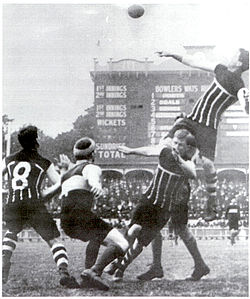 Port Adelaide was Champion of Australia 3 times between 1910 and 1914.


1914–1918: World War I years
[edit]The SAFL maintained competition for the first two years of World War I, 1914 and 1915, with Sturt winning their first premiership in 1915, but from 1916 the competition was suspended and did not resume until 1919. However, a league competition was formed in 1916 called South Australian Patriotic Football League by the SAFL Clubs and a number of non-AFL Clubs. The league existed for 3 seasons (1916, 1917 and 1918) and Games held were used to raise funds for the war effort. The SAFL was opposed to the formation of the Patriotic League and refused to recognise it during and after World War I.
1919–1941: Inter war years
[edit]Sturt won the first premiership of the post-World War I era, beating North Adelaide in the Challenge Final replay after a Draw occurred in the 1919 SAFL Grand Final.
At a meeting on Monday 19 April 1920 the SAFL defined that part of Sturt district west of South Road as a new district and admitted a newly formed Glenelg to the B Grade for 1920.[51] It became 8th club in the senior league in 1921 but started poorly with five consecutive wooden spoons.
| 1921 SAFL following expansion to 8 Clubs | ||||||||
|---|---|---|---|---|---|---|---|---|
| Club | South Adelaide |
Port Adelaide |
Norwood | North Adelaide |
West Torrens |
West Adelaide |
Sturt | Glenelg |
| Admission Year |
1877 | 1877 | 1878 | 1888 | 1895 | 1897 | 1901 | 1921 |
In 1927, the South Australian Football League was renamed the South Australian National Football League.
Everyone of the 8 clubs won at least one premiership during the 9 years from 1927 to 1935, including Glenelg which their first premiership in 1934 would be the only success in their first 52 years. Prior to World War 2 Port Adelaide won three premierships in the period 1934–1939, appearing in 6 successive grand finals.
-
 Pictured above is the 1929 SANFL Grand Final between Port Adelaide and Norwood who by this time had well and truly become the league's premier rivals.
See Port Adelaide-Norwood SANFL rivalry. -
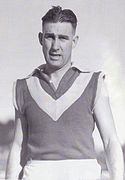 Ken Farmer kicked a record 1,417 goals.
 -
 Ian McKay leaps for a spectacular mark in the 1952 SANFL Grand Final


1942–1945: World War II war years
[edit]The SANFL continued normal competition for the first few years of World War II, but from 1942 to 1944 for 3 seasons the clubs merged on a geographical basis.
The competing teams were:
Port-Torrens (Port Adelaide and West Torrens), wearing Port Adelaide colours and known as the Magpies
Norwood-North (Norwood and North Adelaide), wearing North Adelaide colours and known as the Redlegs
Sturt-South (Sturt and South Adelaide), wearing Sturt colours and known as the Blues
West-Glenelg (West Adelaide and Glenelg), wearing Glenelg colours and known as the Tigers
1946–1959: Post World War 2 and Port Adelaide 50s Dominance
[edit]Post World War 2 was dominated by Norwood who won 3 flags in 5 years between 1946 and 1950. Port Adelaide, led by Fos Williams, dominated the 1950s winning seven premierships, including a record setting six Grand Final wins in a row from 1954 to 1959. This record also matched Norwood's six in a row in 1883, set before the advent of regular Grand Finals.
From early 1949 there was some discussion about expanding the competition to 10 teams due to the growth of metropolitan Adelaide and in particular adding teams from Woodville who had made an application and the outer northern Gawler and Barossa area which had a strong local league and was connected to Adelaide by the train. Previously a country team from Gawler had competed for 4 seasons from 1887 to 1890. South Adelaide were also requesting to consolidate their zone and to be potentially based at Kensington Oval.[52]
On 20 March 1950 Salisbury Football Club made an application to join the SANFL.[53][54] Applications by Burnside and Woodville were also rejected by the SANFL in June 1950.[55]
In February 1953, The Mayor of Woodville again raised the issue of having a team admitted. Citing a large number of players from West Torrens and Port Adelaide actually resided in the City of Woodville.[56]
In 1954, the tradition of painting the chimney of the West End brewery in Hindley Street, then owned by the South Australian Brewing Company, with the team colours of the SANFL premier and runner-up began,[57] when a West Adelaide player and employee Clarrie Cannon[58] suggested painting the chimney in the West Adelaide colours, red and black, as the brewery[57] was located in their territory. General manager C. R. Aitken agreed, but only if West Adelaide was the winning team that year. However Port Adelaide coach and captain, Fos Williams, said that he expected his team to win, and the men agreed that if Port Adelaide won, their colours would be painted on the chimney. Port Adelaide won that year, so the chimney was painted in black and white vertical stripes, but Williams suggested that a red stripe be painted below the black to honour the runners-up.[59][60]
1959–1964: Expansion to 10 Teams
[edit]In 1959, after doubting whether the club was viable as a league team, the SANFL granted South Adelaide a substantial area of the newly developing southern Adelaide suburbs. Also the SANFL finally expanded to 10 teams by admitting a new club Central District based at Elizabeth in the outer north and Woodville an existing amateur league club based in the north west of metropolitan Adelaide. The newly admitted Clubs would play 5 years in the Reserves (B Grade) before joining the A Grade in 1964.
| 1964 SANFL expansion to 10 Clubs | ||||||||||
|---|---|---|---|---|---|---|---|---|---|---|
| Club | South Adelaide |
Port Adelaide |
Norwood | North Adelaide |
West Torrens |
West Adelaide |
Sturt | Glenelg | Central District |
Woodville |
| Adelaide Metropoliation Zone | Southern | Outer North Western | Eastern | Inner Northern | Inner Western | Inner South West | Inner South | South West Coastal | Outer Northern | Inner North Western |
Both new clubs initially performed poorly, especially against the two strongest clubs at the time Sturt and Port Adelaide, and many questioned the purpose of introducing two more teams, in particular Woodville, who were closely surrounded by existing clubs, Port Adelaide and West Torrens and only qualified for the finals on 3 occasions throughout its history.
Central Districts qualified for the finals in 1971, 1972 finishing 3rd in both years losing in the preliminary to Port Adelaide. In 1979 they collected the minor premiership but lost both finals to again finished 3rd.
Woodville qualified for the finals for the first time in 1979 and finished in 5th. Their most successful season was 1986 in which they 3rd which was followed up by a 5th place in 1987.[citation needed]
1962-1970 Port Adelaide and Sturt Domination
[edit]Port Adelaide continued their dominance of the competition from 1962 with three more premierships in 1962, 1963 and 1965. They would contest 7 successive Grand Finals from 1962 to 1968. Their successive premierships was broken by South Adelaide which went from wooden spooners in 1962 and 1963 to the win the Premiership in 1964 (their first since 1938) by defeating Port Adelaide. In 1965, Port Adelaide exceeded Norwood for the most premierships when they collected their 23rd Cup.
A resurgent Sturt under coach Jack Oatey won five straight premierships from 1966 to 1970, sharing a fierce rivalry with Port Adelaide whom they met in four consecutive Grand Finals from 1965 to 1968.
1970–1979: Golden Era
[edit]
Sturt began the 1970s by defeating Glenelg in a rain-affected Grand Final by 21 points. North Adelaide secured back-to-back premiership victories over Port Adelaide in 1971 and 1972 and defeated VFL premier Carlton by one point in the end-of-season Championship of Australia match. Glenelg won their 2nd premiership, and first since 1934, defeating North Adelaide by 7 points in 1973 in the highest scoring Grand Final 21.11 (137) to 19.16 (130). Port Adelaide continued their success, winning two premierships themselves (1977, 1979), and finishing lower than 3rd only once for the decade. Other premiership winning clubs in the 1970s were Sturt (1970, 1974, 1976), Glenelg (1973), and Norwood (1975, 1978). On 4 May 1974, Central District and North Adelaide played the first game at newly opened Football Park at West Lakes. SANFL moved its administration to the new stadium, and 58,042 attended the first Grand Final at the ground later that year, with Sturt defeating Glenelg by 15 points despite kicking into a stiff breeze in the last quarter after leading by 5 points at three-quarter time. The 1975 season was highlighted by Glenelg's score of 49.23 (317) against Central District, with a winning margin of 238 points which was larger, at that time, than the previous highest score ever recorded by a side in a single game. In 1976, Sturt defeated Grand Final favourites Port Adelaide by 41 points in front of a record ticketed Football Park crowd of 66,897. Norwood won the 1978 premiership in their centenary year by beating Sturt in the Grand Final by one point after Sturt had lost just one game for the entire season. During the 1970s, an increasing number of SANFL players moved to Victoria to play in the VFL competition.
1980–1989: VFL leaves ANFC and expands whilst SANFL struggles
[edit]Four clubs Port Adelaide (Premiers 1980,1981,1988,1989 RU 1984), Norwood (Premiers 1982,1984 RU 1980), North Adelaide (Premiers 1987, RU 1985, 1986 & 1989) and Glenelg (Premiers 1985,1986 RU 1981,1982,1987,1988) dominated the SANFL in the 1980s, accounting for nine premierships. The only year being the exception was 1983 when West Adelaide defeated Sturt in the Grand Final for their first premiership since 1961. In the decade between 1979 and 1989 only three clubs, Central District, Woodville, both admitted to the SANFL in 1964, and West Torrens were the only clubs not to reach at least one grand final. The exodus of high quality players to the VFL accelerated in the 1980s. In this same decade only Hawthorn (1983, 1986, 1988 & 1989), Carlton (1979, 1981, 1982 & 1987), Richmond (1980), and Essendon 1984 & 1985) were successful in the VFL. Only Collingwood (1979, 1980 & 1981), Melbourne (1988) and Geelong under first year expat coach and former Woodville player Malcolm Blight (1989) would reach a VFL grand final. In 1981 the VFL rejected a SANFL bid to enter a composite South Australian team to its competition. Night football was introduced in 1984 after floodlights were installed at Football Park.The SANFL introduced a player retention scheme in 1988 in an attempt to maintain the quality of the competition in the face of falling attendances.
The tradition of painting the colours of the premier and runners-up was maintained at the Hindley Street premises of SA Brewing until its closure in 1980,[57] before transferring to the Thebarton site,[61][58] which was rebadged "West End".[62]
1990–1999: Adelaide and Port Adelaide AFL entry
[edit]
On 31 July 1990, Port Adelaide surprised the SANFL by making an independent bid to join the AFL. The SANFL was left with little option but to submit its own bid to enter the AFL. In a thirty-minute meeting[citation needed] the SANFL formed the Adelaide Football Club. While Port Adelaide had by far the largest supporter base in South Australia, it could not compete with the SANFL's offer of a composite club, dismantling of the SANFL player retention scheme, dropping of court action against Port Adelaide and the use of Football Park, and in November 1990, following a legal battle (dropped), the AFL announced the Adelaide Football Club had been granted a licence and would enter the competition in 1991.
The Adelaide Football Club, nicknamed the Crows, debuted in 1991 wearing the state colours of navy blue, red and yellow. While the Adelaide Crows enjoyed crowds of over 40,000 every week and dominated local media coverage, crowds at local SANFL matches suffered substantially.
In 1994 after a tender process put to all the SANFL clubs, the Port Adelaide Football Club secured a licence to enter the AFL. Port Adelaide chose the nickname of 'Power' since 'Magpies' was already used by Collingwood. Port Adelaide wished to maintain its presence (as the Magpies) in the SANFL, which was agreed to on the basis that Port Adelaide's SANFL and AFL entities operate independently. The club in the SANFL was renamed "Port Adelaide Magpies Football Club" to reflect this separation.
Port Adelaide dominated the SANFL in this time, contesting 10 Grand Finals in 12 years between 1988 and 1999 – winning 9 premierships (1988–1990,1992,1994–1996,1998–1999) and losing just the one Grand Final in 1997 to Norwood (their 27th Flag). This Port Adelaide dominance in the period is somewhat of an aberration. It should be kept in context with the hasty formation of the Adelaide Crows in 1991.[63] During this period many of the remaining SANFL clubs' best players were seconded to the Adelaide Crows, whereas the Port Adelaide list was largely left intact due to the conflict that ensued around the Port Adelaide rank-breaking bid to join the expanded VFL competition as a stand-alone club. The Woodville and West Torrens Clubs merged at the end of the 1990 Season and won their first premiership in 1993 against Norwood. Between 1900 and 1999 Port Adelaide contested a total of 59 Grand Finals – winning the flag 33 times to bring their total to 36.
2000–2010: Central District domination
[edit]
There was a changing of the guard as the new century started. For more than 100 years one of Port Adelaide, Norwood, North Adelaide or Sturt appeared in every Grand Final. The year 2000 saw the two newest teams Central District and Woodville-West Torrens played off in the Grand Final. Central District appeared in 12 Consecutive Grand Finals from 2000 to 2011, collecting nine premierships (2000–2001, 2003–2005, 2007–2010). Only Sturt (2002) and Woodville-West Torrens (2006 & 2011) interrupted Centrals' run during this period. Centrals played in 28 Finals games between 2000 and 2011 for a total of 25 wins (which included 12 consecutive 2nd Semi Final wins) and just 3 losses (2002,2006,2011 Grand Finals).
Under-age divisions were restructured, with under 17 and under 19 competitions dissolved in favour of under 16 and under 18 leagues, the latter coming into line with Victoria's TAC Cup competition and under the sponsorship of McDonald's would be known as the Macca's Cup. The former would become the Macca's Shield, the season length is around half that of the other levels of competition. Night games would become a feature at Elizabeth Oval, with Central District hosting Saturday night matches from 2006.
2011–2019: Independence for AFL clubs; league returns to Adelaide Oval
[edit]Central District finished minors again in the 2011 SANFL season and defeated Norwood in the Second Semi-Final for their 12th Consecutive Grand Final appearance but suffered a narrow 3 point loss to Woodville-West Torrens, despite after outscoring the Eagles 4–4 to 1–1 in the last quarter, which brought an end to their dominance in the Grand Finals. The 2012 SANFL season saw Centrals exit the finals for the first time since 2000 without contesting in the Grand Final, this time after finishing 2nd at the end of the minor round with defeats by West Adelaide in the Qualifying and then North Adelaide in the 1st Semi-Final.
The 2012 and 2013 premierships were both won by Norwood, firstly defeating West Adelaide by 49 points to win their 28th flag and then subsequently defeating North Adelaide by 40 points for their 29th flag. This was the first time Norwood had won back to back flags for 90 years when coincidentally they also beat West Adelaide (1922) and North Adelaide (1923).

With Norwood and Elizabeth's night match experiment largely successful and popular, West Adelaide (2010), South Adelaide (2011) and Glenelg (2012) would follow suit by installing their own lighting systems at their respective grounds while Woodville-West Torrens had hoped to play under lights at Thebarton Oval, which to date have only done so once in 2012 during their premiership defence.
In 2011, AFL-based Port Adelaide and SANFL-based Port Adelaide Magpies merged to address losses at both clubs, however, in 2013 the club announced that the Magpies would officially become the reserves team for Port's AFL players, joining the Adelaide Football Club in fielding a reserves team in the SANFL in time for the 2014 season. These moves caused some furore in some fan circles. The 2013 Grand Final was the last SANFL match at AAMI Stadium, with SANFL league headquarters to remain at AAMI but the finals to return to the new and improved Adelaide Oval from 2014. Ahead of the 2014 season, the AFL-based Adelaide Football Club were granted a licence to field a reserve team in the competition, increasing the number of teams in the league to 10.
As a result of the Magpies becoming the Power's reserve team, and the inclusion of the Crows reserves team in the SANFL in 2014, the other SANFL clubs will lose their AFL contracted players as those contracted to the Crows or Power will move to play exclusively for those clubs in either league. Norwood defeated arch-rivals Port Adelaide Magpies by 4 points in the 2014 Grand Final to secure their 30th Flag and 3rd in a row (2012–2014) for the first time since 1887–89.
Norwood's dominance of the competition would end in the 2015 season, eliminated at the first week of the finals as West Adelaide ended a 32-year premiership drought with their five-goal defeat of Woodville-West Torrens in the Grand Final.
The 2016 and 2017 premierships were both won by Sturt their 14th and 15th Flags and first since 2002.
The 2018 premiership was won by North their 14th Flag and first since 1991. North Adelaide were fined $10,000 and docked four premiership points for next season but allowed to play in the Grand Final against Norwood after a controversial 5 point win in the Preliminary Final against Woodville-West Torrens when they had 19 players on the field during the early stages of the fourth quarter.
The 2019 premiership was won by Glenelg their 5th Flag and first since 1986 ending a 33-year premiership drought. This meant within the last 10 seasons 7 different clubs had won a premiership. Only the two original clubs of the competition South Adelaide (last flag in 1964) and Port Adelaide (last flag in 1999) had not won a premiership flag in at least the last 20 years (excluding the Adelaide Crows reserves team).
2020–present
[edit]The 2020 season was originally scheduled to run from April until September; however its commencement was delayed to June 2020 due to the COVID-19 pandemic. The number of clubs participating in the season was reduced to eight, as Adelaide Crows AFL Reserves and Port Adelaide Magpies AFL Reserves were barred from fielding their reserves teams by the Australian Football League.[64] This is the first time in its history that Port Adelaide did not compete in the SANFL. The season was conducted with 14 rounds and a Final Four. Woodville-West Torrens defeated North Adelaide in the Grand Final.[citation needed] This was the last time that the top two teams' colours were painted on the West End brewery's chimney, before that site's closure.[65]
The Woodville West Torrens Eagles were the 2021 SANFL Premiers, after they defeated Glenelg.[66] The tradition of painting a chimney in the two teams' colours continues at the Hoffmann Kiln at the Brickworks Marketplace in nearby Torrensville from 2021,[67] with the cost of the painting continuing to be borne by Lion.[68] but the colours had to be temporarily placed on a replica chimney, as due to high winds it was deemed to unsafe to climb the chimney on the day of the ceremony.[57]
Clubs
[edit]Current clubs
[edit]| Club | Colours | Moniker | Home venue | Former Competition | Est. | Years in SANFL | Premierships | |
|---|---|---|---|---|---|---|---|---|
| Total | Recent | |||||||
| Adelaide (R) | .svg) |
Crows | Adelaide Oval | – | 2014 | 2014-2019; 2021- | 0 | — |
| Central District | .svg) |
Bulldogs | Elizabeth Oval | SANFL Reserves (1959-1963) |
1959 | 1964- | 9 | 2010 |
| Glenelg | .svg) |
Tigers | Glenelg Oval | SANFL Reserves (1920) |
1920 | 1921- | 7 | 2024 |
| North Adelaide | .svg) |
Roosters | Prospect Oval | Adelaide Suburban Football Association |
1881 | 1888- | 14 | 2018 |
| Norwood | .svg) |
Redlegs | Norwood Oval | – | 1878 | 1878- | 31 | 2022 |
| Port Adelaide (R) | .svg) |
Magpies | Alberton Oval | – | 1870 | 1877-2019; 2021- | 36 | 1999 |
| South Adelaide | .svg) |
Panthers | Hickinbotham Oval | – | 1876 | 1877- | 11 | 1964 |
| Sturt | .svg) |
Double Blues | Unley Oval | – | 1901 | 1901- | 16 | 2025 |
| West Adelaide |  |
Bloods | Richmond Oval | Adelaide Suburban Football Association |
1892 | 1897- | 9 | 2015 |
| Woodville-West Torrens | .svg) |
Eagles | Woodville Oval | – | 1990 | 1991- | 5 | 2021 |
- (R) Denotes that the club is the reserves team of a senior club of the Australian Football League.
On 10 September 2013, Port Adelaide and the SANFL agreed to a model to allow all its AFL-listed players (not selected to play for Port Adelaide Power in the AFL) to play for Port Adelaide Magpies in the SANFL.
The Adelaide AFL Club formed in 1990 created a reserves team in 2014.
- Adelaide (R) and Port Adelaide (R) have played every season except 2020 due to COVID.
Uniforms
[edit]


















Former clubs
[edit]| Club | Colours | Moniker | Home venue | Former League | Est. | Years in SANFL | Premierships | Fate | |
|---|---|---|---|---|---|---|---|---|---|
| Total | Recent | ||||||||
| Adelaide (I) | .svg) |
None | North Park Lands (now University Oval), North Adelaide |
– | 1860 | 1877-1880 | 0 | – | Merged with Kensington in 1881 [69] |
| Adelaide (II) | .svg) |
None | Adelaide Oval, North Adelaide | Adelaide and Suburban Junior Association | 1884 | 1885-1893 | 1 | 1886 | Resigned and disbanded at start of 1894[70] |
| Adelaide-Kensington | None | North Park Lands (now University Oval), North Adelaide |
– | 1881 | 1881 | 0 | – | Resigned after 4 games in 1881 and disbanded[71] | |
| Bankers |  |
None | Adelaide (I) Ground (now University Oval), Adelaide |
– | 1877 | 1877 | 0 | – | Folded before end of 1877 season (forfeited 6 out of their 15 games)[72] |
| Gawler |  |
Albions (1887), Athenians |
Gawler Recreation Oval, Gawler | – | 1880 | 1887-1890 | 0 | – | Withdrew in 1891[73] |
| Kensington |  |
None | Kensington Oval, Kensington | – | 1871 | 1877-1880 | 0 | – | Merged with Adelaide (I) in 1881 [69] |
| Hotham (North Adelaide (II) 1888) |
  |
– | Adelaide Oval, North Adelaide | ASFA | 1881 | 1887-1888 | 0 | – | Merged with Adelaide (II) in 1889[74] |
| Royal Park |  |
Roosters | Adelaide Oval, Adelaide | – | 1880 | 1882 | 0 | – | Folded after 5 games in 1882[75] |
| South Park |  |
None | South Park Lands, Adelaide | – | 1877 | 1877-1884 | 0 | – | Resigned and disbanded at start of 1885[76] |
| Victorian (North Adelaide (I) 1883-1884) |
 |
Tigers | Montefiore Hill, North Adelaide | – | 1874 | 1877-1884 | 1 | 1877 | Resigned and disbanded at start of 1885[77] |
| West Adelaide (I) (1887) |

|
Butchers | Kensington Oval, Kensington | ASFA | 1878 | 1887 | 0 | – | Resigned start of 1888 and disbanded[27] |
| West Torrens (Natives 1895-1896) |
 |
Eagles | Jubilee Oval, Hindmarsh Oval, Thebarton Oval, Football Park |
– | 1895 | 1895-1990 | 4 | 1953 | Merged with Woodville in 1990 to form Woodville-West Torrens |
| Woodville (I) (Port Suburban 1868–1870) |

|
None | Woodville Oval, Woodville | – | 1868 | 1877 | 0 | – | Folded at end of 1877 season |
| Woodville | .svg) .svg) |
Woodpeckers (1964–1982), Warriors (1983–1990) |
Woodville Oval, Woodville | SAAFA | 1938 | 1964-1990 | 0 | – | Merged with West Torrens in 1990 to form Woodville-West Torrens |
Venues
[edit]Games are generally hosted at suburban grounds throughout Adelaide.
| Adelaide | Norwood | ||
|---|---|---|---|
| Adelaide Oval | Norwood Oval | ||
| Capacity: 53,583 | Capacity: 22,000 | ||

|

| ||
| Prospect | Elizabeth | ||
| Prospect Oval | Elizabeth Oval | ||
| Capacity: 20,000 | Capacity: 18,000 | ||

|

| ||
| Alberton | Richmond | ||
| Alberton Oval | Richmond Oval | ||
| Capacity: 17,000 | Capacity: 16,500 | ||

|

| ||
| Unley | Woodville South | ||
| Unley Oval | Woodville Oval | ||
| Capacity: 15,000 | Capacity: 15,000 | ||

|
|||
| Glenelg | Noarlunga Downs | ||
| Glenelg Oval | Hickinbotham Oval | ||
| Capacity: 15,000 | 12,000 | ||
|
|

| ||


Former venues
[edit]- Old Adelaide Ground, North Park Lands - Old Adelaide's Home Ground (1877-1881) - Now University Oval, Adelaide
- Glanville Hall Estate, Semaphore (1870–1879) - Port Adelaide's Home Ground until moving to Alberton Oval in 1880.
- Kensington Oval (1875–1963) - Kensington's Home Ground 1877–1881. Norwood's Home Ground 1882–1897. Also used as a neutral venue by all clubs until 1963.
- South Parklands, Adelaide (1877- 1881) - South Adelaide and South Park's Home Ground until moving to Adelaide Oval.
- Montefiore Hill, North Adelaide (1877- 1881) - Victorian's Home Ground.
- East Parklands (1878 to 1881) - Norwood's 1st home ground now the CBC Oval on Bartels Road.
- Gawler Oval (1887–1890) - Gawler's Home Ground (also known as Gawler Recreation Ground)
- Jubilee Oval, Adelaide (1898–1921)
- Hindmarsh Oval (1905–1921) West Torren's Home Ground before moving to Thebarton Oval.
- Thebarton Oval (1922–2012) West Torren's Home Ground until merging with Woodville in 1991.
- Wayville Showground (1927–1939) - West Adelaide's home ground until WWII.
- Football Park, West Lakes (1974–2013) - SANFL Headquarters after moving from Adelaide Oval.
- Bice Oval, Christies Beach (1992–1993)
League administration
[edit]The league's revenue is derived from its paid attendance, media and payments from both the Adelaide Crows and Port Adelaide AFL clubs for use of Adelaide Oval.
The SANFL is classed as a semi-professional competition. In 2008 the league had a salary cap of $400,000 (excluding service payments).[78] This is the second highest in Australia for an Australian rules football competition, after the AFL.
The Chief Executive Officer (CEO) of the SANFL is Darren Chandler, who replaced Jake Parkinson in the role in 2020.
SANFL Ladder
[edit]South Australian leagues (including the SANFL) award two points for a win, and one for a draw. Elsewhere in Australia generally four points are awarded for a win and two for a draw. In addition percentage is calculated as "For" ÷ "Against" × "100".
Audience
[edit]The SANFL match-day program is called the South Australian Football Budget/Football Budget and is sold at all SANFL matches. A special edition is produced for the grand final.
The SANFL competition's "match of the round" was broadcast weekly in South Australia on ABC Southern (ABC1 South Australia). Until early 2008, it was also broadcast nationally on ABC2 television. In 2012, nationwide SANFL match replays resumed on ABC2. Match replays are also available nationally on ABC iView. In 2007, the SANFL measured a record 1,415,000 total television viewers.[79]
The SANFL competition is covered by local radio stations Life FM (live) and 5RPH (live). ABC Local Radio and 5AA broadcast the SANFL Finals Series.
In 2013, the SANFL signed a three-year deal with the Seven Network to broadcast weekly matches on 7mate from the start of the 2014 season.[80] Popular Mix102.3 radio host and Seven News Adelaide sports presenter Mark Soderstrom, former Port Adelaide Magpies captain and 5AA breakfast show personality Tim Ginevar, and former Fox Sports commentator John Casey (who spent time with Seven Adelaide during the 1980s and 1990s) would be the chief callers for the 2014 SANFL season.
This marks the league's return to commercial television for the first time since Channel 9 broadcast the SANFL in 1992.
Attendance
[edit]Although SANFL crowds now competes heavily with the two AFL national league clubs, the SANFL still has the second highest attendance of any Australian rules football league and the highest attendance for any regional league of any football code. It continues to publish attendance figures.
The record attendance for an SANFL fixture was set at the 1976 SANFL Grand Final between Sturt and Port Adelaide at Football Park which saw 66,987 crammed into the stadium, though some estimate the crowd to have been as high as 80,000 with thousands turned away at the gates.[81] The largest attendance for a minor round fixture was set in Round 19, 1988 for a double header at Football Park. 38,213 fans saw Sturt play Port Adelaide in the early game while reigning premiers North Adelaide faced ladder leaders Central District in the late game.[82] The record suburban ground attendance was an estimated 24,000 who saw Sturt and Norwood at Unley Oval on 9 June 1924.[83] A verified attendance of 22,738 saw Port play Norwood at Alberton in Round 11, 1977*.
* South Adelaide played Port Adelaide in front of 30,618 at the Adelaide Oval in Round 2, 1965. At the time the Adelaide Oval doubled as both league headquarters and South Adelaide's home ground. South Adelaide would move to Hickinbotham Oval in 1995. The Unley Oval record is for current SANFL team home grounds, though the figure was only an estimated amount. Unley Oval's confirmed record attendance of 22,015 was set in Round 9, 1968 for Sturt vs Port Adelaide.
The following are attendance figures since 1991.
| Year | H&A | Finals | P | Total | Avg | GF | Ref. |
|---|---|---|---|---|---|---|---|
| 2023 | 172,162[84] | 96 | 33,049 | [84] | |||
| 2022 | 27,479 | ||||||
| 2021 | 22,956[a] | ||||||
| 2020[b] | 82,670 | 32,966 | 60 | 115,636 | 1,927 
|
17,038[c] | |
| 2019 | 96 | <284,000 | 2,958 
|
39,105 | [85] | ||
| 2018 | 40,355 | ||||||
| 2017 | 39,813 | ||||||
| 2016 | 208,081 | 71,618 | 96 | 279,699 | 2,914
|
30,213 | |
| 2015 | 188,562 | 50,121 | 96 | 238,683 | 2,486
|
25,625 | |
| 2014 | 253,201 | 72,301 | 96 | 325,502 | 3,391
|
38,644 | [86] |
| 2013 | 236,163 | 57,020 | 96 | 293,183 | 3,054
|
36,685 | [87] |
| 2012 | 259,242 | 52,309 | 96 | 311,551 | 3,245
|
29,661 | [88] |
| 2011 | 291,209 | 52,387 | 96 | 343,596 | 3,579
|
25,234 | [89] |
| 2010 | 276,583 | 67,308 | 96 | 343,891 | 3,582
|
34,355 | [90] |
Awards
[edit]Overview of History of Premiers, Runners-up and Wooden Spooners 1877–2023
[edit]See also List of SANFL Premiers and List of SANFL wooden spoons

Club
[edit]The Grand Final winners each season are presented the Thomas Seymour Hill Premiership Trophy, named after administrator Thomas Seymour Hill.
The Stanley H. Lewis Memorial Trophy, awarded annually since 1962, recognises the best combined record in all levels of SANFL competition.[91] The trophy is awarded to the best performed club across five grades of the competition – Men's League, Women's League, Reserves, Under 18 and Under 16, with 100 points allocated for a men's league win, 100 points for a women's league win, 50 points for a reserves win, 50 points for an Under 18 win, and 25 points for an Under 16 win. In the event of a draw, half of the points allocated for a win in that grade are awarded to each club involved.[91] Prior to the creation of the women's league, the trophy was awarded on the basis of performances in the men's league, reserves league and under-18 league.
Individual
[edit]The Magarey Medal is awarded to the fairest and most brilliant player in the SANFL each season and is the oldest individual football award in Australia.[92]
The medal was originated by and is named after William Ashley Magarey who, in 1897, was the inaugural chairman of the South Australian Football Association (as the SANFL was then known). In 1898, in an effort to stamp out rough play and improve respect of umpires, Magarey instituted the medal to be awarded to the player deemed by umpires to be the fairest and most brilliant for that season. The inaugural winner of the medal was Norwood's Alby Green. Magarey presented every medal until he died in 1929, with West Adelaide's Robert Snell the last to receive the medal during Magarey's life. The Magarey Medal is still awarded to the fairest and most brilliant SANFL player each season. The Reserves Magarey Medal recognises the standout performers in the seconds or Reserves. It is not unusual for the Reserves Magarey winner to play only half a season in the 'seconds' and the rest of the season in their club's league team.
The Ken Farmer Medal, much like the Coleman Medal in the AFL, is awarded to the league player with the most goals in a season. Named after North Adelaide and South Australia's most prolific goal-kicker Ken Farmer who ended his SANFL career with a still record 1,417 goals, the medal was introduced in 1981 after Farmer's death, with Port Adelaide's Tim Evans winning the inaugural award; Evans kicked 993 goals in premiership matches for the Magpies between 1975 and 1986.
There are also the McCallum and Tomkins Medals, which up until the 2008 season were awarded to the best and fairest players of the U-17 and U-19 divisions respectively. These awards were merged in 2009 when the two under-age competitions were replaced with an U-18's league, similar to those adopted in the West Australian Football League and the VFL's TAC Cup. The first winner of the newly created McCallum–Tomkins Medal was South Adelaide's Luke Bowd.
The Jack Oatey Medal is awarded to the player voted best on ground in the SANFL Grand Final, first awarded in the 1981 premiership decider to Russell Ebert of Port Adelaide. In the same year, the Fos Williams Medal was also commissioned to recognise the standout performer for South Australia in interstate football, the first of which was awarded to Peter Carey of Glenelg.
Despite State of Origin football being dropped from the AFL calendar after 1999, the medal continues to be awarded to the best player for the SANFL representative team in interstate football.
The R.O. Shearman Medal, since its inception in 2000, is awarded to the player voted by the League's senior coaches on a 5–4–3–2–1 basis each game of the home-and-away season.[93]
The Bob Quinn Medal is awarded to the player voted best afield in the Anzac Day matches between the Grand Finalists of the previous year. Commissioned in 2002, the medal was first won by James Gowans of Central District.
Also in 2002, the SANFL created the South Australian Football Hall of Fame to recognise the players, coaches, umpires, administrators and journalists who had made a significant contribution in the SANFL. The inaugural class of 2002 saw 113 inductees into the Hall of Fame and included such greats as Russell Ebert, Ken Farmer, Barrie Robran, Malcolm Blight, Fos Williams, Brian Faehse, Lindsay Head, Neil Kerley, Rick Davies and Jack Oatey.
SANFL Women's
[edit]In February 2017, the SANFL followed the example of VFL Women's in Victoria, and created a state-based women's Australian rules football competition replicating its men's league. The SANFLW expanded over the following two years, and is now played by eight of the SANFL clubs between February and May, with Adelaide and Port Adelaide not participating.
Due to the timing of the league, most SANFLW players are not contracted to clubs in the semi-professional AFL Women's national competition, though some AFLW-listed players do play occasional matches for their respective club.
Other SANFL competitions
[edit]Aside from the senior SANFL competition, the league has operated a reserves competition since 1919 (such a competition has existed since 1906), and has also operated four underage competitions. Under-19s and Under-17s competitions were run from 1937 and 1939 respectively until 2008, when the league merged these competitions to form the Under-18s competition (initially known as the Maccas Cup) from 2009, and it introduced an Under-16s competition the following year.
Neither Adelaide nor Port Adelaide field teams in these competitions: Adelaide has elected not to field teams, while Port Adelaide previously did, but shut down their underage teams in 2014 and their reserves team in 2018.[94][95]
For a full list of reserves and under 16–19 premiers, see List of SANFL premiers#Minor grades.
See also
[edit]Notes
[edit]- ^ Restricted due to COVID-19 Pandemic in South Australia.
- ^ Due to the COVID-19 Pandemic in South Australia, the 2020 season was played with eight teams rather than the usual ten; many games during the Home and Away season were played at the same venue, on the same date, complicating the attendance calculations.
- ^ Restricted due to COVID-19 Pandemic in South Australia.
References
[edit]- ^ Rucci, Michelangelo (24 February 2016). "New logo, new brand as SANFL strives to strengthen image in State football". The Advertiser. Archived from the original on 11 October 2018. Retrieved 28 May 2017.
- ^ "SA FOOTBALL COMMISSION AND AFL AGREE TO TRANSFER OF CROWS AND POWER LICENCES". Archived from the original on 30 March 2014. Retrieved 27 March 2014.
- ^ "LEGISLATIVE COUNCIL". Southern Australian. Vol. VII, no. 549. South Australia. 20 August 1844. p. 2. Retrieved 3 February 2018 – via National Library of Australia.
- ^ "THE GAWLER INSTITUTE RURAL FETE". The South Australian Advertiser. Vol. I, no. 208. South Australia. 10 March 1859. p. 3. Retrieved 3 February 2018 – via National Library of Australia.
- ^ "Advertising". South Australian Register. Vol. XXIV, no. 4221. South Australia. 25 April 1860. p. 1. Retrieved 4 October 2021 – via National Library of Australia.
- ^ "Adelaide (Original)". AustralianFootball.com. Archived from the original on 29 June 2013. Retrieved 20 June 2013.
- ^ "14 May 1873 – FOOTBALL. – Trove". South Australian Register. Trove.nla.gov.au. 14 May 1873. Archived from the original on 30 April 2021. Retrieved 20 February 2022.
- ^ "Football". South Australian Register. Adelaide: National Library of Australia. 7 July 1873. p. 6. Archived from the original on 20 February 2022. Retrieved 12 March 2013.
- ^ "09 Apr 1877 – THE COMING FOOTBALL SEASON. – Trove". South Australian Register. Trove.nla.gov.au. 9 April 1877. Archived from the original on 12 August 2020. Retrieved 20 February 2022.
- ^ "Latest News". Evening Journal. 24 March 1876.
- ^ "Football". Adelaide Observer. 22 July 1876.
- ^ "28 Apr 1877 – Cricket & Football. – Trove". South Australian Chronicle and Weekly Mail. Trove.nla.gov.au. 28 April 1877. Archived from the original on 20 February 2022. Retrieved 20 February 2022.
- ^ 4 Quarters, Issue No.4, pg 49, September/October 2008, Slattery Media
- ^ Page 5 of 'League Football in South Australia' (circa 1978). Official SANFL publication describing the SANFL's history up to and including its 1977 Centenary season.
- ^ "Football". Adelaide Observer. 5 May 1877.
- ^ "01 May 1877 – FOOTBALL. – Trove". South Australian Register. Trove.nla.gov.au. May 1877. Archived from the original on 27 November 2020. Retrieved 20 February 2022.
- ^ "03 Oct 1877 – FOOTBALL. THE SEASON OF 1877". nla.gov.au. 3 October 1877. Archived from the original on 20 February 2022. Retrieved 19 November 2020.
- ^ "18 May 1878 – FOOTBALL. – Trove". Express and Telegraph. Trove.nla.gov.au. 18 May 1878. Archived from the original on 8 October 2019. Retrieved 20 February 2022.
- ^ "02 Sep 1878 – FOOTBALL. – Trove". South Australian Advertiser. Trove.nla.gov.au. 2 September 1878. Archived from the original on 30 June 2016. Retrieved 20 February 2022.
- ^ "Junior Football Association". South Australian Advertiser. 25 March 1880.
- ^ "Football". Evening Journal. 28 April 1881.
- ^ "South Australian Football Association". Adelaide Observer. 4 June 1881.
- ^ "Football". Adelaide Observer. April 1882.
- ^ "Football". Evening Journal. 19 March 1884.
- ^ "Football". Evening Journal. 7 May 1884.
- ^ "Football Old and New". Daily Herald. 30 April 1910.
- ^ a b "S.a. Football Association". Evening Journal. 6 April 1888.
- ^ "UNITED FOOTBALL ASSOCIATION OF SOUTH AUSTRALIA. - South Australian Weekly Chronicle (Adelaide, SA : 1881 - 1889) - 12 May 1888".
- ^ "Football". Evening Journal. 6 April 1889.
- ^ "Football". South Australian Chronicle. 14 May 1892.
- ^ "15 Mar 1893 – Football. – Trove". Evening Journal. Trove.nla.gov.au. 15 March 1893. Archived from the original on 30 April 2021. Retrieved 20 February 2022.
- ^ "06 Apr 1893 – SOUTH AUSTRALIAN FOOTBALL ASSOCIATION. – Trove". Advertiser. Trove.nla.gov.au. 6 April 1893. Archived from the original on 30 April 2021. Retrieved 20 February 2022.
- ^ "Football. S.a. Football Association". Adelaide Observer. 14 April 1894.
- ^ "Football". Express and Telegraph. 16 March 1895.
- ^ "Football". Evening Journal. 13 March 1895.
- ^ "Football. S.a. Football Association". Adelaide Observer. 13 April 1895.
- ^ "06 Jun 1896 – FOOTBALL. – Trove". Express and Telegraph. Trove.nla.gov.au. 6 June 1896. Archived from the original on 20 February 2022. Retrieved 20 February 2022.
- ^ "Football". Chronicle. 15 August 1896.
- ^ "Football". Advertiser. 27 October 1896.
- ^ "06 Apr 1897 – FOOTBALL. – Trove". South Australian Register. Trove.nla.gov.au. 6 April 1897. Archived from the original on 3 May 2021. Retrieved 20 February 2022.
- ^ "27 Oct 1896 – FOOTBALL. – Trove". Advertiser. Trove.nla.gov.au. 27 October 1896. Archived from the original on 27 November 2020. Retrieved 20 February 2022.
- ^ "20 Mar 1897 – FOOTBALL. – Trove". Advertiser. Trove.nla.gov.au. 20 March 1897. Archived from the original on 17 January 2018. Retrieved 20 February 2022.
- ^ "The Football Difficult". Adelaide Observer. Adelaide, SA. 6 May 1899. p. 19.
- ^ "03 Apr 1900 – SOUTH AUSTRALIAN FOOTBALL ASSOCIATION. – Trove". Express and Telegraph. Trove.nla.gov.au. 3 April 1900. Archived from the original on 14 August 2019. Retrieved 20 February 2022.
- ^ "09 May 1899 – FOOTBALL. – Trove". South Australian Register. Trove.nla.gov.au. 9 May 1899. Archived from the original on 12 May 2021. Retrieved 20 February 2022.
- ^ "18 Aug 1900 – After the Ball. – Trove". Critic. Trove.nla.gov.au. 18 August 1900. Archived from the original on 11 May 2021. Retrieved 20 February 2022.
- ^ "11 Oct 1900 – FOOTBALL. – Trove". Evening Journal. Trove.nla.gov.au. 11 October 1900. Archived from the original on 11 May 2021. Retrieved 20 February 2022.
- ^ "Football League". Register. 4 December 1912.
- ^ "South Australian Football League". Barrier Miner. 7 March 1913.
- ^ "League Football". Journal. 3 April 1913.
- ^ "Football". Express and Telegraph. 22 April 1920.
- ^ "Room League". News. 26 January 1949.
- ^ "Salisbury Applies To Join Football League". The Advertiser (Adelaide). Vol. 92, no. 28, 532. South Australia. 21 March 1950. p. 12. Archived from the original on 11 May 2021. Retrieved 27 March 2023 – via National Library of Australia.
- ^ "SALISBURY TO JOIN LEAGUE?". The News. Vol. 54, no. 8, 301. South Australia. 15 March 1950. p. 13. Retrieved 27 March 2023 – via National Library of Australia.
- ^ "League Rejects Plan To Alter Club Boundaries". The Advertiser (Adelaide). Vol. 92, no. 28, 609. South Australia. 20 June 1950. p. 8. Archived from the original on 11 May 2021. Retrieved 27 March 2023 – via National Library of Australia.
- ^ "Woodville Wants To Play League Football". The Advertiser (Adelaide). Vol. 95, no. 29, 441. South Australia. 20 February 1953. p. 7. Archived from the original on 11 May 2021. Retrieved 27 March 2023 – via National Library of Australia.
- ^ a b c d Sutton, Malcolm (5 October 2021). "The Eagles' back-to-back triumph given 'replica' honours on alternative SANFL chimney". ABC News. Australian Broadcasting Corporation. Archived from the original on 6 October 2021. Retrieved 6 October 2021.
- ^ a b Alison Painter. "South Australian Brewing Co. Ltd". SA History Hub. History Trust of South Australia. Archived from the original on 27 February 2017. Retrieved 20 May 2017.
- ^ "The beer * Sponsorships * Community". West End Draught. Chimney Ceremony. Archived from the original on 3 September 2009.
- ^ "Port have it in black and white". The News (Adelaide). Vol. 63, no. 9, 718. South Australia. 4 October 1954. p. 22. Archived from the original on 20 February 2022. Retrieved 4 October 2021 – via National Library of Australia.
- ^ "West End Brewery, Hindley Street" (Photo + text). State Library of South Australia. Archived from the original on 6 October 2021. Retrieved 6 October 2021.
- ^ Richardson, Tom (13 October 2020). "End of the West End: tears flow for historic brewery as Lion quits SA". InDaily. Archived from the original on 6 January 2021. Retrieved 13 December 2020.
- ^ view.officeapps.live.com https://view.officeapps.live.com/op/view.aspx?src=http://www.sahistorians.org.au/175/bm.doc/endangered-species-2a.doc&wdOrigin=BROWSELINK. Retrieved 2 April 2024.
{{cite web}}: Missing or empty|title=(help) - ^ "Port Magpies, Crows out of SANFL". Canberra Times. 12 May 2020. Archived from the original on 27 November 2020. Retrieved 19 November 2020.
- ^ Milbank, Zac (20 October 2020). "2020 West End Chimney Ceremony Replay". SANFL. Archived from the original on 6 October 2021. Retrieved 4 October 2021.
- ^ Millbank, Zac (5 October 2021). "Eagles Begin a New West End Tradition". SANFL. Archived from the original on 5 October 2021. Retrieved 5 October 2021.
- ^ "SANFL's new tradition for Chimney Unveiling Ceremony". SANFL. 3 October 2021. Archived from the original on 3 October 2021. Retrieved 4 October 2021.
- ^ Sutton, Malcolm (6 August 2021). "Crowds return for SANFL as the Brickworks kiln is flagged as new grand finalists tower". ABC News. Australian Broadcasting Corporation. Archived from the original on 4 October 2021. Retrieved 4 October 2021.
- ^ a b "Adelaide and Kensington Football Club". Adelaide Observer. 16 April 1881.
- ^ "Football. S.a. Football Association". Adelaide Observer. 14 April 1894.
- ^ "South Australian Football Association". Adelaide Observer. 4 June 1881. p. 15. Retrieved 30 July 2021 – via Trove.
- ^ "Latest News". Evening Journal. 15 September 1877.
- ^ "Football". Evening Journal. 7 April 1891.
- ^ "Football". South Australian Advertiser. 25 March 1889.
- ^ "Football Notes". South Australian Register. 15 July 1882.
- ^ "Football". South Australian Advertiser. 20 March 1885.
- ^ "Amusements". Evening Journal. 23 April 1885.
- ^ 2007 Salary Cap Changes Archived 13 February 2012 at the Wayback Machine, media release, FootySA
- ^ 2008 SANFL Match Program announced Archived 8 December 2008 at the Wayback Machine, 29 November 2007, SANFL website
- ^ "SANFL returns to commercial TV in 2014 for first time since 1991 after signing deal with Channel Seven". Archived from the original on 23 December 2013. Retrieved 6 January 2014.
- ^ "Grand Finals". SANFL. Archived from the original on 16 July 2011. Retrieved 28 July 2011.
- ^ "Double Header Blues for Port". Archived from the original on 22 June 2013. Retrieved 19 June 2013.
- ^ "Spectacular Football". The Advertiser. Adelaide: National Library of Australia. 10 June 1924. p. 12. Archived from the original on 20 February 2022. Retrieved 11 August 2011.
- ^ a b Get ready for 2023 Hostplus SANFL League finals fever 17 August 2023
- ^ "2019 Annual Report" (PDF). Archived (PDF) from the original on 24 September 2020. Retrieved 11 May 2021.
- ^ "Archived copy" (PDF). Archived from the original (PDF) on 21 September 2015. Retrieved 4 June 2015.
{{cite web}}: CS1 maint: archived copy as title (link) - ^ "Archived copy" (PDF). Archived from the original (PDF) on 26 August 2014. Retrieved 24 August 2014.
{{cite web}}: CS1 maint: archived copy as title (link) - ^ "Archived copy" (PDF). Archived from the original (PDF) on 2 April 2015. Retrieved 15 June 2013.
{{cite web}}: CS1 maint: archived copy as title (link) - ^ "Archived copy" (PDF). Archived from the original (PDF) on 3 April 2015. Retrieved 16 October 2012.
{{cite web}}: CS1 maint: archived copy as title (link) - ^ "Archived copy" (PDF). Archived from the original (PDF) on 22 July 2011. Retrieved 19 May 2011.
{{cite web}}: CS1 maint: archived copy as title (link) - ^ a b "Stanley H. Lewis Trophy". SANFL. Retrieved 25 August 2025.
- ^ "History of the SANFL". Archived from the original on 19 June 2010. Retrieved 11 March 2013.
- ^ "Summerton wins 2014 R.O. Shearman Medal as voted by the League's coaches". September 2014. Archived from the original on 24 September 2015. Retrieved 8 September 2015.
- ^ "Port Adelaide Magpies legend Russell Ebert slams changes to club's junior teams". Adelaide Now. 27 August 2014.
- ^ "PORT MAGPIES' RESERVES DUMPED". The Advertiser. 30 October 2018.
External links
[edit]- Official website

- "SANFL Premiership season – Season 2021". Australian Football.
- "SANFL Football Memories".

| Authority control databases: People |
|---|
South Australian National Football League
View on GrokipediaHistory
Origins and Early Adoption of Rules (Pre-1877)
The origins of Australian rules football in South Australia trace back to the late 1850s, when the game began spreading from Victoria, where it had been formalized earlier in the decade.[3] Influenced by the Victorian code, early enthusiasts in the colony imported equipment and ideas to establish local play, with John Acraman playing a pivotal role as the "father of South Australian football." Acraman, who arrived in Adelaide from England in 1847, imported five round footballs in the 1850s and arranged for the erection of the colony's first goalposts, facilitating the introduction of organized kicking games in the parklands.[4] These efforts reflected the broader colonial interest in British public school sports like Harrow rules, which emphasized kicking, marking, and no offside positions, adapting them to the unstructured Australian environment.[5] The first designated club, the Adelaide Football Club (unrelated to the modern AFL team), was formed on April 26, 1860, following a meeting at the Globe Inn on Rundle Street, initiated by Acraman alongside William Fullarton and Robert Cussen.[5] Early play was informal and intra-club, with the inaugural match occurring just two days later on April 28, 1860, pitting Acraman's team against Fullarton's in a nearly three-hour contest divided by pink and blue caps.[5] By 1861, the club had evolved into a loose association, organizing scratch matches split by geography—such as north versus south of the River Torrens—or by affiliations like schoolboys versus townsfolk, often drawing large crowds to Adelaide's open parklands.[5] In this colonial setting, football emerged as a primary recreation for working-class men, including laborers, clerks, and young settlers, offering a robust outlet amid the colony's rapid urbanization and limited organized leisure options.[6] The first recorded interclub match took place on August 30, 1862, when the Adelaide club faced the newly formed Modbury and Tea Tree Gully Football Club on a fallow paddock near the Modbury Hotel, with 20 players per side but no umpires to enforce play.[6] Subsequent years saw the emergence of additional clubs, such as Kensington in the early 1870s and Port Adelaide in 1870, each adopting localized variations of rules that led to inconsistencies in gameplay.[5] These differences, including disputes over handling the ball and physical contact, prompted growing calls for standardization, culminating in key 1876 interclub events. In July 1876, amid rising tensions from rule variations—particularly between the Adelaide club's Melbourne-inspired code and the more restrictive Kensington rules—a pivotal meeting was held on July 20 at the Prince Alfred Hotel, attended by 56 representatives from clubs including Old Adelaide, South Adelaide, Woodville, and Victorian teams.[7] Led by Charles C. Kingston, who advocated for uniformity to resolve disputes, the gathering adopted the Victorian rules with minor amendments: prohibiting running after claiming a mark (Rule 6), allowing players to be held or thrown until the ball was dropped when taken in hand (revised Rule 7), permitting pushing only when running (Rule 8), switching to an oval-shaped ball, and removing the crossbar and top rope from goal structures.[7] These changes, which eliminated some boundary officiating and emphasized kicking over carrying, marked the gradual alignment with Victorian standards and set the stage for formal organization the following year.[7]Formation of SAFA and Initial Years (1877-1887)
The South Australian Football Association (SAFA) was established on 30 April 1877 at a meeting held at the Prince Alfred Hotel in Adelaide, marking the formal organization of Australian rules football in the colony.[8] Twelve clubs sent representatives to the inaugural gathering, but the senior premiership competition initially comprised eight founding teams: Adelaide, Bankers, Kensington, Port Adelaide, South Adelaide, South Park, Victorian, and Woodville.[9] This formation addressed the growing need for standardized rules and structured competition among the scattered football clubs that had emerged in the preceding decade, drawing on Victorian influences to unify play across South Australia.[10] The 1877 season, the SAFA's first, featured a round-robin format among the eight senior clubs, with matches played on various public grounds including the Adelaide Oval and Montefiore Hill, the latter serving as the home venue for the Victorian club.[11] Games adhered to rules closely modeled on those of the Victorian Football Association, stipulating 20 players per side and no fixed time limits, allowing contests to continue until mutual agreement or exhaustion, often resulting in lengthy and physically demanding encounters.[12] South Adelaide emerged as the inaugural premiership winner, finishing with an impressive record of 10 wins, 1 loss, and 2 draws, having scored 22 goals while conceding just 1, though some contemporary accounts noted disputes over final standings due to the absence of a playoff system.[13][11] Early SAFA administration focused on resolving operational challenges through regular committee meetings, including the establishment of basic umpiring protocols where clubs often provided their own neutral referees to mitigate bias in the absence of centralized officials.[11] Rule disputes, such as interpretations of offside and handling the ball, were frequent in the initial years and addressed via amendments adopted at assemblies, helping to standardize play amid varying local customs.[9] Irregular attendances plagued matches due to poor weather, conflicting community events, and limited transport, leading to occasional forfeits or abbreviated fixtures, yet the competition persisted, expanding slightly in 1878 with the addition of Norwood while some junior clubs like Gawler were relegated.[11] By 1887, after a decade of refinement, the SAFA had stabilized into a seven-team league, with premierships rotating among emerging powers like Port Adelaide (1884) and Adelaide (1886), laying the groundwork for sustained growth.[9]Splinter Groups and Reorganizations (1888-1900)
In 1888, escalating disputes within the South Australian Football Association (SAFA) over the appointment of umpires and access to grounds prompted a major schism, with key clubs including Adelaide, Port Adelaide, and South Adelaide seceding to establish the rival South Australian United Football Association (SAUFA).[14] This splinter group operated as a parallel competition for the 1888 and 1889 seasons, highlighting administrative tensions that threatened the league's cohesion.[15] The fragmentation continued into 1889, when further dissatisfaction with SAFA governance led northern-based clubs to form the Northern Football Association, creating another breakaway entity focused on regional interests.[16] These divisions underscored the challenges of maintaining centralized control amid growing club rivalries and logistical issues in early organized football. By 1890, reconciliation efforts succeeded as the seceding clubs from the SAUFA reintegrated into the SAFA, enabling a re-formation of the league with a broader base of participants and renewed stability. This reorganization helped consolidate the competition, though the SAFA retained its name until a later shift in 1907; the period marked a transition toward more sustainable structures. The decade's premierships reflected this consolidation, with Port Adelaide claiming the 1890 flag and returning for victory in 1894, while South Adelaide emerged as the era's powerhouse, securing six titles between 1892 and 1899.[10] A pivotal reform came in 1897 with the introduction of electorate district zoning, designed to curb talent poaching by assigning players to clubs based on their residential districts—such as Port Adelaide being allocated the Port district—to foster local loyalty and competitive balance.[10] This system, made compulsory by 1899, addressed ongoing recruitment disputes and laid the groundwork for the league's long-term viability, contributing to the administrative maturity observed by 1900.[17]Pre-World War I Growth (1901-1913)
The South Australian Football Association (SAFA) underwent substantial expansion in the early 1900s, stabilizing at seven teams following the addition of Sturt Football Club in 1901, which introduced a new suburban powerhouse to the existing lineup of Port Adelaide, Norwood, South Adelaide, North Adelaide, West Adelaide, and West Torrens, thereby enhancing competitive depth.[10] This growth was supported by the implementation of zoning rules in 1897, which regulated player recruitment by residential district and reduced inter-club poaching, fostering a more balanced and sustainable structure.[10] Emerging rivalries added intensity to the league during this era, exemplified by Port Adelaide's rising dominance. The club claimed premierships in 1910 and 1913, defeating strong challengers like Sturt and laying the foundation for intense contests that captivated fans and promoted competitive parity across teams. These successes highlighted Port Adelaide's tactical prowess and player talent, such as stars like Vic Richardson, while spurring rivals like West Adelaide—who won back-to-back flags in 1911 and 1912—to elevate their game.[18][19] Infrastructure developments further propelled the league's popularity, with the erection of admission gates at major venues like Adelaide Oval and improved public transport networks, including expanding tram services, facilitating larger gatherings. Attendances surged as a result, averaging over 5,000 spectators per match by the late 1900s, reflecting football's deepening embedment in South Australian social life as a unifying community activity. This period also saw the sport's cultural integration advance through inaugural interstate engagements, notably South Australia's participation in the 1908 Melbourne Carnival against Victoria and other states, marking a milestone in national recognition.[10]World War I Disruptions (1914-1918)
The outbreak of World War I in 1914 profoundly impacted the South Australian Football Association (SAFA), later known as the SANFL, as enlistments depleted player rosters and shifted public priorities toward the war effort. In 1915, the league managed to complete a reduced season amid growing enlistments, with matches increasingly framed as patriotic events to support soldiers, such as exhibition games organized to raise funds for the troops.[20] By mid-1915, agreements between the SAFA and military authorities allowed football to continue under conditions that prioritized recruitment, including shortening the season to facilitate enlistment drives.[21] The disruptions peaked in 1916 when the SAFA cancelled its regular season due to severe player shortages from enlistments, opting instead to form the South Australian Patriotic Football League (SAPFL) as a wartime substitute competition involving SAFA clubs alongside additional teams like Goodwood and Christian Brothers College.[22][23] This patriotic league featured combined or reduced squads from traditional clubs—such as a merged South Adelaide side—and focused exclusively on charity matches to fund war relief, raising between £350 and £400 in its inaugural year.[24] Hundreds of SAFA players enlisted across the war years, exemplified by clubs like Norwood, which saw 78 league and reserves players serve, and Port Adelaide, with numerous enlistees including four league players killed in action.[25][26] At least 20 players from SAFA clubs are known to have died in service, highlighting the league's heavy toll.[25][26] Prominent figures like Sturt's Vic Richardson, who debuted in the SAFA in 1915 before enlisting in August that year as a driver in the 2nd Divisional Ammunition Column, embodied the era's sacrifices; he served in France until 1919.[27][28] The SAFA actively supported recruiting drives, with club officials and matches used to encourage enlistment, though this sparked debates over whether football diverted from national duty.[21] The SAPFL persisted in reduced formats through 1917 and 1918, with teams like Port Adelaide and Norwood competing in charity-focused rounds, but overall participation remained limited as enlistments continued.[22] By 1918, while grand finals drew crowds of around 7,000—such as the Port Adelaide victory over Norwood—regular game attendances had declined significantly due to war fatigue and the Spanish flu pandemic, often falling below pre-war levels and contributing to lower revenues despite patriotic fundraising success.[24]Interwar Expansion and Stability (1919-1941)
Following the armistice of World War I, the South Australian National Football League (then known as the South Australian Football Association) resumed senior competition in 1919 with seven teams: North Adelaide, Norwood, Port Adelaide, South Adelaide, Sturt, West Adelaide, and West Torrens.[29] This return to play, after a three-year hiatus due to wartime enlistments and resource shortages, signaled a period of recovery and gradual expansion, as communities sought normalcy through sport. The league operated with these seven clubs through 1920, focusing on rebuilding player rosters and fan engagement amid post-war economic adjustments.[29] Expansion occurred in 1921 when Glenelg was admitted, increasing the competition to eight teams—a configuration that provided competitive balance and territorial representation across Adelaide's suburbs.[29] This growth stabilized the league's structure for the interwar years, fostering rivalries and consistent scheduling of 14-round minor seasons followed by finals. The addition of this club not only broadened participation but also injected fresh talent, contributing to elevated standards of play as the decade progressed.[29] The 1920s economic prosperity in South Australia, driven by industrial growth and population increases, boosted attendance figures and solidified the league's cultural significance. Record crowds became commonplace, exemplified by the 1927 Grand Final at Adelaide Oval, where 33,222 spectators watched West Adelaide defeat North Adelaide by seven points—a turnout that underscored the sport's rising appeal amid the era's optimism. Average weekly attendances climbed steadily, reflecting improved transport links and disposable incomes that drew families to matches as affordable entertainment.[30] Rule modifications during the 1920s aimed to enhance game flow and fairness, overseen by the Australasian Football Council. A key change in 1920 revised the holding the ball rule, allowing umpires to award free kicks against players tackled while in possession, which encouraged prompt disposal and reduced stalling tactics. By 1928, time-on provisions were introduced for stoppages like goals and behinds, ensuring quarters maintained their nominal 20-minute duration despite interruptions. Complementing these, reserves grades were established in the early 1920s, enabling clubs to field second teams for talent nurturing and injury cover, thereby deepening squad resources without diluting senior quality.[31] The onset of the Great Depression in the 1930s imposed severe financial pressures on clubs, with reduced sponsorships, gate receipts, and player wages straining operations. Some associations saw temporary mergers among junior or suburban teams to pool resources and sustain participation, though the senior league avoided such disruptions by maintaining its eight-team format. Clubs like Port Adelaide endured acute hardships, including debt and player losses to interstate opportunities, yet the competition's core stability persisted through cost-cutting measures and community support, preserving its role as a unifying force during economic hardship.[32]World War II Interruptions (1942-1945)
The onset of World War II significantly impacted the South Australian National Football League (SANFL), with widespread enlistments leading to acute player shortages by 1942, as over two-thirds of league players had joined the armed forces by the end of 1941. Unlike World War I, which saw the competition suspended entirely from 1916 to 1918, the SANFL opted to continue operations through temporary club amalgamations, reducing the league from eight teams to four merged sides: Norwood-North Adelaide, Sturt-South Adelaide, Glenelg-West Adelaide, and Port Adelaide-West Torrens. These teams relied heavily on junior players, reserves, and returning servicemen, resulting in constantly fluctuating lineups—for instance, the Norwood-North Adelaide combination utilized 44 different players across the 1943 season alone.[33][34] To accommodate the disruptions, the SANFL shortened the home-and-away season from 17 rounds to 12 for 1942–1944, while maintaining the traditional finals structure where all four teams qualified. No interstate or representative matches occurred in 1942 and 1943 due to travel restrictions and resource priorities, though a single state game against Western Australia resumed in 1944. League grounds, including Adelaide Oval, were repurposed for military use, such as housing troops in transit, further limiting access for football activities. The 1942 premiership went to Port-Torrens after defeating Norwood-North in the grand final, followed by Norwood-North claiming the 1943 and 1944 titles.[33][29][35] Patriotic efforts were central to the wartime competitions, with players providing their services gratis to sustain the league and support fundraising for war-related causes and charities. Matches generated proceeds for appeals, exemplified by a 1943 lightning football carnival on August 28 that raised funds for the Adelaide Children's Hospital. By 1945, as the war neared its end, the SANFL reverted to its full eight-team format with an expanded schedule, culminating in West Torrens securing the premiership and marking the transition toward post-war revival.[33][29]Post-War Revival and Port Adelaide Dominance (1946-1959)
Following the interruptions caused by World War II, the South Australian National Football League (SANFL) returned to full competition in 1946 with all eight clubs participating, marking the end of a period of amalgamations and reduced schedules.[29] The resumption was met with enthusiastic public support, as the sport provided a welcome distraction and sense of normalcy in the post-war era. Grand final attendances quickly surpassed pre-war levels, with 53,500 spectators watching Norwood defeat Port Adelaide in 1946, and crowds regularly exceeding 50,000 throughout the 1950s, such as the 58,924 who attended the 1957 decider between Port Adelaide and Norwood.[36][37] This surge reflected the league's growing cultural significance in South Australia, where football served as a community focal point for rebuilding social ties. Port Adelaide emerged as the preeminent force during this era, securing seven premierships between 1947 and 1958 and establishing an unmatched level of dominance. The club won back-to-back titles in 1947 and 1948 before a brief interruption, then claimed four consecutive championships from 1952 to 1955—a feat that underscored their tactical superiority and depth of talent. Further successes followed in 1957 and 1958, with Port appearing in every grand final from 1951 to 1959 except one. Central to this golden period was Fos Williams, who transferred to Port in 1950 and became captain-coach in 1953, instilling a hard-edged, disciplined playing style that propelled the team to six of those seven flags during his tenure.[38] Williams' leadership not only elevated Port but also influenced the broader evolution of coaching strategies in Australian football. The post-war boom extended beyond on-field achievements, driven by significant social and demographic changes in South Australia. Large-scale immigration from Europe, including countries like Italy, Greece, and the former Yugoslavia, swelled the state's population and diversified the player pools, with many newcomers embracing Australian rules football as a pathway to integration.[39] This influx expanded fan bases across clubs, contributing to the packed stadiums and vibrant match-day atmospheres. Infrastructure enhancements supported the growth, including upgrades to grounds like Alberton Oval, where Port Adelaide invested in better seating and facilities to handle the increased patronage. Early television exposure in the late 1950s, beginning with replay broadcasts, began to extend the league's reach beyond live attendees, setting the stage for wider popularity.Team Expansion and Port-Sturt Rivalry (1960-1969)
The 1960s marked a period of structural growth for the South Australian National Football League (SANFL), as the competition expanded from eight to ten teams in 1964 with the admission of Central District and Woodville football clubs.[40][41] This expansion followed a probationary period for the new clubs from 1959 to 1963, during which they competed at reserves level before gaining full league status, increasing the schedule to 18 rounds and enhancing regional representation in Adelaide's northern and western suburbs.[42] Sturt Football Club emerged as the dominant force of the decade, securing four consecutive premierships from 1966 to 1969 and breaking Port Adelaide's hold on the competition that had persisted through much of the post-war era.[29] Under coach Jack Oatey, Sturt's disciplined, handball-heavy style revolutionized gameplay, culminating in grand final victories that showcased their tactical superiority.[43] This success contrasted with Port Adelaide's three premierships earlier in the decade (1962, 1963, and 1965), shifting the balance of power and intensifying their historic rivalry.[29][18] The Port Adelaide-Sturt rivalry reached its zenith in a series of high-stakes grand final clashes from 1965 to 1968, with Sturt prevailing in three of four encounters.[43] The pivotal 1966 grand final exemplified this intensity, as Sturt defeated Port Adelaide 16.16 (112) to 8.8 (56), securing their first flag in 26 years by a 56-point margin and initiating a dynasty under Oatey's coaching duel with Port's Fos Williams.[44][45] Subsequent wins in 1967 (13.10 (88) to 10.17 (77)) and 1968 (by 27 points) further entrenched Sturt's supremacy, while their 1969 triumph over Glenelg by 65 points highlighted sustained excellence.[43][18] Rule evolutions during the decade standardized match durations to four 25-minute quarters, aligning with longstanding SANFL traditions to maintain a brisk pace of play totaling approximately 100 minutes.[46] Night games were trialed under floodlights at venues like Norwood Oval, building on earlier experiments from the 1950s to explore evening fixtures and boost spectator access.[47] Attendance figures peaked amid the era's competitive fervor, with over 52,000 spectators attending the 1963 grand final between Port Adelaide and North Adelaide, reflecting the league's growing popularity.[48] This enthusiasm carried into record crowds, such as the 62,543 at the 1965 grand final where Port edged Sturt by three points.[49]Golden Era of Competition (1970-1979)
The 1970s represented a pinnacle of competitive balance and on-field excellence in the South Australian National Football League (SANFL), with five different clubs capturing the premiership across the decade, fostering intense rivalries and high-quality football. Sturt Football Club dominated early, winning flags in 1970, 1974, and 1976, leveraging their strong defensive structure and key players like Rick Davies. North Adelaide achieved back-to-back triumphs in 1971 and 1972 under coach Neil Kerley, marking a revival for the Roosters through disciplined team play and stars such as Barrie Robran. Glenelg broke through for their 1973 premiership after years of near-misses, propelled by prolific forward Fred Phillis who topped the league's goal-kicking tally. Norwood claimed titles in 1975 and 1978, while Port Adelaide rounded out the era with successes in 1977 and 1979, highlighting the league's depth and unpredictability.[29] The Magarey Medal, recognizing the fairest and most brilliant player, underscored the era's individual brilliance, with multiple winners from diverse clubs elevating the competition's prestige. Barrie Robran of North Adelaide secured his third medal in 1970, dominating as a versatile midfielder-forward. Russell Ebert (Port Adelaide) won in 1971 and later in 1976, showcasing his leadership and skill. Other notable recipients included Bob Edmond (North Adelaide) in 1973, Dave Hurst (Central District) in 1974, Peter Carey (Glenelg) in 1975, Robran again in 1972, Terry Grimwood (West Adelaide) in 1977, Kym Hodgeman (Glenelg) in 1978, and Andrew Duckworth (Central District) in 1979, reflecting the medal's role in honoring sustained excellence amid evolving umpire voting scrutiny for fairness.[50] South Australia's state representative team experienced significant successes in interstate fixtures during the decade, affirming the SANFL's talent pool against national rivals. A standout moment came in the 1972 Perth ANFC Carnival, where the Croweaters delivered commanding performances, including a 22.24 (156) to 9.12 (66) victory over Tasmania, contributing to their strong overall showing. The 1975 state clash against Victoria at Football Park resulted in a narrow 17.15 (117) to 16.12 (108) win for South Australia, with key contributions from SANFL stars like Ebert and Robran, boosting state pride and highlighting the league's competitive edge. These results positioned South Australia as a formidable force in national carnivals and matches.[51] The SANFL solidified its status as South Australia's dominant sport in the 1970s, captivating the public with vibrant crowds and expanded media exposure that amplified its cultural significance. Television broadcasts, which began in 1965 and grew substantially through the decade via channels like ADS-7 and NWS-9, brought weekly highlights and full games to households, increasing accessibility and fan engagement beyond traditional radio coverage on 5AN and 5KA. Football permeated local identity, with matches drawing tens of thousands to grounds like the Adelaide Oval and Norwood Oval, reinforcing its role as the state's social and sporting heartbeat.[52] Amid this prosperity, early tensions with national expansion surfaced as the Victorian Football League (VFL) intensified scouting of South Australian talent, signaling future challenges to the SANFL's autonomy. In 1974, premiership players Malcolm Blight (Woodville) and Craig Huppatz (Port Adelaide) crossed to North Melbourne and Footscray respectively, drawn by higher profiles and payments, marking the start of a talent drain that tested local loyalty. This recruitment push, though limited initially, foreshadowed broader VFL incursions and debates over player movement between state and national levels.[53]VFL/AFL Expansion Impacts (1980-1989)
During the 1980s, the Victorian Football League (VFL) intensified its national expansion efforts, including staging high-profile interstate matches in South Australia that showcased VFL talent and drew significant crowds to Football Park. State of Origin games featuring VFL players against South Australian sides regularly attracted 30,000 to 50,000 spectators, highlighting the growing appeal of Victorian-style football and putting pressure on local leagues like the SANFL to compete for fan interest. For instance, the 1983 South Australia versus Victoria match at Football Park pulled in 42,521 fans, underscoring the VFL's ability to command large audiences in non-traditional markets.[54] This expansion coincided with a notable talent drain from the SANFL to the VFL, as clubs in Victoria offered higher payments and greater exposure to promising South Australian players. Key examples include Port Adelaide's Craig Bradley, who joined Carlton in 1981 and became a star midfielder, and Glenelg's Stephen Kernahan, recruited by Carlton in 1983, where he later captained the club and kicked over 700 goals. Other high-profile departures, such as John Platten moving from Central District to Hawthorn in 1987, further depleted the SANFL's talent pool and eroded the competitive balance that had defined the league's golden era of the 1970s. In response to these poaching pressures, the SANFL explored measures to retain players, though specific salary restrictions were not formally documented until later in the decade. To counter the VFL's influence and revitalize local attendance, the SANFL introduced night football in 1983, allowing midweek games under lights at Football Park to attract working fans and create new revenue streams. Despite these innovations, overall league attendances declined throughout the decade, dropping from an average of around 9,500 per match in 1980 to approximately 8,300 by 1986, reflecting the shifting loyalties amid national competition pressures.[55] Amid this instability, Norwood emerged as a stabilizing force, securing premierships in 1982 and 1984 under coach Neil Balme. The 1982 Grand Final saw the Redlegs defeat Glenelg by 62 points in front of 47,336 fans, marking their 25th title.[56] In 1984, Norwood made history by becoming the first fifth-placed team to win the flag, edging Port Adelaide by nine points in a tense decider that symbolized the league's enduring competitiveness despite external strains.[56]AFL Entries and SANFL Transition (1990-1999)
The entry of South Australian teams into the expanding Australian Football League (AFL) marked a pivotal shift for the South Australian National Football League (SANFL) during the 1990s, transitioning the state competition from a premier national entity to a developmental pathway amid talent poaching and financial strains. In late 1990, Port Adelaide's surprise independent bid for an AFL license sparked intense conflict with the SANFL, which had unanimously agreed earlier that year to delay any state entry until 1992; this led to legal battles, including court injunctions secured by rival SANFL clubs to block Port's direct negotiations with the AFL.[57] In response, the SANFL hastily formed the Adelaide Football Club as a composite team owned by the league, signing a head license agreement on October 10, 1990, and drawing its initial 52-player squad from across all 10 SANFL clubs by March 1991.[57] The Adelaide Crows debuted in the AFL on March 22, 1991, defeating Hawthorn by 86 points at Football Park in their inaugural match, instantly drawing crowds away from SANFL fixtures and causing a sharp decline in local attendance as fans prioritized the national competition.[57] This talent exodus intensified, with SANFL clubs losing top players through zoning allocations to the Crows—such as key recruits from South Adelaide's Fleurieu Peninsula region—repositioning the league as a reserves feeder and prompting financial support mechanisms like the Crows' agreement to remit 80% of profits and $400,000 annually to the SANFL from 1992.[13] The 1990 SANFL Grand Final, won by Port Adelaide over Glenelg by 15 points at Football Park, stood as the last premiership before the Crows' entry, highlighted by standout performances from defender George Fiacchi (Jack Oatey Medal winner) and forward Scott Hodges, who set a single-season goals record.[58][59] Port Adelaide's AFL ambitions culminated in 1997 after prolonged litigation, including a Trade Practices Act breach claim against the SANFL that resulted in an $8,000 fine for the league; the club entered as the Port Adelaide Power, while its traditional Magpies side continued in the SANFL as the Power's reserves team until 2000.[60][61] This dual structure helped stabilize the SANFL, with further zoning adjustments reallocating areas like the Eyre Peninsula from Port to clubs such as North Adelaide and Norwood to mitigate imbalances.[17] The Power's entry paradoxically boosted SANFL interest, reversing some attendance dips as local derbies like the inaugural Showdown on April 20, 1997, at Football Park drew widespread attention and reinvigorated statewide support.[62][13] Amid these upheavals, Central District emerged as a rising force in the late 1990s, reaching consecutive SANFL Grand Finals in 1995 and 1996—losing to Port Adelaide on both occasions—before securing their first flag in 2000, signaling a new era of competitiveness as the league adapted to its post-AFL role.[63] Port Adelaide dominated the decade with six premierships (1990, 1992, 1994–1996, 1998), underscoring the transitional turbulence while other clubs like Norwood (1997) and North Adelaide (1991) provided sporadic resistance.[29]Central District Dominance (2000-2010)
The 2000s marked a period of unprecedented dominance for the Central District Football Club in the South Australian National Football League (SANFL), as the Bulldogs secured nine premierships during the decade, establishing themselves as the era's preeminent force. This remarkable run began with back-to-back triumphs in 2000 and 2001, followed by three consecutive victories from 2003 to 2005, additional successes in 2007 and 2008, and further flags in 2009 and 2010. Central District's sustained excellence was underpinned by a blend of astute recruitment, including the influential Gowan brothers—Ryan and Scott—who played pivotal roles across multiple grand finals, and a robust club culture that emphasized resilience after earlier struggles. Their nine premierships not only shattered previous records for a single decade but also highlighted the SANFL's capacity to foster high-level competition amid the shadow of the national AFL.[29][63] This era of Central District supremacy contributed to the SANFL's stabilization as a premier state-based competition, allowing the league to refocus on grassroots development and local talent pipelines following the disruptions of AFL expansion in the 1990s. While regular-season home-and-away matches continued to be hosted at individual club ovals, all finals series—including grand finals—were centralized at AAMI Stadium (formerly Football Park) since the early 1990s, providing a professional atmosphere that enhanced the league's visibility and supported infrastructure investments in player facilities and coaching programs. The SANFL prioritized developmental initiatives, such as junior academies and talent identification pathways, to ensure the league's sustainability as a breeding ground for future stars, even as AFL clubs maintained close ties.[64][65] Player pathways between the SANFL and AFL strengthened during this period, exemplified by dual-listing arrangements that enabled athletes to compete at both levels. Central District served as the primary reserves affiliate for the Adelaide Crows from 1997 onward, facilitating seamless transitions for rookies and fringe players; notable examples include premiership contributors like Matthew Pavlich (later of Fremantle) and others who honed their skills in SANFL matches while holding AFL contracts. This system not only bolstered Central District's on-field strength but also reinforced the SANFL's role in AFL talent production, with over 50 players from the league debuting nationally in the 2000s. Concurrently, seeds for women's participation were planted through the growth of the South Australian Women's Football League (SAWFL), established in 1990 but expanding rapidly in the 2000s with increased registrations and competitive fixtures, laying groundwork for future integration into the SANFL structure.[66][67] Attendance figures reflected the league's revitalization, with minor-round crowds surpassing 263,000 in 2009 alone—averaging around 3,000 per match—and grand finals drawing over 10,000 spectators, signaling a recovery from earlier AFL-induced declines to more robust levels by the decade's end. This uptick underscored growing community engagement and the SANFL's successful pivot toward its identity as South Australia's heartland competition.[68]Path to Independence and Venue Shifts (2011-2019)
During the early 2010s, the SANFL pursued greater autonomy from AFL influences, particularly through the restructuring of reserves affiliations for Adelaide and Port Adelaide. In 2011, discussions intensified around separating AFL club reserves from traditional SANFL teams, allowing the Crows and Power to field dedicated affiliate sides rather than distributing players across multiple clubs, a move aimed at enhancing development pathways while preserving the league's integrity.[69] This culminated in 2014 when both AFL clubs achieved full independence, with their sub-licenses transferred directly to the AFL Commission, freeing the SANFL from administrative oversight of these teams.[70] The league further asserted its identity in 2018 by announcing a naming rights partnership with Statewide Super, rebranding the men's competition as the SANFL Statewide Super League starting in 2019 to emphasize its statewide scope and commercial viability.[71] Venue transitions marked a significant shift during this period, driven by the $535 million redevelopment of Adelaide Oval completed in 2014. SANFL matches, previously hosted at AAMI Stadium since 1974, returned to the historic Adelaide Oval, which became the primary venue for grand finals and major games, fostering a return to traditional roots and improved fan engagement.[72] The move included provisions for AAMI Stadium to serve as a secondary venue for SANFL fixtures, ensuring financial stability through a revenue-sharing agreement that guaranteed the league's access to upgraded facilities.[73] This redevelopment not only modernized infrastructure but also symbolized the SANFL's adaptation to shared AFL-state arrangements without full subordination. Competitively, the era saw the end of Central District's prolonged dominance from the 2000s, with Woodville-West Torrens claiming the 2011 premiership by defeating Central by just three points in a thrilling grand final at AAMI Stadium.[74] The Eagles' victory, their second flag in six years, highlighted emerging parity as traditional clubs challenged the Bulldogs' streak of appearing in every grand final since 2000. This trend continued with North Adelaide's drought-breaking 14th premiership in 2018, overcoming Norwood by 19 points at Adelaide Oval in a high-scoring affair.[75] Rising from fifth on the ladder, the Roosters' triumph underscored renewed competition among historic SANFL sides. Player retention emerged as a persistent challenge throughout the 2010s, exacerbated by AFL drafts that drew top talent from SANFL rosters. The introduction of the AFL mid-season rookie draft in 2019 intensified concerns, with five SANFL players selected in its inaugural year, prompting criticism that the AFL showed "little or no regard" for state league stability.[76] Clubs like Graham Cornes advocated for retention schemes, arguing that such poaching threatened the SANFL's competitiveness and talent pipeline, as high-performing local players were frequently lured to national level without compensatory measures.[77]COVID-19 Era and Recent Challenges (2020-present)
The COVID-19 pandemic significantly disrupted the SANFL in 2020, with the season postponed from its original April start until late May due to government restrictions on gatherings and travel.[78] The league adapted by shortening the home-and-away schedule to 14 rounds, allowing for a condensed finals series that concluded in October, while initial rounds were played without crowds to comply with health protocols limiting spectators to zero before gradually increasing to 500 and then 1,000 per game. Woodville-West Torrens secured the premiership with a 39-point grand final victory over North Adelaide at Adelaide Oval, attended by 17,038 fans—the first significant crowd since the pandemic began—highlighting the league's resilience amid financial strains from lost gate revenue and venue costs.[79] In 2021, ongoing restrictions led to further adaptations, including a two-week pause after Round 15 due to a local outbreak, prompting an extended season with revised fixtures to accommodate 18 home-and-away rounds and ensure player welfare through enhanced COVID-safe measures like check-ins and marshals at venues.[80] Glenelg claimed the flag, defeating Woodville-West Torrens in a grand final that drew over 14,000 spectators, as vaccination rates rose and protocols shifted toward mandatory full vaccination for players and staff by season's end. The 2022 season marked a transition to post-peak pandemic operations, with the removal of the vaccination policy in May and support for AFL contingency plans allowing top-up players from SANFL lists during COVID-related absences in the national league, enabling Norwood to edge North Adelaide by one point in a thrilling grand final attended by 27,479.[81][82] Post-pandemic recovery brought renewed competition, with Glenelg dominating recent years by winning three consecutive premierships from 2023 to 2024, defeating Sturt by 24 points in 2023 and Norwood by five in 2024, before Sturt halted their streak with a 31-point triumph over Glenelg in the 2025 grand final.[83][84][85] These successes underscored the league's competitive depth, with crowds rebounding to over 35,000 for the 2024 decider, reflecting strong fan engagement after years of limitations.[86] Contemporary challenges have centered on bolstering the AFL talent pathway and embracing digital innovation for sustainability. In 2024, the South Australian Football Commission approved a restructured SANFL competition to better develop young players, including enhanced under-18 and reserves alignments with AFL clubs to streamline progression to national lists.[87] Digital streaming has grown substantially, with a landmark 2023 AFL partnership providing live and on-demand access to all league matches nationally via AFL.com.au, extended through 2025 and bolstered by a collaboration with LIGR Systems for improved broadcast quality, automated graphics, and revenue from sponsorships.[88][89][90] Discussions on potential expansions or mergers gained traction post-2023 amid concerns over the league's eight-club format, particularly with AFL reserves teams like Port Adelaide and Adelaide considering full separation; a 2024 review emphasized growth strategies to maintain viability without immediate structural changes.[91]Clubs
Current Senior Clubs
The South Australian National Football League (SANFL) comprises ten active senior clubs, all operating as community-based, not-for-profit entities governed by member-elected boards, with financial support from sponsorships such as those from Hostplus and local partners that have evolved in the 2020s to include digital streaming and youth development initiatives. These clubs compete in an 18-round minor season followed by finals, with the 2025 minor round ladder reflecting strong performances from top teams like Sturt and Glenelg.[92][93] Adelaide Football Club, established in 1997 as the reserves affiliate for the AFL's Adelaide Crows, plays its home games at The Parade Oval in Unley and has secured two SANFL premierships (2018 and 2023). In the 2025 season, the club finished third on the minor round ladder with a 14-4 record.[29] Central District Football Club, founded in 1959 and admitted to the SANFL in 1964, is based at X Convenience Oval in Elizabeth and boasts nine premierships, including a dominant period from 2000 to 2010. The Bulldogs placed fourth in the 2025 minor round with 11 wins.[94][29] Glenelg Football Club, formed in 1920, hosts matches at Gliderol Stadium in Brighton and has won seven premierships, with their most recent in 2024. The Bays finished second on the 2025 minor round ladder, advancing to the grand final.[29] North Adelaide Football Club, established in 1882, plays at Prospect Oval and holds 14 premierships, highlighted by successes in the early 20th century. The Roosters ended the 2025 minor round ninth with four wins.[29] Norwood Football Club, one of the league's originals founded in 1878, is homed at Coopers Stadium in Norwood and has claimed 31 premierships, the second-most in SANFL history. The Redlegs secured fifth place in the 2025 minor round.[29] Port Adelaide Football Club, the oldest club dating to 1870, competes at Alberton Oval and leads with 36 premierships, though its SANFL focus has varied since entering the AFL in 1997. The Magpies finished sixth in 2025 with seven wins.[61][29] South Adelaide Football Club, founded in 1877 as a charter member of the league, plays at Flinders University Stadium in Noarlunga and has 11 premierships, including the inaugural 1877 title. The Panthers placed eighth in the 2025 minor round.[13][29] Sturt Football Club, established in 1905, bases at Unley Oval and now holds 16 premierships following their 2025 grand final victory over Glenelg. The Double Blues topped the 2025 minor round ladder undefeated in all but one match.[29][85] West Adelaide Football Club, formed in 1877, hosts games at Richmond Oval and has nine premierships, with a notable resurgence in 2015. The Bloods finished tenth in 2025 with three wins.[19][29] Woodville-West Torrens Football Club, created in 1990 through the merger of Woodville (1927) and West Torrens (1897) clubs, plays at Maughan Thiem Oval in Woodville and has five premierships since formation. The Eagles ended seventh in the 2025 minor round.[29]Former Senior Clubs
The South Australian National Football League (SANFL) has seen numerous clubs enter and exit its senior competition since its inception as the South Australian Football Association in 1877, with many early teams folding due to financial difficulties, poor performance, or internal disputes. These defunct clubs contributed to the league's foundational development, often feeding players and traditions into surviving organizations. Later in the 20th century, structural changes driven by economic pressures led to the only major amalgamation in modern SANFL history.[11][95] Among the earliest senior clubs were those that competed in the inaugural 1877 season but disbanded shortly thereafter. The Bankers Football Club, formed in 1877, lasted only one season before folding due to a lack of competitive talent; it is remembered for the tragic on-field death of player Charles Poole during its lone campaign. Similarly, the Victorian Football Club joined in 1877, was renamed North Adelaide in 1883, but disbanded in 1884 amid organizational challenges, with its players dispersing to other nascent teams. Woodville Football Club also debuted in 1877 but dissolved at season's end following internal conflicts, its roster integrating into Norwood. South Park Football Club competed from 1877 to 1884 before disbanding, with many of its players transferring to South Adelaide, helping establish that club's early identity.[11] Other short-lived entrants included Kensington Football Club, formed in the early 1870s and a 1877 founding member, which merged with Adelaide in 1881 but withdrew after just four games due to competitive struggles. Royal Park Football Club joined in 1882 but dropped out after four losses and a forfeit in its debut season, unable to sustain operations. Gawler Football Club entered as a junior in 1877, achieved senior status via a 1887 merger, but played only four seasons before its final match was abandoned in 1890 due to heavy rain and waning support. Hotham Football Club, formed in 1881 and admitted in 1887, merged into North Adelaide in 1888 as the Ariel-Hotham combination but disbanded that same year. An early iteration of West Adelaide (distinct from the modern club), formerly known as West Torrens, joined in 1887 but finished last and folded after one season. The original Adelaide Football Club, established in 1860 and a 1877 participant, merged with Kensington in 1881 (withdrawing soon after), reformed in 1885, secured the 1886 premiership, but ultimately disbanded in 1893 owing to consistent poor results. These clubs' legacies endure through their role in shaping SANFL's structure and populating rosters for enduring teams like Port Adelaide and Norwood, with alumni from the 1880s era contributing to the league's amateur-to-professional transition.[11] In the post-World War II era, the most significant change to senior club composition occurred through the 1990 amalgamation of West Torrens and Woodville Football Clubs, forming the Woodville-West Torrens Eagles for the 1991 season. West Torrens, formed in 1897 and a long-standing SANFL club, won four premierships (1924, 1933, 1945, 1953) and produced legends like dual Magarey Medalist Bob Hank (1946, 1947). Woodville, which entered the SANFL in 1953 after regional success, never claimed a flag but developed stars including Malcolm Blight, who won the 1972 Magarey Medal and later coached the side to third place in 1986. The merger was prompted by declining attendances, financial strain from AFL expansion, and the need for viability in a contracting league, reducing the senior competition from 11 to 10 teams. The Eagles inherited both clubs' histories, achieving five premierships (1993, 2006, 2011, 2020, 2021) and preserving legacies through honors like the club's Magarey Medal roll, which includes contributions from former West Torrens and Woodville players who transitioned to AFL careers. No other senior clubs have folded or merged since, though some, like North Adelaide, briefly operated at reserves level in the 1990s before resuming full senior status.[95][96]Club Uniforms and Traditions
The guernseys of SANFL clubs serve as visual emblems of their heritage, with primary color schemes deeply embedded in each club's identity and fostering strong fan allegiance. Port Adelaide's iconic black-and-white prison bar design, adopted in 1902 after players complained that their previous magenta-and-blue striped guernseys faded during washes, remains a symbol of resilience and has been largely unchanged since, except for minor sponsor placements. Similarly, South Adelaide's blue-and-yellow vertical stripes, dating back to the club's 1877 foundation, evoke its early colonial roots and continue to unite supporters at matches. These colors not only distinguish teams on the field but also appear in fan merchandise, reinforcing community bonds across generations. Over time, SANFL club uniforms have evolved to accommodate modern broadcasting and inclusivity needs. In the 2010s, clash guernseys were introduced league-wide to prevent color conflicts visible on television, with many clubs drawing from historical designs for their alternate strips; for example, Glenelg debuted a black-based clash guernsey in 2021, inspired by its 1934 premiership jumper featuring a central tiger emblem. This shift balanced tradition with practicality, allowing clubs like West Adelaide to incorporate red-and-blue elements in away kits without altering core identities. Cultural traditions tied to these uniforms enhance fan engagement and loyalty in unique ways. The Port Adelaide Cheer Squad, formalized in 1966 with roots tracing to 1965 supporter groups, organizes pre-game rituals, banner unveilings, and chants that amplify the black-and-white guernsey's presence, making it a rallying point for thousands of fans. Other clubs maintain rituals such as heritage guernsey days, where players wear replicas of past designs to honor milestones, further embedding uniforms in the emotional fabric of SANFL fandom.Venues
Current and Primary Venues
Adelaide Oval has been the primary venue for the South Australian National Football League (SANFL) since 2014, hosting all finals matches, including the grand final, as well as select showpiece regular-season games for the Adelaide Football Club. With a seating capacity of 53,500, the stadium features state-of-the-art facilities, including multiple grandstands and extensive corporate hospitality areas, making it a central hub for elite Australian rules football in South Australia. Its multi-purpose design allows shared usage with AFL clubs Adelaide and Port Adelaide, alongside cricket events by the South Australian Cricket Association, which influences SANFL scheduling to coordinate availability.[97] Each of the ten current SANFL clubs maintains a designated home ground for the majority of their regular-season fixtures, preserving the league's traditional suburban footprint across Adelaide and its suburbs. These venues range in capacity from 9,000 to 18,000 spectators and include modern amenities tailored to semi-professional competition. Representative examples include Norwood Oval (Coopers Stadium), home to the Norwood Football Club with a 15,000 capacity and grassed banking for general admission; Alberton Oval, the historic base of Port Adelaide with approximately 11,000 capacity (with ongoing upgrades as of 2025); and Prospect Oval, North Adelaide's ground seating 15,000 with recent enhancements for spectator comfort. Other key sites are X Convenience Oval (18,000 capacity for Central District), Stratarama Stadium (14,000 for Glenelg), Magain Stadium (10,000 for South Adelaide), Thomas Farms Oval (10,000 for Sturt), Hisense Stadium (9,000 for West Adelaide), and Maughan Thiem Kia Oval (11,000 for Woodville-West Torrens).[98][99][100] Throughout the 2020s, SANFL venues have seen targeted infrastructure improvements to boost functionality and revenue potential, with a focus on lighting and premium amenities. Adelaide Oval installed a $5 million LED tower lighting system in 2023, enabling high-quality night broadcasts and events while reducing energy use. Prospect Oval underwent a $4.5 million redevelopment in 2023, adding corporate boxes, coaches' facilities, and a new function room atop the grandstand to support club operations and fan engagement. In 2025, major redevelopments continued at key venues, including a $79 million masterplan for Elizabeth Oval to improve accessibility and community use, and progression on Alberton Oval's $35 million upgrade to boost capacity and modernize facilities. As of November 2025, these enhancements have facilitated approximately 70-80 regular-season matches across club homes, with Adelaide Oval accommodating over 20 high-profile SANFL games annually alongside its AFL commitments.[101][102][103][104][105] The multi-use nature of premier venues like Adelaide Oval requires SANFL to navigate shared calendars, often shifting non-finals games to avoid overlaps with AFL or Big Bash League fixtures. Extreme weather, particularly summer heatwaves exceeding 36°C, frequently impacts scheduling, prompting early starts or rescheduling as seen in multiple 2024 and 2025 rounds to prioritize player safety under league heat policies. Rain and lightning also occasionally suspend play or delay matches at open-air club grounds, underscoring the need for robust contingency planning in South Australia's variable climate.[106][107]Historical and Former Venues
The South Australian National Football League (SANFL) originated in the parklands of Adelaide, where early matches were played on rudimentary grounds amid evolving urban landscapes. One of the earliest sites was Montefiore Hill in North Adelaide, utilized from the 1860s through the 1870s for intercolonial games and club fixtures, including those of the Victorian Football Club from 1877 to 1881; sheep reportedly grazed nearby during play, reflecting the informal nature of the era.[108][11] Similarly, Kensington Oval served as a key venue in the 1860s and 1870s, hosting founding clubs like the Kensington Football Club in 1881 and SAFA (precursor to SANFL) matches until 1897, before being phased out due to urban expansion and the league's shift toward centralized facilities.[108][11] Football Park, later known as AAMI Stadium, represented the league's most prominent historical venue, constructed by the SANFL in 1973 on swampland at West Lakes and opening in May 1974 as a dedicated Australian rules football ground with an initial capacity of 51,515. It hosted SANFL premierships and finals from 1974 to 2013, accommodating over 16 million spectators across 458 AFL and SANFL matches during its tenure. The stadium's abandonment followed the 2013 season, driven by escalating maintenance costs and the SANFL's transition back to Adelaide Oval amid broader venue realignments in the 2010s.[109][110][111] Legacy events at Football Park underscored its role in SANFL history, including the 1975 grand final between Glenelg and Norwood, which drew a crowd of 53,283 and marked one of the venue's early high-attendance spectacles. The ground's peak attendance record came in 1976 with 66,897 fans for the Sturt versus Port Adelaide premiership decider, though unofficial estimates suggested up to 80,000, highlighting the era's booming popularity before its eventual closure.[112][109]League Administration and Governance
Organizational Structure
The South Australian Football Commission serves as the primary governing body for the South Australian National Football League (SANFL), comprising a nine-person board responsible for overseeing SANFL Community Football operations and the eight member clubs: Central District, Glenelg, North Adelaide, Norwood, South Adelaide, Sturt, West Adelaide, and Woodville-West Torrens.[92] The board is chaired by The Hon. Rob Kerin, with Nicole Haack as deputy chair; other members include Janet Finlay, Bill Moody, Louise Small, Luke Powell, and Steven Trigg, who was elected in March 2025.[92] This structure ensures strategic direction for the league's competitions, player development, and community engagement. Darren Chandler has held the role of Chief Executive Officer since September 2020, leading the SANFL's day-to-day management, including executive oversight of football operations, finance, and business development.[92] [113] Key executives under Chandler include Matt Duldig as Executive General Manager of Football and James Bayer as Executive General Manager of Finance and Business Operations, supporting the commission's governance through specialized leadership.[92] The SANFL maintains dedicated departments for operational integrity and officiating, including the Umpiring Department, which in 2025 appointed South Australian-bred AFL umpires Eleni Tee and Leigh Haussen as joint coaches to enhance training and development programs across leagues.[114] The Integrity and Compliance unit, led by Manager Scott Irrgang, investigates breaches of rules, salary caps, and policies to uphold fair play.[115] [116] These departments operate in close alignment with AFL South Australia, facilitating talent pathways, joint funding initiatives like the $8 million Gather Round legacy fund, and shared governance for sub-elite football development.[117] Financially, the SANFL derives revenue from diversified sources, including broadcasting partnerships that provide media coverage across television, radio, and digital platforms, as well as major sponsorships such as Hostplus (naming rights for the 2025 league) and West End (extended through 2029).[118] [119] In 2024, these streams contributed to cash earnings of $1.718 million, bolstered by income from AFL events and functions at Adelaide Oval, with similar projections for 2025 supporting investments in facilities like the $25.3 million Talent and Community hub at West Lakes.[118]Key Historical Administrators and Reforms
One of the earliest influential administrators in the SANFL was Frank Marlow, who served as league secretary from 1912 to 1935, overseeing significant growth in competition structure and umpiring standards during a period of expansion for South Australian football.[120] Marlow's tenure helped professionalize operations, including the establishment of formal rules for interstate matches and club governance. His contributions earned him life membership from both South Adelaide and the SANFL.[120] In the mid-20th century, Max Basheer AM emerged as a transformative leader, serving as SANFL president from 1965 to 1991—the longest tenure in the league's history.[121] Under Basheer, the league navigated key developments such as the construction of Football Park in 1974, which became the central venue and boosted attendance and revenue.[121] He also played a pivotal role in managing the influx of national competition influences, ensuring the SANFL's financial stability amid growing professionalization. Don V. Roach contributed significantly as SANFL general manager from 1974 to 1984, a era marked by administrative modernization including improved club licensing and broadcasting agreements.[122] Roach, a former premiership player with West Adelaide and Norwood, focused on enhancing league operations and player welfare during the transition to color television coverage in 1975, which expanded the sport's reach.[123] His leadership laid groundwork for subsequent governance enhancements. In the 1990s, the SANFL underwent major structural reforms through affiliation agreements with the AFL, triggered by Port Adelaide's independent bid in 1990.[41] This led to the licensing of the Adelaide Football Club in 1991 as South Australia's inaugural AFL team, followed by Port Adelaide's entry in 1997, with the SANFL retaining ownership of the licenses to protect state-based football.[124] These agreements established reserves affiliations, allowing SANFL clubs to host AFL players and fostering talent pathways while preserving the league's autonomy. The reforms, overseen by administrators like Basheer, secured financial partnerships that sustained the SANFL amid the national expansion. Leigh R. Whicker AM, a key figure from the 1970s to 2010s, served as SANFL General Manager from 1984 to 2014 and as Executive Commissioner of the SA Football Commission from 1990 to 2014, managing stadium operations at Football Park and negotiating vital revenue-sharing deals.[125] Whicker's efforts included strengthening anti-doping measures in line with national standards post-1980s, aligning the SANFL with Australian Sports Drug Agency protocols to promote clean competition.[125] He received SANFL life membership in 1996 and AFL life membership in 2004, reflecting his impact on governance stability.[125] These reforms and leadership transitions, including the 1990s AFL affiliations, briefly referenced the broader impacts of national league growth on state competitions, ultimately reinforcing the SANFL's role as a developmental hub.[126] In October 2024, the SA Football Commission approved a new competition structure for the 2025 season, permitting AFL clubs Adelaide and Port Adelaide to each recruit up to six additional under-21 SANFL players through a Talent Development List to strengthen pathways to elite levels.[87]Competition Format
Season Structure and Ladder
The South Australian National Football League (SANFL) regular season, known as the minor round, consists of an 18-round home-and-away competition involving all 10 senior clubs, a structure in place since 2014 to align with the league's 10-team format following the integration of the Adelaide Crows reserves side. Each club plays every other team twice—once at home and once away—over approximately 20 weeks, typically from late March to late August, allowing for byes and scheduling flexibility around state representative fixtures and AFL commitments. This format ensures a balanced contest while accommodating player rotations between senior and reserves grades.[105] Premiership points are awarded as follows: 2 points for a win, 1 point for a draw, and 0 points for a loss, with the ladder ranked primarily by total points accumulated. In the event of tied points, the first tiebreaker is percentage, calculated using the formula (total points scored for / (total points scored for + total points scored against)) × 100, which emphasizes scoring efficiency across the season. If percentages are equal, the head-to-head result between the tied teams determines the ranking; for multi-team ties, further considerations such as results against common opponents may apply, though draws remain rare in the competition.[93][127] The Reserves competition mirrors the senior structure with its own 18-round schedule and independent ladder, using identical points and tiebreaker systems to foster depth and player development. This alignment enables seamless integration, as eligible senior-listed players can be named in reserves sides to maintain match fitness without disrupting the primary ladder standings. In 2025, no major trial alterations to quarter lengths or other welfare-focused rules were implemented in the minor round, preserving the standard 20-minute quarters plus time-on.Finals System and Playoffs
The South Australian National Football League (SANFL) employs a finals system that determines the premiership winner through a series of knockout matches involving the top five teams from the regular season ladder. This format, known as the McIntyre final five system, has been in place since 1973, providing a double-elimination opportunity for the higher-ranked teams while ensuring the minor premier receives a bye in the first week. The system rewards ladder position with home-ground advantage and additional chances to advance, structured across four weeks leading to the grand final.[128][129] In the first week, the second-placed team hosts the third-placed team in a qualifying final, while the fourth-placed team faces the fifth-placed team in an elimination final; the minor premier (first place) earns a rest. The second week features two semi-finals: the winner of the qualifying final challenges the minor premier in the second semi-final, and the loser of the qualifying final meets the winner of the elimination final in the first semi-final. The third week consists of a preliminary final between the loser of the second semi-final and the winner of the first semi-final. This progression ensures that only one loss eliminates lower-seeded teams early, while top teams must be defeated twice to exit. The system briefly reverted to a final four format in 2003 and was expanded to eight teams in 2020 due to COVID-19 disruptions, but returned to the standard top-five structure thereafter.[128][130] The grand final is a single decisive match contested between the winners of the second semi-final and the preliminary final, crowning the premiership winner. Since 2014, it has been held exclusively at Adelaide Oval, marking a return to the venue after grand finals were played at Football Park (AAMI Stadium) from 1974 to 2013; prior to 1974, finals were also hosted at Adelaide Oval under the earlier Page-McIntyre final four system, which allowed for a second "challenge" final if the minor premier lost the initial decider. The victorious team receives the Thomas Seymour Hill Premiership Trophy, named after the influential SANFL administrator who served as league secretary from 1938 to 1963.[131][132][133] In the 2020s, grand final protocols include provisions for ties, where a draw after regular time triggers two five-minute periods of extra time (with time-on), following a three-minute break and coin toss for center circle possession; this replaced earlier replay systems to ensure a same-day resolution. All finals matches, including the grand final, adhere to these extra-time rules to maintain competitive integrity without full replays.[134][135]Audience and Attendance
Historical Attendance Trends
Attendance at South Australian National Football League (SANFL) matches has varied considerably over time, closely tied to economic conditions, population growth, and the league's competitive landscape. The Great Depression of the 1930s marked a period of particularly low turnout, as widespread unemployment and financial hardship reduced disposable income for leisure activities. Grand finals provided rare highlights, drawing larger numbers relative to the era's constraints, but overall participation reflected the broader societal struggles. Post-World War II economic recovery and a baby boom fueled a surge in interest, leading to attendance booms in the late 1940s and 1950s. Seasons during this period benefited from increased prosperity and community engagement, with the 1950 campaign recording a cumulative total of 686,735 spectators across 72 matches, averaging 9,538 per game. By the 1960s, this momentum continued, as evidenced by the 1967 season's 1,090,164 total attendance over 104 games, underscoring the league's role as a central social outlet in a growing South Australia. The 1970s represented a peak era for SANFL crowds, with average match attendance hovering around 10,000 amid strong rivalries and suburban venue expansions like Football Park. Weekend rounds often saw combined figures exceeding 40,000 across multiple games, culminating in blockbuster grand finals such as the 1976 decider between Sturt and Port Adelaide, which attracted a record 66,897 fans. This prosperity was supported by a stable local economy and the league's status as the premier football competition in the state.[136][49][137] The entry of the Adelaide Crows into the Australian Football League (AFL) in 1991 triggered a marked decline in SANFL attendance during the 1990s, as the national competition captured significant fan loyalty, media coverage, and top talent. Average crowds fell to around 10,000 per match, representing a substantial shift from pre-AFL levels and highlighting the economic impact of divided allegiances on the state-based league. Changes in venues, including greater reliance on centralized grounds, further influenced accessibility and turnout during this transitional period.Modern Viewership and Engagement
In the 2020s, the South Australian National Football League (SANFL) has experienced a resurgence in live attendance following the disruptions of the COVID-19 pandemic, with the 2024 finals series drawing a total of 63,000 fans across four weeks, marking a 7% increase from 2023.[138] The 2024 Hostplus SANFL League Grand Final at Adelaide Oval attracted 35,129 spectators, the largest crowd since 2019 and underscoring a return to pre-pandemic levels for marquee events.[138] This trend continued into 2025, with the Grand Final drawing 34,426 fans.[85] While regular season averages hover around 2,500 to 3,000 per match based on early-round aggregates, such as the 110,000 total for the first nine rounds of 2023, the league's focus on high-profile fixtures has helped stabilize overall engagement.[139] Television and streaming viewership have complemented live crowds, with the 2024 SANFL Grand Final achieving a peak audience of 138,695 on Channel Seven, reflecting strong broadcast interest.[138] Digital platforms, including the SANFL Now streaming service and the official app, have seen sustained growth post-COVID, with all competitions available live and 80 SANFL Juniors matches streamed via KommunityTV in 2024; subscriber numbers for SANFL Now remained stable amid broader digital expansion.[138] The league's app reported 72,700 active users in 2021, a figure that has supported ongoing access to scores, news, and highlights, contributing to diversified consumption patterns.[140] To enhance fan participation, the SANFL has introduced family-friendly initiatives such as dedicated zones and activations during Super Matches, which averaged 3,400 attendees in 2024 and emphasized inclusive experiences for younger audiences.[138] Multicultural events have also gained prominence, highlighted by the annual Hostplus SANFL Multicultural Round at X Convenience Oval, featuring the Bachar Houli Cup with 27 female and 25 male teams from diverse communities, alongside cultural performances like Middle Eastern drummers and food trucks to foster broader inclusion.[138] These efforts align with post-2020 digital surges, where social media impressions reached 58.6 million and engagements hit 2.65 million in 2024, driven by a 7.4% growth in total followers to 150,577 across platforms like Facebook (up 17.6%).[138] Despite these advancements, the SANFL faces challenges from competition with the AFL, particularly the presence of Adelaide and Port Adelaide's reserves teams, which has strained resources and player pathways while diverting some fan attention to national-level play.[141] Economic pressures, including cost-of-living increases, have further impacted hospitality and junior participation, though the league remains confident in its viability through targeted community programs.[138] Overall, modern engagement emphasizes hybrid models blending live, broadcast, and digital elements to sustain interest amid evolving viewer habits.Awards and Achievements
Premiership History Overview (1877-present)
The South Australian National Football League (SANFL), established as the South Australian Football Association in 1877, has awarded an annual premiership to the league's top-performing club, determining the champion through a ladder system and finals series. The competition experienced suspensions during World War I (1916–1918) and a modified format during World War II (1942–1944 due to wartime restrictions). Over 148 seasons to 2025, Port Adelaide has secured the most premierships with 36, establishing itself as the league's most successful club. Norwood follows closely with 31 titles, while Sturt claimed its 16th in 2025 by defeating Glenelg in the grand final at Adelaide Oval.[61][142][85] Early dominance characterized the league's formative years, with Norwood winning the inaugural premiership in 1878 and securing five consecutive titles from 1878 to 1882, a feat unmatched in the competition's history. This period reflected the growth of organized football in South Australia, as clubs like Norwood and Port Adelaide laid the foundations for rivalries that persist today. The interwar era saw more distributed success, with North Adelaide and South Adelaide each winning multiple titles in the 1920s, though Port Adelaide began asserting influence with four premierships in the 1930s. Post-World War II, Port Adelaide entered a golden age in the 1950s, capturing nine premierships between 1954 and 1965, including three in a row from 1959 to 1961, driven by strong recruitment and tactical innovation.[29][143] The 1960s and 1970s marked a shift toward competitive parity interrupted by dynasties, as Sturt won five straight premierships from 1966 to 1970, their largest haul, before North Adelaide and Glenelg claimed titles in the 1970s. The 1980s and 1990s featured Port Adelaide's resurgence with 11 premierships, including back-to-back wins in 1988–1989 and 1994–1995, amid the league's adaptation to professionalization and the entry of AFL-aligned reserves teams. Since 2000, Central District has dominated with nine titles between 2000 and 2010, winning nine in the 2000s (2000–2009), while recent years have seen a resurgence from traditional powers like Glenelg (premiers in 2023 and 2024) and Sturt (2025). These eras highlight cycles of dominance influenced by player development, coaching, and structural changes in the league.[29] Wooden spoons, awarded to the last-placed team on the ladder, reveal patterns of struggle among clubs, particularly in the early years when transient teams like Bankers (1877) and Kensington (1878) finished bottom. Among enduring clubs, South Adelaide holds the record with 23 wooden spoons, reflecting prolonged challenges in the mid-20th century, while Port Adelaide has endured four (1877 shared, 1886, 1896, 1900, and 2024), the latter marking their first since joining the AFL. West Torrens (now part of Woodville-West Torrens) has five, including consecutive in 1975–1976, underscoring periods of rebuilding for merged or restructured clubs. These low points contrast the premiership successes, illustrating the league's competitive depth.[144] The following table summarizes the year-by-year premiers, runners-up, margins, and venues from 1877 to 2025, compiled from official league records. Note that early seasons (pre-1900) often lacked formal grand finals, with premierships decided by ladder position, and data for margins and venues is incomplete for wartime and inaugural years.[29]| Year | Premier | Runner-Up | Margin | Venue |
|---|---|---|---|---|
| 1877 | South Adelaide/Victorian | - | - | - |
| 1878 | Norwood | - | - | - |
| 1879 | Norwood | - | - | - |
| 1880 | Norwood | - | - | - |
| 1881 | Norwood | - | - | - |
| 1882 | Norwood | - | - | - |
| 1883 | South Adelaide | - | - | - |
| 1884 | Port Adelaide | - | - | - |
| 1885 | Port Adelaide | - | - | - |
| 1886 | South Adelaide | - | - | - |
| 1887 | West Adelaide | - | - | - |
| 1888 | Port Adelaide | - | - | - |
| 1889 | Port Adelaide | - | - | - |
| 1890 | South Adelaide | - | - | - |
| 1891 | Port Adelaide | - | - | - |
| 1892 | South Adelaide | - | - | - |
| 1893 | West Adelaide | - | - | - |
| 1894 | North Adelaide | - | - | - |
| 1895 | North Adelaide | - | - | - |
| 1896 | Port Adelaide | - | - | - |
| 1897 | North Adelaide | - | - | - |
| 1898 | (No competition) | - | - | - |
| 1899 | North Adelaide | - | - | - |
| 1900 | North Adelaide | - | - | - |
| 1901 | Port Adelaide | South Adelaide | 4 | Adelaide Oval |
| 1902 | North Adelaide | South Adelaide | 14 | Adelaide Oval |
| 1903 | Port Adelaide | South Adelaide | 15 | Adelaide Oval |
| 1904 | Norwood | Port Adelaide | 12 | Adelaide Oval |
| 1905 | Port Adelaide | Norwood | 6 | Adelaide Oval |
| 1906 | Port Adelaide | South Adelaide | 34 | Adelaide Oval |
| 1907 | West Adelaide | Port Adelaide | 12 | Adelaide Oval |
| 1908 | Norwood | West Torrens | 10 | Adelaide Oval |
| 1909 | Port Adelaide | West Torrens | 46 | Adelaide Oval |
| 1910 | Port Adelaide | West Adelaide | 44 | Adelaide Oval |
| 1911 | West Adelaide | Port Adelaide | 12 | Adelaide Oval |
| 1912 | West Torrens | South Adelaide | 12 | Adelaide Oval |
| 1913 | Port Adelaide | North Adelaide | 42 | Adelaide Oval |
| 1914 | Port Adelaide | Sturt | 46 | Adelaide Oval |
| 1915 | Port Adelaide | West Adelaide | 44 | Adelaide Oval |
| 1916–1918 | No competition (WWI) | - | - | - |
| 1919 | North Adelaide | Norwood | 44 | Adelaide Oval |
| 1920 | North Adelaide | West Adelaide | 55 | Adelaide Oval |
| 1921 | North Adelaide | Caulfield | 56 | Adelaide Oval |
| 1922 | South Adelaide | West Adelaide | 30 | Adelaide Oval |
| 1923 | West Adelaide | South Adelaide | 19 | Adelaide Oval |
| 1924 | North Adelaide | West Torrens | 38 | Adelaide Oval |
| 1925 | North Adelaide | West Torrens | 48 | Adelaide Oval |
| 1926 | Port Adelaide | North Adelaide | 12 | Adelaide Oval |
| 1927 | West Torrens | Port Adelaide | 17 | Adelaide Oval |
| 1928 | West Adelaide | Port Adelaide | 10 | Adelaide Oval |
| 1929 | Port Adelaide | West Torrens | 39 | Adelaide Oval |
| 1930 | Port Adelaide | West Torrens | 28 | Adelaide Oval |
| 1931 | North Adelaide | Port Adelaide | 27 | Adelaide Oval |
| 1932 | North Adelaide | Port Adelaide | 46 | Adelaide Oval |
| 1933 | Port Adelaide | Sturt | 61 | Adelaide Oval |
| 1934 | Port Adelaide | Glenelg | 59 | Adelaide Oval |
| 1935 | South Adelaide | Port Adelaide | 93 | Adelaide Oval |
| 1936 | Port Adelaide | Sturt | 55 | Adelaide Oval |
| 1937 | Port Adelaide | South Adelaide | 56 | Adelaide Oval |
| 1938 | Port Adelaide | Glenelg | 35 | Adelaide Oval |
| 1939 | Port Adelaide | Glenelg | 49 | Adelaide Oval |
| 1940 | Sturt | South Adelaide | 34 | Adelaide Oval |
| 1941 | North Adelaide | Port Adelaide | 41 | Adelaide Oval |
| 1942 | West Adelaide | (Condensed) | - | - |
| 1943 | No grand final | - | - | - |
| 1944 | West Torrens | (Condensed) | - | - |
| 1945 | West Torrens | Port Adelaide | 16 | Adelaide Oval |
| 1946 | Port Adelaide | South Adelaide | 65 | Adelaide Oval |
| 1947 | South Adelaide | North Adelaide | 8 | Adelaide Oval |
| 1948 | West Adelaide | North Adelaide | 7 | Adelaide Oval |
| 1949 | North Adelaide | West Adelaide | 38 | Adelaide Oval |
| 1950 | Norwood | Port Adelaide | 2 | Adelaide Oval |
| 1951 | North Adelaide | Port Adelaide | 9 | Adelaide Oval |
| 1952 | Port Adelaide | North Adelaide | 2 | Adelaide Oval |
| 1953 | West Adelaide | Port Adelaide | 5 | Adelaide Oval |
| 1954 | Port Adelaide | West Adelaide | 32 | Adelaide Oval |
| 1955 | Port Adelaide | North Adelaide | 12 | Adelaide Oval |
| 1956 | Port Adelaide | Glenelg | 16 | Adelaide Oval |
| 1957 | West Adelaide | Port Adelaide | 15 | Adelaide Oval |
| 1958 | Port Adelaide | West Adelaide | 14 | Adelaide Oval |
| 1959 | Port Adelaide | West Adelaide | 15 | Adelaide Oval |
| 1960 | Port Adelaide | North Adelaide | 56 | Adelaide Oval |
| 1961 | Port Adelaide | North Adelaide | 92 | Adelaide Oval |
| 1962 | Port Adelaide | West Torrens | 81 | Adelaide Oval |
| 1963 | North Adelaide | Port Adelaide | 10 | Adelaide Oval |
| 1964 | Port Adelaide | North Adelaide | 29 | Adelaide Oval |
| 1965 | Port Adelaide | North Adelaide | 62 | Adelaide Oval |
| 1966 | Sturt | Port Adelaide | 36 | Adelaide Oval |
| 1967 | Sturt | Port Adelaide | 21 | Adelaide Oval |
| 1968 | Sturt | Port Adelaide | 27 | Adelaide Oval |
| 1969 | Sturt | Glenelg | 6 | Adelaide Oval |
| 1970 | Sturt | Glenelg | 94 | Adelaide Oval |
| 1971 | North Adelaide | Port Adelaide | 16 | Adelaide Oval |
| 1972 | North Adelaide | Port Adelaide | 44 | Adelaide Oval |
| 1973 | Glenelg | North Adelaide | 7 | Football Park |
| 1974 | Central District | North Adelaide | 38 | Football Park |
| 1975 | Glenelg | North Adelaide | 17 | Football Park |
| 1976 | North Adelaide | Glenelg | 16 | Football Park |
| 1977 | Port Adelaide | Glenelg | 39 | Football Park |
| 1978 | Port Adelaide | Central District | 28 | Football Park |
| 1979 | Port Adelaide | South Adelaide | 56 | Football Park |
| 1980 | Port Adelaide | Glenelg | 26 | Football Park |
| 1981 | Port Adelaide | Glenelg | 21 | Football Park |
| 1982 | Norwood | Port Adelaide | 37 | Football Park |
| 1983 | West Adelaide | Sturt | 21 | Football Park |
| 1984 | Port Adelaide | Norwood | 30 | Football Park |
| 1985 | Glenelg | North Adelaide | 82 | Football Park |
| 1986 | Glenelg | North Adelaide | 43 | Football Park |
| 1987 | North Adelaide | Glenelg | 94 | Football Park |
| 1988 | Port Adelaide | Glenelg | 25 | Football Park |
| 1989 | Port Adelaide | North Adelaide | 32 | Football Park |
| 1990 | Port Adelaide | Glenelg | 15 | Football Park |
| 1991 | Port Adelaide | North Adelaide | 39 | Football Park |
| 1992 | Port Adelaide | Glenelg | 35 | Football Park |
| 1993 | Woodville-West Torrens | Port Adelaide | 41 | Football Park |
| 1994 | Port Adelaide | Woodville-West Torrens | 35 | Football Park |
| 1995 | Port Adelaide | Central District | 20 | Football Park |
| 1996 | Port Adelaide | Central District | 36 | Football Park |
| 1997 | Port Adelaide | Norwood | 36 | Football Park |
| 1998 | Adelaide (reserves) | Port Adelaide | 32 | Football Park |
| 1999 | South Adelaide | Port Adelaide | 25 | Football Park |
| 2000 | Central District | North Adelaide | 14 | Football Park |
| 2001 | Central District | Woodville-West Torrens | 38 | AAMI Stadium |
| 2002 | Port Adelaide (reserves) | West Adelaide | 72 | AAMI Stadium |
| 2003 | Central District | Port Adelaide (reserves) | 22 | AAMI Stadium |
| 2004 | Central District | Woodville-West Torrens | 15 | AAMI Stadium |
| 2005 | Central District | Port Adelaide (reserves) | 16 | AAMI Stadium |
| 2006 | Central District | West Adelaide | 49 | AAMI Stadium |
| 2007 | Central District | North Adelaide | 40 | AAMI Stadium |
| 2008 | Central District | Adelaide (reserves) | 28 | AAMI Stadium |
| 2009 | Central District | Norwood | 28 | AAMI Stadium |
| 2010 | Central District | Norwood | 35 | AAMI Stadium |
| 2011 | Central District | West Adelaide | 21 | AAMI Stadium |
| 2012 | Norwood | West Adelaide | 43 | AAMI Stadium |
| 2013 | Central District | Norwood | 14 | AAMI Stadium |
| 2014 | Central District | North Adelaide | 22 | AAMI Stadium |
| 2015 | West Adelaide | South Adelaide | 33 | AAMI Stadium |
| 2016 | Sturt | South Adelaide | 50 | AAMI Stadium |
| 2017 | Port Adelaide (reserves) | Sturt | 16 | AAMI Stadium |
| 2018 | North Adelaide | South Adelaide | 16 | Adelaide Oval |
| 2019 | Glenelg | Adelaide (reserves) | 30 | Adelaide Oval |
| 2020 | Woodville-West Torrens | North Adelaide | 31 | Flinders University Stadium |
| 2021 | Woodville-West Torrens | Glenelg | 22 | Flinders University Stadium |
| 2022 | Glenelg | Woodville-West Torrens | 13 | Adelaide Oval |
| 2023 | Glenelg | North Adelaide | 12 | Adelaide Oval |
| 2024 | Glenelg | Norwood | 14 | Adelaide Oval |
| 2025 | Sturt | Glenelg | 31 | Adelaide Oval |
Individual Awards and Honors
The Magarey Medal, awarded annually since 1898, recognizes the fairest and best player in the South Australian National Football League (SANFL) during the home-and-away season.[50] Named after William Magarey, the league's first chairman, the medal was first presented to Alby Green of Norwood and has been given every year except during 1900, 1904, and the World Wars.[50] Field umpires allocate three votes to the best player, two to the second-best, and one to the third-best in each match, with totals determining the winner at season's end; players suspended for reportable offenses are ineligible.[50] Notable multiple recipients include Barrie Robran of North Adelaide, who won three times (1968, 1970, 1973), and Russell Ebert of Port Adelaide, the only quadruple winner (1971, 1974, 1976, 1980).[50] In recent years, the 2024 award was shared by Harry Boyd of Norwood and Will Snelling of Sturt, while Tom Lewis of Sturt claimed the 2025 honor.[50][145] Another key individual award is the Ken Farmer Medal, presented since 1981 to the SANFL's leading goalkicker in the minor round, honoring North Adelaide legend Ken Farmer, who kicked 1,417 goals from 1929 to 1941.[146] Prior to 1981, the title was simply awarded without a named medal. Recent winners include Mitch Harvey of North Adelaide in 2024 with 45 goals and Lachie Hosie of Glenelg in 2025 with 65 goals, marking Hosie's second victory.[147][148] Club-specific honors, such as the Knuckey Cup—South Adelaide's best-and-fairest award since 1923, donated by supporter Charlie Knuckey—complement league accolades by recognizing standout performers within individual teams; recent recipients include Elliot Dunkin in 2024 and Oliver Davis in 2025.[149][150][151] The South Australian Football Hall of Fame, established in 2002, honors individuals for outstanding contributions to the sport in the state, encompassing players, coaches, umpires, administrators, and media figures.[152] Selection criteria emphasize exceptional achievement, impact on the game, and service to South Australian football, with an initial class of 114 inductees including icons like Robran and Ebert.[152] Since then, inductees have been added periodically, such as Andrew Payze, James Allan, David Kantilla, and Kris Grant in 2025, recognizing their premiership successes and individual excellence across SANFL clubs.[153]Club Records and Milestones
Port Adelaide holds the record for the most SANFL premierships with 36, followed by Norwood with 31 and Sturt with 16 as of the 2025 season.[29]| Club | Premierships |
|---|---|
| Port Adelaide | 36 |
| Norwood | 31 |
| Sturt | 16 |
| North Adelaide | 14 |
| Central District | 9 |
| South Adelaide | 11 |
| West Adelaide | 10 |
| Glenelg | 7 |
| Woodville-West Torrens | 5 |
| West Torrens | 5 |
| Adelaide | 1 |
| Port-Torrens | 1 |
| Norwood-North | 2 |