


Community hub
Recent from talks
Contribute something
Nothing was collected or created yet.
SS Klondike
View on Wikipedia
 Klondike II | |
| History | |
|---|---|
 Canada Canada | |
| Owner |  British Yukon Navigation Co. British Yukon Navigation Co. |
| Launched |
|
| In service |
|
| Fate | Ran aground 1936 (Klondike I) |
| Status | Museum ship (Klondike II) |
| General characteristics Klondike II | |
| Type | Sternwheeler |
| Tonnage | |
| Length | 64 m (210 ft) |
| Beam | 12.5 m (41 ft) |
| Draught |
|
| Depth | 1.5 m (4 ft 11 in) (molded depth) |
| Installed power | 2 × compound jet-condenser steam engines 525 hp (391 kW) |
| Propulsion | Stern paddlewheel |
| Capacity | 270 tonnes |
| Crew | 23 |
| Official name | SS Klondike National Historic Site of Canada |
| Designated | 24 June 1967 |
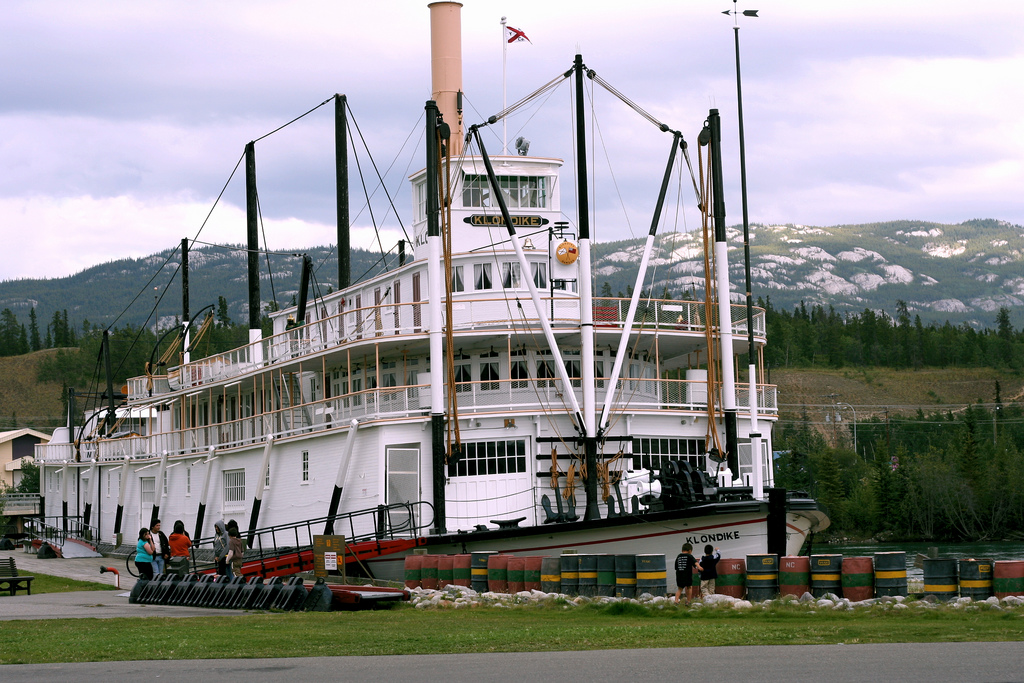
SS Klondike is the name of two sternwheelers, the second now a National Historic Site located in Whitehorse, Yukon. They ran freight between Whitehorse and Dawson City, along the Yukon River, the first from 1929 to 1936 and the second, an almost exact replica of the first, from 1937 to 1950.
Klondike I was built by the British Yukon Navigation Company (a subsidiary of the White Pass and Yukon Route railway company) in 1929 and had the distinction of having 50% more capacity than a regular sternwheeler, while still having the shallow draft and meeting the size requirements in order to travel down the Yukon River. Klondike I had a cargo capacity of 270 metric tonnes without having to push a barge.
In June 1936, Klondike I ran aground north of The Thirty Mile section of the Yukon River (at 61°40′17″N 134°52′22″W / 61.67139°N 134.87278°W). The company salvaged the ship's boiler, engines, and many fittings to build Klondike II the following year. The remains of the hull of the Klondike I can still be seen at low water by canoeists on the Yukon River.
Klondike II carried freight until the early 1950s. Due to the construction of a highway connecting Dawson City and Whitehorse, many Yukon River sternwheelers were decommissioned. In an attempt to save Klondike II, she was converted into a cruise ship by White Pass and Yukon Route.[1] The Duke of Edinburgh (consort of Elizabeth II, Queen of Canada) was invited to tour the ship in 1954, being taken on a short trip down the Yukon River and back to Whitehorse during his day-long visit to the city.[1] The venture shut down in 1955 due to lack of interest and Klondike II was left on the ways in the Whitehorse shipyards.
The ship was donated to Parks Canada and was gradually restored until 1966, when city authorities agreed to move the ship to its present location, at that time part of a squatters' area. The task required three bulldozers, eight tons of Palmolive soap, a crew of twelve men, and three weeks to complete. Greased log rollers eased the process. On 24 June 1967, the SS Klondike was designated a National Historic Site of Canada,[2] and she is now open during the summer as a tourist attraction.
See also
[edit]References
[edit]- ^ a b McLaughlin, Les, The day the Duke came to town, Yukon Nuggets, retrieved 10 August 2022
- ^ S.S. Klondike National Historic Site of Canada. Canadian Register of Historic Places. Retrieved 6 September 2013.
Sources
[edit]- Green, Dianne (1996). Exploring Old Whitehorse. Whitehorse, Yukon: Northbush Publishing Ltd. ISBN 978-0-921114-01-7.
- Dobrowelsky, Helene; Ingram, Rob (1994). Edge of the River, Heart of the City. Whitehorse, Yukon: Lost Moose Publishing. ISBN 978-0-9694612-2-7.
External links
[edit]
National Historic Sites of Canada by location | |
|---|---|
| Provinces | |
| Territories | |
| Other countries | |


.svg)
| National parks | |
|---|---|
| National historic sites | |
| Territorial parks |
|
| Marine Protected Areas | |
| National Wildlife Areas | |
| Other | |
60°42′48″N 135°02′51″W / 60.71333°N 135.04750°W
.svg) | This Canadian government–related article is a stub. You can help Wikipedia by adding missing information. |
SS Klondike
View on GrokipediaHistory
Klondike I
The SS Klondike I was constructed in Whitehorse, Yukon, by the British Yukon Navigation Company, a subsidiary of the White Pass and Yukon Route, and launched in 1929 as the largest sternwheeler in the company's fleet.[1] Designed by engineer Herbert Wheeler, the vessel represented a significant advancement in riverboat technology, enabling it to carry cargo exceeding 272 tonnes—approximately 50% more than contemporary sternwheelers—while maintaining a shallow draft of about 1 metre for navigating the Yukon River's challenging shallows and rapids.[1][7] Built during the waning years of the Klondike Gold Rush era, when large-scale gold prospecting had declined but mining activities persisted in the Yukon Territory, the Klondike I was primarily intended as an ore hauler and freight carrier to meet ongoing supply demands for remote communities and operations, such as the silver-lead mines in the Mayo District.[1] Its key routes focused on upstream transport of ore from Stewart Landing to Whitehorse for rail connection to Skagway, Alaska, and downstream delivery of general merchandise and supplies from Whitehorse to points along the Yukon River, including challenging sections like the Whitehorse Rapids.[1] Over its seven years of service, the vessel typically operated without towing a barge, relying on its enhanced onboard capacity to efficiently support the territory's economic lifeline amid the shift from gold rush frenzy to sustained resource extraction.[8] The Klondike I's career ended abruptly on June 12, 1936, during its third voyage of the season from Whitehorse toward Dawson City, when it struck a rock wall while rounding a bend between Lake Laberge and Hootalinqua, then drifted about 4.8 kilometres before grounding on a gravel bar.[1][8] Laden with around 227 tonnes of freight and a small number of passengers and livestock, the incident resulted in no human fatalities but the loss of two horses and significant cargo damage; the hull was deemed unsalvageable as a whole, though the company recovered usable parts, including the engine and boiler, for reuse in a successor vessel.[1][8] This grounding highlighted the inherent risks of Yukon River navigation, even for advanced designs like the Klondike I, and marked the end of the original ship's short but impactful role in the region's transport history.[1]Klondike II Service
The SS Klondike II was launched in Whitehorse on May 7, 1937, constructed by the British Yukon Navigation Company using salvaged components from the wrecked Klondike I, including its engines, boilers, and paddlewheel shaft, along with most mechanical systems.[1][9] Designed with similarities to its predecessor for efficient river navigation, it quickly entered service as the flagship of the company's fleet on the Yukon River.[10] Primarily a freight hauler, the vessel transported up to 270 tonnes of cargo, including silver-lead ore from the Mayo District, mining equipment, and essential supplies for remote communities, along the route from Whitehorse to Dawson City and intermediate stops like Stewart Landing.[11][9] It also carried passengers in limited capacity during its early years, supporting the regional economy tied to mining operations. From 1937 through the 1940s and into the early 1950s, Klondike II operated at peak during the short ice-free navigation season of approximately May to September, with a typical crew of 23 members—including officers, engineers, deckhands, and firemen—managing the demanding upriver and downriver voyages along the approximately 460-mile (740 km) route between Whitehorse and Dawson City.[10] However, its role diminished as all-weather roads extended to Mayo in 1950 and to Dawson in 1952, reducing reliance on steamboats for freight and bolstering competition from rail and emerging air services.[10] In 1954, facing declining freight demand, the British Yukon Navigation Company refitted Klondike II as a cruise ship at a cost of $100,000 in collaboration with Canadian Pacific Airlines, adding luxury staterooms for 50 passengers, an upscale lounge, and amenities for excursions featuring gold panning, fishing, and historical tours between Whitehorse and Dawson.[12] This adaptation included a notable short tour down the Yukon River by Prince Philip, Duke of Edinburgh, during his 1954 visit to the Yukon Territory on August 8.[13] Despite operating at capacity in its inaugural season, the passenger venture proved unsustainable due to high operating costs, low overall demand, and intensifying competition from air travel, leading to decommissioning in 1955.[12][10]Design and Specifications
Construction Details
The SS Klondike vessels were constructed by the British Yukon Navigation Company, a subsidiary of the White Pass and Yukon Route, at the shipyards in Whitehorse, Yukon.[14] The first vessel, Klondike I, was launched in 1929 as a wooden-hulled sternwheeler reinforced with steel elements, such as hog chains—steel rods fastened to hull timbers and supported by wooden posts—to provide structural strength against the stresses of river navigation.[9] Measuring 64 meters in length and 12.5 meters in beam, with a molded depth of 1.5 meters, it featured a shallow draft of 0.6 meters when light and 1 meter when loaded, enabling navigation over the Yukon River's sandbars and rapids.[11] This design represented a key innovation in Yukon river transport, with expanded cargo holds allowing Klondike I to carry over 270 tonnes of bulk freight—50 percent more than contemporary sternwheelers—without requiring a towed barge, all while maintaining the shallow draft essential for the region's variable water conditions.[15] Built amid the post-Klondike Gold Rush transition to a sustained mining-based economy, Klondike I was among the last major sternwheelers engineered for efficient ore and supply hauling on the Yukon River.[14] Following the grounding of Klondike I in 1936, the company launched Klondike II in 1937 using many salvaged parts from the original, resulting in a nearly identical vessel with subtle enhancements for improved stability drawn from the prior incident.[14] Retaining the same dimensions, shallow draft, and reinforced wooden construction, Klondike II incorporated the proven larger cargo capacity to support the growing silver-lead ore trade, solidifying its role as the largest sternwheeler on the Canadian stretch of the Yukon River.[11]Technical Features
The SS Klondike was a sternwheeler steamboat featuring a single rear-mounted paddlewheel, which provided superior maneuverability in the shallow, winding rivers of the Yukon compared to propeller-driven vessels.[11] This design allowed for precise control during navigation through rapids and sandbars, essential for operations on the Yukon River. The paddlewheel measured 5.9 meters (19 feet 4 inches) in diameter and 7 meters (23 feet) in length, with 16 buckets to engage the water efficiently.[16] Propulsion was driven by two tandem compound jet-condenser steam engines, each with a high-pressure cylinder of 43 cm (17 inches) diameter and a low-pressure cylinder of 71 cm (28 inches) diameter, connected to a 183 cm (72-inch) stroke crankshaft turning at 16 revolutions per minute.[16] Together, these engines produced a total of 525 brake horsepower (391 kW), powering the stern paddlewheel.[11] Steam was generated by a single locomotive-style fire-tube boiler, manufactured in 1901 by Polson Iron Works in Toronto, with 242 tubes operating at 184 psi (1,269 kPa) and fueled by wood—consuming up to two cords per hour during peak operation.[9] This wood-fired system was standard for Yukon sternwheelers, relying on riverside wood stations for refueling during voyages.[9] Key dimensions included an overall hull length of 64 meters (210 feet), a beam of 12.5 meters (41 feet 9 inches), a molded depth of 1.5 meters (5 feet), and a loaded draft of just 1 meter (3 feet 3 inches), enabling navigation in low-water conditions.[11] The vessel's gross tonnage was 1,226 (or 1,363 long tons), with a registered tonnage of 918 (or 1,021 long tons).[11] Cargo capacity reached 270 tonnes (approximately 300 short tons), primarily for freight such as ore and supplies, while passenger accommodations varied: initially limited, but in later tourist configurations after 1950, it supported up to 32 first-class berths with dining for 30.[11][9]| Specification | Measurement |
|---|---|
| Length (hull) | 64 m (210 ft) |
| Beam | 12.5 m (41 ft 9 in) |
| Loaded Draft | 1 m (3 ft 3 in) |
| Cargo Capacity | 270 tonnes |
| Passenger Berths (later config.) | 32 |
| Gross Tonnage | 1,226 tonnes |