Hubbry Logo
Saber archSaber archMain
Open search
Saber arch
Community hub
Saber arch
logo
8 pages, 0 posts
0 subscribers
Be the first to start a discussion here.
Saber arch
Saber arch
from Wikipedia

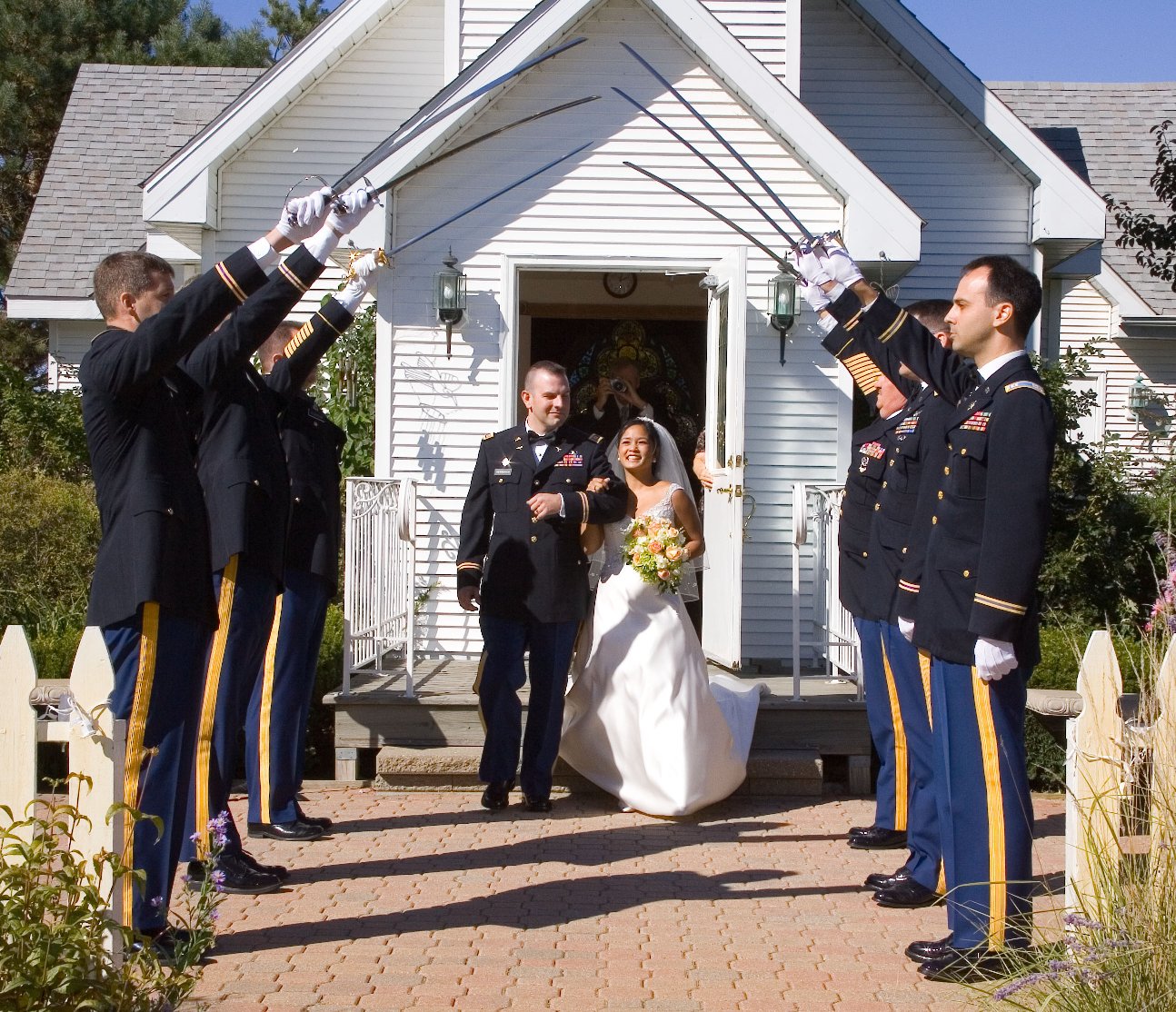
A saber arch at the wedding of a US Army officer and his bride.

A saber arch is a wedding tradition in which sabers or swords are used to salute a newly married couple. The bride and groom pass under an honorary arch of sabers, typically when exiting the building in which the wedding ceremony took place. The tradition is in use worldwide.

Jocular imitations of it also occur, as in using cricket bats or hockey sticks and such in the nuptials of a professional or dedicated amateur athlete.

Sporting equipment such as bicycle wheels or hockey sticks can be also used if a bride or a groom is an athlete

United States, Canada and United Kingdom

[edit]

In the United States, Canada and United Kingdom, the tradition is often performed at the weddings of military or police service members and had its origins in the Royal Navy. The tradition varies slightly among the different branches of the United States Armed Forces and Canadian Armed Forces and is considered a privilege accorded to members of the service. Usually, an honor guard composed of officers or NCOs, often from the same unit as the service member, form the arch with sabers or swords.

The ceremony

[edit]

Officers and enlisted personnel in the bridal party wear formal dress uniforms in accordance with seasonal regulations of the services. A female may wear a traditional bridal gown, or she may be married in uniform. White gloves are required for all saber or sword bearers, who are normally officers or NCOs. Military or police guests usually have the option to attend the wedding in uniform or appropriate civilian attire, but none may carry a saber or sword unless attired in a formal dress uniform.

Immediately after the marriage ceremony is officiated, usually but not always in a building such as a church or chapel, the saber team positions itself in formation just outside the doorway, with typically six or eight saber bearers taking part. The guests of the wedding are afforded the opportunity to assemble outside to view the event before it begins.

On the command, the saber team raises their sabers into a high arch, with tips nearly touching and the blades facing up and away from the bride and groom. As the newly married couple exits the building, the senior usher announces, "Ladies and gentlemen, it is my honor to present to you (American Rank or Canadian Rank) and Mr/s. (insert name)" This is modified when both parties are in the military or the police.

The bride and groom proceed into the arch, and as the couple passes through, the last two saber bearers usually lower the sabers in front of the couple, detaining them momentarily. Before releasing the couple, the saber bearer to the couple's left gives the bride a gentle swat on her backside with his saber, announcing "Welcome to the (insert branch) Ma'am!" If the bride is in the military or police, this step is omitted. In some ceremonies, every pair of saber bearers may lower their sabers, stopping the couple from proceeding each time. One of the pair may say something along the lines of, "Kiss required to pass," and the bearers will not raise their sabers until the bride and groom share a kiss. After the couple leaves the arch, the saber team recovers on command and dissolves formation.

Only the bride and groom pass under the arch. It is also traditional at the wedding reception for the wedding cake to be cut with a saber or sword.

Germany and Austria

[edit]

In Germany and Austria, saber arches are commonly employed by various types of male-only Studentenverbindungen (student fraternities).

At weddings, the current officials – usually a team of three – salute their newlywed member and his bride by a single arch featuring a flag just outside the church. No further protocol is common.

In a similar fashion, the aforementioned officials salute their deceased brothers at funerals. Usually walking directly behind the coffin bearers in the procession, they surround the grave from three sides at the graveyard. The saber arch is then presented from both sides, and the flag is raised above the head of the corpse. As the coffin is lowered into the earth, both the saber arch and the flag follow him, usually resting there while last words are uttered.

Sabers are commonly held by the first and second member in charge, whereas the third highest-ranking member presents the flag, usually displaying the fraternity's characteristic colors or coat of arms. The process is inspired by military traditions, as early Studentenverbindungen consisted mostly of officers or aristocrats. The uniforms worn are usually derived from those employed in the Polish revolution of 1830 and are complete with hat, sash and jacket in the fraternity's colors, white pants, riding boots with spurs and white gloves.

Indonesia

[edit]

In Indonesia, this ceremony is known as "Pedang Pora". This ceremony is done on weddings of a military or police officer as either the groom or the bride.[1] Other uniformed services also have a similar ceremony for an officer's wedding ceremony.

References

[edit]
Revisions and contributorsEdit on WikipediaRead on Wikipedia
from Grokipedia
A saber arch, also known as an arch of swords or sword arch, is a ceremonial tradition in which uniformed service members raise and cross sabers or swords to form an overhead arch, allowing the newly married couple to pass beneath it as a symbolic of honor, loyalty, and protection. This custom, rooted in British practices and particularly associated with , has been adopted across various branches of the U.S. armed forces, including the , , , and Marine Corps, where it serves to welcome the couple into the community. The tradition's origins trace back to historical military customs symbolizing safe passage and communal support, evolving from medieval European knightly traditions where swords were raised to form protective arches for newlyweds. In the British context, it became a standard element of weddings, with rules prohibiting the drawing of swords inside places of worship, leading to its performance outside the church or at receptions. Adopted in the United States as part of formal ceremonies, reflecting the service's emphasis on discipline and unity. The procedure typically involves six to eight saber bearers, who must be commissioned officers in full uniform, forming two and executing precise commands such as "Present, Sabers" and "Arch, Sabers" to create the structure. As the couple walks through, the final two bearers often cross their sabers to halt them momentarily for a kiss, followed in the U.S. by a gentle tap on the bride's backside with a saber flat and a traditional welcome, such as "Welcome to the , Mrs. [Last Name]." Variations exist by branch—for instance, the and prefer swords, while the uses sabers—but the core symbolism remains consistent: a pledge of protection from fellow service members. This ritual is often paired with other military wedding elements, like cutting the cake with an unsheathed saber, underscoring the blend of martial precision and personal milestone.

History and Origins

Medieval and Early Traditions

The saber arch tradition finds its foundational roots in medieval European knightly customs, where swords were employed by the groom's comrades to form a protective passage for the , symbolizing safe passage into married life and a pledge of from fellow warriors. This practice drew from the chivalric , emphasizing the knight's duty to safeguard his and honor bonds of brotherhood. Such rituals underscored the transition from martial alliances to familial ones, with swords representing both defense and communal support during an era when weddings often occurred amid feudal conflicts. However, is often dated more precisely to 19th-century military practices. Early English and European influences on the saber arch emerged prominently from the 16th to 18th centuries, particularly within naval traditions of the , where officers formed an archway of swords—with cutting edges upward in the quinte guard position—for the bride and groom to pass through upon leaving the ceremony. This custom, adapted from polite society's emphasis on honor and protection, symbolized the naval community's guardianship over the couple as they entered married life. Swords, as the gentleman's weapon of the period, were integral to officer uniforms and ceremonial salutes, reflecting the era's military ethos. Historical accounts of weddings in colonial America and Britain during the illustrate informal uses of sword arches predating formalized U.S. protocols, often influenced by British naval and army practices. The transition from battlefield salutes to rituals gained traction during wartime alliances in the , as soldiers adapted sword-drawn honors—originally signals of in —to celebrate unions forged amid ongoing conflicts, thereby reinforcing camaraderie and protection in both and personal spheres.

Development in Modern Military Customs

The saber arch tradition in modern military customs emerged in the late 19th century within U.S. forces, evolving from earlier British naval practices where swords were raised to honor dignitaries and newlyweds. In the United States, this coincided with the formal integration of sabers into drill routines, notably through John J. Pershing's establishment of a drill team known as the Varsity Rifles in 1893 at the of , which was renamed the the following year. By the early 1900s, sabers were added to these teams, facilitating ceremonial salutes. The U.S. Army's initial adoption of the saber dates to , when the government contracted for 2,000 sabers amid preparations for potential conflict, marking the weapon's entry into standard equipment.

Symbolism and Procedure

Symbolic Interpretations

The saber arch embodies core symbols of protection, loyalty, and safe passage for the newlywed couple as they embark on married life, signifying their integration into a supportive that pledges ongoing guardianship. In contexts, this tradition represents a collective vow from peers to safeguard the union, welcoming the couple into the broader "family" of service members. Similarly, the arch underscores by affirming the enduring bonds of honor among participants, ensuring the pair's transition is blessed with communal endorsement. The crossed sabers forming the arch are interpreted as a symbolic gateway or threshold, evoking chivalric ideals of honor and where the blades' intersection marks a protected entry into a new phase of commitment. This draws from longstanding that emphasize knightly virtues of and defense, transforming the arch into a rite of passage that honors the couple's vows under the canopy of shared principles. Across different settings, the saber arch's meaning varies subtly: in professional environments, it conveys a pledge of lifelong support from fellow service members, while in fraternal or student groups such as ROTC programs at universities, it highlights bonds of brotherhood and communal welcome. For instance, at institutions like Dartmouth College, the tradition symbolically inducts the bride into the "army" community, fostering a sense of belonging among cadets. Psychologically, the saber arch reinforces group identity by publicly ritualizing the couple's acceptance, strengthening within the and facilitating a seamless transition from the formal to the celebratory reception. This threshold symbolism aids in marking personal milestones, providing emotional reassurance through collective affirmation.

Standard Ceremony Elements

The saber arch ceremony typically involves 6 to 8 participants, often commissioned officers or designated honor guards in full , who form two parallel lines facing each other outside the ceremony venue, such as on chapel steps or a walkway, to ensure ample for passage. On command, the participants draw their sabers in a continuous motion with the right hand, initially holding them at shoulder level or presented to the with cutting edges up and tips touching, before extending their arms upward and inward to cross the blades overhead, forming a protective arch angled for the couple to pass beneath. White gloves are worn by all bearers to maintain ceremonial precision and hygiene, while sabers remain undecorated to preserve their formal significance; belts and scabbards are also standard, with cases prepositioned nearby for post-ceremony storage. During execution, immediately following the wedding vows and typically outdoors to respect venue restrictions, the newlyweds approach the arch after exiting the ceremony space, walking hand-in-hand under the crossed sabers as a unified salute. The final two bearers at the arch's end lower their sabers to waist level, crossing them to briefly halt the couple and prompt a kiss, after which the blades are raised to allow passage; optionally, the bearer on the bride's side may deliver a light, flat tap to her backside with the non-cutting edge of the saber, accompanied by a welcoming phrase such as "Welcome to the [military branch], Ma'am." Only the bride and groom pass under the arch, with all movements rehearsed in advance for synchronization, and the couple may return a salute to the honor guard upon completion. Safety protocols emphasize prohibiting the drawing or handling of sabers within sacred indoor spaces like sanctuaries, requiring prior approval from or venue coordinators to avoid any risk to attendees or the structure. Bearers must ensure even spacing between lines—typically aligned by height for tips to meet seamlessly—and use controlled, precise motions to prevent accidents, with the informed in advance of any optional tap to maintain comfort. Post-arch, the sabers are lowered on command to the carry position, sheathed with a unified motion, cleaned to prevent , and returned to their cases by a designated lead bearer for secure storage or later use, such as in cake-cutting if permitted. This procedure underscores a symbolic pledge of and protection from the community to the couple.

Regional Variations

United States, Canada, and United Kingdom

In the , the saber arch is a longstanding at weddings involving active-duty or members of the , , , and Marine Corps, symbolizing the military's pledge of loyalty and protection to the couple as they enter married life. The typically occurs immediately after the , with six to eight participants—usually officers or non-commissioned officers in —forming the arch outside the or venue by raising their sabers on the command "Arch Sabers," creating a passageway for the and groom to walk through. White gloves are required for all saber bearers, and weapons must remain sheathed until outside the , per regulations. At the reception, it is optional for the couple to use a saber for the first cake cut, with the groom placing his hand over the 's to guide the blade, further honoring military . Similar protocols apply in the Canadian Armed Forces, where the arch—often using swords in ceremonies and sabers in Army ones—is formed outdoors by uniformed officers following the service, emphasizing shared English-speaking military heritage with minimal variations in command phrasing or glove requirements. In the , the tradition persists in and weddings, with participants drawing swords to form the arch outside the ceremony site, adhering to comparable etiquette on uniform standards and positioning. Participation requires active-duty, reserve, or status for those bearing sabers or swords, limited to commissioned officers, warrant officers, and non-commissioned officers across branches, to maintain ceremonial integrity. Coordination with base chaplains or clergy is essential for approval, particularly if the arch is considered indoors or on property, ensuring compliance with venue policies. In the U.S., a distinctive adaptation allows integration of (JROTC) or (ROTC) members to form the arch at civilian weddings, extending the tradition beyond active installations while upholding protocol. This practice, along with the arch itself, was documented in U.S. guides from the onward, reflecting its roots in formal service customs.

Germany and Austria

In and , the saber arch is predominantly a tradition of male-only Studentenverbindungen, such as and Burschenschaften, which originated in the early amid the customs of the German-speaking world. These fraternities, emphasizing principles of honor, friendship, and patriotism, integrate the saber arch into wedding ceremonies as a symbolic gesture of protection and communal blessing for the couple. A key element of the involves three fraternity officials forming a single saber arch, often with the organization's displayed nearby, positioned outside the church following the service; participants wear traditional attire, including colored caps (Couleur) and sashes that denote their affiliation. This practice draws from the dueling heritage of Mensuren, ritualized sword fights that reinforce fraternal bonds and personal courage within these groups. The arch serves as a non-military , less prevalent in contemporary armed forces weddings but enduring in academic fraternal contexts.

Indonesia

In Indonesia, the saber arch tradition is known as "Pedang Pora," a ceremonial sword salute performed exclusively during the weddings of active officers in the (TNI) or the National Police (Polri). This ritual symbolizes honor, solidarity, and the official welcome of the bride into the military family, marking the officer's transition to married life while upholding the values of and brotherhood among ranks. The ceremony typically involves fellow officers in full dress uniforms forming an arch with drawn swords, through which the newlywed couple passes immediately after exchanging vows, signifying a final salute from the ranks. This procession often occurs at military bases or reception venues following the religious ceremony, emphasizing the hierarchical structure and collective commitment within the uniformed services. In line with Indonesia's predominantly Muslim population, the Pedang Pora integrates seamlessly with Islamic wedding customs, such as the akad nikah, while reinforcing military ethos through precise formations and pledges like the Ikrar Wira Setya, a vow of lifelong duty. Introduced in the post-independence era after the formation of the TNI in , Pedang draws from established global military customs adapted to Indonesian contexts, serving as a that preserves institutional pride and unity. The tradition, reserved for commissioned officers (perwira), underscores the emphasis on rank and valor, with the sword arch representing and in both personal and professional spheres.

Other Global Adaptations

In and , the saber arch tradition aligns closely with British customs, featuring an honorary arch formed by sabers or swords held by uniformed personnel to salute the couple as they exit the ceremony. This practice symbolizes protection and communal support for the couple's union, often adapted in weddings involving active service members or veterans, with ANZAC heritage adding a layer of remembrance in events tied to wartime commemorations. For instance, historical naval weddings during incorporated the arch of swords, breaking from some protocols to emphasize shared bonds. Jocular adaptations of the saber arch appear globally in civilian contexts, substituting ceremonial swords with thematic items to honor the couple's interests, particularly in sports-related nuptials. In the and , bats have been arranged into arches by teammates or enthusiasts during weddings, creating a playful homage to the sport's cultural significance. Similarly, in , hockey sticks form such arches at events celebrating athletic communities, enhancing the festive exit with lighthearted symbolism. Emerging military adaptations in blend the core arch tradition with local contexts. In the Philippine Armed Forces, the arch of swords—formed by at least four pairs of commissioned officers—serves as a during military weddings, representing fidelity, honor, and the collective pledge of protection to the couple's future. This ceremony has extended to symbolic events, such as the 2024 military-style weddings of former rebels in , where the arch underscored reintegration and communal well-wishes. In , the sword arch originated in military ceremonies but has proliferated in civilian weddings since the early 2000s, often using rented props to evoke honor and unity, though it has drawn scrutiny for potentially violating uniform regulations when performed by active personnel off-duty. Beyond military origins, the saber arch has gained traction in non-military weddings for its dramatic visual appeal and symbolic depth, particularly post-2000s amid rising interest in personalized rituals. Couples incorporate prop swords or thematic variants—like Viking-inspired arches or exchanges—for cultural, historical, or fantasy themes, often inspired by officiant guides and media. This extension emphasizes safe passage into without requiring service affiliation, broadening the tradition's global reach in diverse ceremonies.

References

Add your contribution
Related Hubs
User Avatar
No comments yet.