



Community hub
Safety net
View on Wikipedia | This article needs additional citations for verification. (February 2017) |

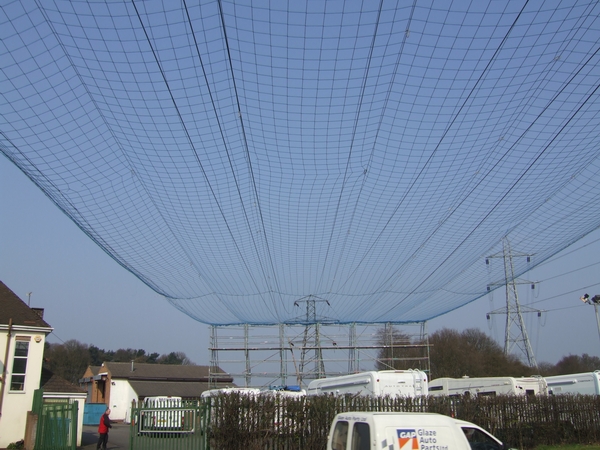
A safety net is a type of net designed to protect people from injury after falling from heights by limiting the distance they fall, and dissipating the impact energy. The term also refers to devices for arresting falling or flying objects for the safety of people beyond or below the net.
Safety nets are used in construction, building maintenance, entertainment, and other industries.
Action of a safety net
[edit]
A safety net gives falling objects much more time to come to rest than hitting the hard ground directly. In physical terms, this means more time for deceleration and kinetic energy transfer, resulting in a softer landing and a much lower risk of damage.
The specific type of net to be used depends upon many factors, such as the falling object's speed and mass. To withstand more force, a greater total width of the net is required. The minimum distance between the spot on the net where the object impacted and the nearest edge of the net is also important and must be maintained above a certain limit. The materials used to make the net, and the tension of the net's ropes, are other important factors. Additionally, the net must be placed at an appropriate height from the hard ground, so that a falling object could not make contact with the ground. The hole size of the net should not be so big that falling objects could pass through its holes.[1]
Construction safety net
[edit]
Construction safety nets are used on high-rise building construction sites to prevent the fall of people or objects from the site. Construction safety nets are the safest and most cost-effective fall prevention system in such an environment. Construction safety nets are typically made from high-density polyethylene (or HDPE) fibers. The construction safety netting system, also known as debris netting, can be installed both horizontally and vertically according to the site requirements. The best practice of construction safety netting is to wrap up the whole construction site from bottom to top, which works as a protection wall to prevent anything from falling without blocking the view of workers on the site. Installation of a safety net at any building site requires professional expertise and technical knowledge.[citation needed]
Other uses of safety nets
[edit]Safety nets can also be used for escape from a building during a disaster (especially fires), action-sports and entertainment, etc.
See also
[edit]- Construction site safety
- Fall arrest harness
- Roof edge protection
- Shock absorber
- Buffer (disambiguation)
- Buffer stop
- Buffer (rail transport)
- Damping ratio
- Damper (disambiguation)
- Damped wave
- Cushioning
- Shock (mechanics)
- Impact (mechanics)
- Jerk (physics)
- Impulse (physics)
- Collision
- Brake
- Terminal velocity
References
[edit]External links
[edit]
- Safety Net Systems // Occupational Safety & Health Administration
- Safety nets: Fall protection for the construction industry / National Safety Council Data Sheet 608, February 2006
- Fall Protection in Construction, OSHA3146 / U.S. Department of Labor Occupational Safety and Health Administration, 1998, page 6 "Fall Protection Systems Criteria and Practices", page 12 "Safety Net Systems"
- Guide to Fall Protection Regulations, Workers Compensation Board, Canada, June 2013, page 11
- A technical guide to the selection and use of fall prevention and arrest equipment / Glasgow Caledonian University for the Health and Safety Executive 2005 - "7.0 FALL ARREST NETTING (SAFETY NETS)" pp 107–138
Safety net
View on GrokipediaOverview and Principles
Definition and Purpose
A safety net is a passive fall arrest system consisting of a large, strong mesh or fabric structure designed to catch falling workers, tools, or materials, thereby limiting the fall distance and dissipating impact energy to minimize the risk of serious injury or death.[1] Unlike preventive measures such as guardrails, safety nets do not stop falls from occurring but arrest them by providing a decelerating surface that absorbs kinetic energy upon contact.[4] In construction and other high-risk industries, these systems are mandated by OSHA standards under 29 CFR 1926.501, requiring fall protection at heights of 6 feet (1.8 m) or more above lower levels, with safety net systems per 29 CFR 1926.502(c) used where other methods are impractical.[5] The primary purpose of safety nets is to safeguard individuals in elevated work environments, such as building sites or bridges, by offering a reliable backup against falls—the leading cause of fatalities in construction, accounting for over 400 deaths annually in the U.S.[6] By distributing the force of a fall across a broad area, nets reduce the likelihood of penetrating strikes or hard impacts with the ground, thereby lowering injury severity and enabling survival in scenarios that would otherwise be lethal.[4] This aligns with broader fall protection strategies that prioritize collective safeguards over individual equipment, promoting safer overall site operations.[2] Safety nets have been employed since the late 19th century as a critical tool for accident prevention, with early patents emerging around 1887 for fire rescue applications that influenced industrial use.[7] Their adoption accelerated in the early 20th century amid rising construction hazards during the Industrial Revolution, evolving from rudimentary canvas designs to standardized systems.[8] A landmark example is the 1930s Golden Gate Bridge project, where an expansive safety net suspended beneath the structure saved the lives of 19 workers who fell, demonstrating the device's potential to dramatically cut fatality rates in high-stakes builds.[9] Key benefits of safety nets include their cost-effectiveness relative to rigid barriers like parapets, as they require minimal ongoing maintenance and can be deployed across irregular site geometries without extensive structural alterations.[10] Additionally, their portability allows for easy relocation and adaptation to dynamic work conditions, making them suitable for temporary setups in construction and maintenance.[11] These attributes contribute to reduced fall-related injuries by providing passive, area-wide protection that complements other controls, with historical implementations like the Golden Gate net underscoring their role in achieving near-zero fatalities from falls during construction phases.[12]Physics of Fall Arrest
When a worker falls from a height, gravitational potential energy is converted into kinetic energy as the body accelerates under gravity. The potential energy at height $ h $ is given by $ E_p = m g h $, where $ m $ is the mass of the falling object, $ g $ is the acceleration due to gravity (approximately 9.81 m/s²), and $ h $ is the fall height; this energy transforms into kinetic energy $ E_k = \frac{1}{2} m v^2 $, with impact velocity $ v = \sqrt{2 g h} $.[13] Safety nets arrest this motion by dissipating the kinetic energy primarily through deformation of the net structure and frictional forces at contact points, preventing direct impact with the ground.[14] The net achieves a controlled deceleration, limiting the forces transmitted to the body to avoid injury. The stopping distance $ d $ required to halt the fall can be calculated using the kinematic equation $ d = \frac{v^2}{2a} $, where $ v $ is the velocity at impact and $ a $ is the average deceleration provided by the net, typically in the range of 5-10 times the acceleration due to gravity (5-10 g) to keep peak forces below human tolerance thresholds of around 10 g for short durations.[13] For example, in a 7 m fall for a 100 kg mass, the impact velocity reaches approximately 11.7 m/s, requiring the net to provide sufficient deceleration over an extended distance to absorb the resulting 7.7 kJ of energy without exceeding safe force limits.[15] Energy absorption in safety nets occurs through a combination of elastic deformation, where the mesh stretches and stores energy temporarily before releasing it, and inelastic deformation, involving permanent distortion and damping that converts energy into heat via friction and material hysteresis. The net's mesh tension and overall deflection play critical roles; nets are engineered to sag or deflect by 1-2 meters upon impact, spreading the deceleration over time and reducing peak forces by a factor related to the square root of the deflection distance.[15] In tested configurations, the net itself absorbs roughly 90% of the total energy (e.g., 7 kJ out of 7.7 kJ in a 7 m drop scenario), with the remainder handled by supporting structures, primarily through high structural damping (up to 34% of critical damping) that accounts for energy loss in knots and fibers.[15] Performance is influenced by several key factors: fall height, which is critical for standard nets up to 10-15 meters where energy scales quadratically with height; angle of impact, as oblique strikes (e.g., angles from 0 to 90 degrees relative to the net plane) can alter load distribution and increase localized stresses; and net tautness, where excessive tension reduces deflection and raises deceleration rates, while insufficient tension may lead to excessive sag and ground contact.[16][14] These elements ensure the net maintains energy absorption capacity while complying with standards like EN 1263-1, which specify minimum performance for dynamic loads.[15]Types and Designs
Horizontal Safety Nets
Horizontal safety nets are installed parallel to the ground and suspended below elevated work areas to provide collective fall protection by catching workers or objects that fall from heights above.[2] These nets are commonly used in construction sites, such as on bridges or rooftops, where they span open areas to intercept falls and absorb impact energy through controlled deflection.[17] Unlike personal fall arrest systems, horizontal nets offer passive protection for multiple individuals without requiring individual harnesses, making them suitable for dynamic work environments.[2] In design, horizontal safety nets feature a mesh structure with a maximum opening of 6 inches by 6 inches (15 cm by 15 cm) to ensure effective capture of falling persons while allowing smaller debris to pass through if needed.[18] They are suspended using perimeter border ropes that encircle the net, providing structural integrity; these ropes must have a minimum breaking strength of 5,000 pounds (22 kN) according to OSHA standards, though some guidelines specify up to 30 kN for enhanced durability.[3][19] Attachment points and connections are spaced no more than 6 inches apart and must match the strength of the net components, with the net extending horizontally outward from the work edge by at least 8 to 13 feet depending on the vertical drop distance to minimize pendulum swing effects.[2] The overall system is positioned as close as practicable to the work surface, not exceeding 30 feet below, to limit fall height and ensure adequate clearance beneath to avoid contact with lower surfaces during deflection.[2] For applications involving falling objects, debris variants incorporate smaller mesh sizes, such as 1 inch or less, often using knitted polyethylene or wire to contain tools and materials without compromising personnel safety. A key feature of horizontal safety nets is their high deflection capacity, designed to stretch and absorb kinetic energy from a fall—up to several feet depending on the span—reducing injury risk by distributing forces across the net's structure.[19] This energy absorption is critical, with nets required to withstand a minimum impact of 17,500 foot-pounds without failure, as per performance standards.[18] Border ropes enhance this by maintaining the net's shape under load, while the mesh configuration balances catchability and ventilation to prevent debris buildup.[20] Horizontal safety nets provide advantages such as multi-level protection across large areas, enabling safe work on scaffolding or open structures without obstructing operations, and serving as a cost-effective collective safeguard for teams.[2] However, they have limitations, including reduced suitability for scenarios with vertical drops near edges due to potential swing-back or pendulum risks, where a falling worker could arc into hazards if the net's horizontal extension is insufficient.[2] Additionally, they require unobstructed space below for deflection and may not be feasible in confined areas where drop testing is impractical.[2] Testing protocols for horizontal safety nets emphasize drop tests to verify performance, typically involving a 400-pound (182 kg) sandbag, 28 to 32 inches in diameter, dropped from the highest walking-working surface or at least 42 inches above the net.[2] These tests, required after installation, relocation, or major repairs and every six months thereafter, simulate fall energy absorption and ensure the net stops the load without penetration, excessive deflection leading to ground contact, or structural failure.[2] If on-site testing is unreasonable, manufacturer certification based on prototype tests—such as a 350-pound load from 50 feet per ANSI A10.11—must be provided, with records maintained on site.[20] Weekly inspections for damage, wear, or accumulated debris are also mandated to maintain integrity.[2]Vertical Safety Nets
Vertical safety nets are upright installations designed to catch individuals or objects falling sideways from edges, such as building perimeters or scaffolding, providing passive fall arrest by absorbing impact energy. These nets are particularly suited for scenarios where workers operate near unprotected vertical drops, including multi-story construction sites and elevated platforms. In the United States, OSHA regulations primarily address horizontal safety nets under 29 CFR 1926.502, while vertical nets are commonly used internationally under standards like EN 1263-1 and may serve as supplemental edge protection. Unlike horizontal nets that span overhead areas, vertical nets focus on lateral containment to prevent falls to lower levels.[21][3] In design, vertical safety nets are suspended from overhead anchors, such as structural beams or scaffolding frames, extending downward to the ground or intermediate supports to form a continuous barrier. This configuration ensures full coverage along exposed edges, with typical heights ranging from 5 to 20 meters to match common scaffolding elevations in urban construction projects. Mesh sizes generally fall between 5 and 10 cm (50 and 100 mm), allowing passage of air and light while retaining smaller falling objects like tools; European standard EN 1263-1 specifies a maximum of 100 mm to maintain effectiveness.[21][22][23] Key features enhance durability and adaptability, including reinforced edges bordered by steel cables or high-strength ropes to distribute loads evenly during impacts. Many systems employ modular panels that connect via clips or ties, facilitating quick assembly and disassembly on dynamic sites. Specialized variants, such as catch nets used by stunt performers in entertainment, incorporate higher tensile strengths— with border ropes rated at a minimum breaking strength of 30 kN to handle dynamic loads from acrobatic falls.[24][25][26] Vertical safety nets offer advantages in scaffolding perimeters, where they provide comprehensive edge protection without obstructing workflow, enabling safer access for tasks like formwork or cladding installation. However, they require adequate clearance—typically at least 3 meters behind the net— to allow deflection and energy absorption, preventing rebound injuries or net failure.[27][28] Performance evaluations under EN 1263 standards demonstrate high reliability, with tests simulating edge falls showing effective capture and impact reduction; safety nets have been shown to reduce fall-related incidents in construction settings.[28]Materials and Construction
Common Materials
Safety nets are primarily constructed from synthetic polymers and, in heavy-duty applications, metallic wires, selected for their ability to absorb impact energy through deformation while maintaining structural integrity. Polypropylene is a lightweight, UV-resistant material commonly used for temporary construction nets due to its cost-effectiveness and resistance to environmental degradation.[29][30] Nylon offers higher tensile strength and elasticity, making it suitable for personnel safety nets where greater energy absorption is required, though it absorbs water and may degrade in prolonged wet conditions.[31][32] Polyethylene provides chemical resistance, ideal for industrial settings exposed to corrosive substances, while steel wire variants deliver exceptional durability for permanent or high-load installations.[33][34][35] Key properties of these materials include tensile strength, typically ranging from 500 to 2000 N per mesh for synthetic nets, enabling them to withstand fall impacts without tearing.[36][37] Elongation at break varies from 20% to 50% for nylon and polypropylene, allowing controlled stretching to dissipate kinetic energy from falls, as referenced in the physics of fall arrest.[38] Weight per square meter generally falls between 0.1 and 0.5 kg/m² for lightweight synthetics, balancing portability with robustness.[39][40] Material selection depends on environmental resistance, such as polypropylene's low UV degradation rate, retaining approximately 90% of tensile strength after two years of exposure.[41] Cost considerations favor polypropylene at $1–2 per m² over nylon at $3–5 per m², influencing choices for budget-constrained temporary applications.[42][43] Sustainability factors include the recyclability of polypropylene and polyethylene, which can be processed into new nets, reducing waste in line with circular economy practices.[44][45] Historically, safety nets evolved from natural fibers like hemp, used in the 1800s for their tensile properties in early maritime and circus applications, to synthetic materials post-1950s, driven by advancements in polymer chemistry that improved durability and weather resistance.[46][47]Manufacturing and Installation
Safety nets are produced through a multi-step process starting with the extrusion of raw polymer fibers, such as high-density polyethylene (HDPE), into monofilaments or multifilament yarns, which are then twisted into ropes suitable for mesh formation. The core mesh is created either by knotting, where individual ropes are interlaced and tied at intersections to form square or diamond patterns, or by weaving on specialized machines for knotless designs that interlock fibers without knots for smoother energy absorption. These methods ensure the mesh size typically ranges from 60 mm to 100 mm, as required for fall arrest applications.[48][49] Once the mesh is formed, edges are heat-set or heat-sealed using steam and controlled tension to stabilize the structure, prevent unraveling, and enhance durability against environmental factors. Border ropes, often 12 mm in diameter with a minimum breaking strength of 30 kN, are then threaded continuously through the perimeter meshes and secured with splices, thimbles, or eyelets to provide attachment points for installation. This bordering reinforces the net's edges, distributing loads evenly during use.[50][51] Quality control is integral to manufacturing, involving visual inspections for defects and performance testing per standards like EN 1263-1. Each batch includes test meshes subjected to drop tests with 100 kg sandbags from heights up to 4.5 m to verify energy absorption—minimum 2.3 kJ for Class A nets and 4.4 kJ for Class B—along with tensile tests confirming a minimum breaking strength of 30 kN for border ropes. Certified nets receive labels detailing the manufacturer, production date, class, mesh size, and serial number for traceability.[49][52][53] Installation begins with site assessment to identify load-bearing anchors, such as beams or columns, capable of supporting at least 6 kN per attachment point at a 45-degree angle. The net's border ropes are secured to these anchors using galvanized shackles, clamps, or snap hooks rated for the required load, with suspension points spaced no more than 2.5 m apart to maintain structural integrity. For irregular shapes, custom framing or additional support ropes are incorporated to conform the net to the site's geometry without compromising coverage.[54][26] Proper tensioning follows attachment, where the net is hoisted using winches or pulleys and adjusted to achieve 5-10% elongation, allowing controlled sag (typically 3-5% of the span) for optimal deflection while preventing excessive looseness that could reduce effectiveness. In multi-panel configurations, adjacent nets overlap by a minimum of 2 m along edges, secured with coupling ropes of at least 7.5 kN breaking strength to eliminate gaps larger than 100 mm and ensure seamless protection. The process for a standard 100 m² net generally requires 4-8 hours, depending on site access and complexity.[55][26][56] Common installation errors include over-tensioning, which limits the net's ability to absorb impact by reducing deflection distance, and inadequate anchoring, such as using insufficiently rated hardware or poorly spaced points, potentially leading to net detachment or failure under load. These issues underscore the need for trained personnel and adherence to manufacturer guidelines during setup.[55][26]Applications and Uses
Construction and Scaffolding
Safety nets are integral to construction site safety, providing passive fall protection for workers on scaffolds and buildings typically exceeding two stories (approximately 20-30 feet), where they act as a barrier to arrest falls from unprotected edges and open sides. These systems are particularly vital for perimeter protection around elevated work areas, ensuring that if a worker slips or loses balance, the net absorbs the impact and limits injury. In demolition operations, safety nets serve as debris containment measures, capturing falling materials such as tools, bricks, or structural fragments to safeguard personnel on lower levels and the public below. Furthermore, they can be combined with guardrails in hybrid configurations, where guardrails prevent falls while nets provide a secondary arrest layer, optimizing protection without impeding workflow. Horizontal safety net designs are commonly employed in these settings to span broad areas beneath active work zones. Regulatory frameworks enforce the deployment of safety nets to mitigate fall risks in construction. In the United States, the Occupational Safety and Health Administration (OSHA) standard 29 CFR 1926.502 requires fall protection, including safety nets, for employees working 6 feet (1.8 meters) or more above lower levels; nets must be installed as close as practicable under the walking/working surface, but never more than 30 feet (9.1 meters) below, with mesh openings not exceeding 36 square inches and border ropes rated to at least 5,000 pounds breaking strength. In the European Union, Directive 2001/45/EC on work equipment for temporary work at height prioritizes collective protective measures like safety nets to prevent falls where risks exist, generally above 2 meters; compliance is guided by EN 1263 standards, which specify net performance for fall heights up to 6 meters, including requirements for energy absorption and secure attachment points spaced no more than 2.5 meters apart. Historical and contemporary case studies underscore the effectiveness of safety nets in reducing construction fall incidents. During the 1930s construction of the Golden Gate Bridge, innovative use of safety nets beneath the work platform saved the lives of 19 workers who fell—earning them the nickname "Halfway-to-Hell Club"—in a project that otherwise saw only 11 total fatalities from falls out of thousands of workers, highlighting nets' role in dramatically lowering mortality rates compared to unprotected high-elevation work. In New York City, the 1980 Local Law 10 mandated facade inspections and protective measures, including nets, for buildings over six stories, contributing to fewer debris-related injuries to pedestrians and workers; data from the Department of Buildings showed a decline in such incidents at scaffolded sites through the 1990s.[57] Cost-benefit evaluations further support their adoption, with installation costs ranging from $1 to $5 per square meter for durable knotted nylon or polyethylene nets, far outweighing litigation and compensation expenses from fall accidents, which average $2.5 million per fatality according to National Safety Council estimates including medical, legal, and productivity losses. Key challenges in deploying safety nets on construction sites include addressing wind loading in high-rise environments, where gusts exceeding 50 mph can cause net deformation or failure unless reinforced with additional tie-backs and wind-permeable mesh designs compliant with ASCE 7 load standards. Temporary installations, common for phased building projects, demand frequent inspections and adjustments to accommodate evolving site layouts, unlike permanent setups that allow for more robust, fixed anchoring but are less flexible for dynamic construction needs.Entertainment and Acrobatics
Safety nets play a crucial role in entertainment and acrobatics, providing essential protection for performers engaging in high-risk aerial maneuvers in circuses, theaters, and sports venues. These nets are strategically positioned beneath apparatus to arrest falls, allowing artists to execute daring feats with reduced risk of severe injury. In circus performances, nets are commonly installed under trapeze rigs and high-wire acts to catch falling acrobats, enabling safer practice and live shows.[58] Similarly, in film production, safety nets are deployed for stunt falls, cushioning performers during controlled descents from heights to minimize impact forces.[59] In acrobatic gymnastics training, nets serve as protective platforms, allowing athletes to rehearse complex routines like flips and dismounts while containing falls within a secure area.[60][61] Design adaptations for entertainment nets emphasize performance safety and functionality, differing from industrial variants by incorporating greater elasticity to facilitate controlled bounces rather than abrupt stops. These nets often feature materials that allow significant stretching—up to several times their original length—absorbing kinetic energy over an extended distance to reduce deceleration forces on impact.[62] For instance, in Cirque du Soleil's production Kurios – Cabinet des Curiosités, a 30-foot by 40-foot steel-framed net is engineered to propel performers up to 50 feet high, leveraging its spring-like properties for dynamic aerial sequences while ensuring safe landings.[63] Some designs include padded undersurfaces or integrated foam layers beneath the netting to further mitigate injury risk during rebounds. Vertical configurations, similar to those used in construction, may be adapted for theater stages to prevent falls into orchestra pits.[64] The 1944 Hartford Circus Fire underscored critical limitations of early safety measures, including nets, in preventing mass casualties during non-fall emergencies like rapid fire spread in tents. The disaster, which killed at least 167 people and injured over 700 during a Ringling Bros. and Barnum & Bailey performance, highlighted how nets alone could not address fire hazards, such as flammable tent materials and inadequate exits, prompting stricter regulations for circus safety equipment and protocols.[65] In modern contexts, the integration of safety nets has contributed to markedly lower fatality rates in acrobatic performances; for example, a study of circus operations estimated artist mortality at 37.5 per 100,000 full-time equivalents over a decade, with most incidents involving non-fatal injuries rather than deaths, reflecting improved net usage and overall risk management since enhanced standards were adopted.[66] Training protocols for performers emphasize familiarization with net dynamics to ensure effective use during falls. Acrobats practice controlled drops to understand the net's bounce, which can propel the body upward if not managed properly, requiring techniques like tucking or rolling to dissipate energy safely.[58] This skill-building occurs in supervised sessions, where spotters guide initial interactions to build confidence and prevent disorientation from the rebound effect. Setup for arena-scale nets typically requires 1-2 hours for a team of riggers to tension and secure the structure, ensuring even distribution and stability before rehearsals or shows begin.[67]Industrial and Maritime Settings
In industrial environments, safety nets are deployed to mitigate hazards associated with cargo handling in warehouses, where they prevent falling objects from causing injuries or damage to inventory and pedestrian pathways below. These nets are typically installed along elevated storage racks and conveyor systems to catch dislodged items, enhancing worker safety in high-volume operations.[68] For protection around machinery pits, netting serves as a barrier to stop personnel or tools from falling into open service areas, often used as an initial safeguard alongside covers or guardrails in manufacturing facilities.[69] In maritime settings, safety nets are essential for preventing overboard falls, particularly along decks and railings of vessels, where they catch crew members or objects during rough seas or routine operations. Railing nets on ships and yachts secure passengers and equipment from accidental slips, reducing the risk of man-overboard incidents. According to IMO guidelines in MSC.1/Circ.1331, a safety net must be installed along accommodation ladders and gangways on vessels where there is a potential for persons to fall, applicable to ships including those over 500 gross tons to ensure compliance with SOLAS requirements for embarkation safety. For cargo securing during storms, nets complement lashing systems by containing shifting loads on open decks, as outlined in the IMO Code of Safe Practice for Cargo Stowage and Securing (CSS Code), which emphasizes preventing cargo from becoming hazards to personnel.[70][71] Unique adaptations for these environments include corrosion-resistant materials, such as UV-stabilized polymers, for saltwater exposure on ships and offshore platforms, ensuring longevity in harsh marine conditions. Flame-retardant coatings are applied to nets used on oil rigs to mitigate fire risks from nearby hydrocarbons, meeting standards like NFPA 701 for offshore operations. The ILO Code of Practice on Safety and Health in Shipbuilding and Ship Repair recommends safety nets as part of fall prevention measures, contributing to overall reductions in occupational accidents through integrated hazard controls, though specific incident data varies by implementation.[72][73] Safety nets in industrial and maritime contexts integrate with personal fall arrest systems, such as harnesses and lanyards, to provide layered protection; for instance, nets act as a secondary barrier beneath elevated work areas, allowing workers to use personal equipment while relying on the net for backup in case of failure. These systems are scalable for large areas, such as shipyards covering up to 1000 m², where modular netting panels can be customized and anchored to enclose vast dry docks or assembly zones without compromising structural integrity.[74]Architectural and Public Space Applications
In addition to industrial and construction uses, safety nets are employed in public and architectural settings where aesthetic considerations are paramount, such as monuments, public buildings, atriums, balconies, galleries, lookouts, stadiums, and helipads. These applications prioritize passive fall protection with minimal visual obstruction to preserve views, natural light, and architectural integrity. A prominent solution in these contexts is stainless steel wire rope mesh, often branded as Webnet (developed by Jakob Rope Systems). This system consists of woven or ferrule-connected high-tensile stainless steel cables (typically AISI 316 for corrosion resistance) forming a flexible diamond-pattern mesh. Key features include:- High translucency and minimal visual impact: Especially in sleeveless variants, the mesh appears almost invisible, allowing unobstructed views and light transmission while blending into the environment. It can be colored (e.g., RAL) for further discretion.
- Durability and low maintenance: Corrosion-resistant, UV-stable, and robust, with lifespans exceeding 50 years and virtually no maintenance required.
- Safety and engineering: Provides effective vertical or horizontal fall protection, can be non-climbable with appropriate mesh size (e.g., 40mm) and tensioning. Certified by bodies like the German Institute for Building Technology (DIBt) for fall-stop applications.
- Adaptability: Conforms to irregular geometries and supports large spans (up to 6m width, 8m height without extra ropes).