Hubbry Logo
SalarymanSalarymanMain
Open search
Salaryman
Community hub
Salaryman
logo
8 pages, 0 posts
0 subscribers
Be the first to start a discussion here.
Salaryman
Salaryman
from Wikipedia
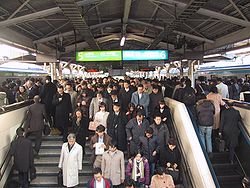
Salarymen take their train daily to work in the Tokyo metropolitan area (Tokyo Station, 2005)

The term salaryman (サラリーマン, sararīman) is a Japanese word for salaried workers. In Japanese popular culture, it is portrayed as a white-collar worker who shows unwavering loyalty and commitment to his employer, prioritizing work over anything else, including family. "Salarymen" are expected to work long hours, whether overtime is paid or not. They socialize with colleagues and bosses, including singing karaoke, drinking, and visiting hostess bars.[1]

"Salarymen" typically enter a company after graduating from college and stay with that corporation for the duration of their career. In conservative Japanese culture, becoming a salaryman is a typical career choice for young men and women, as parents map out their child's education path in order to make sure they can attend a prestigious university which in turn will lead to recruitment by a major company.[2] Those who do not take this career path are regarded as living with a stigma and less prestige. On the other hand, the word salaryman is sometimes used with derogatory connotation for his total dependence on his employer and lack of individuality. Other popular concepts surrounding salarymen include karōshi, or death from overwork.

History

[edit]

The word sararīman is often described as a wasei-eigo, a Japanese formation from English loanwords, but it appears instead to be a straight borrowing from the English phrase "salaried man", which predates the Japanese term by nearly a century. The Japanese term saw widespread use by 1930, even before government expansion and militarization drove the growth of white-collar employment.[3] The term does not include all workers who receive a set salary, but only "white-collar workers in the large bureaucracy of a business firm or government office." The term includes those who work for government (e.g., bureaucrats) and major companies (e.g., those listed in Nikkei 225). Workers in the mizu shōbai (nightlife) and entertainment industries (including actors, singers, musicians, artists) are not included even though their income may be salary based. Similarly, doctors, lawyers, politicians, freelancers and corporate executives (the C-suite, board of directors) are also excluded. Engineers and accountants who have their own firm/practice are not included as well.[3]

Description

[edit]

A typical description of the salaryman is a male white-collar employee who typically earns his salary "based on individual abilities rather than on seniority."[4] Companies typically hire the salarymen straight out of high school, and they are expected to stay with the company until retirement, around the ages of 55 or 60. As a reward for their loyalty, companies rarely fire the salarymen (see below for the Madogiwa Zoku or “the window tribe”) except in special "dire" circumstances.[5]

Once a salaryman reaches age 30, they are typically promoted to their first supervisor role (Kacho), overseeing new hires who are younger than them. Traditional Japanese companies do not allow employees to supervise people who are older than themselves due to "respect". At age 40 they would become a department head (Bacho), and between 40 and 50 they would be promoted to senior management (although these posts are still considered middle management, below the top executives/directors). They retire between the ages of 55 and 65.[6]

Underperforming employees in the over 40 age bracket are sidelined with some of their responsibilities taken away, although they do not formally receive a pay cut nor a demotion (Madogiwa Zoku or “the window tribe”). Haruo Shimada, a professor at Keio University, states that "It's important to treat madogiwa-zoku well, because many young people think about their future in terms of the way these older people are treated", in line with business orientation where employees are expected to show loyalty to their companies and be shown loyalty in return. In other words, no-longer-productive employees were kept around to raise the morale of productive employees, since the young and productive would be able to look forward to the day in which they, too, could sit by the window and collect a salary for doing nothing.[7][8]

Salarymen are known for working long hours, sometimes over eighty hours per week. Often, because of his busy work schedule, the salaryman does not have time to raise a family and his work becomes a lifelong commitment. There is also a belief that the "amount of time spent at the workplace correlates to the perceived efficiency of the employee." As a result of this intense work-driven lifestyle, salarymen may be more likely to suffer from mental or physical health problems, including heart failure, or to commit suicide.[9]

A salaryman's typical outfit consists of a dark suit, a white shirt, and a simple tie in neutral colors like navy, black, or gray. Dressing in such a manner is not only part of professionalism, but also following the cultural emphasis on group harmony where dress uniformity shows everyone belongs to a team, as opposed to standing out which is often seen as potentially disruptive to this harmony. Companies often have specific dress codes, and employees follow these guidelines as part of their role. While companies often take part in the Cool Biz initiative which encourages workers to wear lighter clothing (short-sleeved shirts instead of long ones) during the hot months to reduce air conditioning use, Japanese salarymen still retain a clean and professional look, in contrast to Western business casual which permits khakis or jeans with polo shirts.[10]

In Japan, hotel chains created business hotels to cater to salarymen for work-related travel. Similar to economy and limited service hotels in North America, Japanese business hotels provide small but efficient rooms at a reasonable price, without all the frills and facilities of luxury/international class hotels. Business hotels typically do not have banquet halls, conference rooms, swimming pool nor exercise room, although they may have an onsite restaurant offering breakfast and late-night ramen, while some establishments come with an onsen.[11]

Social image

[edit]
Hitokara at Karaoke-Box
Mahjong tiles

The prevalence of salarymen in Japanese society has given birth to many depictions by both the Japanese and American media. Some films in Japan about salarymen include Mr. Salaryman, Japanese Salaryman NEO (based on the TV series), and a drama series entitled History of a Salaryman. There is a certain expectation among the middle and upper classes for Japanese people to become salarymen. For many young Japanese men and women, accepting anything less than becoming a salaryman and conforming to its ideal is considered a failure, not only of themselves, but also of their parents.[12]

The life of a salaryman revolves around work. The activities that they do outside of their working hours typically involve their coworkers, which lessens the distance between them and work. Due to this expectation, there have been a variety of derogatory names given to salarymen: 社畜 (shachiku, literally "corporate livestock" in reference to wage slavery), 会社の犬 (kaisha no inu or "company's dog"), and 企業戦士 (kigyou senshi or "corporate soldier"), to ridicule salarymen.

Entertainment

[edit]

Changing social circumstances have greatly diversified the life of the salaryman outside of work. Though the importance of social drinking has not declined, its image has changed over time from mass partying during the economic bubble to conservative consumption at home after the collapse of the economy during the 1990s. Mahjong was an immensely popular game among the 1960s generation of salarymen, who brought the game into company circles directly from high school and college groups. The 1970s generation saw a gradual decrease in the number of avid mahjong players, and by the 1980s, it became common not to show any interest at it at all.

Golf became widely popular during the economic bubble, when golf club passes became useful tools for currying favor with corporate executives. Many mid-level salarymen were pressured into taking up golf to participate in golfing events with their superiors. The collapse of the economic bubble led to the closing of many golf courses, and playing golf with executives has become increasingly rare. However, some current salarymen may have golfing experience from their student days, and golf is still acknowledged as an expensive hobby for salarymen.[13]

Karōshi

[edit]
A salaryman asleep on the Tokyo subway.

Extreme pressure on salarymen can lead to death by overwork, or karōshi.[14][15] Salarymen feel intense pressure to fulfill their duty to support their family because of the gendered expectations placed on men. According to a Washington Post article, the Japanese government struggled for years to pass a law limiting to the number of hours one can work, and the issue has been prevalent since the 1970s.[citation needed] In 2014, after 30 years of activism, Japan's parliament (the Japanese Diet) passed a law "promoting countermeasures against karōshi."[15]

However, many Japanese still criticize the government and believe there should be some form of punishment for companies that violate work hour laws. Approximately 2,000 annual applications are filed by the families of salarymen that die of karōshi.[when?] However, the death toll may be much higher, and "as many as 8,000 of the 30,000 annual suicides each year are thought to be work-related," with "as many as 10,000 non-suicide karōshi deaths per year."[14]

Karōshi, literally "overwork death," was first diagnosed as a "circulatory disease brought on by stress" in the late 1970s after the 1973 oil crisis, which took a toll on the post-war reconstruction of Japanese industry.[15] Since then, the number of deaths from overwork has increased, especially at larger and more prestigious companies. In 2002, Kenichi Uchino, a 30-year-old quality-control manager at Toyota, collapsed and died after working over 80 hours unpaid overtime for six months.[16] After this incident, Toyota announced that it would begin monitoring their workers' health and would pay for all of their overtime hours.[15]

See also

[edit]

References

[edit]
[edit]
Revisions and contributorsEdit on WikipediaRead on Wikipedia
from Grokipedia
A (sararīman) denotes a male white-collar employee in Japanese corporations, embodying corporate through lifetime , hierarchical conformity, and prolonged work hours that often extend into unpaid . This archetype originated in the early amid Japan's modernization but became emblematic during the post-World War II economic boom, where salarymen fueled rapid industrialization and sustained GDP expansion via dedicated labor in conglomerates like groups. Central to the salaryman ethos is the expectation of for company success, manifesting in rituals like after-hours socializing (nomikai) and commuting in uniform dark suits, which reinforced social cohesion but also entrenched gender roles with women often relegated to supportive "" positions. Defining controversies include , or death from overwork—first documented in 1969 and involving cardiovascular failure or from chronic exhaustion—with Japanese government data recognizing 883 work-related disorders in 2024 alone, alongside surveys indicating one in ten workers exceeding 80 hours monthly. Economic since the 1990s bubble burst has eroded the model, prompting younger cohorts to reject lifetime drudgery for flexible careers, signaling a shift from salaryman-centric toward individualized pursuits amid demographic pressures like aging populations.

Definition and Core Elements

Etymology and Terminology

The Japanese term sararīman (サラリーマン), a katakana transcription of the English compound " man," originated as a in the early twentieth century to refer to salaried s in Japan's burgeoning corporate sector. Unlike Western equivalents such as "," which lack the same cultural connotation of corporate and uniformity, sararīman specifically evokes the of a male employee in a hierarchical firm, often clad in a dark and tie. This terminology distinguishes sararīman from the parallel term for female office workers, ōeru (OL, short for "office lady"), which denotes women in primarily clerical or supportive roles such as secretarial duties or tea service, reflecting gendered divisions in Japanese workplaces. While sararīman traditionally emphasized male salary earners, its usage has broadened over decades to encompass a wider array of salaried professionals, yet it retains strong associations with employees of Japan's interlinked large corporations, or keiretsu, where lifetime employment norms historically prevailed. This evolution underscores the term's embeddedness in Japan's industrial structure, differentiating it from more generic Western descriptors of office-based labor.

Defining Characteristics

The salaryman embodies key elements of Japanese corporate culture, including nenkō joretsu, a promotion system based on seniority and length of service rather than merit alone, which structures career advancement around age and tenure. This system fosters long-term commitment within firms. Complementing it is the principle of wa, or group harmony, which emphasizes consensus-building and avoidance of direct confrontation to maintain collective cohesion in processes. Deference to superiors underpins hierarchical interactions, with juniors expected to show respect and follow directives without overt challenge. Visually, salarymen are identifiable by their standardized attire of dark suits, white shirts, and ties, reflecting uniformity and in urban settings. Daily routines involve commuting on overcrowded public trains, often enduring long travel times from suburban residences to central business districts. Professional identity centers on affiliation with the employer, where individuals are primarily known by their company rather than specific job functions or personal achievements. Empirically, salarymen—predominantly white-collar employees—have represented a notable segment of the labor force, with workers in large corporations employing over 500 people never exceeding 30% of the total Japanese workforce, concentrated in these firms' stable environments. This prevalence underscores the archetype's role in corporate , tied to observable patterns of devotion and structured .

Historical Evolution

Pre-War Foundations

The of marked the onset of Japan's rapid industrialization and modernization, during which the imperial government centralized authority and adopted Western-style bureaucratic structures to bolster national strength against foreign pressures. This shift abolished feudal domains and established a merit-based system, drawing on Prussian models, which created salaried positions for educated administrators primarily recruited from former and gentry classes. These proto-salarymen, often clad in Western suits to symbolize progress, embodied diligence and loyalty to the state, as government roles offered stable incomes and social prestige amid the transition from agrarian hierarchies. Parallel to state bureaucracy, the rise of conglomerates—such as and , founded by merchant families with ties—introduced salaried managerial classes in private enterprise. By the , these firms expanded into heavy industries like shipping and textiles, employing white-collar workers who prioritized firm loyalty over traditional guild or familial ties, fostering early corporate cultures of long hours and hierarchical obedience. Confucian principles, imported via and adapted in Tokugawa-era , underpinned this ethic, emphasizing transposed to employer devotion and rigorous self-discipline as virtues essential for societal harmony and state power. In the (1912–1926), urbanization accelerated with industrial growth spurred by exports, swelling city populations and the salaried in sectors like banking and manufacturing. Tokyo's population surged from 2 million in 1910 to over 3 million by 1920, drawing rural migrants into office roles that emphasized collective effort over individual autonomy. Loyalty shifted further toward firms, as lifetime employment norms emerged in zaibatsu affiliates, reinforced by state-promoted militaristic ideals of endurance and hierarchy that echoed Confucian diligence while adapting to capitalist demands. This period solidified proto-salaryman identity, blending obedience to authority with economic utility, though labor unrest hinted at underlying tensions in the system.

Post-War Rise and Economic Miracle

Following Japan's defeat in , the salaryman archetype emerged as a cornerstone of the nation's economic resurgence, embodying disciplined, loyal white-collar workers within large corporations who prioritized collective enterprise goals over individual mobility. The period from 1955 to 1973, often termed the "income-doubling" era after Hayato Ikeda's 1960 plan to double national income within a decade, saw average annual real GDP growth of approximately 10%, fueled by in sectors like , automobiles, and . This plan coordinated fiscal, monetary, and industrial policies to achieve sustained high growth, with salarymen's adherence to lifetime employment () providing firms with a predictable, skilled labor pool essential for rapid productivity gains through and technological adaptation. Shūshin koyō, under which salarymen typically joined firms post-university and remained until retirement age, minimized labor turnover and enabled companies to recoup investments in employee-specific skills, a causal factor in Japan's ability to scale efficiency and compete globally. This system contrasted with higher-mobility Western models, fostering internal labor markets that supported continuous improvement () and just-in-time production precursors, directly contributing to the export boom that quadrupled GDP from to 1973. Empirical indicators of this stability included unemployment rates averaging around 1% from 1960 to 1975, reflecting voluntary worker commitment rather than structural rigidities. Complementing individual loyalty, the ringi process—wherein proposals circulated bottom-up for multilayer approval—ensured salarymen across hierarchies aligned on strategic initiatives, reducing implementation resistance and accelerating firm-level adaptations to market demands. Government orchestration via the Ministry of and Industry (MITI) directed resources toward high-growth industries, while inter-firm networks stabilized supply chains and financing, allowing salaryman-driven enterprises to maintain low-cost, high-volume output with minimal disruptions. Labor peace further underscored these dynamics, with experiencing far fewer workdays lost to strikes per 1,000 employees compared to the U.S. (e.g., 69 days in Japan versus 369 in the U.S. during 1975–1980, indicative of earlier trends), as enterprise unions negotiated within firm bounds rather than confronting management adversarially.

Bubble Era and Decline

During the from 1986 to 1991, salarymen faced intensified work pressures amid rapid economic expansion, with stock prices tripling and real estate values surging due to loose and speculative lending. Overtime hours escalated as companies capitalized on the boom, contributing to a rise in (death from overwork) cases that gained public attention in the late , when labor shortages and corporate exuberance normalized 60- to 80-hour workweeks. This era exemplified corporate excess, including lavish entertainment and property investments, but masked underlying vulnerabilities in the salaryman model reliant on perpetual growth. The bubble's collapse, triggered by rate hikes in 1989-1990, led to a 60% drop in index by 1992 and a protracted ary known as the "Lost Decade." Asset eroded corporate balance sheets, prompting layoffs and restructurings that challenged the lifetime norm; while large firms historically avoided mass firings, downsizing in the disproportionately impacted younger and mid-career salarymen through voluntary retirements, transfers, and non-renewals of contracts. rose from under 2% in 1990 to over 5% by 2002, with an "employment ice age" leaving many early-1990s graduates in precarious non-regular roles, undermining the that defined salaryman identity. Corporate bankruptcies surged post-burst, reversing a late-1980s decline and reaching approximately 15,000-17,000 cases annually by the late 1990s, particularly among small and medium enterprises tied to and . This instability accelerated a sectoral shift, with falling from 14.6 million in to under 11 million by as firms pivoted to services amid global competition and domestic stagnation. Service-sector jobs, often part-time or irregular, offered lower stability and wages, further straining traditional salaryman practices. Despite economic erosion, cultural adherence to company loyalty endured among salarymen, with large firms maintaining low turnover through implicit contracts even as overall job mobility increased modestly; surveys in the early showed persistent valuation of tenure in core workforces, though youth disillusionment grew. This resilience reflected in Japan's employment institutions, prioritizing harmony over rapid adaptation amid and banking crises.

Work Practices and Daily Realities

Employment Structure and Loyalty

The employment structure for salarymen traditionally revolves around the shūkatsu recruitment process, where juniors and seniors attend coordinated job fairs and seminars starting around of their third year, culminating in offers for entry-level roles upon graduation the following , typically at age 22, with work commencing in April to align with the . This system prioritizes fresh graduates over mid-career hires for core positions in large corporations, fostering an expectation of long-term tenure until ages of 60 or beyond, often extended through re-employment arrangements. Promotions within this framework adhere to the nenkō joretsu system, where advancement and wage increases are primarily determined by years of service and age rather than individual performance metrics, though recent shifts incorporate some merit-based elements amid economic pressures. Compensation includes a base monthly supplemented by semi-annual bonuses tied to company profitability and individual attendance, commonly equaling 2 to 4 months' pay in total—rising to 5 or 6 months in prosperous years—which incentivizes collective alignment over personal opportunism. Empirical indicators of include annual turnover rates of approximately 11% in firms with 100 to 499 employees, lower than the 15.3% in smaller enterprises with 30 to 99 staff, reflecting the persistence of institutional bonds in larger organizations despite a broader decline in strict lifetime since the . Overall retention stands at about 84.6% nationally, with average tenure lengths increasing to over 12 years by 2020, underscoring a cultural and contractual emphasis on stability that differentiates salaryman paths from freelance or entrepreneurial models characterized by higher mobility and .

Typical Workday and After-Hours Norms

The typical workday for a salaryman nominally spans 9:00 AM to 5:00 or 6:00 PM, adhering to Japan's statutory 40-hour workweek established by the 1987 Labor Standards Act amendment. In practice, however, many extend beyond official hours due to cultural expectations of remaining until superiors depart, resulting in effective daily shifts of 10 hours or more for full-time regular employees in large firms. A 2023 survey indicated an average of 22.2 hours of monthly overtime across Japanese workers, though this figure encompasses both paid and unpaid portions. Overtime, known as zangyō, frequently includes unpaid "service overtime" (sabisu zangyō), where extra effort is rendered without additional compensation as an implicit demonstration of and reciprocity toward the employer. This norm persists despite 2019 work-style reforms capping at 45 hours monthly for most workers, with surveys showing nearly one-quarter of companies still requiring over 80 hours per month in some cases prior to stricter enforcement. Overall, Japan's average annual hours actually worked per employee stood at approximately 1,610 in 2023, per data, reflecting a decline from historical highs but remaining shaped by these embedded practices among salarymen. Commutes bookend the workday, particularly in metropolises like and , where salarymen endure overcrowded "hell trains" averaging 40 to 60 minutes one way, totaling 1.5 to 2 hours daily for many urban commuters. Nationally, the average round-trip commute for workers is about 1 hour 19 minutes, reliant on punctual rail systems that facilitate but intensify the packed conditions during rush hours. After-hours norms thus involve late returns home, often past 8:00 PM, minimizing discretionary time before rest.

Company Socialization Rituals

Company socialization rituals in , particularly among salarymen, emphasize after-hours activities designed to cultivate group cohesion, loyalty, and hierarchical deference, often extending the workday into informal settings that blur professional and . These practices, rooted in Confucian-influenced norms of vertical relationships, reinforce corporate by requiring subordinates to demonstrate attentiveness and , such as pouring drinks for superiors during gatherings, which anthropological analyses describe as performative to maintain wa (harmony) and avoid conflict. The cornerstone of these rituals is the nomikai (drinking party), where colleagues convene at izakayas or similar venues to engage in nomunication—informal communication lubricated by alcohol—to build rapport and navigate office dynamics outside formal oversight. Historically, attendance was quasi-mandatory, with participants expected to partake regardless of personal preference, as refusal could signal disloyalty; a 2017 survey indicated that about 75% of workplaces still organized such events regularly. These sessions often follow a structured , including sequential toasts (kanpai) led by seniors and juniors refilling glasses without prompting, which subtly entrenches status differences while ostensibly flattening barriers through shared inebriation. Complementing nomikai are organized group activities like company sports teams and shain ryokō (employee trips), which promote esprit de corps through collective exertion and leisure. Many firms maintain intramural baseball or soccer teams, where participation fosters camaraderie and allegiance, echoing pre-war taiiku kai (athletic associations) adapted for modern offices; these events, held on weekends or holidays, require teamwork under managerial oversight, mirroring workplace roles. Similarly, shain ryokō—subsidized excursions to hot springs or rural sites, peaking in the 1970s-1980s economic boom—involved guided itineraries emphasizing deference to leaders, with employees covering minimal costs but facing implicit pressure to join for bonding. Such rituals historically bolstered paternalistic employment models, where firms acted in loco parentis, financing trips to instill familial obligation. Participation has waned among younger salarymen since the , driven by health concerns, work-life balance priorities, and aversion to obligatory socializing; polls reflect this shift, with workplace nomikai frequency dropping to under 60% for year-end events by 2024, a nearly 20 decline from 2019, as and Gen Z increasingly cite fatigue and disinterest. Anthropological observations note that this retreat undermines traditional reinforcement, as opting out reduces opportunities for seniors to mentor informally, potentially eroding the vertical trust that sustained lifetime employment norms.

Societal Roles and Perceptions

Family and Gender Dimensions

The traditional emphasizes the male as the sole breadwinner, or daikokubashira (central pillar of the household), responsible for providing while devoting long hours to corporate loyalty, with wives typically assuming the role of sengyō shufu () focused on domestic management, child-rearing, and meticulous household budgeting, including allocating a fixed allowance to the husband from his salary. This model, rooted in economic expansion, reinforced specialization but limited women's career continuity, as many exited the upon or to prioritize duties. Shifts toward dual-income households have accelerated since the , driven by stagnant wages, rising living costs, and women's increasing labor participation, with such arrangements now comprising a majority of married couples with children, exceeding 60% by the early 2020s according to government surveys tracking household employment structures. Despite this, salaryman norms persist in constraining shared domestic responsibilities; paternity leave uptake, while reaching a record 30.1% among eligible fathers in fiscal 2023, remains subdued relative to international peers due to pressures and cultural expectations of male career primacy, thereby sustaining imbalances in career progression. Women hold only about 9.8% of managerial positions as of 2023, per surveys of thousands of firms, reflecting barriers like interrupted careers and limited promotion opportunities in male-dominated corporate hierarchies. These dynamics contribute to empirical trade-offs in family formation: the salaryman model's emphasis on financial security has historically correlated with lower rates and stable nuclear families compared to dual-career pressures in other economies, yet it coincides with delayed s, with men averaging 31.1 years at first marriage in 2023 amid prolonged job instability and high entry-level salaries insufficient for immediate support. Such delays exacerbate Japan's decline, as economic demands prolong the transition to parenthood, though dual-income setups show potential for higher child numbers when supported by policy adjustments.

Cultural Representations in Media

In Japanese , salaryman archetypes frequently glorify corporate diligence, as in Kachō Shima Kōsaku (serialized since 1983), which traces protagonist Kōsaku Shima's promotions at Hatsushiba Electric through loyalty and perseverance, portraying work as a pathway to personal and economic ascent mirroring Japan's post-war boom. This affirmative lens contrasts with satirical comedies like Salaryman (1994–2014), where former biker gang leader Kintarō Yajima infiltrates a firm, using unorthodox brawling and intuition to dismantle inefficient hierarchies, thereby mocking bureaucratic rigidities while endorsing raw determination as a corrective force. Anime and representations often position salarymen as symbols of conformist drudgery against indigenous tropes of obsessive subcultural immersion, with overworked executives serving as foils to protagonists retreating into , games, or collectibles for relief from office monotony. Such contrasts underscore cultural tensions between collective duty and individual fantasy, distinct from Hollywood's sporadic, exoticized portrayals of Japanese executives as inscrutable antagonists rather than everyday conformists. Post-2000 depictions increasingly emphasize burnout's toll, as in Kurosawa's Tokyo Sonata (2008), which follows a downsized bureaucrat's futile pretense of , leading to familial alienation and identity amid economic . Similarly, the series (2018–2023) satirizes exploitative superiors and endless overtime through junior accountant Retsuko's karaoke-fueled death metal rants, capturing the psychological strain of entry-level corporate endurance. Yet, continuations of classics like Shima Kōsaku evoke for the salaryman's erstwhile stability, idealizing pre-bubble loyalty as a bulwark against modern job insecurity.

Economic and National Contributions

Fueling Industrial Growth

The lifetime employment system central to the salaryman model, characterized by low turnover rates averaging over 80% job retention after 10 years in large firms during the 1960s-1980s, enabled firms to invest heavily in worker training and skill accumulation, fostering productivity gains through firm-specific human capital. This stability was crucial for implementing just-in-time (JIT) manufacturing, as pioneered by Toyota in the post-1950s era, where committed workers minimized inventory waste and ensured reliable production flows, reliant on reciprocal loyalty rather than short-term incentives. Japan's real GDP per capita grew at an average annual rate of approximately 6% from 1955 to 1990, contributing to an overall economic expansion that multiplied output several-fold during this period of industrial catch-up. Salaryman discipline underpinned practices—continuous, incremental improvements involving frontline workers—which enhanced and operational efficiency, allowing Japanese firms to outperform Western competitors in automobiles and electronics by the and . For instance, Toyota's application of within reduced defects and lead times, capturing global from U.S. and European rivals whose higher labor turnover disrupted similar process refinements. Econometric analyses of sectoral productivity indicate that these practices drove labor productivity growth exceeding 5% annually in during peak decades, outpacing individualistic Western models hampered by union conflicts and mobility-induced skill mismatches. Comparative studies suggest a counterfactual where greater individualism, as prevalent in Europe, might have slowed Japan's rapid convergence to Western income levels; Europe's post-war growth averaged below 4% annually amid fragmented labor commitments, while Japan's cohesive salaryman ethos aligned worker incentives with long-term firm goals, accelerating technology diffusion and scale economies. This structure's emphasis on tenure-based promotions and group-oriented discipline minimized shirking and facilitated knowledge sharing, empirically linking low voluntary quits (under 2% annually in core sectors) to sustained output per worker surpassing European benchmarks by the 1980s.

Responses to Globalization and Stagnation

In response to the economic stagnation following the asset bubble collapse in the early 1990s and intensifying globalization pressures, Japanese corporations restructured their employment models, moving away from the traditional lifetime employment system central to salaryman culture. This included a marked increase in non-regular hires—such as part-time, contract, and dispatched workers—which rose to 36.7% of the total workforce (excluding executives) by the late 2010s, diluting the proportion of core, full-time salarymen with long-term job security. Such shifts allowed firms to enhance flexibility amid deflationary pressures and slow domestic growth, though they eroded the paternalistic loyalty exchange that defined salaryman norms. To counter rising labor costs and yen appreciation, which challenged export competitiveness, Japanese manufacturers expanded of production, particularly to , from the onward. Overseas investment by Japanese firms grew steadily, with affiliates abroad increasing output shares to mitigate domestic stagnation, as evidenced by a doubling of outflows in between 1990 and 2002 despite overall investment declines. This trend helped preserve operational efficiency without fully dismantling domestic salaryman cadres, though it contributed to selective hiring freezes and reduced promotion prospects for younger entrants into core roles. Despite these adaptations, maintained robust global competitiveness, retaining its position as the world's fourth-largest exporter throughout the , with goods exports exceeding $700 billion annually even amid currency strength and trade frictions. Sustained investment in , averaging around 3.2% of GDP from 2010 to 2019, further underpinned technological edges in sectors like automobiles and , where salaryman-led persisted. These measures demonstrated resilience, as firms balanced cost-cutting with strategic priorities, though they accelerated the fragmentation of the archetypal salaryman .

Health Risks and Empirical Costs

Overwork Deaths (Karoshi) and Data

The term , denoting death from , emerged in 1978 amid reports of 17 such cases, highlighting sudden cardiovascular fatalities among workers subjected to extreme hours. In 1987, formalized recognition of under laws administered by the Ministry of Health, Labour and Welfare (MHLW), enabling families to claim benefits upon proving occupational causation, typically requiring evidence of at least 100 hours of monthly preceding the event or an average of 80 hours over preceding months. Diagnostic criteria for certification focus on cerebrovascular or cardiovascular diseases (e.g., , ) linked to overwork, with thresholds including 100+ overtime hours in the month before onset or 80+ hours averaged over 2–6 months, alongside exclusion of non-work factors; these standards, derived from epidemiological data showing elevated risk beyond 45 monthly overtime hours, apply strictly to physical deaths rather than outcomes. Recognized karoshi cases peaked during Japan's economic bubble in the 1980s and amid post-bubble stagnation in the 1990s, when rapid industrialization and corporate downsizing intensified workloads, leading to hundreds of annual compensations for brain and heart diseases amid total overwork-related fatalities exceeding 1,000 when including suicides. By fiscal year 2023, MHLW data recorded 216 cases of brain or heart diseases approved as occupational accidents due to overwork, of which 58 were fatal, reflecting a stabilization at roughly 50–60 annual karoshi deaths from cardiovascular causes. Total recognized overwork-related deaths and disorders reached 1,304 in the same period, predominantly involving mental health claims, though underreporting persists due to evidentiary burdens and cultural stigma, with labor advocates estimating actual cardiovascular fatalities 2–3 times higher based on unrecompensed claims. Japan's per capita karoshi rate remains lower than in neighboring economies; official fatal cases equate to approximately 0.4 per million population annually, contrasted with South Korea's gwarosa incidents (similar overwork deaths) numbering over 500 yearly in a smaller populace and China's guolaosi reports suggesting thousands amid lax recognition, where absolute overwork fatalities may exceed 600,000 per some analyses despite vast population scale. These disparities stem partly from Japan's formalized certification process versus less systematic tracking elsewhere, underscoring karoshi as a documented but contained risk in salaryman-centric industries like manufacturing and finance.

Mental Strain and Suicide Correlations

Work-related suicides, termed karojisatsu, represent a subset of Japan's overall suicide statistics, specifically linked to occupational mental strain rather than physical overwork alone. According to data from Japan's Ministry of Health, Labour and Welfare, compensated cases of suicides due to overwork-induced mental disorders numbered around 80 annually in recent years, though broader police reports indicate approximately 2,000 suicides per year attributed to work factors such as exhaustion and stress as of 2016, with similar trends persisting. Salarymen, predominantly middle-aged men, are overrepresented in these figures, with the highest incidence among those in their fifties, reflecting the cumulative pressures of long-term corporate loyalty and hierarchical demands. Longitudinal studies correlate excessive working hours—often exceeding 55 hours weekly—with heightened risks of burnout, depression, and among Japanese workers, distinguishing mental strain from acute physical collapse. Economic recessions exacerbate this, as job loss or demotion triggers and shame in a culture valuing provider roles, per analyses aligned with frameworks on socioeconomic determinants of . Japan's national rate stood at 15.3 per 100,000 in 2024, above the global average of approximately 9 per 100,000, with work-related factors contributing disproportionately to male middle-age demographics. Empirical data reveals reporting gaps amplified by cultural stigma against disclosure, potentially understating true incidences, as victims often conceal work-induced despair to preserve . Nonetheless, Japan's rigorous correlates with lower youth idleness rates—evidenced by below 5% in recent years—suggesting that while middle-age salarymen bear intense strain, the cultural emphasis on mitigates broader societal disengagement linked to suicides elsewhere. These patterns underscore causal links from chronic to , independent of karoshi's physical manifestations.

Criticisms, Defenses, and Reforms

Charges of Stifled Individualism

Critics of salaryman culture, particularly from Western progressive commentators, argue that its emphasis on hierarchical and group harmony stifles individual expression and initiative, fostering a risk-averse that prioritizes consensus over bold personal endeavors. This perspective posits that rigid corporate structures, where decisions often require extensive bottom-up approval via systems like ringi and , discourage employees from challenging superiors or pursuing unorthodox ideas, thereby embedding a cultural aversion to failure that extends beyond the . Empirical indicators cited in these critiques include Japan's high filings—ranking among the global leaders in triadic s—contrasted with comparatively low rates of commercial and startup formation, suggesting a to translate inventive output into disruptive ventures akin to models. investment in stands at approximately 0.08% of GDP, significantly below levels in the United States (around 0.6-0.7%) and other peers, which critics attribute to salaryman norms that deter entrepreneurial exits from stable corporate paths. Similarly, 's total early-stage entrepreneurial activity rate hovers around 5% of the adult population, the lowest among developed economies per Global Entrepreneurship Monitor data, with risk aversion rooted in cultural expectations of and often blamed for these figures. Such charges extend to barriers for women and other groups seeking from salaryman trajectories, where low female entrepreneurship rates (compounded by societal gender roles) and the psychological costs of abandoning lifetime employment norms are seen as reinforcing a conformist trap. Left-leaning media outlets frequently depict salaryman routines as "soul-crushing" cycles of and uniformity, amplifying narratives of personal alienation while downplaying evidence of voluntary adherence driven by preferences for and achievement over individualistic pursuits. This framing, however, reflects a selective emphasis, as sources with institutional biases toward valorizing Western-style may overlook on sustained worker satisfaction in hierarchical systems.

Counterarguments on Discipline's Benefits

The discipline embedded in salaryman norms, characterized by and long-term commitment to employers, has causally enabled Japanese firms to invest heavily in firm-specific , as reduced turnover minimizes the dissipation of specialized skills critical for competitive edges in and sectors. This contrasts with more mobile U.S. labor markets, where frequent job-switching discourages such deep investments, limiting the development of tailored expertise that enhances and at scale. By lowering transaction costs related to repeated and , lifetime employment practices have historically supported efficient organizational growth, allowing firms to prioritize internal over external market dependencies. Empirically, these norms contribute to broader social cohesion, evidenced by 's homicide rate of 0.2 per 100,000 population—over 25 times lower than the U.S. rate of approximately 5—linked to stable employment structures that mitigate economic insecurity and unrest prevalent in more individualistic societies. Such discipline fosters collective reliability, reducing societal volatility without relying on coercive measures, as homogeneous work cultures reinforce mutual trust and order. Critiques of often overlook self-selection, as surveys show substantial worker preference for the stability salaryman roles provide; for instance, 37% of new hires in 2025 expressed intent to remain with their firm until , prioritizing amid perceived global volatility. This voluntary alignment underscores personal agency in embracing disciplined routines for predictable outcomes, rather than inherent exploitation, with many valuing the trade-off for long-term over short-term flexibility.

Policy Shifts and Modern Adaptations

In response to persistent overwork concerns, Japan's government enacted the Work Style Reform Law in June 2018, with key provisions taking effect from April 2019, imposing a cap on overtime at 45 hours per month and 360 hours annually for most workers, excluding certain exceptions like emergencies that allow up to 100 hours monthly on average. This legislation aimed to curb karoshi by mandating accurate hour tracking and promoting alternative work styles, building on earlier 2010s initiatives under Abenomics to boost labor participation through flexibility. Empirical data indicates partial efficacy, with average monthly working hours per employee falling from 142.2 in 2018 to 139.1 in , reflecting initial adoption in tracked sectors. However, compliance remains uneven, as many firms reportedly exceeded limits through exemptions or informal practices, underscoring challenges in enforcing mandates amid entrenched salaryman norms of dedication. Corporations have piloted adaptations like flexible hours and reduced schedules to align with the law; for instance, major firms introduced options for shorter workweeks in the late , yet uptake has been limited, with adoption rates often below 1% in eligible groups due to cultural resistance and fears of penalties. These efforts correlate with localized drops in claims, but broader analyses suggest that rigid caps may constrain output in high-intensity industries where voluntary extended hours previously enabled competitive edges, as evidenced by Japan's historical reliance on such practices for rapid industrialization. Overall, while reforms have nudged behavioral shifts, low voluntary engagement highlights tensions between regulatory intervention and ingrained incentives for long-hour commitment.30266-9/fulltext)

Recent Developments

Post-2020 Shifts in Work Norms

The COVID-19 pandemic prompted a rapid trial of remote work across Japanese firms, with government surveys indicating that around 40% of companies implemented telework measures by mid-2020 during the state of emergency, rising from pre-pandemic levels of under 20%. This acceleration was driven by public health mandates and infrastructure investments, yet sustained adoption remained limited, dropping to 24.8% of firms using hybrid or full remote models by 2023 according to a nationwide survey. Reversion to office-centric norms has been evident in major institutions, such as Nomura Holdings' August 2025 policy requiring Japanese employees to work in-office the equivalent of two days per week, doubling prior minimums to align with productivity and collaboration goals. The freelance sector has expanded post-2020, challenging the lifetime employment archetype central to salaryman identity, with Japan's freelance population surging 68.3% to 6.4 million between 2015 and 2021 and continuing growth amid digital platform adoption. This shift reflects younger workers prioritizing flexibility over corporate loyalty, as evidenced by increased job-switching rates and a 2025 Economist analysis noting the erosion of rigid salaryman expectations. However, in small and medium-sized enterprises (SMEs), which account for over 70% of employment, the traditional salaryman model endures due to resource constraints and reliance on in-person hierarchies for trust and coordination. Overtime hours saw a measurable decline post-2020, with nonscheduled work dropping over 13% in 2020 alone per Ministry of Health, Labour and Welfare data, and annual average hours falling to 1,903 by 2022 from higher pre-pandemic figures. These reductions stem partly from pandemic-induced adjustments and the Work Style Reform Act's caps, yet cultural factors like emphasis on collective presence and implicit pressure for presence have constrained deeper reforms, maintaining hybrid inertia over wholesale remote or reduced-hour paradigms.

Wage Dynamics and Demographic Pressures

Japan's wage dynamics from 2020 to reflect a transition from stagnation to acceleration, influenced by post-pandemic recovery, pressures, and tightening labor markets. Nominal wages grew modestly in the early period but surged in and during annual shunto negotiations, with companies securing an average increase of 5.46% in —the highest since 1991—particularly targeting smaller and medium-sized enterprises (SMEs) amid widespread worker shortages. This followed a 5.1% rise in , the first above 5% in over three decades, as unions like Rengo prioritized base pay hikes over one-off bonuses to address long-term compensation shortfalls. Inflation-adjusted remained negative for much of 2020-2024 due to rising costs outpacing nominal gains, but turned positive in July 2025 with a 0.5% year-on-year increase—the first in seven months—signaling potential sustained rewards for persistent participation, including among salarymen committed to lifetime norms. These developments challenge entrenched stagnation narratives by demonstrating how market-driven shortages can incentivize higher compensation for and retention, rather than alone. Demographic pressures amplify these trends, as Japan's population aged 65 and older reached 29.4% in September 2025, surpassing 28% earlier projections and creating acute labor gaps across sectors. The shrinking working-age cohort—projected to decline further—has forced firms to confront shortages affecting two-thirds of companies, prompting extensions of ages to 65 and rehirements of older workers, including salarymen, to leverage experience amid insufficient younger entrants. This adaptation sustains productivity but places added strain on mid-career salarymen, who increasingly face prolonged tenures without proportional demographic relief.

References

Add your contribution
Related Hubs
User Avatar
No comments yet.